Unspoken Security Ep 15: People are the Solution
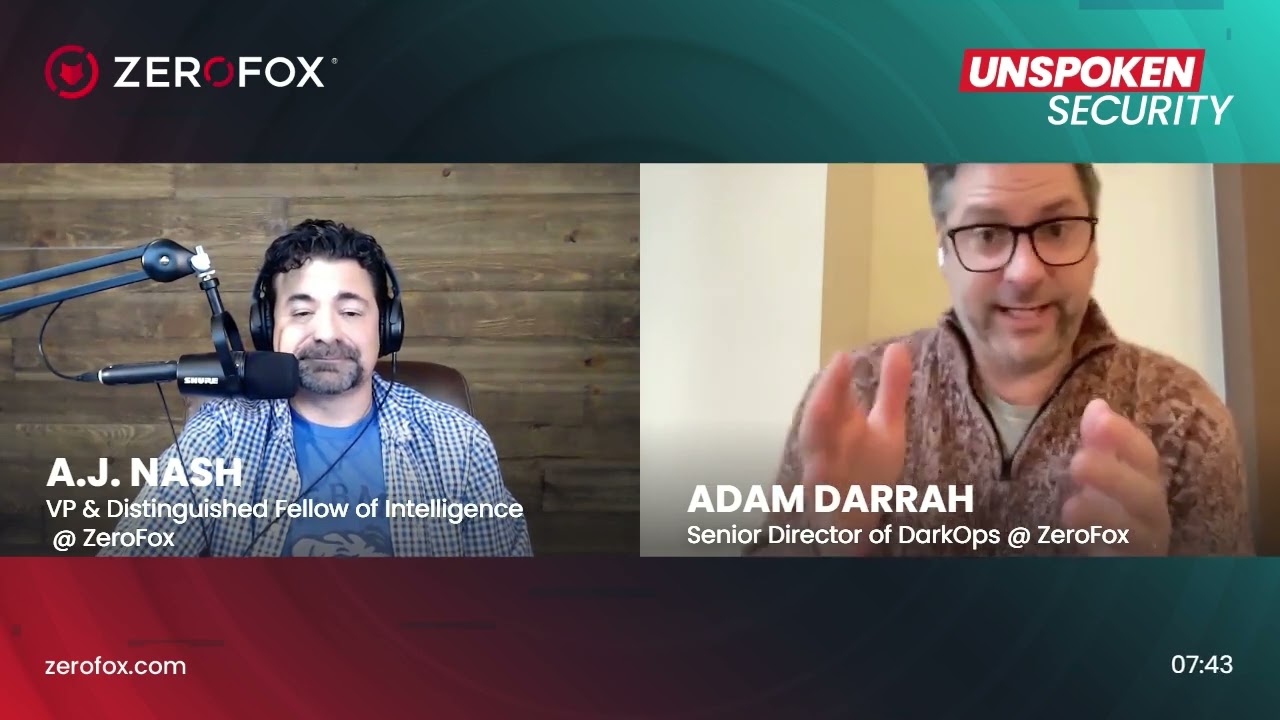
In this episode of the Unspoken Security podcast, host AJ Nash interviews Adam Dara, Senior Director of Dark Ops at ZeroFox. The conversation weaves together Dara’s background in intelligence (CIA/NSA), the formation and vetting of ZeroFox’s DarkOps team, and the operational and legal challenges of gathering intelligence from the deep and dark web. Throughout, the hosts emphasize that skilled human talent—not just AI—remains the critical asset for effective security. Mid‑episode, Dara shares a personal, humorous story about staying in a supposedly haunted hotel, complete with a mysteriously opening closet door and nightly furniture‑moving noises, and jokes about his newfound hair‑drying and moisturizing routine. AJ and Dara riff on the limits of rational explanations versus the unknown, using the anecdote to illustrate openness to mystery while staying grounded. The episode wraps with gratitude, a call for listeners to share and review the show, and a reminder that ZeroFox provides a unified external cybersecurity platform.
Chapters
At the CIA, we consider ourselves people people. I was able to gain a lot of technical knowledge and know-how working with my colleagues in operations and then transition that. So the U.S. government's really good at training people. Like the U.S. government's very, very good at it. And so to overlay that really good training over like the entrepreneurial problem set, uh, you know, bring, you know, bring some of that gravitas and expertise to the private sector has been a huge blessing.
Welcome to Unspoken Security by ZeroFox, the raw and gritty podcast for cybersecurity professionals who want to understand how threat actors are leveraging the internet. In each episode, your host AJ Nash engages with various industry experts to dissect current trends, share practical insights, and address the blunt truths surrounding security. Ultimately, the lessons learned will enable security professionals to take an intel-driven, proactive approach to physical and cybersecurity. Security that extends past the perimeter. Let's get started. Hello and welcome to another episode of Unspoken Security, brought to you by ZeroFox, the only unified external cybersecurity platform. I'm your host, AJ Nash. For those who don't know me personally, for first-time listeners, I'm a traditional intelligence guy who spent about 19 years in the intelligence community. That was both within the Air Force and then as a defense contractor, and most of that time was spent at NSA. I've been in the private sector for over 8 years now, primarily building or helping people build effective intelligence-driven security practices. I'm passionate about intelligence, security, public speaking, mentoring, and teaching. I'm also deeply committed to servant leadership, which is why I completed my master's degree in organizational leadership at Gonzaga University. Go Zags! Sadly, basketball season's over for us this year. Another year, not a title. Happens. Uh, so anyway, today we're gonna talk more about the podcast and this podcast brings all of the elements I just mentioned together except for the basketball, uh, with some incredible guests to have authentic, unfiltered conversations, maybe even some debates about a wide range of challenging topics. This is not the typical polished podcast. You might hear or see my dog Riley. She is around here today, although I don't think she'll be in the room this day. People may swear here, although probably not our current guest. I might, and we might argue or debate, and that's, that's all okay. Like, think of this as the podcast. You know, it's really just a conversation you might overhear at a bar or restaurant after a long day at one of the larger cybersecurity conferences. These are the conversations we just usually have when nobody's listening. So today, I hinted at my guest. Today I'm joined by Adam Dara. Adam's senior director of dark ops here at ZeroFox. So we work together. Now, before anyone tunes out, remember this, this podcast is not about selling anything. Adam and I both work for ZeroFox, but this is not going to be an infomercial or a sales pitch. I wouldn't tune in for something like that, and I sure as hell wouldn't expect you to. The fact is that Adam is one of the most interesting, engaging, and experienced guys I've ever met. Uh, and we always have a great time talking about all sorts of cool things that he's doing. I mean, at least the stuff he's willing to tell me about, he's kind of secret squirrel on a lot of things. Uh, Adam brings extensive experience in intelligence, including putting his bachelor's and master's degrees, uh, in Russian language and literature to good use when he worked for 8 years at the CIA, which is almost as good as NSA. So in the private sector, Adam has spent the last 6 years primarily focused on countering threats posed by cybercriminal organizations. Adam, anything I left out? Anything you want to add?
So much to add, but, uh, well, let's save it for another time.
Listen, I understand we could go on about NSA and CIA. We've done that many times before, but you're stuck. This is my show. So, uh, that's right.
Well, we finally, we are finally, the last I had heard, uh, we have finally caught up to NSA in terms of the awful parking situations.
Oh, congratulations. Yeah. For those who don't know, uh, parking is, uh, just a comical nightmare. Uh, specifically at NSA. Uh, CIA used to have better situation, but NSA you could park and then walk. About, I don't know, half a mile to get into the office. It seemed like it just went on forever. It was quite a good exercise program. Um, and as I used to say, the reason it didn't change is because the people with the problem didn't have the power. It was people like me who parked half a mile or a mile away, and people with the power didn't have the problem because they had reserve spots right there in the front. So, and we couldn't build a parking ramp for some reason or another. Yeah. Anyway, it's nice to know the CIA is, uh, suffering just as much as we always had. Uh, congratulations for that. So anyway, let's, you know, let's get into the show a little bit. You know, we often hear about and read about people are the problem. People talk about that in security all the time, right? Hell, I'm guilty of saying it more times than I can recall. It's kind of a cliché actually. But the title of today's episode is People Are the Solution because it does take talented people, not just machines talking to machines. I know we're going to hear all about AI forevermore, it seems like, but I assure you that is not the solution to everything. It's people, uh, that still need to do the work, uh, to defend against the seemingly endless waves of threats in cyberspace. So I think we should dig into that and, and have that discussion, right? How, how people are the solution. And let's start with you, your people. Uh, so, uh, you know, what about your transition from the intelligence community to the private sector? Like how, how did that come about? Why did you make the leap? You know, how, how did that all happen? Because you're really talented and the government certainly could have continued to use your services. I'm glad you're out here with us, but let's talk about that. Talk about your transition and how that all came about, man.
I appreciate it, man. Thank you for all the kind words. And I'm, I, I, I still can't believe like I'm on a podcast. My, my, my kids think it's so cool that like dad is on a podcast or like is on YouTube sometimes. Like it's so, so it's, it's super cool to be here, AJ. Thank you so much. But yeah, so me, Adam. Uh, so. I will tell you the years, the year that I left the agency, it'll maybe make a little more sense. So I left in 2018, uh, 2 years after the 2016, um, presidential election. And my entire career was working against the Russian target, right? So I, I spent my, my time as an analyst doing political analysis, you know, leadership analysis. I mostly mostly did like Russian domestic politics, like leadership and decision-making, that type of stuff. And then in the run-up to 2016, things got weird, to say the least. And all I can say is that the messages, the, the campaigns that were being waged by, uh, an adversarial government, those tensions, those, let's call them like I don't know what another word for it, but like the effects of the campaign eventually made it to where things got weird on the inside as well. In terms of colleague to colleague, you know, substantive matter experts, you know, decided to maybe like rethink some things, longstanding intel lines, you know, analytic lines were fudged a little bit. Yeah, I'm not saying it was necessarily negative. Right? I'm just saying like, we began to question fundamentally like our identity in terms of like our relationship analytically towards the Russian Federation, right? So we had an epic clash, you know, that really began, we had an epic clash of culture really when Russia invaded Ukraine in 2015, the first time, right? Like, right? So we began seeing that culture clash between operations and analytics, right? Analysis. And so what I decided to do is I had this, you know, call it a religious experience, call it an epiphany, call it like the universe speaking to me, whatever you want to say. It was a very spiritual experience where I was sitting down one day and I decided like, I need to do more. And so I transitioned out of analysis and, and went over to do something called targeting. And in, in, in, in the government world, there's two types of targeting, right? There's warheads, you know, there, there are things to make go boom. And there are things to do to orchestrate, let's call them coincidences, right? And so you learn about people, you learn about what they, what their likes, their dislikes. And so my entire career has been focused on people. How are people, what makes people make decisions? What, why would a person decide on this day under duress or not under duress or, or, or like, you know, how, how could somebody become, go from oppositionist to loyalist? How can you go from loyalist to oppositionist really? Or are you really right? So the way that the reason that people make decisions is interesting, right? And so, At the CIA, we consider ourselves people people. And so I was able to, you know, gain a lot of technical knowledge and know-how, uh, working with my colleagues in operations and then transition that, like, that. So the U.S. government's really good at training people. We're very, like, the U.S. government's very, very good at it. And so to overlay that, that really good training over, like, the entrepreneurial problem set. You know, bring, you know, bring some of that gravitas and expertise to the private sector has been a huge blessing, right? So the private sector moves at the speed of Adam. And I just, I really like how, I really like how, how, how absurdly quick the private sector moves. And I really enjoy that the fact that, you know, another big reason is the private sector doesn't say we can only legally by law, like this is your potential in economic terms, right? So the government says. By law, here is your potential in economic terms and that's it. It is illegal for— Right. You're illegal. It is illegal for us to pay you more than this. And it's so it's illegal for you to be more than you are. Right.
Right.
Or, or not. Right. It's like, it's really, you know, so, but in the private sector, it really gives you an opportunity. I don't know, to embrace some wacky ideas you've maybe been toying with on the inside. Um, You know, and, but it's been very humbling, right? I say the speed of Adam, that seems weird and oddly strange to say, but like, um, it also—
not for anybody who knows you, Adam. I, I, not for anybody who knows you. I think it's, I tell people speed of cyber usually, but speed of Adam is a little bit faster actually. So I think it makes sense once people get to know you. Uh, the government is a model of inefficiency really. I, I, I spent a lot of time in the government. I loved working there. There's, like you said, it's a great place. Training is amazing. Your experiences are, you know, second to none. There's things you're going to learn and do and see that you can't anywhere else, you know, legally speaking. But government's also a big, slow machine. That's just how it generally works. It's not agile by design. It's not a bad thing. It's just how it's built. And so yeah, I hear what you're saying and that, you know, out here, first of all, you have a chance to earn your potential, you know, financially speaking, but you also have opportunities to be agile and to, you know, fail fast is a common thing in tech, right? And, you know, try new wacky things, throw it up against the wall, give it a shot. If it doesn't work, move on to the next thing. I understand what you're saying, man. I made the transition., you know, as well. And I've seen some of the same things. There's pros and cons. I miss being inside sometimes, not enough to ever go back, I don't think. Well, it's okay. I don't think I'm invited either, but I'm listening. At least I'm hearing what you're saying here. You know, speed of atom does make sense for anybody who knows you, I assure you.
Well said, AJ. Like, you can fail, fail quickly and move on and try to bring the most value to your company, to your team, to your clients, to your colleagues. Like, it's a really cool environment. And it's a different battlefield of service. It is a distinct honor to serve the American taxpayer. It really is. Right. So as somebody who, like, I'm what they call like a true believer, right? Like, I really do believe in the mission. And so having that mission on the inside and understanding that people are sacrificing their income in form of taxes to make sure that like you keep them safe and informed. There's a lot of satisfaction that's derived from that. But here in, here in the private sector, it's a different form of service, right? We are, we are trying our best with much more limited resources, much more finite resources to do a really good job to keep people informed and as safe as is reasonably possible. And so, um, it's, it's, it's great to be in the private sector. And I remember like, you know, the private sector found me by, by complete accident. It's a great story, but like, suffice it to say that I'm very thankful and I still feel like I'm on those coattails of, of the mentor, uh, of my mentor that brought me out of the government and into, into, you know, the private sector. So, uh, it's, it's wonderful to be here.
Well, listen, we got a couple minutes to dig into that story. So, you know, we know why you, you moved on from the government space to the private space. You kind of gave a pretty good overview of that, but there's apparently a, a person who helped it along too. Like, what was Who was the person, if you don't want to take my name, if you don't want, but of course, what actually happened that went, okay, this is how I'm going to move. Like I've told my story, right? Mine was accidental. Essentially, I got recruited. I, somebody finally talked me into getting on LinkedIn. Literally the day after I joined, they announced they'd been breached. Uh, but the breach was prior to my joining. And because of being there, somebody reached out to me, uh, in the private sector and recruited, and I ended up moving out and going to a bank. So, you know, in my case, it was, it was Happenstance, right? Uh, you know, for, I don't know about you, but in the office I worked in, virtually everybody I worked with wanted to be in the private sector. None of us knew how to get there. You know, you've been in the government a long time and it's, you, you start, you come to believe like my badge is my identity, my badge and my, you know, my experience and my clearance. This is, this is going to be my income forevermore. And a lot of us are like, gosh, I wonder what it's like on the other side, but none of us knew how to get there. And like I said, for me, somebody reached out and that's how it went. What was it for you? Like, what was, what was the actual thing that said, hey, let's, let's make this move. How did you make the transition?
Yeah. And I just want to be clear, like the government, like there is nothing like inherently wrong with, with, with being a government servant, right? Like, so the government does a couple of things, right? It, it provides a lot of stability and, and clarity for people, right? It provides, it provides that stability that, that is important. It's important, right? And so it plays a great role, but one of the things it does it's like, and I saw this when I, when I began, when I, when I put in my notice to leave, it's like, well, nobody will love you like us out. Like nobody will ever, like nobody will ever love you.
What an abusive thing to say to somebody leaving a relationship.
It feels, well, it just feels weird, right? Cause they're like, well, what about your pension? What about medical? What about all these things? And, and then they have a good point there. Right. And so when, yeah. So, so I just want to be clear, like, you know, the, you know, private or public sector, whatever path you choose, like, You know, stay close, uh, and stay close to your intuition and then do a great job no matter where you are. Lift where you stand. That's all that matters. Lift where you stand.
Nice.
So what happened to me is I, I, I sat with my operations friends and, uh, somebody on a different team who, with whom I had a, a positive working relationship. She approached me one day, she goes, I have this weird opportunity. She was already leaving to the private sector to go to one of the social media firms, US social media firms. And so she came to me and she goes, I have a friend looking for somebody with a very weird skill set that oddly matches yours. Do you know anybody like you? Because you'll never like, nobody knows anybody like you. She goes, she goes like basically like, hey, can you, can you introduce me to like the people you roll with? Because again, like operations people, as you know, like think that like analysts only hang out with analysts, right? Sure.
Yeah.
It's like high school, right? Like, so you only hang out with your peer group. Like you wouldn't dare like, you know, go play chess with those people, go to the band with those people or like whatever. Right. Right. So, you know, so the operational jocks, so to speak, you know, only hang out with other, you know, the same, right? But it's not true. On the ground truth is that's not true. Right. Um, we all get along very well, but anyway, so that's how it happened. My name was passed. I got in contact. I actually thought it was a dangle from an intel. It was too good to be true.
You thought it was a foreign adversary that was trying to pull you in?
100%. So like it took about a year of doing a delicate dance between us via emails. Like, you know, I'm like, are you— research— am I doing my own research? And Cause I'm like, this sounds like something we would do to somebody we were trying to, uh-huh. It's a pretty good, cause it was, and again, that just shows you like how lucky some of us are. Like it's, we're blessed, lucky, fortunate. Uh, one of those things, you know, preparation meets opportunity, right? So we, you know, I happened to be in the right place at the right time and, and this wonderful thing happened. So yeah, it was so good that I thought this is obviously a dangle and China, Russia, Iran, somebody's behind this. Like, I don't deserve this. Somebody stands behind this. You know, there's, there's somebody like AJ on the other side going, oh, excellent. That's exactly what you should have done. You know, Adam very well, you know, right down the path.
Come to us. Yes. We'll get all of his secrets.
And so, yeah, I, I left Friday night, Friday, and then on Sunday night, I was on a plane to Arizona to meet my, to onboard and meet my, my colleagues. And, and I, I was mentored very well in that first role that I had and And I just have loved it ever since.
That's it.
In love.
Yeah. And that's very cool, man. And, and like you said, listen, you know, for anybody who, who doesn't, you know, believe us or it wasn't emphasized enough, none of us are attacking the government. I'm, I got nothing but appreciation for my time in government space. I love, I loved being there. Like you said, the mission is, I mean, I, the passion for it is, is just second to none. You know, on a daily basis, most people I knew, certainly myself and obviously you, really kept in mind what we were doing and the importance of it and why it mattered and what we were trying to accomplish. Right. When I say everybody I worked with, you know, pretty much in that last office I was in wanted to leave. That really isn't because of a negative. We just all been doing it a long time. You know, I said I did between the military and contracting. I was in the government space 19 years. It was leaving was as much about, I want to do something different. I want to see what the rest of the world is. I don't know that I want to do this for 40 years and not know what else was there. There also is obviously some economic stuff that goes with it. And I'm not going to lie, it's nice to see sunshine for anybody who's ever worked in the government space. You spend a lot of time in a SCIF, which is a windowless cave a lot of times. I did a lot of night operations and it's nice also to be able to tell people what you do for work. I mean, the trade-off is it's also cool to go, I can tell you to kill you and then just not tell people anything. But no, I agree with what you had said. There's no good or bad. I know people who are going to do 20, 30, 40 years in the government and thank you for your service and thank you for all you do. And it's awesome. And we get some opportunities in the private sector to work with government still. I still have a clearance, uh, which is kind of the best of both worlds, although it doesn't get used much now. Um, but yeah, this isn't about, about attacking, you know, government or bagging on government. There's, you know, there's a lot of amazing stuff there. I highly encourage people, you know, given the opportunity to go in for a bit if you can. The training's amazing. The, the knowledge you pick up, the sense of mission. Um, you know, it's, it's really cool, but you do it long enough and most anything, a lot of people just want to see something else and do something else. And the curiosity was what was getting most of the people I worked with. It wasn't that we didn't like our, you know, our role or our responsibility. I was also, listen, I was also a, not a blue badger. I was a green badger. I was a contractor. So it's a little different life. I was blue badge in the military, green badge as a contractor. For those of you who don't understand blue and green, you don't have to. It doesn't really matter. We know blue badge as a private, you know, if you're not in the military, it means you're an employee of the government as Adam was. So you're talking about like pension, things like that. I didn't have that. I was a contractor. You know, we're mercenaries to begin with. We already bounce around a little bit. So the stability part isn't quite there. We're on whatever contract's running at the time and we can be booted from contracts or contracts can change companies or they can die or whatever. So there's a little bit more of a nomadic life. We do get paid a bit more usually. But I'd already been used to some of that, right? So stability wasn't as big a draw for me and there's no pension with that or anything. There's 401 like everybody else. So, Anyway, I just wanted to kind of close the loop on that, that yeah, government's great. Like I got no bad, you know, no ill will, no bad feelings. I love working with them now. And for those who don't trust the government, uh, you know, that's fine. Like don't trust anybody too much, but I will tell you most of what you hear is, uh, pretty unfortunate and sad. I only worked with great people really. I mean, I can't, I, I'm trying to think of people that I would be like, you know, I mean, there's the occasional abuse because there's always some, somebody wants to spy on their Ex-wife or girlfriend or some garbage like that. And they get caught in like 8 minutes because they're stupid. You know, these systems are really well protected, but most of them I worked with just was willing to sacrifice. Like you said, you know, less income, long hours, thankless, can't tell people what they do. You know, in our generation, I'm maligned as well. It used to be at least that didn't happen, but now, you know, thought of as the enemy of the people and that kind of crap. And it's just not true. Like the people that are there are just like you and me and everybody else listening right now, just good people trying to do good things to make make the world a better place and make America safer and stronger and better. And, uh, you know, it's a shame that it's, it's hard work and, and underappreciated, I think. Um, anyway, so, all right. So we talked a bit about, about what you did and, and your transition, both, you know, what made you want to go and then, and of course the actual mechanism for anybody out there who's government thinking of leaving. I'm sure Adam's happy to chat about that. I'm also happy to chat offline if you want, reach out if you're looking to transition, uh, or if you want to go in from the private sector. You know, I'm sure happy to have that chat too. But now that you're out, now that you're in the private sector and you've been doing this a while, you've got this kind of unusual position in my opinion, this leadership position because you lead this team of like spooky experts really. You know, folks who just lurk in all the dark corners of the internet, places that I tell people do not go, but your people do because that's what they're trained to do. And, you know, building these capabilities to collect things that to be honest, aren't meant to be collected. I mean, that's kind of the purpose. So, you know, in talking about the theme again of the show being people are the solution, how do you find the special talent to build the kind of team you have now and the kind of teams you've had before? What's a day in the life like on, on DarkOps? You know, let's talk a bit about that. How do you build a team? What do you guys do? Whatever you're capable of sharing, I'm sure people love to hear it. Sure. And we can talk stories and whatnot.
Absolutely. No, great question. So, you know, to my earlier comment about You know, holding, you know, just feel like I'm still being, you know, pulled along on the coattails of greater people. So, um, how do we find talent? So when I, when I first came out, like it was not, I didn't find anyone. They found me. Right. And so, um, you know, we did, we deal with, with, with human intelligence, right? Partly, right? That's our secret sauce is, is the quality of humans. Who infiltrate certain groups, certain communities, and befriend is too strong a word, but like are a part of these ecosystems, have credibility in these ecosystems within US law. And we, so it is hard to find morally upright people who are dual-minded, right? Who are as equally upright as they are, let's call them sneaky and cunning, right? And so you have these people who can operate who can be, who can be, who can play in the dirt all day, but then also can transition to become a civilized, educated person, which they all are, right? So these operative teams, so first off, like I inherited some wonderful talent from there. And since then, you know, it's all about reputation. So these individuals, they act very similar to the way that our targets act., right? In terms of like, they need to trust you. They need, you need to have some credibility. You need to bring something to the table. You need to prove your loyalty. And so as time goes on, we, we find, we attract people. People are recommended to us, you know, based on the trust factor and our credibility factor, you know, me as a, as a person, the team that we have as people, right? So we're all very close-knit. So we trust each other. We can be our worst and our best. It doesn't change people's opinions. Uh, we, we are allowed to show emotion. Um, if we're having a bad day, if we're having a great day, if we're having a boring day, like there's that trust that we can, you know, do the different masks we wear, right? Uh, we can, we can put on all of our masks and nobody seems to be too put out or bent out of shape. So that, that's the most important I would say is like credibility in this ecosystem. You do have to establish yourself as someone credible to deal with, someone that is stalwart and trustworthy. Because in the underground economy, let's face it, like it's the same thing, reputational and money currency. Those are the two things that matter of equal value, I would say reputation and actual money, money currency. So that same thing, we take that same ethos into our, we take the best parts of that culture Uh, and then bring it over into dark ops, which is, hey, this is how we identify talent. Are you credible? Are you morally upright? Like, yes, some, some people may have, may have been curious at a younger age. And so kind of understand, uh, understand the, the underground economic culture of it. Uh, and so they know how to talk and act a certain way, but then stop short of committing a crime. And then that's what we're looking for. So a trustworthy person who knows who understands the different lanes in the road, the different masks we wear, and can be an above-ground, educated individual, but also be in the mud all day and not get dirty.
Well, and you've got, I mean, you've got domestic personnel, you know, US-based people, and you've got overseas personnel, obviously. I imagine it's easier to do background checks and validate for domestic, you know, for US citizens, or, you know, maybe Canadians as well, I guess. If you can talk about it, I don't know that you can dig into it too much. Challenges of, of vetting, you know, Eastern Europeans, for instance, you know, I'm not getting into specifics on where we have folks other than to say we have folks who are native speakers in some of these locations, you know, in some of these underground locations, which means they come from other parts of the world, right? What's the challenge? I know, I mean, we can talk about OFAC certainly from a legal standpoint, but what other challenges are there? Is it, is it again, just like being in the underground? Is it reputational? People know people? Is it networking? How do you validate and vet that people are both going to stand up, right? Are going to be ethical and honorable and stay within the guardrails, but also are any good at what they do? You know, I mean, we're dealing with people who certainly could lie and say they have lots of connections and do lots of things to make a few bucks. So how do you, I mean, how do you work through that? And you've been doing this for quite a while now and you've got a team that's, for those who don't know, Adam's got a super loyal team. Like they don't, they go everywhere together virtually. None of them live anywhere near each other, but I mean, this team is, you know, the whole, we, where one goes, one all goes, the QAnon thing, which is garbage, but you guys would be the closest thing to having that motto make sense because literally this is like a horde that all travels, you know, one, one voice, you know, united. So how did you, how do you do that? Like, how do you, how do you handle all that with the, with the overseas assets, which is a bigger challenge, I assume?
Well, just one quick thread to pull on. Like, I am convinced my dad is Q. Just so everybody knows, it's my dad. I just, I just wanna be clear that kind of thing.
Somebody's gotta be, I guess it could be him, right?
I think it's him and I'm trying to get him to crack and I'm close.
Uh, but well, I know it's not my dad cuz he's dead. So at least I know I, I, I eliminated him from, from contention. Well, I'm just saying, I, I should say, I assume if you believe in the conspiracy theory, maybe it is my dad. Maybe he is like Elvis and he didn't die. You know, who knows? Like could be anything at that point, you know? But man, if it's your dad, I'm gonna, that's a, you're coming back on the show. We're gonna have a whole, I'm gonna bring your dad.
Absolutely.
We're gonna have a great episode about that. That'd be amazing.
You should bring my dad on anyway, but, uh, things will all make sense. Um, the world will make sense. No, you bring up a good point, right? So we, so to the title of the, of this episode, right? At the end of the day, I, I as a person am going to make a decision. I'm going to make a decision based on as much information is available combined with intuition. Right? Like, so like there are legally, there are legal boxes that are checked on everyone, but at the end of the day, I have to either, I'm going to make a call like, okay, yes, like you, I'm going to take a chance on you or hey, like all the boxes are like all the stars are almost aligned, but like it just doesn't feel 100% here.
Right.
Right. So people make a decision. It's Flaws are baked into the cake and it's like, we just have to be okay with that. Why can't we just be okay with it? Why are we so hard on each other? Like, why are we so hard on each other? I don't understand. So it's like, yeah, I mean, I've had plenty of people try to like professionals try to like explain to me why, you know, we, why I, Adam, am hard on myself. Right. But like at the end of the day, like I just see this, like this harshness. You know, when people that on themselves and others and right. And as a, as somebody who just thinks it's that people are fascinating, endlessly fascinating. We are just like such a great creation. Like we are just amazing, amazing as a, as a species. Right. But like, but, but in terms of our operatives, at the end of the day, I make a decision and I, and I rely on trusted individuals to tell me Hey, like you tell me, right? And so it just, it goes back to that credibility building, that loyalty and, you know, everybody doing the best they can. And we've been very fortunate that there hasn't been an egregious falling out or anything because, you know, at the end of the day, you know, relationships matter. There's no need to be awful. To each other, right? We don't need to be awful to each other. And business is personal. I have a pet peeve with like, it's just business. It's not personal. Like, are you kidding me? And like, my identity is wrapped up into my business, right? Like my ability or inability to come through for my client, for my team, that is personal. It's like, so, so please let's, let's, let's get rid of that, please, if we could. Because these are people's livelihoods. Like, because of my clients, like I've learned so much and I've grown so much and I just, I love my clients. I love my team, right? So it's very personal and that the human, the necessity of us, like we are necessary to make this all work. And that enthusiasm, that enthusiasm for our connections, our job is very real to us on the DarkOps team and in the industry in general, right? Like other great companies have these teams to a certain extent. And then it matters, right? Like it matters. And, and it's, it's, as you know, the biggest struggle is, you know, because it's so cool and because our people are so good, like sales gets excited, marketing gets excited. It's like, let's tell everybody everything. And so the CIA in me is like, whoa, no, I was joking. I don't have a team. It's all me. Like I was kidding about everything. Those people don't exist. Right? Because you want to also protect., you know, respect their privacy and respect what makes them special. We need to respect what makes people special. And then in this case, like the people that we have working, you know, very loyally for, for us and for our clients, they take pride in the fact that they're private people because they're not everybody lives in a, not all of our people live in a law and order country. Right. And so for those that do not, we need to respect their situation and, and, and honor that.
Well, yeah, there's a lot of risk in this work. I mean, it's the reason I tell people all the time, you talk about building intel programs and I always tell people, don't build, don't, don't go into the deep of dark web yourself. Don't go into the cyber criminal underground, please. You know, and I know now obviously I work for a company that does this, so, you know, it'll sound self-serving, but I've said, listen, I, I, I've been on the other side. I've been on the customer side. It's the one area where I, I don't believe you should cross over because it's just, it's hard. It takes special talent. It takes a lot of architecture and design and, and overhead anyway, and it's, it can be dangerous. Like, it is not, it is not a perfectly safe place to be doing business, uh, especially if you're an amateur and you're going to stand out. You know, it's, it's the one, one of a few, I suppose, but one where I consistently say, if you're going to hire vendors for anything, hire them for deep and dark web stuff. You want that separation from a safety standpoint, and you want that expertise you're just not going to have an easy time getting yourself. So it just makes sense. Because you're going to have people like Yukan Fine that are entrenched, right? That are in the culture, that are in these countries, that are willing to take the risk. It's not entirely safe work, right? They're, you know, they're working in environments with people who would not appreciate finding out that somebody there is not on their side, that they think might be on their side. And we aren't, you know, it's not a law enforcement issue, but still, you know, it's, it's foiling their efforts to make money. And this is their livelihood. Criminals, they do this for money. Like, it's not a hobby. This is their livelihood. They don't appreciate being stopped, I'm sure. Um, so, you know, I think, like you said, it's very important to keep in mind the risks people take, but also, you know, in general, and you said a lot of points that obviously resonate with me about just taking care of people, you know, being good, good to people in general, I think is something we don't have enough of in industry in general, not just ours, but any, uh, but even more so, I think it's a challenge and I'm curious on your thoughts on this because with the people you're working with and the teams you're building, there's a great deal of confidentiality. Obviously when somebody's on the inside of the operation, whether it's here or another team, They learn everything about what we're doing, or some of it. I mean, not everything. I'm sure there's some compartmentalization, but they certainly learn other people's identities. You know, who's, who's in these, these marketplaces that aren't really criminals. They actually work for us or other companies. And I mean, listen, you have a bad falling out with somebody who leaves, uh, those bridges that get burned can be really, really, you know, expensive bridges to rebuild or really, you know, scary, dangerous things. Right. So aside from taking good care of people, because you're a good person and I think people should just do that because we care about other people. There's certainly an operational reason to make sure you don't have a bad falling out, right? People leave. It happens. I'm sure you've had some, you have a lot of loyalties, I doubt many, but I'm sure there've been hires that don't work out for whatever reason. But making sure it's, you know, that respect, that mutual respect and that concern and that care for others makes people less likely to be, you know, angry or vindictive or vengeful on the way out the door. And the damage for a team like yours would be far more superior, you know, far superior to say, you know, somebody who leaves pick another operation, you know, product, marketing, sales, whatever. Right. No offense to anybody else, but you're not likely to out a whole bunch of people that, and, you know, ruin collections and cause harm. Right. Yeah. In those, in those fields. So I think it's, it speaks to your point that it's even that much more important to be good to people and take care of people and care about them so they care about each other. So if things don't work out, it's not a scorched earth, you know, result.
Well, and this was something that, that I learned watching watching the agency, watching the CIA, like being on the inside, you know, reading, being a reader of our internal products that we had, you know, and the agency is, is a lot more humble and has learned, learns in very real time. And one of the things that stuck out to me at least was what, what they learned with regard to making sure employees just are generally happy. Um, because unhappy employees can, can, can make, can make decisions in the moment, right? That are not good for themselves or for the agency. And, and, and, you know, my friends and colleagues on the inside, right? And America, right? Like that's, it's not, it's so the agency's been quite humble about this and has done a lot of research on this and is changing, you know, how they deal with certain things. And so, you know, I just want to put a fine point on what you said because everything you said is right on. But one thing I would add is that once a relationship with a client is very healthy, dark, dark green healthy, like just really healthy, they disclose things to us that if a competitor knew could do damage to our clients. If a bad guy knew, like a, if a bad guy knew about these things, they could do economic or other types of damage to our client friends, right? So it's not actually like we are careful, we are prudent, and we are very excellent to our operative team that deals with corporate secrets, embarrassing information. I remember a time where a client asked us to do a standard deep and dark web sweep. During that sweep, we found some very concerning, and I don't know the English word, but like kompromat, right? Like compromising information, right?
Like so like blackmailable information.
We found some very embarrassing personal information about an employee that was, you know, tangential to this research project. And so I called him on Signal and I said, hey, I would like to speak only to you about something and I would like to send this thing only to you because of the following, right? It's very, very embarrassing. And we're not in the business of making people feel bad or embarrassing them or anything to pat ourselves on the back or to go, hey, like, hey, check out what we found. Hee hee hee. Right? Like we don't do that. Like we don't, we don't pass funny things around to each other when we find silly, embarrassing, information, right? So it's more than just like, yeah, we're great people. We do good things. We do cool things. Like there is that, like, yes, check, check, check. All good. But more than that, like we value, we don't take for granted the things that take, that companies disclose to us or share with us willingly so that we can give them a fighting chance. Right. And we don't ever want to We don't want that reputation or that relationship to fail because of, of silliness or perceived carelessness with that information.
Yeah. Well, and that's a good point because the adversaries are just the opposite, right? They'll, they'll capitalize on all of that. And that's exactly the reason we have to be in a position, your team, your team has to be in a position to find all the things, right? And, and helps when people trust you enough to tell you more things, more things to look for perhaps that they might not want to originally tell., but to find all the things before and somebody who's going to do harm will, and to see how to get in front of them or how to get, get them taken care of or whatever it might be. Listen, everybody, virtually everybody has secrets, like big, small, whatever they are. You know, I'm not sure everybody's burying bodies in the yard, but people have secrets, right? And, and, you know, what we used to talk about in the government, I always, you know, when I, I used to talk about, you know, we all get our, our clearances, right? We all have these polygraphs. I used to, I'll try to clean this up for this a bit. I, I say we can swear on the show, but there's only so far I can probably go. I used to tell people who were nervous about the polygraph, listen, they don't care if you have sex with goats. They care if you care if you have sex with goats, because then you're blackmailable. Just tell them everything. They don't care about your secrets. It's the secret you don't tell them that they find out. That's the way you won't get a clearance because now they know an adversary has something they can find to use against you. Now, to clarify, if you have sex with goats, you probably won't get a clearance. That was just a figure of speech. I don't know. Uh, I'll leave that alone. We'll get a polygrapher to answer that one later. But, uh, but that was the point, right? And that's the same thing here. It's not about secrets. It's about which ones are going to be used against you and which ones are leverage. There are people who can't get clearances over minor things because that's the thing that scares them. It's not a big deal, but it is because it's the thing that people have assessed. An adversary would learn this about you and use it against you, and you would make bad choices because you're more afraid of this thing getting out than the bad choice. Even if the thing isn't a big deal to most people, right? Um, and then there's other people who've done far worse things and have clearance. This is not an issue because they're trusted now for whatever the thing was. And it's a thing that nobody would say could be blackmailed about. And that's a bit of what you're getting into, I think, too, is, is having that trust factor with clients. And because of the respect that you and the team have when something's found, like you said, we're not sending things around internally and giggling and laughing at other people's private lives. We all have private lives. It's, you know, respect and trying to keep it, like you said, minimum exposure. Hey, one-to-one on Signal, I want to share this with you so we can have a plan of action, but, you know, no point in disseminating this to a bunch of people. That builds a great deal of credibility. I mean, it's, it's why your team is so good. I think.
Well, I appreciate that, but, you know, I, I learned this by watching leadership at all levels of the agency. You know, there's this stereotype of this, there's a stereotype of a CIA officer that maybe it's true, maybe it's not, but about this, like, you know, this cowboy, like this cowboy figure who this, I don't know, like it's just, it's interesting, but, you know, I watched many middle to senior leaders, you know, admit, I mean, there was just no stigma around admitting operational or analytic shortcomings, right? Like, and that, that was a huge leadership lesson for me. I was very humbled by these great men and women that I looked up to. And, and I would see in cable traffic or I would see in email traffic, that's all very public of like, yes, I, I made a mistake and this is what happened and this is how we're going to fix it. And, and there was no shaming. There was no like it was all just part of the culture, right? And that's, I've taken that. I'm like, okay, I love that. Like I want to work at a place that values this, right? If you do something silly or like you make an error in judgment, just say, you have to disclose it.
Yep.
Right? Like if you, we get into trouble when we hide things. Right? I know that from personal experience. I know that from watching other people. I know this, right? And so, um, I, what, and so You know, again, like I, I've watched people carefully. I've, I've, I've appreciated those, those lessons along the way. And I, and I am forever grateful for all the many lessons I've learned from watching my peers and mentors at the agency.
And so, yeah, well, I think you're right. I mean, accountability is a big part of it, you know, transparency and honesty and accountability. And, you know, you mentioned we get in trouble when we hide things. We see that a lot, right? We see that with ransomware attacks, ransomware and somebody, it's on their endpoint and they're like, I'll just, you know, I'll pay the ransom. I won't tell anybody. They hide, you know, they think they're going to get away with it. And of course they don't. It spreads and other problems happen. And we've seen it happen. In government space before where, you know, things get leaked that shouldn't have. And there's, it turns out somebody could have stopped it from being worse, but tried to cover it up because they're more worried about their own embarrassment than the bigger picture. You know, trying to do well, but not thinking about the big piece. And part of it is that culture, right? Because you work in environments where people, if it's a one mistake culture, you get one shot and if you fail, you're going to be humiliated and run out of town. Then people hide a lot of things. Whereas if you work in a culture where people are like, listen, we're humans, nobody's perfect. Obviously, if you make mistake after mistake after mistake and they're critical, we're going to have problems. But, you know, if you make an error, just like you said, fess up to it quickly. Hey, this happened. We need to get in front of this. I apologize. It's on me, but I need help now to get ahead of it and to fix it and to get moving forward. People appreciate and respect that, and it causes a lot less harm. And it frankly, it creates more trust and credibility because the next time I know that person's going to be accountable. I don't, I don't have to, you know, go dig and find the thing. You know, we, we do that all the time. We do it with friends and family and kids and you know, it's, it's just something you learn as you get older and it helps to be older and more established, frankly. I mean, it's hard, especially for young folks who are trying to break in because they sometimes don't feel like they're going to get a lot of leeway and they sometimes don't depending on where they work. Yeah. Um, you know, when you're older and have been around for a while, you get a little bit more sometimes. Uh, but I'm, I'm with you. I'm a big believer in that's a cultural thing to make sure that people understand the goal is to do the best we can. Nobody's perfect. Let's, let's get in front of the challenges that come up and not hide, hide them and try to, you know, bury them because it just doesn't work and it just, you know, crops up into bigger problems for us. So, all right. So I, uh, I want to move forward a little bit. Um, keeping track of time, obviously on some of this, we got some other questions we want to get through, but, um, you know, we talked about, you know, building the team and you talked a bit about where that goes. We didn't get too much into it, uh, the day in the life part, but I'm going to roll that into the third question. We can kind of do this all together because I'm curious right now, what do you find most interesting most challenging, you know, in these days, you know, when it comes to, to dark ops work, uh, whether it's collections, whether it's, you know, real operations going on right now in deep and dark web. You could tell us some war stories, uh, the good and the bad, you know, what's, what's, what's interesting, what's challenging right now. You know, what, what are you and the team focused on on a regular basis? You know, on a daily basis, you know, what's it like? Uh, how are things going for, for all of us that aren't there?
Things are overall wonderful. They're good, but it's a complicated good, right? It's hard because we don't see everything or catch everything, right? There are a lot of harmful, there are harmful things. I won't say a lot, but there are harmful things that are being circulated, being talked about, being brokered multiple times infinitely all at the same time. Right. And so it's that. Feeling of, you know, we get this ticket, you know, this, this every day, like, why did you, why did you miss this? Why did you miss this? Why did you miss this? And again, to my earlier comments about taking business is personal. It is personal. Right. And so, you know, obviously, like, when I see that for the first time, my, you know, my Neanderthal brain kicks in and is like, you know what, I can tell you exactly why we missed it. Who is like, We have the budget of an ant compared to the world's great intelligence services. So anyway, so like I can go down my list of Neanderthal reasons and my silly immature reasons to come back at the client or our colleagues and go, this is why, right? This is why we missed it. How, you know, why did you miss it? But in reality, like it hurts, right? It's not, it's not pleasant for people like our team. Like our team is very motivated not to miss things. And I think most, I think I would say that all security-minded teams in the world feel that, oh, I will speak for almost all of them. Like there's a certain mindset for people that work in security who work in intel. Like we don't want to fail. We don't want to fail because no matter the reason, budgetary constraints, um, how are we supposed to know? They made that decision sitting in a room by themselves, not on their computer or the dark web, right? Like they didn't tell us like at 4 o'clock on Thursday, July 22nd, I am going, you know, I am going to do this awful thing and nobody can stop me. Right. So, so like not all plans and intentions are, are, are coordinated in these, in these deeper, darker recesses of Telegram, deep and dark web, Discord, wherever, right? Wherever bad guy things are sold. So, so that is challenging, right? So it's challenging on many levels. The first, first and foremost, it's challenging because we want to be everywhere and we want to be out in front of it and we want to warn, provide the context and not add to our clients already daily list of infinite things that they need to worry about. Right? I don't, so, so like a lot's coming at our clients, a lot's, you know, and, and, and you might most, you know, some of our clients like It's the same individual or same two people who are responsible for password resets, plugging in keyboards, defending the network, and doing external threat intelligence and incident response. Like, it's one to two people that do everything for very large companies, right? And so they're also frustrated because they get asked the same thing. How come you didn't tell us this? How come you missed it? And so it's like, mm, laser beam, zero thoughts, right? Like, or any provider, right? So, so, so it's, it's one of those never-ending frustrating things. It's like, we want to, we want to help you. Like, we didn't wake up and go, hey, today, you know, I'm going to, I'm not going to look at real intelligence. I'm only going to pass like the other stuff. Right.
Right.
Right. And so that's, that's just hard on a personal level to like miss things. But overall, you know, overall things are, things are cool. Our operatives are doing cool things. They're doing meaningful things. You know, we've, we, we, we recently, we recently got out in front of a ransomware attack. We recently, as happens a lot, we have a client involved in an incident that may, that, that like they're a third party to another client and their client has their own firm, right? And so we're not intentionally, but just by default kind of going up against other wonderful teams, right? And, and just recently we had the threat actor actually told us, like, I'm charging this guy everything. Like, I'm charging this other guy, like, for everything. I'm just giving it to you for free. Right? So, like, because our operative just has a better relationship with the, the adversary in this case, or that's it, right? We got lucky. We got lucky that in this particular case, we have the gravitas. We speak the same language. We speak the same jargon. We know how to, you know, we kind of, we know what to do.
Sure.
Um, you know, we, we have another relationship with, uh, with, with an individual like in temporarily occupied southeastern Ukraine, who is a sympathizer to Russia. And he'll say things to our operative like, oh my gosh, I just saw my buddy's building get hit by artillery. Right? So we just learn really interesting human things about people. Right? We've, we've become close, close working colleagues with people because they trusted us. Like one guy sent us a picture of his rash and he's like, I'm, I'm in a hospital with a rash. I will get you. I will get you the data that you wanted. Just, I need some, I need just a couple more days because I'm, I'm laying in the hospital. Check out my rash, bro.
Right.
You know, giving you proof. Yeah. Like, look, look through.
It's like a doctor's, it's like a doctor's note. I'm missing work because I have a doctor's note. It just happens to be in this case, it's from the other side of the world and It's a criminal.
Yeah. Well, and he's, you know, like some of these guys are really sweet, you know, they're just, they're just, they're just literally just want to make extra money. And so it gets complicated, like how you view them, because at the end of the day, yes, they're breaking, like they're, they're, they're taking data from like our grandparents, our moms, our dads, our loved ones, our friends, right? Like our colleagues, our associates, our clients, right? That's because at the end of the day, that's what they're looking to do. They're abusing, um, they're abusing people. But like, we had an idea. I told the operative, I'm like, ask him how much his hospital bill is. And, uh, it was like $25. And I was like, $25 or $50. I'm like, dude, kick him 50 bucks, 50, you know, kick him that money. And he started like, he's like, oh my gosh, bro, bro, bro. He just started sending us like all kinds of interesting information after that. Right. And so like the human story behind the intel is what motivates all of us on the dark ops team. Right. Like the human story, the human element. Is so fascinating because a lot of these guys really, we have another relationship with somebody that like, kudos to this operative, right? Like he goes, hey, check out what I have. I'm going to sell it to this really bad ransomware gang. And our operative's like, I think in this case you shouldn't do it. This is like really bad. Right. And the guy decided, he's like, oh yeah, shoot. I didn't think of that. Right. Like, sure. Yeah.
Yeah.
Yeah. I'll take it off the market. Right. So it's like these little things here and there that we get to know people, right? Like we get to know that we're not their friends. Like we're, we keep it, you know, we keep it within, well, as professional as we can with, with somebody who's enabling the destruction of our internet, right? That works. Right. But, but like, it's interesting to find out that like they sometimes don't connect those dots. They don't connect the dots because they're just, again, so compartmented, head down in what they're doing. They're one thing because they do the one thing, they sell it, they move on, they sell it, they move on. And so like just to kind of like peel back a little bit of the human side of things and go, you know, and to learn about them because at the end of the day, it's a human on a keyboard making a decision. And another question we get a lot was, Well, why did they do this? Why did they do this? Money.
Because it paid. They needed to.
Yeah, right? Like, um, I mean, sometimes it's malice, I'm sure, but most cases it's money. For example, okay, here's another. So, one of our operatives was trying, we were trying to get onto an exclusive forum. It was a Russian-speaking, Russian-speaking forum, um, a deep web, a dark web forum. And they rate, like the admins challenged us and said, well, why do you want to be on here? And they asked us all in Russian, right? And none of us at the time were native Russian speakers. And so I just typed money, women, and cars. That's why I want to be on it. And I was immediately approved. Right. So, so like, yeah, sometimes it's that sometimes it's as simple as like, you know, younger, younger people with like a worldview of like everything's like a, a 1990s video of like just money flying everywhere and yachts and fast cars and stuff. But some of them still live in abject poverty and just do it because they think they're smarter than everyone. And they don't understand, you know, they don't understand, you know, what they're really doing has real, real world implications. And so again, like, We are the people people that we love tech. I mean, ZeroFox is a tech firm. We love tech. Tech is blessing the world faster than anything else, right? Like this tech is a great thing. AI is a great thing. Great things are going to be done to better humanity and to make the world a more efficient, comfortable place to live, you know, but still humans are necessary in this. In this process because it's not a— yet, not yet, but robots are not making these decisions for us yet, right? Okay.
AI is not actually sentient. It's not truly intelligence. It's a, it's a misnomer in the terminology.
I don't know, man. I belong to a couple Telegram groups that beg to differ with that opinion, AJ. So I'm just saying, no. So at the end, you know, humans making a decision behind a keyboard matter. You matter. Your data matters. Like, people are interesting. There is a multi— I probably think it's in the trillions, but let's say multi-billion dollar industry just to learn about our habits. People spend so much money getting to know us in the above-ground economy. In the civilized, law-abiding world, there are legitimate, law-abiding companies buying, selling, brokering, analyzing our habits. Because humans are fascinating and they want to make what we want very efficient and they want to do great things for us. That same interest level in people, in our habits, into what we do. What is more sacred than what we do behind our keyboard? That is who we are. When we're alone, we're typing our dream vacations, our innermost desires, our sicknesses, our happiness. Our jealousies, our everything is on that keyboard, right?
Our shopping habits, our friends, our enemies, everything in our life is keyboards and phones. We used to talk about in the Intel space, I know you know this, we used to call it pattern of life analysis, was a really common term in the Intel space. We did it in SIGINT, you guys I know did it in HUMINT as well. And the idea in pattern of life analysis, for those who don't know, is just to understand everything about somebody's pattern of life. When do they wake up? When do they go to sleep? And everything they do in between. What are their cares? What are their dreams? What are their hopes? What are their wishes? What are their loves and hates and purchasing, you know, all the things, right? And we did that from an intel standpoint because it's targeting now, as you, as you mentioned, that's, that's how you learn about adversaries. So you can either get them if that's the goal, whether it's to, you know, apprehend or, or remove from the breathing populace, uh, or whether you want to have those happy coincidence where you meet them, right? And, and befriend them and, and create a human source. And what you're talking about is now, I mean, it happens at mass scale with mass technology to the entire populace. And in a lot of cases, I think you're right, it is to better our lives. In a lot of cases, it's also to make a lot of money. And, you know, we, we make more and more decisions with less and less autonomy than we think on a regular basis. We, I don't think people realize just how influenced we all are, myself included, by things we, we don't understand, the algorithms that bring things to us and the decisions we make based off of those. You know, free will is kind of an interesting discussion right now. You know, as I was up at 3 in the morning, 4 in the morning actually.
AJ Nash.
I know, but I was shopping. That's the point I'm going for, not the sleep thing. You can give me a hard time about sleep later, but yeah, I bought clothes at like 4 AM because it came up in my feed at the right place, right time. I was like, oh yeah. And I do not need more clothes for anybody who knows me. And yet there I was buying them because right place, right time. Pattern of Life Analysis. They know what I'm going to like, push the exact right thing to me. I'm like, yep, I bought 4 of those.
But isn't that great? Like, I think that's fantastic. Maybe I'll return it, but, but it doesn't matter. But like, okay, you can return it, but isn't that magic? Isn't it magic? Something that you can— it shows up when you know you need it. You click on it, you buy it, it comes to you. And if you— and because there's this crazy thing called trust. And our logistics here in the, in the Northern Hemisphere are fantastic. Like our, our supply chain is wonderful right now. You can just, there's enough trust and there's a healthy supply chain that you can like return it. And it's like the money magically appears in your account. Like everything's magically returned. Like it is magic. Technology is magic.
Oh, unbelievable. Yeah. I don't disagree. I mean, I, I, anybody who thinks that it's not magic explain to me and I'm sure somebody smarter than me will now, but I can be on a plane at 35,000 feet. And I can, I can be communicating in real time with people. I can be buying things. I can be doing financial transactions. I can be doing work, which is probably what I'm supposed to be doing all at the same time, by the way. I mean, while hurtling at hundreds of miles an hour in a silver metal tube at 35,000 or 40,000 feet to cross, you know, the continent or the globe in, in just a matter of hours. I mean, we live in a, it is magical in my opinion. I'm with you. You tell somebody 100 years ago that that's what life would be. And it's incomprehensible. It just unfortunately comes with all sorts of terrible risks and threats and concerns, many of which we don't even see or perceive because they're just happening whether we're paying attention or not. And we can have a whole discussion about misdis and malinformation and information operations. That's a whole different, different show for another day.
Let's do it.
Well, listen, we're, yeah, we will. We're, we're running out of time here. Of course. Um, but I'm going to have you back because there's some more really interesting stuff we didn't even get to in this episode, which is which is great because you're fun to talk to and I'd love to get you around. But as we're closing out, you don't get a pass. Like, the name of the show is Unspoken Security. Everybody knows that. And so every guest gets asked the same question, friends and the like, you know, with the thought of unspoken security in mind, tell me something you haven't told people before, something in your life that's so far been unspoken.
All right.
So, oops.
All right. So, this, there are two things. Uh, so the first thing is I've never understood, I don't know if it's because of how I was raised, where I was raised, but I've never understood why a man would use a hairdryer. Like, I just, I think it's weird.
This is the hard-hitting shit that people want to know, Adam. I'm really glad you're bringing this forward. Why are men using hairdryers? This is exactly the unspoken thing I was going for today, Adam. For the man with perfect hair, by the way.
But yes, no, no, no, no, no, no.
If you have, if you're only listening and not watching, please get the YouTube just to look at Adam's hair. I promise you it's worth it.
I've spent time in Eastern Europe. I've spent time in Finland and, and like men blow dry their hair. And I just think I've always thought it was weird, but recently I started blow drying my hair. Uh, and, and, and, uh, the convert. And using moisturizer on my face. So like, I was like, dude, a man should— like, why would we put moisturizer on our face and blow dry our hair? And then I started doing it and I thought, man, this is like, wow, like, I get it now. Like, European men were, were like onto something, and I was too prideful as an American man to be like, I'm not using a blow dryer and I'm not putting moisturizer on my face. Um, that's, that's one thing. And, and one, and one other thing, like Can I share like a supernatural thing that happened recently?
Yeah, man. It's your, it's your unspoken truth, buddy. You can share whatever you want.
So I was in, I was in a hotel recently and it was advertised as a haunted hotel. And sure enough, like it was the weirdest thing. My closet door like kept opening. Like, and it wasn't like a sticking thing. It wasn't like like it wasn't like I, I'm, I know how to close a door, right? Like, yes, I believe you. So I would like, I kept, I kept clicking it and like, I would like pull on it. I'm like, yeah, it's secure. But on 3 occasions, it would just like open. It was wild. And then at night, I could hear like what it sounded like an all like somebody was moving furniture all night above me, all night, just moving furniture. It sounded like they were like moving a coffee table or like a chair, like dragging a chair across. Like, so I guess like those are a couple of things that I really haven't told anyone before. It was like, that's a little creepy. I blow dry my hair. I use moisturizer on my face now. That's very embarrassing. I'm sorry, America. But I recommend it. It's great. But also like this very strange, like possible paranormal experience. I don't know. Uh, but it was super cool. I was like, I wasn't scared as much as I was like, no way this is happening to me. Is it time? Are they finally coming for me? Like, this is great. Uh, this is great.
You welcome the, uh, the apparitions coming for you.
Yeah. Yeah. Like I always thought I would always sort of have like a pretty negative reaction if like the people in the sky came for me or like the ghosts or whatever. Uh, but I felt pretty at ease with the whole situation. Like I was like, I'm ready for this. Like I can talk. I'd like to talk or like, you know, be taken, be taken to a place to have experiments, whatever. It's all good. So that's what I have, JJ. Thank you so much.
I can tell you, I don't own a hairdryer and I haven't in, in as long as I can remember, to be honest. I don't recall. I probably owned a hairdryer since I was a kid. I never thought about it though until you mentioned it. First of all, I was in the military a long time. I had short hair. You know, I, I, I didn't have any hair to blow dry until I got in the private sector either. So it's only been 8 years where I've had any hair. And yeah, I just, I put some product in it and I kind of just run my fingers through it and call it good. I guess I never thought about it. I do moisturize. I'm with you on the moisturizing, by the way, for those who don't listen, it's going to take years off your life. It's as simple as that. Moisturizing, you know, that's, that's why some people age better than others. It's just way too good moisturizer and a lot of times, so I'm, I'm all on board with them with moisturizing. Ghosts, I, you know, I treat it a bit like I treat a lot of things. I don't know. I think maybe, maybe not. I mean, I could, the rational part of me would go, dude, maybe the closet, you know, maybe humidity changes over the night and the frame shifted a little bit. I mean, I could give you that moving furniture. Maybe there were actually people upstairs moving furniture. I don't know.
I'll give you that. I'll give you that.
Yeah. But, uh, but I also wouldn't discount it. Right. You know, there's a lot of things in the world we don't know and understand. Sometimes we try too hard to understand things that we aren't meant to understand that are just beyond us. And we try to, find that answer and then we stick to it and we say that's the answer. And then we tell everybody else their answer's wrong because our answer must be right because it's what gives us a foundation and a belief system and whatever. As opposed to just going, you know what, man, we're all just on this spinning rock and none of us really knows shit. I mean, we do the best we can and we don't know the big, big questions. We don't know. You take your best shot at it. I'm one of those people, believe whatever makes you happy and healthy and safe. Doesn't hurt other people. And I, I'm, I leave the door open. You may very well have experienced ghosts or not. Who knows? But that's, it's a cool story. And like, I don't know if you want to share where it was. You don't have to, by the way. Uh, there's a lot of hotels with that rumor. No. Okay, cool. There's a lot of hotels that are rumored to be haunted hotels and, and I, I always find those interesting. I know some people like to hunt those down. Um, but that's very cool, man. I, I like it. We got a two for one on you. You know, you, you blow dry your hair and you're a, you're a pretty boy now with the blow dried hair and the, and the moisturizing. You're very, very glammed up. And, uh, and ghosts may have come to you. Those might not be coincidental, by the way. It could be one led to the other. The ghosts might be very interested in the better hair and moisture now. So maybe I don't know.
My dad even had a perm in the '80s. Oh, I remember my dad getting a perm in the '80s, and I still don't think he blew dry his hair. Like, I don't think he blow dried his hair. No, no. So I, I wasn't raised around males that blew, that blow dried their hair. That's all I'm saying. I just wasn't around.
Nah, I'm with you. I'm with you, man. All right, listen, so we're gonna wrap this one up. Uh, I can't thank you enough, Adam, for coming on. Uh, it's always fun to hang out with you. We, we left half of our content on the table, so we'll have to come back and do another one of these obviously, cause there's a lot more to talk about. You know, I, I think there's some interesting points. We just, we ran outta time. It just happened. Uh, but that's cool cuz we can definitely have you back on, talk about more cool stuff and, and what's going on in the dark web and, and you know, more war stories and, and that kind of thing. Um, is there anything you want to add before we jump out? Because it's only the last time I'm going to hear from you and then I'm going to close the show out. I want to make sure I didn't leave you without some last word of wisdom you want to share besides blow drying and moisturizing.
No, it's been a pleasure, man. You're, you're, you're just a, you're just a standup guy. So easy to talk to. And this has been a very, a very good experience. And I just appreciate you even thinking to have me on. So appreciate it, AJ.
I couldn't, couldn't be, couldn't be thankful enough, man. You know, the pleasure's all mine. You're, I'm glad you made the time. I know you're very busy. You have a million things going on keeping the world a lot safer. Um, and I, so I appreciate you coming on. So listen, with that, for, for those of you who stuck with us through all this, please, you know, take the time to, to like and review and thumbs up and click and love and I don't know all the things right on all the platforms, please. Uh, if you love the show, please share it with others. Let people know if you hate the show, please don't tell anybody, uh, ever. Um, but tell me at least, you know, feedback matters. This is really about, this isn't about me. Like I say, every episode, this is about guests like Adam and other really smart people. This is about the audience, about bringing cool stuff and content in a real fashion to people who can benefit from it. So, want to keep trying to make it better. So please take the time to spread the word and provide your feedback. Until next time though, just thank you again for being here and tuning in. And, you know, this is another episode of Unspoken Security. So until next time, you know, be safe out there. That's a wrap for this episode of Unspoken Security. Brought to you by ZeroFox, the only unified external cybersecurity platform.
This is how legends are made.
If you enjoyed this episode, follow us wherever you listen to your favorite podcasts. See you next time. This is how legends are made.
More from AJ



Unspoken Security Ep 61: Should We Be Afraid of Artificial Intelligence (AI)?



Unspoken Security Ep 58: Stolen Credentials, Fake Hires, and the New Insider Threat




