Unspoken Security Ep 22: Bringing Humanity to Security
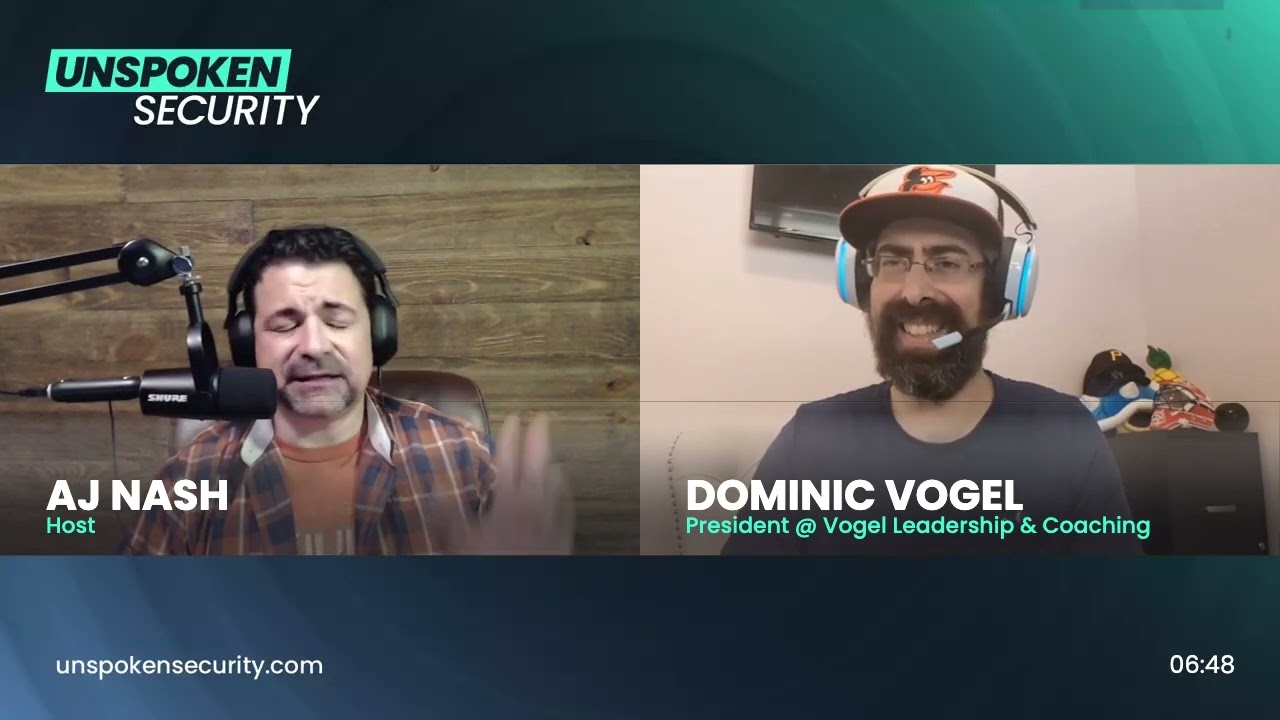
Dominic Vogel, president of Vogel Leadership & Coaching, left corporate security work to build a business on kindness and genuine relationships. He credits the K-L-T framework (know, like, trust) on LinkedIn with generating client work, and says focusing on people over products leads to better long-term outcomes than chasing deals.
Chapters
I'm a big believer of having gone through that, that there's power in the relationships that you build. And it's easy just to say to someone, hey, hey, I just liked your post. You better reciprocate. Better like that for me. But if you do, if you show up for someone time and time and time again and ask for nothing, you ask for nothing other than saying, I'm a kind person. I see you. I respect you. I love you. Keep being you. More often than not, that person will say, hey, you've shown up for me time and time again. What the hell can I do for you? Like, you are so friggin' nice to me and you've asked me for nothing. Like, seriously, tell me and I'll do it for you. Right? And again, that's not to say that's some, you know, manipulative ploy. It's just, again, human nature in which if we show kindness and come from a place of genuine kindness, that's how you open up the hearts of people around you and people that you've never met.
Welcome to Unspoken Security, the raw and gritty podcast for security professionals who are looking to understand the most important issues issues related to making the world a safer place, including intelligence-driven security, risks and threats in the digital and physical world, and discussions related to corporate culture, leadership, and how world events impact all of us on and off our keyboards. In each episode, host AJ Nash engages with a range of industry experts to dissect current trends, share practical insights, and address the blunt truths surrounding all aspects of the security industry.
Hello and welcome to another episode of Unspoken Security. I'm your host, AJ Nash. I've spent 19 years in the intelligence community, mostly at NSA, and I've been building and maturing intel programs in the private sector for about 8 years now. I'm passionate about intelligence, security, public speaking, mentoring, and teaching. I also have a master's degree in organizational leadership from Gonzaga University. Go Zags! And I continue to be deeply committed to servant leadership. This podcast brings all of these elements together with some incredible guests to have authentic, unfiltered conversations on a wide variety of challenging topics. It's not your typical podcast. It's not all polished and put together necessarily. My dog might make an occasional appearance. She certainly has. Uh, people argue and debate here. We might swear. I've been known to do a lot of that. Uh, and that's all okay. Uh, although I doubt there'll be a lot of arguing today with our guest. Uh, but you wanna think of this podcast as a conversation you'd overhear at a bar after a long day at one of the local or one of the larger cybersecurity conferences, uh, like Vegas for that matter. Uh, these are the conversations we usually have when nobody's listening. So today I'm joined by Dominic Vogel. Uh, he's the president of Vogel Leadership and, and Coaching. Uh, Dom's built a strong reputation and a following, uh, as an authentic leader providing pragmatic solutions to cybersecurity and leadership, and as he puts it, saving companies from evil cyber villains. Uh, prior to opening his own firm, Dom built his foundation Uh, with over 15 years in the cybersecurity space, including roles in the financial, healthcare, and transportation sectors. He holds a bachelor's in computer science from Simon Fraser University and is based out of Vancouver, British Columbia, where he is a very dedicated family man and an avid collector of hats. As you can see, he's got his Baltimore Orioles hat on today. Uh, and so he's, he's, he's working on all those things in his private time when he is not out saving the world. Uh, Dom, is there anything—
No, I, I'm just really happy to be here, AJ. Looking forward to spending time with you and Yeah, thanks for having me.
Yeah, man. Thanks for being here. I mean, really happy sort of cap, you know, captures who you are, right? I mean, I've, I've talked to a couple folks. In fact, just before we came on today, I was chatting with somebody. I said, listen, this guy is the happiest guy in the world. I mean, I, without being just on drugs all the time, as far as I know, he's the happiest guy I know. And, and so like, it's, you're infectious in a good way. You know, in the age of COVID infectious doesn't always sound good, but in a good way, right? You're just, you're remarkably happy and positive. It, it, it just emanates through everything you do. It's how we met, obviously through, through social media, actually through LinkedIn. And, and I was immediately attracted to your personality. You know, you just, you're just, you're just a beacon of positivity. So it makes me ask, as today, the topic of today's show is bringing humanity into security, because, you know, we spend a lot of time in this industry. It's, it's metrics and KPIs and OKRs and there's a lot of, you know, a lot of regimented stuff and details and money and all these kinds of things, right? But the humanity often gets lost and you're just, that's who you are, right? So bringing humanity into security being today's title, I wanted to start like, listen, were you always such a touchy-feely guy when it came to business? Is this always how it was for you or not?
I wasn't always this person. I'll say that I've evolved into the version that I am today and I like to think I'll evolve into a future version at some point as well. But Um, you know, I, I growing up, I was actually always very introverted. Um, you know, and friends that I did have always saying, you're so funny, you're so kind. And, um, it was, it's, so it's always been in me, just that it's taken time for me to appreciate, I guess, who I am and what, what I can bring, um, to the world. And I recognize that now one of the greatest joys that I have apart from being a dad and the husband and the family man, the greatest joys that I get are just spreading kindness on platforms like LinkedIn. That's why when I'm on LinkedIn, I actually never talk about security, AJ. I can't remember the last time I talked about cybersecurity on LinkedIn. My posts are geared towards feeling good, right? It's about kindness, about positivity. Um, same thing with my comments. I'm just trying to bring random smiles to people's faces. And it's amazing how much the world has opened up to me and vice versa by just trying to be a source of kindness. Um, more than anything in security and in the world for that matter, I think we could always, I think we could all enjoy a little more kindness. Yeah.
I mean, I couldn't agree more. Like I said, obviously I follow you on LinkedIn and, you know, we've talked a lot and, and it's true. And for those who, who don't know, uh, Dominic Vogel, if you're not following him, I highly recommend it. And, and you might listen, I know some people listen to this show and it's some people very buttoned up and put together and I don't have time to, to, you know, listen to somebody who just wants to, you know, make everybody smile. I promise you it's not what you think. Like Dom's a lot of interesting insights, right? It isn't just a bunch of fluff and unicorns and butterflies all day long. It's positivity, but in a way that actually is productive. It is helpful. You do provide a lot of insights. I've obviously seen a fair amount of, you know, of your personal life in there too, in a good positive way, I think. And I think it's really important, you know, because this is a tough business, man. I mean, we spend every day and every night, it's 24/7. You know, I've had other shows we've talked about how this is a relentless industry. It never stops. You know, adversaries are there all the time. Uh, there's always a threat. People are under a lot of stress. And, and of course now we're doing, you know, there's economics and there's, there's contraction in the industry. There's people who are, you know, struggling to find, you know, new, new places to spend their time and energy. And so it just makes it all the more important to have somebody who's able to come in and say, hey, listen, the world's not terrible. Like there's a lot of great things going on. We spend a lot of our time focused on all the bad things in the world. You know, we're helped with that. Media does that and social media certainly does that. And, you know, adversaries will do that with, you know, with their campaigns as well, influence campaigns. So there's a lot of negative in the world. But, you know, having somebody who's able to say, hey, listen, the world's not all bad, and here's some cool insights on how just coming in with a good attitude matters, right? You know, just being able to say there's cool things. You know, take a minute to, you know, smell the roses is cliché, but, you know, to spend the day with your kid, for instance. I mean, your son's on LinkedIn a fair amount, and, you know, I admire that you are able to have a flourishing business in this industry, but you're clearly still dedicated to family and, and, you know, bringing people insights about, you know, how the world's still a pretty good place. I don't know. I'm not going to lie. I don't know how you do it. You know, and I'm curious, you know, we got a few questions here to go through. But I mean, listen, just before we went on, I'm going to share this because I think it's funny and it'll open up a story. But Dom also has a puppy who apparently like every puppy in the history of ever, occasionally doesn't do things where you want them to do them. And Dom was kind enough to share with me this morning, he in bare feet stepped into a puddle of puppy. And but here he is smiling and laughing about it. Like, how do you, how do you do it every day? Like, how did you get to the point where you're like, I'm just going to focus on the good and not, you know, burn all my energy on the negative? Like, is it something you had to actively work on? Did you go to courses and training on this?
Did you just— for me, what happened, AJ, was that I actually burned out in corporate. That was my transformation. I burned out terribly in corporate. I'm actually entering 10 years now as an entrepreneur. So 10 years post-corporate where I was a shell of myself. So there was the corporate version of me and that person ended up burning out and it ended up transforming me in a way in which, or what I like to say, it broke the pieces that needed to be broken in order for me to transform into who I am today. And at the time it was so awful. I'm thinking, why, why, why, why is this happening to me? But the gift of time and perspective made me realize just how grateful I am, you know, and to the point that I always jokingly say now that, you know, the CIO that I worked under, who was a very toxic human being, I'm actually grateful that he was who he was because, and I should send him a fruit basket as a thank you because the version you're talking with today, AJ Nash, would not have happened had he not been that type of person. You and I would likely never have become friends had he not been that type of person. Things do happen for a reason. I'm a big believer in that, and it just, it sometimes requires time for us to have that level of perspective, you know, and being able to recognize that when there's no such thing as good luck or bad luck, you know, to me, there's only we'll see. Something that may seem like bad luck you give it enough time and perspective, it actually maybe ends up being more good luck than it was bad luck, you know? And so that's, you know, to answer your question, was I always like this? No, but I like that I needed to be broken in places that needed to be broken in order for me to be more aligned with the higher version of myself. I'm very grateful for that.
It's interesting you say that. I mean, that really resonates with me. I've had a handful, 3 that come to mind. Of really toxic people that I've worked with. And I could name them, I'm not going to, it's, that's not, anybody who knows me probably knows them anyway, but I've had 3. And, and it's interesting because like you said, you know, in the moment it's miserable, it's awful, it's, you know, it's, it's, it can be soul crushing, it can be depressing, it can be angering. It depends on, you know, how they're reacting, you know, how they're acting and how you're reacting to it. But, you know, it can create a lot of despair, right? And yeah, in retrospect, I look and go, God, I'm really glad I came across that person because look what happened as a result. You know, I've had a couple of bumps in the road. Most of us have, especially if you're my age. And at the moment it's always really, really hard. And there are moments when you feel like maybe this is it. You know, we listen, for better or worse, we live in a pretty aggressive economic system. You know, it's, you gotta make your own way for the most part, or you're gonna struggle. And granted, I'm in the US where I think it's even slightly more brutal. Than it is in Canada, although probably not that much. But it's, it's a little more brutal in that, you know, healthcare is tied to it and things like that. So it's easy to despair very quickly. It's easy to get in a position where you're like, well, this person treats me terribly, but what am I going to do? Like everything in my world's tied to this job and they just beat you down and it could be for any number of reasons. And then you find out later, as you said, you know, you get away from that toxic person and maybe that was what you needed to go, hey, I need to see the world differently or I need to take a risk or a chance that I wouldn't have otherwise. And unlike you, I've talked about sending thank you baskets. I've more than one occasion I said I should really send a basket to that guy because if he hadn't been who he was, I wouldn't have made the move I made and things have worked out pretty well. But in the moment, it's really, really hard when you're in the storm. You know, it's the old hurricane analogy, right? When you're in the storm, all you see is the storm. And then afterwards, maybe you see, you know, something really good came out of it. You know, and for those who don't know, I'm sort of in the middle of some of that stuff right now. And and it's hard. But, you know, we've sort of stolen a little bit from the second question, but I think there's more you can dig into on it. So I was asking, you know, how you got here. The question that we had put together prior to talking was, you know, what made you decide that things weren't working or there was a better way? So you've already mentioned you had this toxic leader that you obviously had to move on from, but there's a difference between saying, hey, I've got this toxic person. I'm sad. I'm miserable. I'm angry, whatever, whatever's happening. Was there a moment that, that was the moment where you're like, I've got to make a move? Or was it just a series? What, what got you to finally take that, that leap, that scary leap to go, I'm done being this way, I've been treated this way, I've been feeling this way, I've got to do something?
Absolutely. It was definitely also gradual entry, just like me gingerly getting into a bathtub. Yeah, it was basically after I, after I burned out in corporate, I fell backwards into becoming an entrepreneur. And I never had any intention of becoming an entrepreneur, right? That was That I could barely spell the word. I can still barely spell the word. Uh, and as I was going through that, those, the first year or two, I was just thinking, okay, well, you know, there's a platform like LinkedIn. I'm going to try selling my services and DMs and all, everything was just around security, right? I'm a small business owner. When's the last time you had a security maturity assessment or something along those lines? And it got me nowhere. It got me nowhere.
Thanks, AJ.
Uh, which shouldn't be a surprise. Uh, and I was like, there's gotta be another way. And I was looking, you know, looking through all the posts at the time. I was like, boy, so much negative energy here. Like people are just, someone's posting, posting something or being vulnerable about something and people are crapping all over them.
I was like, hmm.
And I thought there's gotta be something else to this and call it epiphany, a light bulb moment. I'm not sure, but like I said, the whole notion of kindness has always been rooted in me. As a very, I'll say, side step to this, but I believe it's related to why I am who I am. Growing up, my mom suffered and continues to suffer from fairly severe mental illness. And again, growing up, I thought, well, this is awful. Why do I have to deal with this? It's not fair, that type of thing. But over time, I recognized that it gave me qualities such as compassion, empathy, kindness, things that, although I wouldn't wish mental illness on anyone, I'm grateful for the qualities that I have. And it came out of the fact that I grew up in a household with a parent that suffered from mental illness. You know, back to the story, knowing that was now rooted in me, I thought, well, what if I can just share some kindness, right? In this day and age, especially in social media, Doesn't seem to be enough kindness or positivity. And I thought, what if I do things differently? What if I just leave an absurdly random comment on someone's post telling them that they're friggin awesome? Or you— I'm a huge fan of alliteration, so I just come up with a bunch of random high-energy words and just see what that does. AJ, within the first 3 months doing that and doing that consistently, right, showing up people and saying, hey, I see you, I support you, you're friggin awesome. Keep doing that. I went from having a few hundred to a few thousand connections and followers just after, you know, 6 months of doing that consistently. And it led to very meaningful relationships. I'm a big believer of having gone through that, that there's power in the relationships that you build. And it's easy just to say to someone, hey, hey, I just liked your post. You know, you better, you better reciprocate, better like that for me. But if you do, if you show up for someone time and time and time again and ask for nothing, you ask for nothing other than saying, I'm a kind person. I see you. I respect you. I love you. Keep being you. More often than not, that person will say, hey, you've shown up for me time and time again. What the hell can I do for you? Like, you are so friggin nice to me and you've asked me for nothing. Like, seriously, tell me and I'll do it for you.
Right?
And again, that's not to say that's some, you know, manipulative ploy. It's just, again, human nature in which if we show kindness and come from a place of kind, genuine kindness, that's how you open up the hearts of people around you and people that you've never met. Right? And like I said, it was a series of, like I said, epiphanies, but I'll say it's a series of interconnected events that made me me and realized that maybe I should do things differently. I've always felt, even though I am a security professional by trade, I never quite felt like I was a security person. Um, I always felt a little different in that community. I thought, hmm, well, what if I tried being differently, right? Looking at the stereotypical view of, you know, and that was all now 10+ years ago, how people looked at security professionals, right? As, you know, either condescending, rude, asshole, you know, the, the, the—
this goes on.
I thought, what if I beat that?
That's not describing me, Don. That's really interesting.
It's almost right to the point now where I, uh, people are like, wow, you are— I always take it as a compliment to a degree, but also a damnation on our industry when people are like, wow, you're not like any other security person I've ever met. Right. And, you know, that's what you said is to me is, yeah. And, uh, as I became an, as I entered sort of year 3 and year 4 as an entrepreneur, I quickly realized that what I do, i.e., security, does not equate to who I am. In corporate, my identity was so inter— I couldn't tell who I am from what I do. It was all intertwined. But as I got farther away from that, I recognized who I am and what I do are two different things. And if I just was me on the platform like LinkedIn, I've come to— I don't quite remember where I saw the acronym, but it's the acronym KLT: know, like, and trust. If I get people to know me, to get to like me, and get to trust me, What I do is largely irrelevant. I could end up selling ice and it doesn't matter, right? And ICE isn't meant to be an acronym for some other expensive security technology. I literally mean, I literally mean ice. The, seeing that separation, like having people get to know you and have that very deep visceral connection. And like I said, for me, the greatest jump point for me was actually during COVID When we were all, you know, we lost our physical proximity to one another, those that were able to develop emotional proximity, those deep visceral human connections with one another saw an explosion in growth. And that's where, for me as an entrepreneur, that's where I saw my greatest explosion in growth by investing in that human capital.
Well, and I think you made some interesting points, you know, that are worth mentioning. I mean, first of all, authenticity, right? It's not just about, and I know you know this obviously, it's not just about reaching out, but like that quid pro quo doesn't work. Hey, I made a comment about you. You should make one back about me.
Like that's not authentic.
That's not trying to that's not trying to build human relationships. That's just trying to build numbers, right? And that's not the same thing. And people confuse the two. You know, I know people have a lot higher, you know, a lot bigger following than I do, certainly. And some of them have really authentic connections across the board. A lot of them just don't. It's just, it's a numbers game to them. That's the contest, right? And that's fine. And listen, there's money in that. You can market that if you have so many followers and people pay per follower. I mean, there's something in there, but I think the point you made about it being an authentic connection. Like, you know, in, in sales, people, you know, I've often said people buy people. They don't buy products. They don't buy services. They buy people, you know, that know, like, trust, uh, scenario you were talking about. Because a lot of times, listen, the products and services, I mean, sure, there's some that are really lousy, I'm sure. And there are some that are industry leaders, but there's a lot that are really close together. And, and a lot of times the separator in whether somebody wants to do business is, do I want to work with this person? Do I want to know this person? Do I trust that if I make a phone call, they'll answer? Are they telling me things now that will be different when I sign the paperwork? Because you have to have that. So, I mean, there's a business component to this for those who are thinking about this strictly from a business standpoint. You know, there is a business component to this, but I'm like you in a lot of ways, not, not nearly positive enough, frankly. But, but I do think it's interesting in the background, you know, you mentioned your mother and I, you know, my mother has her, had some challenges as well in retrospect. I think we've all figured out a bit more what that might've been prior to knowing at the time. And so we both came from a background that had some similarities. I'm not going to try to make a comparative. And I think we've had some of the same similarities in business of working with toxic people. And lo and behold, I think I'm sort of on the journey you're on, sort of. I'm behind you essentially. I'm getting a little more positive annually, I think. I mean, those who know me closely, maybe we'll argue about this later. Uh, but I try, certainly, I try certainly to do that, right? I, I had somebody, like, in the last couple years, people have said, you're such an optimist. And that is not something that I would've been described as, as a younger person. Um, but you know, I do try to see the positive in it. And, and more importantly, I think like you, I'm all about the people, right? It's about the connection. It's about people. It's about how can I help? You know, whenever somebody reaches out to me on LinkedIn, and I'm sure some people probably think it's a script at this point, it really isn't. But if somebody reaches out to connect and it's something I want to, somebody I want to connect with, my response is always virtually the same. You know, thanks for reaching out to connect. How can I help? And I mean it, you know, it's not a script. It's all handwritten and occasionally there's typos in there as a result, but I mean it, you know, my goal is to do that. You know, I have a fair amount of connections. There are very, very few and none recently that I haven't had some interaction with. Maybe it's just that simple message. So it might not be a lot, but I don't just click yes to everything. You know, I could have a much bigger following. I've got, you know, hundreds or more, I'm sure sitting in a box someplace that I'm not probably ever going to accept, and it's nothing personal to them. It's just, you know, we don't have a connection and I don't have time for everything, but I like you. It's about that personal connection, right? I want to be involved. I'm active on LinkedIn. I comment on posts and I try to be positive, but I'm not always. Listen, I've got my negativity on things that I feel strongly about, I suppose, but I'm trying. I think I might, I feel like a bit, I'm on that journey with you. I don't know if I'll ever be quite as positive as you. You're the only person I know who steps in dog pee in the morning and shows up on camera laughing and smiling about it. I think I might still be a little bitter, frankly. Uh, but you know, so I, I, I got more to learn from you, but I'm curious. So you've been on this journey and so there's two things that, that come to mind on this. The first one, I don't have much time for. I know we're, we're, we're running a little short on time. Dom's such a busy guy. He actually has something coming up right after this, which is gonna force me to actually stay on schedule and not run an hour and 20 minute show today. But, uh, the first thing I, I want just like, like 10 seconds or 15, you mentioned burnout. Like what did burnout look like to you? Like, what did it look and feel like when you said, hey, I'm burnt out? Like, what were the indicators for you? Like, this is, I'm burnt, I gotta, I gotta stop doing this. Like, how toxic was it?
What was it? Yeah. The burnout for me, it was actually, I didn't actually fully recognize it. It was my wife and she said, I don't recognize you. She said, you are so cynical. You're so jaded. You're so negative. When you come home, you're exhausted. And you just want to be by yourself. She's like, that's, that's not you., right? And it, that was the awakening moment for me. And, you know, my, my daughter was little at the time. My daughter who's 14 now remembers my corporate days. My son has no, he wasn't born, right? So to him, working is this. I'm glad he doesn't know corporate me.
Yep. Yep. Yeah. And I can appreciate that. I had a similar, again, experience. We have a lot in common in this way. And again, it was a partner that told me too. I didn't realize just how miserable I was. Until it was somebody who said, hey, I'm worried about you. And then I had to take an assessment. I was like, God, I really am miserable. You're right. Like all the minutes of the day, like this is what it came down to. It was true. Like when I was at work, I was unhappy. When I was at home, I was thinking about work and being unhappy. Plus I had a toxic boss who would call me at all hours of the day and night. So I was always working the weekend. All I was dreading was Monday. Like it just was, it was invasive. Right. And, but I still hadn't quite noticed it until somebody said, hey, this is, I'm worried for you.. And I was like, yeah, this is bad. I gotta, I gotta make a move to something else. Um, so it's interesting to see it work out the same way. And then, so now that you've made this transition, you know, you're 10 years down the road, as you said, as an entrepreneur, you're out of corporate, you're, you're free of that toxicity. You're just the nicest, kindest, happiest person I probably have ever come across. Can you talk a bit about like the results of, of your way of connecting with people? You know, what are the impacts you've seen on them? What are the impacts you've seen on yourself? You know, you mentioned a little bit of that, but now you're 10 years down the road, you know, and by the way, I think we can all talk about the impacts of your mental health and, and how it feels, which I do want to, but I know for some who are listening, if they're still with us at this point, they're gonna ask about the business aspect too, cuz there's some people, it, that's just how their mind works, right? So, you know, how has it translated to business as well?
I'll start off with this story. So, um, so on LinkedIn, like I mentioned earlier, I never post about security.
Mm-hmm.
Um, because I noticed that when I would post about security, I would get very little in the way of leads or any engagement. And I, post about something meaningful or, you know, a life lesson as a parent. And then I end up getting more business as a result of that post. I thought, okay, well, I'm gonna stop talking about security because I've come to realize for the most part, people don't really give a crap about cybersecurity unless they have to, right? So I thought, okay, maybe I did— it's a true story, right? It took me 20 years to figure that out. But I was like, okay, well, let's change the script here. And You know, when I post about, when I, the things I post about, and this, this story sort of to me epitomizes why I don't post about cybersecurity. Um, someone that has followed me for, for years, um, you know, she and I were catching up and she said, Dom, you don't know this, but like past 6 months I was going through a real dark time. Your posts were one of the things that was like a bright light that I would look forward to every day. I always knew that at least at some point during the day, your posts and your comments would make me smile. And I just had the biggest cry when she said that. It was happy tears because I thought, that's why I post, right? It's stuff like that. That's why I post, because if I can make an impact on someone's day, uh, that again goes back to the deep visceral connections, right? The deep visceral humanity, right? Back to our title, right? We're not human enough in our field, right? I would try to be deeply humanizing if nothing else, and, you know, giving even just that one person as an example, I've gotten more meaningful work from that one relationship than any other cold calling, any other traditional '70s way of doing business. And the quality of the work, the quality of the relationships, the quality of the clients, significantly higher than if I just set up the sales funnel or the other BS that whatever different LinkedIn gurus tell you about. And again, I recognize, and this is where I'll say it's what trying to understand what it is that your ultimate why, like, why do you do what you do? When I became an entrepreneur, I had this grandiose vision of trying to build like a consulting company, you know, have it be worth tens of millions of dollars. I ended up picking a business partner and all that. When I ended up building, I ended up building a prison. It was an actual prison for me. And in this new iteration where it's just me, I recognize, yeah, I'm never, I'm not going to create a, you know, the $100 million company. That's not what I wanted. What I really wanted was actually just the freedom, the freedom to wear this, the freedom to be like, hey, you know what? I don't feel like doing anything today. I'm going to go spend it with the kids or I'm going to go out with my wife today. It was the lifestyle, right? And to me, ultimately recognizing that why was the driving force and being able to now say, okay, yes, does what I do scale? No, it doesn't, but that's okay. Right? I can't tell you how often it pisses me off, but I get it. Someone's saying, oh, Tom, your business won't scale. I said, you're asking the wrong question. You didn't even ask me, do I want to scale? Right? That's the prerequisite. I don't, right? I do not want to scale.
Right?
So to me, as a solopreneur, back to your question of, you know, how does this impact your business? I wish I had done this sooner, right? Leading with kindness, leading with something other than security, because like I said, No one gives a damn about it. Um, by just trying to be a good person, develop meaningful relationships, I have built a life. I built a business that I never thought possible. And like I said, the clients that I get as a result of those relationships end up being clients for years. And now, unlike how it was when I was trying to build a company, I don't have these short-term clients that really drain my energy. I have clients that are friends. I have clients that are with me for years. You don't get that. When you do, when you try to scale. Yeah.
I mean, that makes sense, right? You're, cause you're building relationships again. You know, I've, I've been in plenty of conversations. I've been as, as a vendor or as a customer where it's, you know, every, everybody talks about, hey, you know, we're not, we're not trying to, to, to be your vendor. We want a relationship. We want to be your partner long-term. It's a sales pitch. And, and maybe they do or don't believe in it. Some companies do, a lot of them don't. But even when they do, it's, it's for the reasons you said, but maybe not the application. It's, Churn costs money. Listen, going on acquiring new business is more expensive than keeping business you have. Having great relationships, you'll have a customer that will give you more latitude, more leeway. They're more, you know, give you more grace if things don't go well, cuz nothing's perfect. But it takes time to build those relationships. It's hard. There's a lot of sales folks who just want to, you know, get a relationship, move it onto the, you know, get the deal done, move it onto the customer satisfaction organization, get the next deal. And, and, and, you know, churn through that's their business, right? And. And it does create this, this churn and this move. You know, we're in an industry where there are so many companies that are battling for the same business. And, you know, listen, I should probably share this on the show. Nobody cares.
I think that's security.
It's probably true. Uh, like they don't, like most people don't, right? So what do they care about then? I mean, some care about, hey, can you, you know, am I getting a lot of steak dinners? Are you going to give me a lot of, you know, bonuses for, for picking your company? But I think most people, it's that relationship. I want to know that when I pick up the phone, you'll answer. I want to know that you actually care about my problem, that you're going to listen. You're not going to shuffle me off. There's a lot of value in that. Um, but it's hard to do. Now, I will say this, I, I disagree with people who will tell you this can't scale. Yes, there's a cap. You can only scale so far. I think it can scale if you build a team of people who are like-minded though. There just aren't that many. But I think this is a kind of business model that can and should scale. It's about changing how people work in industry, whether it's our industry or any industry. If more people looked at it from a human standpoint, And from a, how can I genuinely make your life better?
All right.
I assume if I do that, the money will show up and my life will also be better for it. But if I just said, hey, how do I make this person's life better? Talk to me about what your problems are. You know, it's a consultative approach in sales. It's Sandler sales for those who've done, you know, sales. But you have to actually mean it. You have to actually care. Don't take the Sandler class because you know these are the steps to make people believe you. Actually give a shit and just sit down and go, hey, talk to me. What are your problems? And also be honest and say, hey, I can't solve those problems for you if I can't, but I know somebody who can because that also pays off. That person will recommend you someplace else. I think if we just had more that did that, I don't think the business is something that can't scale. You personally can't. I mean, there's only so much you can take on, but if you had 3 partners, 4 partners, if you had a firm of people who all had this as their mantra, we just care about the people and had that trust and had that knowledge and like and trust, as you said, and I think it is scalable. I think it should be, the entire industry should work this way and I think it would scale greatly, but it just doesn't because people are either not of a mind or just lazy maybe. I don't know if it's, or maybe they're not knowledgeable. Maybe I shouldn't make it so negative. Just haven't been informed yet that there's a way to do business like this that can be effective. You know, getting your message out, having more people see that you can do this. And sure, if you wanna do as a solopreneur, you can do that too. And I think it's great to say, hey, I just wanna make enough to have a decent life for my family and not be poisoned and miserable every minute of every day. And, you know, hang out with my kids and be a happy person. But I actually think the concept itself can scale. I think you just need more people that are willing to believe in the same concept. And we just don't have enough of it, which is, you know, part of the reason I wanted to have you on, part of the reason, you know, we're friends is we need more Dominics. We need more Dom Vogels in the world, basically. And I don't think cloning's been figured out yet. So, I assume you're, you've got a couple kids, so I assume you're making a couple of little, you know, doms, which would be good. So you're making some new people in the world, but, but it's gonna take time and that's, that's how you're gonna scale. You're gonna have a, you're gonna have a family business and have the kids work there someday. But, but I appreciate what you do. I appreciate what you put into the world. I learn from you. I, I follow you. Like I said, I, I pay attention, you know, I, I got a couple more things. I mean, we gotta get to our closer question. I have a question that wasn't part of this at all, but I'm just curious. Um, and I'm, I think others might be too. So you've got a 14-year-old daughter. You've got, uh, your son is, and I don't normally talk about people's families, but you're pretty open with yours. Your son's 6.
Okay.
And that's, so that's my big question actually is, is probably more focused on him. Maybe the 14, I don't know. What are you doing for Halloween? Uh, so Halloween's coming up and, and I'm curious, first of all, I don't know, I assume like Canada's the US. I mean, you're just here basically. So I assume Halloween's as big a deal in Canada, but, uh, like what are the kids going as for? Are you a guy who dresses up? Does the whole family do a thing for Halloween? Uh, are the kids super involved in it?
Like, how does, I'm, I'm just, I don't know why, but I'm really curious about how we do like Halloween here in Vancouver and, and the country as well. I mean, uh, so it, it's, uh, it's always a fun, fun thing for the kids. I mean, my, my daughter's now gone through it, which she's, uh, she's not trick-or-treating anymore. She's now with her friends. I, I'm no longer cool. I, I argue, I'm not even sure if I was ever cool, but I'm no longer cool.
Yes.
Yes.
That's not— you will be again in about 8 years. So don't worry.
Yeah. My, my son is 6 and he's just still at this age. He's in grade 2 where it's just really fun going, you know, trick-or-treating with him. And this year we'll be going with some of his friends, which is, which is great. And our golden retriever, we're gonna be dressing her up. She's probably gonna be a pumpkin. So we're really looking forward to that more than anything. It's, it's something that at least in Vancouver, we have fairly mild Octobers. So it's either going to be a nice cool night, not super cold, or it'll horribly raining. But either way, it's a ton of fun, right? We live in the community, the neighborhood that we live in has lots of great, you know, decorations and stuff. It's really busy on Halloween night. So I'm actually really looking forward to it. And this year, my son, asked to be a happy snowman. So he's gonna be a happy snowman.
Yeah, that's awesome. Of course, he's gonna be happy. I mean, it goes with the family motto, right? So makes perfect sense. He's gonna be a happy snowman. Like, listen, you know, growing up, that wasn't my— wasn't what I went as, you know, but I wasn't— I wasn't raised the same way. So a happy snowman is awesome. Now I grew up in Minnesota. I'm back here now. I moved back a few years ago. For us, Halloween, we joke about it around here because at least when I was a kid, it was often what your costume was, was whatever was gonna fit over a snowsuit cuz it's gonna be, you know, Arctic cold already. And you know, we, we get, we, we've been known to get a foot or two of snow on Halloween. Like it happens. So yeah, a lot of costumes were like, you had good intentions, then you just ended up being the fattest Spider-Man ever because it had to be stretched over this, you know, snowsuit or, you know, your parents would drive you from house to house or, you know, you trick-or-treat for, you know, 7 houses and go home cuz you had frostbite. You know, we're the only place I can remember where trick-or-treating, you almost always came home with frozen candy. Uh, it was just kind of the norm. Um, you know, so it's, it's a little different around, uh, around, around town here. But, uh, but actually the reason I asked, it does sort of tie into the rest of the conversation because a lot of people, if I ask that question, their answer's gonna be, I don't have time for that. You know, I'm working, I'm outta town that day. I got, I got business, I got, you know, I got meetings, you know, Halloween, you know, obviously 5 out of every 7 days it happens on a weeknight. Um, you know, a lot of people don't have that time. And your answer, it wasn't like, well, I don't know, I gotta see my schedule and You know, your answer, I knew what, I didn't know what the answer would be, but I knew for sure the answer was going to be, I'm going to be with my family. I'm going to hang out. I'm going to do stuff with my family. And, and that's a value I think people don't understand that, that just comes with being free of some of these toxic leaders and some of these, you know, flawed priorities, you know, and it's not easy, right? I mean, very few people are able to go out and make that leap and build a business that's sustainable., that also, you know, fits with their values and their morals and their, their goals and objectives and feeds the family and does all those things. Uh, so I really admire that. Um, as we're getting to the end here, so there's a closer question I ask everybody. As you know, uh, nobody gets a free pass. The name of the show is Unspoken Security. Uh, so with that in mind, uh, you're on, you're on the hot seat today, Dom. So tell me something that you've never told anybody before, something that, you know, to this point has gone unspoken.
That's a good question, AJ. I'll bring this back to my corporate days, actually. So something that no one knows is that during an audit with— I was dealing with an external auditor. The auditor said, okay, well, there's a bunch of red items here. You know, what do we do about that? I had been trained to say, well, this is what we're going to do, right? Even though, you know, my, I knew my bosses had no intention of ever doing it. So I said, you know what, here's what my bosses want me to say to you, but they're actually a bunch of bullshitters. They have no intention of doing any of this. So this was actually towards the end of just as it was starting to burn out, AJ, where I was in the no longer get the law. Yes.
I'm sure.
Well, it was going to be towards the end of your time either way. So, uh, uh, yeah, no one, no one knows that. And, uh, you know, um, but that is what I did.
Yeah. And what are they going to do now? Right. I mean, you've been gone 10 years and, and so, I mean, what are they going to do?
Right.
I'm sure the auditor got a good chuckle out of it. Yeah. The only honest person in the history. Yeah. He's like, ah, look, somebody's more, because he knows he's the most honest answer ever. Yeah. I mean, yeah. The auditors know, they know it's all bullshit, right? They know everybody's lying. This is the steps we're gonna take. These are our remediation plans. They know it's all bullshit. The auditors know, and then they write it down and they move on to the next thing. And you know, I shouldn't say all, listen, there's somebody out there right now going, I don't lie. We do what we say. Okay, fine. There are ethical people in the world, but a lot of people, they're gonna bullshit their way through. They're gonna get to the next thing. They'll get to it when they get to it. And I will say, you know, it's, it's a good indicator for anybody who is either working in a toxic environment or if you're leading a toxic environment, which you probably don't realize, but let's assume you do. That's what's going to happen eventually. Like, just so you know, like the people, when they burn out, they burn up and they'll burn everything around them. Like, it's just sort of what happens. You got to the point where, you know, you just were out of fucks to give, frankly. And, and that's what'll happen, you know, and people just eventually say the things that they mean, whether you like it or not. And it can be, you know, it can be unpleasant or uncomfortable or whatever for those, you know, for those who are there. I obviously, I think what you said was the right answer. It's easy for me to say, you know, I'm a big believer in integrity and honesty. I'm sure the company wasn't thrilled with the answer, but that's what'll happen. I mean, that's part of it, right? If you're burning people out, they're not going to, You know, they're not gonna put in the, they don't have the energy left, frankly, to, to, to go the extra mile to do the thing. And especially if it's something that is already unethical or immoral or dishonest or like if people just go, I'm done being that for people who just treat me poorly and, and burn up my life. So I'm not shocked. I'm, you're probably not the first person to do it, but, um, I, I think, uh, I mean, it's a great, it's a great reveal by the way. We've been doing this a while now. Uh, you know, you know, a couple dozen episodes, you know, on the books and, and I get some really cool reveals and some that you're like, oh, that's interesting. This is one of the better reveals that, you know, I, I, I hope the person that you worked for at the time happens to watch or listen to this podcast and go, aha, I knew it. I knew it. I couldn't prove it, but I knew that son of a bitch said something. God, that was the worst audit we ever had. And I knew it was because of him. Uh, and, and now it's, you know, it all comes together for me. You know, and, and I, it probably won't happen, right? It's, you know, 14 people.
How was that? I was just quickly add to that, you know, on that same day, this was later on that epiphany, you know, you asked me about, about burning out and, my wife saying it was sort of half of the awakening. The other half happened after that audit. On that same day, I went to go watch one of the Batman movies. It was one of the Christian Bale trilogies. And I've always been someone that could feel something in my heart. I feel fire, right? And I could feel that going away. And there was the line, I don't remember which Batman movie it was, but I remember sitting in the IMAX theater. Watching it and the, and the line was, you know, you either live long enough to see yourself become a villain or you die a hero. And I thought, Jesus Christ, like that Batman just saved my effing life. Like, and it was actually after that, that coupled with what my wife had told me earlier in the week, the day after is when I put in my resignation. So my wife and Batman saved me.
God, that's a good, that's a good one. I, I, I think you may have the line backwards. Maybe the other way, but see that guy pedantic. I think it was, uh, live long as the hero or die a villain, right? Yeah, it was, I even know the scene actually. Uh, yes. He chose to, to take the responsibility for something else and, and let the world think he was the bad guy. Right. Uh, it's, it's a great line. It's a great movie.
Yes, that's right.
It was part of that Two-Face in it. So, um, and, and the Joker.
Yep.
Yeah, exactly. So, um, really good movie and, and a great quote, but it's interesting that that was like an impactful moment, right? You know, it's, we connect to all sorts of things, right? And I've had it happen. Where I've, I've had a song come on or a movie where I'm like, that's it. This is the moment. Like, this is, this is that epiphany where like, that's the message. Um, where you just realize, all right, I got to make a change. Right. And it's, it's, you know, it's a credit to, to you that you're that person that you feel things right. And you, you process them. And it's a great line in the movie.
It's a Christopher Nolan as well. I should just thank him as well.
It's a good one. If you're going to pick a movie to change your life. Exactly.
Yeah.
If you're going to, if you're going to pick a movie to change your life or have a moment, do it. That's not a bad one. Like those are pretty solid, pretty solid movies. Uh, other than Christian Bale always sounding like, you know, he was hoarse for, for his entire time as Batman. Um, I'm not really sure why he went with that version of, of Batman, but, um, you know, it's easy for me to say. I don't think Bale cares about my opinion. Uh, anyway, so we're, we're running outta time and you've only got a few minutes till you got a client to run to. So with that in mind, listen, I want to thank you for taking the time to come on. This was everything I hoped it would be. You're, you remain just an amazing, like I said, a beacon of light, a positive guy., but also again, a really smart guy, a good business person. You know, uh, uh, what you do matters. You, you're not just connecting with people, you're actually really good at the work too. I mean, you have the technical solutions, you have the ability to help people, you know, have a better, uh, sense of security and, and as you said, protect the world from, you know, from evil. Uh, so, you know, it's possible to be a good guy and a good guy, like you can do both. Uh, and, and that's, you know, an important thing. Um, so, you know, with that mind, I don't know if there's any last thoughts, anything else you wanna throw in before we, we wrap up. I wanna give you, you know, like a minute or whatever. Before we do that, if there's anything we left out—
all I want to say is thank you for the gift of your friendship, my friend. I am very grateful to call you a friend. And if you're ever out in Vancouver, you let me know, as I look forward to meeting you in person one day, whether it's at a conference. I can't promise I'll ever be in Minnesota, but I'm sure at some point the universe will allow us to meet at some point. I look forward to thanking you for your friendship in person, but thank you for today, my friend.
Oh, 100%. Thank you. And I appreciate it. Yeah. If you come to Minnesota, don't do it in the winter, but obviously if you're ever here, let me know. I'd love to get out to Vancouver. I've been to Seattle, haven't crossed over, but I'd certainly like to get out there at some point. It's beautiful country. And if I do find my way there, I'll definitely connect with you and we'll, you know, we'll grab a bite and catch up. So with that, I'm going to wrap this up. This has been another episode of Unspoken Security. Again, thank you so much, Don, for being on the show. Thanks everybody for listening and watching. Please like and subscribe and, you know, give good comments and tell your friends and neighbors. If you don't like the show, just shut up. I don't want to know about that. No, I'm just kidding. Feel free to tell me that too, and we'll try to make it better. But But again, thanks everybody for being here. Thank you, Don, for being here. And with that, I'm going to close it out. This has been another episode of Unspoken Security.
That's a wrap for this episode of Unspoken Security. If you enjoyed this episode, follow us wherever you listen to your favorite podcasts. See you next time.
More from AJ



Unspoken Security Ep 61: Should We Be Afraid of Artificial Intelligence (AI)?



Unspoken Security Ep 58: Stolen Credentials, Fake Hires, and the New Insider Threat




