Unspoken Security Ep 31: The Growing Movement of Digital Investigations
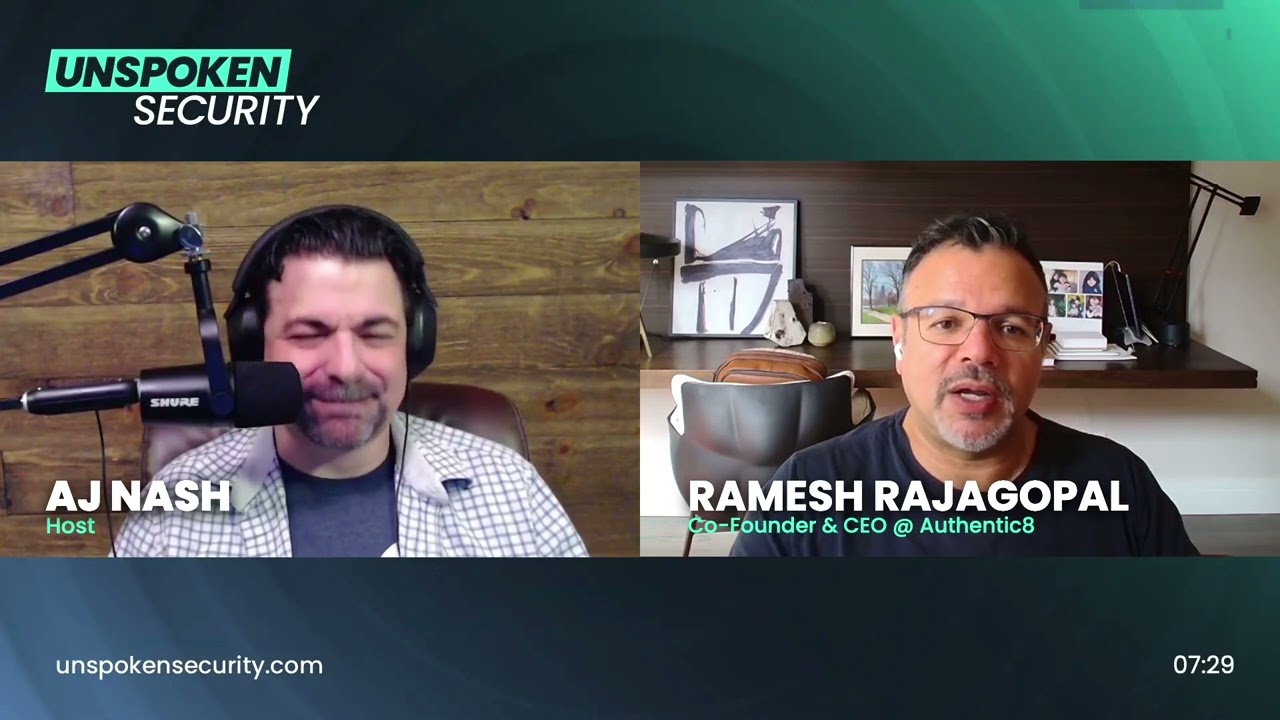
In this episode of the Unspoken Security podcast, host AJ Nash interviews Ramesh Rajagopal, co‑founder and president of Authenticate, about the evolution and practice of digital investigations. The conversation frames digital investigations as a core intelligence lifecycle activity that requires analysts to directly engage with threat actors in hostile online environments (deep web, dark web, social media, open‑source). Authenticate’s Silo platform is presented as a productivity‑first, secure, multi‑tenant SaaS that isolates internet access, provides built‑in case management, automated collection, malware containment, and language tools, allowing analysts to work from any device without exposing corporate assets. The hosts discuss the rapid shift from a primarily government market to a broad commercial adoption across many risk‑focused teams (CTI, AML, executive protection, trust‑and‑safety, etc.), and the growing need for trained tradecraft. AI is described as an “equal‑opportunity” tool that can dramatically improve triage and signal‑to‑noise reduction but also empowers adversaries to generate more misinformation, so human analysts remain essential for primary analysis and decision‑making. Recommendations for organizations include investing in skilled analysts, establishing systematic intelligence production, creating custom metrics, and communicating value through regular reporting and internal advocacy. The episode ends with a personal “unspoken” revelation: Ramesh writes short stories as a private creative outlet, highlighting the human side of security professionals. Throughout, the tone is candid, conversational, and occasionally humorous, with a generally optimistic but measured sentiment about the future of digital investigations.
Chapters
The general point I was trying to make is that now, when we wake up in the morning and when we think about the, the world that we're selling into, we think about that user. What are they looking for? What, what are they looking to do? And what more could we do for them? And yes, we always intrinsically have security and anonymity as a core part of our platform, but fundamentally, we think about ourselves as a productivity app for that analyst.
Welcome to Unspoken Security, the raw and gritty a weekly podcast for security professionals who are looking to understand the most important issues related to making the world a safer place, including intelligence-driven security, risks and threats in the digital and physical world, and discussions related to corporate culture, leadership, and how world events impact all of us on and off our keyboards. In each episode, host AJ Nash engages with a range of industry experts to dissect current trends, share practical insights, and address the blunt truths surrounding all aspects of the security industry. Hello and welcome to another episode of Unspoken Security. I'm your host, AJ Nash. I spent 19 years in the intelligence community, mostly at NSA, and I've been building and maturing intelligence programs in the private sector for about 9 years now. I'm passionate about intelligence, security, public speaking, mentoring, and teaching. I also have a master's degree in organizational leadership from Gonzaga University. Go Zags! And I continue to be deeply committed to servant leadership. Now, this podcast brings all these elements together with some incredible guests to have authentic, unfiltered conversations on a wide range of challenging topics. This is not going to be your typical polished podcast. My dog makes occasional appearances, although the dogs are both out of the house today. People argue and debate, they even swear here. I certainly do. And that's all okay. I want you to think of this podcast as a conversation that you'd overhear at a bar after a long day at one of the larger cybersecurity conferences we all go to. These are the conversations we usually have when nobody's listening. Now today, I'm joined by Ramesh Rajagopal, the co-founder and president of Authenticate. That's a platform that isolates and obfuscates internet access while integrating all the tools and capabilities an analyst or investigator needs to conduct digital investigations safely and securely. Before founding Authenticate, Ramesh held impactful positions at Google, Microsoft, and Postini, just to name a few places. He has a master's in economics from Cambridge and an MBA from the University of Chicago. Amazing credentials. And honestly, he's a damn nice guy too. Anything you want to add to that, Ramesh?
Well, thank you for having me, AJ Nash. It's a real pleasure to be on and, um, look forward to, uh, having a good chat here.
Yeah, absolutely, man. Thanks for being here. Now, before we jump into the show, I have to admit that I'm actually biased towards Authenticate. So I've been using Silo. That's one of Authenticate's flagship platforms. I've been using that for about 9 years. So long time now. It's one of a handful of tools I openly brag about to everybody. I've done it in pitches around the world with different companies. So people are familiar with this. Ramesh recently asked me, or he actually invited me to join the team. And now that I've been able to see things from the inside, I'm even more excited. This, that's not the point of today's show. This isn't a big old sales pitch, but I like to be transparent. I want everybody to know, I, This is a great company that I just happen to like and I've had a long relationship with. So, getting back to the show itself, the title today is The Growing Movement of Digital Investigations. So, when we talk about digital investigations, Ramesh, what are we talking about? What do we mean here? Yeah, thanks, AJ.
It's a, it's a great question. And, you know, even as recently as 5 to 6 years ago when we were out in the marketplace and talking about this use case and the need for our platform, there wasn't necessarily kind of mainstream understanding, but that's shifted massively, I would say, in the last 5 years. So, when we talk about digital investigations or digital intelligence, there's a bunch of tools and vendors that sell into that space. But the place where we really enter what we call that kind of lifecycle of intelligence is when an investigator of some description needs to go out and do primary analysis. They need to directly engage with threats and threat actors in the wild, and they need to go into their environment. Now, it could be just to passively surveil what's going on and collect information, all the way up to and including actively interacting with counterparties, potential adversaries, what have you. Whatever, wherever they are in that spectrum doesn't really matter because they need to basically get out of the boat and get into the water and interact with threats and threat actors in situ or at the source, if you will. And that's what we think of when we think about our platform. That's how we think of kind of direct engagement and digital investigations.
It's interesting you talk about get out of the boat and get into the water. So, the water is like infested. Like that's, that's the big challenge, right? Is, you know, I, a lot of people want to get into those waters. They want to, when we talk about the water, you know, we're talking like the deep web, deep web, the dark web. Cybercriminal marketplaces, could be covert communication channels, like your Discord groups, things like that, Telegram, those kind of things. And those are not friendly waters. You know, anybody who's done this for a period of time knows that. Generally speaking, I warn people all the time in intel, if you're building programs, if we're working on that, I say the thing you don't want to do yourself, unless you really know what you're doing, is the deep and dark web, is the criminal enterprise, right? And because a lot of organizations want to fumble around there, so they end up funneling that work to others. But for those who have the skillset to do it, or at least want to double-check on their vendors, it's nice to be able to go to these places safely, right? Uh, and, and it's not easy. You know, I've, I've been in places, you know, when I first joined the private sector at a bank, it was like, oh, we had to set up this big dirty network and it was, you know, VPNs on top of VPNs and it was all this obfuscation. It was super expensive and time-consuming and an irritant. And I didn't own an engineering team and I couldn't run, understand most of the crap, which was actually when I got introduced to Silo originally, because now suddenly I just had something on my desktop and I was boom, I was right into the dark web. And nobody knew who I was or where I was. And I was able to do some pretty simple things quickly. Like, you know, you just want to go on Marketplace and see like what are credit cards being sold for? You know, that was my first exposure to the platform. And then from there being able to go deeper. So, you know, when you talk about going into these environments, firsthand access, you know, it's nice to have vendors and, and we have a lot of them and I still recommend people have them for a lot of cases, but there's something to be said for being able to go there directly firsthand and see what's happening. But you just can't wander in there randomly, right? You can't set up Tor in your network at some corporation where you're probably not allowed to.
You can't wander in there.
And you don't want to be just, you know, out there willy-nilly, right?
Totally. I mean, you can't just descend into the water, you know, unprotected, right? But the other thing is, you know, when we first started selling into the market, both federal and commercial sectors, we found that teams were actually taking one or two people within their intelligence group and asking them to play IT guy, right? So as you just said, please set me up an investigative environment because there's some pressing threat that we have to go investigate and get intelligence on. So IT usually says, hey, you can't use the corporate network to get out and do this kind of work. And I don't want you using the company machine. So you've got actual intel analysts who were creating, you know, WorkSpaces on Amazon or setting up a VDI or even kind of setting aside laptop machines as burner devices and then trying to jerry-rig a network on the back of it, right? And first of all, that's not what they're paid to do. They probably don't wanna do it, otherwise they'd be in a different job. And most importantly, from the organization's standpoint, time's ticking by. You know, you got somebody out there trying to create a research environment. By the time you actually get behind the wheel and drive that out into the world and try and touch an adversary, who knows if the threat has moved on, if it's transient, if it's dynamic, if, you know, a thousand things could have happened by that time. That doesn't mean the risk has gone away, but you've lost time prosecuting that risk and that risk may have moved to another place, you know? And so that's what we thought we would be for this market, right? We want to be simple, easy, a multi-tenant cloud service. You click a button, you configure your research environment just through a GUI, and you hit go. And that gives you the fingerprint, the network attribution, and the tooling to start doing that investigative work in minute 2, as opposed to minute, you know, 102, whatever.
Mm-hmm. Well, yeah. And, and so obviously I focused right away on, you know, deep and dark web and in the cyber criminal enterprise, 'cause that was the flashy thing for me, to be honest. Like, hey, I've got internet, but all of a sudden I can go on the dark web and I can do these things. But the truth is there's a lot more to it, right? So, you know, there's obfuscation and protection just in any open source research. You know, open source research isn't harmless and it isn't without risk. People think so sometimes, but depending on the project you're working on, the target you're working on, you might not want to be out there and have a whole bunch of noise that ties back to you that says, hey, this, this particular IP has been hitting these websites and searching for these targets or these topics, right? So, you know, being able to go in and, you know, and use the platform to set up— I can have browsers that show, you know, I'm in 4 different parts of the world, I could show hundreds of parts if I have time. But I mean, I can have browsers showing that I'm in Europe or showing I'm in Asia or showing I'm, you know, in the Middle East or, or that I'm in the US, but different parts. I can show different, different browsers. I can make it look like I'm using Edge or I'm working on Chrome. I can show different, I can show mobile if I want, which is great cuz sometimes websites show up differently if they're mobile, right? And all these different things then give you different time zones. They give you the native language of that area, which can matter. Anybody who's done open source can tell you, you know, you go to a website in a foreign country in their language versus your own and maybe a very different experience and a different message. And being able to do all that again from the, from my own position was nice, from my own laptop, my own desktop. Was great. You mentioned, even if you have experts, right? The last team I, I led, dark web team, great group, but like you said, we all had burner laptops. You had, and so that's expensive. We had to issue separate laptops to everybody. They had to go buy laptops that weren't tied to the company at all. They had to use IP space that wasn't tied to the company at all, which means then we didn't really have oversight over everything they were doing, uh, which was a bit challenging. And of course it's all hardware that's just burnt at that point. So it was a lot easier using Silo. I mean, like I said, I've told people I'm kind of a fanboy. Because it's just a lot easier. I'm not a real tech expert, you know, but I can, I use it on my personal laptop. I use it for work and I've found it to be super helpful for all those different investigations. Deep and dark web's the, the sexy one. That's one I think people wanna talk about. 'Cause I can go show you drugs being sold on the dark web or guns or all these horrible things that are scary and they make for good slides really quick for, for leadership. But to be honest, it's a lot of that open source stuff I find to be much safer, especially in a world now where more people are tracking back. What somebody's doing, you know, they want to know who's who in the zoo, so to speak, right?
Yeah. No, look, dark web's a great use case for us. A ton of our customers use us to go and, go and engage on the dark web. But, you know, you're right. It's also just general web research. It's also social media intelligence, right? Way more data is being held within social media platforms and you need to enter those things reliably, safely, and securely. And, and potentially anonymously in order to get the information you need. So, so that's exactly right, AJ. And, you know, we started out when, when we first started talking to this market, we talked to them through the lens of our platform. And our platform really had a cybersecurity protection-oriented message around it, right? You know, don't expect, uh, expose your corporate environment or your, or your personal laptop to these toxic places online, potentially toxic. Places online and also manage your identity, right? So it had a very kind of defensive feel to it. But as time's gone by and we've really understood who kind of our hero user is in the organization, we realize, you know, we're actually enabling a workflow for a particular type of person, right? And, and that person is an intelligence analyst, a little i and a little a, right? Like, they're called different things— CTI guy, you know, KYC, AML,, uh, uh, trust and safety. It doesn't matter what label they have. So when I say intelligence analyst, I'm using it in a very general way, right? To talk about these people. But we thought about that user and what their day job is and how stressful it is. And now when you look at our platform and you see the things that we've added that go beyond security and anonymity, there's a lot of what we just think of as productivity tooling that's baked into the product. To help that user in the pursuit of getting intelligence or responding to a threat, right? You know, simple things like, well, how, where do I store some of this collected content? I can't bring it locally. I need to put it someplace. Well, we have a cloud storage layer. How do I mark up and annotate some of that content so that I can build case intelligence out of it? Well, we have tooling for that around a case manager. How do I interact with foreign language content, which might be audio or, you know, video or text? And how do I translate and transcribe that into something I speak? You know, how do I set up maybe an automated collection routine? 'Cause I have a persistent need to go and look at what's happening in a certain part of the world, right? And I could go on with features, and I'm not gonna do that. The general point I was trying to make is that now when we wake up in the morning and when we think about the, the world that we're selling into, we think about that user. What are they looking for? What, what are they looking to do? And what more could we do for them? And yes, we always intrinsically have security and anonymity as a core part of our platform, but fundamentally we think about ourselves as a productivity app for that analyst.
Yeah, well, it's an excellent point. And listen, I said at the open, I've been using Silo for like 9 years. I'm going to confess, I don't know if I told you this yet, but I'm going to now apparently. There were a lot of features I didn't actually realize Silo had until I joined the team and started playing more. Like, there's an automated collection feature I've actually never used until now. Now I use it, it's fun. And I can set up to have persistent collection on, you know, a website, for instance. So if somebody's, you know, got a website, they've bought the URL and it's dead right now, but it's a typo squatting, right? A lot of times you'd have to go back and check over and over again. If I worked for, say, a bank and somebody had one, you'd have to have somebody go back and check to see, have they changed this site? Have they added content to it? Are they turning it into a phishing site? Somebody's got to do that. You either give a vendor that responsibility, and they charge you whatever they charge for it, or you have to go do it yourself, et cetera. I just have it set up automated now. I can just say, okay, we're gonna check this, this website every hour, every day, whatever I want, and it'll go check it for me. And then I've got this available and I can look, oh, nothing's changed. So I've got this automated monitoring, which is a, a pretty cool feature. I can, I can go out and do all sorts of research now if I got a topic in mind and have the system go pull things for me. You know, the ability to pull in video and have it transcribed and translated. You know, there's other ways to do that, but they're a hell of a lot more cumbersome, quite frankly. Than to have it all in there. And, and the big one that I, I, this one I did know, I don't play with it much, but every once in a while is because of the containerized system you said for, for your, the drive, right? This, this isolated drive. I can play with malware, which is something you just would never do on your own system. I never would. But now I can pull in malware samples if I want, and I don't have to worry about compromising myself. I actually go to websites now. If there's an Intel report of a website that's like a watering hole website, right? I want to go there now. I wouldn't before. Now I actually do, 'cause I've got a browser. I can go in and I can see the code and I can see what it's trying to do. It can infect me. If it tries to, you know, download virus for me, it goes into the storage and then I've got this, this malware sample that I can play with. And again, for somebody who's not an engineer, which I'm not, it's actually a pretty cool thing. And these are some features I honestly never played with, if I'm being truthful. I did open source research with the platform and I did a lot of deep and dark web with it, but all the other features, I was thinking, this is really cool. And then the obfuscation you were talking about. You know, I'm thinking to myself, journalism comes to mind, right? Journalists have an increasingly challenging and, and sadly dangerous job, I think. And sometimes being able to do the work they do is, is gonna require having people maybe not know exactly where they are or, you know, where they're coming from or what research they're looking at. And there aren't a lot of platforms that are available to my knowledge that do that and are easy. Again, you don't have to be an engineer, you don't have to be a cyber expert. Listen, journalists are journalists. They're not cyber experts, just like a lot of intel folks are not IT people, right? It's not really a question I was planning on, but I don't know if you've seen anything in that space, if journalism's been kind of an uptake for you, or if you've seen that people have interest in that, or is it something people should know more about?
Yeah, totally. Both, you know, citizen journalists as well as professional, right? But these are people who can be very exposed, right? And they're not thinking about it through the lens of working for an organization necessarily, right? And they're not thinking about it through the lens of cybersecurity. They're just worried about actual threats against them, the individual, like the human being doing this work, right? It's very, very valuable work, but you know, you expose yourself when you do that kind of work, right? And so, yeah, we have seen journalist groups or human rights groups or nonprofits and people like that pick up the platform. Potentially these are users sitting in hostile territories as well, right? And so there's all the network security and misattribution around it. But there's also the need to then try and, you know, make sure that the watcher's not being watched by a hostile environment, right? So, so yeah, it's a great use case for us. It gives us a lot of satisfaction to know that we can help people like that. We've also done a few programs actually where for those types of communities, we've offered our platform at, uh, at no cost or, you know, uh, given them a full year's access to get their job done. So it's definitely something that we want to invest in. And it's a, it's a growing need globally, just given, you know, geopolitical risk.
Exactly. Well, and that's good to know. Like, I know the company, I know leadership, I know you. It's good to know that, you know, you guys are good people, right? I mean, the idea of saying, hey, listen, there's a need, a, you know, a real need, not a business need, but like a life or death need. And, and it's not, well, let me see how I can profit on that. It's how do we help these folks? You know, there's, there's an opportunity to give people access. You know, to give anybody an example, uh, the quick story of, of how obfuscation can, can help or how bad it could be if you don't have it. So years and years ago, I have a child, uh, my kid's 15 now, but my kid was a baby and I'm an Intel guy, so I don't have Facebook and I don't have all those things. And, but my family wanted to see baby pictures and all that kind of stuff and I didn't live close to home. So I had set up a home server 'cause I'm just enough of a geek to do that. And I had a home server and I had a home webpage and, but it was very limited access. And, uh, and one day somebody tried to get into my website and I didn't know who they were. It didn't take much to go track them down. I had an IP address, I had a couple little bits of information. And I was not using government systems since I was still in the intelligence community, but all just using open source. I spent, I don't know, 6 or 8 hours cuz I'm that kind of guy. I had a dossier and I mean a thick dossier. I've got this guy's name, address, phone number. I've got his resume, I've got his travel schedule, his calendar, his home. I've got satellite pictures. I've got his car. I've got, I got license plates. I got pictures of his, of his significant other. I was able to tell you that this guy was at like 4:00 AM in San Diego on his iPhone. You know, pinging my, my home server, probably because he was drunk and bored on vacation. Well, not on vacation, drunk and bored on a business trip, actually. Anyway, I went through all of that. Now, the person was harmless and I let it all go, but I briefly thought about notifying them, hey, it's, you know, you should be careful what you're pinging because you never know who's on the other end. I didn't because it seemed very threatening, but it just tells you how easy it is with very little information to go track somebody back down. I think people don't realize a lot of times that when you go to a website, like, they log your IP address, they log a whole bunch of information on you, and it's not hard to go track people down. And that, again, this guy was harmless, no big deal. We had similar names, and that was what I think attracted him to the site. But it's not hard to do that. And so when you talk about going out and doing research, we talk about journalism, for instance, and I talked about, you know, some open-source research. It's— this is not sci-fi. For those who don't know, obfuscation can be the difference between discovery and not. And it could be anything from a very life-threatening situation to just having the thing you're researching disappear suddenly. They realize somebody's looking at them from an IP address that they would prefer didn't, and suddenly a whole bunch of things disappear. So, uh, there's a lot of real-world aspect to this. That was kind of a, you know, interesting moment.
But that's it. That's an interesting anecdote. You know, like we, we've seen this as well, which is just to share anecdotes. When we have, we have, I won't name the company, but we have a large social media platform as one of our customers. And they loved the platform. They were evaluating it. But the thing that sealed the deal and got them to sign was, this was during COVID So they had some analyst on one of their risk teams and that analyst was working from home and, uh, the guy was doing his job, right? He was looking for some kind of a risk, some kind of a threat, you know, he's maybe saw some post or some, some social media notice that suggested he should go do some research and he started doing research on it, but from his home ISP, and I'm not sure what machine, but it wasn't a cloaked machine. And he starts leaving a digital fingerprint out there, right? And this gets back to your point, right? A lot of people might say, well, you should know better if you're in that field. Well, look, we sell to a very diverse set of intel analysts. Again, little i, little a, right? Some of them might be in the cybersecurity, digital risk, you know, area. But others are looking at very different types of crimes and threats, right? Physical risk, risks against executives, terrorist acts against property, plant, and equipment for their company. They're not necessarily experts in digital and digital risk, like journalists you were mentioning, right? They're trained to be journalists, not to be cybersecurity practitioners and protecting their identity. So anyway, back to this story. This guy was sitting in his home trying to do this work and gather intelligence on our function, but meanwhile leaving a full kind of breadcrumb trail out there. And lo and behold, you know, the feds showed up at his door and said, look, we've been watching what kind of sites and traffic you've been doing and what are you doing? Now, of course, things were fine. He told them what his job was. He got his boss involved. They cleared it up. You know, this is in service of an investigation against the organization. Everything was fine, but it just goes to show right? That this is risky work. It's being done by experts, but they don't necessarily have expertise in the area of protecting themselves and their organization. And we're in a, we're a global workforce now. And I forget COVID, right? People do work from anywhere, any device, right? You're on holiday somewhere and you're in a hotel and your boss says, hey, there's some, something pretty nasty going on. Can you spare half an hour to take a look at something? You know, what are you going to do? So, so the portability of the job also plays into this as well, right? And so this gets back to, you know, when we wake up in life, it's like we want to be a SaaS platform that puts this kind of at-risk user, regardless of their level of expertise, in the driver's seat, protects them and their organization, and then accelerates the rate and the efficiency of the work they do.
Yeah. I mean, and also just to clarify, listen, I, I'm an intel, I don't know, somebody might say expert. I don't, I, I hate using that word about myself, but I've been doing this a long time. I'm old. Let's go with that. You know, I've been doing intel since like '99. I'm not above making mistakes either. It, it also happens that sometimes you're just working and you just don't think it's either late at night or you've been doing a lot of work or you forget which laptop you're on. It, it doesn't take much. Human error is still reality. It doesn't take much to accidentally expose yourself. Everybody I know who's been doing this, you know, who's worth their salt, who's done it for any period of time, at some point has gone, damn it, I burned Everything, you know, I, I burned an identi— I burned a sock puppet. I burned my identity. I burned my gear. I've gotta, you know, wipe— everybody's done it at least once and it's, it's a hassle, right? So it's hard. And, and like you said, then there's different levels of, of training and experience and, and, you know, it's, it's not easy. And the travel is another big piece. I do a fair amount of stuff on the road as well, and it's nice to have the ability to do it from anywhere, whether it's my system or somebody else's system. So, uh, I wanna jump in. So now that we've talked a lot about digital investigation and what it is, You guys have been in business a while, you've been doing this a while. What changes have you seen commercially when it comes to the adoption of digital, of digital investigations, you know, as, as a concept, as a, as a business practice, what have you seen changes in the last 10 years or so?
Yeah. So what, when we started out selling this, this product for this particular use case, right? Unsurprisingly, we were selling to a lot of government agencies, right? Because they're in the business of intelligence, and, and that's where we started. But I would say in around 2019, maybe 2020, somewhere around there, we started to see this massive crossover for the same use case into the commercial sector. And it was, it was really interesting to see. In some cases, it was actual, you know, analysts who'd work in the public sector, some agency, federal organization, and they'd maybe hung up their boots on working for the government and they were getting a new job in the private sector. And so, they were standing up a team at the request of the company to try and mitigate some kind of risk to that organization. And then what we started to see was a huge proliferation of the types of teams doing this work within corporate organizations. I think everyone, you know, the natural thing that comes to mind is it's always the guys doing instant response or it's the guys doing, you know, is sitting in the SOC doing investigative analysis and following alerts, or maybe it's the CTI team. For sure, they are fantastic use cases for us, and they're probably our first knock on the door when we go to any large organization, because we know that regardless of the vertical you're selling into, there's probably those teams in existence. But beyond those initial teams, we've seen so many other teams and identified them within corporate organizations, right? It could be physical asset protection. It could be corporate security. It could be executive protection. It could be know your customer or anti-money laundering type groups working in financial services firms. It could be crypto mining and, you know, financial fraud analysis teams. It could be insurance groups looking for insurance fraud, right? Trust and safety teams in social platforms. They could keep listing these groups. They all go by different names based on the verticals and the people that they hire, very similar backgrounds, but maybe have different titles. But for us, they all look the same at one very, very common denominator level, right? They're doing cutting-edge work. They're being asked by their organization to go out and actually do direct engagement and primary analysis. They're building intelligence product, they're doing that over a long period of time, and they're bringing that back to the organization so that that organization can put in place remedies and mitigation steps for, for these risks, right? And so that's just blown up for us, right? The commercial sector at this point is our fastest growing sector, and there are frankly more teams and more use cases that we're learning even as time goes by. Right? This market and the applicability of this kind of digital research in the private sector, I think is on its maybe first, second, maybe third innings, but that's about it, right? There's a lot of room to go. And these users are extremely specialized in the area of the risk that they, that they spend time in, but they also intuitively know that they can't just do this work ungoverned and unprotected, right? And that's really where we see kind of us entering the market space much more meaningfully in the future because we're trying to connect with these very specific profiles and we, we feel like we understand the situation that they're in, right?
Um, well, yeah, and it's interesting. So, oh, go ahead.
Oh, go ahead. Well, I was gonna say, we see more people being trained and learning the tradecraft to go out and do this kind of work as well, right? Whether it's 4-year established organizations that they're learning at, or it's like online courses or whatever, it doesn't matter. People are adding this to their repertoire as a skill set, and they're trying to get trained to do the tradecraft properly.
Yeah, it's interesting. Now, I've been, like I said, in the private sector about 9 years, and a big chunk of my career has been teaching people just the basics of intel, frankly, coming out of the intel community, just teaching the intelligence cycle and, you know, intelligence community directives and things like that. I have seen a lot of growth in that time. It's not obviously just me. There's a lot of other people doing it. But as you said, there's, there's this big growth. There's more people doing it and doing it quote unquote the right way, I'll say. But, you know, they're teaching more of the fundamentals. There's universities that have courses on, you know, intelligence and cyber intelligence, cyber threat intelligence, which is a combination of traditional intelligence and like computer security, right? So, I've seen a lot of good maturing in the space. You mentioned early innings and that's still true. It might even be early innings in like cricket innings, not baseball innings because it is taking a while for everything to get up to speed. And for those who don't know the difference between cricket and baseball, cricket goes on for days and days. So if you think baseball's long and boring, check out a cricket match once in a while. It takes like a week. It's very interesting. Just so anybody who likes cricket doesn't get mad I said that, but their innings, it's a lot more innings. Anyway, so it's interesting to see the growth. Go ahead.
I was talking about baseball.
I know you're a cricket fan, so I know you're going to know.
Well, I, I was, I used baseball specifically cuz they tell me it's 9 innings. Did I get it out right? Is it a 9? It's a 9 innings game.
Yeah, it's 9 in baseball. How many is it in cricket? It's like 228 or something.
Well, technically the innings is 2 per team in the longest form of the game, but we won't go there.
Oh, it's 2 per, well, they are the longest innings.
Could, you're right, it could, it could be a 5-day game. It could be a 5-day game. Yeah.
Yeah. It's, It's a fascinating game. I've got to learn more about it. It's fun to watch. I see some amazing plays once in a while, but I won't pretend I understand cricket. All I know is it's wildly popular and apparently the US is pretty good at it all of a sudden, if I'm led to believe correctly, at least. But anyway, so the key piece here, you know, is that as you said, we're seeing more of this growth. And listen, we're hearing a lot in the news now about a lot of changes in the government, whether you like it or not. Politics aside, a lot of changes in the government. Appears we're gonna have a lot of people leaving the government. I, I believe while that's disruptive right now and, and challenging, and I, I suspect for a company that does a lot of government work has probably been interesting to watch unfold, it also means we're gonna have a lot of talent move to the private sector that again has this skill set, has these, these backgrounds, also is used to having the tools to get the job done, uh, that are suddenly going to find themselves in different environments where maybe they don't. So, you know, I'm hopeful that we're going to see, uh, another uptick in the growth, in the maturation of intelligence programs and intelligence-like work. As you said, it might not be part of intel and brand protection, executive protection, physical security, all these other spaces, you know, you're talking about money, anti-money laundering, things like that. I'm hopeful we're actually gonna see a big influx of talent again coming in saying, hey, these are the ways to do these things properly. And therefore there's more opportunity for these kind of tools to get more growth because people come outta the intel space and see a tool like this, go to platforms like this, go, well, shit, I gotta have this 'cause I don't have this anymore. I don't have what I had in the government and I can't just be out here on Google on, you know, Microsoft Edge just wandering around the world. It's not gonna work out well for me. I'm curious though, along with that, you know, this growth and this change, where does AI fit into all of it? And I'm gonna ask the, the question everybody's gonna ask anyway. AI's everywhere now. So, yeah, like how does AI fit in, not just, not just into the platform, but how does it fit into doing the open source research or the, or the counter aspects of, of the research? And what does that, what does, how does that play in, how does it play in the platform as well and some of the tools, but how does that How's that the thing? Because people are going to ask, so I'm going to just throw AI into every conversation now. Where does AI fit in in your mind?
Yeah. I mean, it's going to have a huge role. There's no doubt about it. Not just in our space, but every space, right? I always describe it with respect to our area as an equal opportunity tool, right? Meaning, does it have the opportunity to help the types of folks that we're selling into be more effective and do their job better? 100%, absolutely. But it's, it all, it is also an equal opportunity tool that helps adversaries just flood the zone with even more noise, misinformation, and disinformation and decoys. Mm-hmm. Right? And so as long as we look at it as such, right, it's not a panacea that only works on one side of the fence, right? It's, it's gonna be on both sides of the fence. And so I would expect, and we have seen. Adversaries pick this up as a weapon to amplify and misdirect and, you know, hide in an even bigger data deluge that we're all facing, right? The one thing's for clear, whether it's AI-assisted or not, the amount of information being created digitally on a per-day basis, whatever that means, you know, websites created, social media posts, photos uploaded, crypto mining transactions, you pick your metric, it's only up and to the right. So how can AI be helpful? Yeah. Well, look, I think AI can be hugely helpful when applied on the right side of the fence, right? If you've got 10 billion alerts and data points, AI is a fantastic tool to try and winnow that down some, somewhat. But even after all that, I think my, you know, the key message we tell our customers is that's great. Use the hell out of it, and there are third-party vendors who are partners of ours who sell AI tools to try and separate signal from noise, and they do a fantastic job. Great. But at the end of all of that, you still got a lot of suspicious alerts, and you need to go out and A, verify them, and for the ones that are real, you actually need to then go actually do something. You need to respond in some way. And so my, my comment to customers thinking about how AI impacts their kind of, you know, risk, risk lifecycle is it's great, use it, but don't think that the role and the expertise that you've developed in your team and your people to go do intelligence work is reduced because AI is gonna take the load. It's not right. AI can help make their job a little bit more bearable, and it'll do a fantastic job at doing that, but your people ultimately still need to go out there, get out of the boat, get into the water, get actionable intelligence. Sometimes they need to go out and do primary analysis where there is no upstream alert, right? There's no alert when, if you are looking at a new region or a geography or a new supply chain partner on the other side of the globe, or, you know, your executive is traveling to a new place, there's no threat alert that's blinking on a screen there that AI has told you about. That's primary analysis you need to go do before you go then execute whatever your plan is as an organization. So, you know, logistics, transportation, planning, business partnerships, know your customer work, all of these things aren't AI-assisted triaging, right? This is primary analysis. So whether it's an alert-generated thing or it's just the organization realizing they have to do primary analysis, one way or the other, an investigator, a human being who's highly trained, needs to get out of the boat and into the water and start doing direct engagement. And that part's really important.
Yeah, I think you make a good point. I'm sorry. I think you make a good point when you talked about, you know, people that think that like AI is going to replace intel folks. And I see it all the time. And, and I see people trying and I've seen some very cool tools. I just saw a demo last week for a tool that it'll go out and it'll, it'll pull a whole bunch of research for you and it'll pull back and actually write some products. And I've played with some of those tools. But, uh, you know, the key piece is there's some nuance that's lost there. The tools aren't perfect. I think they'll, they'll make people into humans become superhumans with, with AI and these capabilities, but it is not replacing us. It's a long way from it, I think. And it's unfortunate 'cause I think people want to believe it will. I think from an efficiency standpoint, in terms of speed, but also let's face it, in terms of cost, intel people are expensive. And I think a lot of companies would like to have all the intelligence and none of the cost, but the talent is still the talent. And I think it's interesting, you've been talking, you've said it a couple times, you talk about like primary analysis, right? That first-person position, which is just not something you're quite getting with the technologies yet. AI is not there. AI is fed what it's fed. And again, I use AI, listen, I'm not bagging on the systems. I use them a lot, but they're also fed the datasets they're fed. They're not live. They're not pulling everything as it's happening. A lot of them tell you that if you ask what their cutoff dates are. So there's still gaps there you have to go find. But it's important that people do, do recognize that there's no solution right now that's just an automated AI, I'll go do it for us. It'll pull everything back. It'll tell us the answers. And, and the challenge of course is that intelligence, the job of intelligence is to inform people to make decisions. It's actionable, ideally, not always immediately. Sometimes it's informational, but the goal is to be in a position to make decisions. And I don't know if anybody should be making decisions based on what a magic box tells them that they don't understand all the details of it yet. So I always worry about that. So it's nice to hear you talk about it in that sense that it's important and it's relevant and it's definitely improving things. You know, you talk about these, you know, endless amounts of alerts, right? And alerts are fine, but that's, you know, as you said, you gotta be able to take action. It's sort of like having a guard at the bank who says, hey, there's somebody robbing us. Well, that's not really your job. I mean, I appreciate you hit the alarm and now you, can you try to stop them? That'd be, no, no, I don't do that. I just stand here and watch. I'm just telling you somebody's robbing us. It isn't really helpful. And by the way, I stole that from some commercial on TV. I didn't make it up. I wish I had. But it's important to be able to go beyond that. And AI, with all these alerts, still you have to have somebody that takes action and does something. So it does, I mean, I think a place for both to work.
And I'm a big fan of it too. And there's opportunity in here. We should, you know, our company will be using AI to make our product even better as well. So there's no kind of, you know, AI is good, AI is bad, simplistic bumper sticker I'm talking about here. But What I think it can do is potentially that first-pass triage, right? It might free up the bandwidth for some of our users to actually graduate and spend more time doing deeper levels of hands-on investigation and intelligence production, right? That could be a very, very near-term benefit of enhancements from AI in what we call the front sec— the front section of the intel lifecycle. Right? It just creates more bandwidth. You know, we're all overworked. We're all doing, you know, more jobs than we're paid for. There's only 24 hours in a day or whatever. And so like that, that time allocation between basic triage and verification versus investigative analysis and intelligence production, you know, maybe that starts to shift courtesy of AI. Right? So it's all, it's all like, you know, which would be great. How is this used and what, what is it being asked to do? And where does the scope of one, you know, product area end and another begin? You know, that's, that's maybe how I would describe it, right? It's a huge assist, but let's not assume that the scope of this thing kind of eats the world yet in this, in this full Intel lifecycle.
Yeah. Well, and that's a good point because Intel people, long as I, I'm, again, I started Intel in '99, so I'm old. And as long as I've been doing intel, the ratio has been we spend about 80% of our time on research and about 20% on actual analysis and production. And you'd love to reverse that 'cause the research is, you know, it's time-consuming and cumbersome. It's the basis. You can't do the analysis without it, but then you don't have as much time as you'd like to actually focus on the content and really do the analysis and maybe do the, you know, run through the structured analytic techniques and things like that. And the hope is that AI will help us with the research, 'cause it is capable of going out and, and pulling things in very, very quickly. And as long as we have the right databases set up, et cetera, and then we're able to spend more of our time putting together the puzzle instead of just laying out all the pieces. So I'm, I'm hopeful that's gonna happen. I've, I've had so much success with it and it's fun to see companies think that way. So listen, I, I wanna move on to the last, you know, question we had put together prior to the show when we were setting up. You know, we've talked about what the space is, what digital investigations, you know, what the whole space is, what the marketplace is, what you've seen as far as, you know, maturation and growth over the last decade or so. What kind of recommendations do you have for organizations that are working in this space, whether it's CTI, whether it's, you know, as you said, the know your customer, all the different facets that can fall into digital investigation and sort of that intelligence and research work? What are your recommendations for organizations?
Yeah, I think the key theme that, you know, we see is invest in your team, right? Like, I think when I think about the benefits of running some kind of intelligence program, in a function of an organization, right? The benefits really accrue when you're doing it over a continuous and long-range basis, right? Sure, there's always interrupt-driven, reactive, alert verification type work that's being done, but the real needle-moving, you know, let's understand our risk environment, let's pick up new risks as they emerge, and let's develop countermeasures to it. That happens because you have a trained group of people, you invest in them in terms of training and tradecraft there, so they're getting better in their jobs. You're equipping them with the right platform and tools to do their job. And then from a program perspective, you're doing continuous long-range work that counts, right? And if you do that, it's almost like it's, you know, that analogy, you know, if you put a, you put a grain of rice on it, on, on the square of a chessboard and you double it every single square, right? Like the first 10 of those is easy. By the time you get to square 15, it's impossible, right? So it's like that cumulative reward from doing this work over time and investing in a team that's specifically understanding and becoming masters in your risks. That pays huge dividends if you give it long enough time to kind of germinate and grow. And so that requires building that team in the first place. And growing that team. So that would be one key part of it. And I would say, you know, the best organizations realize that the expertise of their human capital is actually key from a risk mitigation standpoint. The tools are great and the technologies are great and the, you know, but the expertise of those individuals and their tenure at the organization are huge. The second thing I might say is, And this varies by organization, so I'm generalizing a lot. I get it. But I would say make intelligence production a systematic and regular practice and publish your findings internal and make people understand the type of so whats and then what types of analysis that you're doing, right? It's one of those areas where if nothing bad is happening for a while, Somebody somewhere is going to say, hey, what's the value of this team? We don't get it. You know, like we're spending all this money on building up this team and this tooling and we're doing this kind of proactive risk intelligence work, but like nothing happened. Yeah. Sherlock, guess why? Because people are actually, you know, people are actually hopefully identifying and mitigating this stuff before it gets to your desk. Right? And so the, the ability to—
that's the hardest part in intelligence. It's the hardest part in intelligence is that value component, right? If you're preventing things and nobody sees them, then they go, well, why do we, why are we spending money on this? And intelligence professionals are sort of trained to be quiet professionals. The goal isn't to draw attention to yourself. The goal is to go out and find things and prevent things if you can. And, and you take action. And, and yeah, it's a, it's a huge challenge. I've had, you know, my whole career in the government space, it's less of a challenge only because the government prints the money and they just sort of get it. So if you're an Intel and you're one of thousands and thousands of Intel analysts, they normally get it. Apparently right now, not so much. There's a whole lot of prove your worth on a minute-by-minute basis, which is not really gonna be great in the intelligence world cuz that's not how Intel works. But in the private sector, I've seen that as a challenge. People are like, well, what do you guys do? And you try to explain, you know, what did you do last week? Well, we, we, you know, we followed these threats. We did. Well, yeah, but what action did you take? Oh, watch out for my microphone. What action did you take? What did you accomplish? And, and it's like, well, nothing this week. Oh, well, I don't know if there's value in this. And it's hard to explain that Intel is an ongoing long-term investment. And if you, if you take snapshots moment by moment, yeah, it may not look good. I tell people all the time, it's, it's like physical security at a bank or having, say, health insurance. You know, if, if you haven't been robbed as a bank in a couple of years, I doubt anybody decides to just shut down the physical security system and get rid of the guards. It's the cost of doing business. Everybody knows you're a bank, you'll get robbed at some point. And then you don't just get rid of your health insurance, at least in the US where it's required for everything, because you've been healthy, you know, because something is going to happen. It's just an understandable thing. And then there's all these preventative components, you know, geez, I haven't had a cavity in a long time. Well, why? Well, I've been getting my dental cleanings twice a year, which are covered by insurance, but you don't really think about the component there. Well, if you stop getting dental cleanings, you're probably going to get cavities. And people just don't connect those dots. Now, how do you, As a guy who's been doing business a long time here, and, and ROI is always a big part of it, right? People want, you know, where's my return on investment? They want to know yesterday, the day they buy, they want return on investment, right? How do you manage this? How do you bridge that gap to show people the value over time? You're saying, hey, we need to invest in the people, invest in the tooling and the platforms, and have a systematic approach to it. How do you help people with that? How do you help people show the value over time? What kind of metrics are you able to, to help people understand so that they can justify this to their leadership, even if they understand it, or if they don't, then how do they, you know, justify it to them?
Yeah, I think the key things are, you know, if you're a leader or either manager of one of these groups of intel analysts, right, come up with your own metrics, right? Maybe corporate hands you a set of metrics and who knows whether they were created and by whom, right? But if your team is at the cold face of doing this kind of work, come up with your own metrics that actually shows this is how forward-leaning and proactive we're being, and here are the tangible results from it right now. Now, what those metrics are is specific to your organization and your business, of course, but the key point I'm making there is have them be yours.
Mm-hmm.
And then start to publish against them and just realize that the further you move out, in terms of concentric circles from your organization, especially as you go up your organization, the less understanding and the less appreciation there's gonna be for the role that you deliver to the organization, right? And, and you know, worst of all, you get onto, you know, you start hitting a C-level executive outside of a risk function, and then I wouldn't expect that person to have any real clue that you even exist, let alone your, your metrics. So publicizing that I think is really important, right? And if that means lobbying people higher up in your chain so that they can then lobby people up in their chain, I think that's a key part of the role, right? And I'm not just talking about preserving your function here. That's a very negative way I'm looking at it. I'm talking about helping you and your users be appreciated for the value you're delivering the organization., right? Because, you know, there are teams doing amazing works across all sectors, right? But, you know, their own set of metrics that they're publishing and, you know, it's being adopted by the organization at large and there's appreciation for their team. I think there may be a way to go on that front.
Yeah, I think you're onto something with that too. And I've had some discussions with people helping with develop metrics and whatever, right? Like I said, I've built some programs. I also consult with a lot of folks building programs. And this is something that was a learning for me coming out of the government space. And I'm all in now. And I tell people, when you're building a program, you know, one of the things you're going to have to do is understand, obviously, understand your stakeholders and their needs and start building it. But you're going to have to advertise. Like, something like that is just anathema for a lot of intel folks. But I've said, you're going to have to advertise internally. You're going to have to build momentum. You're going to have to build champions. People have to understand what you do and why it's valuable, because that's how you're going to keep your budget and keep moving forward and deliver real value, right? Again, it is about creating metrics and being able to say, this is what we do and this is how it helps. It's hard when you're doing something that's proactive because if you actually did it right and prevented, so it means now as an intel person, you have to go into the operations space that most intel people don't want to do and go across and say, hey, we did this and it resulted in these recommendations. Were changes made? Did people change policies? Did they change countermeasures? You know, things like that. Then you're able to use that as the metric to say, here's how intel actually forced or improved things, created change, right? Because that's, that's the metric that people are looking for. Prevention is tough. If you're doing a really great job in preventing things, then it, it's hard to show the value, which means you have to be able to go and show the actions that were taken as a result of the intel. You know, it's easier when you're dealing with some things like executive protection, perhaps nothing bad happens and they go, well, nothing bad happened. But if the executive felt good going into the experience, then you've got some metric there. They felt they were comfortable and they were safe and they were able to change their behavior. For instance, uh, know your customer's probably another one that comes up with some good metrics, but some it's really difficult, right? So, I think you make good points. I've started doing the same thing with people, you know, talking about getting with stakeholders, getting their intel requirements, tying your intel production, your output, your reports, whatever they are, your briefings directly to requirements. So you have a metric to say, you know, here's how many reports we did and they were against these tiers of requirements, et cetera. But also having that marketing, for lack of a better word, so people understand that you're, that you exist and why you exist and the impact you have, even if they don't see it directly. Because it has a lot to do with, with the survival of the program, especially in, in an era where there's so much pressure. Uh, and there always is some, but there's so much pressure on budget and on ROI and, and on efficiency and all these things. And it's tough. It's tough for intel people, I think, a lot of times to realize that now you kind of have to advertise too, and you have to, I don't wanna say sell yourselves, but we can't just sit quietly and be these quiet professionals that are just doing the work and don't want the attention. Most intel people really don't. They just wanna do things and, and be quiet. And now you kind of have to draw some attention to yourselves. Or you don't end up having, you know, advocates in the positions that are going to make sure your program continues. And then of course, every place I've seen that kills intel, bad things happen. And then they have an interest and then they want their intel program back. You know, they'll find out the hard way, but nobody wants to go through that.
And it's, you know, it's not like, you know, people are malicious or there's misalignment or, you know, it's just human psychology to some extent, right? Like, you know that your team is going to be asked to do after-action reports and postmortems post some kind of an event, right? Like, that's just, it's part of it, right? That's gonna get circulated up and depending on the severity of the incident, it's gonna get to higher and higher audiences and your team's gonna be known through that lens, right? And, and, and I think all we're, we're saying, or all I'm trying to say on this is, look, there's something outside of that kind of level of engagement with the rest of the organization. It's the preemptive, proactive planning and assessment work that you're doing on behalf of your company. Make sure that that's out there as well. Make sure it's equally balanced, right? Make sure it's the thing that actually gets to the right desks absent any kind of an event, right? Maybe make sure there's a quarterly summary that says, here are all the things that we did and what we found and the things that we preempted and the measures that we're putting in place, right? Like, that's just as important because there's somebody in the organization whose only aperture into the work that might be done in your organization, the only aperture they have is like an after-action postmortem type experience. And that's such a small part of the overall risk management work that your team is likely adding to your company or your organization.
Yeah, no, excellent points. And that communication, you know, I do tell people Intel is not a product, Intel's a service. And people have to remember that there are Intel products, but Intel itself is a service. It's a people business. You have to have those relationships because there's trust involved. And that does require being able to build those relationships and being able to build some transparency. And, you know, you make a good point. Things like quarterly reports, just, you know, wrap-ups. Listen, as an Intel professional, I hate those. And most of us do. Like, nobody wants to do their weeklies or monthlies or quarterlies. It's, it's a hassle, but there's a real value that I'm not gonna lie, I probably didn't recognize until just the last few years. I've always been on the other, you know, when you're on the production side, it's like, ugh, I just did all this stuff. Now I have to go back and wrap it up and I have to put it in a bow and I have to make this pretty little picture. Can't you just read the intel? It seems like a waste. And then you realize, no, this is actually really important to roll this stuff up for people who aren't gonna read the 280 reports. And you've gotta be able to tell them, this is what we did. This is the, these were the outputs and this was the value. It's in everyone's best interest to take that time. And, and that's been, that's been something that's been hard for a lot of Intel folks, I think, who just want to do the work and, and quietly go about their business. And it, and it can't be done in most days anymore. So listen, we're, we're coming up on time. I want to be cognizant of that. I, first of all, thanks for being here. This has been a really cool discussion. Digital Investigations is very interesting, obviously Authenticate and, and the Silo platform. You know, like I said, I'm a big fan, but as we're getting to the end of the show, you know, I got a closer question. Everybody gets, nobody gets a break. That includes you. Even though you pay me a little bit now, uh, it's still, you're still, you're still gonna get hit with the same question. So the, the question obviously being that the name of the show is Unspoken Security. So with that in mind, tell me something you never told anybody before, something that's been unspoken.
Wow. From any, any, any aspect of life, right? That's the, that's the question. It's completely okay.
Yeah. Any, it can be business, it can be personal. I always tell people like, don't confess to a murder. Like I might be required to tell people this is being recorded. So I, you know, I don't wanna be that guy. So don't confess to something just horrible. But yeah, any, anything, anything in your life really is open.
Well, if you're a good intel guy, you should have known that I, if I did committed a murder. So no, I have not committed a murder.
Uh, I guess there's, to my knowledge you haven't. And I'm decent. Yes, exactly.
I guess there's a, I think there's one thing, um, I, I, I've been writing short stories for a long time. Uh, and I really never Yeah. And I've, and I just like the format of it and it's kind of like a, I guess it's relaxing to kind of just like open a blank doc and start riffing. And I'm sure they're terrible, but I've never ever told anyone that I do it. And, and I've certainly never shared any of them with anyone ever because I'm too frightened about as to what the feedback would be. I think that would be crushing. If someone said, this is the worst story I've ever read, it's complete crap.
Oh, I doubt that'll be the case. How many are we talking? I mean, you've been doing this for like, do you have hundreds? Has this been going on for years and years? How many stories?
I don't think it might be high double digits by now. And we're talking like, you know, 3 pages, 4 pages, you know, some, you know, these aren't like, you know, that's fascinating. But yeah. And I, I know I rarely go back and look at old ones cuz I find that kind of demoralizing and I, and as of yet I've not shared them with anyone or requested any kind of feedback.
Huh.
But you know, it's something I do.
Is there a specific theme? Do you, I mean, are you like writing sci-fi? Are you writing romance or, or do they all over the place? Is there, is there some, no, it's usually, theme to them?
It's usually I'll meet some interesting character bumping through life, meeting people, and then I'll I'll meet like 3 or 4 people and between them I mash them together and create some odd person. And then I talk about their interactions with the world, you know?
Uh-huh.
So it's inspired by people I've met, but it's never, it's never about a specific person. It's usually like an amalgam of different personality types. And I just write some, whatever comes into my head. It's a very unstructured thing. I'm not gonna pretend I do like a bulleted skeleton on all that jazz. It's like, It's like jazz.
Well, it sounds like a stress reliever for you. I mean, it's obviously outside of work. It's outside of, I don't know, the day-to-day for you, right? So yeah, it sounds like a really interesting escape. It's definitely, I've never heard it before from anybody else so far. I mean, I've heard people write obviously, but I've never heard, you know, this was a first heard from you obviously. And I think it's really interesting and the way you do it, what you're describing is actually fascinating that you just, it's an amalgamation of a few people and then you sort of just create a story, a fictional story of what their life might be like or what their interactions are. I think that's really interesting. If you ever decide to share, I'm happy to look, uh, and I won't get you—
if I do, you'll be the first.
I can be polite. I can be polite. If, if not me, I will tell you, I have a friend of mine, and I'll even name him by name if you ever listen to the show, Chris Dagny. So Chris is a— you have something in common, actually. You both went to University of Chicago. Chris is a Harvard and then University of Chicago man. He's a PhD in mathematics. He's brilliant and a really nice man. He also left the cybersecurity and sort of defense industry and, and writes short stories. Uh, that's what he does now. Yeah. It's, and I think it's full-time. I, I'll have to check. I'll connect you with Chris after. And if anybody knows Chris Dagny, if you know me, you might know him. He's fantastic. And tell him I called him out on the show. Yeah. He went into that like full-time and that's what he does. And it's, it's fascinating to see. And he writes like some, he tries to really write compacted, like very short stuff. It's very interesting the stuff he can put together. He writes, you know, longer stuff too, I think. But, but I've seen it done before. Well, And again, somebody I wouldn't, you know, totally different industry, wanted to do it on the, on the side. I'm sure his, his doctorate in mathematics isn't really paying off as, as part of his writing skills. But he's brilliant too and kind of took the same concept. So if nothing else, I'll introduce the two of you. I'm sure since you don't know him, you can quietly share him some stuff. He'll never tell anybody. And this is what he does regularly and seems to really enjoy it. And I think he does all right with it too. So cool. I think it's fascinating. I'm glad you shared it. If anybody wants to hack into Ramesh's systems, it'll be hard cuz I'm sure he's using Silo, so it's gonna be hard to find him, but But if you do and you find those short stories, you know, I, I, I'd be interested to get a chance to read some of those. It sounds really interesting. And if I turn up in one of these, I'm, I'm not sure if I'll be flattered or if I'll be insulted. I guess it depends on how you pictured my life.
Exactly. Well, this has been a real pleasure. Fascinating. Thank you for having me on.
No, thank you. I, I really appreciate it. I appreciate you making the time. You know, it's a, it's a busy world and you're the CEO. Well, you're the president and the founder of a co— co-founder of a company. You're a busy guy. And, and to take the time. I really do appreciate it. Before we let you go, is there anything, any last thoughts, anything you want to, any parting, parting thoughts, anything? If you want to plug, you know, Authenticate and Silo, you're welcome to. I'm sure I'll put something in show notes, but is there any last thoughts you want to leave the audience before we check out for the day?
Yeah, look, we're, we build a platform for what we think is really important work being done in the world. It's the type of work that actually really impacts people's lives. We are passionate about. If you're listening and you're an intelligence analyst of some description working in some risk team somewhere, you know, we try and wake up in the morning and build a platform that enables you to be safe and do your job more effectively. We'd love to get to know you. We're always learning from our community. We like to get as close to our, well, you know, our user base as possible so we understand what it is they need, how they're using the platform, and what more we could add to it over time. So, please feel free to reach out. Um, as AJ mentioned, he's part of the team now, so you can ping him, ping me, but we'd love to, we'd love to meet you. We'd love to talk to you and, uh, we'd love you to check out Silo.
Awesome, man. Thanks. I appreciate it. So yeah, we're gonna check out, listen again for everybody who's listening and watching. I appreciate it. Uh, you're taking the time today. Feel free to follow us and subscribe and give great reviews. If you don't like the show, just keep that to yourself. Uh, no, tell, tell me privately. I'm happy to try to make the show better. If you have ideas on how to make the show better, let me know. You can send me an email at aj@unspokensecurity.com. If you have guest ideas, if you want to know more about Ramesh or Authenticate or anything else, please reach out. But please do continue to follow and subscribe and, and download and spread the word so we can keep the show going and have great people like Ramesh on. And again, so with that, I'm going to go ahead and sign off. This has been another episode of Unspoken Security. That's a wrap for this episode of Unspoken Security. Security. If you enjoyed this episode, follow us wherever you listen to your favorite podcasts. See you next time. Legends are made.
More from AJ



Unspoken Security Ep 61: Should We Be Afraid of Artificial Intelligence (AI)?



Unspoken Security Ep 58: Stolen Credentials, Fake Hires, and the New Insider Threat




