Unspoken Security Ep 4: Stop the World, I Want to Get Off!
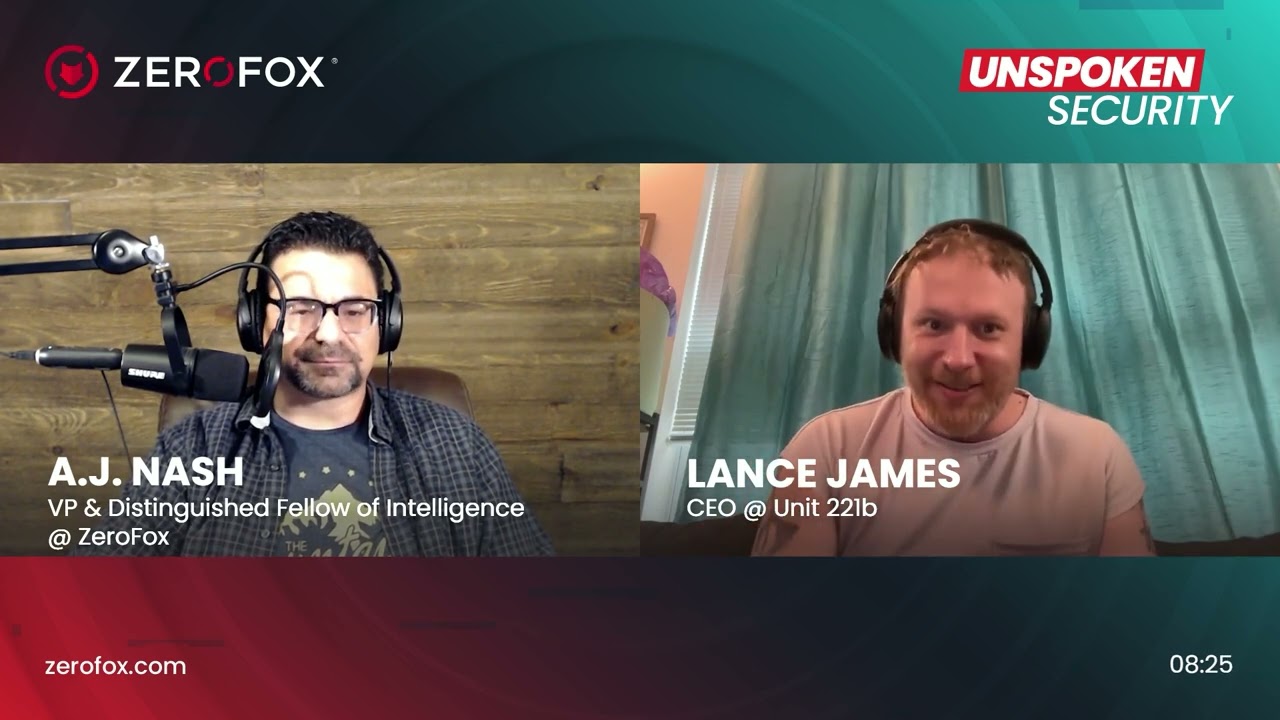
AJ Nash talks with Lance James, CEO of Unit 221B, about burnout in security work and personal tragedy. Lance took 90 days of grief leave after his son drowned; AJ lost his girlfriend suddenly. Both credit meditation, clear boundaries, and supportive employers with helping them rebuild.
Chapters
you gotta just have faith in that the floor's gonna still hold while you're walking around. And then also that the people are gonna do their thing. And I like that you said, if it isn't illegal, this and that.
Yeah, for sure.
Because in the long run, the number one thing humans want in this world, work or outside of work, is to be understood.
Welcome to Unspoken Security by Zero Fox, the raw and gritty podcast for cybersecurity professionals who want to understand how threat actors are leveraging the internet. In each episode, your host, Host AJ Nash engages with various industry experts to dissect current trends, share practical insights, and address the blunt truths surrounding security. Ultimately, the lessons learned will enable security professionals to take an intel-driven, proactive approach to physical and cybersecurity that extends past the perimeter. Let's get started.
This is how legends are made.
Hello and welcome to another episode of Unspoken Security, brought to you by ZeroFox, the only unified external cybersecurity platform. I'm your host, AJ Nash. For those who don't know me personally or are first-time listeners, I'm a traditional intelligence guy who spent nearly 20 years in the intelligence community, both within the US Air Force and then as a defense contractor. Most of that time was spent at NSA. I've been in the private sector for about 8 years now, primarily building or helping other people build effective intelligence-driven security practices. I'm passionate about intelligence, security, public speaking, mentoring, and teaching. I'm also deeply committed to servant leadership, which is why I completed my master's degree in organizational leadership at Gonzaga University. Go Zags! The goal of this podcast is to bring all of these elements together with some incredible guests and have authentic, unfiltered conversations, even debates, about a wide range of challenging topics most of us are faced with today. This will not be the typical polished podcast. You may hear or see my dog. People may swear here. We may argue or debate, and that's all okay. Think of this podcast as the conversation you might overhear at a bar after a long day at one of the larger cybersecurity conferences. These are the conversations we usually have when nobody is listening. Today, our guest is Lance James, CEO of Unit 221B, a member of several advisory boards, a lifelong troublemaker, but the good kind of trouble. Well, you know, mostly. And a dear friend of mine. Lance, to help the audience better connect with you, can you tell us about your background and some of the great work Unit 221B does to take down bad guys?
Sure.
I have a long history of back, uh, of being what we'd call today cybersecurity. I just call it information security. I think, uh, if you're old enough, you call it that. Combining counterintelligence with cybersecurity. So I always liked, you know, bridging the, like, example, the feds with the hackers and we utilize that to chase bad guys. So 221B is the same concept where we work a lot with, you know, whether it's HSI or FBI or whatever. And we actually work to, to pretty much put an actual, some handcuffs to the work we do, right? Recently, and I'm sure these MGM hackers are going to hate it when I say this, but we know who you are. And that's kind of the awesome work we do. And we tend to know most of these new hacks and who they are. If you're a teenager hacking, we know who you are. So it's kind of in an area. And other stuff that we figured out at 221B is when the Twitter got hacked, those kids ended up in jail. That was our work. Handiwork with the FBI and, you know, just a few different ones along the way. I mean, we just, we're always at something. We've also helped some video game companies and deal with online harassment. And we actually even changed the law in Washington State and in Canada for having it so that companies can actually like back you up if you are getting harassed online. So yeah, we have a lot of fun. That's pretty much what we do.
Very cool. I remember the one you were just talking about that last bit, right? The law changing. So yeah, the Bungie one.
Yeah.
Yeah. You and I were talking about that. That was pretty cool. Thanks for sharing the write-up. If people don't know Unit 221B, and a lot of you probably don't, it's kind of a boutique org. These guys are amazing.
Also by design, we don't go around too much.
So yeah, no, absolutely. It's, you guys are amazing. You and Katie and the rest of the team over there. So I mean, I'm a huge fan. Obviously we've been friends a long time. So of course I'm biased. Everybody knows that, but the work's the work. And I mean, what you guys do is pretty freaking awesome. So, you know, thanks for being on today, man. I mean, I appreciate you coming on here, uh, both as a friend and as an expert. All right. So let's, in fact, let's, you know, kind of jump into this, right? Let's get into the heart of the discussion. So today's podcast is entitled Stop the World, I Want to Get Off because security is this 24/7, 365 career, but life, it still happens, man. You know, bad guys don't get, don't take days off. So as a result, almost everyone I know struggles with that mythical work-life balance. I'm notoriously terrible at this. I don't sleep very much. I don't eat very well. You're on me all the time about hydration because I don't do that much. I never go to the gym. Hey, you'll be happy to know. I went to the gym yesterday. I didn't do anything. Don't get too excited, but, uh, showing up, it's still like, that's, that's right.
It's part of it, you know?
So that's right. I got a new gym membership and went and took the tour yesterday. And, uh, so I'm, I'm working out.
I just started Aikido like literally on Sunday and I'm going back today. So, um, oh, that's awesome. I, I told myself I'd get into a martial art. I'm trying to do what I, I mean, I'm not into it for the fighting side of it, but more the fun and just the activity, the cardio. And I finally kicked my butt and said, all right, I'm going.
That's awesome, man. Yeah.
I'll, you're the gym. I'm the Aikido. Like, yay.
Well, there we go.
Pat on the back.
We got, hey, we got to keep working out. Right. So I mean, this whole work-life balance thing, none of us controls our lives, you know, and none of us controls life events, obviously. So you got pandemics, you got personal tragedies. Sometimes we just want the world to stop spinning so we can handle our personal life, but it just never does. Right. So with also, you got the increased pressures now on everyone because of economic factors. So we're seeing a rise in, you know, use the term quiet quitting. In my opinion, at least, corporate leaders are sort of reframing what used to be considered meeting objectives, which was, okay, you do all right, you wouldn't get a massive rave, but you're okay. Now that's somehow cheating the company out of an employee's full effort. Well, listen, in a lot of cases, employees just don't have any more to give. But with all that as the foundation for today's discussion, I want to open— so there's the format, by the way, there's 3 questions every time we do this. I should be on this camera. There's 3 questions. So the first of those 3 questions is, what are your thoughts on terms like work-life balance and and quiet quitting? How do you land there?
So, and the same with diversity as well. We don't have to talk about diversity, but I feel like these are like words that are purposely designed to guide people. If you give it a label, we start working on them. And unfortunately, they exist because we need to like kind of work on them, right? So work-life balance is simply to me truly just balance. And what I mean by that is that a workplace, like I own a, I run a, you know, help run a workplace as a CEO., but I also have a personal life, right? And when I think about this work-life perspective, I feel like it's like if you just had balance, we wouldn't really have the work-life as the term. And it's, it's a tough one because the expectation you have from a job to say, well, you're supposed to support it, but I mean, they can't fix your life, right? You know what I mean? Meaning, and so where I start with it is like, as it's like, at least from the CEO perspective, I wake up. And I have to look at it as my personal responsibility to keep myself balanced because I've got 65+ people expecting a check-in every 2 weeks and a certain, uh, you know, uh, dependency upon the leadership in the company. Right. And so I wake up and when I think about work-life balance, I just think about my balance. For me, it's like, did I wake up and go to the gym? Did I, um, meditate? Did I check in with my feelings and like myself and like how I'm doing? What's the mood I'm in? Because that's going to matter during the day. You know, just different perspectives. I also do grateful exercises and things like this just because it kind of keeps you in a good mindset. I'm big on a proponent of personal mental health. I have therapy, you know, I'm, I've been doing therapy for 10 years. I'm not going to lie about it. And I'm very proud of it. You know, and I also recognize that I'm a bit, you know, I'm in a lucky position to have this room. So I want to speak to that as like with that caveat that I'm aware that this doesn't, this is not a one fit for all. But the work-life balance, I think when you combine that now with this quiet quitting concept, it's kind of like, I feel like I've watched like during COVID what's really happened, at least in my opinion from observing is, you know, we all had an existential crisis, no matter how we acted, mask, no mask, let's just remove that because it's just all noise. Any utopian existential crisis is going to make us act like that. So that's, that's in the past, no matter what we did, we were scared.
We were, everyone was absolutely, we could, we could literally die.
This could have been the plague, right? Like we, we don't have control of that. And that was a, it was like a collective trauma that we all went through and are still kind of like, it's going to probably take about 10 years to even like heal from it and stuff. And it changed our lives, right? And it, and it stopped us and went, hmm, am I living the life I want to be living? Thus quiet quitting comes around, right? I don't like the term quiet quitting 'cause I'm against passive aggression and I really do believe that like your voice is your number one asset. And so I think it could be kind of something, especially the way media might portray it, right? Is that it could be encouraged where I just think ethically, if I hate my job, I'm gonna still do 100% for that day and I'm gonna try to communicate the best I could. And then obviously if things go South and they just don't hear me. I just go find another job somewhere and I wait and put stuff, but I will do my job 100% because they're paying me. They're not changing their decision on how much they're paying me. So I believe in just at least doing that. The quiet quitting part kind of confuses me because I'm just like, who, nobody wins. You quietly go to another job. Don't speak up to in that next job. That job doesn't understand you and what your needs are. So then it just keeps repeating and that job never gets to improve either because they don't know they're doing something. That is not working with you or, and maybe a few people. Right.
But I got, so I got a piece on that one. So I, I think you're, you're right. But also like this quiet quitting, like this whole concept, everything I've read about it is essentially people aren't performing to the level some companies, some organizations, some leadership want them to. Right. It's, it's the whole, you're not an A player, you're not a superstar. You know, I need you to work extra hours. I need you to stay late. I need you to do this and that. And if you're not, then suddenly you're just not. Well, you're quitting. You're here and you're working. We're paying you, but you're not really giving us everything you've got. And they're sort of reframing this idea that, like I said, what used to be considered just meets objectives, right? You know, it used to be you had like, you were a superstar or you just met objectives or you didn't meet objectives, you know, a PIP or whatever. Right. And meets objectives was, you know, like the C player, right? B, C, whatever.
Yeah.
You're good enough. Like we gave you goals, you hit the goals, you didn't exceed them. You're not special. You're probably not getting promoted, but you're here, which I will say And frankly, you need some of those people on the team. If everybody thinks they're a superstar, everybody's fighting for advancement, it's a cutthroat world. I'm thrilled to have some people that are really good at what they do. They give you, like I said, they give you everything they got. Listen, they do their hours and they're out, whatever it is, they're 40 or whatever it comes out to be. And they're working to live, not living to work. But I think we're seeing more of a push with this quiet quitting term of saying, no, no, no, that's not good enough. Only did 40 hours here and then you went surfing for the weekend. Well, I mean, that's time that could have been spent with us. Or, you know, if you are a DJ at night, well, you obviously have more time and energy. You should be putting more of that into us. You're on salary. It's not like it's an hourly job, but it's— there's this, there's this push to like get more and more out of people, right? Which, which totally, it goes against the whole work-life balance concept, right? We want you to have balance, but not on our time. And now we think all of your time is our time because you're on salary somehow. Which I'm having a really hard time with. And so that's, that's where I'm seeing it. I don't think we're talking as much about somebody who just isn't happy and they quietly leave.
Like, gotcha. Okay, cool. All right. So the good news about that is on both sides, I guess I just don't like the term, you know what I mean?
Oh, I hate the term. Yeah. I'm with you. Yeah. It's, yeah, it's bad.
So the challenge that I, I see here, and I guess I'm not exposed to that because I'm running 221B and we don't allow you to work 40 hours unless it's actually agreed upon by the team and there was a plan for and everything like that. We, we're a little draconian about like making sure that you rest. So for instance, if you did end up working like Friday, we had something that came up and we needed to get a report and most of us were up till 2. This week, these people should be taking a day off, right? And that's kind of where it's at, right?
Well, that's because that's your commitment to balance. You believe in it internally. Obviously you just spoke about it, right?
And you believe it's for everybody. My coaching is obviously the, like, I want to do something different. And so it's obviously not the normal, the norm right now, right? I hope like someday it will be modeled as a norm because I will tell you, I get, I get so much more out of people, not driving them to their deaths, but actually like, you know, uh, it's, I'm result oriented. So I don't really care about how many hours you spend. I care about the result. Sometimes it means that we might have to do a Friday till 2 in the morning because something happens, right? And we all agreed on that, right? And that, that's it. But then, you know, we always try to look at like, okay, this person's about to burn out if they keep going that route. So let's like give them cover fire and. Get them to rest and death, especially like IR, as you know, IR can, such a grind, incident response can be tough, right? And it can be like that. That's why people pay a lot more for it because you're asking people to sacrifice their brains on a weekend, right? It's firefighting.
Yeah, it's firefighting.
And sometimes that happens, right? Um, and so like, yeah, like the challenge I have is I don't think there's a salary in the world that could justify someone to keep going. I want more and more and more and more and more from you. I mean, what did they talk about? Like the idea of like even less than 40-hour weeks was a discussion during COVID as well. Like, you know, and again, I haven't tried those out. I have had the half-day Fridays in a lot of the previous job and they seem to be pretty awesome. And then I even read a study that if you're over 40, it's actually better for anybody above 40 to work 3 days because it's more of a, we just like, as you get older, your, your style, you have, you have to work more smart. You don't have to work as like hard, right? It's like, it's different. And our world doesn't require sprinters. Our world requires brain. Yeah. Right.
So, so this isn't like, we're not in a factory, no offense to anybody there, but we're not cranking things out. This isn't always a numbers game. I mean, I think you, you nailed it. It's, it's output is what matters. Right. And, and a lot of what we do in this industry is, you know, deep thought is analysis is problem solving is where you need a sharp brain and not a marathon pace.
Not exactly like a. Ironically, in engineering, call them sprints, but it's still a marathon pace. Like, the engineers know when to stop that day, whether it's engineers or IR, you know, and again, but like, the idea is that you should build in this balance that respects it, because I'm going to tell you, if there comes a day where you've got a company like that, that's like pushing and pushing and pushing, even if they pay more, someone will go to a place like our place that, you know, we pay pretty well, but like, just say it was like big company to small company and go, oh, we can give you this. They're going to take that over any, the fact that they feel they belong and are heard and understood and get their weekends and everything like that. So when I, for instance, do a contract for me as an executive, and this is like, I coach a lot of executives, like behind the scenes during COVID especially, just as a free part of my time. But like, I would say, hey, you know what, you know, when you go in your new job, you can put in your contract what your boundaries are, right? You actually can do that. I do that at every job I have, by the way. Saturday and Sunday are religious. I'm Jewish on Saturday and I'm Christian Sunday. You know what? Last company didn't bother me at all. I'm neither of these. But the point being is, is that like, like the minute I put that out there, it's none of their business, but I, I added religion and guess what? 5 years, last job, never got a call on the weekend.
Yep.
Right.
And we still see it. And that's a good point about being able to set boundaries. And again, you and I both agree there's privilege to some of the discussion. We know that, right? This isn't for everybody.
I want to be very clear that obviously this is tech. This is this, but if you're in tech, these advice, this advice will likely fly in most cases. Yeah. Unless you're kind of starting out, but you still, boundaries still count.
So totally. But the key thing here is, I mean, to me at least, you mentioned like you're a leader, you, you founded a company, you have people that, you know, look to you to leadership.
Yeah.
And I think it's about having a leader who sets this, the example and the stage and the expectation. This isn't, these aren't catchphrases to you. This, you, you live this, you believe this. You know, hey, you know, I'm, I'm like you in that, you know, yeah, I've, I've led Intel teams and sometimes like, man, I need you to come in. I need you to work Saturday and you're gonna work all night. You might even work all day Sunday. It might be all, but I've literally told people, do not come in on my, like, I will have your computer deactivated for a couple days if I have to. Like, I've done that to folks. You can ask, there's people on my team that'll, my, my old team that'll chuckle now. Cause I've said, if you, if I keep seeing you on Slack, I'm gonna tell IT to shut you off for a couple days. You need the time off.
Yep.
And I think it's, it's, that whole thing is quality over quantity and output, right? If people burn themselves out, especially in these high-intense thinking jobs, they're going to make more mistakes. They're going to do lousier work. They're going to call in more things. It's going to get lazier and slower and softer and weaker because they're just worn out. Whereas if you give them just a couple days off, what they come back and do could be amazing and done quickly. I'm admittedly, I'm somebody who is a bit of a procrastinator and I'm a burst worker. And if you give me a project with a 2-week deadline, I'm not the guy you want to ask for updates 4 days in. The chances are I haven't even looked at the project yet because I've still got 10 days and I got 7 other projects I'm working on. But it'll all get there, right? And I find the time for balance. And for me, that was one of the things with COVID and it's been interesting to see. And I think that's now we're seeing the push to put me back in the offices, and some people have dealt with this differently, right? Listen, I find time every day. I work, I don't know how many hours a week I work. I'm not going to lie. And somebody can go check my computer now and find out, I'm sure. And I hope they don't.. But you know, if, if you go through and look at all the patterns, you might find, oh geez, on Tuesday this guy for 4 hours just disappeared. Yeah, I did. You know, I, you know what, I didn't have anything urgent that day. I probably needed a mental break, so I took the dog for a walk or I took, I took a mental break all day yesterday.
I literally did.
That's right.
Because we had a situation that I won't go into that, like I said, that Friday document, all this stuff to yesterday was my day off. It was like I didn't really get a full weekend. I want my 2 days and yep. So we moved a couple people, literally took off including me and we rotate and that's what happened. So, And that was it. I was like, I am gonna be lazy today.
I don't care. That's right.
I'm literally gonna act like it's Saturday or Sunday.
So, yeah, and it'll work. But of course it takes, I mean, first of all, it takes leadership that believes in this and it takes trust, you know, trust in, in your ability, first of all, to hire people. I think the biggest challenge I see is folks, you know, there isn't enough trust necessarily in the workforces. And a lot of times, listen, some people have earned distrust. There's, that happens. But I think a lot of times it's that people don't trust their own hiring processes. Like I've always said to somebody, if you're micromanaging people, it's, it's a reflection on you in so many ways. You know, one of them is, why did you hire them if you don't trust them? Oh, you know, we hired them and, you know, whatever. Well, it's on you then. Like, do your research.
One of our core values, trust begets trust, is how we try to start. Exactly. Because like, look, I— it's, it's like no different than if I'm in a relationship, right? Obviously I have a wife or whatever, but the reality is, is that I can't walk into that relationship and expect to be successful if I don't trust her at the start. If I— you know the number one reason people cheat on each other? Is because they actually think they're cheating on the other. That insecurity literally—
they think it's already happening to them.
Yes. And so then they go screw it, right?
You know, and they go make a bad choice. They find out they did it first.
To an analogy back in the work environment, it's the same thing. If you think, you know, there was a call I got, it's probably a year and a half ago, but like someone's like, oh, they've got the keys to our admin, we need to figure out this and that. And oh my gosh, and like they just hit me up. I said, why don't you just give them a severance package, 3 months, and get the keys from them and they'll go away. They will go away and be happy because they have 3 months to get a job and they will happily. I said, you guys are like overthinking, ready to go on the attack. I said, trust begets trust. You know, this is why people act that way because you're assuming they will, you know, like obviously not perfect. Sure. I've said we've had some crazy once in a while, but like, you know, we, you know, but outside of that, the majority, you got to remember that it's like that 80/20 thing. You're 80%. If you start trusting everybody 80% of that time, you're going to like, uh, Have a good time.
Yep. I totally agree. And I've had those conversations. It's funny you mentioned that. I've had conversations, I've seen companies who are on the path of possible legal, et cetera. And I'm like, why don't you just give them a better severance package? Find out what the root cause is. And again, it doesn't work for everybody in every situation, but a lot of times the root cause is your issue with that. And it's much easier than all the stress and the frustration and the cost of the other path that you're heading down. I'm not a CEO, so there's a lot of factors in those discussions that I'm not involved in. There's a lot of things I don't understand, I'm sure. But I'm, you know, I've been around forever now. I'm old and I've seen enough to think so. Yeah. Taking good care of people, like, you know, I think mostly it works. I've been chastised before. I've been known to being, for being too trusting. You know, I, I've had, I've had issues where people are like, well, you got bit because you did this thing. And I, I still generally act the same way. When I came into my last new team, you know, I said right away, I'm, I'm gonna trust all of you with my life, essentially. Like, you own my career, not the other way around. I don't have time. To try to figure out if I should or shouldn't trust people. I, you're all experts, you have great resumes, you were hired for good reason. You have all my trust and faith. Let's go do good things and we'll figure it out from there. I've always told my team, whatever team I have, you know, the 3 things are, you know, if it isn't illegal, it isn't immoral, unethical, it isn't against a written company policy, and written is a really important word in that sentence, go do it. Don't ask my permission, go do it. I trust you and I own all the risk and the responsibility for it. If it's, if it's Outside those boundaries, you're on your own. I'm not going to jail for you, but everything else is on me and just go do things. And I've also found, like you said, trust begets trust. Oftentimes, obviously, when a new leader comes in, people are nervous. Who's this person? What are they going to be like, et cetera? And I have those conversations and I've had to actually reiterate them a couple of times because people don't believe you at first, or because I'm notorious, I talk a lot. I tell people I know that. I said, so statistically, I'm going to say more stupid things. If I do, I guess just how it works. If I'm in a meeting and if I said, if I hurt your feelings or I offended you in any way, please let me know. That's right.
And don't wait, call me out in front of the group.
You have my permission. There are no repercussions.
People don't usually believe that, but then they get all shocked when it actually happens. And holy crap, I remember this in my last job and the guy was like, hey, you remember when you said that? I said, yep. And I'm holding to it. And like the dude was relieved on the one-on-one because he's like, holy crap. Like, I'm like, yeah, like I I know it's hard to believe because everybody wants to say that, but I, I, I literally wake up going, if I'm doing a performance for you, I'm like, skip what I'm good at. I'm aware of it. Tell me what I need to work on. I am always looking forward to the areas that I can improve. And so when you have that kind of perspective, and which a lot of people in cybersecurity, I think do, like minus the ego, right? The trick is you gotta get that ego, like to be an advisor, but not necessarily in your way. Right. And, and that takes growth and time and blah, blah, blah. Blah, blah, blah.
We all have it.
We all went through it. But essentially it's really just always being a beginner, always trying to learn, try to like, as a leader, I'm not going to solve this problem. I'm not going to solve every, like, it's like you people don't understand why leadership actually probably pays very well, but it's the mental mindfulness and exercise in the head you have to do. You got to control your emotions, but yet also lend them when they're necessary. Or like you have to see it in the right thing. It's, it's like, it's the challenge, right? But honestly, if you, like, we go back to you working on your own personal responsibility, your own things, your balance. When you do that, what'll happen is you'll actually, if you are balanced, then you're in the moment. So you will make the right decisions in most cases. And when you don't, you quickly say, well, that was a bad call. Let me, you know, blah, and, or apologize or whatever it takes. But you'll be able to like kind of pretty much flow more than you would not because you got to just have faith in. That the floor is going to still hold while you're walking around. And then also that the people are going to do their thing. And I like that you said, if it isn't illegal, this and that, because in the long run, the number one thing humans want in this world, work or outside of work, is to be understood. And the more we actually do that and try to understand every single person as we can, the best we can in the moment, if we're listening to them, if they feel listened, all this stuff, the power you get out of like them enjoying their work, getting in the flow, not having the imposter syndrome for at least a little bit. Not everybody, obviously everybody's got their different stages, but you definitely up the, up the statistical percentage that they're going to find themselves and figure out that flow for themselves.
Right.
Yeah.
I agree.
I mean, that runway, you know, so yeah, I mean, it takes guts.
You gotta be, you gotta have a, you gotta be a bit of a risk taker in this form of leadership. Right. So, and I have been burned. I've trusted the wrong people. And it happens sometimes, but I've also said I'm still gonna keep doing this because overall, like the net's positive.
It's the net. It's always positive.
I, yeah, the teams I've worked with, like I get outta their way. They do amazing things. Yeah. The first time ever, you know, I tell people to call me out. I know something had happened and somebody told me about it afterwards. I was like, oh my God, I, I, I had no idea I had that impact. But they didn't call me out in front of the group, so I sent an email. Now I did not call them out. I was gonna turn it around, but I said it come to my attention, you know, that I said something, you know, thoughtlessly.. And so I gave a full mea culpa and somebody fought back. Like, I can't believe you did that. So I told you I would, like, if you don't call me out in front of the group, I'll call me out in front of the group because it's not right that I should offend somebody in front of a group and then privately you get an apology and I didn't know and I want to fix it. So I wanted to get on that. That's about personal integrity, responsibility. So everybody's held accountable. That includes me and let's move on. And once you've done a couple of those, people are like, oh, I get it. And then of course then somebody calls me an asshole in a meeting and I'm like, aha, you get it. That's what I said. I was being an asshole. Thank you. Exactly. Thank you. You were right. I didn't realize what I said. Absolutely. You deserve an apology for that. That is not what I meant to say. And yes, I was being an asshole. Let's move on from that. All right, cool. I can call the boss an asshole. I'm like, well, don't do it all the time, please. But, you know, if I've earned it, I've earned it.
Yeah. Yeah. You know, Alison, of course.
Yeah, man.
Next, you want to tell later, but like Alison's one of the like things is that we have such a, sometimes I'll be a hardhead, right? For a half a second or like sometimes it might even take up to 30 minutes and Alison's trying to tell me because I might have a previous experience. It's blocking me from listening. And she's like, the one thing I always appreciate you, Lance, is you try to like, at the end of it, you do listen. And there was a thing we were getting to in a debate and I at first was pushed off and it's because my previous job, I was kind of defensive of the engineering team. It was an automatic mode. And then when I thought about it, I was like, oh, you know what? You're actually right. And then I went to the engineering team and said, by the way, in that other meeting, Alison, I know I kind of shut you down. Like I was coming from a perspective of being defensive for the engineering team, but you actually have a really good point here. And I just called it out in our engineering, like Slack or whatever.. And I get like a comment, like from one of our engineers, like, I've never seen a boss that does like, actually owns that right there. And I said, well, that's how we learn accountability across the thing. If I'm doing that, hopefully you guys will do the same and you won't be so afraid of like all the conflicts and the lack of trans— you know, you'll, you'll, you'll go with it.
Right.
And you put the example, you got to be the example.
And that's 100%. And that all goes back to where we're going.
If I don't like it, if I want to swallow it internally, it doesn't matter because my leader hat's on and that's more important. For the people I serve every single day than it is my ego or how I might feel about it.
You know?
Yeah. And I mean, and it closes out that whole first topic we were just having, which is, you know, you want people not to quiet quit. You want people to be committed and involved. Well, if they think you care about them, you care about them, you know, work life, true work life balance, you care about them being healthy and safe. You care about their opinions. You, you are, hold yourself as accountable as you would hold them more than they feel like they're in that environment. They know that they know that's right. Then, then. They'll give you what they have. Now, it doesn't mean somebody has to give you 80 hours a week. That's totally—
No, actually, I think they can do so much with 40.
100%. 100%. Let's dig into the tough stuff, right? This is, I mean, this is kind of the big one. So, as you know, and probably everybody listening does at this point, I've been working my way through grief. I had a girlfriend suddenly die earlier this year. I mean, it was unexpected, right? I left town to go speak. She was fine. By the time I came back, she was very much not fine. And within 24 hours, she was gone. And so I wasn't prepared for any of that, frankly. I mean, who is? And I had to immediately manage a whole lot of things that are massively impactful. And that, like I said, I wasn't prepared for. You know, all the arrangements have to be made, right? There wasn't a will involved. There's family to work through. There's, in this case, geography was part of the issue. So lots of things, right? And so like a lot of us, you know, who are problem solvers, whether you're intel, whether you're IR, whatever, you know, you put on the operational hat. Okay, I'm going to start handling these things, logistics, and you start checking boxes. This has to happen and this has to happen and this has to, and you start knocking out a whole bunch of things, right? And I hadn't really connected with the loss, to be honest. I thought I had. Oh, okay.
But you and I behind the scenes talked about that a little bit.
100%, right? So Emily dies on a Saturday, right? I'm out of town. I come back Thursday and Friday she ends up in the hospital and Saturday she's gone. I actually thought I was going to go to work on Monday. Like I did all logistics, everything over the weekend and like I showed up Monday morning on my computer. And by the way, I hadn't told anybody at work what happened even. Monday morning I get on my first meeting, lasts like 5 minutes, and it just all hit. And I was like, yeah, that's not going to happen. So we're not, we're not doing this meeting. So, and then, you know, that starts a path right now. Before I go too far down my own path to make sure this is a conversation instead of me just chatting alone about my life, I know you've had to manage tragedy too. And, you know, obviously we've talked about this offline, you know, it was, you know, your situation and, you know, I appreciate your guidance and your help as well for mine. So let's clue the audience in on where we both are and we can talk through this. Okay. So, you know, if you're okay with it, you know, can you talk a little bit about what happened, you know, how you worked through it, you know, while still having a career in security?
Sure. So in 2018, my son passed away in a drowning accident. Mine's a very complicated situation because I also had, wasn't allowed to see my children for, at that time, 8 years. And then it was like 10 total due to a very tumultuous divorce. I'm not here to to this side of it, but it was just two sides of it and California law. And if anybody's familiar with that, it's a pain in the butt. So in that, it was a big shocker to me because my biggest fear was also them. I knew they were not having proper structured parenting, this and that, and I was fighting in the courts and all this stuff. But, you know, because of the complicated matter and unfortunately judges don't know you, right? It just kind of gets passed through, passed through, passed through, passed through. Right. Yep. Yep. And so, you know, July 4th, I get a call from a friend of mine that he's passed away and they did the best they could in 10 hours in the emergency room and blah, blah, blah. Medevac from, from Arizona to Vegas. All this gives us all a bullhead. So it was on the corner cusp and it broke me. I'm going to just be straight out honest. It really just broke me in that moment. I could, I, there was, there's some noises that I've never made in my life and they came out of me that moment. Yep. Right. And there's a reason I also didn't say sorry about Emily because we've already, one, talked about it. Two, have you ever noticed that saying everybody's saying sorry gets kind of weird?
Yeah, it's, it's, it is a weird thing, you know, and I've, and I've had, you know, my, I've had some of this, you know, my mother died when I was 12 and, you know, we can go through all sorts of stories. So I, and I remember that and like, I know people mean well, right?
And, you know, I always say, of course, thank you.
There are no words, right? Sorry is just the only, the only one we have available. But no, you and I have talked, listen, everybody at this point, like And yeah, the sorry is I'm good at that and we can go through my journey, but no, you and I clearly talked. I mean, I just, I didn't say, you know, sorry about your, your son.
Yeah, exactly. So we get it, right?
Yeah.
Yeah.
We've been there.
It's understood that, that get it part. I'm going to get to in a, yeah, get it. You're going to get to it later, but I want to actually point that out at some point. But what I did to get through this was I took an immediate 90-day break. I tried to do 60, come back, even try for a day. And I'm like, oh, nope, I'm not there. So I did 90 and I was very this is again, very, you know, lucky because the company I was working at was very non— they weren't toxic. They were very considerate. They like understood. They were like, take all the time you need. They even covered me at my, because I had child support and pretty hefty child support. They covered my flights over to the funeral. They like really were supportive. Right.
That's awesome.
And so I got really, you know, lucky there. And I know that not everybody's situation will have that. Right. But it, like I couldn't move for a good 30 days. So I started getting, and I believe everybody needs kind of a box after a tragedy. Tragedies will kick your butt, right? You know, it just shifts you so much. And some people's like religion, Christianity, Judaism, whatever it is, Islam, blah, blah, blah. Mine was Buddhism, right? And the reason why mine was Buddhism is because it's a book that says be good, but it actually has instructions.
We could use some of those and they're useful ones as I understand, like you can actually do things with them.
Yeah. Yeah. And so Zen, Zen Buddhism, was like, I couldn't move. And I'm like, well, I've got this book sitting on my shelf called Zen Mind, Beginner's Mind. I'm like, I better sit and put it to work because I can't do anything like but sit. And since I'm sitting, I better like, why not learn meditation? And in my world at that time, it was also a way I could talk to my son because we had some, I only saw him last time at 8 and he kind of hated me based on the narrative. So this was kind of like a closure, like complicated closure piece, you know, And so I had to just kind of like, I, I did lean hella into it. And so like, if I had 90 days, I decided to lean in the pain because my entire life, I'm going to be totally honest as an extrovert, I've always avoided my pain. So I always was like out there in the world and this and that. And this is the first time I've forced me to be super silent, super quiet. And I'm like, oh shoot, this is a first for Lance. So I'm like, I better like welcome this weird silver lining while I'm dealing with it, right? And I shared, of course, some of my, my journeys along the way too, because I've learned something about suffering later on is that I'm like, oh, this can actually be used to relate and help someone shortcut something in their life if it happens to them. And I figured if you share it, it's also was kind of like, you know, cathartic for me, but like I wrote music, I shared my experiences when I could. And I really like, you know, because I was thinking a lot. You know, but I was finally getting to know who the heck I was. I've spent most of my life with my own long distance, like, you know, if you're kept from your kids, imagine how much pain that might be.
Awful.
You know what I mean? So then this happens. This is that catalyst of like everything just broke. I was even angrier at mom and blah, blah, blah, like their mom and everything, of course, you know, all this stuff. And so then 90 days comes, right? And I got into a state of like 3 days meditation, like very much into my, like, I just went to town. About like having my own space. And like, weird thing is, once you start like experiencing your own space, you're gonna fight tooth and nail to keep that. A lot of times what happens is we don't recognize until a tragedy hits us about our own space because the world pulls on us. Yeah. And then you kind of like, we're like, oh, I got that, so I'm gonna protect my peace, right? As they say on memes and crap. So, so I head to work and they actually were dealing with a— this is the previous job, uh, was dealing with a reduction in force. And I, when I got back, I joked and I said, what do you guys do at the company? I just leave for 90 days. Come on. All right.
Yeah, sure.
But I was at a very different energy. Like my energy was lower. I was quiet. Like I, I could listen. It was kind of interesting. It's cuz I didn't really wanna talk. It took a lot of energy for me to talk.
Mm-hmm.
Literally, it took a lot of energy for me to take a, a one step, two step, three step. It was, I wore light clothes when I got back. Mm-hmm. I literally got like Buddha's outfits and like whatever was like, I haven't stopped wearing Chinese kung fu shoes from, since he died, because literally I love like the light clothes, like I really do. So because when you're grieving, it's like your body's filled with rocks and it's very, very heavy, right? And so when I came back, they were like, we want you to take over the VP of engineering from, I was already the chief scientist just for a record, but I'm also kind of like, you know, and I said, why? And they said, honestly, the way you've actually handled your grieving is with grace. And also when you were gone, and this goes back to our first subject, when you were gone, your two teams that you ran were the most successful in this company, even when you weren't here.
Nice. And that's a good reflection on leadership right there.
That is, that is exactly the ultimate. And I used to have a problem with that, like insecurity-wise, but that, when this happened, you just got to go with it. And I said, hey, team leads, take the conch. I'll be back in 90, right? So I, but here's the thing. I also used grieving to my advantage. Was the first time I learned about like you could really say no to things, right? It's like where you can learn the power of no and the boundaries, right? Where I actually had an opportunity to reset everything just like I did internally and my meditation and whatever I did all there. I also had now a way to assert myself. You're not going to tell a dude that's like already half energy and like this and that, we want you to do all these crazy things. What I said is, well, you're going to do it my way if I say yes to this because the, the last 3 years of the reason why you got here and no offense to the company, but was just the repeated patterns that we got stuck in. So I said, I have a new way of doing this. I have a different set of energy and there's going to be some things that change. So I had them move all important meetings to Mondays, no Tuesday meetings, period.
Good.
That ended up becoming company-wide after a while. Cause it's like I had a 40-person engineering team. I said, I need a coach. I don't know anything about like dealing with teams bigger than like XYX, right? I deputized obviously my directors and like really relied on them, things like that. But I, I, I made them have a med— like they had a break room, but I made them put a meditation mat in there and respect that I was going to meditate 3, 3 times a day. And I basically started doing this thing called a Focus 4 because I looked at the Jira and I'm like, 32 projects, 40 developers. That's why you guys are not getting what you want out. So I pretty much kicked product out of standups. I'm like, there's no problem. There's no, there's no problem you're solving in a standup. It's literally for the engineers.
Right.
And I got in a big, you know, because I came up with this Focus 4 without asking.
You didn't even want them to be there to listen to the engineers, even if they weren't allowed to speak, just to hear what was there?
They already were always so busy in every meeting that they never got anything done as a product team. I went and read a book on what is the role of product and what's the role of engineering. Because I, I've never been a VP of engineering before.
Sure.
So I had no idea. So I started reading books on organized psychology, all the stuff, because it was like, the reality is I was going to have a team that some people I'm not going to be able to remember their names. I always like small teams because it could be more personal and this and that. But then I started reading these books and I realized, well, actually one-on-ones will also reflect the entire pattern of the group. You'll see these patterns across each one-on-one that you'll hear about too. They'll all have the same pattern, right? So I started just kind of like thinking slowly like this and that, like just kind of like, you know, spending a couple months just listening and like really hearing. I had an STFU in my notebook because I'm also a talker, but because I was also in a different state, I had to shut the fuck up, Lance. Shut the fuck up, Lance, in my notebook. And I wouldn't take my cell phone or my laptops in there. And we wouldn't allow cell phones or laptops unless you were literally on an emergency. If that was the case, I was keeping you out of the meeting anyways. And so essentially I just reset all these rules. I made them go back to their vision and mission, stop having client codependency, step back. And I knew it was, I could do this because I was in a grieving thing and they needed me. And also they're not going to say no because they know I have to operate a certain way if they want me to succeed.
Right. Change the culture, basically. Yeah. So I think it's interesting. So your journey, you were able to take 90 days, which again, good on you, good on the company, obviously being that position, right? I mean, company, you know, working for people that, you know, and with people that are supportive is massive, right? And when you came back, you actually leveraged, you know, some of the perceptions, you know, you're still a father in grief, of course, but also some of the time you'd spent to get recentered and to get more connected and to I got time to study. Exactly. And leverage that into a change. So conversely, and sort of the discussion here about, I think both of us would probably agree there's no right or wrong answer necessarily, but people do things differently, right? And so I'm obviously earlier in my journey. I mean, this is years from now, and so you have a bigger perspective, right? And I'm pretty early, everything for me, I'm just in March and it's September now. So, but at the same time, while going back Monday was clearly foolish and wasn't going to happen, I was only gone a couple of weeks. To be clear, like you, one thing we have in common, my company was great. I couldn't be more thankful. You know, it had nothing to do with bereavement policy, which, you know, most companies have like 3 days.
I think you need to stay busy. I know how you are, man.
And, but 3 days is not enough for anybody, of course.
No.
So, but the company was fantastic. I was overwhelmed with support. In my case, so I, I mentioned, you know, I, I, I went to that meeting Monday morning. I was like, oh, this is, then it all hit me. And I had not, so I, I, I got out the meeting, I didn't even tell anybody in the company. My first thought, which is odd, but I got on LinkedIn actually and wrote, and I know you saw this. I'm sure others did too.
That's why there was a shout out.
I was like, I didn't even know.
Exactly.
Yeah. So it wasn't planned. It wasn't contrived or anything, but it just, I was feeling something. I not only wanted to share what was going on with me, but I wanted to share what I thought was immediately a learning experience for others. You know, I had, again, I'd been out of town when all this started and, you know, consistently for my entire, our entire relationship, my entire career, which had a lot of travel in it. You know, Em insisted on, on us talking every night and she wanted to check on, you know, me and make sure I was okay really. And I was like, I'm always okay. Don't worry about it. And it didn't really occur to me. Are you okay? Like you just assume home is home. Like everybody's gonna be fine. Right. And so I took a moment. I started kind of writing some of that out. And I had, you know, I mentioned obviously what had happened, et cetera. The next thing I, you know, somebody from work pings me and it's like, you know, all the services start and everything. Cause I hadn't even bothered to tell work yet that this had happened.. So of course then I said, yes, I'm, I slacked my boss. So after the LinkedIn note, the next thing was slacking my boss. I said, listen, I'm not, I'm not working today and I don't know when I'm working. This has just happened. And I actually, I shared the LinkedIn post internal, like with him. I was like, I can't write it twice. Here's what happened. And so I was just sharing that with everybody. Here's the message, here's what's going on. And I was very lucky, you know, the company was great. Obviously the outpouring of support from people who, you know, in the network, et cetera, you know, was fantastic and, and really overwhelming. People were just unbelievable in their love and support. And then, so for me it was like, all right, now what am I gonna do? Cause I don't know how long I'm gonna be away or what I'm gonna do. And yeah, I wasn't gone very long. I was scheduled to do some speaking events and you know, the company's like, listen, we can pull you out of these. And I said, please don't. Like, I need to go do these things again. COVID, we're already segregated. I work at home and you know, nowhere near anybody else. I was like, being alone, I can only do so much of that. I had a few days, I cried an absolute ton, but you can only cry with the dog next to you for so long. And you're like, all right, I gotta get out. I gotta, I gotta get out.
Everybody processes it differently. And that's the thing that my version of it is, it shouldn't be your version. Of it, you know?
Exactly. Yeah, exactly. And, and so I remember my next thing was to go to Toronto. So, you know, this happened, I was actually in Denver for, for speaking for FS-ISAC in Denver when all this unfolded. My next event was in Toronto also for FS-ISAC. So it was a lot of the same people who now knew what had happened in between, right? And, but I, you know, I said, listen, this is where, this is where my home is. This is where my comfort level is. This is my support system. And, you know, frankly, Em was a big supporter of me doing these things. And, you know, it also still a way to honor her as I was going forward. And so, so yeah, I was only gone, I don't know if it was 3 weeks total, I doubt it was probably a couple weeks. And, and I have been busy, but for anybody listening and wondering, including you, I'm not disconnected from what's going on. I'm still processing it and managing it. And you know, like you said, 5 years for me and I'm still processing.
I'm just starting to get outside and do stuff. That's why I was like telling you I just started Aikido.
Yep.
I'm trying to get out. Like it's, it can take a long time and it It's like waves, you know.
Totally, totally. And part of the reason I got this gym membership— I mean, obviously I could stand to be in better shape, but the truth is part of the reason I got it is because they do yoga and meditation. I'm looking for outlets as well, you know. But I'm also finding myself already with some learnings out of this, you know, again, connecting with yourself like you said, what really matters, what's really important. When something shocking like that happens, you're able to go, all right, all this is fleeting. You know, we all know that and we talk about it, but it hits you again. You're like, yeah, all this really is leading, what really matters, and starting to lean in on the things that do matter, right? Like you did, you know, coming back and saying, listen, it's gonna be on my terms. Now, of course, the flip side is because of the way I like to work, and I'm always known for it, I'm actually still doing the opposite. I say yes to everything. I haven't gotten quite to the power of no piece. I got to work on that. I say yes to everything and let future AJ figure it out. And that poor son of a bitch has a tough life usually, and he hates past AJ.
It's all about how people cope, right? Like, it's like, you know, and Carl Jung said it. AJ Nash, uh, best that when a big tragedy happens, so ego death tends to occur. It doesn't mean your ego is gone. It ripped my entire world apart. And, and I'm gonna be totally honest, people won't recognize this because obviously, you know me at conferences, it's a little different, right? But I became a better husband over it. I became a better father over it. I became better to myself. It took a couple years to really kind of lay out that groundwork. And fellowship is also a big key. You know what I mean?
So yeah, that's another one.
Yeah.
So no, and I agree. And you know, and that was one of the things I was really thankful for. Again, so many people were so kind and reached out. And you know, one thing I learned out of all that, you know, and it's funny you mentioned we started the opening, like people say I'm sorry, etc. And I've thanked folks en masse and individually when I can, but I've said—
scale that, come on.
Oh, it's hard. But I've said to people, listen, if you don't think what you say matters, I learned how much, you know, how much it does. I do the same thing everybody does. Something happens, you're like, I'm really sorry, if there's anything I can do to help, And, you know, I'm really sorry, you know, to hear about this. I'm thinking about you, whatever it might be. Those actually do have cumulative effect. Listen, some of them you realize like, you know, is there anything I can do to help? I'm like, come on. We've met one time. You live in, you know, Kansas. You're probably not going to be able to do much for me, but I appreciate it.
Well, the good thing about our cybersecurity is always cybersecurity community. We are an intelligence, but like we're all very like open and helpful.
If anything, we don't always know our own limits with that, but you know, totally, totally. So, but it, you know, I realized there's a cumulative effect to that. I never really felt alone. Even though I, I mean, aside from the dog, I really was for a big stretch there, but I wasn't every day between Slack and email, which I still check between my phone and, you know, Signal and LinkedIn. And, and I mean, there were messages everywhere.
I, there wasn't a day that many people didn't remind me, you know, for me, it got a little overwhelming for a second because it was all coming in like this and I had people calling me and wanted to talk like, like I didn't take phone calls. I have a few people to thank that literally called because they've also had it happen to them and they were calling saying, welcome to the, the, the losing a child club and blah, blah, blah. And they kind of like walked me through stuff because when you went, someone actually has gone through it, you can relate a little bit and you kind of go, don't feel so like, what do I do? Cause there's no map for this crap, right? You know what I mean?
So yeah, 100%. No, I think, you know, that was, that was huge. So listen, we got to move on to the third question here. You know, give me your 3 biggest takeaways from managing tragedy and grief, you know, and how they affect you personally. And professionally, like what were the 3 things that you either learned from or you grew the most from or you're the most thankful for through that process?
Okay. Okay. So like one, I can listen to my wife now in a way that I've always wanted to. What I mean by that is that I'm a talker. I have like my ego used to be in the way and defend and debate and all that stuff. Like, you know, you're, you're a younger version of yourself. You don't always know that you're there. But when you get woken up and you get that ego death and it kicks your ass and all this stuff, and I'm not saying my ego's gone, but what I'm saying is it really definitely dampened down the, uh, the insecurities, right? My brain, like, it's kind of a thing where it's like, you can't even hurt me anymore. I have had the worst thing happen to me.
Yep.
I got it. So why am I stuck on like, like extra thoughts? I'm not, right? And I believe meditation obviously trained my brain to like, I used to have 50,000 thoughts at all the, at the same time. And now it's kind of like, it's nice and sequential, right? So it's calmed me down. Like, I can choose to have my energy. I can now be accountable. I can be reliable. Before, my earlier versions of me, I could not. I could write off my laurels and all my talents. That's its own thing, but it doesn't— it didn't teach me anything, right? And now, like, when I do it, like, because of this, like, whatever I went through kind of thing, I finally became the man that I like, where it's like my idealistic version of me. Became my realistic version of me. And I've been waiting for that for a long time. I've had the wisdom to understand that I want to be that way, but I could never get it right. You know what I'm talking about? Where you're just growing, right? And it also hit around my 40s. So there might be a great— I personally do think men really become men when they're like hit their 40s, you know what I mean? It all kind of compounded in one place. And one of the things I learned is, is that I, you know, I practice and learned how to listen now. And I am literally at the place I'm being Second thing, I let go. So a thing, and I, this only works for me. I'm not sure if it works for everybody, but I think there's like a secret to life. Everybody has a jihad. What I mean by that is the real term in Arabic means struggle. We're on a narrative. There's something we're holding on to. There's a trauma. There's this, there's that. Mine was the kids, the 10 years, this and that. And I was building up anger because of this. I didn't understand it. So of course I'm angry. During COVID when this existential crisis started hitting, and then I noticed that I could actually hear my wife like completely Completely. I mean, COVID actually was great for us. And what I mean that it's not like I don't purposely not listen to my wife, but I, I was calm and I can actually hear, you know, listen to me.
I get this.
Absolutely. And it's, it's, it was new to me. I'm like, oh my God, that's awesome. Right. You know, I just had that moment where like, what the, what the hell? Right.
Well, the thing about the pandemic, just to interject quickly, is we saw lots of stories of relationships that completely fell apart, et cetera. But what I'd said to folks is to me, the pandemic would amplify whatever you had, right? To be honest, ironically, it was the— some of the best years of the relationship I had with M as well.
It—
but if you were unhealthy, it was, it was just gonna amplify it. It was all probably gonna blow up. And if you were healthier, like, we leaned more into the healthier parts of who we were. We spent more time together, and, and we had to, obviously, and we worked through a lot. But it's funny, I felt like you did. I started to become a better person, and in her passing and in my process, and I'm not there yet, of course, but as I'm going, I resonate. Like what you said totally resonates with me about becoming the person you want to be. I already feel and I see it. I see it in my actions and my words. I'm a better version of me now, which the irony of that is that's great. And I also feel some guilt. I actually was just having a conversation the other day. I said, you know, I owed Em more than I realized. And I didn't, you know, there were things I was, now I'm like, oh, I was wrong about some stuff that I never got the chance to tell her I was wrong because I didn't realize it. But now it's somewhere in here I got a little more clarity and a little more focus.
The best way to show her love is to keep taking care of you.
Well, and that's, and that's exactly, and that's exactly where I've landed on this too. You know, I've had discussions and said, listen, you know, there's— we talked a little, you know, everybody at some point in your couple talks about, you know, what happens if I die, what are you going to do? And we all go through a little bit of that, right? And she had some health issues, so we had some discussions on the subject, just not the real logistics of it. Yeah. And I landed right now thinking it is actually real is like, what? Totally. When I landed where you are, I'm like, listen, this is not somebody who would want me to just pine away and be miserable. We loved each other and would want the other person to go on and be a healthier, happier, better person. Right. And I'm with you. Part of honoring people we've lost is to be better and to do the things that we were going to do. Right. So I've gotten there. And that's hard because you feel some guilt and there's a lot of pieces in that, of course. But I've also had some reflection. God, I could have been better. I'm better now already than I was then. And it's unfortunate, you know, she's been cheated out of that. She's been cheated out of a lot of things that have nothing to do with me, of course. And there's a lot there, but, but yeah, I'm, I, what you said resonates, right? I'm already like, I feel like I'm a better person now than I was 6 months ago, which is an interesting side effect to some of this. I do find myself listening more. The podcast probably is going to be the best way to prove that, prove that. But I do find myself listening to people more. I do find myself with more empathy. Which I was already on a path and working on, I thought, and trying to remind myself of what's really important, which again, I'd been on that path. I've, I've been through tragedy before. I've been through death before.
You know, I lost both my parents a little bit more like right in the— it is, it is, it's different when it is. It's different when it's a child. Like when you're a child, it etches itself totally different than it does as an adult. An adult, we actually have an opportunity to like go, hmm. And as a child, it's not really our fault. We can't really know what to expect our brains to do with that. And so it usually actually engineers some trauma reactions As an adult, yep. You know, as an adult though, it's kind of that thing where the rule is like, look, if you were poor as a child, that's one thing. But if you're poor as an adult, when I mean in spirit, you know what I mean?
Yeah, I gotcha.
Like you gotta change those, you gotta just, you have an opportunity as an adult to work on it, right?
Yeah. There's more maturity and then, and then more responsibility that goes along with it.
Right. So obviously with caveat, it's an interesting, a lot of different limits.
Sure, sure.
I mean, there's no, there's no couple, but in our cases, if we have the opportunity to, we should. Right. Okay. So I'm gonna go back to, The second one was also letting go of this struggle that I actually, during COVID let go. And I was reading a Buddhist passage that just says, love dispels hate, hate never dispels hate. Right. And you know, it's easier read than done.
Sure.
And I would, but I was realizing like we all could die and I had to go through this acceptance in my own meditation that I may never see my daughter, which, which was left, who's, who was left in this lifetime. Right. I could die, right? I could be, this was pre-vaccines. This was all this other stuff. And I know everybody has different opinions about, but for me, like, this was where I was at in my state, and I'm like, oh my God, I could step outside and it could cost my life, right? And we're all thinking that. And so I meditated on this, and at the time, mom was also suing the, the, the people he was with, the homeowners association, just, just whatever. And it requires two people in California to sign off. I said, fine, whatever. I didn't, I just didn't want to talk to her at that time. I was definitely raw., but then they won. It was like $100,000, 30, 30, 30, you know, basically against like after legal fees, but like also the lawyer gets a piece or whatever. I immediately like meditated on it and I just like did this thing where I said, give her my half. I just want a receipt for child support. And I literally moved on and let go. Like I didn't argue, I wasn't angry. It wasn't anything. I don't even care what she did with it. Right. I just was like, I let go and accepted this. A month later, she comes around and my daughter's in my life. So what I'm saying is I learned that letting go might be a little bit of a secret. I know it's easier said than done, easier read than done, but I also practiced an act of compassion with that letting go. And then it actually kind of like enforced the letting go, but I literally just let it all go. And I just, like, I have a deal with my daughter now. I'm not going to talk bad about your mom. Like, I'm not getting into that stuff, right? We're just going to have our relationship. And that's the second one. And then the third one is that there's a beauty in suffering when you go, you're still in the early ages, but there's going to be this beauty. I end up getting like the universe or however you want to put it, but puts me in front of people I can help. And some of them have been during COVID and afterwards, fathers who have lost their children, like, or about to lose their children because maybe they have like a stage 4 or this or that. Yep. Yep. And I have literally made it a duty to share and stick with it with them. So if they're, they're not alone, because I'm telling you, it can take you to a dark place. I was definitely in a dark early spot in there. And, you know, I, I'm really blessed that I came out of it. Honestly, it's my wife is a big. Champion here, but like, God bless you on that, if you know what I mean.
So absolutely, I'm with you, right?
So like, so essentially, I, I had a friend who's Chris. He was one of our employees, but also a good friend of mine. He was at our wedding and he passed away, or like tragically and suddenly at 32. It was his only son. We went, of course, to the funeral. Allison and I went to the funeral. Jaleesa as well, blah, blah, blah. I met his dad. Like, we had just paid off this dude's debt so we could actually get him here, all this stuff. And it wasn't a kindness thing. It was more of that was like, it's in my way because I want you to start at Unit 2, want to be fresh and Yep. And there's this long story, but essentially his dad and I still talk every single day. And I met his dad through this. So there's this, this beauty, this, this, this. And then recently I was talking to him a couple of, probably about a month ago. And he's like, I'm still trying to get like the old me back. I said, stop trying to get the old you back. Embrace the new you.
It's gone.
I said, embrace this new you. I said, I can, I don't regret, I said, of course I want my son back, but I don't regret the person since I have survived who I am now. I am completely. Content and happy with who I am. And he hits me up in the morning, goes, I haven't been able to sleep all night because of something you said. I'm like, well, you know, what did I do? I'm sorry about that.
Right.
And then he showed me the thing. He goes, I've been wrestling that for like the entire time since he's died and has changed my view 110% and I feel much better. And like, this is the beauty in suffering is that my suffering then will like be something someone else can go, oh shoot. You know how someone go, oh, you've never been through that. Actually, I have.
I have.
Yeah.
Right. And that is something like they can, you know, ask questions. I'm like, ask me anything like this and that.
Like, it's like paying it forward, but you know, it's, it's, I mean, we're not paying forward something, a kindness in this case, but we can turn it into one. And I'm with you. Like, you know, I know we talked a little bit about this previously.
You teach compassion. You can truly teach compassion.
Totally. And the old you is gone. Like, that was something I'm thankful that I I guess having been down this path before, like I already knew that going in. I was, you know, I, I, but you still do that. Like you had that moment, you're like, God, I just, I want to get back to what was. And then you have to sit and go, all right, well, that's over. And that's, you know, I told people, I said, listen, that part of my life, that chapter is gone. Like it cannot be recreated. I shouldn't try to. It's unhealthy. You know, it'll just take you back to a pattern that will repeat. Yeah, exactly. You know, in a new relationship, you can't say, well, this, I want to compare this to the last one. These are going to be comparisons are the thief of joy anyways.
They are not a good— it's a great line. Don't compare.
Comparisons are the thief of joy. That's a great line.
Yeah, they really are. So not my line, by the way. It's— I've seen that everywhere.
But yeah, I know it's a good one though. But I mean, I think that's, you know, I think that's a key piece, right, is, is to that acceptance, right? That's part of the— that's the last step in grief is that.
And it takes time.
It takes a lot. Yeah. And, you know, and I don't think it comes— it's not a bulk, right? I've accepted things.
Yep.
I don't know if I've accepted everything yet.
Once that guilt goes away that you're working out, that's when you'll have acceptance.
Exactly. You know what I mean? So, you know, I think, but I think that's a key one, right? And like, you know, I'm, I'm no doubt that he was up all night and it was a big thing to say, yeah, that's it. I gotta stop trying to time travel. Basically, I can't go back. It's done. I've got to get to the point where I go, what are we going to do going forward? You know, this has ended. Great things are still ahead if I allow them to be, but not if I'm continuing to look in the rearview mirror. You know, you got to find where that's going to be, right? So those are the 3 questions. But I always have one bonus question every episode. So, you know, the name of this show is Unspoken Security. So, you know, with that in mind, I ask every guest, and I'm going to ask you the same thing. Tell me something you've never told anyone before, something that's unspoken.
Hmm.
All right. I bluffed my first job. I bluffed my way on the resume. It said that it needed Citrix. I had no clue. About using Citrix and my first job at this company, which I'm not going to name, these people are still my friends to this day that owned it. So, but essentially I totally was like, yeah, I know Citrix and I figured it out along the way. And so I bluffed it and I, and I padded it a little bit just to get there. But I also ended up getting a great mentor out of it that he's like 80-something now. We still talk to this day. He's an ex-NSA from the '60s guy, right? You know, so like some Vietnam War shit. But yeah, like in a weird way, I don't regret it. I don't necessarily say everybody should do it, but I think that, you know, it's the whole like fake it till you become it kind of thing.
Fake it till you make it.
Yep. Yeah. Cause like, honestly, it drove me during the interviews. I'm just like looking up freaking Citrix left and right. So I, I mean, I totally played the game, but I wanted that job. And honestly, it was one of the first best jobs you could ever have. So it was kind of cool.
So yeah. So I think that's awesome, man. Thanks for sharing that. Like I'm getting some really interesting ones here as I start putting these together. You're not the only person certainly who has a story sort of like, I mean, yours is interesting in itself. You know, they're all unique, but yeah, there's a pattern to some of this stuff. And I can say I have one position in my past and I had an interview with some people I'd be working with, some peers, and we did it remotely. We did it by Zoom or Skype or whatever we're using at the time. And so I had my computer obviously to do it. And they asked me a question that I didn't know the answer to., but I'm a pretty decent public speaker and I can kind of keep things going and I can multitask. So while I was working towards the answer, I was Googling the answer and I found, you know, the right documentation. I'm like, yes. And then I, you know, I subtly looped it in. So I answered the question. I didn't like read a page. It would've been too obvious. I answered the question right. I didn't have the knowledge in my own head. I had it in my own head by the end of the day though. I mean, it wasn't 6 weeks.
I didn't have to work on it. Our job, half our job comes down to being resourceful.
That's right. If you can answer the question, you're good.
Can you figure out how to figure out the problem? Yes. That's the question. A lot of people don't want the people's memorized road. They want the person that went outside and like did a measurement and like figured out how to problem solve.
Right.
That's right. And didn't have the answer right off the bat cuz they looked it up.
Yeah. The guy I interviewed, the guy that interviewed me might've known, he may not have, I don't really know, but I, I think, you know, that's the key, right? Can you find it quickly? Can you get me, can you get me the answer I need? Might've been all he was looking for. You know, and I was able to do that obviously subtly in a way that nobody, I don't think was, it wasn't obvious. I don't think they actually ever knew. So, you know, and then I learned that stuff like you, I'm sure you went and dug into Citrix and you knew it very quickly. And that's what I did. I was like, I'm going to need this for the job.
Yeah. Actually be surprised how easy it was. I mean, I didn't realize it was mostly just a UI thing. I was a Linux kid back then. So this was like, okay, whatever.
All right, man. Listen, this has been fantastic. Thank you so much, you know, for coming on today and helping me get this podcast going. And, you know, I, I couldn't thank you enough. You know, you're, we'll have you back for other things. We could talk on a lot of other topics obviously along the way, but thanks for taking the time. You know, Lance James, CEO at Unit 221B, and obviously a good friend of mine. If you're looking for some of the things they do, I highly recommend checking out their website. Frankly, these guys are amazing. He mentioned, you mentioned Allison Nix. I gotta get Allison on here. I'll reach out to her. Allison's way smarter than both of us. And I just gotta figure out what we can have on here that I can hang in with her at all, or I should just get outta the way. Probably she's just too smart, but honestly, just let her, we're gonna get her, let her go at it and You'll, you'll, yeah, she takes out bad guys all the time in amazing ways. So I want to get her on.
She's probably the best hacker hunter I've ever met.
So probably, yeah, I, I, if you say so, I'm sure that's the truth. Like, I think she's brilliant. So I want to get her on here, but today it was about you. Thank you for coming on, man. I really appreciate you being here. I appreciate you as a friend. Uh, and I'm looking forward to talking more, but that's it for this episode of Unspoken Security. Until next time, you know, thanks for tuning in. Looking forward to sharing more and having more conversations down the road. Thank you.
Feelings mutual, brother. All right, have a good one. Thanks.
That's a wrap for this episode of Unspoken Security, brought to you by ZeroFox, the only unified external cybersecurity platform. If you enjoyed this episode, follow us wherever you listen to your favorite podcasts. See you next time.
More from AJ



Unspoken Security Ep 61: Should We Be Afraid of Artificial Intelligence (AI)?



Unspoken Security Ep 58: Stolen Credentials, Fake Hires, and the New Insider Threat




