MBS622- Secrets of #Fail: Unlocking Financial Freedom: A Journey with Visionary Alan Akina
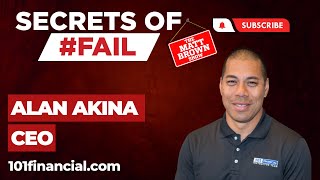
Episode of the Matt Brown Show (Secrets of Fail series) featuring Alan Akina, CEO and founder of 101 Financial. Alan explains 101 Financial’s mission—financial literacy for individuals, families and companies—reflects on early self-doubt and imposter syndrome, and describes how a mindset shift (“Why not me?”) enabled rapid company growth (from $20,000 start to Inc. 500 within ~7 years). He shares practical habits (daily micro-learning, reading/listening to leaders), hiring lessons (put the right people in the right seats earlier), and frames failure as an essential step toward personal and organizational destiny.
Chapters
Foreign. Welcome back to yet another cracking installment of the Matt Brown Show. This is the Secrets of Fail series where we're talking about our big ugly failures in business. You know, the things that we don't like to talk about on social media. So with us on the, in the hot seat rather today is al Akina, the CEO and founder of 101 Financial. Welcome to the show.
Thank you, Matt. Aloha.
Aloha. Yes. See, I haven't used that word on the show before.
Yeah, use it, brother.
Yeah, brother. That's absolutely true, man. So you've got an incredible company. So super excited to kick us off today with you and with the elevator pitch. So why don't you give us a sense as to what you guys are up to at 101 Financial?
Yeah, so one on one financial, we are one of the largest financial education companies in the US and so we help individuals, families, and now companies with their financial literacy programs. So we've developed some really cool financial literacy programs that really should have been taught to us in school, but were not. Things on how to budget, how to build credit, how to get out of debt and bank smarter. And so those are the things we've been doing. And we just celebrated our 20 year anniversary this month. Yeah.
That's amazing. How does it make you feel?
Makes me feel old. 20 years has been, Yeah, I just look back at it, been a lot of reflection lately since we celebrated and I feel very blessed, very blessed to be able to make it this far and then to look back at the lives, the people's lives that we changed, the people that have come back to say thank you and appreciate us. Or in Hawaii we say mahalo us, Mahalo means thank you. So they came back to thank us for being able to help them to live better lives. And so I, I, I'm very grateful, very, very blessed.
Yeah, it sounds like it will you have to be to have a business that survives 20 years these days.
Yeah, absolutely. It's, it's tough. And we got some great people and we got a great vision and most importantly, we're out there serving people. And I think that's what it really comes down to and building a successful business.
Why do you think financial literacy isn't something that we're taught at school or in general these days?
Yeah, you know, I have my own, you know, my personal feelings. I, I just think because the, the large banks, financial institutions, they're connected with the government and you know, they don't really want us to be educated. Right. Because the more Educated we are the. The more decisions we can make on our own. But if we are not educated, we need to rely on their advice more. We need to take their advice. Well, you need to get this loan. Okay, all right. The bank said to get this loan, so must be good, or we need this product, so this must be good. Because they said it is. And then when you dig under the, under the hood, you look under the hood, they're like, oh, my gosh, this, this made them the most commission, or, you know, this did that for them. It didn't really help me. And so that, that's sort of my personal feeling. And then I also believe that it's harder to find people to teach it at the schools. There are people that are qualified that want to teach financial education, but they just don't have the resources to be. To provide that to the youngsters.
Absolutely. So, Alan, you've obviously had probably a thousand failures for every year you've been in business, but I'd love for you to pick one of those struggles, those stories of fail for our audience around the world. So kick us off.
Yeah. Many, many failures, Matt. But the one that comes to mind is the failure in my mind, meaning this. When I first started my company just over 20 years ago, I was passionate, I was excited about it, but I was doubting myself. Like, in my own mind, I wasn't good enough to run my own company. Like, I didn't want to be the CEO of the company. I literally was calling people that I knew, people that I thought would be good leaders for this. Like, hey, I got a great idea. This is the, the mission of the company. To bring financial literacy to everyone. You know, come run this for me, and I'll just be in the back. I'll be the biz dev. I'll do this. And, and so in my mind, I was doubting myself. I was thinking. I was thinking these negative thoughts, right? Which created the fail in me. The negative thoughts was like, I'm not good enough. I'm not qualified. I. I don't have a business degree. In fact, I. I was a dropout of college at that time. When I started the company, I had actually dropp school out of university. And then I would say things like, you know, I come from a small town. You know, I'm from a small island. I'm a small town called Kahuku on the north shore of Oahu. When you start using those words, right, Those, those words, they, they affect you over time. I didn't realize that. I didn't Realize that. And until later, this was a few years after my business had got going. And then I started saying to myself, why not me? I just, like, started asking myself, why not me? Why can't I do this? Because I couldn't find anybody to run the company, and things were going okay. But then as I started to say that over and over again, instead of saying the small words, like, I can't, I'm small. I don't have a degree. I don't have the experience, I started saying, why not me? Why not me? Then it started to become more confident, like, why not me? And this was, like, quietly in my head. And then it started to grow, like, Then I started to believe it. I started to believe in myself. I started to overcome that negative challenge. Right?
Yeah. It's such a powerful idea. I think it's come up on my show a few times that. Excuse me, it's this idea of imposter syndrome. You know, it's. I remember, you know, eight years ago when I started this podcast, like, I was like, no one's gonna listen to this. Yeah, no one. No one's gonna come on this show. I mean, I'm only Matt Brown. Like, I've never hosted a, you know, a show before. I wouldn't know what to say to a CEO, you know? And then, you know, fast forward 600 episodes and eight years in a global audience, and now you go, why not me? You know? So I resonate with that.
Yeah. Those three words have ultimately changed my life. It changed the course of my company. Because here's what happened after that, Matt. As I started to believe it more, I started to believe in myself, and I started to see myself more as a leader, more as a CEO. And then once that clicked, once it clicked, the entire velocity of my company changed. And from that point, we just started going on this growth spurt. And then within seven years from the inception of my company, we went from starting with $20,000 of my own savings and no investment, no bank loans, to making Inc. 500. Right. We made Inc. Magazine's top 500 fastest growing companies in the U.S. and at the time, we were the second company from Hawaii to ever make that list. And I'm sitting in there with two of my other executives, guys that, you know, I grew up with in Hawaii. And we're in our suits. We're at the gala in Washington, D.C. at this Inc. 500 conference, thousands of people, and that was the first time that I pulled my head up out of the trenches and said, wow, look at what we did. We met all these other entrepreneurs, these other CEOs and founders, and they were impressed with us, first because we were from Hawaii and like, wow, what is the company from Hawaii doing at Inc 500 in Washington D.C. and then secondly, they saw what we were offering. We're offering the ability to change people's lives through financial education. And they're like, well, we just sell rims or we, we have a CRM, we do this right. And, and I realized at that moment that I, I, I'm, I'm here, I can do this. And, and I started incorporating that into my teaching, helping people to believe in themselves more. And, and then, funny thing is, that was in 2009, in 2010. I ended up going back to college in 2009, the year we made Inc. 500. And I would take a class here and there. So I graduated college in 2010. So we're Inc. 500. I'm going to college, I'm working, I'm raising a family. And it was just an amazing time that when I look back on everything.
Absolutely. So when you look back at that time, Ellen, what strikes you as a key lesson that you learned from that experience?
I think you have to pour into yourself, right? If, if you are a leader. We all have those, those self doubts, right? We have tens of thousands of thoughts that go through our mind. And I think entrepreneurs, we, we probably double that than the average person. Right? I mean, Matt, I'm sure your brain doesn't go to bed. I, I mean, go to sleep. It's hard for me to turn off at night. So we have all these thoughts and a lot of those thoughts are negative. They're just negative. It's just human nature. And so what I've learned is to pour into myself. So every day I try to feed my mind some positive things. So listening to podcasts like yours, reading books. I take two showers a day. My average shower time is about 11 minutes and 14 seconds. And what I do is I listen to a, a YouTube clip that's around 10 minutes or so in my shower. So, so every day I'm getting a minimum of 20 minutes of education just from showering. And I'm listening to different topics, you know, topics like yours or lately I've been listening to Warren Buffett. I love Warren Buffett. So I've listened to all of his talks and even old school Earl Nightingale recordings on, on these records that I'm listening to while I'm in the shower. So just imagine every day I'm picking up 20, 30 minutes, sometimes in the car. Half the time I'm on a call, half the time I'm feeding myself. So there's another 15 to 20 minutes. So I might, I might get an hour a day. And if you do that consistently, week in, week out, month in year and years and years, you have all of this, these positive vibes that will fight the negative thoughts, the negative feelings, the self doubt, and that's when you start to grow.
Mm. And then let's go back in time. What would you do differently? Ooh.
I. I think I would have tried to hire. People for the right positions earlier on. I think I would put the right people in the right seats on the bus that we're in. But I was growing. I was learning. I was a biology major in college, and I dropped out of that.
Right.
So I didn't really know. So I didn't take any accounting or business class. I was kind of figuring out, so I was doing a lot of it on my own. And then it was easy to find people that were smarter than me because I was already kind of dumb anyway, so that was the, that was the easy part. But find the right people, putting them in the right positions, and then letting them drive and let them, let them go. I think I would have done that earlier on in my, in my career. Now I've learned that after 20 years. And we're, you know, we're, we're building a new digital bank. And so I've been hiring the right people. We got PhDs and we got, you know, specialized people that are super smart. And it seems like it. That's working better.
Ellen, what's Your advice to CEOs or founders, entrepreneurs, men, women out there in terms of the. Their relationship with failure?
I would say embrace it. Right? It's, it's just inevitable. I mean, failure is going to come, right? And some of it, some of us experience failures in different ways. Some are more extreme than others. So. So embrace it. Just accept that there are going to be opportunities or things that will come our way that will, Will derail us. But I want you to know that it doesn't have to stop you. Right? Those challenges that come our way don't have to stop you in your tracks. It shouldn't be, you know, something that makes you quit. Because if you're, if you're quitting, that means your why inside of you isn't big enough, right? Your why. Why are you doing this needs to be big enough to overcome any challenge and any obstacle and then use those failures as stepping stones to get to where you are ultimately destined to be, because that's what they are. They're just. They're just there. And I, and I have the, the ability now to look back. Hindsight is 20 20. I get to look back 20 years and all those lessons that I've learned. And gosh, those failures helped me. Those challenges help me to get to where I am today. And it made me the person that I am today. And also as, as a secondary thing, it helped my family like I, I see it helped me personally. But my, my wife and my kids. My wife and I, we have seven kids, and we, we have three of them currently in college. And I. And they've seen the failures, they've seen the struggles, they've seen the success, and I think that's helped propel them to where they're at faster than what it helped me. Like, we, we got. Our oldest son is at the Marriott School of Business at BYU in Utah. He plays golf on the golf team. My second oldest son is at the Stern School of Business at New York University. He plays basketball there. And then my daughter is at Harvard playing rugby, and she's majoring in environmental science and public policy. And so when I look at what they're doing, I was, I was a college dropout, you know what they're doing, and I wasn't making it in biology. And I see that those struggles, the, the way that we fought through and the challenges, it made my kids tougher. It made. And it made us tougher.
Ellen, do you believe in destiny? Do you believe that. Do you believe that failure is a way to uncover what your destiny should be?
Absolutely. I believe we all are destined for greatness. We got to go find it. And the challenges are just a natural part of life. The failures are. Are just part of life. Failure. If we don't have failure, we don't have success or joy. And so I believe that's all part of life. I accept that. I accept those challenges that may come my way, and I try to be ready for them because they're going to come at any moment. We never know. But if we are prepared here to say failures will come, and here's how we will deal with it, right? That's in my mind. I know what's going to come. So what I say is, look, if a failure comes, a challenge comes. My first thing is, let me just go around it. Let me just see the easy way. Let me just try to walk around it. If I can't go around it. And then I say, well, can I Just go over it. Can I jump over it? And if I can't jump over it, then the last thing is I'm gonna say I'm gonna go right through it. I'm just gonna smash my way through it. So no matter which way, whatever way we go, we're gonna get through those failures. And that's part of the mental preparation that, that I've done over all those years of not believing in myself.
Do you recommend any tools or books or resources for other CEOs or entrepreneurs to use on their journey?
Oh, gosh, that's a great question. Here's what I like. I like studying other people. So like I said, currently I'm studying Warren Buffett, and I, I like to read about other people or listen to, you know, what, what other people went through in their life that are successful. So I, I, I'm going through Warren Buffett now. I, I just did some things on Michael Jordan, and I wanted to learn about how he is so determined to win, right? I wanted to learn how to win. So I've been studying Michael Jordan and, and then listening to a lot of talks from his trainer and that wrote the book. I think it's called Unstoppable or something like that. It's a great book by Michael Jordan's trainer. So I kind of picked those things apart of what, what I'm trying to learn. Like Warren Buffett, how did he last so long? Right? He's 90 years old. How did he go for so long and find that enjoyment? Now I've been going for 20 years. And then Michael Jordan previous, like, how does he win? I want to win more in life. I want to win more in business. I want to win more with my family. What are some things I can pick up? So what are those things that are lacking if you're a CEO, go find those people that have done and study them. And I buy thick books like this just to get one golden nugget out of it, just to get one piece. If just one quote in the entire book that costs 30 bucks, that was worth it to me. Just one thing. And that's what successful people do. They're always looking for that edge. They're always looking for that competitive advantage and, and studying those people that have been there can do that for you.
Alan, what an incredible story, dude. You know, truly inspiring. Thank you so much for being on the show and, you know, specifically being vulnerable in terms of sharing your own personal journey of failure and success. So thank you for being here. It's been a real privilege thank you, Matt.
Appreciate you.
Alrighty, thanks, everybody.