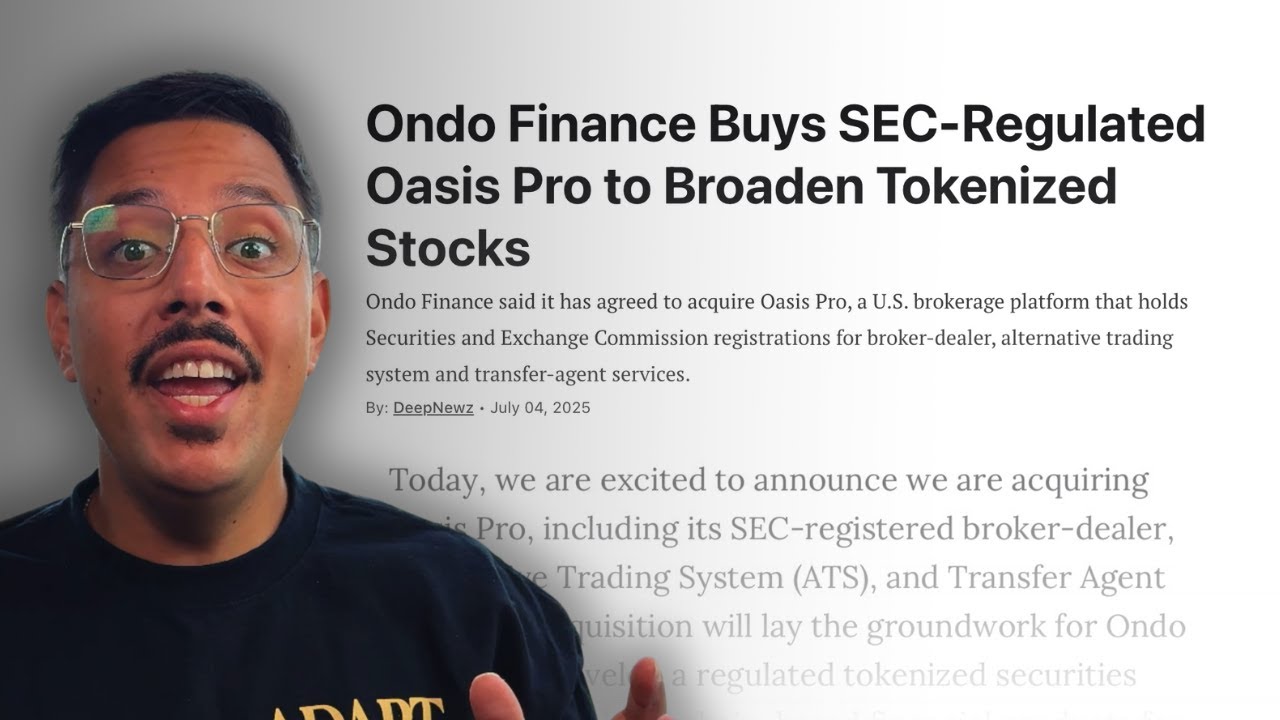
In this commentary, the presenter outlines Ondo Finance’s recent $250 million acquisition of Oasis Pro, which provides an SEC‑registered broker‑dealer framework for issuing and trading tokenized securities tied to real‑world assets (RWAs) such as government treasuries and property. He explains the concept of RWAs and how tokenization could allow fractional ownership of physical assets. The discussion then shifts to the pending “Clarity Act,” a legislative package that will classify crypto tokens either as commodities (decentralized, low oversight) or securities (subject to SEC regulation). Ondo’s strategy is positioned as a bet on the security side, securing the ability to list tokenized securities before the law takes effect. The speaker argues that this gives Ondo a strategic advantage, potentially delivering 5‑10× returns compared with larger altcoins, citing its low liquidity depth ($250 k for a 2 % price move). He warns that many existing coins may lack the legal infrastructure to qualify as securities, leading to mass delistings, blacklisting, and exchange splits once the Clarity Act is enacted, likely by late summer/fall. The video concludes with a call to integrate the Clarity Act into research strategies and to monitor further regulatory developments.
Chapters
Oh boy, we could be seeing the early signs of an altcoin season. Ondo Finance just put a $250 million bet on investing in RWAs specifically, and it also confirms the regulatory, the new regulatory framework that all of these crypto projects are adopting that again could lead us to understand what the altcoin season's gonna look like. So Ondo Finance, they create things called RWAs or real-world assets. So there's assets in the real world like treasuries, that's government debt, or like a house, right? These are assets in the real world that are now being tokenized, meaning a blockchain is being put behind them and you can purchase shares. For example, here's just one hypothetical. A house could be worth, I don't know, $1 million, and you could purchase a fraction of the house. This technology is not capable yet, but this is what the future looks like. You can purchase maybe 1/10 of the house and still get the appreciation of the house, right? And maybe go into a pool of investors or whatever the case is. But what recently just happened is really, really big. And it's also a confirmation for the altcoin cycle. And they're making some big moves that I think are very important for everybody to understand. So Ondo Finance just acquired this company called Oasis Pro. Now, the main reason I believe they did this is because they want an SEC-registered broker-dealer. Okay. Now, super important. I want you to listen. Okay, to what I'm saying, because it's— it could be a little bit complex, but basically Ondo Finance now owns a fully compliant U.S. legal framework to issue, trade, and manage tokenized securities. Look, keyword: tokenized securities. Tokenized securities. I want you to remember that. So basically there's something called the Clarity Act, okay, and it's part of 3 bills that are trying to be passed on Crypto Week coming the 14th to 18th, and the Projection of when these bills will actually become law looks like from previous videos. You guys can reference my other videos. It looks like towards the end of the year. Nobody knows the exact dates. There are projections. Now the Clarity Act. Let's focus, right? Clarity Act. The Clarity Act is basically proposing standards for cryptocurrency tokens. Okay? So they could either be under two categories: a commodity or a security. Remember we talked about tokenized securities? Remember that? It could either be a commodity. Or a security. So what Ondo Finance is doing is they're securing positions when it comes to a regulatory environment and making sure they can issue securities. So the question is, what is a commodity and what is a security? I'm not going to go into too much detail, but basically a commodity has no central issuer company, is decentralized, has no external team that they actually rely on, and a token is used for functionality. And basically the gist is it's just more decentralized. So what Ondo Finance is trying to do is get into the security world where they can get things like US government and treasuries, as well as a house, things that are for profit as a way to sell tokens. So they're trying to get into not the commodity aspect, but the security aspect. So what Ondo Finance did is they actually purchased a company called Oasis Pro, like we talked about, that issues, sells, and trades security tokens. They're trying to take over that aspect of the market. Not only that, there's a couple things that we can draw from this. Number one, Ondo Finance is probably a good investment in context of other bigger altcoins. Like for example, if you're looking to buy Ethereum, you'll probably get like a 2 to 3x. Ondo, you might get like a 5 to 10x. Nobody knows for sure. But look at the liquidity depth. The +2 liquidity depth is at like $250K. So basically, to pump the price of this coin by 2%— not exactly, but you need to add all those up And this is significantly less than Ethereum. So Ethereum is probably going to be— I don't know, no one knows, but it's going to be a lot more. So in context of safe investments, well, they have obviously a very strategic advantage. They have connections to BlackRock, and their liquidity depth is lower than something like Bitcoin, Ethereum, or some of the older coins because this is a brand new coin. At least, you know, it has relevance this cycle. Not financial advice. Number 2, you better make sure whatever coins you're currently holding clearly put themselves either a commodity or a security and have the money to pull this off. Now, Ondo Finance has $250 million to do this, so they can actually issue tokenized securities. But a lot of the coins people are holding can be categorized as a security, and they might not have the money to pull that off. They might not have the lawyers. They might not have the infrastructure. Half of these coins, these people are anonymous. So when this actual regulatory infrastructure comes into play towards the end of the year through the Clarity Act actually gets signed into law, What's going to happen is that every single coin on the market is going to essentially have to put in, right, some type of notice if they're a commodity or security. And there's a 60-day window where the Security Exchange Commission will determine which side they fit on. Now, if they're a commodity, there's significantly less regulatory oversight. But if they're considered a security, boy, you better let go of that coin. Which leads to my last and most important point. You guys better be integrating this new bill into your research strategy. You better understand this because again, I foresee— I don't know, maybe this is too aggressive, but I foresee basically something like a mass delisting. I've been talking about it in my videos. Basically, if you are a centralized exchange or a decentralized exchange and you have a coin on your exchange that is considered a security by the SEC and they are not following that regulation, what's going to happen is the exchange will likely delist the coin, or the exchange can get sued, right? So I see, for example, a mass delisting, probably mostly with centralized exchanges. And I also see blacklisting and website restrictions. There's a lot of coins right now that you can't buy, you don't have access to in America. This is currently a thing. So that's probably gonna be for a lot of coins where you cannot load the website in America. And see, the thing is, America has the most trading volume, the most liquidity. They have the world reserve currency. The vast majority of investments are into America, right? Like, we know this, right? So being blacklisted or restricted from America is going to be very significant for a lot of coins. So in general, we've been talking about this, this whole entire kind of like Clarity Act and how important it is in multiple YouTube videos. You know, we see it with Coinbase making the hybrid system. They basically partnered with Aerodrome Finance, which is a decentralized exchange. We've never seen this before. And we were talking about this, how basically how they're making a hybrid centralized exchange, decentralized exchange system, where maybe we see some commodities on one exchange, and then we see some tokenized securities on the other exchange, right? That's what we see with Coinbase. Now we see the trend continuing. Right with Ondo Finance. Second confirmation where we see Ondo Finance making sure they can actually list tokenized securities. This is—it looks like it's real. Now, a lot of what I say, it's theory and I'm speculating. But when we see companies putting up $250 million, when we see Coinbase partnering with a decentralized exchange, bro, like how? Like these are confirmations. These are points of credibility. Where the company is foreseeing something that we don't see and they're changing their entire structure of their business to accommodate something going on, right? So focus on the Clarity Act. If you hold coins and you don't understand the Clarity Act, you're making a massive mistake. And I will be giving you guys videos updating you on everything, of course, step by step. We are far ahead. I don't see it happening within the next month to 2 months. We don't know for sure, but by projections, it really looks like October— August, October, like towards that period of time— we could see this actually being written into law. So focus, pay attention, and if you don't get with it, you will get left behind. Catch you guys in the next video.