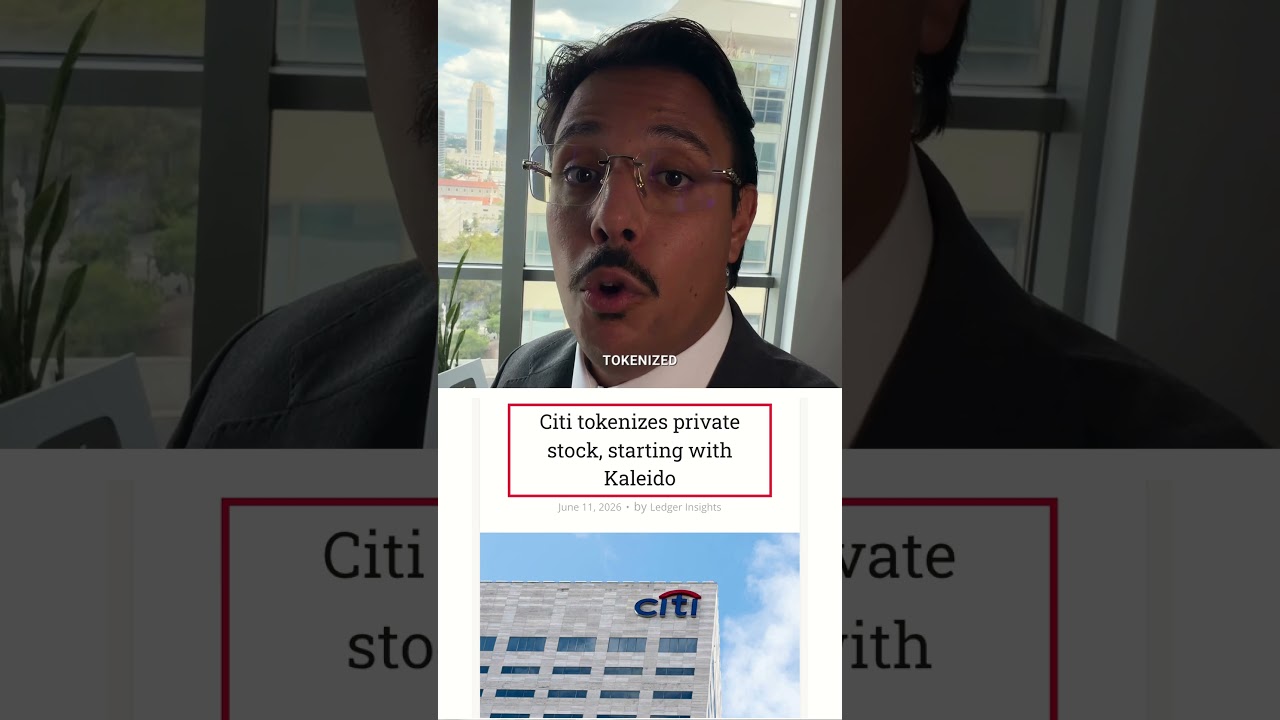
In this commentary, the speaker explains Citibank's June 11, 2026 launch of digital depository receipts (DDRs) that represent private company shares, marking the first time a global financial services firm acts as both issuer and custodian of tokenized private‑equity securities. The DDRs are built on regulated blockchain infrastructure operated by SIX, a Swiss exchange and central securities depository approved by FINMA. The inaugural transaction involved Caldeo, an institutional tokenized‑asset platform backed by Citi Ventures, with participation from Citi Wealth, issuer services, custody, wealth markets, and venture teams, demonstrating a bank‑wide effort rather than a sandbox experiment. The speaker argues that tokenizing private‑market equity upstream of IPOs gives institutional investors cleaner records, faster 24/7 settlement, and access to value that is otherwise locked in fragmented secondary markets. While retail liquidity and token supply remain undisclosed, the move signals a shift toward institutional demand for pre‑IPO equity token wrappers. The video concludes with a promotional pitch linking to a paid service that claims to combine Claude Code automated trading with this crypto adoption wave.
Chapters
Everybody's watching tokenized public stocks, but Citi just moved one layer earlier. Private company shares before an initial public offering. And this is where it gets out of control and serious. A lot of people have been asking me how to make money off this crypto adoption. I'm telling you right now, the combination of Claude Code automatically trading and this crypto adoption inception point is out of control and people are going to get rich. Learn all of it. The link is in my bio. We charge $1. Go to the link in my bio and take advantage. On June 11th, 2026, Citi launched digital depository receipts on private company shares. The product uses uses regulated blockchain infrastructure operated by SIX. As Citi says, it's the first time a global financial service company is both the issuer and the custodian of tokenized depository receipts representing private companies. That sounds complicated, but the idea is simple. A depository receipt is a traditional financial wrapper. Investors do not always need to hold the underlying share directly. They can hold the receipt that represents the exposure through a structure institutions already understand. Now, Citi is applying that logic to a private company equity on tokenized infrastructure, right? Private companies. Why does this matter? Because private markets are where a lot of value has been hiding for crypto. Companies stay private longer. IPOs come later. Secondary markets for private shares can be fragmented, expensive, and hard to access. By the time retail investors finally see a hot company like an IPO, a huge amount of value may already have been captured privately. Citi is trying to build a cleaner institutional lane before that IPO moment. Now, the first transaction involved is Caldeo, an institutional tokenized and digital asset platform backed by Citi Ventures, with investors inside of Citi Wealth, Citi's issuer services, custody, wealth markets, and venture teams. They were all involved. That tells you this is not one innovation lab playing with a blockchain. This was the banks trying to make tokenized private equity fit across the machine completely. The infrastructure matters too. The SIX digital exchange received Swiss FINMA approval in 2021 as a stock exchange. And central securities depository for tokenized securities. SIX says its digital asset infrastructure supports issuance, custody, asset servicing, collateral mobility, interoperability with traditional CSD rails, and 24/7 settlement. Now add Citi as the issuer and custodian. The real story is not stocks on chain, it's Wall Street building token wrappers around pre-IPO equity private market access, custody, settlement, and distribution. And if that works, the demand does not start with retail, it starts with private banks, wealth desks, and institutional investors, issuers, and custodians who want private assets— listen— to move with cleaner records and faster settlement. This is not mass retail yet. There's no public volume, no broad liquidity data, and no token supply disclosed. But that's why it matters. Tokenization is moving upstream, closer to where the wealth gets created before the public ever gets involved. And we've seen that type of adoption time and time again over the past 200 years. Get with it or get left behind.