Clear Predictions on Crypto and Stocks
Alexander Lorenzo uses Google search data on war-related terms to track how geopolitical fears move Bitcoin, gold, the S&P 500, and oil. He argues markets are in risk-off mode and suggests shorting a low-liquidity altcoin while buying tokenized gold.
Chapters
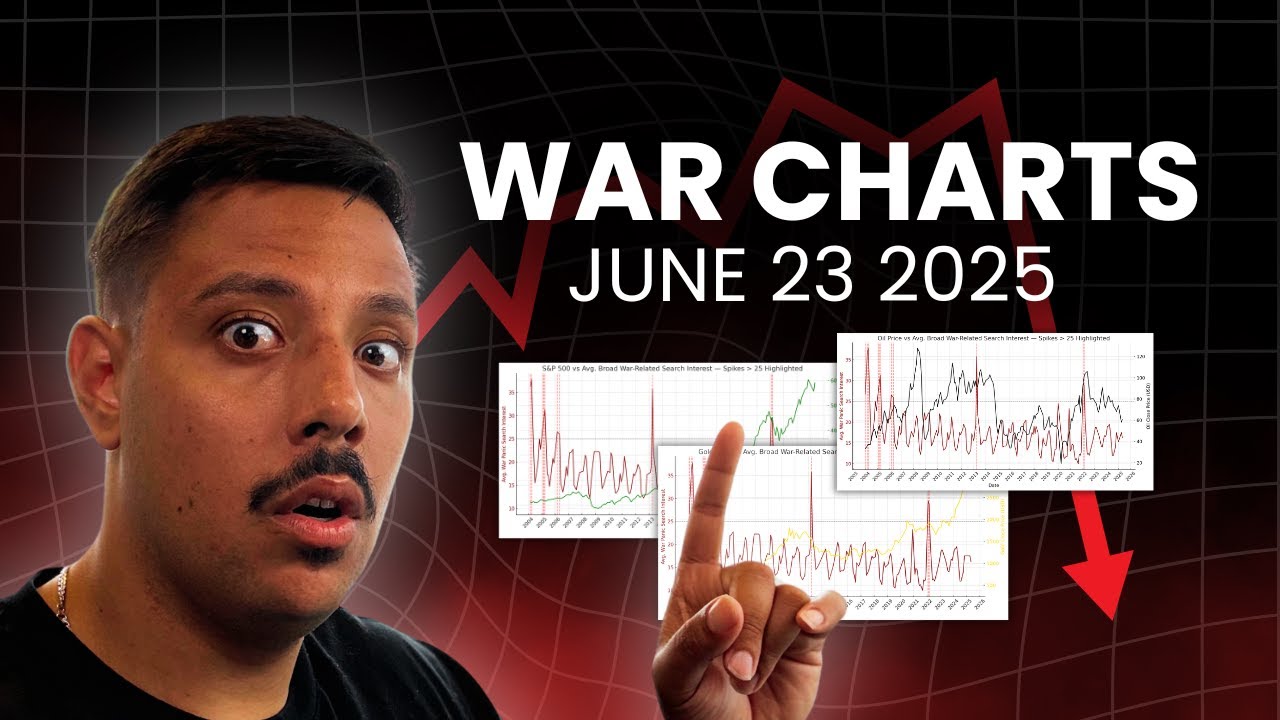
I'm going to give you guys 3 charts that give us kind of a prediction of what's going on with the market right now with World War III. Obviously, it's important to understand what's going on when Trump just bombed Iran and there's like obviously military conflict all over the world. This is very important to understand cryptocurrency and stocks. I have 3 charts that I just created from scratch. You're not going to get it anywhere else on the internet that will clearly give you a picture of what's going on and what has happened in the past. The modern era when it comes to world war conflict. Also, if you want these charts for free, go ahead and go to coinpixedu/data and you can analyze it for yourself and look into the research. We're also going to be uploading more charts in the future. Who forgot about tariffs? So obviously Trump has inputted a lot of tariffs all over the world and their specifics are a little bit foggy, but there's one thing that we know. On February 1st, there was a massive tariff on China and Canada and Mexico, which are the biggest importers into America. And shortly after, the price dropped in Bitcoin by 26%. This was a massive drop. This is on the day. So obviously tariffs have an increase in volatility. And it just so happens to be that on February 1st, since there was a massive market fall, Trump actually extended, put a pause on the actual tariffs to negotiate and to talk to people. And he put a 90-day extension pause, and that's coming up right now, July 8th to 9th. That's coming up in the next couple weeks. So just to be clear with you guys, if he extends the pause, this could be good for the market. We could have a little bit of relief, you know, the market could rally because we have seen, you know, when he did extend it, the market did rally after. Or he could actually input tariffs. If you ask me, With all the war going on, to be honest with you, he's probably going to pause it again or put very light tariffs. I don't think he wants the conflict. He already has a lot going on with World War III. The stock market is looking a little shaky. Bitcoin just broke below $100K yesterday. So I don't think he wants the market to fall again. So I would assume that he's probably going to put a pause or something like that. Obviously, we don't know for sure, but it's something to pay attention to. Again, July 8th and 9th. And also he might come out with something earlier. So just pay attention to this tariff news. It's important. So just to be clear with you guys, again, he put in these massive tariffs exactly right here. This is Bitcoin's price exactly right here. We had a 26% drop, which is not a joke for Bitcoin. But when he extended the tariffs, when he extended and paused it for 90 days, that was right here. And so that deadline is up July 8th and 9th. Pay attention. Let's get into the charts. Now we've been looking at Google search term history. So basically when people type in words on Google, it's like public perception. They're all looking it up. For example, if you look up food near me, there's a certain amount of searches that happen in your area. So there's— these are called key terms and key phrases on Google. And so right here, World War III has been spiking, and it's pretty significant because this does affect assets. Listen to what I'm saying. Perception is important. If people start panicking out of a whole bunch of fear, you know, we could have assets contract, and vice versa. When people are optimistic, they start spending more money. So it's a good way to gauge the public psychology. And as you can see, it's been going viral. We talked about this in the last video. Now, I took it way deeper than that, and that's what we're going to go into. But first, Perception spreads like virus, and it actually does change the real world. If you guys read this book called Narrative Economics, it'll give you a background on this. But just to be clear with you, belief, behavior do affect economic outcome. If you believe something, it changes your behavior, and it does affect what you buy or sell. This is a fact. So this is one of the most understudied areas of economics. There's all different types of areas in economics. And nobody until modern history has been really looking into narratives, how stories in markets drive perception. And to me, it's one of the most important variables specifically in cryptocurrency because the vast majority of these coins move off of narratives. Narratives are just a story. You remember stories, stories since the beginning of time. There's so many stories that have shaped your reality. So we must understand the story behind war. So I took it way further. I started looking at the search term nuke, obviously nuclear war is scary, world war, World War III, the same search term. We looked up bomb and invasion. Here's all of the data. And what I did is I averaged out the spikes. So I made a chart and this is the 3 charts and we compared it to different assets in the market. Basically we're averaging out when all of them spiked. What were the periods of time when people were really searching nukes? World War, World War III, bomb, and invasion. Those periods of time, how did it affect assets? That's what I want to see. It's really interesting. So the first chart we're going to be looking at is gold. So again, those search terms averaged out. It's not just one search term, it's 5 search terms that are kind of telling the story. And what I want to do is actually put together kind of like a plethora of different search terms to try to figure out what the market's thinking, right? And there's these periods of time where we have big spikes. And by the way, this is gold's price. So that gold line there is gold's price. And the thing about gold's price is people start buying gold when they're scared of something happening. When people are scared of the world going under, they start— it's called— they're like gold bugs. They buy a whole bunch of gold to save up for Armageddon or something like that, and gold will forever hold its value. That's kind of the story behind gold. So what I want to do is show you guys specifically what happened to gold. Now we have 3 spikes here and the price of gold went up a lot. Okay. So that's interesting. Um, so that's kind of the perspective of gold right now, right here we have a spike. The market did go down a little bit, but we bottomed out and went on like the most epic gold rally in human history. Right now gold is at all-time high, right? So just think about this. This is kind of like risk-off mindset. People are not taking risk. They're trying to preserve their wealth and save it for something bad to happen. So this is like perception turn— like turning into an actual action, right? It's like belief. Remember, let's pull it up over here. It's like right here. It's a belief turning to real behavior, and the economic outcome is gold increasing in price, as you can see right there. And then we have another spike that that led to another rally. So in general, this world stuff, right, when it comes to World War III and all that, it's going to be risk-off, not risk-on. People are not buying stocks and crypto. It's risk-off. Pay attention. Now if we scroll down, S&P 500, this is risk-on chart. So the S&P 500 is a basket of stocks. This is risk-on. And as you can see right here, we also have big price increases. Look, S&P 500, these 3 spikes, it did lead to a fall later on. This is the federal funds rate. So I would say it was a price increase short-term, and then eventually we did fall in the S&P 500. This was the 2008 housing market crash. Right here we had a big spike and the market went up. And then right here we had a big spike and the market went down. So out of 3 kind of situations, I consider this one because they're all around the same area. Three situations. Two of them were bearish. One of them was bullish right here. This one was bullish. So in that case, it's slightly bearish on the longer time horizon. Now let's look at the last chart. Let's look at oil. Oil is a commodity, so it's similar to gold. But the country that you know is obviously under war is Iran. They produce a lot of oil, and as you can see right here, it's kind of like really volatile. In this case, the price of oil went up. In this case, the price of oil tanked. It went down a lot. And in this case, as you can see right here, the price of oil went down, not up. So in general, it really does look like a risk-off environment. You can make money off that. I'm even thinking about putting a trade in my group, for example, where I take $10,000, split it into 2 $5,000 allotments. I can short a high-risk altcoin, something with low liquidity. I could short that coin But at the same time buy gold, which by the way, there's tokenized gold in crypto. You don't need to physically buy gold. There's something called Paxos Gold. Like right now you could buy Paxos Gold, which is tokenized gold. You could literally go to Ethereum, swap it. It's crazy. And then so the price of gold goes up, I make money. If the altcoin drops, if I'm correct that we are in a risk-off environment, we're not in a risk-on environment, And I'm correct, I can make money on both directions. If I'm slightly wrong, then one of them can cover another, right? So we know gold's going to go up with war, right? If the altcoin goes up and I'm wrong about shorting the altcoin, I'll lose a little bit of money there, but I'll make money off of gold. And you get the point of that situation is it gives you flexibility, it gives you peace, and it gives you calmness. So we're going to be talking about that in our group. So just to give you a quick summary, based off of gold, oil, And the stock market, it's very clearly risk-off. So again, the risk-on environment is when investors are confident and are willing to take higher risk buying, you know, tech stocks and AI stocks and investing in the stock market. They're taking way more risk. This is when we've seen crypto do extremely well. Okay, listen to what I'm saying. Crypto usually does well in risk-on environments. Stocks do well in risk-on environments. Now, a risk-off environment is when people take defensive positions. They take defensive positions by buying, you know, gold, by jumping into US bonds, right? Jumping into cash. They don't want to take excessive risk because the market is very uncertain. Like, I don't know, like World War III. Their perception, their belief is leading to an actual action of being defensive. Listen to what I'm saying, but it does not mean you can't make money, right? That's that's not what I'm saying. Like everybody freaks out when I say something that you know Bitcoin broke below 100K yesterday. That's not good for price. Like Bitcoin breaking below the 100K psychological level is clear signs of instability. So pay attention, take your time, and stop gambling. Okay. You can make money on both directions. It doesn't need to be one-sided where you hold an altcoin and 1,000x. You'll never be able to consistently make money and achieve financial independence without actually understanding, make educated decisions, and actually becoming an investor. That's the only way you could do this is to do it for real. So I just wanna say that's kind of the summary here. We're clearly in a risk-off environment. So you know the difference between risk-on and risk-off. I showed you a couple of charts that showed very clearly belief turning into actual price, right? That clearly shows we're in a risk-off environment. Now, I don't know if we're actually gonna go into World War III. I don't know. But if that does happen, it will make my case even stronger, right? But it's not all doom and gloom. You can make money on both sides. So I just wanted to release that information for you guys. Thank you guys so much for watching this video. I'm dropping another one tomorrow. We're gonna go over some more charts. I'll catch you guys later. Peace out.






