This content was created by Alexander Lorenzo. This content was uploaded by Alexander Lorenzo. This is a YouTube video titled "HOW MUCH MONEY DO YOU NEED TO INVEST IN CRYPTO TO MAKE YOUR FIRST MILLION" (uploaded 2025-07-03). The excerpt is a single-speaker instructional monologue (labeled SPEAKER A) that gives practical crypto-investing advice: assessing time commitment and risk profile, recommended liquidity-pool (LP) ranges for different target multiples (e.g., ~50–200x for LPs below $200K; safer targets in $5–20M LP range), starter-capital scenarios (example: $5K requires ~200x, $50K requires ~20x, large capital may only need ~2x), and guidance on matching time, experience, and capital to pursue a first million. The presenter encourages saving the video for reference; no other participants are present.
Chapters
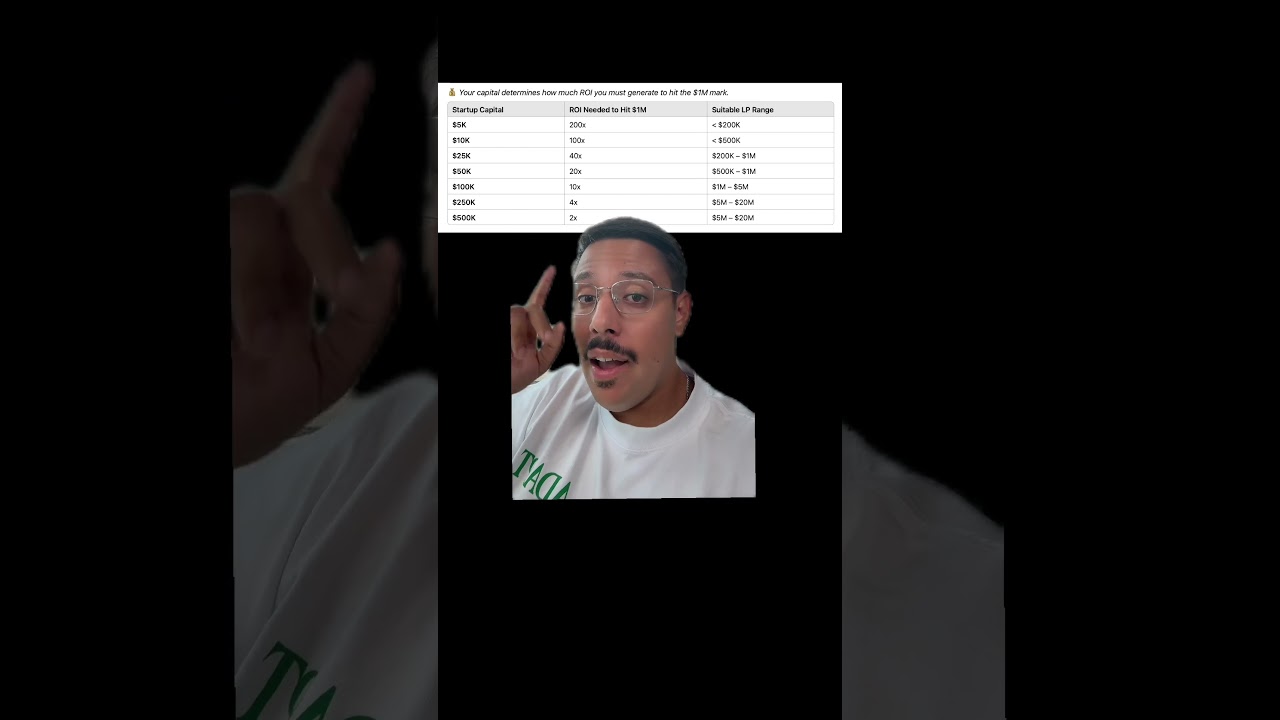
How much money do you really need to invest in cryptocurrency to make your first million dollars? I've trained thousands of people and here's the exact math in extreme detail, not overly hyped but a realistic strategy. First have to figure out how much time you're willing to commit to crypto because people that have more time will probably be able to take higher risk, right? So by the way, from 5 to 9 after you get off work, you have 4 hours. So that's 4 hours times 5 days a week, that's 20 hours. So if you're really committed, you could actually do the 20 to 25 hours if you work weekends or whatever the case is, if you're disciplined. But the point is, look at the risk profile. Keep it low risk, stay under $1 million liquidity pools, and we're going to break this down if you do not have a lot of time. And I'm going to give hypotheticals for different types of people. We're going to build your portfolio. It also really depends on how much experience you have. So if you have a lot of experience and a lot of time, I would probably recommend that you focus on lower liquidity pools, very cheap coins that move very fast, right? So it really depends on that as well. And then also, just to give you a breakdown, and you can save this video for future reference, when it comes to the multiples, right, here's kind of the dynamic. If you want a 50 to 200x, you need to focus on liquidity pools that below $200K. So that will give you those very fast moves all the way up to here. If you want a safe Very easy strategy, then focus on high liquid coins at around $5 to $20 million in liquidity. Okay, this is very important because all this will be used to figure out exactly how much money you need to invest in crypto. We take a look at startup capital. If you have $5,000, you need a 200x. Okay, now if you have $50K, you need a 20x. This is kind of like the recommended level I usually tell people, like try to get, you know, $50K in the market because that's only a 20x to make your first million. And we also have the suitable LP range. This is the LP range of liquidity pools, right? If you don't have a lot of capital, you have to kind of focus on the lower liquidity pools, the small little small, small coins, right? You have to because you have to give higher multiples. So if you don't have a lot of capital, you need to spend time and you need to gain experience fast. Now the flip side, if you do have a lot of capital, all you need is a 2x and you don't have to leverage your time as much. You don't have to spend too much time and you don't need to be a sophisticated investor. You just need to jump into higher liquid projects. Here's kind of like the official recommendations. If you do not have a lot of capital, you need to focus on lower liquidity projects. You need to figure out a way to get experience fast and you need to spend a lot of time in crypto. The safe holder, if you only have 7 hours to invest per week, which is like an hour a day, your experience doesn't need to be that high. You don't need to buy the lower liquidity, high-risk coins. And you need higher capital. So it really just depends on your time, your experience, and how much money you have to make your first million dollars. Go ahead and save this video so that you can reference the charts for the future.