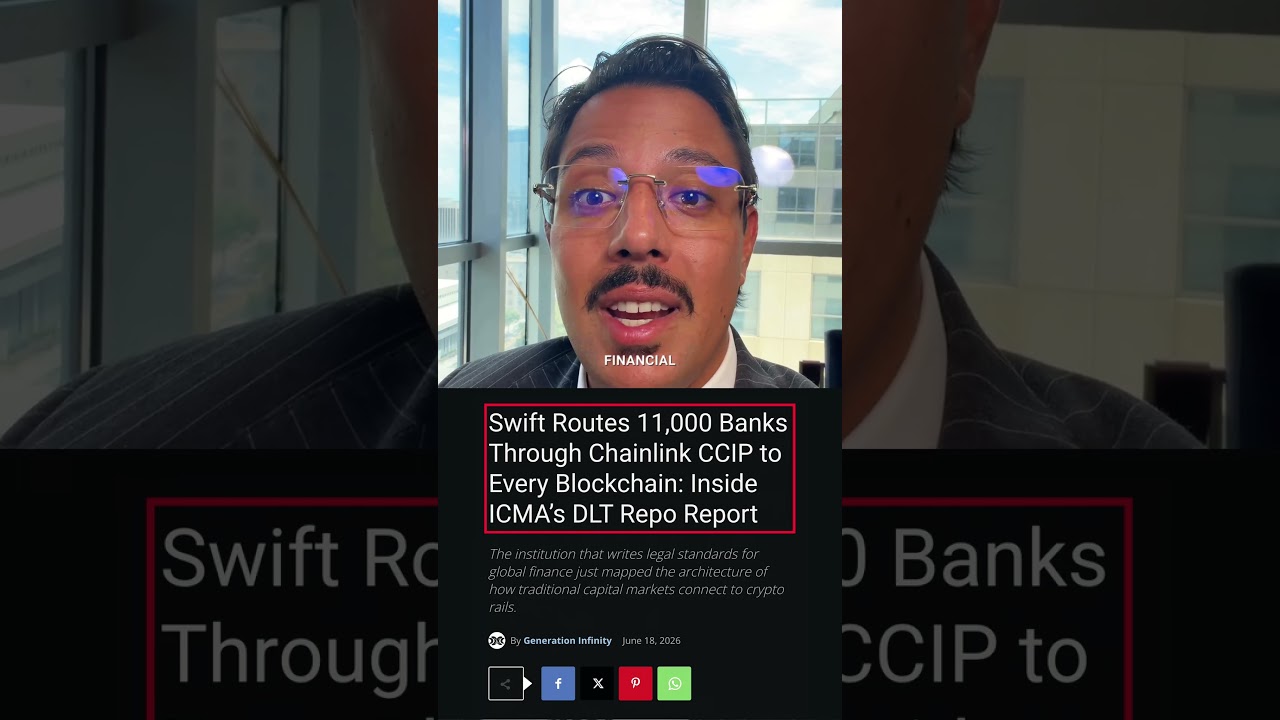
In this video, the speaker reports that more than 50 banks holding over $10 trillion in assets have independently selected the same blockchain infrastructure—Chainlink—within a 19‑day span. The first announcement (June 23) concerns the Pangaea project, led by ING, BNP Paribas and a coalition of Korean lenders, which aims to speed up Europe‑to‑Korea cross‑border payments by keeping existing payment messaging while using Chainlink for settlement beneath the layer. The second announcement (June 4) is a SWIFT‑authored 71‑page report revealing that SWIFT’s own blockchain layer runs on Chainlink technology, effectively placing Chainlink under the global interbank messaging network that moves the world’s economic value every three days. The only publicly tradable component of this emerging ecosystem is the LINK token, which paradoxically fell from about $8 to $7 after the news, despite banks committing to infrastructure that underpins a $9.6 trillion‑a‑day market. Live transactions are slated for mid‑2027, emphasizing that the plumbing takes years to build. The video concludes with a promotional call‑to‑action for a $1 AI‑driven research and automated trading service.
Chapters
So more than 50 banks holding over $10 trillion just picked the same altcoin technology twice in 19 days, and the token actually is very cheap right now and got cheaper. So let's go over the research. On June 23rd, a project called Pangaea went public, and behind it was ING, BNP Paribas, plus an alliance of more than 10 Korean lenders. Together, over 50 banks, over $10 trillion in assets, and their one mission is to fix the international money transfers. So a payment that takes 2 2 days to settle, the same day, and either both sides settle at once or the whole thing cancels. Their first target is Europe to Korea corridor, one of the 15 biggest money routes on Earth. And here's the clever part. The banks rip nothing out. They keep their normal sending payment messages, and the blockchain does the settling underneath. And here's the entire plumbing that they actually chose. They chose Chainlink, the network that connects the old banking systems to directly to blockchain. The token is LINK. Here's research number 2. 19 days earlier, on June 4th, the organization that writes the rule book for the global bond market published a 71-page report. Buried in the black and white details is SWIFT's own blockchain layer running on Chainlink's technology. We're talking about SWIFT, the network connecting more than 11,000 financial institutions, where roughly every 3 days the value of the entire world's economy crosses the wires. Those are the rails Chainlink now sits underneath. So twice in 19 days, the deepest pools of money in traditional finance named the same exact infrastructure. Chainlink's own head of capital markets called it a major milestone towards rebuilding how global value moves. Now the part that matters for your money: almost nothing in this story is buyable. The European banks— the euro coin doesn't launch until late this year. The Korean coins that will be basically bank products. Swift is a member-owned club. There is no stock. The only piece of this entire machine you can buy on exchange today is the Link token. But here's the twist: the market actually sold the news. Link slipped from around eight dollars to around seven after the announcement. Banks committed their plumbing to a nine point six trillion dollar a day market, and the token actually got cheaper. I want to be clear about timing so you understand. First, the live transactions are targeted for mid-2027. This is a plumbing story, and plumbing actually takes years. It's like building a road. But the banks have already chosen twice in 19 days. The only question is, how many more times do they choose it before anyone really notices? And by the way, if you guys want to learn how we get this research before anyone, automated with AI agents, and how we execute trades, buying and selling with AI agents automatically, go to the link in my bio, click that link. We give it away for $1. Take advantage now.