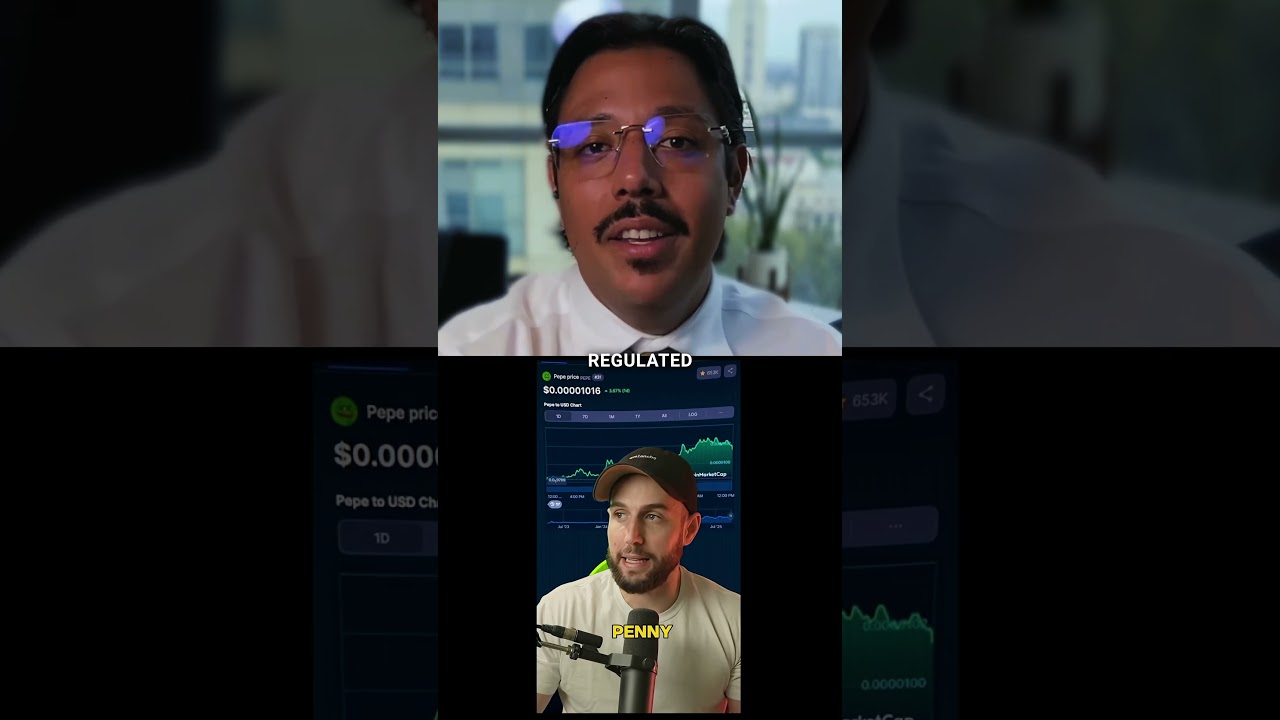
In this YouTube dialogue, Speaker A and Speaker B debate the allure of ultra‑low‑priced meme cryptocurrencies. Speaker B lists tokens priced at fractions of a penny—specifically the meme coin Pepe and the well‑known Doge—presenting them as attractive buys. Speaker A counters by explaining that a token’s low price is often engineered through an enormous supply, which can keep the price stagnant despite a large liquidity pool. He argues that cheap‑price marketing is a tactic unique to the largely unregulated crypto space, where creators can inflate supply to make a coin appear inexpensive. The conversation shifts to the importance of fundamental analysis: evaluating a coin’s genuine value, the proportion of its liquidity pool to that value, and its underlying utility rather than its nominal price. Speaker A also warns against buying coins merely for hype or view‑driven promotion, emphasizing that true investment decisions should be based on solid fundamentals and realistic upside potential.
Chapters
This is why you should stay away from mainstream media. No hate to Elio Trades, but he knows that this is not relevant. Let me explain what I mean by that.
These are the best crypto tokens that you can buy under $1. First and foremost, we have the king of all meme coins, Pepe, coming in at just a fraction of a fraction of a fraction of a penny.
So when you say something's a fraction of a penny, what you're basically saying is that it's cheap. The problem with this is that it can move up in price really slow. We're not shopping for underwear. If you're putting on underwear, the bag costs $10 and you find it for $2, that's cheap. In the context of crypto, you could have something that's extremely small but the price does not increase. So in the case of trading, it's not really about how cheap it is because you could just get large quantities, or even how expensive it is. The flip side is true as well. You can have a coin worth a lot of money, but it goes up really fast. When we say cheap in trading, what we're saying is I want something that's small that will increase in size. That's what we're actually saying. And he is saying it's a fraction of a penny, but really the only reason it's a fraction of a penny is because they typed in the computer a large supply of tokens, a massive supply of tokens. They on purpose made it Fraction of a penny to try to convince everybody's cheap, but that liquidity pool could be really big and the price doesn't go up at all. This is one aspect about cryptocurrency that the stock market doesn't have: is the stock market is regulated. They can't you can't do that in crypto. You could just make a trillion, ten trillion supply on purpose so that it's a fraction of a fraction of a penny. So when you see this, it is marketing.
Then we have the biggest meme coin of all time, Doge, coming in at twenty-three cents.
You got to be careful. I know like he's doing it for views and he got things going on, and it's not always. Wrong to do things for views. I do things for views all the time because you want people to see your content. I don't think there's anything wrong with that, but you got to give context. People can buy into a coin that gets wrecked that's a fraction of a fraction of a— that's not the reason you should buy a coin. You should buy a coin because it has strong fundamentals. The liquidity pool in proportion to its value is really good. The liquidity pool is small in proportion to the genuine value that the coin makes, right? That's what you need to look for. That's technically cheap. It's called fundamental analysis, not because the coin's a fraction of a fraction. You got to be careful, man.