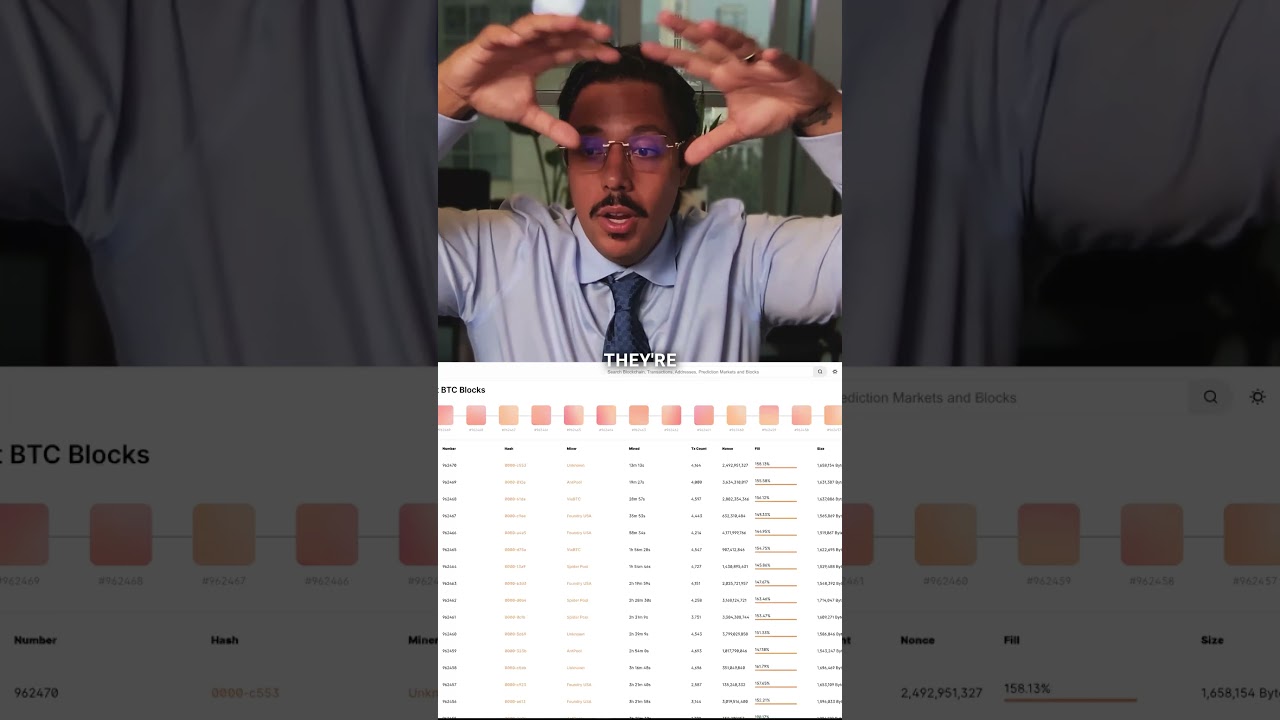
In this monologue, the speaker argues that Bitcoin’s price cycles are driven primarily by protocol‑level scarcity and mining economics rather than macro‑policy or regulatory actions such as Canada’s Clarity Act. He points out that even during periods of extreme interest‑rate policy and massive Federal Reserve money printing, Bitcoin reached $124,000 and sparked altcoin rallies, demonstrating that a bull market can occur without Fed influence. He uses a bank‑ledger analogy to explain the Bitcoin ledger’s transparent transaction history, describes mining as a competitive process akin to gold mining, and emphasizes the halving event—where block rewards are cut in half roughly every four years—as the core scarcity mechanism that makes market movements predictable. The speaker reinforces his point with everyday analogies (gold mining, limited‑edition sneakers) to illustrate why reduced supply drives price expectations, concluding that the Clarity Act’s regulatory impact is minimal compared to the built‑in economic dynamics of Bitcoin.
Chapters
I truly believe that there's nothing more consistent in crypto's world than this, not even macroeconomics. Well, this cycle we had the worst interest rate policy ever, but Bitcoin still went to $124,000 BTC and we still had a mini altcoin cycle. That's why I said the Clarity Act doesn't matter that much. It even surpasses and bypasses the most powerful entity on the face of the planet, which is the Federal Reserve. It will have a bull market without the Federal Reserve. We've seen it 2 different times. Now, the— when the Federal Reserve printed To be honest, it went way crazier, but we've still seen bull markets without it. So basically it's very simple. So everybody, I want you to imagine this. Imagine a bank, you go into the bank and there's a long sheet of paper of every transaction that's ever happened. Okay. Bitcoin has one of those, it's called the Bitcoin Ledger. You could basically explore every single asset class and all of the transactions. Look, latest blocks. So in each of these blocks, there's a bundle of transactions that happened within a 10 to 15 minute timeframe. Why Bitcoin is so good is that they have this supercomputer connection thing. It's like a whole bunch of computers that are mining, and they're all connected to one network that ensures that these transactions are not fake. That's important because one of those miners win every 10 to 15 minutes. They win. It's like gold when you're mining gold. Like imagine you're mining gold. You strike gold. When you strike gold, a little bit amount of Bitcoin. Spits out, you win it. That number of how much spits out of the system gets dropped in half every four years or so. That's scarcity. That's like if if like you know these Jordans that sell for twenty five thousand dollars. The reason why they sell for so much is because they're limited. They're scarce. That's why the Bitcoin halving is so important because imagine the entire security of the blockchain. They're eating. They're being paid off of the amount of Bitcoin that comes out the system. So if it gets cut in half, that means that their food just got cut in half. So that's why this is so predictable. It's so predictable 'cause it gets cut and everybody knows, all of the big dogs are like, oh my goodness, it's getting cut soon, and then the market starts moving.