Team Retreat Builder
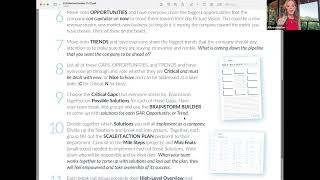
A step-by-step guide to running a one or two day team retreat. Use gap analysis and group brainstorms to surface problems, prioritize them as critical or nice-to-have, then assign owners and deadlines to solutions. Review progress in quarterly follow-ups.
Okay, Retreat builder. So this basically is similar to what they do in Scale Team. I think it's a little bit different, but this is taken from the years and years that we led our leadership meeting in for Pinnacle, and it's similar to what we just did here for those of you that were in Mexico, although we did a. We did a very watered down version of this here. So this also utilizes three other tools. The Gap Analysis, the Big Picture Vision, and the Brainstormer. Okay, so this is in there, the execution tab on the tools. And they need to be having these planning meetings with their team, and then of course, we can do it for them in Scale Team. But regardless, they need to understand to do this quarterly and yearly. Now, the quarterly ones will be much more. You know, they're. They're not going to be. They don't need to be as lengthy. So they could do this in. You're going to need at least one full day to lead this complete process. Ideally two days, but one day works. So basically, you start out, you pass out the gap analysis, and it could be the CEO, it could be, you know, second in command. That's. That's leading it. We've also had even, you know, for ourselves, we've had somebody else come in and lead it first. What I had always done was to share the wins. So if it's the beginning of the year, we share the wins from the entire last year. If it's from the quarter, then we share the wins of the quarter. And this really is something to inspire the team that, hey, we're moving in the right direction. And a lot of times we don't stop and celebrate those wins. Then we share. Then you share what you feel, what you personally, the business owner feels, or whoever's leading is the, the superpowers of the company. What separates you? What differentiates you? Okay, then this is great. And you all have. If you've been here for a while with us, you have done this where we go around and you have the team, and this may just be the leadership team. So whoever they have in their meeting, stand up and share what they feel their superpowers are. This is amazing because I. Every time we do this, even for those of you that I've known for a long time, when you share your superpowers, I'm like, I did not know that. You know, I remember, Louie, when you stood up and shared at. When we did it at our house, and you were just. I was like, man, Louie, I didn't know that about you. So I think this is great because there may be some talents on the team that, you know, our clients don't realize that they can tap into. So I think this is a great exercise. The other thing you can do if, depending on the amount of time, is you can have other people share what they think their superpowers are. So that's a real great bonding exercise as well. Like if I'm saying what I feel Phil's superpowers are or Greg's, it also really bonds the team. Then the whoever's leading it will share what the intentions are and pass out the big picture vision. Now, we've done this in numerous ways. If the big picture vision isn't fully formed, it could be, in a word, doc, or it can be the full big picture vision. But the idea is that we want to bring the team into it for suggestions and ideas. So when we shared the big picture vision at our meeting here in Mexico, I said, okay, is there anything here standing out for you? Is there anything you would change? Is there anything you would add? And we did get some great feedback on that and we have made those changes. Although I know for the values, I can't find the notes on that bill. So I need to. I know there was some ideas you had on our values that I need to edit, but I did take Giles suggestion on changing it from 7 to 8 to 7 to 9 figures. So those kinds of things, you want the team to feel that they're part of developing the big picture vision. This should be a joint experience. Then you share the or who's leading it will share some metrics that you. Your intention. And then there's a lot of thought. Like for instance, when we came up with the metrics for the next year and the three years, it was number of clients and number of mentors in one year, two year and three years. And I spent a lot of conversation talking to Tim about this, talking to Marshall about this. It wasn't like I just randomly came up with numbers out of my head. But I think this makes it very tangible for people to have something to hold onto. You can also have, you know, like me, you're 25,577, 271 client, you know, have your BHAG as well, but then kind of make it tangible for everybody. Then everybody go. Everyone shares what they feel are the biggest gaps keeping the company. So this is based on. So if you look at the gap analysis, right, you've got your superpowers, then you're going to get into your gap. So you're really just following the gap analysis. So have everyone share what they feel the biggest gaps are from keeping the company moving forward. And somebody is in charge of writing these things on the big post it notes like those big poster size. We've had Maddie doing that when we had ours here a while back. And somebody that you can. That's legible. Right. With their writing. And then you move on to opportunities, which is the next piece of the gap analysis and have everyone share the biggest opportunities that they feel that the company should capitalize on. And so these are new ideas like the book that we're doing that came out of actually this meeting. That was Phil's idea to do that, that book and that came out of this exact process that we're doing right now. So anything that is could be a new revenue stream, a new market, whatever. Then you move on to trends. And this would be where people are talking about things that, you know, whether it's AI AI or I don't know. If you guys watch the video and read that article I shared on Sunday. If you haven't, please do it. Because it's two major disruptors that are coming down the pipeline and one is the GLP1 drug that is going to be changing the face of business. So those are the kind of things that you would talk about because you want to be prepared on. Okay, so how are we going to be pivoting or you know, staying on the pulse of what's, what's going on? Okay, so once you have those all listed on these post its on the walls, then what you want to do is go through it. You can go through it together. One time we had somebody pull them all off and it was on an iPad and they had to go through and just do it on the computer. And then we kind of tallied the numbers. Either way you're going to label each because you can't do all the ideas. You don't want to do all the ideas. It's too much. So you would label them critic. C for critical, N for nice to have. You know, critical is we would. This is like we need to do this now. Nice to have is. Well, we really want to do it, but it could be a little bit later in the year or next year. Okay. So then you kind of focus on those critical ones first and then you, you vote, you go through and you talk about them and you vote as a group on the ones that you need to focus on. And then you pull out the Brainstorm Builder. Okay. And you divide everybody in two groups. For so you might, you would say, you would say. Let's say, let's say one of the gaps is we are not visible enough as a company. We need to create more visibility in the marketplace. We need to expand our brand. So that would be. You'd write it in the. My intention here. And then the group would get together and in these squares here they would write, everybody would share their ideas and you would come up with different ways to solve this issue. Okay. And then they would come back and present this to every. Each group would come and present this to the group. And, and we've had some amazing presentations over the years from, from the, from the group. And then you would decide together out of all the different solutions that people have come up with, what are going to be the ones that you're going to use. And so it's all, it's like throwing stuff at the wall, scaling it back. Throwing stuff at the wall, scaling it back. That's kind of what. So it's just a really nice innovative process. And then once you have done all of that, then you pull out the Scale IT Action plan. And I don't think it looks like this, so I'm not sure why it looks like that. But the one we have right now is actually called the Scale IT Commitment Plan. That's what we're using now. I like it better than action plan because it means this is what we're actually going to do. So then they divided, then you again divide it into groups, whoever's going to be in charge of what and you really, as a group, you lay it out, what are the milestones and what are the many feats? Because if you just leave and you've got this idea, it's never going to be implemented and it's too much for the whole company to like spend, spend the time breaking all this down. And they need your brains on this. So what would be the main initiatives and then the, the milestones, you know, it's your big picture vision is the big vision. Your milestones are the projects, the bigger initiatives, the things that are going to take more than a day or a week. Right. It's a, it's a whole project. And then the mini feats are what would be, brainstorm on what those small steps would be. Okay. So then they, the groups come back and they just present kind of a high level overview of this is, you know, how we're going to do the branding, we're going to get, you know, we're going to start sourcing a team. We're going to, you know, have a designer work on our brand, you know, whatever the decision is, that's. And they give a high level overview and then they also share how the day was and how it impacted them and then however the company wants to do it. What we did was Maddie, actually Maddie is on here. She went back and put all of these into. I don't even know where you put them, Maddie at the time with Google Docs. I think at this point we would put them in our software. And then when we did our quarterly meetings. Oh, and the other thing that's really important on here is the deadline date. Who owns it and when's it due? Who owns it and when's it due? So you're working with your clients. This is the great thing on this. The owner of the company should not even be involved in these groups at all. This is the team owning the project and determining when it's going to be done and what's the deadline date and who owns it. And it feels amazing for your clients to see your team doing this. And then somebody is in charge of making sure it goes from paper into the system. But it's, here's the thing, I think it's great doing this on the paper. It's old school, but it's more hands on and interactive as a team. When you're in person to have something everyone can look at instead of a computer screen. If you want to do it all digital, you could do that as well. And then on the quarterly meetings you are going to go back to these things and you know, did this happen? Did the things in Q1 or Q2 happen? And then what is, were there any challenges and, and what do we need to, are there any course corrections and what is the focus for the next quarterly meeting? So for us, we just booked our next. We have quarterly meetings set for the year based on what our intentions are for the year. So that is it. That's the retreat builder design.
More from Allison

There are 90,000 marketing agencies in the U.S. but 99% aren't worth your money.

Would you leave your comfort zone for the sake of your business? #businessgrowth #scalingbusiness

Are you willing to trust the process to grow your business? #businessgrowth #scalingstrategies

He Built a $150M Company Without Taking a Single Dollar of Outside Capital | Erik Huberman




Wing Lam has run Wahoo's Fish Tacos for 38 years and his hiring rule is simple.


