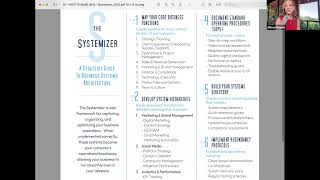
Allison Maslan explains how companies in growth phases 3-4 must document and standardize repeatable systems to avoid chaos. Break business areas into sub-systems, standardize infrastructure with naming conventions and folder structure, document workflows with screenshots and videos, and hold regular systems meetings. A PepsiCo CEO learned that frontline workers will avoid poorly-designed software, so updates and training matter as much as the systems themselves.
The systemizer is in scale or fail book. So a lot of people come in and they've been already implementing the process. We just updated it and this is what is in now in the software. So basically, as a company gets into phase three and four, they've got to get their systems together. It's a game changer when they can automate things, when they can get organized, but they also need to keep these systems updated. We just kind of found out now for our March event that now that Tim is getting involved that our system kind of sucks as far as our organization for this, the events. We have so many people involved in organizing the events that there were a lot of people, a lot of things slipping through the cracks. And so you're going to have to constantly update the systems. New technology, AI can do so many things right that to make life easier. So basically it is just getting things step by step. There's a framework for anything that is repeatable in the company. If it's happening weekly or monthly or even yearly, you need to have a system behind it. So first determine what are all the areas of the company we've got here. Nine. So, but you know, every company is a little bit different. You could help your clients do this. If you find that they're just working too hard or their team is frustrated, it's. It's usually because they, they don't have the systems in place and people are, they're on that hamster wheel. They're recreating the wheel all the time. So it would be helpful not to just hand this to them, but actually have a conversation around. This would be the one to pull up. If you find that they are just kind of in chaos, then what you want to do is take each one of these and break them down. So for instance, marketing and brand management, well, that's a massive category. So you got digital, you got content, SEO. But whatever they have for their company, no, they may not have SEO. Okay, and so you're going to break those down for each one. Now the way I have it in scale or fail. And actually I think I should really adjust this on here. But we have it like one. So if marketing is one, it would be digital marketing 1.1, content strategy 1.2, 1.3. So Jamie, actually I'm going to update this just to drive you all crazy. We're going to do an updated. Now I'm looking at this and I didn't realize that didn't have it. So that way they can always go, oh, we need 1.3 and so moving on to the next part here is the infrastructure. So this is something we didn't have on the last one but just figure out what are the naming conventions? How are you standardizing the folder structure? Like we, we've had a challenge for our videos and photos because they've been in so many different photo. So many different folders. Some are on Vimeo, some are on. So this has been a just an always source of frustration for us personally to find stuff because it has not been a standardized structure here. So we're working on that. And who has permission to get into certain things? Like if you have. If 1Password is your thing, you want to make sure not everybody has access to that to certain things on the CRM. So it's just. And then regular backup procedures. These are things that we don't often think about but also for cybersecurity. And how are they integrating with other things? I think that I don't know. Tim said something like we had a thousand Google more than a thousand Google Docs on things. Which is ah. So he's been working hard to get that organized. Then you want to. For each one you want a step by step workflow. Okay, so if we go back here and it is let's say email marketing, we know that we email three days a week and these are the steps that happen. We determine what the topics are at the marketing meeting. Then Susan assigns it or the marketing project manager assigns it to the copywriter. The copywriter then delivers it to the marketing project manager and it is then queued up in the soft, you know, the CRM and it goes out at this time. So it's like the step by step. You can have screenshots, you can have videos and you can have metrics. You can all these things. The, the more clear that you are, the better. Trainal is a great software to use. In fact we are looking to do a strategic partnership with them. They actually came and approached us. So this is something that we are looking to do. And then we've got a. This is a big one. Where the heck is everything? Okay, so this is something we are working on is a systems map and directory. So it could simply just be a Google Doc that just says this is where these things are found, this is what they're labeled under and so forth. If there's compliance issues then that has to be obviously they need to follow whatever those requirements are. Okay. And then here's another thing that's not on here and I think when I do the updated one I'll add it on here is this is something we used to do. And in a sense the team does, because the admin team gets together regularly is we did a systems meeting once a month. Because if you have new systems that are created and the team doesn't know how to use them, they're never going to use them. And so you're going to create systems that will just sit there and nobody will use. And sometimes you can over systemize too. So you gotta have a balance. I watched this great masterclass from on masterclass from the woman who was the CEO of PepsiCo. And if you ever get a chance to listen to it, it's phenomenal. One of the best leadership courses that I've ever listened to. And she talked about how she went out undercover on these trucks to where they would deliver the Pepsi to the stores. And they, she just wanted to kind of see what was going on and how the, how that whole process was going. So she rode in some of the trucks and she found that the drivers, when they were delivering the Pepsi, they were not using their software. They were writing it down old school, especially ones that had been with them for a long time. And so she said, oh, are you not using the software? And they said, oh yeah, that thing's a pain in the butt. We don't like to use it. So what she realized was that they needed a lot more training and simplifying the process. So even big corporations have these issues as well. So it's important that everybody gets on board and understands how to use it to use these systems, otherwise it will be a lot of effort for nothing.