Lead with Intentions: Eric Stenlake ~ Energetic Life & Relationships
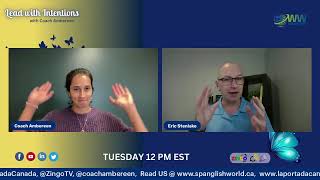
Coach Ambereen talks with Eric Stenlake about building intentional mornings through gratitude, journaling, and the STOP technique. They cover habit-stacking, family dynamics, and how vulnerability around addiction and recovery shapes better coaching for parents and teens.
Chapters
Foreign welcome to Lead With Intentions. I am your host, Coach Ambreen and today the intention for the show is to have an appreciative day. So I hope you find time in your day to appreciate someone and that also somebody appreciates you. Welcome to Xingo and Spanglish Network TV where here you can download our application across all of the iOS devices, Android devices. We're also available on any platform you could think of, Roku, Amazon, our own applications. Please go ahead and download us and leave a review. Let us know what we're doing well and let us know what we can improve because it's really important for us to make sure that you have the best experience on this platform. With that said, I do want to to welcome everybody here for giving me your dedicated time as we meet here every Single Tuesday at 12:00pm Eastern Time to talk about a topic and hopefully welcome you to an individual who is doing just that, leading their life, intentionally living more intentionally into who they are, what they're meant to do and also who they're meant to be. Today is no different. We are going to be welcoming Eric Stanley and he is somebody who's got a show here for us. So he comes in and he tunes in currently on Wednesdays at 4pm and it's what Eric loves to do, which is Energetic Life now. And his coach will actually his time will be changing to Tuesdays at 8pm Eastern. Moving forward, Eric is somebody who is super passionate about families and also teens. But before I go in a lot deeper, I'm going to hand the mic off to Eric and ask himself to introduce the best of who he is with all of us.
Awesome. Amri, thank you so much for having me on your show. I really appreciate the opportunity to be here. Hey friends and family around the world, thank you guys for tuning in. This is really fantastic. Like I said, my name is Eric from Energetic Life Now. I'm a teen parent family success coach. I got into that space because I survived my own three kids and I thought I would help others survive the growing years, whether it's from early early childhood on up through the teen young adult years and former teacher of middle school and high school athletic coach. And I really just have gotten into the space of personal development and into the the whole ideology of providing a safe place for parents to come to for questions, ideas, support, help and just really passionate about the family unit and helping you guys become the very, very best that you can be together.
There you go. Mic drop on that one. As we know, Eric is super invested in Making sure that he shows up every single time intentionally to serve to be on purpose and to also bring a very beautiful sense of energy into him. As we dive in deeper, you will see and you will hear us giggling, laughing, but then also having these moments. We're both pausing to recognize that there are challenges that we as coaches even face with our own families. You know, he said, surviving his three kids, I am making sure I can actually start to thrive with my three kids. And we are here to give you some tools, some conversations, some maybe new perspectives that you can implement starting today with your family and even your loved ones, your coworkers, you know, like your extended family, that stranger that you see who may be in need of something that you can just acknowledge and understand. My intention here, of course, is not only to give you the best of who I am, but be fully attentive and present and aware. Because for me, serving you is the highest level of honor that I can have just to be here, you know, present in mission. And I want to dive in deeper and ask. Eric, Eric, for those of us who are watching you and I often talk about, take those notes, do the work, you know, tell us something about you. You said that you're a coach, you went into, you know, the athletics, you're kind of into education, but if you want to define yourself to somebody else, who are you?
Boy, that. That is such a great question. And I think in. In my old age, I've kind of come to this realization because I've done a lot of self work on, you know, with myself. Right. This isn't something I ask of or where we ask of our clients without doing it ourselves. And so for me, really, I. I've fallen into this personal identity, if you will, that I am a champion of power, hope, energy and love. And I take those that identity statement into how I conduct my rise routine in the morning in my systems and processes, and then really target that I am then throughout the rest of the day being present and showing up in that space of all the action items I need to do that day, from all the roles that I play, the goals that I have so that I can really, truly be that best version of myself that I can be.
Okay, well, that I think is such an intentional way of living. Right? And we're going to kind of, kind of keep going back and forth in this space and in this routine to know that this is what it's all about. When we are on this show, we are talking about how do you live more intentionally. You actually talked about A lot of things. And I really want to dive in and understand what are some routines that you have in the morning that set you up to live into your words and remind all of us again. Because I think it's important for us to repeat those words to ourselves so that way we can actually start to become that.
Well, I would say first things first in the morning. Coffee. We're not going. We're not going anywhere without the coffee. Let's just put that right there. Right? So I'm. I'm the person that I get up and get that coffee pot going. And I love to sit there. And I've. I've really learned in this intention and being present that as I hear that, that coffee percolating, because I'm old school, I got the percolator, I don't have the Keurig. And listening to that coffee percolating and bubbling, that's. That's where really where I start. Gratitude. I'm like, oh, man, I am so grateful for this coffee. This is going to taste so great here in a couple minutes when it's all done and then start looking around. What am I grateful for? What am I feeling? What am I thinking about? What intentions, awareness do I need to. To kind of put into perspective today? What am I taking from yesterday? The great things that I went to bed saying, oh, this is what I was so grateful for today. This is what happened that was so amazing. And then taking that energy, that excitement, that gratitude, and then building, building, building into my next day and just being able to sit in the quiet and really just connect and. And listen and be aware and get connected in my core of that gratitude that, that, that is my. That is my number one go to in. In the morning once, once I got that cup of coffee going, okay, it's. What's my next step? Is that journal writing? Is it. Is it prayer? Is it manifestations? Like what is next? And I kind of have a number of things that I can do. I want to get into that space of really listening to me is what do I need? And asking myself that what am I feeling right now? What do I need? Is it this? Is it? This is this. Is it something that happened yesterday? Is it something I'm anticipating future that I could be worried about? But where do I need to be presently to get into that space and then say, okay, I'm ready to tackle this day. I'm ready to set aside that have happened what happened yesterday and not worry about tomorrow, but really focus on today. Who am I gonna. What People are gonna come across my path today. How can I get prepared for that interaction? Whether it's in the grocery store, whether it's going to school, and it's my students, it's the parents, it's the staff members, it's my own kids, my family, who do I need to be ready to be present for today? And who do I need to show up for me?
So there's a lot of inspiration that just completely flew into my heart, you know, more than anything else. And for that, I admire you. I think one of the most profound things that you have said, which reminds me of a. A quote from Deepak Chopra, and he says, when did we ever go from human beings to human doings? Okay, I'll repeat that one again for everybody listening. When did we go from being human beings to human doings? And what Eric just shared with us is one of the biggest gifts that we, including myself, that we can give ourselves, is ability to be fully present and know what you want to do. I love that there's structure in your day, especially in the morning hours. Like, my coffee is a mustard. That's a no. Yeah, that's. Don't even move it. Don't even think about it. That is gonna happen. But sitting there with that coffee and analyzing what the next steps are. Right. Like, many times, I think we become so rigid in our morning routine that it doesn't really serve us as much as it should. So it could be something simple like, hey, I. Today I want to journal first. Yeah. Or, hey, you know what? My mind is wandering in so many ways. It's like. It's just chaos right now. And maybe after this coffee, I'm going to actually go ahead and just meditate. So really defining how every single day unfolds differently depending on the challenges of the day before is such a beautiful way of putting it. Yet realizing that there's more work to be done after coffee. I think that's what everybody who's listening needs to define for themselves is after you are able to wake up in the morning and hopefully set an intention for yourself or really zoom into gratitude for just getting one more day to live on this planet, which is not guaranteed to any of us. Just really zooming in to say, what do I need to do today? For me, but then also for everybody else that I'm going to cross my path with. What does it mean, Eric, for you to lead with intention or to live an intentional life?
Boy, that's such a great question. I think for me, it's. I've learned to get into that space of awareness, right? Where because for me, what I, what, what I'm thinking and feeling determines the action that I'm going to do, which of course produces a result of some, of some sort, right? So if, if I'm in that, that mindset, my belief about something or the psychology, which is the belief about myself, others, the world around me, and I begin to fine tune that to how I'm feeling in my core and not be so quick to rush into the do part, the action. Right. I think that's sometimes as humans we become that, that doer rather than the being is. We're just constantly going, going, going, going, going and not thinking and connecting to feelings of the why behind what we're doing. And so if I'm going to set intentions around that, I really want to begin to, to connect and align these systems together so that I can it. Well, for me, it's going to help me not be so stressed out, situations, relations, whatever that, that time is in space of which things are going to be coming at me, stimulus, outside stimulus. It's either going to be happening to me or through me. And I get to choose that. And that, that for me is, is in that constant alignment and awareness of what I'm thinking and feeling really helps to keep me, you know, in, in check and on track, if you will.
Okay, so for those of us who don't really know Eric, you know, you're talking about some big words. You're saying things like alignment and congruence and really knowing what that intention is that I need to feel. How would you define and describe the word alignment to the people who are watching here today?
Yeah. So great. So, well, we're gonna go back to for a second if we will to, to. And forgive me if I say his name wrong. Debug chopper. Right. Yes. I love, I love his stop technique. And the stop technique that he teaches is really about setting that intentional alignment with your systems.
Right.
And so I, I've taken a few pieces from, from even with Dr. Joseph McClendon III and kind of create, teach to my clients, which, you know, typically our kids and families. And so the stop technique is this the word stop? S, T, O, P. Okay. The S is where I need to really push this pause button on my life remote. Here's my remote control. I'm remote control. Push the pause button for a second. Push your pause, you got your play, your fast forward, your rewind, whatever, push that pause and get into. Okay. The S is say what this emotion is. I Am. Oh, my gosh. I'm so frustrated right now. I'm so angry right now. Right think it's especially working with kids and families. I'm scared right now. I'm worried I'm gonna attach what is going on to this feeling and emotion, and I'm going to say what that is. The T is take a deep breath. I don't know that I've ever taken more, you know, one deep breath and had that be enough. Because depending on where the height of that emotion is, and I'm aware of that, I'll get into a rhythm of deep breathing. Whether it's a. A 4, 2, 4, 4 account of 4 in for that breath, hold for 2 and then a 4 out. When I'm. When I'm teaching people at the very beginning of this, they haven't done this a lot or ever. And so they can build that capacity so that four becomes four, four, four. Or then it can go to six. In hold for six and out for six. Boy, that really does great. And realigning your emotional state, realigning your physical state together. So when I'm talking about taking what's going on in the systems, it's really helping to bring it back together. And I always go into this core. I feel like Iron man in my core. I want to get that power and that energy back in my core. So the S is saying what that emotion is. The T is taking the breaths. Go into deep breathing. Get into rhythm. Slow yourself down with that. Now the O. What's my opportunity or outcome if this. Then what If I continue on the same path, what's my outcome going to be? Well, it could, could be negative if I'm focusing on that. If I change what I'm thinking and feeling and now do this, what's my outcome or what is the opportunity, the problem to be solved within this. Okay, now I'm realigning everything. So I'm. I'm pulling that negative emotion out and now putting back the intention of that outcome or that opportunity. And then now I can step back into that situation or that relationship and say, okay, now, now I'm. I'm realigned for that. And then the P is simply this. Praise yourself, pat yourself on the back, say, listen, I did it right. So here's, here's my. I am. And I think this is backwards on screen. I am a champion of power, hope, energy, love. When I do that stop technique. I'm realigning all of this. And the champion comes from my grandfather. He used to call me champion and he would say, good job, Champ. Way to go, champ. That's my praise phrase. That's when I'm patting myself on the back and saying, yeah, good job, Champ. Way to go, Champ. That just makes me feel good. That's a great, great dopamine release. I'm like, okay, I'm back in it. I've set that attention. I've realigned myself. I now can step forward and continue on. At first, this might. You might think, wow, that's going to take a long time. No, quick. It's quick. When you practice, practice, practice, practice, and. And are shooting for that mastery of this, it's going to get faster and faster and faster. And that time and space of that you need is going to shrink, and it's going to be boom, boom, boom. And you are going to default to that intention and best practice of showing up and being present, not only for you, but for those around you.
Yeah. Consistent theme in your life and mine too, it seems. So what coach Eric just told us is that you kind of have to force yourself to acknowledge the feelings that you're going through, and you have to make sure that you reset or you pause, and then you will find out is an opportunity of growth. Am I really focused on the outcome? What's the worst that can happen from this? And then one of the most important things that I think people are missing from their life is what our intention is today. A sense of appreciation. We appreciate other people. When it comes to us, the glass is always half empty. You need to fill that glass up so much with everything that you do, recognizing how wonderful and amazing you are. Because it's that small step that will actually start to change your mindset, to be one that serves you and then hence serves every interaction around you. So when we actually keep practicing this. Right. With anything, with any habit, you know, and I loved how you have kind of talked to us a little bit about habit stacking. Every single conversation that I'm. We're progressing towards, like, well, I do this and I do that. I have my coffee and then I just sit down, pause, and think. And then I realized something isn't right. Let me go ahead and use a stop methodology to get myself to realign. So for those of you who now have a better understanding, I hope, of the word realignment, it's like thinking where your mind, your body and your soul all kind of connect up and they're just all streamlined. Is it easy to do? No. Can it be done? Yes. With practice and consistency and the self of discipline. Because your life deserves a little bit more. We can all learn to master it. That's what Coach Eric just mentioned to all of us as well. What's one personal thing, Eric, that you would like to share about yourself with everybody watching today, including me?
Oh, geez Louise. Well, you know, I've been fortunate enough to live a lifetime already of mistakes. Wait, what? I thought it was supposed to be positive. Wait, no. I've led a lifetime of mistakes that have. What? Taught me and continually teach me to keep myself in alignment and kind of sorry, but I'm at this place now where it's like, I don't lose. I either win or I learn, and I'm grateful for both. I don't look at. I don't look at things as, like, no man. Listen, I'm a champion of power, hope, energy, and love. What did I just learn from that? It didn't work out. Why? Great. Dissect that. Pull it apart. Which part of that didn't work? And then get back into realignment, get back into focus, get back into attention. What I need to do from here. Where should I go? How should this be? And then get back in and do that. Now, listen, if. If you're hearing and I'm repeating this intentionally on this. Oh, wait, are we getting intention? Yes, I'm repeating this intentionally because you're thinking about driving down the road. You're thinking about going to the grocery store. You want your kids to clean up after themselves. You want dishes to go from different places in the house and make them wear back to the kitchen. Look at your systems and processes as a family. What do you need to enact change in? What are those areas of life that you intentionally need to get change in? That's what I do for me. And so in this space of vulnerability, I am not perfect. Ask my kids. They'll tell you.
Right?
But what I can do is say, you know what? That didn't work out. Okay.
Why.
Do I need to apologize here? What happened here? I. I bring it all back together and get back into the alignment or realignment, if you will.
What would you say? Because I know a lot of people are listening today will say, well, that's great. You know, Eric, Coach Eric, you have the time to sit there and reflect and course correct and realign, like you say, I don't have the time to do that stuff. How would you help support those families, those teens that are really struggling to understand this is a priority that they should not put on the back burner?
Yeah, great question. And because this Is one of those questions that come up with families in the very, very beginning. This sounds like it's going to be a lot of work and a lot of time. What's the impact if you do this? What's the potential if you do this and you commit to doing this? And then I'm on the flip side of that. What's the impact if you don't?
Right.
The definition of insanity is doing the same thing over and over again and expecting or wanting different results. Don't tell me you don't have time and you're not willing to change, but you're sitting in front of me telling you, you that you want to change and need to change. It's time. It's time to put your, your big kid pants on and say, listen, it's time for us to make some change and, and we have to do this and we're going to commit. If you're not going to commit, I'll. I'll see you later. Not the right time for you. You're not, you're not the client I'm looking for. I'm looking for people that are willing to get out of that comfort zone. Say we're ready to. We're ready to realign, refocus our family, refocus individuals and come into this alignment together because we got too much of this going on fighting in the household. And we would much rather be here in alignment together and going through this journey together. So, yeah, it's, it's, it's your decision. It's your choice on your time. You're either willing to do it or you're not.
Kind of tying it back to what you said in the beginning, right? That you've had the privilege to make mistakes. Which I look at is like another word, like failure, right? Like, oh, I failed again. I failed my kids again. I failed it. I lost my cool. I failed to submit the project on time. I failed to show up as my best self. We as humans are constantly going to fail. That's the best part about this journey. But the thing that you're talking to us about is when you're failing, it's an opportunity to find out what's priority. I often tell people I talk to and my own clients that all of you say family matters, but how do you show it? You can tell me that the most important thing in the world for you is your family, yet realizing you need the support and help of a professional that can help you get there. And folks like you and I, Eric, we're not looking to get the money. We're like, you come to us, you give us your time and your energy and you want to grow. What a legacy we get to leave behind. And it's this impact train that we're all on, right? The butterfly effect. If you look at my logo, it's all butterflies. Because we do impact each other when we start to live more intentionally and in a way that's going to uplift everybody else around you.
Okay?
Now share something about your family so that way we can get to know the stem links a little bit better.
Well, are you sure you're ready for that?
Got my sleeves up. Let's go.
Eric, listen, I'm here to tell you that, that this is definitely not a perfect family. Okay? And the reason why I'm in this space and I'm coming to you now in full vulnerability is because I have. We have a 24 year old who for the first time in nine years is seven months clean and sober. Okay? So when I tell you I've made mistakes along my journey to be in this place now, to be in alignment, to help and support you friends and family around the world, I'm. I'm coming to you in full vulnerability and telling you this. Everything that I've learned in this journey has prepared me for today and tomorrow and the next day and the next day.
Right?
We've got kids who are other two. We have three kids. Our other two are dealing with anxiety. Daughter has PTSD from sexual assault that happened at school. Okay. So we're, we're in this space together as a family. We've not given up on each other. We've not given up on our kids. We've, we. I've told my kids since they were little, there's nothing you can ever say or do there is ever going to stop me from loving you. So give it your best shot. And they did. And they, they, they, they took it to the edge in, in some situations and circumstances. So I, I'm saying all this to you out of deep, deep love. Everybody that's watching this live, the replay down the road. This is. Parenting is not easy and it takes a lot of work. And in order for my kids to change, I had to change. I had to go through my alignment and get that so I could model that for my kids. And in this last time, this is, this is. Well, seven months ago, I found my oldest son who at 23 years old was homeless. I found him overdosed in a, in a park bathroom. And when we got him, you know, revived and I Said, you're, you're either going to get in the car with me and go to detox and get off drugs, or you're. I'm going to leave and you're going to go back into that bathroom and I'll see you when I see you, because I know what's going to happen. You are not going to survive today. And to have that choice with your own child, that conversation with your own child was not. Was not easy. And he looked so horrible. I couldn't even look him in the face. I, I had to have this conversation with him because I didn't want to. I didn't want that image to be on my mind, in my mind of, of how horrible he looked, because he didn't look like my son. He was somebody else. And he was like, okay, I'll. I'll go. And we. I, I thank God. I thank God to where he is today. He just came over last weekend and looks absolutely amazing. He smiles. Which, when you have a. Someone who doesn't smile for years and to see them smile again, like, I, I was shaken. I was like, oh, my God, he's smiling. Like that simple little thing was just huge. So what kind of, what kind of family are we? We're survivors and we're thrivers, and we move and we go through hard times and we come out the other end and we look back and say, I'm grateful that we're survived, that we survived. I'm grateful that we're thriving now. What are the lessons that we've learned? How can we help others? And that's that. In a nutshell, is, is. Is where we are. As a famous.
First of all, I want to commend you on your courage, and I truly appreciate you giving us a glimpse of reality. We were talking about how families won't ask for support, and here you are telling yourself, either my son is going to rise and I'm going to help him, or he's going to sink and I'm going to watch him. And as a parent, you never want your children to feel like they're not worthy, they're not worth the fight, but to acknowledge that we as coaches even have troubling times. We have also not figured out this space of family that we really want to impact people because we have gone through so many challenges that we don't want other families to face it.
Right.
We want to cut the process short. We don't want it to be nine years of constant watching your son kind of taking his life away every minute. He's just not realizing that this breath that you get to lead with, that you get to have is such a blessing. And I think it speaks volumes about how you and your wife. I don't know what her name is. If you can let me know. Yeah.
Jennifer.
Jennifer.
Yeah.
So as Eric and Jennifer, they've shown us in this situation that, you know, we accept our children as they are. And I think that is one of the biggest challenges that we as humans face. We don't accept our kids as they are. We are always trying to change them. Their mindset, their perspective, their interest, their wants, their desires. And it's like we're projecting ourselves onto them, but they're not created to be us. And I'm gonna actually move on to the next question after this. This one comment. Yesterday, my kid was like, okay, mom, like, I don't want to be a high performance coach and a family coach when I grow up. And I looked at him, I was like, hey, buddy, I don't want you to be that either. Like. And I was like, you do You. Your dreams are far too sacred.
Yeah.
And my dreams for you are that whatever you want to achieve in life, that you have the courage, the strength and the discipline to get it done. Okay. What would you say? I know you did share a little bit about where things were for you. What do you say is the biggest challenge that you're facing in a relationship right now, Eric?
Biggest thing I'm facing in a relationship right now. I can't think of anything huge, if you will. Like, I. I think I'm. I think I'm pretty. Pretty dialed in. I. I can't. Can I. Can I say that it's individuality, meeting with the members of our family and coming to that place of understanding how each member of the family operates to a place that I can offer unconditional love, unconditional acceptance, grace, so that they can be them.
Right?
Thinking. Thinking of. Of my kids. Right. It wasn't their dream. I had dreams for them. We. We had dreams for them. They're going to go to college. They're going to do this. They're going to do this. They're on their own journey. They're on their own path. And being able to let some of those things go, to be able to love and appreciate who they are here and be present for them and show up for them and learn what matters most to them. And I think that learning that over the years really has helped me take that into whether it's opening a door for a stranger at the Grocery store or. Or doing something for, you know, for anyone. Showing up for my students at school, whatever. Whatever that is. I think I just try to take that. Those learning experiences and just make that impact. That's my word for 24. Impact. Make that impact as big and stretched and as far and as wide as I possibly can.
And I really believe you will, because here you are on Lead with Intention, and you're constantly reminding me and everybody watching that intentional living something that you choose. That I choose. So in any given moment, as humans, we have the choice. It's just up to us which way we want to go. And I think it's lovely that you said it's not the biggest challenge, per se, but in reality, as humans, understanding each other as they are and being okay with it, it's far more difficult than we may think, Especially. Especially with our loved ones.
Yeah. Yeah.
The home is where you're, like, the most comfortable, and you'll say things, and then you're like, I would never talk to my client or even say that out loud to them. But at home, we often don't give our best to the people around us because we, in a way, take them for granted. Right. And if you're listening to this and you are a mom, a dad, a grandpa, a grandma, a brother, a sister, an aunt, an uncle, a great grandparent, whatever you are, it's really important for all of us to do this, work together, to be intentional in making sure that even if it is for just a little bit, accept the other person as they are. Limit your judgments and your biases to be like, okay, this is their truth, and I'm gonna hold space for that. And that will create profound differences in the way that you lead and then the relationship that you have. Let me ask you, what is one change you want to see in the world?
Well, that, my friend, is an amazing question. So glad you asked. What change do I want to see in the world that's coming straight out of my word for 24, which is impact. That is my whole focus for 2024. Impact is what kind of impact can I make? And I want to make the biggest impact that I can globally.
Right?
We have these. We have our shows that. That is being seen around the world globally, and being able to spread messages of what power, hope, energy, and love. Just take that and spread that out to the masses to say, listen, we get you. We're here. We've done this. We've gone through this. Now we're here to help support you. That's. That's it for me, that's where my passion lies, my intention. I, I just, I, I keep looking for, you know, tomorrow. Like, what kind of impact can I make tomorrow? What kind of impact can I make right now? And just staying within that just, man, that's what's, that's what's making me literally hop out of bed, get that coffee going, because I'm like, yes, let's do today, let's do this. Let me be, let, that's my, that's my prayer for the today, my intention for today. Let me be present enough that I can have an impact on everybody that I meet. Let me, let me be able to take that, that energy and what we call that 50 foot rule, that magnetism that, that anybody that I pass, anybody that comes into proximity is going to feel that magnetism, that energy and go, I don't know what it is and I don't understand it, but why do I want to be near that person? Why do I want to be surrounded by that person? That's, that's the impact that I'm, that I'm holding true for, for myself for this year.
I think that's one of the most important human drives, the sense of, you know, leaving something behind. And for everybody who's watching here, Coach Eric mentioned twice already that, you know, the impact is my big word for 2024. I also, every single year I kind of define like an overall theme and that helps me decide and make decisions really fast. And so Erica's like, if this is not going to lead to impact, I'm not sure about this one. And for me, that word this year is to surrender.
Oh.
And kind of stumbled upon it after watching a really amazing mastermind. And so for everybody who's watching here, I want you to think of one word that is your overpowering word. The main intention for 2024. And yes, it's not too late. It's never too late. Even if you're watching this on December 30th, it's not late. Come up with the word that becomes the overarching theme for that year. And then if you really want to do a bit more every year, you know, Eric talked about four words. He kind of keeps putting up his post it with his beautiful sun, like the love. And so think of three words. So these are three words that your future self, the most ambitious future version of you, that could be a year, three years, five years you would use to describe that person with these words. Okay, so these are three words that you're going to be Living into as your most ambitious self. And I guarantee you, if you put that those three words up on a bathroom mirror and you see it every single day, something's gonna change in your life naturally. You don't have to sit there and make it into like this meticulous thing. But just looking at them, glancing at them while brushing your teeth, it starts to do this magic. And so I would love for you all to tell me when this starts to work. So DM me on coachembreen across any social media and just say, hey, I watched that episode with Eric and you talked about these three words, which I call clarity words of my most ambitious self. I am living into my own power. I do have a little bit more hope. And these are personalized to you. Nobody else. Right. Except for you. And then how do people, you know, as we're talking about this, how do people get in touch with you, Eric.
To get in touch with me, energeticlifenow.com is the easiest way to do that. Or you're going to find me on. On all the social media platforms at Energetic Life. Now that's. That's another easy way to get a hold of me as well.
Okay. Yeah, I think it's important because we are talking about impact, and 2024 is that year of impact, which means if someone is really looking to find you because they like what you're saying, because it resonates so well, because you are the right coach for them, because maybe their child is going through ptsd, maybe their spouse is going through some addiction. Right. Or they see that there's more potential to this relationship and they relate to you because your life is a journey that they can relate to and they want to understand better how they can lead, which I think is so brilliant and amazing. And I think just being you, being open about that message, it's so profound. And I really wanted to thank you from the bottom of my heart because this has been a very inspirational conversation thus far, you know, with you and I. So tell me this. How did you get into this space? Like, why did you stumble upon making an impact in the lives of families and teens?
Yeah, great, great question. So I, I think I mentioned earlier that, you know, working with kids, I've been a teacher in middle school and high school and whatnot, and then got into the space with a company called Franklin Covey. And this, if you guys are familiar with the seven habits of highly effective people for the last. Well, this is. Yeah, 14 years I've been in the education division and going all around the United States and Canada, and teaching the seven habits of life, effective people, teens and families all across North America. And I. I just became really engrossed with the personal development from the perspective of the teens, the families, you know, teachers, and. And when 2020 hit and everything really, really shut down, then I got. I got associated with Dr. Daniel Amen from the Amen clinics. He actually was a. A mentor of mine prior to that. So I'm a brain health coach with. With his organization and then with Dr. Dr. Joseph McClendon III in the neuroencoding Institute. I became a neuroencoding specialist with him in that neuropsych psychology field. So I take those pieces in with the personal development space of things like the seven habits and speed of trust and the five choices to extraordinary productivity. And. And when I keep saying that, like, my life is a journey, I just am pulling from so many different things, avenues, and just got into this space where it's just like, I get it. I get it, like, this is where I'm gonna make that impact. And so as. As a coach and a speaker, this is what I. This is what I get to do. And that just. That's what's driving me every day to hop out of bed and get rocking.
Because I think that is such a beautiful lesson. Often we don't really know what our purpose is.
Yeah.
What it is that we're meant to do. Right. And I think it's such a journey. I was watching, you know, Black Panther again yesterday, and I was like, the words in there are so profound. Where those people who go through the most difficult times become great leaders. Right. Because their challenges are kind of there to remind them that you're creative for something more, something bigger. And, you know, kudos to you for sharing that with us because it is through these mistakes, trials and challenges and falling that you recognize, oh, damn, that Dr. Daniel Amen, who I adore, too. I think I'm gonna pull that one because that goes with, oh, wow. It fits like a puzzle. And it's these small little moments that I think we as humans are just waiting and asking and wanting to be like, how do I fit the story a little bit better? You know, and as families go on, we're constantly shifting and pivoting all the time. It's not like you just have it figured out. And I was telling my group, coaching, you know, adolescents as well, I was like, if you think you've got life figured out, you're doing something wrong. Like, you have to reset and recenter all the time, you know, as we come to a close, I know we're kind of jumping on time here. So I'm trying to create, not trying to. I am creating this beautiful space in this beautiful place where kind of the last five minutes of our show, I call them the rapid. The rapid five, the rapid fire. Or like an intentional wrap up. Whatever your heart desires, you choose as you're watching and tuning. And if you do want to let me know, I can lean towards one way if I get enough comments saying, hey, I'm brain rapid fire versus intentional wrap up. Or maybe just keep it the way it is. It doesn't matter what I want to ask you. And these are questions I want you to answer without overthinking. So maybe a sentence too to kind of wrap up and let the users know a little bit more about how we as coaches just kind of think on the spot really fast about, okay, what do you leave? What do you want to leave behind to the world?
Leave behind to the world? Hope. Hope.
And how would you define hope for those people who want to feel that when, you know, when you're not here with us?
Hope being no matter what you face in life, situation, relation, whatever that space is that, you know, you have hope to really navigate through successes, challenges, whatever that looks like, that's the hope is being able to move yourself from where you are to better, to great, to, you know, absolute magnificence.
You heard it here. So excel and strive for excellence. And magnificence, it seems, is what Eric wants to leave behind. Making sure that hope is something that's always there. For those of you who feel like it's that you're reaching, like a very difficult roadblock or difficult challenge, always be hopeful. Okay. How will you know you've led an intentional life?
Great question. I think probably till the day that I leave this earth, I'm just going to keep trying. And some days I'm going to be successful. Some days are going to be more challenging. And I hope that when that date comes that people will be able to see that I led and. And was an example of. Of what it could be for them.
Okay, if you could create one law that everybody had to follow, what would that law be?
One law that everybody had to follow. Love more.
So that's a great place to wrap up, but we've got a few more. Oh, my God. So everybody, somebody love more. I tell my kids, my loved ones all the time, love is free and it's limitless. So, yeah, tap into it a little bit more. What is one lesson that has made you who you are today?
Boy, I don't think it's one. I think it's, it's, it's. It's all of the opportunities that I've come across where I've not been successful.
Okay. Failure is a great teacher, you're saying. Yeah, yeah. What is the key to a healthy relationship?
Get out of your head and get into your heart and lead from your heart.
There you are. So I think that this conversation has truly been one that is so thought provoking, but also very humbling because I'm going in with, like, I have so many great inspiration, like, inspirational moments. I'm going to write down and I hope throughout this whole conversation, most of you have taken some notes, have recognized what the STOP methodology is, have recognized that as families, we're not all perfect. Nobody has it figured out. We're all making mistakes. And that's how we learn best, is through our mistakes. So for those of you who are still here and have tuned in to our entirety of the show, which is lead with intentions, that I have the honor and privilege to be here every single week with you. I want you to know that this show can be heard on Spanglish Radio Network. Please check out Spanglishworld ca. That is SP A N G L I S H World ca. And for all new program, for all news and programmings, please tune in to Spanglish World. Watch it, hear it, read it, download it, and most importantly, live it. With that said, I hope today is a day where you truly inspire someone through inspiration and appreciation to lead the best life that you can. Thank you so much for your time.
Sam.










