Lead with Intentions: Guest Izi Chinchay
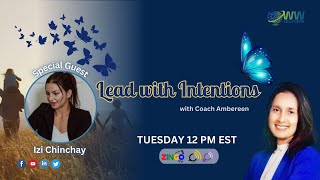
YouTube interview (Lead with Intentions) hosted by Coach Ambereen with guest Izzy Chinchay. Izzy — a former Division I soccer player turned coach and entrepreneur — discusses coaching philosophy (prioritizing fun, creativity, and rewarding effort over outcomes), mindset practices (smiling, slowing down, authenticity), practical productivity tactics (time-blocking, phone-free monotasking), family dynamics (avoiding gossip/triangulation; direct confrontation), and personal biography (homeschooled, late reader, injuries, career transition). The episode closes with leadership advice ("your mess is your message"), contact info (Instagram: IzzyChinchay; izzychinchay.com; The Izzy Chinche Show podcast), and a rapid-fire intentional wrap-up.
Chapters
Foreign Welcome. I hope today your day is filled with brilliance because that is what the intention is for today. For those of you who don't know me, my name is Coach Ambreen and I run this show every single week at 12:00pm Eastern Time where we welcome you to Spanglish Network TV and Xingo TV channels 245, 249, 250 and 251. Remember to download Xingo TV app on your respective TV devices and at the app stores. We're available all across iOS and also Android. As you are downloading this app, please make sure to tune in and give us some feedback. That feedback is super critical for us to do a better job of serving you. And of course, the app is completely free. It's also available across the Google Chromecast, fire sticks, Fire TV along with the Roku devices and any smart TV that's supported from 2016 on forward. As we are launching into today, I am super, super, super excited. I've got one of my homegirls on today. We have brought upon coach Izzy Chinche, who is a remarkable human, but a brilliant coach indeed. She's somebody who does the work and is currently an entrepreneur and is super passionate about soccer. So she works with individuals to recruit them and to make them skill up. But that's not all. As we dive in deeper, you will hear so many amazing things about Izzy and how she continues to trailblaze and just set an example of who she wants to be, which is why she is welcomed here on Lead with Intentions. Welcome, Izzy.
Thank you so much. Thank you for that intro. That was amazing. I am so, so excited to be here and hopefully contribute to what you're doing here and the impact that you're having in this world.
Yeah, well, that's perfect because tell us something about you. Who are you and what is it that you do?
So, as you mentioned, I am an entrepreneur and a coach. You know, a daughter, a sister, a friend, you know, many other things. But as far as my work goes, I am very passionate about business, about scaling my coaching business, about helping as many players as possible move on, play in college, play to the next level, fulfill their dreams, enjoy the sport. I feel like that's something that's lost now. We're just like, grind, grind, grind. We got to be D1, we got to be professional or it's nothing. But, you know, at the end of the day, it's a game. It's supposed to be fun. We get better the fastest when we are having fun, when we are enjoying what we are doing. So I'm very passionate about bringing that to my coaching style. So that's a little bit. A little bit about me. I also have a podcast, so I love talking.
All right, share with us a little bit about your podcast.
So my podcast, I do a lot of solo shows where I mainly talk about the realm of. In the realm of personal development. And I share a lot about my life, things that I have been through. I just really try and be as real, as raw and as honest as possible, even when I don't want to. And then I also bring on lots of coaches, entrepreneurs, and business owners. I've had you on the show. So within that realm, I also like to bring on athletes, everyone kind of in that space, so that I can add value to the listeners. You know, interview people who are knowledgeable in their realm and let them share to the listeners and hopefully add value. That's what we're trying to do.
So, yeah, 100%. So you mentioned a little bit about adding fun, and I know you and I, we've talked about that. A little bit of how we do incorporate a lot of fun into coaching, which is traditional. Right. So tell our viewers here who are listening and who actually just want to have fun in life or even think of fun in sports together.
Yeah, I think, you know, I work under the concept or try to work under the concept of reverse engineering. And when I think about what it is to have fun is when we're having fun, we're not afraid of failure. Right. And we're not trying to be perfect. And so I really try and get away from those spaces. Because if you are trying to be perfect and if you're trying to never fail, you're fear driven, and you're driven by fear, which I spent a lot of my time as an athlete in that space of being driven by fear, of being driven. Like, what if I don't make it? If I don't good? If I'm not good enough, I'm not fast enough, I'm not fit enough, whatever. And that was the main motivator. And sometimes that can work to your advantage. And there's a time and place for that. But then I was, like, thinking about that on the other side. Well, who is it that learns the fastest? And. And it's pretty widely known you work with kids all the time. Kids learn the fastest because they are having fun, because they're not afraid, not mistake. You know, they're not afraid to fall in their face or fail or they're not like, obsessed with being perfect so my athletes will make a mistake. And I tell them, like, I don't care. No one cares. It's not a big deal. Shake it off. You know, I tell them like that sometimes I'm like, just loosen it up. Like, let's laugh a little bit. Put a smile on your face. So that's kind of, kind of the part of the philosophy in that space.
And let me ask you this, for everyone who's listening, was like, yeah, yeah, easy. Have fun. Laugh it off. Like, just, you know, like, get over it, move on. How often does that work? Or what's something that you can give our viewers who are watching here maybe a quick short tip for it to actually be effective?
Tap on. Yeah. I think the first thing is to not take yourself so, so seriously. That's something I've struggled with my whole life. Like, everything was always so serious for me. I was like, this is do or die. Which, again, isn't always bad. You know, it can be good. It can, you know, drive excellent results. But on that end of things, you can get burnt out. You can get burnt out much easier, easily. So I would say something that I do and I teach my athletes is to simply just put a smile on your face. And you put a smile on your face, you give someone some cheese. Like, your body has a response to that, and your body can automatically, like, let some tension go. Like, I can smile right now. Okay. And then you connect to your smile. And then once you're smiling, it's so much easier to connect to a laugh. Right. If you don't have it. Like, we smile before we laugh, right. So if I have no smile on my face, I'm not going to be able to connect to a laugh. And I think laughing is probably one of the most fun things that you can do. So if I connect to a smile, I'm going to be much more open to, you know, maybe chuckling or laughing, laughing at myself, laughing if I make a mistake, you know, and not taking it so seriously and trying to just calm and smile and relax that way.
Well, okay, I think that's true. So the fun part is how you're talking about this concept of smiling. And there are two things that come to mind. One of our spiritual practices as a Muslim is to smile. And they say smile is what we call a charity that keeps on giving. Right? So it's like, you never know who needs a smile. You can literally be walking down the street and you smile some random stranger. You're like, maybe that's exactly what they needed and then they'll smile back. Right. It's kind of like contagious. The other thing that is really important about smiling is not only is it a great stress reliever, but the kids that I work with as well, I'm like, listen to me, man. Laugh, smile. It's free. Right? Like, and I love the fact that you're saying that, you know, put a smile on your face until you start to believe it and tap into those feelings because that's when you can shift the mindset.
Yeah, yeah. And when, Go ahead. When we're, when we're having fun, we're so creative and, and creative is to play, right? It's to play. And you know, we stop into that state of creating and playing. Like, I think that is like, probably one of the, the roots of fun. I'm trying to think about the definition of fun, but like, really, truly, I think it's when we're in this creative state, because that's what kids ask you to do. Will you come play with me? Will you come play outside with, with me? Will you play this game? Because they're creating and they're evolving and they're chasing, they're hiding, they're seeking and they're doing all these things and, and that's where we learn the fastest. And like, I know from being an athlete and also coaching my athletes and I watch the kids that excel the most and it's the kids who are just enjoying being out there and having fun.
Yeah, it's true. I think as we age, as we get into adulthood, we do start to take life more seriously, like you said. And when you tap back into like, you know what, what's meant to happen is actually going to happen. So why don't just enjoy the journey, even if it is with a five second smile on my face, Right?
Yeah, yeah, yeah.
What do you think helps these, you know, your, your clients, what do you think is the one advice that you give them? Well, what do you think helps them to make it, to make them realize that this is not the end all goal? Right. Like, how do they get past this? Because I know everyone's like, I have to build a caliber, I have to build my skill set, I have to be seen, I have to get recognized, I have to go into college. And there's so many stresses that people have, you know, because they need to make it, so to speak.
You know, I do wish there was just kind of like one thing I would say and then we could fix it. I think culturally it's it's ingrained in us to climb the ladder of the of success and to do it in a certain way. And I've seen that come into the world of soccer. It's like you have to be playing for these kind of club teams and you have to be playing at this level, in these showcases, in these tournaments. And if you do all of these things, then you will find success. Then you will be proud of yourself instead of. Well, first of all, maybe my end goal isn't to go all the way. Maybe it is just to enjoy it and stay healthy and stay fit. But also, we got to start rewarding the work instead of the success. And if you can start rewarding your work more than anything, that's going to make a big shift because then your value and your self worth isn't dependent on the scoreboard and it's not dependent on anything else other than, you know, I gave a good effort, I gave my best effort, and I'm able to be proud of myself.
All right, so for those of you who are zooming in, tuning in, watching, listening, we always talk about the need to take notes, the need to do the work. When you come on these, you know, on this podcast or on the show specifically, I really want you to look at this as a place and in the way of learning how can you actually take more ownership and lead your life with intentions? And as you just dropped a phenomenal nugget. Because I tell people, I'm like, ah, you're not the only one. I got my notebook too. You know, like, so if you start to reward the work, you'll start to see that there's progress and that gives you momentum.
Yeah. And I have to remind myself that, like, I think hustle culture is really easy to slip into. And so I have to remind myself, and there's time and place. I have to remind myself, like, sometimes I will actually sit down at the end of the day and be like, well, what did I accomplish today? And it's like, you know, I went for a walk, I worked out, I got those emails done. You know, they could be really simple things, like even like making dinner for me. Sometimes I'm like, yeah, that was work. Like, I didn't go out and eat something unhealthy. I made dinner. I made a good choice. Like, I will reward that work. I'll recognize it, you know, for myself. Makes a difference for me.
No, definitely, because that's something that I often talk about here on this show as well, is this necessity to champion your own self. Right. Cheer yourself on, because you're the only one. Let's say you were just like, man, I don't want to cook today. I just not feeling it. But you had the courage to say, you know what? I made a commitment to myself. I'm going to eat healthier, so that means I'm going to go ahead and cook today. And then you did it. It's all in your mind, but you can reward yourself for it, right?
And I love.
I love listening to that, and I love hearing that.
Good. I'm glad I had a good. I got a good talk about it this morning, actually. Before. Before I came on, I was talking to a good friend, and she said, you know, I think I'll start posting on. I always told myself, I start posting on social media once I finish my PhD. Like, once I graduate, you know, my PhD. And I said, if you wait, if you keep on waiting for the next milestone, you'll never feel worthy of it because you're putting your worthiness in accomplishment. And. And she was like, oh, my gosh, you're right. I said, you know what? Start posing now, girl.
You're good. Okay. So do not po. You know, do not put your worthiness in accomplishments. Wow. How often do you think we do that, Izzy?
All the time. I do it all the time. I've done that probably most of my life. I think, you know, it's a. It's not some line you cross. You're like, all right, I'll never do that again. You just. You try. But I think our society is set up that way. Like, we reward the success, the finished product, not the. Not the behind the scenes, not the little things, as much as I think would be beneficial for us all to do what I.
And I loved, is what you said. And I really want to dive in deeper, a little bit into. I said I had done that most of my life. So it's kind of in the past. Now you're mindful about it. What actually allowed you to change that habit or that behavior?
I think finally stepping away from being the athlete and becoming the coach and my entire identity was poured into becoming this elite athlete. I derived all my value and looked for all my validation through my success as a soccer player. And I am proud of myself. I'm proud of my, you know, what I accomplished. And, you know, I got a Division 1 scholarship. That's something that, you know, I had to overcome a lot to. To make that happen. But I hit a point where I was very unhappy doing what I was doing. I had been A forward my whole life. Due to injury, I had to switch to goalkeeper. And I made that dream happen. So I was able to play semi pro. I was able to play Division 1, and I started getting this success and I got the scholarship and I, you know, all the. I cried cross these milestones and I felt awful. And I was like, why do I feel so bad? I was like, why do I feel so bad? I am finally getting the thing that I worked for for the past 15 years, you know, at 20 years old. Like, you're, you're working since day one to get a division one. That's what I was doing. And I got it. And I felt like a fake. And I remember, like, I had this party, these people threw this party for me for, you know, getting this, this scholarship. And I was in the bathroom and I was like, I feel like a fraud. I said, I feel like a fraud. And I wrote. I was like, why do I feel like a fraud? And I said, because this isn't what I truly want. And everyone told me, you're living your dream. You're living your dream. But my dream was to be a forward, but I had been injured, so I had to be a goalie. And so I had to, you know, eventually come to terms with that and make the decision to walk away from that dream, which was one of the hardest decisions of my life. But that's where I started to make that shift and be like, that was an accomplishment in its own walking away from something because I knew that wasn't for my. My highest good.
And kind of walk us through, because there's a lot of times, like, let's say someone's going through an unhealthy relationship, we really kind of zoom in here and talk about how to create healthy relationships. And, and that relationship was even our own selves. What was that self dialogue that you had to overcome and what was going through your mind to be like, okay, it's required for me to walk, you know, walk away a step aside?
Yeah, that's a great question. I think a lot of it was. I lived in this space for a long time where I believed that if I wasn't to some degree suffering, if I wasn't miserable to some extent, I was not moving forward, if I wasn't in such an intense grind that almost every day sucked to some capacity, I wasn't moving forward. And I started to really look. I was like, I dread every single day of training. I dread getting out there. And I was like, did this always used to be this way? And the answer was no. And I was like, is this how it is for everyone? I was like, no, it's not. And I was like, then why am I going to keep myself in this place of suffering? And I realized it's. It was most comfortable for me to be there. It was most comfortable to suffer to that extent. And that's why I really started going, okay, all right, we gotta. We gotta redo some thinking. Redo, redo some pattern patterns in my brain. And it's, you know, still something we work on, definitely.
And I kind of want to connect what you said, you know, 15 years of working, working, working, working to get a dream.
Yeah.
Accomplish the dream, to find out that, you know what? This is not how I want to feel. And it's so beautiful because as human beings, we always are looking for those feelings.
Yes.
And many times we don't feel the feelings. Right. And that's, I think so much trouble starts. Right?
So good. That, that, I mean, that's. You nailed it right there. When we don't feel the feelings that we think we're going to feel. And that's where I started to shift, is like, I decided if I am not enjoying the ride of my life, it's not worth it. And I was not enjoying that ride. And I said, I'm not going to, you know, stay on. Stay on a bus to, you know, get to a certain destination and hate the bus ride. And even as, like, an entrepreneur, I thought for a long time, like, it had to suck every day. Had to suck every day. Had to, you know, feel like I was never going to make it. I was going to go broke, and I wasn't going to hit that, and I wasn't going to enjoy anything or treat myself. And I said, that is. I'm not doing it that way. And I know that's kind of the culture is like, yeah, you know, you have to pay your dues and you have to da, da, da. I said, you know what? That's not worth it to me. I'm gonna be the. I'm gonna do it my way. I'm gonna do it my way, in my way. My way is beautiful.
I love your way. I'm on the bandwagon of your way, too. Yesterday I was reading an article and I was talking about this man's, like, when you wouldn't become an entrepreneur, it's the grind. You work 20 hour days and you do this and all these things. And I said, why are we, like, why are we promoting that mindset to say, forget sleep, forget Healthy relationships. Forget well being, and all you're doing is this grind only to, like Izzy said, 15 years later. Yeah. You may be a multi millionaire, but what did you lose along the way? Yeah, I think that's key, right? Because if you lose yourself and the essence of you. Why you even did it.
Yeah.
Point.
Yeah. And it's like, what. What if I need to go a little bit slower and it needs to take me a couple more years to. To get there? But those years weren't terrible, and I enjoyed them, and they were more fruitful. That is well worth, you know, prolonging some sort of monetary wealth. You know, I'm like, okay, if I need to slow up a little bit so I don't compromise my relationship with my fiance. Done. No problem. I got date night three nights a week. Let's go.
I. I love what you said because I'm as. You know, like, I'm super big on this content concept of authenticity.
Yes.
And authenticity is, like, just customizable. Right. Today I could be crushing it with my, you know, with my schedule and just staying on top of things. And there are some things, like today in the morning, I was like, nope, you can't start working right now. I know the kids are gone to school, but you need to walk. And I was like, walk. I was like, to walk. And I just. I just walked. I walked for, like, a good 45 minutes, trying to kind of see what. What's going down. What are these. What are these emotions that are coming up? And why are they coming up? Oh, I was able to let go, and I was like, I had to forgive five people. I was like, oh, that's what you were holding on to?
Yes.
And I think. And I think that's key, right? Like, what you said is something that you don't hear entrepreneurs saying. Yes, slow down, slow down. Or even for parents, Right. We literally. We have, like, this whole checklist. Go, go, go, go, go, go, go. Or with your fiance, I'm sure, right? Like, yeah, you gotta do this. And so sometimes you're like, no, I'm gonna scratch and redo my schedule today.
Yeah, redo your schedule. I think that's. I love what you said about the walking, because that's actually what I did this morning. I walked for about 45 minutes. And I had a plan. I was gonna. The sun was shiny. It was so beautiful. And I had a plan to do an inside workout. And I said, but I'm gonna miss out on the sun that's shining right now. Like, no, I'm you know, I'm getting out, I'm getting out there and I'm go being flexible. I mean, we have these extensive to do lists now, right? There's so many things, especially as an entrepreneur, as a coach, like, you always have like 10,000 things you could be doing, and it's just being a little more realistic and then being able to just say, you know what, none of that's going to get done today. Like, I need to focus on this. And that will actually take you so much further because there's no such thing as, like, not confronting something. You're just putting it off. You're just putting it off. So if I put off my feelings of, like, man, I woke up not feeling well today and I'm just going to push through and not, like, sit with myself and meditate and journal and just try and go straight to the gym or go straight into, you know, email marketing and all, all the things. It's going to come up later. And then the more each time it comes back, it's a bigger dragon because it needs to get my attention. And so it's better to just nip it in the bud, feel it out all the way and then. And then we go about our day.
Yeah, I think there's this beautiful mastermind I just heard recently was talking about a concept of, like, there's always thunder before the storm, right? So if you keep, like, I'm not talking about you today. Oh, I'm not. Like, just go.
Do, do, do.
That thunder is like that voice inside of your head saying, no, just stop pushing things off. Right. Like, yeah, journal a little bit longer. And you're right. That's exactly what I said to myself. I want to drop all of my kids off to the bus stop. We have this beautiful tradition where I am the only mother who will walk to my high school son's bus stop. And we'll walk, we'll talk, and we do three things. So for any one of you who's listening and you really want to add a little bit more connection to your family, a short way of really impacting your children and getting impacted by them too, we, what we do is we ask, what's your intention for the day? Like, I shared with all of you, mine's having a brilliant day. I just want it to be like, I felt like I was on top of my game today. What is something that you're grateful for before they get on that bus? And the third thing that we do is what's something that you can celebrate about yourself today? And it has to be today. Celebration has to be today. Because like you said, Izzy, I, I can celebrate that long 45 minute walk because the sun is shining. So it's something that they have made an intentional effort to do, which is what we actually celebrate before they get on that bus. And, you know, I think we're talking so much about just this concept of intentionality and listening to what needs to happen. What does lead with intentions or intentional living mean to you?
I think it starts with just the word it says myself and just questioning my intent behind my actions and my simple actions. Like, what is my intent in picking up my phone and going to scroll on Instagram right now? What is the intent? Is the intent to distract me from something that I need to get done or that I need to face? Like, what is my intent with the conversations that I have? Just actually just asking myself, what is my intent and kind of being like, okay, don't, don't think I like that intent that much. Like, or, or it's, it's just because I'm simply distracted from like the, the real thing that I need to get to. And I, I'm a firm believer that we live in a world of distractions and we distract and react and distract and react instead of facing the things that can actually propel us forward. And I think if you just start questioning yourself, what is my intent here? A lot of time you'll find that you're trying to distract and then you're in a state of reaction because you've distracted yourself and now you're reacting to that distraction.
Okay, how can you. What is one thing you can share with our, our viewers today about how you can stay a little bit more focused and actually decrease those distractions?
So for me, well, I'll start with two things. The first thing is when I've been waking up in the morning, I've been asking myself, I've been waking up with a little bit of anxiety recently, and I've been asking myself, are you thinking about the past or are you thinking about your future and just kind of checking in with myself? I'm like, you know, I have this feeling rising of anxiety right when I wake up. I shouldn't, I shouldn't. I don't need to have anxiety right when I wake up. Nothing's happened yet. And so I just ask myself, and a lot of times it's because I'm still thinking about things from the past and I try to like, let that go. And then I just picture like the thing that I really want like the next level, the next amount of income, the next client, you know, the next connection, whatever it is. And I'm like, okay, good. The other thing, like, the more practical step, as far as not reacting distracting, is just using time blocks. Like, just set a timer, and for that time, don't look at your phone. Like, if you don't think that doing something and looking at your phone is not multitasking, you're wrong. It is. And we know multitasking is not efficient. Monotasking is a much better, you know, way to get work done in. In the sense of the phone. And so if you set a timer, like, sometimes for me, like I'm working on my soccer course, I work on my course all the time. Like, okay, I set a timer, two hours. I will not touch that phone, and then I will only focus on the one thing, and then I'm not distracted by as much.
I love that you said that, because I know as for myself as well, that's something that I work on with my families. Right. Or individual clients that I'm working with. That. What, like, what's the intent right now? Oh, it's family time. Oh, your alarm for the family time went off 6 o'.
Clock. Okay.
Set another alarm or some other timer to say, hey, you know what, 50 minutes on the clock or two hours on the clock, whatever the designated time is to get that task done. And I really think as human beings, we have been trained and retrained and reprogrammed to be more distracted. And we live in a world right now where the biggest commodity, you know, is time. And if that's not well managed, then you kind of lose your life with that.
Yeah.
And so I love what you said is block the time. And for me, I've heard. I've heard the greatest, the highest performing coaches, the best coaches, the elite ones in the world, say, we don't even have our phone in our rooms. Like, when we're in our workspace. We don't even. Because we know it can come up. Yeah, right. Yeah. And. And sadly, on average, an American picks up their phone a hundred times in a day.
At least. Yeah, hundred.
I mean, I'm talking about if someone picks it up and scrolls it or do it, does the work or text somebody or email somebody, then they put it down and they pick it up again a hundred times in a day. What if you were present 100 times in a day?
What if you squatted 100 times a day? Is he like, let's do that? Yeah, yeah, it's a lot. It's crazy.
And how do you. How do you. Because I know I want to kind of go back a little bit with your. With your clients as well. How do you get them to be in a place where. Where they are fully focused on the end result, you know, or on the end result of even that day so that they can be a little bit less distracted?
I think soccer, sports in general are kind of. They're kind of cool. A little bit of an exception because there are no phones out there. So for the. And that's one of the things I love about, like, you're not talking to these kids, and they're on their phone because they're on the soccer field, they can't hold their phone. So we're kind of in that space that's just like, you know, present and trying to perform at, you know, a high place. But I think I remind them. Try to remind them to remember their goals and their why while they're out there. I'm like, hey, you know, let's stay focused right now. Because. Because you want this, and I want you to achieve this. I know that this is something that you want, you know, and then encourage, encourage, reinforce, encourage, encourage. Remind the goal. And then, you know, for the most part, I don't really have to deal with that, I feel like. Because they don't have their phones out there, so I love it.
I love that. Because I think what I've noticed is, like, with my kids, they play soccer, too. And a lot of time, the distraction is in noticing other players and their games. And then the sad thing is that comparison beast comes up.
Yeah.
They're like, well, that person kicks stronger than me, runs faster than me, or has more power than me.
Yeah.
So how do you get kids? You know, or even. I think this is even applicable to humans. How can we rewire humans to really understand that the.
The.
The commitment should be with yourself? The, you know, the fact that you want to become better with. How do you get people to actually change that and become more focused in that area?
Yeah, I think it's. I think it's tough because we live in a world where we are comparisons at our fingertips every second. We get to look at what other people are doing with their day all the time. And I think that makes it really tough. I think that's also, like, if that's not natural, it's not a natural way of life. It has become a natural way of life. So I think first, like, giving yourself some critical credit, like, you know, we weren't dealing with this 100 years ago. We weren't dealing with this 50 years ago. You know, this is. This is a new territory.
And it's tough.
It's tough to, like, I have to remind myself all the time. And I think first, like, not judging yourself for it, because I think that's like, I'll go there sometimes. I'll be like, really? You're going to compare? And I'm like, well, yeah, like, you know, there. We don't have curriculum out there yet. We don't have all these, you know, these teachers out there reminding us, like, you know, comparison is at our fingertips, and we got. We have to be aware of it. And it's not a healthy thing. I think just bringing that awareness to it and teaching that, you know, it's okay to do it because it's new. You know, it's okay if you do it, but I don't want you to continue doing this because it does nothing for you. You get nothing by looking at what someone else is doing and. And then comparing it to what you're doing. You don't. Unless you're specifically trying to improve something. No, if you're comparing and go, they're better than me. Wha. You got nothing out of that. And I would talk to a friend about this recently. I said, you know, you are comparing your first draft to someone's like, final product. That's that they've been for years. And that's what I'll do. That's what I'll do with my Instagram, with my podcast, with my whatever. I'm like, oh, but it's not like this. I'm like, yeah, because I am new, and everyone who's good at anything at one point knew nothing about that thing. And it's like, remembering that. But we are comparing our first draft to the finished product, and that is when comparison is super negative. Right? Because we're like, oh, they're all the way up here started. But if we can. If we can just get. Get rid of it and only use it as inspiration, that would make everyone a lot happier, for sure.
Yeah. I think it's so true. You know, comparison is. Is a robber of joy.
Yeah.
It just strips it all away. And what I try to teach, you know, the people that I work with, is compare yourself to you. That's it.
There you go.
Am I a little bit better than yesterday or not?
Right?
Or like a week ago, I made this one commitment that when my kids, you know, do something, something that frustrates me, how am I going to React differently. Okay. That's what I'm going to do differently. Okay. I. I did that. I got, like,.00001% better at that. Okay, great. Look at me. I'm making progress. Right? I love that. Yeah.
I think that's so good. I think I compare to me often, and I compare sometimes, like, I think I need to compare, like, to yesterday or a week ago. I compare to future me, though. I'm always focused on future me. I want to be future me. Like, I. You know, and sometimes I'm like, well.
I can be this.
And I'm like, hey, you're not there yet, but look at where you was. Was me a year ago. Proud of future me now? Yes. And did she want to be here? Absolutely. Okay, let's. Let's move forward. I love that you said that. Am I better than yesterday? Okay, check.
And the thing is, what I think we have to remind everybody here is, like, when you're looking at anything in life, unless you put the reps in, no one's gonna get better. And that grace that you talked about, I give myself grace to be like, okay, you're comparing yourself again. Okay, what are you gonna do? All right, I'm gonna be graceful, but I'm gonna say, you know what? There's no need for it. What's one personal thing, Izzy, that you would like to share with our audience here today about you?
About me? I think probably that, you know, I didn't have a normal upbringing. I was homeschooled. I'm one of eight kids, so I have seven siblings. And I couldn't read till I was 10, and I could barely read at 10. And I thought that, you know, I was so embarrassed by, like, my reading, my spelling, my grammar, all through high school, even in college, I thought that that was going to be something that was gonna hold me back my entire life. And if I had, let would have. But it's funny to me now. It's so irrelevant in the scheme of my life, in the scheme of, you know, who I want to be. And I think just that ultimately, my uniqueness helps me and whoever is listening. Your unique thing that maybe you think is holding you back might get in your way. It is exactly what you need, and it is exactly what's going to resonate with someone else, because we are most qualified to coach the people who used to be us. So our mess, truly, truly is our message. Like my mess with my soccer career. And every. That is part of my message. Everything that I have ever been afraid, afraid of or, like, didn't want to share with. With someone is exactly what has helped people now, because I'm relatable. If I was some perfect person who had it all together and never stumbled, no one would ever relate to me. But if I can say, hey, you know, I've dealt with this, and, yeah, I wake up with anxiety sometimes and, you know, A, B, and C. But, like, I'm still moving forward, I'm relatable. So don't hide away. Don't try and hide any of your. Your flaws and, you know, your faults or things that you are embarrassed of. Like, your mess is your message, and they're by design, and they're going to move you forward.
All right. I love that your mess is your message. Yeah, I'm writing that one down. I love it. And I think that's so beautiful that you said the fact that you are unique and you are different. That's it. And we live in a world where we're trying to conform to what. What we see. Right. Which isn't real. Right. Like, yeah, you see somebody and how they look in their home, that maybe the chaos behind their. Their beautiful screens and their perfect, you know, glamorous shots or that's not real life. And I think when we start to embrace and realize that, yeah, all these challenges I'm going through, the way that I think, the way that I feel, I need to start embracing that. And you become more relatable because people can. Can tell when you're being authentic and when you're not.
Exactly.
When we're talking about these topics. Right. What is one challenge that you would say you are facing? The biggest challenge you're facing with your family or a relationship?
I think with my family, because I have a very large family. Cutting out triangles of talking. And if I have an issue with someone, I need to confront only that person. I don't need to go to everyone else. And I think if you've grown up in a culture where we always, like, talk about everything, and sometimes talking negatively about someone doesn't come from a bad place. It's actually like bonding. You know, you're like, oh, we got to talk about this sister. Because, you know, now I get to get close to this sister. I think that's been the biggest challenge and something that I've partaken in, I'm like, this is really toxic. Why am I doing this? I don't want to do this anymore. But I realized over time, it just creates distrust in the family and becomes really toxic. And then you're Constantly afraid of who's talking about who. And I think that's probably the biggest challenge, navigating that right now and rebuilding these relationships and being like, hey, how can we move forward in a. A more productive way? But, like, kind of compartmentalizing that. And just my relationship with so and so is my relationship with so and so. We don't need to bring everyone else in on it.
Okay, so that's a really great one. Because I think as families, as relationships, you can't really hide away from it. It does catch up, right? And most of the time, if you're the person talking ill about another family member, you, in the back of your mind is always like, oh, someone's talking bad about me too. I'm sure they are, because you are doing it. What's one thing. Let's say that your brother comes to you and he's talking about, you know, your sister, who right now needs more support. What is something that you can do or that you already do to be like, no, I'm not entertaining the negativity.
I think part of it's hard because you don't want to offend the person who's telling you this. And this has been the family pattern for me, it's been just trying to casually divert the conversation honestly and not even say, hey, I don't want to talk negative. Because then I feel like sometimes that can be perceived as like, well, you're coming at me like I was trying to, you know, And I'm just like, hey, I just, like, I sometimes literally just say something else, and then you start talking about something else, and it doesn't have to be that big of a deal. I think sometimes that can be very helpful. It's just, like, not even acting like. Especially because I got so many siblings. That's why I'm like, you gotta be, you know, you want to keep it kind of chill. So sometimes I'm just like, yeah, okay. Anyways, Hagrid, my dog is so adorable. Like, I don't know, whatever. And then sometimes just say, hey, I'm trying. Not. I'm just. And don't make it about them. Make it. I make it about me. Like, hey, I'm really trying not to talk about anyone right now, like, in any kind of way. So let's just talk about something else. But trying to make it casual helps.
I think harmony is important. I think it's necessity, right? For me, harmony is something that we all should aspire to have in our lives. But I'm going to challenge you, Izzy, because I know who you are. Okay. What if I were to say, you know what? Why can't you confront it in the most respectful, kind manner? Because you understand your siblings, and you can, you know, cultivate the conversation to be very personal.
Well, I have. We have had, like, a group discussion about it. I'm just saying if it does come up, I'm like, we've had the conversation. So you already know where I stand. I don't need to read. I'm just gonna divert more gently. But, yeah, I agree. And I have. We have had a conversation about it.
And I think that's important. Right. Because I think a lot of times not recognizing that there is something that needs course correction, we're just making it worse and worse.
Yeah.
To say, let's just level set and create a better expectation for ourselves.
Yeah. And I love what you said. The fear of. Because I had to look inward. I'm like, man, why am I afraid of them talking about me like this? I'm like, yeah, because I've partaken in it. That's a lie. You know, that's like, oh, you're like, that stings a little bit, but okay, let's go. Let's try and fix that. Or shift. So true. Very true.
Yeah. And I think that's what. That's what's key when we're talking about this, because a lot of times, you know, we dove in a little bit about fear and how, especially even in, like, the athletic world, fear is so constant, because fear of, what if I don't get selected? What if I don't get picked? What if I don't make it? But if I don't get to where I need to go and all these things that we have. But what fear does is kind of takes away from this moment, from right here, right now, because I'm sure for you to hop on here, there was a little bit of fear that came in. Right. Same for me. I'm like, will I deliver the way.
I want to make you a little nervous? Yeah.
And fear is actually. It could be healthy if you look at it like this thing really matters to you.
Matters. Yeah.
And you want to do a great job at it. I want to excel. Like, I want to make Izzy shine. I want it to be like, people reach out to her. Like, she will. She will take your kiddos to where they need to go and where they want to go because she's been doing the work. And, you know, just the fact that you've been so raw and authentic with us from, you Know, anxiety is the fact that you couldn't read until the age of 10 to thinking that would be a reality forever. You know, we've dug in a little bit with your family dynamics and just knowing that it's such an important part of who we are as humans. But often we shy away from our loved ones and our family.
Yeah, they're the easiest people to back down from because we want to be accepted by the pack. We want to be accepted by our loved ones, which is natural and it's good and it's fine. But sometimes that can also hold us back. And being up front and making the changes you need to make sometimes is necessary.
Wow. What's one change that you want to see in the world, Izzy?
I would love to see more leaders. I would love to see more people not letting the fear of others opinions hold them back from sharing their mess slash message with the world. And I think if, you know, we have more leaders, we have more impact and we have more people thinking of themselves as leaders, there's more people taking ownership and we can create change and create a better world. But I think I would love. If you see yourself as a leader, you're not going to be so afraid to post the thing you actually want to post because you're like, hey, I'm a leader, I got to set the example. But right now I think we live in a space where a lot of us are really timid to actually share the raw and vulnerable things that can have an impact on someone's life. And I, I want to encourage as many people as possible. Like that's part of my message. Like, you're a leader, I believe in you. You know, be a leader. Just like, you know, your show. Lead with intentions, you know, gotta get out there, gotta get out there and lead and stop pointing the finger, look in the mirror and make yourself happier and make the world a better place.
So if you can tell our audience here, what's one quality of a leader, you know, for somebody who's like, I don't know if I want to lead, there's so much I have to do to become a leader, right. It's too hard, it's too intimidating, it's too much work. What's one quality that you would say for them to kind of, you know, self reflect on and see if they have it so that way they can actually burst and bloom with this, you.
Know, with this leadership, I would say two things. First, there are many different types of leaders. And you know, it's not always a person who's out there on the TV show or whatever. You know, they're servant leaders and lots of different ways to lead and actually discovering your leadership style is something that's going to be very helpful. But realizing that if you don't, no one else will and you actually are needed. And when you realize that you are needed, man, it puts like a fire in you. Because then it's not just about you getting what you want in life. It's about you having impact in the world and making this world a better place. And that is powerful. And that's where you get so much fulfillment. So I was going to tell someone, like, this is the one thing I would do. I feel like think about the bigger picture. Think about not just you think about the bigger movement you are a part of. And you thought, you start thinking of yourself as a leader. I think that's just as simple as it is. Just start thinking about yourself that way. Just start thinking like, yeah, I'm a leader. Your place of work, where you coach, where you hang out, your church, your friends, your family. Be the one to lead. Be the one to say, no, I'm not going to gossip about so and so, right? Be the one to say, hey, let's, you know, let's do some journal prompts, whatever it is, right? And I think that's a good way to start just that little switch to start thinking of yourself that way and you start taking ownership and action.
There you go. Ownership and action. How do people take action to get in touch with you, Izzy?
They can connect with me on Instagram. That's probably the best way. It's Izzy Chinche I Z I C H I N C C H A y and Izzy Chinche.com and the Izzy Chin Che show for that's on YouTube, Spotify, Apple Podcasts. If you would like to listen to my podcast, which I am very passionate about and love to connect with you on, for sure.
There you go. All right, so we have a tradition and we've got this, what we call an intentional wrap up. It's a rapid fire. I'm going to ask you a few questions, okay? One word or one sentence that comes to mind and then let's, let's dive in. What do you want to leave behind for the world?
Inspiration.
How would you know you've led an intentional life?
How do I. How would I know if I've led an intentional life? I think I just feel it. I think I just feel it. I think people would feel it. I think, I think I would feel it. I Don't know. I think more than anything, I would. I would feel. I feel whole. I feel connected. If I feel connected, I was intentional.
So, yeah, I mean, hey, that's perfect. We were talking about a lot of feelings today. So if you can create one law in the world that everyone had to follow, what would that law be?
Look in the mirror and take ownership and action before you point the finger.
There you go. Do the work. All right, what's one lesson, and maybe the biggest one or the most important one to share that has made you who you are today?
Soccer. 100%. My entire lesson was soccer, with working hard for one thing, and then also getting injured. I like major injuries. And then choosing to walk away and step into a coaching position. I would say soccer all the way.
I hear you guys, but you're here still coaching soccer. What is the key to a healthy relationship, Izzy?
I think it's open communication, and that's probably all I can say. If there's only one, I would say open communication.
I think that is truly something that's lacking in the world. And, you know, for those of you who are interested and want to learn more about Izzy, please follow her across social media, Izzy Chinche, across Instagram, on her website, on her podcast. I adore her and I love her, and I'm so, so, so humbled and privileged to bring you on today, Izzy. And for those of you who are actually in tune and watching, this show can be heard on Spanglish Radio network. Please check out Spanglishworld ca. And for all the news and the programming, Spanglish World. Watch it, hear it, read it, download it, and most importantly, live it. Thank you so much for joining. Stay blessed.
Bye bye. Thank you. Sa.










