Lead with Intentions: Haaris Qadri ~ Pursuing the Arts with Intention: How Can We Tell Our Stories?
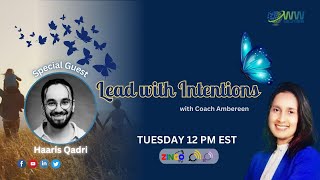
A recorded episode of the Lead With Intentions series hosted by Ambreen Hamid featuring filmmaker Haaris Qadri. The conversation (April 23, 2024) centers on intentional living while pursuing an arts career, especially as a first-generation immigrant: relocating and 'finding oneself' in a new city, building friendships and collaborative relationships, the role and forms of mentorship across career stages, and artistic priorities (family-centered, diasporic slice-of-life dramas). Haaris reflects on festival validation and rejection, his short film (Majburh Mamula) and festival screenings, ambitions to make a feature film, and provides contact details for follow-up.
Chapters
Foreign.
Welcome to Lead With Intentions. I am your host Ambreen Hamid. This show, as you know, is set out on an expedition to allow you to discover the best of who you are. It is my intention every single week to bring on guests that that leads you to living a little bit more intentionally in your day to day while prioritizing what truly matters which is our families. Before we dive in, I want to go ahead and welcome you to Spanglish Network and Xingo channels 250 and 251. Please remember to download the Xingo TV app on your respective devices iOS, Android. Also making sure that while you are downloading this app across even the Google Chromecast, the Amazon Firesticks, the Roku's and NETV 2016 and beyond, that you rate and you respond and you let us know how we are doing, give us some of that good feedback so we know what we're doing well, but more importantly what we can do better for you as we bring on guests every single week. I want you to know this, this platform is completely free. Download that app, let us know how we are doing. Without further ado, I want to go ahead and welcome you and I welcome our guest today who is somebody that is a remarkable human being. I've had a few interactions with Haris Khadari and every single time I find out that he's such an influenced, influential and remarkable human. Which is what today's intention is. So when you are tuning in it is important for all of us to realize what is our intention for the day? How do you want to show up every single moment of our day. So go ahead and set that up. And as we embark on this journey with a filmmaker who grew up in Canada and now resides in London. Yup, all the Way to the Other side Hottest aims to make films that are seamlessly blending of authenticity, of naturalism and vividly paints realism. His works delves into essence of everyday life, capturing the subtle moments that evoke deep emotions and hopefully a lot of good changes. Hadas is drawn to deopic narratives exploring themes of identity, familial fragmentation and nuances of intergenerational dynamics. His short film Majboo de Mahmoud recently screened at the Montreal Festival and won Best Canadian Short Film by the National Film Board of Canada. His movies have been screened at tiff, Next Wave Film Festivals, the Canadian Film Festival and and recognized by Los Angeles Asian Pacific Film Festivals. As you know, we can keep diving into Harris's credentials, but I do want to take a pause and let you guys let him Be on the show. Just speaking from his own art and letting us know. How are you, Hadith, welcome to our show.
Thank you so much for having me. And thank you for that warm introduction. Yes. Yeah. So I'm on the other side of the world now and in a place that is unfamiliar and finding new. New pathways here that. Yeah, just a brand new place for me. So a bit of finding myself in this as well.
Okay, I love that. Explain to us a little bit what it means to find yourself.
I think, as a person and even as an artist with you. Each film I make or each film I write, parts of myself show, and it's a reflection of myself and that work itself. And I think now being in a new place where I don't necessarily have all the credentials that you listed, they kind of don't mean the same here. And it does kind of feel like starting from scratch as an artist and building new networks and creative circles. And also this is a brand new experience for me, never having left home before, so what that means for me. And again, I guess being more intentional about how do I want to live right now and the independence that kind of comes with that. And I think that's what. In a nutshell. I know it doesn't go all over the place, but in a more condensed version.
But I do want to dive into all over the place because for me, it sounds like you're kind of reinventing yourself. So as you're taking this journey on reinventing yourself, how do you think you're going to lead with intentionality to build up the next best version of you?
I think part of my practice as an artist is to really think about what I want to do and what do I want to say with this thing. And I think when I take that as a part of myself and when I take that of the right now and what I'm. What I'm living is not looking at it in a huge, grand picture, but day to day. And I don't necessarily think I'm creating a new me in this process. You know, I think it's still doing everything I've been doing up until now, just in a different place. And part of that looks like making new friends. And I think that's. That's not necessarily a new thing for me. I love walking into spaces and seeing if I can make a genuine connection by the time I leave. And not just. Not like in a. Not like in a networky or in a business kind of transactional way, but in a way of I would really want to hang out with this person after. And I think all those small minute practices that I do back home, it's just in a place now where I really don't know anyone here in these places, in these creative circles. And I think when I'm living intentionally with that, it's just, well, I really want to make new friends here and I really want to make something here. And one thing that I love about film and the kind of filmmaking that I'm interested in, it is collaborative in nature and you, you can't do it alone. So you want to make sure that you make meaningful relationships with people that I want to make like minded work with. So I think with that in mind, that's how I'm kind of living intentionally.
Okay, so let's dive in a little bit more into that because now you're talking about a lot of things that people who are listening, you know, I want to go ahead and thank our audience members once again for tuning in and watching this show. When you're talking about, you know, maybe we have people who are listening who are really trying to figure out I've relocated or my old friend circle no longer serves me anymore. What are some things that you look at at and actually build a friendship where you said this, this just. There's just this essence of connection.
Do you mean that in a strictly friendship way and also in a friendship that might be a working relationship with.
Hey, I, I think evolution is amazing.
I think that, well, one, I wouldn't say that the friends and collaborators I have back home are still very much a part of my life. And even as I write my next project, these are people who have had long standing relationships with years. So they're people I trust. But I think one thing that I look for, and I agree I am all for making great friends. And I think one thing that I really keep in mind when I'm making friends shouldn't feel forced in a sense, like. And I think some of those things, some of those qualities and traits of what you look for, for friendships are almost unexplainable in a sense of when you know, you just know that. So you've hit it, right? You know, there's something about this person that I want to be around them or I want to hang out with them. I think in moments where, where these might be collaborators I am more particular about and one that means is shared vision for simple things like labor ethics. In terms of, okay, how many hours are we working on this? Whether the space feels safe for everyone in terms of ideas in terms of just being, you know, an overall, like, shared kind of vision about what are we, what are we interested in making? And I think those, in a strange way, when it comes to people that I want to work with, I'm way more particular because again, the collaborative nature of it, you have to make sure that it fits, and it should fit like a puzzle. And each person that you bring on to a production, you want to make sure that it all works. And I think most of, like on bigger sets where you have hundreds and hundreds of people, you can't necessarily do that with the same intention, same focus. But how I'm leading my practice is smaller sets. One, kind of, I don't really have an option, but two, I also really like working in that way. So. So those are things that I'm more particular about, and I think those are the traits that I'm looking for.
Yeah, I think exactly what you said. When you know, you just know. And I feel like that can be in a collaboration with work that could just be random people that you meet. So when you are talking about, when you just know, what are some values that you think would benefit our users or our audience members who are listening right now? What are some values that you think are at the center of great friendships?
Coming back to the word intention, you know, I think when it shows that there is a meaningful, meaningful reciprocation and love that again, isn't transactional but feels genuine. And the want to, to be a part of this person's life and almost sense, it almost sounds like in a romantic sense. But I do think there is, there is that beauty that exists within friendships. You know, you show up for each other. And time and time again, from when I think about all my friends, from some friends that I still maintain contact with since like elementary school, even if we don't speak every day, or even if we don't speak months at a time, we show up for each other in certain ways, whether that'll be one random day where they really need a phone call and we talk and catch up, or just like a simple errand to run and they need some help. And I think you want to water those relationships. And it shouldn't be something where they're obsolete for months on end, only when you need something. And I think there's a clear distinction between having relationships that aren't contingent on having to do that. So, yeah, I don't know if that answers it quite.
But hey, there is no right answer. The answer is whatever you pour into us. I think it's a beautiful blend of what you're saying. Yesterday I was talking to one of my ex coworkers who is, you know, who literally turned out for six. I'm your daughter. And you know, and it was just like this fun moment when I used to be with her, how I almost became like her mentor. But I haven't spoken with her for, you know, for a while now for at least eight, nine months. And she said, I'm. You're crossing my mind a lot, so I want to get on the phone with you. And yesterday we spoke and it's just that she said I didn't need to keep connecting with you. But when we connected, it was like we picked up right where we left off. So it's this beautiful balance of pouring when there's, when you need to pour in water and then when maybe you get busy with life, maybe you have other priorities. Maybe some things happens where you're not able to give as much as you want in your friendships, then you know, that's okay too. And I think that's. I think it's a beautiful balance. Hares, can you tell us something personal about yourself which would allow myself and the audience here the opportunity to get to know you a little bit better?
Yeah, sure. I'm trying to think about what that specifically would be. I mean, I think I can tie it back to kind of how I was introduced on the show, which is I entered filmmaking on a whim and I didn't know I wanted to be a filmmaker. And don't get me wrong, I love the medium. But there's something that I read from one of my most looked up to film directors, Iranian film director named Abbas Karastami. And in one of his interviews, he spoke about how if someone took away filmmaking from him, he'd still be able to live, he'd be fine, he'd find something else to do. And I love the medium, but I think I feel the same and it's important to me. But yeah, I do recognize that it's not something that I necessarily aspired for since being a kid. And I think there's this romanticism and thing that you see where it's like Spielberg knew he wanted to be a director at the age of six. And like all the great masterminds of this craft, you kind of see they've been thinking about it since they were children and that's not me. So I think that's something that I keep in mind and tell people that I'm not this masterful or all knowing about Cinema. And there's so many people I look up to in my friends, friend groups and collaborators that I will go to when I need help, but that's not me.
Okay. I actually want to dive in a little bit deeper because my mind's provoking a ton of wonderful thoughts. We know, you know, we know this from research. The most important thing in a human being's life that kind of equates to happiness. Fulfillment at the end of life is the essence of relationships. Right. And I love that you've dived in and you've said, you've dove in and said, you know, kind of my filmmaking is a part of who I am, and if it didn't exist, I would still be okay. Yet I aspire to look up to other people who are mentors, and I want to dive in a little bit to really understand this because I don't think that enough people seek mentorship, you know, And I don't look at mentorship as something that's like, only work related. So tell me a little bit about how have the mentor sculpted you and helped you to find yourself, find your rhythm, or find your voice?
Oh, that's a great question. So I think this goes back a little. I think when I can think about my first mentor, it would have been in 2016, and this would have been right after my first year in film school, I was feeling kind of hopeless. You don't see many black indigenous people of color on Canadian productions or at that time, I didn't really realize that minority groups are making films. And my first year of university didn't help with that. And I found this great film festival called Toronto Reel Asian International Film Festival. And they had a summer incubator called Unsung Voices for emerging filmmakers. I applied, got in, and that was the first time I really had a mentorship in a personal level where I came in with this film idea and I was passionate about making this film, but I just needed help on how to do it. And my two mentors were Amar Kishodia, he is now a programmer at tiff, and another brilliant, brilliant Canadian filmmaker named Brandoquita. And they. Oh, man. Just in terms of. From. From creative support, looking at drafts of scripts and giving feedback, to even just being like I was. I was, what, 18 years old, hadn't really been on set, and now I had to direct for the first time and run a set. And just the support, the moral support, where it's like, you can do this. You know, we'll be there to watch. And if you have Any problem, we got your back. Whether it's something like, someone forgot to pick up a piece of equipment, we'll go run that for you. You know, making me feel so supported. And then that process. And I think mentorship looks so different depending on the stage you're in. That was really early career for me. And that mentorship was not just. It became a friendship after the fact, after the program ended. And these are people that, to this day, when I'm working on something new, when I feel like it's polished enough, I go back to them for feedback. And it's crazy to think that they've seen how far I've come in terms of, like, my style, of how I'm working with things. But that's important to me. And then when I think about later mentorships I have, there is a filmmaker by the name of Zorar Khan who I'm kind of absolutely brilliant. Pakistani Canadian director. His film In Flames is currently showing actually in New York. But it was. Was that Ken. Was that tiff. Was that all over. All over the world, traveling everywhere with this film. But he is currently mentoring me with a new project I'm working on. And this is, like, purely like, okay, well, what do you want to do with this film? What's your goal? And how. How can I help you figure that out? So from getting feedback on how do I fund this thing, how do I. How do I apply for these grants? This is a whole new world to me, and him kind of being like, this is everything I. I've done. Take a look at it and do what you want with it, but I'm not gonna hold your hand in this process anymore. You know what you're doing, but if you have questions, I'm here to answer them. And it looks so different from my earlier mentorships, where I actually needed more support and, like, oh, how do I do this? And I'm going to not only as like, this person will help me make this thing, but help me emotionally during the process. So it looks really different, but, like, the common thread of all these great mentors I've had in my life is just their willingness to really help and see you succeed. You know.
I love that, by the way. I am looking down, but I am taking notes, as all of you know. I hope you guys got your. Your notebook out. And it's so important, I think, when we are having a conversation, to really just take those nuggets, right? So willingness to help you see succeed. And. And that's their ultimate. That's the ultimate gift, right, is like, hey, we got your back. If you fall, we'll help you up. But now you're in a place where I'm just gonna give you a map, okay, and you. And you take the route that you want. You know, how do you know how it is, what that next best project is for you? Like, how do you dissect that? How do you get inspiration? How do you let your imagination run wild to be able to create something from scratch?
I think I say this every time I ask this question is that I know people who are amazing creatives that have like a box full of ideas. I'm not that person. An idea will come to me ever so rarely. And my whole ethos with how do I know I want to make something? Is that if I think of something I want to make, I won't write it down. If I still remember it the next day, that means it's worth writing down. So currently, I think I have two things written down, one of which I'm making. The next one isn't as fleshed out, but I know at some point it'll come to me. But right now, what I'm interested in as a filmmaker is family dramas. And that ties into family dramas of diasporic communities, specifically right now, South Asian communities. Really going into the right what you know, based off of experiences and what you've seen. But that whole writing down thing is definitely important to me. And I think there was at one point in time where I became so strung up on what success looks like as a filmmaker. And I think for filmmakers, we look at film festivals as being this token of validation whether your film gets seen at so and so city. And I get it. There is something really important as a filmmaker. If you want financial success and even get attain the opportunities to make more films, that is important. But then you sometimes get hung up on the idea of, is this film, is this film good for that festival? Like, am I making this film for this festival instead of yourself? And I think there was a point in time where I was thinking like that. And I think I realize now that's that that's not how it works. And I want to make what I'm interested in. And if a festival finds it interesting that they want to screen, great. But I'm not going to make it as part of this model of how do you like? It almost feels formulaic and it almost feels like you're making this concoction. And I don't think that's what interests me in filmmaking. So it's just really like, do I feel connected to this? Do I really want to tell this? And part of that's so internal. Whereas again, I'm drawn to the ordinary and slice of life. And I think it's thinking about what's important in that and then being so interested in relationships and what families look like.
Yeah, I love, I love that we're diving in. Like we. We've evolved this conversation so much. Right. From this understanding of. I'm trying to figure out where I'm at in life. I'm in a brand new place to friendships, to mentorships. Not really diving into, not only finding your voice, but I find it so profound and fascinating when you know, you're a young guy, when you're able to detach from the outcome. Because I really want our audience members who are here listening. I want them to actually know that they don't need to seek validation. They gotta have to go back to those feelings and the internal connection. How did you get to that point at such a young age?
I think it would be great if I got to that stage at a young age. I think I haven't gotten there. And I'll be honest that it does really suck when you get that festival rejection. And it really sucks when you get that email that says, no, you didn't receive this mentorship or you didn't receive this fund. And it's tough. And those rejections still sting. But I think I've gotten better at realizing that doesn't mean that my work isn't important. That doesn't mean that my voice as a filmmaker isn't good enough. But then also just understanding the realism in terms of that, like it's not all tied down to that. I think being on the other side of filmmaking and having done some programming work as you realize that it's so many factors. Like for a film festival, it could be, what's the theme for this year's program? It could be, do we want to support more local talent in our city? Or do we want more international voices this time around? And sometimes it could be that, oh, the programmer knows so and so this filmmaker. So we're going to screen their work. And it sounds awful. Sometimes it is solely down to nepotism, but there are other times where you can get in based off the merit of your work and whether it connects with that year's theme. But there's so many factors. And I think realizing that grounds, you know, and it reassures you that it's not that. And I think, like, how I mentioned earlier, it disheartens you as a filmmaker when you don't get that validation because you worry whether am I going to be able to make the next thing without it. And I do think that when I talk about, yeah, you, you can't let it all be determined by that validation. But it is also easy for me to say because I've had attained some of that validation, you know, and when I think about other filmmakers that I've spoken to in Toronto that tell me like, how, how did you get that fund? Or like, what can I do? And they also say, well, you've screened at these places, so maybe that's why you've gotten it. And I can't discredit that. That is, that is part of it and that's how the industry kind of works. So it's a, you know, it's important, but you can't let that define you. And it's, it's a battle every time you finish something or it's a battle every time you want to make something and receive funding for it. I think just being aware of that and reminding yourself that is so important. And I bring back my mentor, Randall Akira. When I made my last short, Majburh Mamula, I had really hoped it would have gotten into really big festivals. And that first wave of rejections stung so bad and I had to call up Randall and be like, Randall, like, does my film suck? Like what's going on? And then you kind of reminded me. And he saw the film and he told he had really great things to say about it. And it like, I know there's truth to it because all these years I've been mentored by him. He's given me such honest feedback about my work. So I know it really resonated with him. I know he liked it and he reminded me that, listen, you look up to me, I've screened so many places, but I have other projects that didn't do so well on that industry validation point. You can't let that define you. So that was the, probably the first real realization of that.
Yeah, I think it's, you know, it's point on when you say that realizing, recognizing, you know, that it's there, being aware to it, but not being connected or not letting that define you. I think it's such a difficult place that we as humans find ourselves. So you talked a little bit about, for you, the center of your filmmaking is a lot more family oriented experience that you've gone through in your own life. So help me understand and help our Audience, understand something, a personal share about your family, which will kind of let us dive into your world, especially when it comes to this, you know, this beautiful, this beautiful relationship.
I think as a first generation child of an immigrant, I think this kind of goes across like, not even just South Asian communities, but so many children, immigrants. We have one that, that hybrid of culture, being from there and being from here at the same time. And that's part of your identity. Again, like that Canadian, American, Pakistani identity, that hyphenate identity is part of, part of me. And then when it comes to specifically South Asian stories that, like, in relation to my family is, there's certain expectations that children have in terms of being. Being seen to be caretakers of their parents. And sometimes it looks across like being their translator or being not just a child in some cases. And then even in terms of like, oh, that's a hard question, you know what I'm thinking about it. And I think one of the things that's so important to my practice is also breaking those stereotypes, you know, that already exist in terms of like the tiger Asian moms and things like that that exist within, like American mainstream media. And realizing that, you know, sometimes there is truth to the stereotypes and that does make it part of our identity, like, but also that, again, going back to that doesn't define us, you know, that's just one facet of life. So when we, when we talk about, like, what South Asian stories look like and what I'm interested in, families are so rooted, like in our culture, where you're always thinking about family and there is this closeness and we take care of each other and it takes a village, but that's one facet of it. And I think with my next project, what I'm interested in is showing that sometimes it can look perfect, but it's fragmented and just like any other family, you know. But I think putting a lens on it, that we aren't quite seeing in mainstream representations of us. When I think about Asian American representations, like, and this isn't specifically South Asian, but everything everywhere, all at once. Lulu Wang is the Farewell Minari. You have these all movies centered around families and the relationships we have with our parents. And they've kind of done this thing where they're showing that, like, yeah, we have family problems just like everyone else, you know, like, I may not get along with my mother just like that American family that we've seen like movies about again and again. It's just this time with a different cultural perspective, you know, And I think that's what's kind of important to me.
I mean, I think that's so brilliant because I too, like, you know, I'm from a very similar background, right. I am an immigrant, so my kids are first generation. And it's. It's like this. This blend of how much of the culture do I preserve and how much flexibility do I bring forward where they can also assimilate to this one and not feel like they're not part of it. So as you've grown up, what do you think are some beautiful family values, you know, that come from the culture that you would love to carry forth?
I think, again, the care for our parents. And I think that I explore this in my last film where it's about a daughter who takes her mom for a doctor's appointment. And it plays out in four acts. The daughter taking her mom in the car. They get to the doctor's office and they're in the reception area. Then they're waiting for the doctor to come and the drive back home. But it shows how as we care for our parents and they can frustrate us. And sometimes it feels almost burdensome at times where there's this expectation to have to care for them. And we love our parents, but sometimes it just feels like, can we just be the children for once? But it. It's a balance of both. And you go back and forth between those feelings, but at the core of it, it is we love and take care of our parents. And I think that's something that's really important to me as a person and as a filmmaker, to show that relationship properly. Because, again, like, what we have in the mainstream about that is, like, parents being overbearing and like the children just kind of being like, forget that, you know, like, I don't want to be that. And I think it's like an internal battle at times. But there is, I think, overall that feeling of, yeah, but that's important to us as a community. Echoes. Oh.
Yeah. I did watch the movie we're talking about here, and it is brilliant. The acting is point on. You're like, how long have they been doing this? Right? Like, I found myself, you know, in that script. Brilliantly written too, I would say, is it's such a simple interaction, but it speaks volumes. Even, like the fact that she was tapping, you know, on the steering wheel at one point in time. We could just see the elevation and the frustration, you know, in the. In the actor's demeanor, which I was. I'm like, brilliantly depicted because that's super rare. To be able to captivate and capture, you know, like, you kind of felt sucked in to be like, is that how I do it? Is that how my kid feels? And all these questions that come up. And I wouldn't say this is only specific to, you know, the South Asian community or immigrant parents. I think all families face these challenges where sometimes the parents have expectations that they want love and care, but I don't think it's been defined, you know, as something that's needed. So, you know, you. You've said a little bit about how your family is so important to you and how it's kind of part of who you are growing up. Let us know, like, let us tap into your world a little bit. How was that home dynamics for you?
I have one older sister, three years older, and then my mom and dad living together. And it's strange. Like, I feel like we grew up with family being really important, but most of our family living in the States, so you get only burst of everyone altogether for certain periods of times. But other than that, it felt really nuclear. Family had some family friends. We still have those family friends outside of our circle, but it didn't feel like there's this whole sense of community that when I go back to New York or when I go to Chicago, these communities that my families there have, it doesn't feel like that at all. And it does feel more nuclear. And I guess in that sense, you. You have less people to. To see and to go to and then be a part of your lives all the time, at least that aren't there in short bursts. And I think growing up, there were, like, certain general roles and expectations that you see and you work towards breaking, you know, some things that didn't sit right with me or my sister growing up. And we think about, well, what do we want to do? And. Yeah, but I think the benefit of that was that at times there was it almost like a no is no from parents. Kind of feels like that's it. And you don't have other family members to be like, hey, can you convince them that, like, you have that pull? But in other times, like, it's almost less people to have to convince if you want to do this thing. Like, when I think about families back home, like, if they have, like, if one person wants to go to college somewhere else, it becomes a whole thing. If there's other families all in one city, it becomes this, we're going to collaborative again. The whole it takes a village mentality. And which. Which I love, but I didn't have that. It was just getting approval from my mom and dad or sometimes just even getting approval from one of them was enough, but way more nuclear. And I think that's something that comes back to my work too, where it's like it's not focusing on all these people, but really micro and really honing in and also thinking about, like taking elements of that and also fictionalizing it as well. But I think that that closeness or that immediacy of like having these only people around you being a big factor probably into. Into what family looks like for me. Yeah.
So you talked about a little bit, you know, that you guys face challenges or there were difficulties and it was like, either you're convincing or you're not. Flat out, no. What's the one theme, you know, one challenge that you would say came up quite a few times, you know, for you, you know, and you're in your home?
I think it was. Oh, no, I think. I think, I know this. It's wanting to do what you want to do. And not from a selfish point of view, but from. If the vision doesn't align, then getting to do that becomes difficult. And I think like, this can easily extend to just me as a filmmaker when I had the threat of maybe I want to pursue filmmaking and maybe I wanted to do this for post secondary education, that being a battle and there wasn't shared alignment of what my dad in this case wanted for me and what I wanted for me. So that being like one. One challenge. But I think it all comes back to, like, what do they see for you and what do I see for me?
Okay. Yeah, I love that. Let's dive in. Let's keep diving. Because I know a lot of audience members who are here listening may either have faced this or are facing this right now, or will have kids who are going to think really differently, you know, so let's bridge that gap. Let's kind of help them identify. How much of it do you let go of and when? Is it something that you're like, no, this is kind of something there's like, there are no ifs and buts about. Where's that beautiful blend to just say, you know what? This feels so authentic. This feels so true to who I am. It's like my inner calling. Even if it is for right now I have to pursue this, even if I make a few people mad or disappoint my family.
I think it's strange. I think we think about what we want to do in post secondary as one of like the most Important decisions of our life because you might be pursuing that for years if you're going to post secondary. And when you think, well, it's really awful that you make a 17 year old think about this. One decision might like weigh everything, you know, And I think that you allow yourself, and I think parents should also allow kids to make mistakes and learn from it and also be a space where it's like, hey, I've made a mistake. Can I, can I go back on this? You know, I think as much as it drives me crazy to say that, oh, if like film didn't work out for me, if I went to my dad, be like, hey, I think I want to pursue something else, he'd be like, okay, great, you know, maybe for him it's just like a time, don't waste time. That's always the thing it comes back to. But I think as a person, and as I think as a young person feeling what's important to not give up on, I think it comes back to when you know, you know, and I think sometimes those feelings might be wrong and it's okay for it to be wrong. You might have been really passionate about it. But if you come to the realization later on that, you know what that I thought I knew and you probably did, you were sure of that moment. But things change and you allow yourself to not feel like you're compelled to have to stick it through with any decision you make, there is impermanence to still be intentional about those decisions. And you can think it as best as you can. You can really know that. I don't want to let this go and act on it. Like, I'm not saying that people should give up on it, but also come to a realization that no, it wasn't, that's okay. You, when you know, you know. But also to that same extent, you can also know and know when it's not for you anymore.
Yeah, I think that's essential, right? I think allowing ourselves that grace to say in this moment or, you know, in the next little bit, this just feels so right for my heart, for my soul. It just feels like this is what I'm meant to do. But then allowing grace to enter and say, no, I was, that's, that's where the journey ends. And I think many of us don't do that gracefully. A lot of that shame and a lot of that anger and that bitterness comes in whether that be going back to our family and saying, you know, I failed or I didn't, I made a mistake. I try to help People figure out that that wasn't a mistake. Right. I almost feel like you needed that, you needed that as a part of your journey for whatever that future is. You know, when you see yourself in your future hottest what's, what's gonna bring you that success, that joy, that happiness element. Where is that? Where's that for you?
It's strange at the same time where I just like previously said, like oh, if you took away filmmaking from me, I'd be okay. But I want to make things and when I think about the future, I want to make a full feature length film and I want to be able to keep making films because that's something that I want to do and I think that's what, that's what I, what I see in the future for myself. And I think that will yeah festival valid. Like I talked about all of that. But I think success for me looks like is if I get to make a feature. Making a feature isn't an easy thing. And even being able to make a feature in a way that, where I feel like is ethical and is labor conscious and all these things are so important to me. It, it is going to be like an uphill battle, like uphill battle to be able to do it. And I think when I finally do it I'll feel like I have some success that I, that I kind of dreamed of. I think about when I was in my last year of film school, Prof. Asked me to write down where you see yourself in. I think it was 10 years. And I think I wrote on that note that I will have made a first feature by then. And I'm not, I'm not fussed on timelines and certain things like that. I think I've come to learn from that that you can't put life in these parameters of by this I'm going to achieve that. But no, I feel like I'm so close to being able to make a feature. I'm writing one now like in the most earliest stages of writing one now. But I think that's, that's what's for me in the next few years.
Yeah, I think that's, it's brilliant. I think a lot of times there's some values that we all live by. And so for me faith and patience is kind of the pinnacle of it. But with patience there is so much that's required. And when you're talking about knowing I want to achieve this but not having like a timeline around it, how do you help our audience members who are listening and even me, how do you help us dissect to not be so timeline focused. When everyone says goals are measured around the timeline and achieved within that too.
I think, again, when you, when you just look out of yourself and when you look out to the world, you realize that there's so many brilliant minds that have made things at different points of their lives. You know, some filmmakers got their start when they were in their 40s or 50s. And there's some filmmakers who were 21 when they made Del Valle Tolanyin Le Jangue. You know, that Guy was like 21, 22 when he made that film. And I think it looks different for everyone. And I think just when you look outside and stop being so inner focused, it helps.
Finding the extraordinary in the ordinary, I think is such a brilliant way to embrace life, you know, which I think, honestly, many of us don't do. This conversation, you know, we've been at it for about 45 minutes. It doesn't seem like it, but we are. I do want to ask you, you know, how do our. How does our audience members, how do people who really took something from you or who just want to get in touch with you or who think that, you know, what maybe had is going to be a great mentor for me, how do they get in touch with you?
You could reach me through my website@hottest qadari.com spelled H A A R I S Q a D R I.com also with that same handle on Instagram, hottest ghatari. It's the best way to reach me. And yeah, yeah, I think I, I'm not a slow responder, so I can get in touch with people, whoever reply, but that's the best.
And as we know, Hottest is seeking friendships, you know, so if this is somebody who, who you feel like, oh, wow, you know, he's in the vicinity of London, I would love to go and grab some coffee. You know, I too have done that with Hottest. And it's been, it's been a really fun, you know, fun connect, I would say. So I want to ask you, you know, in this, in this show, I'm trying to create this fun ritual at the end of it. These are called intentional raps or the rapid fires. When I ask you a set of questions that I want you to answer in one word or in one sentence, and I think this gives us an understanding of, like, who you truly are. Hottest, ready to dive in?
Sure.
All right. What do you want to leave behind for the world? Hottest.
Films. Okay.
How will you know that you've led an intentional life.
Oh, man. It's supposed to be rapid fire. Whoa. When I can be happy with the decisions I've made.
I love that. If you can create one law that everyone in the world had to follow, what would that law be?
Oh, supposed to be rapid fire. I'm thinking way too into this.
No, I. I mean, go ahead.
Oh, man. Oh, this is a tough one.
Everyone's almost. To give yourself a ton of grace.
I think to be able to donate a certain percentage of wealth to in poverty, like impoverished people. Okay.
It's a distribution of wealth. I love that. Okay, There you go. All right. What is one lesson that you want to share with us which has made you who you are today?
To slow down and to really realize. I think honestly, going back to the whole success and validation and what that looks like, not tying your worth to organizations or even like to certain people in your life's view of who you are. And it's important to look outwards, but you can't define yourself with that and having some certainty of who you are as a person.
Love that. Yeah. I think slowing down is key, especially in the world that we live in now where everything is so fast paced. Right. At least in London you get to walk a little bit. Not here in the US we don't as much. What would you say Hares is the key to a healthy relationship.
Setting healthy expectations for people?
Okay. Love that. Well, thank you so very much, Harris, for coming along on this journey with us today. It was. I think the conversation was beautiful. And for anyone who wants to reach Hares, we all know, get into that harishadri.com or on Instagram as well. I think this was a beautiful conversation. I thank you so much for your openness. For all of you who have tuned in thus far and who have heard this, please, please, please share what resonates with you, because that really helps us see how much of an impact we here are making in your lives. This show can also be heard on Spanglish Radio Network. Please check out Spanglishworld CA for all the news and the programming. Spanglish World. Watch it, hear it, read it, download it. Most importantly, live into it with intentionality to make a better version of you.
Thank you so much for having me.
You're welcome.
Sa.










