Lead with Intentions: Jorge Gamboa ~ Flow Driven Leadership
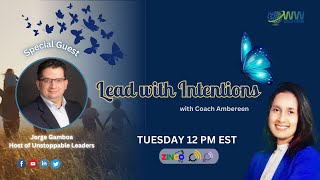
Jorge Gamboa, an agile coach, shares how to lead with intention through practical exercises like the hat exercise for prioritizing life roles and scheduled problem hours to contain worry. He emphasizes dreaming as a driver of growth and building community to sustain yourself through hard times.
Questions this video answers
October 16, 2024
12:00 noon Eastern (US)
Spanglish World / Xingo TV channels 250 and 251; Xingo TV app on iOS, Android, Chromecast, smart TVs (2016+), Amazon suite, Roku.
Via LinkedIn (search for Jorge Gamboa and message/connect).
Unstoppable Leaders
Chapters
Foreign welcome to Lead with Intentions. Today's intention is have a reflection filled day. Welcome to the show where every single week your coach, Ambreena Mead shows up here ready to serve you. And it's a truly an honor to cross path with you today because nothing is by coincidence. And I really, really, really want to say I appreciate every single one of you tuning in to give me the most important commodity in the world. That is your time. Welcome to Spanglish World network and Xingo TV channels 250 and 251. Please remember, download the Xingo TV app on your respective app stores, the full iOS lineup, Android lineup, Chromecast, any smart TV, 2016 on forward, the whole Amazon suite, and even on the Roku ones. All right, while you're downloading the application, how do you engage with us? Rate it, comment, let us know what we're doing. Great. But also give us that feedback to say what we can do better. And as always, this app is completely free of charge, so I don't see why you should not be downloading it. All right, so every single week we get on this, we get on here at 12 noon here in the U.S. you know, Eastern time. They bring on guests who are living intentional lives. Today is no different. He is somebody who you guys have seen many times on these networks is George Gamboa. And he has a show here called Unstoppable Leaders. So what does that mean? That means in order for him to invite people who are like that, he's also got to be one as well. I've talked to George quite a few times and it's always astonishing to see. And today we're going to dive into his journey to learn more about what it is that he does, because there's so many layers to him. So I want all of you to welcome, help me in welcoming George Gamboa onto the show. Hey, George.
Hey. Great to be here. Thanks for the invite. I love this. Awesome.
It's a pleasure. We've, we've tried this back and forth for a little bit. So I'm glad you are officially and finally here.
Yeah, no, this is awesome. Cool.
All right, so the first thing I want to ask you, George, is tell us something about yourself. Who are you and what is it that you do?
Yeah, so that's a very loaded question. Keeps on changing. So, as you mentioned before, I have my own show, Unstoppable Leaders. And it all started because over the last 10, 12 years, I was working as an agile coach, helping organizations and their teams work together. And all those things but there was one question that always caught my attention. Given all things equal, what makes some people just crush their goals? They make everything seem simple, smooth, and things work for them. And that started looking and finding patterns. And I realized some people just have that. I want to be unstoppable. I'm going to be unstoppable. And when life throws punches at them, it's just like Teflon. It just fades away, doesn't stick, and they keep on going. So that's how I started with this concept of unstoppable leaders. And I love having great people and learning from their journey. And that's one of the things I'm doing these days.
Wonderful. Okay, so how would you describe who you are, George?
So as I think you need to go from, from a person. Right. As a person, I'm an eternal optimist, which can be not too good at times. But yeah, I always believe the best is yet to come. And I also have a big believer in dreams. That's what drives us. So if you're not dreaming, yeah, you need to take a moment because something needs to be fixed as a result. One of the things that I'm doing over the last, pretty much this year is I'm partnering with small business owners that want to take it to the next level, that are really hungry to grow to be unstoppable. And I'm finding ways to help them either on the operation side of their company or creating these client acquisition systems for them and helping them get to the next level. And yeah, I love all of that. And it's fascinating. It's a different world.
Must be, because when you're doing something like that, you're really tapping into different industries and different people, different teams to see how people lead. Let me ask you this. What have you noticed is a common theme among these people that you're serving?
You know, when I. In order to find a client that I'm going to be working with, because I have to believe in what they do, because it will require me. I don't want to follow the classic model of agencies where you just start getting clients and dispatch them, but I need to get deep into what they do, their philosophy, their services, in order to get in their minds and be able to, to be effective, especially if I do that client acquisition side of things. So one of the first things that I need to know or that makes it a feasible prospect is if they have that desire to, to take, to go to the next level. Because believe it or not, there's a lot of Business owners that for whatever reason, over the years they went from surviving to thriving at surviving, and they are happy to stay there. They don't want to go to really thriving, so they don't feel like taking risks. They don't. They want to play it safe, play it small. So that's. That's just not gonna work with me. So.
And why would you say it's so important to work with individuals who are really looking to thrive in their businesses, taste those risks that are so necessary? Because I'm also looking that like, you know, for all of you who are listening, appreciate you so much, really want you to start to think about how you can apply the same philosophies that George is talking about into your own lives. So what do you think it is, you know, that's so necessary for us as humans to live a life that is filled with just thriving and driving our own life by design?
You know what? It all comes down to what your show is all about. You need to live intentionally and have a purpose for a lot of people. We get a purpose via our business, our company, what we do. That's where we spend most of our days, right? Working on a job or running your own business. But you need to find what is the purpose that is that thing giving you to your life. And for entrepreneurs, their purpose has to be creating a bigger impact in whatever it is that they do, not that there's anything wrong if you're an employee. For example, I have had friends. A good friend of mine for many years was a security guard in one of these big companies. So all he had to do was, from work perspective, show up at 7 in the morning, leave by 3pm no stress, just receiving people in and out, and that was it. Because work was not the main focus in his life. It was just a compliment. What he had was a very engaging and active personal life. So finding that purpose is. Is drives you. It's the. The beginning of everything.
The beginning of everything. Okay, I like that. I like that you're saying that the purpose, the beginning of everything. Now would you say. How would you say that you live an intentional life?
The first thing is trying to figure out what do you want to do? What do you want to achieve? And over the last few couple of years, I went through some shifting in priorities in my life and says in where I. Where I am, where I'm going. And one of those realizations is if you are regardless of the religions that anybody professes, you come to this world. And part of that is to experience many different things and you want to get the most out of it. So if you have a purpose that is going to help you help other people develop or achieve something, that's where you start being intentional on how whatever it is that you're doing today is going to help you support that purpose. That purpose becomes your North Star. That is guiding and aligning what you're doing. So once you have that North Star, everything else is just what I'm doing today, is that gonna help me get there? It's not gonna help me support that North Star vision? If yes, then go for it. If not, then time to think.
Yeah. So right now we're talking a little bit more about just, I think, entrepreneurship.
Yes.
For the, for the, you know, for the. Individuals are listening right now. Most of them or many of them may not be entrepreneurs. So they're like, well, George, that doesn't apply to me. Like, I don't, I don't need to live unintentional or purpose in life. I don't need to fuel myself. Like, I'm good with my 9 to 5, I'm good with my paycheck. I'm fine. How do you think we can think about purpose in that light when it comes to everyday, you know, individuals?
Yeah. So one of the exercises that, that I do with my clients is I call it the hat exercise. And that's because we wear multiple hats. If you're a business owner, obviously you wear many different hats in there, but as a person, you wear multiple hats. For example, somebody can be a father, a brother, you have your job, that can be another hat. Sometimes maybe you, you play some sort of sports, that's another hat that you're wearing. And when you look internally, you wear multiple hats, like your financial hat, your health and fitness hat, your foodie hat, if you like to cook or whatever. So you wear multiple hats and the next step is identify what is it that you enjoy doing out of all those cats. So kind of prioritize these hats. I love to wear these ones. Not so much. And once you have that prioritized, then it's time to do the thing that I love the most. To dream. Now see yourself 12 months from now wearing each of those hats that you love to wear. And start dreaming. What would you like to be doing in that hat? How would you like to be taking that cat to the next level? And that is if you're healthy, what does that mean? If you are changing your life, trying to be more healthy, trying to lose weight, trying to eat less junk food, what does that look like. So now you're starting to set objectives of where you want to be based on those cats. And from there, now you can start identifying those results that are gonna help you measure the progress. For example, if I want to be healthy, healthier 12 months from now, that means I can run for the day, run for having, needing to catch my breath or, okay, swimming for half an hour or whatever that means. That's my end goal. So now you can start thinking how you're going to be progressively getting closer to that objective based on the hat you wear. So that's how you can start applying and bringing what works in the business to your personal life.
Okay?
And it works really well.
And now you've talked about this, you know, a few times already in just the last, you know, 12 to 13 minutes that we've been on air. And, and I also think it's a beautiful concept, dreaming, imagining, play. Most of the individuals that are listening right now are about the age of 18 to 55. That's my, you know, most of my target audience. And how are you going to tell them to go back and do this thing that kids do, right? And why is it so important, you know, to dream?
I think we get caught up in life because you're right. In the early days, it's more common for children to dream everything what they want to be, everything they can dream of, right? But then life gets in the way and we just get so busy doing, going through the motions that we forget to, to look at where are we going, what do we want to achieve. And I have some, some friends that are in the 50s and probably a little more than that. And you can see the difference. Some of them are just looking to win down, just enjoy life, retire, while others are looking at, continue doing their business or others are looking at doing all sorts of different activities like going on hiking to different trails and experimental things. So this bring us back to dreaming. I think dreaming is what fuels that fire from the inside that pushes you to want to pursue something, to want to achieve something. And depending on where you are and obviously the resources that you have at your disposal is how much impact and how big those dreams can be. Going back to the business side of things. The classic example over the last few years has been Elon Musk, right, who is dreaming, I'm gonna change the way the world looks at electric cars. And he just did that, or took a few, a few years, but he did it. And now he's making with SpaceX, people dream and actually think that, hey, Maybe it's possible to eventually have a trip to Mars and colonize Mars. So it all starts with a dream. That's what makes humans so special, because dream creates curiosity. And once you are in that curiosity, things can happen.
Yeah. I think I often talk about this as actually remarkable that we're talking about dreaming just in, you know, I have a group of women that I'm coaching together, and we were talking about this concept of, like, taking life so seriously as adults. You know, we don't really dream. We don't have fun. We don't play. And I was talking about how Einstein said, you know, the most important thing in the world is imagination, and imagination is just that we're tapping into our dream. And I said, you know, think about how much fun kids have. Like, they're throwing an imaginative party. You've got all these guests, and the. You know, the kids are having, like, a full meal, and they're serving their guests. And. And then I started to tell her, like, you know what? If you allow your daughter to dream, she'll add so much fun into your life. And she's like, what do you mean by that? Like, she'll be having a party, and she'll invite you to the party, and then she'll say, mom, mom, you're stepping on Jimmy. And you're gonna say, oh, I. I apologize. Like, and I love. You know, I love Rebecca's shoes. Like, well, what shoes does she have? You know, she's wearing these black shoes with, like, a silver bow. And when we become adults, even our dreams are so serious. So when we're talking about this specific thing, you know, talking about dreams and really being able to apply this philosophy of dreaming more holistically, not just for businesses and entrepreneurs, because the individuals that are listening are ordinary people, just like you and me. Right? How did you. When. How did you start to dream a bigger dream for yourself and if you could share that dream with us?
So I have a story that I was watching a few weeks ago. I'm not sure if you know Grant Cardone. Yeah, he's very famous, right. He's a billionaire. And I was listening to his wife, Elena Cardone, and she was talking how in the early days when I don't remember if they were dating or they were already married, she saw the potential of what Grant could become. But he was playing it small. He didn't have enough of a vision. So she started playing what they called the Millionaire game, where every day they would have dinner, the two of them, because they didn't have Any kids at the moment. And then she would start. Encourage him to drink. So let's say that Tomorrow you earn $10,000. What would you do with that? How would your life change? So now he starts thinking about that. And this is happening every night, right? So after a few nights, then she changes. And probably I'm paraphrasing the way she said it, right. But this is how I got it after a few days. Now she's making $100,000. How will that change? What would you do? What that would look like then goes to 1 million, 10 million. And eventually she was talking about billions and how he was now not only doing things by himself, but building a big team, Buick organizations, diversification of whatever he was doing. But the key is that by doing that little exercise day after day, it got a grant to start opening up to the possibilities and believing that he could achieve way, way more than what he was thinking about. So that applies, obviously, this is a personal borderline business that. But the same thing you can apply. Just focus. What do you want to start dreaming about? And make a point to be intentional. And every day spent a little. A few minutes dreaming about it. And it might be just, where would you like to go on vacation next year or two years from now, or as a family, where would you like to go and visit, have a family vacation? What would you like to do? And feed that dream? That conversation.
I love that. I think what a simple way for all of us to apply it. So maybe for somebody who's like, yeah, I'm really not looking to be a millionaire, George. Even something, right? If. If Tomorrow you made $200 more, you know, $500 more, $1,000 more, kind of just leveling that up. Because in all honesty, we live a life where most of us are anticipating a paycheck, Right. Because that's kind of like, what's that tool? The money is needed, you know, for us to survive in this world. However, we don't really think about the fact that we can make more. And so I think that's beautiful. If you could share something personal with us, George, about yourself, so that way we can get to know you a little bit better.
Yeah. So on the interesting, fun side of things, I'm a cheesehead. And for those that don't know what a cheesehead is, means that I'm a big fan of the Green Bay packers in the NFL. So, yeah, I have my own cheesehead. One of these days, I will post it somewhere, and every now and then you can hear me yelling at the Screen on Sundays when my team is not doing very good. But yeah.
Okay, well, I have to ask, why are the Green Bay Packers?
That's a very good question. So I, I'm from Mexico, so I grew up in, in Mexico and over there the NFL is very big and everybody, you can find people that cheers for different teams. Back then when I was growing up, I had no idea what the NFL was, but I was cheering for another team called the Raiders. Yeah. And it got to the point where as typical teenage male with nothing to do and too much time on my hands, whenever my team would lose, I would get mad for a few days because they lost. Because I had nothing better to do than to be passionate about some silly thing. Anyway, so one day there was this game, Green Bay versus Raiders. And at the end of the day, the game, Green Bay won. But I had a smile on my face. I really enjoyed the way Green Bay was playing and few things came to mind. Number one, and that's when the, they play in this, the stadium is called the Lambo field. And in that game was when they invented, invented the Lambo lip, which is where when one member for a touchdown, they go dance with the people and celebrate with them the touchdown. So that was pretty, pretty unique and I really love that. And the second thing, the second fact was Green Bay is the only team that is actually owned by the people in Green Bay. There's no millionaire owner of the team. So after that, I think I drank the Kool Aid in that game and the rest is history.
Okay. Well, I heard the same theme happen here as you were telling the story is a sense of community. Kind of like celebrating with the people, being owned by the people. Sounds like a very community led effort. So what does community mean for you, George?
It means where you can rely on others in order to bring everyone up to whatever next is. And it doesn't necessarily mean chasing big dreams or big goals, but it is so that when things are good, you can celebrate. And when you are having problems or things are bad for somebody, they can lift you up. So it doesn't feel as bad as you may feel if you're on your own.
Okay, talk about us, be share a story with us about when you actually relied on your, you know, on your own community through a time of difficulty and how they were able to support you.
So, and this happened over the last few years and that's where I have. We're all coaches, right? Well, I'm a coach, you're a coach. And coaches have coaches. It's Wheel of coaches and coaching. Everywhere there's coaching.
It's a coaching pyramid. Yes.
Yeah. And we also, part of that is we also have people that we look up to as, as mentors. Right. Because they have gone through so many things and they can provide advice. So when things get rough and we go through difficulties at a personal level, sometimes we don't ask for help, just for help. Especially if you're a male, we're not wired to talk about those things. But what I did is I went and approached different people for advice based on how our relationship is and how they are. And believe it or not, those advices were significant because the way I look at it, when you are in, let's call it quick sense, you have problems and whatever you think you're doing, you keep just sinking down and you cannot seem to get out. The first thing that you need to do is find hope. Whatever can give you hope. Because once you find that little light of hope, you can hold on to it and start getting out of the quick sense. And as you are getting out, that's when you can, in order to get out, you listen to people for advice from people that have been there or close or you value their perspective. And as you are getting out, then you have to use, whether you like it or not, some inner work. You have to figure out what you need to change because something got you there. Definitely when you have problems, it's a sign that you need to change internally. As you're changing internally, that's when you start looking at how to make decisions. You have those extremes you often here you need to think about abundance versus scarcity. In order to attract abundance, you need to act from a place of love as opposed from a place of fear. So what does that really mean? They, they sound very nice, but until you are face to face that adversity, you don't really get what the truly meaning of those things. So, so back step. The first thing is find hope. Then as you are getting out of the quicksand, that's where you get advice from people that you respect at your mother and each one will give you little tips of advice that help you overcome. But at the end of the day, it takes a community that you are living with and interacting with to help you overcome those ones. But definitely at some degree you will have to do some internal changes.
Yeah, I think that, I think you're 100% right to say that a lot of it starts within. Right. And a lot of it is fueled by our own mindsets. And you know There's I, there's a concept I've. I don't know if it's real or not, but a heart set, right? Got a mindset, a soul set and a heart set. So I think a lot of times we get so preoccupied in our minds that we don't even realize we need to stop, pause and do the internal work. For somebody who's going through, let's say, a very difficult time in their life, let's say that they've lost a job and they found out that someone in their family is not feeling so good and not getting sick. How do we instill and advise them and tell them, hey, you know what? Seek hope and you'll find it?
I think there is no one way that works for everyone because we, we are all biased based on everything that we have lived, right? So, so you need to find whatever you can that will give you hope. For many people, that is religion, whatever religion they practice, there is no right or wrong. What if that gives you hope? Go for it. Other people go into a zodiac signs and that type of thing, they start giving you hope, go for it. I mean, don't get married to something, but if it gives you hope, even if it's temporary hope, hold on to it. And there was a, oh, my memory is so bad today. There was a conversation I had with someone in one of my shows recently where they were putting everything on the line to build their company, right? They partner and they gave themselves the summer to make it work. And they didn't know if it was going to work or if it was going to fail. But, but what they did is they decided we're going to go full in. We're going to, we're not going to think about what happens if we fail until three Fridays from today at six o'. Clock. @ that time we're going to give ourselves one hour and we're just going to go all in and question should we continue? Should we drop it? What could go wrong? And we'll talk all about those negative things, unrealistic things that you need to talk about. But in the meantime, we're just going to focus on making things work. And that was a very powerful aha that I got. Because if you think about it, our mind doesn't think, doesn't recognize negatives. For example, if I say don't think about and don't think about an elephant, the first thing that comes to mind is an elephant. You cannot avoid it. And same things when you have problems. If all you do is thinking about your Problems, you're just magnifying the size of the problems and the bigger they are, they're just going to keep on bringing you down. So you need to, to, to. To figure out a time when you're going to think about your problem. Say one hour on Fridays. That's my problem hour, where I will just go in, think about it, feel bad, whatever. But after that, just try to figure on solutioning, moving out of it, the positive and whatever can give you hope. Hope, hold on to it. But restricted time that you are thinking about the problem helps significantly.
Okay, I love that you're saying that. I think it is true. Like set an intention, maybe go three weeks or a full month and just go full throttle. And that intention, you know, for those of you who are listening, and I'm super grateful that you've tuned in thus far and you're really listening and understanding to this concept of dreaming and hoping and wanting a better future. And all starts with our intentions to make sure that we can. For people who are listening and they're saying, whole month, George. Like, you want me to be nice to my kid for a whole month? They're a teenager. They're so mean to me. Like, why are you saying this to me, George? I want to be a better parent. I want to be a better, you know, whatever, a partner. And you're telling me to keep going for a month before I evaluate. You're gonna drain me out, man. I don't have that much hope. What do you think is a way that they can keep finding that momentum and keep, you know, that the word that you talked about, keep thriving to make that goal, so to speak, Possible.
Yeah, so, so. And that way per week, once there's no one size mod is going to drive some parents bananas if they try to do it in the family setting. And this is not my expertise, but you can just try to go one day at a time and just kind of put between 6, 7 and 7pm that's when I'm gonna consolidate all the negativity, all the frustration, all the you're driving me bananas, kid type of effect that they are having on you and figure out. And you have to go inside, right? That's when you do need to do that introspective. Okay, is there anything I could have done to handle things better? And I go back to, to this analogy. And again, the NFL, there was one coach, I don't remember his name, when he was coaching his quarterback to throw the ball in a specific way so the receptor would catch it and Make a big game, right? And every time he called that play, it wouldn't work. And the other coaches would ask him, hey, what's wrong? It's never going to work out. And this coach was saying, no, no, no, we're this close. I just need to find a better way to communicate so that my quarterback understand exactly how to do that play so that it actually works. And eventually, after more than 100 tries, it worked. And that was a staple play for that team, for that quarterback. So similar happens on the personal side with our kids. They drive us mental sometimes. But if we start thinking, okay, how can I change the way I'm communicating to get a different result? Maybe that will help and go for experiments. Okay, this day was terrible. We are barely surviving under the same roof. So I'm gonna try this approach tomorrow and again at 6:30pm I'm gonna regroup by myself and go into the bathroom, close the door and think how things are going, yell at the mirror and come up with a new plan for tomorrow. But something that like that is what I would probably do in that scenario.
Yeah, I think the same thing we're talking about is if, you know, if there's somebody who is going through and looking at this from a point of view, a business or a team, you've got allocated time. Like you said on Friday, that that's when we have that, you know, that vent session or the processing session or the negativity overcoming session. And the same thing can be applied on a day to day basis. But I love what you said there where you said you have to introspect and ask that question, what could you have done better? And I want to actually take a step further ahead and say, before you even ask yourself what you could do better, I think as human beings you have to appreciate what you have done right or what you have done. Well, you know, my daughter, yesterday I really had to remind her again that, hey, can you just like practice kindness with me? I really miss it because she's going through something and she won't tell me what it is. So just trying to navigate, you know, her mind and the things that she's going through, but she's not very. She's not going to be vocal and tell me until she's ready. So I think as parents even, and this applies for like, you know, it could be like your sibling, you know, something's off, it could be your partner, it could be. It doesn't matter who, right? Your parents, we know that something isn't right yet. Providing them with this essence of grace and still pouring in as the best versions of ourselves. It is hard, but what's really helped me and I think my clients is I say appreciate yourself for all the things you're doing. Exceptionally so say like, oh my God, I'm brain. You talk to her in a polite way. Okay, I'm bring. You took a deep breath before opening the door or as she came and sat in the car, you were just relaxed about it. You didn't ask her any questions. You gave her a little time to process. And I think that is where they're talking about, is that hope. We give ourselves hope to say, oh, I can do a little bit more, but let me just see how amazing I already am. And I think in a world that we live in now, we see other people's efforts, you know, and, and other people's greatness. However, we don't really go back and see the greatness that we have within ourselves. I want to actually ask you this specific question that we are talking a little bit about, you know, families is what do you think is the biggest challenge that your family is facing right now?
I think probably it is breaking the patterns is you're living with the same people under the same roof for so long, right? So without you knowing, we have a, our every. Every person has their own defense mechanisms, right. And they are subconscious. You don't, you don't know, but they are there. And sometimes we enable behaviors on others, but we, we are not aware that we're doing that. So if you want to break away from those and help others to, to break habits that are not very healthy or that they can do better or things like that. You cannot order them or tell them, hey, you should do this, because that's not going to work. They have to go and get to the point where they want to change those things. For example, I don't know a teenager who is. Enjoys snacking or having dinner at midnight, you should change that. Or they don't. They can be awake all night long unless they have early morning classes. That's something you need to change, but you cannot. They won't listen to you once they are teenagers, but they need to together by themselves. So that's one of the biggest challenges is, you know, they should do something because it's better for them. But how they can self realize that they want to change, that's one of the biggest challenge.
Before I ask my next question, I really want to understand like what does the family dynamics look like, you know, in your home? You know, what Is that if we were. If we entered your home, what would we. Who would we see? Who would we meet?
Oh, so I have two daughters, but one is. They are too. They are away in university, their own different universities. So one of them, we see them quite often because it's closer to where we are. The other one, not so much. And. And my wife and myself. So that's the. For us. And a ferret. We have a ferret. A ferret.
Now, let's ask this, George, as your daughters were growing up, and even right now, you know, I think people often say girls are different than boys, and boys are like this and girls are like this. How do you think you've raised them to. To be ready to face this world? Like, what are those important values that you've installed in them?
I think, well, talking about boys and girls, I used to joke about it and kind of believe that with boys you pay the price, front end and with girls is back end for the most part. Don't generalize. It's not every. But with boys, when I say front end is because in the early years, they tend to be full of energy, perpetual motion. So you need to engage them into activities that get them to use that energy. Otherwise destruction will follow. In the house where girls, for the most part, tend to be more calm, more relaxed, more Kumbaya, happy world. Stuffed animals, princesses, the classics, especially here in. In North America. Again, let's not generalize there. Right. And later on in life here, boys tend to be more, when they reach teenage years, on autopilot because they are typically into sports or hobbies or something, but they are very fixated in their own path where girls, that's when they start having that boyfriend factor and things become unpredictable. And that's when you hope you did a good job raising them. So you have the lines of communications open and going on. But that's how I used to think about boys and girl being different. But to answer the question, some of the values that instill is to be open and always count on the family whenever things go wrong, no matter what. Because, yeah, you don't have to go through life alone. Right. There's always someone who has your back or is willing to listen to you.
Okay. Yeah, I think that's very important. I think openness is a. Is a key theme in a lot of the conversation that we have on this show is people are like. Like you talked about, when you can dream, then you become curious. And that curiosity element is so vital to being open because you really can't Be curious if you're closed off in your own ways and you're just kind of limiting your own curiosity. So I think it's also important to kind of tie that back into what we've talked about a little bit about this concept of making sure that community is such a vital part of who we are as humans. Because, yes, it is one of our biggest drives that we innately have. We want to belong, we want to feel like we contributed, that we matter. And that happens in a broader group. And you can, you know, for those of you who are listening, you can define community the way that you see fit. You know, you can keep it as small as you want, as big as you want, you know, and I think community is a great way to serve other people, but also be served, you know, and to raise your hand and say, yeah, you know, I do need some help, or maybe do you know somebody who can assist me in this time of difficulty? Now, how do people, you know, often during the end of the show, which I can't believe time is passing by so fast, is how do people get in touch with you, George?
The easiest way to get in touch is going to LinkedIn and search for me. You will find this unique face in there and you can just message me, connect with me, and yeah, I'm off and over there online.
Okay. Yeah. So the best place to find George Gamboa is through LinkedIn. So for those of you who want to just let us, you know, let him know, let us know how we did what we can, what resonated well with you. I think it's one of the biggest things that we love to do is we love to hear from you. And on this app, actually, you are also able to engage with us and comment. And when our users do engage, I love, love, love sharing that with, you know, the whole community of people who are living and, and tuning in to leave int think it's so great to know that, hey, your live actions, if you have questions, ask and I will be. I will make sure that I can, you know, bring those answers to you because it is really essential and necessary for us to, to make an active and interactive community. Because a community where it's just one way almost feels like we're pouring in. But we also love to receive a little bit too, because today is a day where reflections are happening. And as we are coming kind of close to the show, we have this tradition, George, where I will ask you, it's called Intentional rap, and I'll ask you rapid fire questions. So I'LL ask a question. If you can answer it in a word, in a sentence, maximum, we can go ahead and keep this. Quick. You ready?
Let's go for it.
All right. What do you want to leave behind for the world?
Dreams. A world where people can dream and know that they can go after them.
Yeah. How will you know that you've learned an intentional life.
When you wake up with energy because you're doing something, as opposed to waking up and feeling like, oh, I just want to go back to bed and sleep more.
Thanks. I need that reminder. It's beautiful. If you could create one law that everybody had to follow on earth, what would that law be?
This is from Simon Sinek. If you ever have problems, feel down, feeling bad, you must text or send a message to someone that you value and ask for eight minutes so they can call you, visit you right away, and listen to you without having to give you an advice just to listen to you.
Okay, that's a new one. We've never heard that one before. I like it. Okay, what is the one lesson that you want to share with us that has made you who you are today?
Keep on changing life changes. So you should be changing as well. Don't stay the same unless that's working for you. But.
Okay, and then my last question to you, George, is what is the key to a healthy relationship?
Communication, obviously. Open communication, and also having the same dreams direction where you're going to.
I love it. All right, so for those of you who are here listening, I really, really, really want us to say thank you to George for giving us his time and his attention and his energy. Go ahead and reach out to him on LinkedIn. I think it's a. It's a great place to. To let him know how he can serve you or what's something that you've learned from this conversation. So thank you so very much, George.
Hey, thank you for having me. It was a pleasure.
As the show comes to an end, I would love to let you know the Spanglish Radio Network can be heard. You know, it could be heard over the network as well. Alongside. We'll just check out our Spanglishworld CA for all the news in the programming. And as this conversation comes to a close, my prayer is that this show will embark us on a transformative path to be in gratitude for all the blessings that we have to accept the unfoldings of life and to commit to values and dreams which will allow us to tap into our own greatness. As I have Tawakkal, which means faith in every single one of us and our greatness. When we unleash our authenticity, we start to live intentionally. Remember, there's only one of you. One life designed by excellence. Spanglish World. Watch it, hear it, read it, download it. Until next time, folks. Make sure that you are actually living into it to better serve you. See you next week.
Bye.










