Lead with Intentions: Osman Qureshi ~ Family is a key driver
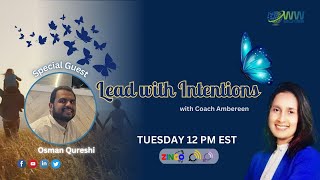
Interview on the Lead with Intentions YouTube show (host Coach Ambereen) with guest Usman (Usman/Osman) Qureshi. Usman describes his immigrant childhood, long-term stuttering/speech impediment, Caribbean medical school (4 years) followed by about a year of residency, and a 15-year career as a physician advisor focused on helping hospitals from a clinical-administrative viewpoint. He explains choosing administrative work for better family work–life balance, his growth from an observer to a more socially engaged person in college, and how his early challenges shaped his compassion and listening orientation. Family is central: married after meeting through a friend, father of twins and a younger child, eldest of five siblings; he emphasizes listening, intentional service to others, and open communication in relationships.
Questions this video answers
About 15 years.
Medical school in the Caribbean for four years.
About one year of residency.
He is the oldest of five siblings.
He is father to twins (girls) and a younger toddler (mentioned).
Chapters
Foreign.
Is there. To every single one of you. Welcome to Lead with Intentions, where every week I, your host, coach and brain, goes live at 12pm Eastern Time. I'm showing up ready to serve. It's truly an honor, more than you can possibly imagine, to cross paths with you today. I don't believe in coincidence. I think this is serendipity. This is divine timing. And I really appreciate every single one of you for giving us the most important commodity in the world, which is your time. And as they give this to us, my intention is to bring on folks and individuals who really tap into intentional living. Today, of course, is no different. Before we get started with my guest, I want to take a moment to introduce our network. Welcome to Spanglish World network and Xingo TV channels 250 and 251. Please remember to download the application, which is completely free on your respective app stores. IOS full lineup, Android full lineup, any smart TV 2016 on forward alongside with the Roku whole brand, Amazon as well, and you can even stream us through the Chromecast devices. So as you're downloading this application, take a little bit of time, be kind to us, let us know what we're doing well, but more importantly, what can we do to make the experience a little bit better for you? Once again, the app is completely free. And the most amazing thing is you can talk to us via chat. You know, if you get on, you could ask questions of my guest, of me. And this way we're actually building a family of intentional human beings and really allowing all of us to be in a place where we feel like a community. All right, so today our guest, somebody who I adore, I admire, I respect, and I even trust. Okay. Usman Qureshi is a physician advisor, but more importantly, he's my bro. He's somebody that I look up to as a mentor, someone I ask for a lot of advice, somebody who helps me level set my own mind and somebody who I find myself in. He is a brilliant father, a loving husband, a remarkable son, and just a beautiful human being. We like to call him Gandhi in our family. Okay, so welcome to the show, Svan.
Thank you. Thank you so much for having me, Ambreen. It's an honor to be on this show. I've seen your episode, so it's really cool to be on the show on your show.
Well, I would have it no other way. And I'm happy that we're able to arrange this. Take some time out of our day and really just, just speak. So the first Thing I want to ask you is tell us something about you, who you are and what is it that you do.
So like you had mentioned in there that I'm a son, I'm a father, I'm a husband. I honestly thought about that right before the show and I think that's really who I am. Everything else is just a part of what I do. So. But by profession I am a physician advisor. That's a fancy word for saying I'm a person with a medical background working for hospitals to try to help increase their revenue from a medical standpoint, sharing my clinical expertise with them. I've been doing this for the last 15 years of my life and that's a little bit about who I am. I can get into more if you.
Ask me more questions, definitely. Okay, well there's a lot of stuff that people with a medical background can do. Right. What was it about this specific career path where you've been in it for 15 years you mentioned?
Okay, so I went to medical school in the Caribbean for four years. And then, you know, life takes you in so many different ways that sometimes you don't know why things happen at that time. But after med school I did do like a year of residency, which is like the clinical training you do after medical school. But alternate kind of pathways came up in front of me. A lot of my friends were getting more into the, into the, into the administrative route of medicine, you know, where you're not involved in like day to day clinical stuff, but you're more seeing it from a, from like business point of view. You're helping hospitals, you know, with insurance companies and different issues. But you're using like a lot of the clinical knowledge that you learn in medical school to help hospitals to get more money basically from insurance companies and things like that. So there's a lot of like admin work that I do. But what I love about the role that I'm doing is the only work life balance, you know, I did, I did have some clinical experience in the surgery area and my schedule would be one, I would be on call every day. So that means that you start at 7 o' clock in the morning and you don't leave till the next day at 9 o' clock in the morning and then you repeat that cycle like after a one day gap. So I kind of saw like if this was a route that I was going to take, the first good half of my career would be heavily without any family life, you know. And I just thought this was more of like the route that I should choose for myself and for my family. So that's kind of how I ended up in this role.
Hmm. Now, when you're talking about, you know, people who are in the medical field and kind of don't find that balance, what about it, about this specific lifestyle, was it that you were like, you know what? I do want that balance.
Having a family for first off, you know, right around the time that I started my internship, that's when I got married. And I saw that even though I was a newly married person, you know, most of my time was involved in hospital. So the, so the time that I had after was really, I saw that as being, you know, this is my time to really find out who I am as a husband and who I am, you know, like a little bit later on as a father as well. So I saw that, that, that my time was really short with my family, with my loved ones. And, you know, even in that time, you know, sometimes you would still be, sometimes you would still be thinking about work, about what happened at work and work, kind of like overwhelmed, you know, and work. And work would sit on your head for a very long time. So, you know, all these things put together kind of wanted me to look outside of that. You know, I think that being in the medical profession is a great field. You help people and it's something that, you know, we need more of in this world in people who are helping with people's health problems and clinical issues. But for me personally, I saw a better life for me outside of that field, you know, one where I wasn't as heavily involved with work and would have time for family, work, life, balance.
Yeah. So for those of you, of course, that don't know, this bro of mine has all the herd of people who are just doctors. So he's kind of been in this, you know, I guess you have this outlook of what it could be when you're over invested in your own, you know, known work and you can't find that time for family. And today the conversation is literally just that, right? Like kind of sharing with the people. Why, for you, family is a key driver of who you are. So when I'm thinking about this, what I want to ask you is what does it mean for you to lead an intentional life?
So leading an intentional life, you know, I always kind of go with the motto like, you know, whatever you can do to help someone in any situation, you should do that just for the sake of. You would want that to happen if you were in that situation, if you were facing Some adversity in life, you know, having someone, you know, putting you first or thinking about what your feelings are. You know, like, if you're talking to someone and you just do something to. To like, entertain them a little and make them happy, you know, So I try to live by that. You should really. I know it sounds kind of cliche, but, you know, but to treat other people's as, like, treat other people like. As how you want to be treated is kind of what I live by.
Yeah, that I know. And I. And I think that's. That's something that I've seen you practice. Now, why is it so important for you to be somebody who is a support to others or to be helpful?
So that has a lot to do with, you know, how I. How I was raised, certain. Certain, like, challenges that I faced. You know, growing up. You know, we came to this country when I had just, like, started to learn how to speak, and I started my schooling from here, and, you know, I went through a lot of, like, adversities, you know, just to kind of. Just to kind of. Just to kind of come out and say it. You know, I. I've had a speech impediment for most of my life. You know, I have something called stuttering, which is like a neurological disorder that affects the way that you communicate. You know, there's many reasons or causes as to why this happens, but I kind of came at a stage where. Where I didn't speak, like, any, like, English when I came. And I started kindergarten as soon as I came to this country, maybe one or two years later. So, you know, because of my speech impediment, I had a very hard time to communicate. I couldn't speak. I say my name. And it was at a stage of my life where I'm learning to kind of, like, assimilate into a new culture, a new environment, and, like, I can't speak for myself. I can't be the person that I want to be because I'm being held back. So a lot of how I view the world, I think it comes from kind of. Kind of my own personal challenges that I faced and the way that I was raised and the way that my communication disorder helped me view the world.
Okay, first of all, super courageous of you to kind of share that with us, because I know that that's something that's very personal to you. I know that you and I have had conversations where in our minds. I think I would even call it like, an impediment. I would just say it's Different, Right. Like in our minds all of us are given something or not given something and that becomes part of our journey. I know for you this has been something where you seek support and ask counsel. Now when you look at this, kind of take us back to the five year old kid and I think that's really important. The reason why I'm going there, you know, for all of you that are listening, and I'm super grateful for that, is many times we face challenges in our lives and we can't make sense of any of it. So take us back to that five year old Usman and how he saw the world and how that shaped the sense and this essence of help and support and understanding other people.
Okay, so you can picture what a five year old kid must feel like in terms of starting school. And you know, you're at that stage where you're out of the comfort of your home and now you're going into an environment where you don't have that much familiarity with because you are like at home for five years and all of a sudden like you're being put into an environment where there's kids, there's interaction, there's social interactions with other kids, with teachers. And this is all something that you know, is completely brand new to someone coming from like a different country, not having any time to like assimilate, going to like going to like preschool and having that time to learn how to interact with kids. So I'm being like my first interaction with the world is now, now in the school setting. So because I'm not speaking, because I'm not interacting, I feel like my senses, the, the other senses heightened up a lot. Like my ability to hear people, my ability to see things for what they are. You know, not having something to say made me want to hear things and made me want to be more of someone who listens. And I feel like that shaped me into who I am. Like I always looked at the world in a different lens as someone who was observing it from the outside versus someone who was actively speaking and communicating and interacting. So that's how I viewed the world when I first started, you know, like in school.
Okay, I, I love that you're diving in there. And I'm doing this for my own selfish reasons. So when we become an observer of life and our environment and our surroundings and the conversations, how does that shift who we become versus when we are, I guess, the active participant in it?
Okay, so when you, when you are an observer, you kind of see like everything from start to beginning. You See how people like, act in situations. You see how people like when they're being spoken to, how they react to certain situations. Like when someone's angry, when someone's sad. You first notice how they act versus how they speak. So that's kind of how I would view things in life. Like, I would see like, like other kids that were also not very comfortable in a school from international background and they didn't speak. So right off the bat, like, I, you know, I had had been, I had been put in, I had been put into like speech therapy and also like esol, because I didn't know how to speak English. So I would see other kids who are kind of, who are kind of going through what I'm going through as a kid because, because, because of the fact that they feel uncomfortable in that environment. They had to be taken out and be put into an environment where they're learning how to speak English, where they're learning how to communicate with each other, where, you know, where we're working a little bit harder than the other kids who know English and are already set in the environment and can, you know, can start learning. You know, I felt like I had to learn how to become me at first. I had to learn how to speak. I had to learn how to, how to speak a language that I didn't know. So all these times, like all these things and they take time to learn. So. So, because you're already looking at it from a different lens, I feel like my ability to read people started to take hype from there at that point in my life. And from that point on, I felt like I would always be an observer. And as I kind of like progressed in my life, I learned how to, you know, how to take it one step more.
Okay, I'm gonna really. I mean, all of what you said is, it's so profound, right? Because it is true. If you're kind of in this culture, if you're going up here, if you know the language, you're not really having to go through and be put in a different environment in a small group to say, okay, let's do the basic stuff. Let's like kind of learn how to even say speak in English. Let's learn how to read English. Let's learn how, what the letters are, even how to write your own name and those types of things. I love what you said and I really want to dive in. And this doesn't have to be from a five year old's lens. When you said that. I had to first learn to Become me. Who is this me that I'm speaking to?
So, you know, like, at that point in my life, like, I didn't know that there's something wrong with me. I didn't know that, that I have something that a lot of people don't have. You know, I have something where I have a hard time to introduce my name. And that's such a common thing for people to ask for when you first meet someone new. What is your name? Where are you from? All these things were. Which seem really ordinary to most people, but to me, extraordinary. So that's kind of what I want, like, everyone to kind of understand what it's like to have something that kind of challenges you on a daily basis. You know, you're. You're basically for someone who stutters a lot of time, like, a lot of the times, like, you're living inside of your mind. You're living inside your mind and saying that, like, hey, I really want to speak up in this situation. I want to say my name is. I want to, like, I want to go interact and not fear me not being able to communicate because of speech impediment. All these things are racing in your mind, and that's a part of who you become. So when I met. So when I talked about, like, I was trying to figure out who I was, my early life was really focused on, okay, I'm a person who has a speech and I want to say so much, but I can't. So I had to learn how to balance life. I had to learn how to balance social interactions. You know, I would say all the way up until high school, I was a person who didn't speak. I was a person who wanted to speak in my mind. I was thinking to myself, raise your hand because the teacher's asking a question and you know the answer. But mine would tell me, you should play it safe. You know, you're going to open your mouth and people are going to see who you really are and they're going to laugh at you. And, you know, this is more, you know, like in the elementary school years where I really faced that little black adversity because I look different, because I sounded different, because I couldn't speak properly. All these were things that made things harder for me and really changed the, like, the view of how I view people and how I wanted to interact settings.
Wow. Like, every single one of you that's listening, I'm really hoping that you're actually. I'm praying that all of you are able to find those small nuggets. Keeps dropping. It doesn't have to be that you're facing a speech impediment or if you have some kind of disability or anything like that. But it's like in life there are things that we are in our minds about, no one knows. And that fear basically starts to drive our life. But then something changed. So what happened in high school, Usman, where you are now saying, I'm gonna try to get out of my mind and like start to face this fear a little bit.
So I mean it didn't happen until after high school for me. I would, you know, like I learned to get by. I learned to get by without speaking much, not speaking when I had to, and even like, you know, to take safety measures, safety measures to try to protect my well being. So I would tell or I would have my mom tell my teachers, hey, he's gonna have a hard time to do like oral presentations in school because he has impediment. So. So like I had already set the stage where the teachers knew that, you know, he's going to be hesitant to be called on. He is not going to feel comfortable. So let's try to make him as comfortable as possible. So a lot of it came out as, let's not call on Osman because he's uncomfortable. Let's, if he has to do like an oral presentation, let's let him go. Let's let him go first so he can get it done with and not have to sit there waiting for his turn and you know, that leading him to be more anxious about things. So like I always found ways to get by. I always find ways to make it more comfortable for myself. And then, you know, I don't know, something kind of happened in my mind when I got into college. I'm like, Okay, I lived 18 years of being sheltered and because I had a little bit more like independence as well. Where now you're not in this sheltered environment where you have like, where you're being like up until high school everyone kind of, kind of has help all throughout the way and you know, they're there to guide you in terms of like yours, like your teachers and you have a more structured environment. But when I stepped into university, you know, it was like I felt more independent. You know, I had gotten my own, you know, like little, little things kind of help you finding your independence and finding out who you are. So kind of being more independent, you know, helped me to find, find comfort and being who I really want to be. You know, finding, finding comfort and being that person that's socially involved, you know. You know, I would say I, like, I, like I, I stepped out of my caterpillar phase and became a social butterfly as soon as I entered university. So I think that kind of helped me. You know, I still went through challenges. Not to say that life was all good, like, all throughout, you know, like something that I'm realizing now, like, as a dad, you know, I didn't understand what my parents were doing at that time to help me with my speech impediment. But now, you know, I have a son who's a toddler, and I see him stuttering. So now, like, I'm seeing myself in him, you know, every day. Like I'm saying, okay, so this is what I look like when I was his age. And, you know, this was my struggle. And I started thinking like that. I start thinking of all the things that my parents did for me. You know, my mom knew that, you know, that this is going to be a thing that's going to hurt his confidence level. It's going to make him feel sheltered. It's not going to want to make him to be more. To be more, like, expressive. So she, so she quickly did things to help me, to help me gain confidence. You know, she put me into taekwondo right away because she felt like that, like maybe him feeling strong and feeling like he's active and can. Can kind of convince. Can. Can kind of like protect himself, you know, if, if he's, if he's to be picked on in school, you know, he'll feel more confident about himself and that will help him. Whatever, like, extracurricular thing that I wanted to do, she let me do it because she knew that, that that was a part of who I wanted. Like, that was helping me get to a certain point, you know, everything that, that I wanted to do was helping me to become more confident. So seeing that now, you know, it, it's hard to see, like, your child kind of go through something that you did, you know, every day when, like, my son says his name and he can't say it and he's having a hard time to get the words out of his mouth. It hurts. But at the same time, it makes you realize that you have a bond with your kid. You know what he's going to go through. You can help shape his life. You can, you know, everything that you felt lacking in your own life, you can be there for him and you can show him the way, and you have that bond that no one else does with him, you know, so it does help you connect with your children or it helps you connect to other people that might be going through something, you know, it doesn't have to be stuttering. But I think that's how I started to view life. Like everyone has their challenges, everyone is going through something and maybe they're not speaking it, maybe they're not able to show the world, but they're going through something really. So, so is it better for you to take more time out to actually hear that person out versus you speaking? Or you know, sometimes like, I don't know, I just feel like, like when you hear people out, like uninterrupted, like the way that person opens up to you or the way that person is able to, to feel in those situations, I think that's what like I want for myself. And that's why like I try so hard to try to see life from another person's view, you know, like, and I think you can do that by, by, by just hearing them out and not speaking much.
Yeah, I mean first of all, like commendable because I don't hear that version of you that I did before. I think the more confident that you've become and I think a lot of times embracing our challenges and being open about it allows you just to be, you know, that, that little five year old kid who's like discovering who am I? Who am I? What am I supposed to be? Why am I so different? Why is the world like this to the person that you are today? Because Osmar is one of those people who will come back from a party with five phone numbers and then reach out to them like three months later like, hey, you were asking about this, let me give this to you. So you're somebody who was like a linchpin, somebody who keeps ties, somebody who puts himself out there and I've seen that confidence building up. And I think for you there must have been some breakthroughs that you went through which were all coming from a place of uncertainty and uncomfort. Like you said until high school I kind of like got by and got like, you know, the extra special treatment to make it work. But in college, that brand new environment, now I get to shape and understand who I am versus that five year old kid. We're trying to figure things out now. Knowing what I know about the world from the perspective of other people, is it a profound way of looking at life? Now you spoke about your son a little bit. Shout out to Abu Bakr, my little, my little nephew. Super confident, super adorable. I literally like this, this munchkin Can. Can do anything, be anything. And I think it's a lot of. Has to do with the fact that, you know, you two are his parents. So as we're talking about family today, you know, share with us something that you would want us to know about your family and the dynamics.
Sure. So me and my wife, you know, we met through a family friend and, you know, that's how we got to know each other. And we got married shortly after and we really felt compatible in the sense that we had bought, that we had. We had both gone through some challenges in life and finding happiness in life and when we found each other and when we were able to connect on certain things, you know, that was the start of, I would say was my family life, was first meeting my wife, who is my stronger half, and I feel like she makes me better and I make her better. And we feel really lucky and fortunate to have found each other and to have started this life together. And, you know, we. We didn't have a family till later on. So when we did have family, we got hit hard because we got hit. Hit hard with two at once. And so if we. We used to joke around that, that if we have kids after the twins, that it would be so easy that we can just use our feet to like, rock them, like to rock the baby to sleep. Because after two, it was just like we had to learn everything at a very fast pace. So our family life is really special to us because, you know, we had our twins first, and that really taught us how to become parents and being the father. Girls, I think it really changes the way you view life. I mean, having special, but having two girls at once, it really changes them the way that you view being a father and. And also being a human being, you know, because you're a father to two precious girls that are all the. That the basic of the light of your life, you know, like along with your wife and your family. So, yeah, I mean, I think having different backgrounds and different upbringings too, is a part of your journey as well. Me and my wife are, I would say that like on two opposite ends of the spectrum. But we learned to kind of find some middle ground and meet in the middle and to build this family that now we value so much. So, you know, at the end, that's what we feel is one of the most, is our family and how we raise them and the values that we give them. You know, they challenge us on a daily basis and, you know, they help us to. They help us to become more patient you know, especially with that are seven now and a toddler in the mix. There's a mix of so many different personalities in one household, you know, but at the end we're kind of like every day we're learning a little bit about each other, we're helping to balance each other out, we're learning from each other and we're growing as a family. You know, that's, that's your own family. So I don't know how else to put it.
You're putting it brilliantly. And I think that wisdom is rapping that I, you know, that I often lean on and I'm like, yeah, he just gets it. You know, as a family coach, my biggest thing is just that, right? How do we prioritize our families? Not just by saying it, but I see you, you know, emulating it so much in your own life. And what you just said is like our children and our daughters became the light of our lives. I wouldn't say that everybody feels the same way, you know, or could articulate that about seven year old girls who come with challenges. So for the, for those of us that are, you know, that are in the same place or have children, what is one challenge that you think is something that you and your wife have faced and how did you. Or maybe you're still in the process of overcoming it or dealing with it.
I would say that because we're coming from two different backgrounds, we were raised differently, you know, like I was raised here in America where she had come, you know, much later on. So, you know, the way that we view things and just in terms of our personality, you know, a big part of me is still someone who is an introvert but is learning to kind of like step outside of my comfort zone, you know. So that was kind of like, like you had asked earlier what made me change from that high school, the high school version of me, like, and that like as soon as I stepped into university, I would say a big part of that is actually accepting who I am, accepting the challenges that come in my life and looking at, you know, my issues with speech as not necessarily like a bad thing, but how it has helped me in life, how it has shaped me into who I am. So I think realizing that and realizing that not everything should be viewed at, viewed as something that can be harmful or being like a big negative in your life, but what you can do with that. So that's kind of when I decided that, you know what, I'm going to step outside of my comfort zone. I'm Going to put myself in situations where I'm forced to interact, where I'm forced. When I'm forced to introduce myself, and I am going to go through challenges. I am going to have difficult situations that come out of it, but it's who I am. It's not something that I can change, but it's something that I can learn to live with and use that to my advantage. So that's kind of how I change from that person who. Who wanted nothing to do with stepping outside of his comfort zone. I mean, I literally, you know, like, I would tell my teachers, I don't want to do anything, so don't. Don't pick on me, don't call on me. You know, I'm only going to do, like, the bare minimum just to get by. So that's how I viewed life. But, you know, something in my mind just is, like, you have to change. You have to go out there and live life and not be sheltered as much. And, you know, that's a big change in my mindset that I had, which kind of helped me to shape me into the person who's a husband now, who's a father now. You know, it's made me, like, I'm, like. It's made me into the, like a son who's very compassionate about his parents. You know, like, seeing everything they've done for me, you know, really makes me want to go the extra mile for my parents and for my family, for my siblings. You know, like, I'm the oldest out of five siblings. And, you know, my role from that time when I was not wanting to step outside to now has changed a lot and changed in terms of how I want, like, how I want to be viewed by people, you know. Yeah. And.
And I know for, you know, especially in our culture and the South Asian culture, when we're talking about being the eldest, you know, and on top of that being the eldest son, there is just some natural pressure that comes into existence. And so, you know, our show airs across the whole globe. So it's not like we're just talking to the people in North America here.
We.
We're talking to everybody. So I do see that Remy. Remy has, you know, shared a link. If you have a question, by all means, drop it in the chat. You know, let us know what we can ask. If there are things that are coming up or resonating with Usman's story about your own story, you want to ask him something or just want to comment, please. I encourage all of you to kind of engage with us in that way. Now, when you're talking about, you know, being the eldest, and you said it very casually, but what does that mean? You know, what. What does that mean? How does that cultivate and shape who you've become now versus, you know, the kid who started to kind of open the door, embrace and accept that, you know, I. This is who I am. In order for me to elevate and become all I'm meant to be, this is a doorway that I'm going to take to. To my life.
Yeah. So being the eldest in a family, it's kind of like you're the unspoken leader of that household. Like, everyone, you know, like. Or I want to be there for everyone. I want to be there for all my siblings, and I want to be there for their challenges in life, you know, even though I may not be with them because I don't live near my siblings, you know, I am, like, you know, constantly looking for ways to communicate with them and finding things that we can do together and seeing that, you know, that, you know, as your parents get older, there's more responsibilities that fall on to you into how your family unit stays together, how they interact with each other and things like that, you know? Yeah. So that's kind of what I want to say about that.
Yeah. Okay, so let's. Let's kind of tap into that. So unspoken is something that was kind of part of your. Your Persona right until a certain age. And that unspokenness allows you to become the observer, to become the processor, to become the person who is more compassionate, more kind, more supportive, more accepting. But when you're talking about an unspoken leader, you know, a lot of times we don't understand what that is because we're like, well, leaders are the ones that speak. They're the ones that guide. They're the ones that talk and tell us what to do, where to go. Why did you use that specific phrase? Because I'm fascinated by that.
Because a lot of times, like, being a leader, you don't get, like, recognized for that right away. Like, you do things because you want to do it. Like, you don't do it for. For someone saying, like, hey, you're doing such a great job. Like, you do it because you see there's a need to do it and you want to do it, and that's a part of who you are. So that's kind of why I said it's kind of like an unspoken leader. Like a leader of a country, let's say, would get that recognition, would be recognized as that. But sometimes you just want to do things just for the goodness of doing the right things as you view it, like, doing something that you think will be beneficial to everyone. You know, being there for people, being, you know, like, I feel my biggest. That, like, my biggest contribution is I'm always someone who would listen to someone with an open mind. And I feel like being a leader, that's something that you need to have in you, like, in terms of your personality traits is being able to hear people without having your own opinion about not having your own opinion about something and sharing your views with someone. Sometimes you just want to be able to hear what that person is saying.
Yeah, it's like a profound quote that comes to mind right now. Oprah Winfrey, I believe, says that most of us listen, you know, to hear or to respond, but not to understand. It's a different way of being. So allowing yourself to realize and recognize that being open, I think, is such a beautiful quality that people should have and, you know, can always keep kind of leveling up. It's something that you arrive at and you're like, okay, yeah, I'm open. Now I'm done. Right. And it kind of puts you into a place, I would say, where you have more leverage, you know, than the person who's not doing all that work. Now, what would you say? You know, we. We've talked about family. We've talked a little bit about career path. We've talked about a little bit about your upbringing. Can you share something personal with us which will allow us to get to know you a little bit better?
I think the most personal thing that I've shared is, you know, like, my journey with speech and my journey with communication, because that's a big part of who I am. Like, I don't. Like, I don't finally comfortable with it, where I speak about it that, like, openly, like, you know, in the past, I wouldn't even want to mention because, like, I spent a good part of my life, like, hiding from it. Even though, like, it was really evident that there was something wrong with my speech. There was something that I, like, I couldn't get words out of my mouth, like, that was really evident to the outside world. But to me, I was like, if I don't speak, then people won't see it. But even though, like, I knew they saw it, I knew they knew something was wrong. But kind of going from that mindset to openly saying that this is a part of who I am, you know, I learned to do that, you know, like, through speech. Therapy to, you know, to counseling. That kind of gave me the courage to realize that this is. This. Is this one part of you. It doesn't define everything that that comes out of it, but it defines what you do with it, you know, and that's kind of when I felt like, comfortable enough to be able to share with people because, like, you never know your journey and your struggle might help someone else. Like, I had, like, there were support groups for people who have stuttering issues. And, you know, oftentimes a lot of people are afraid to speak up and share their experiences. But, you know, I look forward to this, and I volunteer myself to speak at these situations because a lot of times your view on life or your journey will help someone else who might be going through something similar that you did. So that's kind of something that's really personal to me, is my speech impediment. It's not like to say that it's this thing that is an issue for me, but it's a thing that I view as. As a part of who I am. It's a part of how I've been shaped, you know, like, the experiences that came from it. And it's really a part of how I view things, how I understand things. You know, everything, like, to me comes from that, you know, along with my upbringing, with my faith and stuff, you know, that is a big part of who I am, and it shapes me in so many different ways. Yeah. I can't think of anything more.
Like, thank you so much for. For getting personal with us early on, you know, but I didn't want to provide the opportunity to you to kind of talk about anything that you think would, you know, would just support and allow us to tap into your mind and to who you are. I want to go back to the one thing that you talked about a little bit and ask you, you said, you know, my wife and I, we have really different upbringing and kind of challenges that we came through to make that work. You know, many people, when the challenges come, especially in a marriage, you get bitter. They start to kind of disconnect. They let you be you and me, be me, and kind of don't come on that same page. And she is, you know, she's my sister, so I know how she is. She's literally the opposite of him. Right. Like the opposite. And so how did you guys find a way to. I don't want to make it work, but to thrive.
Realizing, you know, how you came up to that point. That's a big part of why we. Why we strive to work with each other. You know, you realizing what a special thing that you have in being like a married unit that has gone through challenges, you know, so to know what's at stake, to know if you didn't have this, what. What would your life be like that should motivate or. That's what keeps us motivated to keep our marriage as healthy as we can do or as healthy as we can. We go through, like, we have disagreements, we have different viewpoints on how you might want to raise children. But at the end of the day, we try to hear each other out, hear where we're coming from, understand each other's perspective on why they think this view of theirs or why this action is the way that they did something. You know, coming from a place of understanding and love, I think that's what motivates us and helps us to keep things together.
Yeah, understanding and love and sprinkle a little bit of compassion on that and you got a few beautiful blend. Now, I, you know, I want to kind of commend you on, you know, on this journey because I can only imagine the amount of nerves that came for you to be like, okay, you know what? I'm launching myself to the world. And my intention always here is the person sitting on the other seat is like, I wanna. I wanna expose, so to speak, or share your greatness with the world. And I see so much greatness within you from the fact that you came here as an immigrant into the US to learning a language, to becoming the observer, which is something that I'm actually on a journey with right now for my own self, and then going through and looking at, you know, life just kind of is meant to be this way. The sooner that I can say that, okay, I accept it, I embrace it. It really. You said, like, it literally, like, shifts the perspective and the narrative. Now, you and I could probably go on for hours, but do want to ask, how do people get in touch with you?
I want to say that, like, I'm the type of person that I like people reaching out to me. I like people sharing things that are personal to them, you know, and, you know, I want people to feel comfortable with me to share things because, you know, a big part of who I am is someone who observes, listens to people. So, you know, like, any way that you would want to reach out to me, I can leave my email, you know, social media, you know, like, I'm open to people. Like, I'm the person that, like, whenever I go to a social gathering, If I see someone that's not interacting, I'll make it a point to go to that person and make them feel wanted and being part of something, you know, because that's what I lacked. That's what I felt that, that I lacked a lot, you know, as a child, as adolescent. So that's kind of the way that I view things, you know, I don't want people to feel what I did, you know, and like, there's something that I can do to change that. Like, I always look for ways to help people.
Yeah, definitely. So Usman Qureshi is, you know, is all over social media, like he said, but Then also on LinkedIn as well. You can kind of go into it as an mfa, I believe, healthcare provider. And so he is somebody who you can def. And like, reach out to him like he will. He's not only saying what he's, you know, that I understand and I listen. He really is the, the epitome of, you know, living into it. And he is somebody that I go to often where I'm just like venting and screaming and not, not screaming, but venting and getting loud only to have points that are connected. And for him to be like, okay, let's, let's take a pause and figure out really, like, what is the underlying theme? So I love that I can talk to you forever, but I do want to actually close things off with what we call an intentional wrap up. This is a rapid fire questions that I ask you, so answer them without thinking, without processing too much. One word or one sentence. And it's supposed to be like a fun way to end the show. Okay, what do you want to leave behind for the world?
Happiness.
How will you know that you've led an intentional life?
By how people view me.
If there was one law that you could create, everybody had to follow this law. What's the law?
I mean, listen and don't react.
All right, look, you see how the themes are. It's coming back to the full circle. Okay, what is one lesson that has made you who you are today?
My experiences. I can't really narrow it down, but just my experiences is what has made me who I am right now.
Wonderful. And the last question that I have for you is, what is the key to a healthy relationship?
The open and honest of communication.
I love it. All right, well, thank you so much, Usman, for being on the show, for wrapping your greatness, your wisdom, your generosity, your kindness, and your support and love with the whole world. This is a moment I want to treasure.
Thank you so much for having me. It was an honor to be on this show and hope I was able to shed some something to someone out there.
Definitely have. All right folks, remember you can always reach out to me at Coach Brain. Reach out to Usman Qureshi across social media. Let us know what's resonated with you and what you want to dive more into questions that you have. Anything right. And I will go ahead and include Osman's email in the actual social media content that I put out so this show can be heard on Spanglish Radio Network. Please check out Spanglish World CA for all the news in the programming as we close the show. My prayer is that this lead with intentions will embark us on a transformative path to be in gratitude for all the blessings that we have, accept the unfoldings of life and commit to values and dreams which will allow us to tap into our own greatness. Because I truly have Tawakkal, which means faith in every single one of us. There's only one of you, one life. Design it by excellence. Spanglish World. Watch it, hear it, read it, download it. Most importantly, live into it with an intention to better serve who you are. Thank you much folks. Until next week.
Bye. Thank you. Bye.










