Lead with Intentions: Reflection & Change
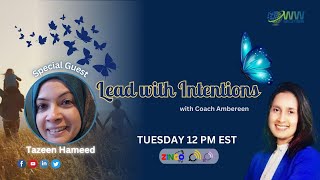
Transcript of a Lead With Intentions episode featuring host Coach Ambereen interviewing her sister Azeen Hamid. The conversation covers Azeen's journey from immigrant roots to education, resilience after an abusive relationship at age 22, breaking Pakistani cultural norms, family and parenting dynamics, living intentionally, presence vs productivity, and practical boundaries for relationships. The tone is reflective and conversational.
Questions this video answers
Every single week at 12:00pm Eastern Time.
About 12 years (the guest says 'happily married for 12 years').
Three children.
Chapters
Foreign.
Magnificent day to you. Welcome to Lead With Intentions, where every Single week at 12:00pm Eastern Time, I, your host, Ambreen Hamid show up here ready to serve you. I truly am honored to cross paths with you and to be here realizing, recognizing that I appreciate you for giving me the highest commodity in the world. And that is your time. All right, let's get rocking and rolling. Welcome to Spanglish World Network and Xingo TV, channel 250 and 251. Please remember to download the Xingo TV app on your respective app stores. IOS, Android, the Fire Sticks, the Roku's, the 2016 TVs on Forward. As you're downloading this app for us, go ahead and leave us a review rate us. Let us know what we're doing well and how we can better serve you. Because it's through this that we can actually amplify and impact more people. As always, this app is completely free, yours to use. So make sure you get those Chromecast, those fire sticks, those Roku's and those TVs locked and loaded, hooked up. So that way you can have, you know, a great experience here with us. All right, for those of you who know me, every single week, my intention is to. To come here and actually introduce you to people who are very rare gems. These people are individuals who are living impactful lives and really, truly want to make the world a better place. A lot of times these people are people I cross path with and other times they're kind of in my path. So today I have the most beautiful guest here for you. This woman, she is something magical. Azeen Hamid is somebody who is truly a remarkable human being. And what makes her remarkable is that she's a Muslim American who is happily married for 12 years with three beautiful, healthy and brilliant children. And it is my honor to call her my younger sister. She has been an influence for me and my rock in the most difficult times you guys cannot imagine. This girl showed up in ways I did not even. I did not even pray for, to be honest with you. The zine is an immigrant who moved to America without knowing any English and now holds a master's degree in in the field of mathematics. Nerd with a master's in curriculum instructions. She's somebody who I've seen grow, bloom, blossom into a force of reflection as she changes often to realize how she shows up as her best self. The greatest thing about the Zine is she is somebody who wears a strong armor to protect herself from the actions of other people. The negativity that may Impact her. And without further ado, please welcome to this show, my favorite sister, Theine.
Hello, everybody.
How are you feeling? I'm good.
I'm good. It's different to be on air, but I'm excited. There you. All right?
All right. So then as you're excited, come on. Because for the pe. No, the audience that's watching be people who are tuned in, which I'm so very grateful for. Tell us something about you. Who are you?
Who am I? All right. I am. I feel like I am just someone that is trying to walk through the different paths of life, reflecting and changing. I have watched this show with amazing people on air, and I honestly don't find myself in the same quote as them. I am just someone that has done dealt with a lot of different experiences in life and have really reflected on what do I want to take away from it and how do I want to live my life. And for that reason, I'm someone that's doesn't just mold and doesn't follow. I will question everything and question how it affects me. And if I feel like it'll make me happy and it'll be good for me, I'll follow it. If I don't, and I stop and I don't answer to anyone for it.
Right there, that last one. I want to dive in there. I don't answer to anyone for it. Now, that is a lot of armor that you're wearing. How did you get there?
Life, it's. It's tough at times. You know, I think that growing up, I'm the third of four sisters and Brina's second and third. And as a middle person, I feel like you're always kind of fighting for that attention, and so you feel like, oh, you have to speak up more. You have to be louder. You have to be now the crazy one in the family. You have to be that, because that's how I want to show up. And I think you just realize, like, you want to make your mark somewhere. But, oh, boy, have I changed. Oh, my goodness. I mean, I think that stopping and reflecting and figuring out, like, perspective has grown. It has allowed me to have this armor. I think that before I came with the armor of having a very loud tongue, that was my armor.
I can adjust.
I've grown up with all that, and now I come with the armor of resilience. So.
That'S brilliant, because what I just recently heard is if there's one skill that will supersede and make you the human you were meant to be, it's Resilience. So I am so glad. Can you share something with us on how you live intentionally or what it means to be, you know, to lead with intentions?
Sure. I think that just from the beginning, from a cultural perspective, I think that growing up in a Pakistani household where my parents were very strict, my mom was very particular on how she wanted certain things to be. You know, my dad came here as an immigrant with four girls, which is already a challenge, trying to make sure to keep us on the right path and we're not doing anything wrong. So unfortunately, his answer to everything was no, no, no. There were these regular things that you were supposed to follow as Pakistani girls. And I questioned it, you know, like, my dad would be like, oh, you need to learn how to cook. And I'm like, why? Why can't the guy cook, you know? Or like, oh, you don't know how to make bread. How are you gonna get married? I mean, these are things my dad used to say to me, you know, And I used to be, like, questioning it throughout the way. And as you're. As you're dependent and you're questioning it, you're kind of. You're not changing. You're questioning it for your own good, but you're saying yes and no to your. You know, you're just saying yes to your parents, and you're following along. But I think when I turned 22, I got. I was, you know, in a. In a past relationship that was not good. And I think in that moment, I really had to stop and be like, what is the meaning of life? And I think when you're in a difficult spot, you really get faced with, like, what you want to get out of it and the little things that you think are important in life. I really don't really mean anything. And so I think that from that point on, I. I learned to live my life how I wanted and learned to say no when I didn't feel like something was comfortable or made sense with me.
22 is very young, very young. So could you dive in, you know, and be as vulnerable as you want to be, be as productive as you want to be? What was it that in that moment when you said, you know, it was a relationship, and I had to kind of see and put a different perspective on life? What about that made you become who you are today?
I think that when you're in a bad relationship, you learn to see, like, what your role is. And unfortunately, I was in a place where it was not a healthy marriage. I was an abusive relationship, and it Put me in a. It put me in a very corner in. In life, and I didn't have my loved ones around me. I. I literally just turned to, you know, Allah for help. And in that moment, I remember sitting and praying and realizing that, like, that my actions are going to affect my life only. And the only way I can find guidance is turning spiritually. And there are so many times where I just feel like the only one I have beside me is my God. And. And I just kind of followed that path and prayed on it. And from the time I was 22, I realized that, like, no, I needed to be a better version of me. I need to live intentionally. I needed to become better for myself, so that can be better for those around me. And that was breaking all stigmas, you know, breaking the cultural barriers, breaking things that you're supposed to do, that you should do, but you don't want to do. And I think from that point, I just kind of. I just kind of led with, like, what would God want me to do? What is the right thing I would want to do that's comfortable for me? And, you know, 22 seems like a really young age now to look back at it. I do think that I was more mature than most people at 22. And so, so, and. And when you're in a life, you know, when you're a difficult situation in life, you unfortunately have to grow up quickly. So I did, and I've kind of just held on to that since 22. You know, I'm not 22 anymore. I know. Brains. Forever 21. But, yeah.
Yeah, I don't think my audience here knows, so thank you, goodness. You want to talk to them about my 22 story?
Well, she believes that she's always 20. Well, she's forever 21, because 21 was like her. Her prime year, where she felt like she was the best version of herself, that she felt good about herself, that she was in a place where she was content with herself in life. And so it's been a while since she's been 21. For those that are watching, hey, most.
People still think I'm 21, so I will take it. I actually want to kind of reflect on something that you mentioned, and it's become a theme already. You know, within just about 10 minutes into the show, you mentioned that when you're, you know, you guys moved here from Pakistan. You guys, when we moved here from Pakistan, your dad was in a totally new, different place. And the answer, naturally, for him was no, no, no, no, no to everything. And Then you talked a little bit about the. You know, culturally, you start to question things. And right now, again, you mentioned breaking the cultural norms. As a Pakistani woman, what are some cultural norms that you felt you had to break to really define the zine and who she's becoming?
I think that growing up, speaking my mind was a very. No, no in cultural. Pakistani culture. I mean, I naturally have a loud voice. You know, I. I mean, I. I take pride in it. I try to use it well now that I did before when I was growing up. But I remember my grandma's grandpa telling me, always tell me, like, girls voices should be lower and they should be not so loud and should stay within the house. Which I understand with some perspective now, but it was very like, oh, you don't see anything because you're a girl, or you don't voice your opinion, even if adults are wrong, because you're a girl. And, you know, in our house, we didn't have any brothers, and the only man voice was my dad. And my dad didn't really speak up. That was not his nature. And so it was like you would just kind of be submissive. That was one cultural norm I was not okay with. I think going into, like, I started to travel after. After my, you know, my. My. My past kind of ended my experience with my. Or I should say my. My ex marriage was done. I started to travel. And you're not supposed to travel alone when you're a girl because you need a guy to be with you. And I was like, well, I know I'm gonna do the right thing and I'm gonna fall into anything dumb, and you should be able to trust me, and I trust myself to do this. You know, I think when I got into, like, marriage, it was the thing of, like, oh, the wife should be doing all of the labor and like, you know, she should be, you know, serving her husband on a plate of food and he should just, like, eat it and leave his plate on the table. And I was like, no. So I remember, like, there's so many times my parents would be, like, looking at me that, oh, no, that's so sad that your husband did that for you because he's doing a chore or my dad being like, oh, he's cooking. That's so sad. Like, why aren't you cooking for him? Are you making him happy? And I think just throughout, I just fought it, like, no, that's not the way that a healthy marriage is. Like, it has to be a mutual thing. And you're. You're each other's companions, right? Companions doesn't mean, like one person takes on the entire load and the other one doesn't. And then as becoming parents, you know, like, there's things that you should do. You should put them in certain clothes. You should have them dress a certain way. You should have them, like, wearing. Watched them and doing this XYZ every single day. And in the beginning, I was kind of following it and I got so exhausted and I just kind of paused and I'm like, no, that's not making me happy. It doesn't make any sense. Not making my kids happy. I'm not doing it just because I'm supposed to be doing it. No. So I think, and I know this is going to be a thing, ongoing journey for me, you know, for probably the rest of my life, but I stuck with it. I don't feel like I never follow the norm.
You know, I won't do that.
I'll stand for myself.
Yeah. I can be. I can be here as a witness. That is this very true statement. I don't follow the norms. I do me. And that's something that I think, on the contrary, I've never done in my life. So the zine talks about, you know, being the middle child. So there are four of us, and I'm second, she's third. We're the middle people, right? We're like the people who are like, give me attention.
We're like the meat of the burger, okay? We're like the. The it.
We are the edge, but we are not focused upon it. Right? So I took the other route, which the scene became loud and rambunctious and very, like, straightforward. And, you know, like she said, I used my tone, you know, to speak. I became quite the contrary, the opposite, you know. And I think it's like when you said, it's a healthy marriage, you know, take us and all the people who are watching who I'm super, super, super honored for, take us down that path. Like, what is something that you can share about your family so that we can get to know your family dynamics a little bit better.
My journey with my husband started about 12 and a half years ago. My husband is definitely an exception to the rule. A regular traditional Pakistani guy is very like, I'm the breadwinner and I bring in the money and that's all I do. And you do the rest of it, right? You raise the kids, you take care of the kitchen, you do the cooking, the cleaning, the whole thing. And you might work if you want to, or if you have. If I feel like you should.
Right?
That's the other traditional thing. And I think when I got married to my husband Osman, thankfully my in laws have done an amazing job of not raising him with those traditional norms. And when I married him, I remember something simple like ironing, right? Like the girl does the ironing and we had to get ready for like, parties, and the girls always take longer to get ready. And here I was like, my husband's like, oh, I'll iron your clothes. And at first I was like, what? Like, you're a guy, you could iron, you know, but she did it. And I was like, okay, this makes sense. Sense, right? Like, we have to get somewhere on time. If he's ready and he hires my clothes. That makes so much more sense than me us being late. And that just became like our thing. Like, what are we gonna do together to like, make the most out of it? So now, like, we have a very healthy relationship in the sense that, like, there's no, like, you do this and I do that.
There's.
Wherever we need to help each other out, we contribute. I, you know, when we had kids, we chose that the life I wanted to be is a part time professor and a full time mom. And so I, I love that. And that's the dimension. I mean, that's the life, that's the family dimension, the dynamics that we want to keep. And so my husband is the main breadwinner, but all the other stuff around the house, he's contributing. You know, in terms of raising the kids, there's a very big norm of like, oh, the mom does everything and she takes them to the bathroom and she feeds them all that stuff. And I just remember my grandma being like, you should be ashamed of yourself that your husband is changing your daughter's diaper. And I'm like, why? That's his daughter. You know, And I think all those are like, a lot of people recognize it. And that's why I was saying reflection and change is like my motto. Because you might reflect on it, but it takes another sass pizzazz to actually change it and be like, no, I don't want to adopt that. Just because that's all I know. Because it doesn't make me happy. It doesn't make me like, make the most of my role in this relationship or whatever role I'm taking on. And I think that for us, throughout, you know, 12 years of marriage, and even with our kids, when you come to our home, it's a very different field. In the home I grew up in. Because there aren't any of those. Like, you should be doing this or you should be doing that.
So, you know, I'm huge on energy and I think it's like something that most of us don't realize how much it impacts ourselves. You just mentioned that the home that you grew up in versus the home that you now reside in, which is your home. What's the shift in that energy and how do you maintain that?
Oh, I mean, honestly, I am always struggling between nature and nurture. Naturally, coming from our household, it was louder. It was like there's these ABC things you do when you come home from school, from, from work or school or whatever. You follow this, this strictly within the one hour. And you know the idea of like, well, kids, you tell them what to do, you don't really ask them what they want to do, you don't give them like an open window to explain because I am the mom and I will explain on your behalf, you know, those type of things. And I think that growing up I felt that because one, I was, you know, raised culturally in the sense that I didn't really have a say, to speak my mind. And I think the other thing was like, well, yeah, that's great that you're saying that, but as long as you're staying within the boundaries that I have formed for you, I'm good with that. You know, I think that over time that became a more of a negative connotation, you know, and it became very like the hospital became very, very anxious. It was always like this discipline idea, which I'm very big on discipline. But I think there has to be a balance. There's the idea of like, you know, just saying no because in their minds it's a no, but not really hearing the other person out. And I think that when I was, you know, when I consciously made our home the way it is now, there is room for error. There is room to be like, okay, why are you acting this way? Or yes, I do expect to do A, B and C, but how do you feel about it? Or is there something else you want to do? Or maybe today is not a good day for you and you tell me what's bothering you that we can talk about it. You know, I think the communication is big and because of that there's no expectation that you have to have coming into the home. It's just to be. And however you are, I'll accept it.
All right, so your wrap ups are becoming extremely impossible, you know, impossible to the trump here. You said something that's profound. I'm not sure if you recognized it. And for those of you who are listening, that lesson that she's just teaching all of us, you know why that she said a wise, influential person is be and I'll accept you as you are. How did that happen? Because most of us are not trying to be. You know, I often will quote Deepak Chopra who says as, when did we go from human beings to human doings? We were created to be, and now we just want to do, do. And you talked about that strict schedule and the discipline. How do you let people be and then you accept them as they're being what you don't want them to be.
With practice. Honestly, like I said, I'm not the person that used to be. So growing up, if someone. I did not like people more than I like people, if that makes sense. And so I was very choosy on who, who I affiliated with. I was choosy on my friends I was choosing on my company. It was around people that I just didn't like, like their energy or what they were saying. I would tune out. And I think my. A lot of my. The credit of this goes to my husband. And honestly, the upbringing, yeah, they're bringing up my in laws where they're just. They don't keep shoulds attached to anyone, you know. And yeah, there are like regular expectations, but nothing that like, oh, if you don't do this, then I will be upset or, you know, you all view you a different way or, you know, you will be belittled because you didn't show up the way I thought you would show up. Right. It was none of that. And I think it took a lot of time for me because I come from very different upbringing where there are expectations, you know, and again, as being a house full of girls, there are a lot of expectations, you know, And I think that I just kind of practice it. The latter part of it was tough because accepting people how they are, I'm kind of like, I don't like you. You know, I don't. I mean, for me, it's like, I don't affiliate with people too much. If they're just complaining and not doing anything about it or not reflecting, or if they ask me for advice, not take away nothing from it, I'm like, okay, well, what was the point of that? I think I am a very practical person in that sense. And so just accepting people for who they are was like, I can't change you unless you want to change. What I can do is Just be here for you and let you be whatever state you want to be in and be okay with it. Because I don't have any expectations attached to you.
Yeah. So having no expectations or low expectations.
Yeah.
That's not something that most of us can say out loud. Right. Like I have no expectations or low expectations from you. Who do you expect from if you don't expect from people?
I think my closest family, like obviously my parents, my siblings, my, my husband, my kids. But I don't. There's no, like, honestly we went through this thing with, when we had our twins, like we're first time parents that we got twins. So we, we had this thing, like what is the worst case scenario?
Right.
You imagine that and if you can mentally prepare yourself for that, anything that comes less than, it's like, oh, okay. It's not a big deal, you know, so for me, I don't expect like someone to go A to Z for me for a certain particular thing. If it happens, it's great. If it doesn't happen, I'm like, okay, well, no big deal. And I think that I have faced hurt when I was a lot younger. And so when you face hurt in a, in a situation where you're helpless, you just learn it's better to have low expectations or no expectations because then you're not disappointed.
So what you're telling us is expect less from others so you're not less disappointed?
Yeah.
Do you feel like you pressure yourself to expect more from you because of the fact that you're expecting less from others?
People say I do, but that's something I'm working on. I think that I don't see it as, it as a pressure or like putting pressure on myself, but I think in the last couple years I have recognized that feeling exhausted, overwhelmed, or feeling like life is throwing too much at you at one time is part of the reason of you putting pressure on yourself and kind of loosening the reins and being like, it's okay, you know, Like, I know you always say give yourself grace and I remind you to give yourself grace because we were taught to do that growing up and that's something we have to learn.
And how, you know, for, for those of, for those of you who are still tuned in, thank you so very much. Let's. Alice asked Azine, like, how do you build that muscle of grace when you're not taught it?
I try to turn to those that have it or certain situations have had it. I turn to those who like in my low points were able to tell Me, it's okay. Or just hear me out and I look to see, okay, how can I adopt that for myself? You know, I think that I learned to kind of pause life and see like what am I getting from other people? Or what can I like I sometimes I think of like, okay, what would my husband do in this situation? Right? Or like, like my mother in law is very graceful and she's like, she's just calm in her nature. My father was very calm in their nature. And for me it's so, it's no so like foreign to me that I'm like, okay, just be calm in your agent. Just be calm. And so I think in those instances I kind of take away from bits and pieces of people that around me that I see doing that. I'm very big on like people living by example. And so if they're examples they show me that I can benefit from, I steal it. But again, they're majority of the people are not going to give you that.
Yeah, I think kind of goes back to that point that you talked about. You were selective with the people that you like. And I think that's just your nature. I think this is how you evolved into this world. Because I remember when we would go to parties and go places. So by all means, like the zine is she was the loudest, the most obnoxious, the most. What are the right words I need to use here? Like I think right on over the top. Yeah, whatever. Like there are times where we are waking up for, for fasting at four in the morning and her and I are hysterically laughing so much that we're, we have fallen off the chairs. Okay.
With the blankets rolling in them. And our dad is of course like.
You know, on next level yelling and screaming like, what is wrong with you all? Both of you. So she was that. And then when you see this person in the house like this and then you'd go to a party and then it was like she would sit there on the table of like 10 people and this is her face.
Yeah, this is it.
And she likes. And then how do you, how do you do that? How do you manipulate your personality to be distinct?
I think that like, I think that I didn't like socializing growing up. And even to this day, like I like it in timed, I guess, like I'm not someone that will socialize all the time. My husband's like, you can sit with anybody and talk. And I'm like, yeah, I can because I have those skills. But do I want to do it? On a regular basis. No. And I think that, like, I felt like my comfort was at home. However the home was. And my parents did like my mom especially, you know, a lot of props goes to her where she made a comfortable home where I could just be who I wanted to be. Outside of the home, it was different. But because my personality was so, like, extra, I felt like, okay, going outside. That's not my comfort. Right. Those people, I don't know. I don't even want to know you. Okay. I don't really care. So I would just have this, like, you know, like. What's that face called? I don't want to call it.
Not that one.
Yeah, that's not what it's called.
Yeah, very serious face, a very composed face.
I just disconnected. I just disconnected because I'm like, I don't know you. So I don't want. I don't want to show you my personality of who I am because, like, you have to earn it, you know, it just can't.
Okay? Most of us don't allow others to earn a place or a seat at our table, the table of our lives. What are some nuggets that you can give to us where people can vet and say, oh, yeah, yeah, if this person shows this, okay, maybe I will. Maybe I'll think about a chair. Okay, well, if person chose this, this and this, maybe I'll pull the chair out. But if they do this, that seals the deal. You get a chair, like, you gotta.
Put yourself on here.
How do people really gauge who should be in their life versus those who are really taking them down without them even knowing?
I think it comes down to self worth. You gotta know yourself worth. And that requires a lot of reflection, requires knowing who you are, building your self confidence. Honestly, I was just thinking on the drive to work today, like, how did I get this confidence? Because I've always had it. I think it was a bit more dangerous before than it is now. I was like, I'm overconfident. You know, I'm compensating for being a middle child. But I think that, like, everyone is their own individual person. And if you just follow, you don't even know who you are anymore. Right. And you have to respect yourself enough to know. There are certain things that I am okay to, like, you know, compromise. And there's certain things that are like a definite no for me. And then you just stick to it because that's what makes you who you are. If you're just saying, oh, well, with this person, I'll be Okay. And that person I'll be okay then. Then you don't even know who you are and, and others will take from you what you give to them.
Right.
If I know my self worth is like, okay, well you know, these certain things are non negotiable in my house, like raising your voice or disrespecting or speaking, speaking someone loudly or, or just being, you know, I guess belittling someone or things like that. I just a no go. I will be very clear to like let people know that you're in, in my company now. So if you want, you're welcome to be here. But there are certain things I don't allow and I think that more people have to take time to do that. Because if you're just a follower, there's gonna come a time where you're going to keep changing your, who you're following, who you follow and there come time we're going to feel very lonely because even if you're surrounded by people, you don't even know who you are. So then how do you, how do you go about living life on your terms?
So let's dive in a little bit and understand, you know, your challenge that your family is currently facing in your life.
My family's facing like my kids and me.
Yeah, if you could share. Yeah, if you can share a challenge. Because I think, you know, when I bring individuals on, we're really living intentional lives. People look at us like, oh my God, this person's got their stuff together. They just know who they are. They're like, they shift and they pivot and they reflect and they change. They're like boom, boom, boom. But then I'm like, not true. Like every day you and I just like everybody else has challenges and you know, we've kind of picked up this theme of family. You are family. I know you're a family. I grew up in the same family. What is a challenge that you like to share with our audience that your family is currently facing? And you know, you guys are just learning the tools that you need to figure out how to best approach it.
I think for me personally is to be present with my kids as a mom. A lot of you might be moms out there with little kids. You're always like, you have this to do this going in your brain. And I was also raised by this discipline of to do list my brain and so understanding that no, this time with my child, I have to just be present and be with him, even if it's like wasting time because I'm not being productive is okay because this. This is intentionally spending time with my kid, and this will make him happy, give him quality time. It will make me happy. And I think the other challenge as a family we're facing is how to navigate the emotions of each of our kids because they're so different. Again, being raised traditionally in a Pakistani household, it was very easy to get slapped at face because that was normal. You know, that's how you discipline. You're not listening to me. You're gonna get. You're gonna get a cup part, you know, But I don't want to. I don't want to take that away, because I don't think that's a good reflection of the mom I want to be. And so there are times where I lose it. I really do. But again, I'm fighting nature and nurture all the time because there's certain way I was raised, and there's certain things I have to change to be like, okay, that's not what I want to take out of it. So how can I help myself do that? And honestly, it takes practice. It does not happen. You will feel like there. Every night that I sleep, I'm like, was this a productive day today? You know, was I happy today? Did I spend quality time with every single one of my child? I'm doing this in my head every single day. And I've realized that it is exhausting doing that. So I just have to be present in the time that I have with them instead of measuring it with, you know, 30 minutes spent here, an hour spent there. And I know, again, that's like, I'm a very math brain, so numbers work. So I'm like, how much time did I really spend? You know, how much time did I spend? Like, 30 minutes or the 15 minutes? So it's. You're always juggling that. You're always thinking of that. And those are normal, everyday struggles that all, you know, a lot of you might be having at home yourselves.
Yeah. So presence is the number one indicator of fulfillment that you'll feel in life. And that fulfillment pours us into, like, this sense of feeling vibrant, feeling like you're alive in the sense of, like, your desires are being met and, you know, who you're meant to be is who you're showing up as. And it is true. It is true that most of us are struggling with this essence of being, being present. And you also talked about this essence of, like, oh, productivity. What if you looked at productivity differently?
Yeah.
How would you look at it? Okay.
I mean, growing Up. It was even like not just growing up, but I think as a lot of my adult life. Productivity means a checklist. How much have you gone through your checklist? And everybody knows a true list will only end and then restart again every single day. So that was productivity. Like, what did I get done today in terms of like all the tasks I had to complete? Productivity, now that I'm teaching myself to do, it's like, okay, when you lie down in bed, did you feel happy in moments throughout the day? Did you feel like you did things just because it felt good to you versus what you should do? And something simple like, okay, watching TV for a bob of like little kids who like always wants to be on top of things. Is, is that something I do every day? You know, there are times when I wait till all the kids are in bed and we'll just come of, you know, relax at that time. And I was telling my husband the other day on Sunday afternoon, I turned on the TV and I sat watching like half an hour and I was like, this is so different for me. And normally the productive mind of mine would be like, dazin, she uses half an hour to do laundry. You know, your laundry pile waiting in your room. And then I was like, no, in this moment I want to just relax and this will make me feel good. So I'm gonna watch half an hour tv. And that's what I did because I know the laundry will end and then tomorrow there'll be another load of laundry. And so that's just like, it's a never ending process, you know? You know, so I think just like, like you said, understanding what fulfills you and then following that.
Yeah, I've also done a lot of my own work when it comes to productivity because as a high performance coach, we're not teaching, you know, clients to, to follow the checklist. It's literally the simple concept of what are the three most important things I gotta get done today. And for me, one of those today was self care.
Oh, can you imagine?
You're talking to me like self care. I was like, what does self care mean? It means not a three minute shower, girl. That's what that means, right? Like your kids are already in school. Why are you hustling? And so that for me is, oh, that's being productive. I'm like, yeah, because that shower is going to show me that I'm taking care of this body that God has given me, the mind that he has, you know, bestowed me with, which is brilliant. And the soul that just wants to Unite and see me care for my own self. And I think there's something that you're right. Like, most of us are looking at productivity as a checklist, but for me to even put myself on there, that's disruptive.
I'm sure that took your time.
Yeah, it did.
I'm sure you're teaching yourself. What does self care even mean? Like, what do I do?
Because you. You know how that is, right? You know, for me, taking care of myself is not something that I naturally do. Yeah. For me, pouring into others is so much more important and valuable. But it's this essence of what Oprah Winfrey says is when your cup runneth over and it's like just, just. It's like an ocean of just, you know, over overflow, then I can pour ocean into somebody else. Versus if my cup is like, you know, three, four full, then there's still, you know, 1 4th math math nerd. That is still, you know, that's still empty. Yeah. So I want to actually ask you. I know we're not concluding right now, but I do want to ask for the people who are like, oh, we really like this Muslim American umbreon sister. You really want to find out more about her? How can people get in touch with you?
You don't. I love it. I mean, I just. I was. It's funny because even getting out to this meeting, it was like, where do you want to send this link to social media? I'm like, I don't. Like, I choose to live a very private life because I don't need other people's faces in my business. And so if you want to find me, you gotta find me in person. Love that.
Okay, so right now we're talking about breaking the norms, doing things unconventional. Right there. I've never had a guest tell me, you don't find me. And if you're meant to be, you're meant to cross path with the zine. Totally can. It just means you have to require you're required to do the work to kind of, in a way be vetted.
I mean, I'm on LinkedIn. If you want to, you know, Google me on there. That's a professional platform I use and I'm on Facebook. But again, I have limited friends on Facebook. I'm not like, my husband was like 675 friends, you know, know.
Wow.
I probably have like six of those. 678 that my husband has. But I really do feel like there's a difference between, like, if I meet people in person and Then that word of mouth gets, connects me to someone else that I feel like is of value to my life. That's great. But I will probably never go through social media and find someone like, oh, I want to find different ways of connecting to them because I will take from them what they can give me to serve me in my life. But that's probably as far as I'll go. So there are people I would definitely want to meet and I'm sure there are people out there that, who are like, who is this crazy? The girl, you know? But you'll have to do some work to get to me.
So let's wrap that up and ask about that concept that you talked about. It all goes back to self worth. You gotta know and respect yourself enough to know that this is the people you want to surround myself with the actions that I want to do. Soft words is one of the biggest things that's, that's proven now. You know, in research is coming up again and again that we as humans don't have this essence of understanding our own worth. And we had a brilliant coach who showed up here who actually gave me this platform to speak and he talked about the self esteem. You know, the esteem is kind of the essence of who we are and that's our worth. Right? That's kind of like for those of you who believe and not believe, I really believe that we all have a soul inside of us as humans and that's the worth. What are some, what are some ways that you know you're worthy?
Oh, what are some ways that I know that I'm worthy? I think that I might just revisit the different roles I have and feel like if it gives me fulfillment and if I feel like I have done a good job to take in that role. So for example, as a sister, you know, I think I was thinking about this yesterday, like, do I feel like I'm a good sister? Like I have three sisters I'm bringing to one of them and we don't really, we didn't grow up like complimenting. That was not a thing. Again, that's a cultural thing that you don't really compliment because that makes you big headed. It makes you arrogant. You want to be there. No one thought that complimenting might make someone feel good, you know, So I started thinking, like, we don't go on saying, hey, you're a great sister, you're a great sister. But the things we say, that we show appreciation to each other. And from what I've taken up, taken from my all My three sisters, it's like, okay, you're doing something right so that you feel like you're serving your sister's good and in that role is important to you, that, that elevates my selfworth, you know, as a husband, as a, as a wife, as a, as a daughter in law, as a sister in law. And I think that I want to reflect positivity with people and I hope that I do that with those that I meet. If I don't really like you, there's not any positivity. There's just not going to be any, any activity. I try to, not to, I try not to reflect negativity either. But just you won't see per se that like they can read my face and know how I feel. So you'll know. But I mean, again, most people that I meet that are close in my life and are of value to me will, will see that. And I hope, I hope that in my reflection I've seen that they feel they can get some goodness, some positive, some something that makes them feel like they want to be with me and want to spend time with me. And that to me is a good reflection of self worth. I think that growing up you're like, oh, did you get this degree and that degree? Did you get a job? And this? And that is that become like the most people's self worth. They do this checklist but with like professionally. And I made this conscious effort in my intro not to have my profession be the first thing I say. Because as soon as you meet someone, you're like, oh, so what do you do? And you're like, oh, I'm a math professor, you know, whereas like I do a million other things. But the focus is so much on the profession, right? Which I think is great. But again, there has to be a balance. You have to be something more than your professional profession, you know, and you can't. And if you have a profession, then yeah, you should pursue it if you want to. But one entity can define who you are. And so in, in every aspect of that, you have to kind of be like, if you feel content in serving that purpose, serving that role, then that will elevate your self worth. And if it doesn't, then you do have to do some work together if you want to. You know, like, if my relationship with my, you know, my younger sister was not great growing up, it was not. But she was someone of value to me because she's my younger sister. So we worked really hard to build our relationship to where it is now where she can turn to me and I will go to her. And we have a very good open relationship. And that required a lot of work, which I think a lot of people hesitate to do.
Okay, why do you so it seems like people have to earn your presence. Okay, I mean, that's a great way of putting it. People have to earn your presence. How do you know that somebody is worthy of that presence, of that time, of that commodity which is so limited?
So if I'm going to a party, right, and I'm meeting people, I'll be nice to you guys, I promise.
Okay?
If I, if, if I don't like you, if I won't see you again, but I'll be nice to you. So it's not like I'm choosing every company of mine, but if I'm choosing my company, I'm looking to see if that person is living by example. And if they just talk, but they're not doing anything about it, I'm like slowly distancing myself from them. And I've actually thought about that because there are many friends growing up that were in our, in our friend circle, but I probably have one or two that have stuck around with and become friends with them, you know, on a long term basis. And there are still friends from high school that get together and whatever, but when I'm in their company, if I don't, if I feel like it's just like, oh, she did this, she did that, or just complaining or, or you're, you know, you're sorry about certain things in your life, but you're not doing anything to change it. You're not doing anything to like doing. Get actual advice and use it. And if you're not living by example, then to me, like, I don't find that company valuable.
Okay, well, that is, I think, brilliant. Now what we're going to do is called an intentional wrap up, where this is a rapid fire. So these are one answer, one sentence answer. These are questions that I asked you which I would like for you to answer in one sentence or one word preferably. And I'm just gonna fire them at you. Okay, ready?
All right, here we go.
All right. What do you want to leave behind to the world?
Positivity.
How will you know you've led an intentional life.
If I see a change?
If you could create one law that everybody had to follow, what would that lobby?
Oh, man, I don't know how to say in one word but one sentence, put your, put your money where your mouth is.
Oh, okay. All right.
I don't mean like money in the way, but I just be like. Don't just talk the talk. Walk, walk the walk, you know?
Yeah. The whole thing of living. Living as an example. Right. Role modeling is important to you. What is the key to a healthy relationships.
Open communication.
What is one change you want to see in the world?
More presence.
More presence. All right. I love, love, love that.
All right.
For those of you who have tuned in thus far, I hope you found the zine as brilliant as I did. And as always, this show can be heard on Spanglish World Radio Network. Please check out SpringlishWorld CA. Follow all the news and programming Spanglish World. Watch it, hear it, read it, download it. As we close, my prayer to you is that this show embarks us on our journey of transformative path where we are in gratitude and we accept ourselves in the unfolding of our lives and we commit to values and dreams which will allow us to tap into our own greatness as I have Tawakal, which is faith. The upcoming transformed version of us will allow us to be the best and lead with intentions. Remember, there's only one of you, one life designed by excellence. More importantly, remember the Spanglishworld CA is something that you want to live into as best as you can. See you next week. Bye.










