Lead with Intentions: Resilience: Pushing past the barriers
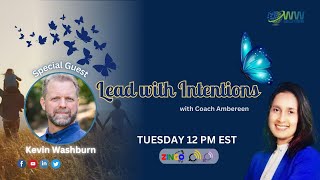
A recorded episode of the weekly show "Lead with Intentions" (Spanglish World network) in which host Coach Ambereen interviews Kevin Washburn — a teacher, running coach, and writer. Kevin describes living intentionally by writing mission statements and selecting three core values (growth, kindness/encouragement, and potential). He explains his unconventional writing process (discovering ideas through writing) and discusses resilience, presenting seven practices: start with the positive, gratitude, nurture relationships, acknowledge + focus, pursue fitness, find the funny (humor), and recognize/avoid cognitive traps (personalization, generalizing, permanence). He relates fitness and nature to mental resilience, shares family background, and promotes his book Uprise: Building Resilience in Ourselves and Others and his website KevinDWashburn.com for contact and purchase.
Chapters
Mindful day Intentional family. I hope today you're having a day where you're choosing to have thoughts. They're going to benefit and serve you. Welcome to Lead with Intentions where every Single week at 12:00pm Eastern Time, I your host, Ambreena Meadow shows up ready to serve. It's truly an honor to cross paths with you today. I want you to know that I appreciate you so very much for prioritizing yourself and for giving us the most important commodity which is your time. Welcome to Spanglish World network on Xingo TV channels 250 and 251. Please remember to download the Xingo TV app on your respective app stores iOS Android. While you're downloading our application, please go ahead and leave us a review, give us some comments, share some love, let us know what we're doing well and more importantly, what we can do better to make your experience one that is exactly what you were asking for. Also, this application can be downloaded across any Roku devices. Fire sticks, Fire TVs, Chromecast, and any TV20 on 2016 on Forward. Remember, the app is completely free, so there's no worry. And the greatest thing is you, you can actually engage with us during this conversation. Drop in your comments, drop in your questions, and we can get back to you as soon as possible. Today our guest is somebody who is an amazing human being. I actually was asked, hey, you know what, I'm bring this guy on. So I thought let's do it. His name is Kevin Washburn and he is an inspiring runner, a coach and a writer. From elementary to graduate classrooms, Kevin has dedicated himself to education and has coached numerous individuals to achieve their first 5Ks and beyond. Living with his talented wife Julia, he finds joy in cycling, swimming, weights, workouts, architecture, music, books. Wow. You are already seeing why I brought this man on and he really wants to, you know, pour into this world. He's somebody who really challenges us to really break past the barriers of resilience and I think he would be an amazing person for you to actually listen to. Also remember to take those notes so that way we can go ahead and grow into our best versions. Welcome to the show, Kevin.
Wow. Thank you. Thank you for that wonderful introduction too. I'm happy and thrilled to be here.
Love it. All right, so we started like to stop the show and ask tell us something about you. Who are you?
Okay. Yeah. My background is in education. I have been in teaching for ever since I graduated from college and I entered education because I love to see people grow and to me nothing is more Exciting than that, than watching somebody grow. Which led me then to doing some coaching and running, which ultimately led to the book that you referenced a moment ago. Yeah, that's me. I love to see people grow, and it doesn't matter the arena, but seeing people strive and improve themselves, grow into their potential, I love that. That's super exciting for me.
Well, that's exactly why you're on the show, because here we like to lead intentional lives. So if your thing, if your purpose is to actually push people past their barriers and really challenge themselves to grow, then you are in the right place. And I hope all of you, as audience members who are listening and tuning in, really do find a lot of value from today's conversation. Tell us, what does it mean, Kevin, for you to live an intentional life?
Yeah, that's a great question. For me, that comes down to meaning and purpose and knowing what. Two years ago, actually, I went through the process of actually writing mission statements for the various areas in which I was working. And that was really, really helpful to sit down and go, okay, what are my values? How do my values relate to my teaching? How do these values relate to my coaching of runners? How do these values relate to my work in other areas? That was really, really helpful to just take the time to go, okay, what is it really trying to do? And to recognize then, okay, now I have direction. I have purpose. I know why I'm doing what I'm doing. For me, that's a really big thing, right? To me, that is being intentional. When I work with teachers, a lot of times in teacher training, I'm real big on, I want you to understand why we're doing what we're doing, not just go into your classroom and do it because someone suggested it was a good idea. Knowing why we're doing what we're doing is what helps us be intentional. And intentionality is all about decision making. You know, I'm going to choose this, and I have a reason for choosing this rather than that. And so that has been significant for me. You know, that. That idea of purpose and meaning, really, really important in all the things that I do.
Brilliant. So tell us, you went on this journey of being like, hey, what are my statements? What are my missions? What am I declaring to myself? What did you find with the values that you're living by, Kevin?
Yeah, growth was one of the top. Kindness was one of the top. And then the. The whole idea of potential, which isn't really a value, but it's kind of a driving force. Those were the three main Things that stuck out as I went through the process. The process was really interesting. I was. I was following a process suggested by another author, and, you know, I had a list of values. And once you get that list, the suggestion is limited to three. If you only could choose three, what are those three? And that was really, really difficult, but really, really insightful. And again, you're thinking that through and making those decisions, that in itself is an act of intention, but that's what I found. And so the whole idea of kindness, growth, encouragement, potential, that's what I'm all about. I often tell people in my coaching of runners I'm a great coach for someone who's doing their first whatever, their first 5K, their first marathon, for whatever reason. I think I'm gifted in such a way that I can help that individual who's striving to do something for the very first time. I work with experienced runners, too, but there's something about helping people who thought they never could do something achieve that that I think just brings out the best in me in terms of my interaction with them and how I help them, you know, get. Cross that finish line that they never thought they could reach.
Yeah, I love that. I love the journey of discovery. Right. You talked about decision making and discovery. And so I want to ask you, you know, you've done this exercise, and for every single person who's listening, this is. When you jot stuff down, you write down, what are my values? And we just like, pour in, is what Kevin is saying. Pour in and identify three values. And you all know how big I am on, like, three things. Three this, three that. So same exact pathway. Identify three values that are authentic to who you are, and then you start to live into that, and that becomes kind of like the baseline, those pillars and foundations. Why did these three stand out of everything else that you wrote down, Kevin?
Because they got me fired up. I don't know a better way to say that. You know, when I thought about them, I got excited about living those out. And it wasn't that the other values were unimportant. They are. They are important to me. You know, honesty, authenticity, things like that. Very, very important to me. But in terms of finding drive and purpose for my work, these three just, you know, two of the three immediately jumped to the top. And then it was choosing that. That, you know, what's. What's that third one? Is it authenticity? Is it kindness? Is it honesty? You know, they were all great choices, but then, you know, kind of landing and going. I think I Am. I am really strong at encouraging people. So I see that as, you know, a type of kindness. And so that was why I chose that third one. But it really came down to when I think about each one of these, which ones light a fire in me, and that's how I made those choices.
Well, we love to light things up here. So you got the right answer. There's no perfect way of saying things. I think one of the things that I really want, every single person who is tapping into your greatness, Kevin, is to know that this is who you are, this is how you speak. And it's all good. We embrace all of it. And I think that it's something that the audience here, they recognize. Right. Every single one of us may not speak in a specific way, but that's what makes us uniquely us. Okay.
Yes.
So what's one personal thing that you would like to share with us so we can all get to know you a little bit better, Kevin?
Wow. Let's see. That's a. That is. Yeah, I'll go do this. I'll go with this one. I am not your typical writer. I do not research for years and become an expert in something and then write a book about it. I develop my expertise through my writing. So people ask me, you know, do you have an outline for your next book? No, because I don't work that way. I have no ideas. I know. I have no clue what ideas I'm going to find, what concepts I'm going to find, what strategies I'm going to come across. All of that unfolds as I tend to research and write at the same time. And the reason I do that is that I've learned that for me, writing is one way that I make sense of the world. I come across these ideas from researchers, but it's not until I go, okay, how does this fit with this and this with that, and actually do it in writing that I recognize the value and the meaning of what I've actually pulled together. Now, that does mean that as a writer, I do a lot of revision. I don't mind that, you know, it would. I. I wish that maybe I would. Would be able to do. Do it the other way, the traditional way, you know, the way they taught us in school. Right. Outline first. Right second. It just doesn't work for me. But because of the way that I do it, I do a lot of revising. Thankfully, I don't mind that. I think revising is a lot of fun. I'm crazy. I know. I think revising is A lot of fun, right? You're hunting for a better way to say what you're trying to say. And that improvement, that craft, actually, of your writing, again, is something that really fires me up. So I listen to podcasts sometimes where authors are or agents are interviewed. And I heard one recently say, if you're writing nonfiction, you absolutely must have an outline. And I thought, no, you don't. There's another way to do it. And, you know, I'm sure that that's probably a different way than most authors approach the type of writing that I do, which is primarily self help, but for me, it works. I think that that's probably an idiosyncratic.
Thing about me, but that's what makes it so brilliant, I think. I think you're saying, there's no script that I'm gonna follow and go, 1, 2, 3, 4, 5. I'm gonna kind of just pour in whatever's coming. And what a growth journey that you go on through your writing experience to say that, oh, this sits well. Well, what about this? Does this kind of get incorporated? Let me go back and revise. And it's this understanding of process, right? Like, trust the process, be okay with the process and be okay with iterations, because that's how you're becoming a better version of your writer, of the ad, the value that you're adding. The one thing I want to kind of go back to that you mentioned is you said, it's not conventional, not traditional the way that I do it. I'm kind of crazy like that. Now I want to ask you, why did you use that word crazy above all the other words?
You know, I love revision. Most writers don't. At least most writers that I've talked to don't love revision. They feel like, you know, I did that draft, I had it planned out, and revising is. Is meticulous. It's. It's all about even individual word choices. I mean, I can't tell you how many times I go, that's the wrong verb. You know, what is the verb I'm looking for? And it's just, you know, I'm quibbling over one word. And so I think I mentioned that because I think it's, you know, I think a lot of writers will look at me and go, you love revising. What's wrong with you? But, yeah, I actually. And, you know, I've had an opportunity now to do a little bit, just a little bit of editing with other authors, and I think that's a blast because you're, you're working with someone and going, okay, what's the best way to convey this particular message? Where does the comma belong in terms of, you know, what you're actually trying to say? Rather than trying to follow all the grammatical rules, let's make sure that what you're trying to say is clear. Yeah. And I love all that. I guess that might be, you know, I taught English for several years, and that might just be the English teacher in me, but, yeah, I think that the draft is raw material. It's like I tell students, I say, when you write your first draft, it's like you just took Play DOH out of the can. Right. It's there. You have the raw material that Play DOH can become anything that you probably can imagine. But now you've got the raw material to work with. Revising is that way. Now we're going to actually work with the raw material and make it into something we really feel great about. And that conveys the important message that you have or the story that you have to your intended audience.
Well, I'm going to dissect that a little bit because I've also, you know, experienced the word crazy. And I, you know, I heard it, like, in a way where it's, like, coming at me daily. I'm like, okay, okay, so something's coming up. God, what do you want me to do? And it was a simple concept that I had to kind of reshift my mindset to look at crazy in a more welcoming way. So. And, like, the attachment, like, oh, people that are crazy, they're not ordinary. Right. They're not your ordinary, average people. They're extraordinary. Of course we're crazy, Kevin. And then, you know, and then going back to this understanding of where Steve Jobs, you know, he's like, the people who are crazy enough to think that they can change the world are the ones that actually do it.
Yeah.
And so, you know, I hear that in your conversation, and the fact that there's a lot of intentionality, there's a lot of purpose, a lot of learning and discovery in what it is that you're doing. And here you are just embracing yourself and saying, you know what? This is just the way that I like to do. It's the way I'm going to do it. And that's what's been working, you know, And I think that's how success is following you so very much, and I love that.
Thank you for that. Yeah. I love how you reframed crazy, you know, and reframing is actually one of the things I talk about in the book, and that's the kind of thing you have to do. That kind of reframing is what will help you process and move forward. So I love the fact that you use that term. Even I had to reframe. Crazy. I love that. Love that.
What is one thing that when you're talking about kind of reframe, what is one thing you're helping your runners reframe when they're taking the challenge on for the first time to say, do I even have it in me to do this?
Yes. Great question. So I'll use an example for this. It is. It is going to happen at some point in the training cycle that you're going to have a bad workout. Nothing's going to feel good. Maybe you're not able to finish the workout, or maybe you end up walking part of it, or, you know, there's just something. And for new runners, especially now, if you're an experienced runner, you kind of go, yeah, that happened today. It was a fluke. Tomorrow will be better. But new runners often go, oh, my gosh, this must mean that I'm not ready. Right? And, you know, kind of talking them down from that and saying, okay, wait a minute. This is one workout. Okay, let's not look at it as you didn't complete it, that it was a failure. Let's look at it as a source of feedback. Now, if we look at this as a source of feedback, let's really analyze what happened. What happened in your day leading up to that workout? Did you have, you know, if it was in the morning, did you eat breakfast before or did you, you know, were you late and you skipped that? You know, was there anything that stood out? What was the temperature outside? Was it overly warm? Was it overly humid? Right. So. So if. If, for example, let's. Let's go with that one. Let's say that the runner said, yeah, it was warm and it was humid that day. Okay, then what do we learn from that? What's the principle we can take from that? When it's warm and humid, like you were running, the situation you were running in, you probably need to reframe your expectations, right? You might think, well, I normally run this fast, but if it's this warm and this humid, you're not going to be able to. That's the one thing about running is the weather always gets a vote, right? So you step into a race situation and you get up that morning and it's warm and humid. You don't go out and you know, run, sprint that first mile, because you're just going to run out of gas. You have to adjust things. So they're looking back at the workout and going, this wasn't failure, it's feedback. Let's analyze it. Let's look at it. Let's figure out what we can so that going forward we can be more successful, because there's some information in there somewhere that if we find it and we address it, you're going to be more successful. Even tomorrow, if you're running and it's.
Warm and humid, and then what do you see with the people that you're working with, the. The runners that you're coaching? You know, we talk about resilience is such a big part of becoming successful and kind of attaining this level of growth. What do you think are some qualities that you can share with us? For people who really want to know, how do I become more resilient?
Yeah, that's a great question.
Even if they're not runners, you know?
Yeah. Oh, yes. In fact, in the book, I address three major areas. Our personal lives, primarily our social lives, like what happens when something goes wrong in relationships, our professional lives, what do we do when something goes wrong at work, and our physical lives. Those are the three areas that I address specifically in the book. And there are seven practices of resilience. And I love this information because it is so practical. I think your audience will appreciate this, too. So let me just run through those. The first one is start with the positive. That is a great story in the book about a Navy diver who is a bomb disposal expert on a dive. Gets caught in some netting or some. Some lines. I'm completely caught, all four limbs. And he talks about the fact that he realized he was trapped, but the first question that entered his mind was, what do I have going for me? And he thought, well, I'm breathing. That's good. Okay, what else do I have going for me? And he realized that the fingers on one of his hands, he still could wiggle. And so he thought, okay, if I can wiggle those fingers, perhaps I can loosen the line on that side. And obviously, he lives to tell the story, but he talks about starting with the positive and seeing that as a cascading positivity. And I love that term, you know, starting with. Instead of, oh, my gosh, this is awful. Which, honestly, if I were diving and trapped, I would probably panic a bit. But, you know, stepping back from something that's not quite that as traumatic, you know, what do I have going? Even though something Went wrong. What do I have going for me? What is working in my favor? And he makes the point that, I love this, that by starting with the positive, he was able to problem solve rather than panic. I think that's fantastic and so very practical. Right? When you catch yourself spiraling into negativity, stop and go, wait a minute, what do I have working in my favor? You may just find your way then to a solution, you know, going forward. That's, that's, that's the first practice to start with positive. Second is gratitude. Express gratitude. Again, I, I love this. Gratitude has been shown to improve so many things. In fact, one of the things I tell my runners is if you're, if you're running a long distance and you feel like, you know, somewhere in there you're just tired, you really kind of want to quit, I said, start thinking about the people who've helped you along the way is start thanking them. And, you know, thank everybody who ever encouraged you. Thank everybody who ever asked you about your running, you know, just anybody you think of, thank them. And what that research shows is that you actually develop grit that by being, by being grateful, you actually find grit. And I've had runners express that to me. Oh, yeah, I was, you know, I was at mile 18 of the marathon. I felt awful, started thanking people. I was actually talking out loud and thanking people out loud, even though they couldn't hear me. And before I knew it, I was at mile 24. Like, yeah, exactly. Gratitude is extremely powerful. In the book, I tell the story of Harper, who really struggled with feeling like life was better for everybody else. Kind of that feeling you can get when you hang around social media for too long. And she saw a news report that night in the local news about a man who wrote one thank you note every single day. And she thought, you know what, I'm going to take some time away from social media each day and I'm going to write a thank you note. And at first it was really easy. She's writing to her parents, she's writing to her school teacher, she's writing to best friends. And then she has to start actually looking for opportunities for gratitude. And she says, you know what? When I started looking for those opportunities, I found myself feeling better about life. Yeah, yeah, yeah. They're finding that they're really looking through the lens of gratitude. Redirected her thoughts in such a way that she, she really rose up at that point and, and, you know, was able to move forward as opposed to feeling the weight of, oh, everybody has a Better life than I do. Yeah. The third is nurture relationships. Relationships for everybody really matter. I'm an introvert myself, but relationships are so vitally important when we are working on something where we need resilience. Friends help us process, experience. They empathize with us. They motivate us, they challenge us. A good example of that, I have a friend that I run with each Saturday. About two years ago, I got diagnosed with osteoarthritis in my right knee. And I was whining. I mean, I was like, oh, you know, the doctor told me to keep running, but my knee hurts so bad, I just find something else to do. And my running partner I was talking to, he was like, nah, you got a lot more running ahead of you. I mean, he was just like, I am not. I'm not taking this. Yeah, yes, you are lying to yourself, and I am not going to let you do that. You know, and that because we had that relationship, he was able to basically, you know, verbally knock me in the head and say, you're thinking wrong. You're lying to yourself. Yeah, the knee hurts. But a month from now, if you do what the doctors told you to do, you'll be in a different place. So those relationships, you know, that's Practice three is nurture those relationships. Practice four is acknowledging focus. A lot of people think that to be resilient, you have to think about something other than what you just went through. And let's say you're at work and you did not get the promotion that went to one of your colleagues. And so a lot of people think, well, to be resilient, you have to just not think about that. No, no, no, no, no. You really do need to think about that. Right. Acknowledge the fact that this happened, that it was a disappointment. But then intentionally. There's that word again. Intentionally. Redirect your energy toward what you can do moving forward, you acknowledge it, but then you focus your thoughts on, what can I do to move ahead. That is a very, very powerful one, because not only does it help you focus more on the positive potential of the future, but it may also encourage you to examine, what did I do wrong? Or what would I do differently? Wrong is probably the wrong word. What would I do differently? With the example of not getting promotion at work, was there a question in an interview that you didn't answer thoroughly? For example, again, that idea of failure as feedback, you know, by acknowledging and focusing on the future, you also can probably find a little bit of motivation to look at what happened in the past. And see if there's any information there that can help you moving forward. So acknowledge and focus. That's a real big one. The fifth one, I have to tell you, I really resisted putting in the book. But the fifth practice is pursue fitness. And I resisted because I thought people are told that fitness is the answer for everything. It feels that way. We're constantly bombarded with messages of you need to get in shape, you need to lose weight, you need to whatever. Especially I was writing that particular chapter around the first of the year, and every single morning show was talking about how to lose weight because that most people's New Year's resolution. So I resisted it. But the research just couldn't be denied. And the thing I loved about what I found was I know myself from my own experience. Fitness can be motivating. You set a goal, you strive for it, you accomplish it, you set a new goal. I mean, there's a lot of motivation that happens if you do pursue fitness on a consistent basis. But the one element of research that I thought was so interesting is that when we are working out whether that's running, walking, hiking, lifting weights, whatever it is, there are several things that happen to us physically. One is our heart rate increases, our breathing becomes more rapid, we sweat, our muscles tense, blood flow gets redirected to those muscles and. And blood vessels, inactive, muscles dilate. Those things also happen when we panic. They're the exact same physical responses that we have to. You know, for me, it's suddenly spying the snake in the grass kind of thing. Right? It just. Right. And now all of those physical responses happen. When you work out and those physical responses happen, your brain learns that, you know what, even though these responses are happening, it's okay, right? That to me, was an amazing element from the research that exercise helps with resilience because it physically and mentally, the connection between your mind and body changes in that your brain goes, oh, I don't need to be alarmed just because the heart rate is up. I don't need to be alarmed just because there's sweat. And that, to me was the whole reason I included it was that research is just too good to miss. 6. 6 is find the funny, you know, humor. It goes a long way in uplifting people. I had a really close friend who passed away Suddenly, unfortunately, in 2018. But he was hilarious. And we were. We ran a marathon, his first marathon. We ran together. He ran across the finish line, and then almost immediately, I had to get him to the medical tent. He was so badly dehydrated. So we were in medical tent for a while. We finally get back to the hotel, and we were supposed to check out that day, but obviously we couldn't. He was just not fit to travel. And so I get the room key change and all this stuff. I've got him, you know, by my side. We're walking down the hallway to the room, and all of a sudden these waves of nausea hit him, and he just turns toward the wall, and, you know, he's just sick over and over and over. In between this, he's. Because we saw that housekeeping was in the hallway because their carts were there. In between these waves of nausea, he's shouting, housekeeping. I'm sorry. I'm sorry. You know, over and over. Well, I get him into the room, and I'm like, you sit down in the bed. Don't move. I've got to call the front desk and let them know about what happened in the hallway. Did that. I turn around, and he's standing in the middle of the room with his finisher's medal on. I'm like, what are you doing? He's like, listen, you have to take my picture so I can put it on Facebook. And I just fell apart laughing. I mean, I'm sure some of it was stress release, but this guy knew how to find the funny and live into the funny. Even in moments when, you know, his. He just was a mess. And I learned so much from him about the power of humor to not only bring people together, but to also uplift spirits. And again, that's something that fosters resilience. And then finally, the last one I know I've been talking about, the last one is recognize and avoid the traps. And there are three traps. They are personalization, the idea that, oh, this bad thing that happened only happens to me. I don't know why this happens to me. Generalizing. I failed in this area, so I might as well give up in this other area, too, because it's not going to go well. And then permanence, believing any of those lies, permanently letting any of those lies live in your head. And those are the traps that can misdirect you because you're basing your actions. Then you might be being intentional, but you're being intentional based on lies. Lies that you're telling yourself. And that will definitely affect your ability to. To come back from whatever the failure or the setback is. Yeah. So those are the. Those are the seven practices. Yeah. That I found in my research that I think are great, great suggestions and strategies.
Well, I Love them, Love, love, love them. And I was like, I wonder what he's gonna say. But when he started off with, like, positive, I'm like, all right, this guy, this is my kind of guy. He knows exactly how to live life. Because in the most dire of moments when you can really shift the mindset and say, you know what? I have so much to be grateful for. Let me just see what I could have done better. Let me figure out, could I have been mentally and physically stronger to tackle this? Right. Is it? And then I think, you know, the cherry on top is like, you have got to add so much fun and joy to life because it will literally pass you by. I love the fact that you finished off kind of talking about, you know, this understanding of personalization is like, why me? Like that blame victim mindset. And then generalizing everybody, like, people will say to me, like, every Pakistani girl is like, blah, blah, blah. And I was like, no. Like, we're all not the same. We're really not, you know, or like, right. This is the way it has to be. And that's it. And that kind of goes contrary to what you're talking about, that growth mindset. To really understand, I want to focus back actually on number five, where it's the pursuit of fitness, which I was like a coach, a runner is like, I don't know if I want this in there. But when you prepare, when we prepare mentally. Right. A lot of that mental game has so much to do with our physicality. So I really want, you know, for. Thank you for every single person who's still here listening and, you know, hopefully getting a ton of value, because I am, too. I'm kind of off here taking notes as. As quickly as I can is why do you think, you know, that fitness piece is so important in the law, in the world now, in the lives that we live in right now.
Yeah, that's a great question, I think. And I'm going to base this somewhat on my personal experience. So I mentioned that I had the osteoarthritis in the knee, and I realized at that point, I can't keep running the way I have been running. I'm just not going to be able to run as many times a week, as many miles. I mean, when I was training for marathons, you know, you're doing 20, 21 mile training runs. And I just knew that that was not probably going to be something I could do, so I had to find something different. So I went to the gym and I was talking about possibly, you know, Joining the gym and, and the, the attendant who was helping me couldn't get the computer quite to do what she needed it to do. So she called this, this gentleman over and he starts asking me a gazillion questions. I mean, I felt like at some point this is an interrogation. Why doesn't he just, you know, sign me up? And, and, but he asks all these questions and then he says, looks at me and says to me, I think I might be a good trainer for you. I said, oh, okay. You know, why would you say that? He's like, listen, I've worked with other people who have limitations, physical limitations, specifically due to arthritis. I've been able to get them back to normal activity. I think I can help you now. At this point, I could barely bend my knee and I was thinking, this guy is nuts. You know, there is no way I am going to be back to running anytime soon. Within six weeks I was back to running, and within six months I was running a half marathon. Now how did that happen? Right? How did that happen? That transformation was due to his expertise, number one, but also due to my consistency in showing up for those workouts, number two. Now why does that matter? That matters because the physical realm, if you're capable of, you know, normal movement, and even if you have to adapt movement in some way due to some limitation, it creates opportunities for you to experience success. There's the possibility of setback too. But you know, when working with my trainer, I'm lifting weights. I never imagined myself being able to lift. Like he had that vision, right? He had that vision and I didn't. And so being able to borrow that vision from him, follow his expertise, gave me the opportunity to experience success in the physical realm with fitness. If you pursue fitness, no matter what you do, you know, it doesn't have to be weightlifting. It can be, you know, some of the classes that are, that are offered at the ymca, swimming, you know, what, whatever, you have the opportunity to actually see progress. And when you see progress in your brain, the neural network that, that becomes aware of your forward movement, your physical forward movement, it, it lights up. And so any kind of progress, when we become aware of progress, that reward system lights up. And, and in the physical realm, you have the opportunity to do that. I think we need that because I think that there are a lot of people for whom Success feels like 9 to 5 at the office and nothing more. And fitness helps you break out of that and realize, no, no, no, no, I'm capable of something more. I'm capable of achieving Goals, and that's going to affect everything. That will affect the 9 to 5. That will affect whether you apply for that promotion, whether you apply for that position. That's a step or two above where you currently are in the company. It's going to affect all of that. The mind, body connection is so critically important, but psychologically too, I feel like fitness provides us with the equipment necessary to be more resilient in all areas of our lives. Yeah.
Couldn't have said it before. Now that I, you know, as I'm talking to you and kind of reflecting back on my own life, that's one of the things that I discovered is the reason why I'm so mentally sane is because I have always leveraged fitness, you know?
Yes.
And when the kids were young, you really couldn't just go and, like, leave them and go to the gym. But I found that I would wake up really early in the morning, hours before it was their time, where it was my time to say, okay, just 20 minutes of pouring into myself every single day. And when I reflect on that now, I'm like, wow, girl, those 20 minutes were like. Those were really good minutes. Because you're focused and you're dedicated, you know, to kind of doing what you're there to show up to do. I want to kind of shift things up and, you know, pivot more towards. I want to ask you, what is something that you can share with us so we can get to know your family and the family dynamics a little bit better?
Yeah, so it's just my wife and I. Let's see, we've been married for 35 years, soon be 36. My wife is a photographer, which is why I have good lighting here today. She also works in graphic design and also runs the various businesses that we have. But, yeah, that's us. I grew up in a relatively large family. Not huge, but there were. I have three siblings. They're all older. I'm the youngest. I'm the youngest by a few years, actually. They're all relatively close in terms of their birth dates, but yeah. So there were two boys, two girls in the house, my parents. It was a pretty typical, you know, kind of nuclear family experience. One thing that was interesting was that my grandparents all passed away either before I was born or early in my life. Then when I got married, my wife had. All of her grandparents were alive. So I was like. I married into grandparents. Like, I didn't even know what that experience was like. And it was wonderful. It was great. Loved it. Yeah. So that's a Little bit about us. Yeah.
So you're talking about. And you're saying that the way that you grew up was pretty traditional. You came. There were three back to back, and then there was a pause, and then there was you. So how was that growing up? What did you find that or challenges that they had faced that you didn't have to face because you came later down the line?
Yeah, that's a great question. So one of the challenges was looking at their success and comparing myself to that which, you know, when there's that much of an age difference, it's a little ridiculous to do that. But I. That was a real trap of my. Like, I really got trapped in that thinking that I had to be at least as successful as such and such a sibling had been in this area, or I'm a failure, or, you know, this. With this sibling in this area. And that idea of comparison, and I don't know why necessarily that that was. That that developed, but it was something I was. I was almost constantly mindful of, especially as I got into late elementary and middle school, into high school. It took me a long time, honestly, to get to grow out of that. For even many years, even after we were married, I really, really struggled with that idea of comparison. And so that was one of the challenges. And I don't know whether that was because there was a gap between us and age or whether it was just a natural consequence of being the youngest and having siblings who always did everything first. Like, there were no. No real firsts for me, except that I played soccer, which none of the rest of them had played. And probably I played soccer because none of them had ever played it before. Right. There's no. There's no spaces for comparison. But in. And every other arena, whether it was grades in school, whether it was, you know, baseball or basketball and or other sports that they had participated in, you know, there was just this. And it would. And it happened without me intentionally thinking about it. It just was like this thought crossed my mind. Oh, my gosh. I was not as good as so and so sibling today. That's terrible. I'm awful. I'm never going. You know, it's just. It's a lie, and it spirals into more lies, and it's really, really destructive. So that was one thing that occurred as a result of, you know, I think probably just where I was in the birth order, but it took me a long time as an adult to overcome that. In fact, writing Uprise, that's the name of the book Writing Uprise was In part my attempt to understand resilience myself. How do I grow, how do I continue to grow past this, this aspect of my psyche that holds me back sometimes? How do I grow past that? So yeah, that, that was part of where, that was part of the motivation for really diving into, to resilience like I did. Great question.
Well, I appreciate your vulnerability first and foremost, Kevin. I think the people that come here, they're raw, they're authentic. They're people just like you and me, people who are actually watching and learning and growing. I really want to, you know, kind of keep going at this topic. Reason being is comparison is the thief of joy that we live in now. It's, it's constant comparison to external things where you're like, this is not even real. It's maybe it's a Photoshop, maybe it's a filter, maybe it's like four hours of work before you came on screen. How did you. And how could you help our audience members here who are listening? How could you give them some tools? What are some shifts in the mindset that they can have to really get past this concept of comparison?
Yeah, that's, that's a great question for me. There was a friend who helped me think through the fact that the comparison did me no good. It didn't motivate me, it didn't make me feel confident. You know, I, it really affected my confidence and basically say to me, what is the value of, of thinking this way? Which was a good hard reality question. The value, the answer is there is no value to this. It's a trap. I'm stuck. I can't get. I don't seem to be able to get past this. So you know that, that for me was the first kind of wake up call. And then being able to go, okay, I'm not going to compare to my siblings anymore, but I'm going to see if what I did today, I can do better tomorrow or I can do better next week. So shifting the focus to. And what that does is rather than making you feel like I'm lesser, therefore I'm less, I'm not as much of a benefit to the world or whatever, looking and going, you know what? Last week I couldn't do this and now I can gives you the confidence to feel like I can be a source of positive influence in the world. It's a relatively simple sounding thing. It's not simple to overcome. I am not suggesting that, I know it's not simple to overcome, but the power of that shift in terms of I'M not going to strive because I'm lesser. I'm a failure to feeling like, okay, wait a minute, if I look at myself a week ago and I look at where I am now, has there been growth? Has there been positive change? If so, that sparks motivation in you to strive to continue, but also I think to be more confident in your ability to influence the world around you. It's a hard, hard thing to get past, but doing it is so worth the work that it takes.
Yeah, I think the question that you're asking yourself, and this is for every single person listening, I hope you're writing this stuff down because what value is comparison adding to my life? Bold it, make it big, highlight it, whatever you need to do. Because there are moments in our day where it's this constant shift that we need to do to say, maybe I can be more. Maybe I can be more of an influence. Maybe I can be a better parent, maybe I can be a better sibling. Maybe I can just be a better version of me in our home. The way I've shifted comparison completely because I've got three little humans is always compare yourself to you.
Yes. Yes.
And that shift I have to get to in my own self to be like, did I get better from like yesterday, the month before, the year before, am I progressing? And I love the fact that how growth kind of keeps tying back into our conversation that we're talking about is one of your foundations and your values. How do people get in touch with you, Kevin? I really want anyone who has found you to be as amazing as I have to really be able to reach out to you and pour into you.
Yeah. So the book is called Uprise Building Resilience in Ourselves and Others. And there you can order it through any of your favorite book retailers. You can also find it to order and find information about me at Kevin D as in David Washburn.com Kevin D. Washburn.com and if they want to get in contact with me, they can do that through the website. They want to know more about me, they can, they can find that through the website. If they want to order the book, they can do that through the website. So that's the place to go. Kevin D. Washburn.com There you go, people.
That's how you connect with him, give him some feedback, share some love. And if you're on the app and you want to engage with us, drop down in the comments. What it is that you want us to know from from your takeaways today? What has Kevin added in your life as Values. And what is something about this conversation that you're going to pull forward and carry forth with in your own life? All right, we've got this tradition here, Kevin. This is called the intentional wrap. So this is a rapid fire question.
Okay.
In one word or one sentence. And we'll kind of want to see where this, the sporadic spontaneousness goes. Okay. Ready for it?
Yes.
All right. So what do you want to leave behind for the world, Kevin?
Work that. That inspires others to grow.
Okay. How will you know you've led an.
Intentional life when the decisions I make fit with the values that I hold in. In high esteem?
All right. If you could create one law that everybody had to follow in this world, what law would that be?
Wow, that is a great question. One law. One law. I think that it would be something along the lines of, everyone must look for opportunities to thank somebody else. I think that would make a significant difference in our world.
Yes, yes. Gratitude is the reason of my joy. No doubt. Okay. What is one lesson that has made you who you are today?
That whole idea we talked about previously, about getting out of the comparison mindset and, and looking at myself and seeing what can I be better tomorrow than I am today? Huge for me. Huge.
Love it. What is the key to a healthy relationship? You talked about your wife a little bit. Your friends a little bit. And grandparents of hers. So what is the key to think to a healthy relationship, Kevin?
Yeah. Two things, I would say. One is communication. Right. Obviously that's. That's important. The second is friendship. And I don't just mean friendship with. With your spouse or significant other, but outside friends who can be a different type of relationship for you. Right. People who make you laugh, with whom you can go on road trips, have adventures, you know, that kind of thing. And I think that both of those are essential. Julia and I have found those to be essential in our marriage as well. She's into photography. She's got photography friends. They're not. I know them, they're acquaintances, but they're not friends of mine. I've got running friends, same thing. She knows them, but they're acquaintances to her, but to me, they're important friends in my life.
Yeah. So basically realizing that in your life, even if you're a companion, if you're married, if you have kids, you gotta really find out what those interests are. They're gonna fuel you and give you your own edge. Right. And I think that time with friends you're talking about, you know, laughter and humor is one of those things. And that Is something that you really do. You tap into the very next level, you know, versus when you are with your family. All right, what is one change that you want to see in the world? And why does that matter?
I would. You know, we talked about fitness a lot. I would like to see people becoming more active outdoors. I think nature and being outside has a lot of good healing properties to it. For me, running is one way that I get to enjoy the outdoors. And I think that if. If everybody had that opportunity to be outside, to be active, whatever that means for. For him or her, I think that that would make a difference in our world and even in some of the things we value and don't value.
Spot on. I am all about nature. It is something that lights me on fire. And it's like, yeah. All right, so I hope this conversation is something that served all of you as much as it served me, and I really hope that all of you are able to pour back into kevin@kevindwashburn.com, let him know anything and everything, even the small nuggets that you are taking away today. Remember, this show can be heard on Spanglish radio Network. Please check out Spanglishworld CA for all the news and the programming. As we close, my prayer is that this show will embark you on a transformation path. To be, to be. In gratitude, accept the unfolding of life and commit to your values and dreams, which will allow you to tap into your own greatness. And as I have, Tawakkal, which basically means faith in us, the upcoming transformed version of you will allow you to be the best version and to lead with intentions. Remember, there's only one of you. One life designed by excellence. Spanglish World. Watch it, hear it, read it, download it. Most importantly, live it with intentionality to better you. Thank you so much, fam, for tuning in. All right, we're gonna. We're gonna keep rolling. It seems like it seems like our. Our. Our back end needs a little bit more support here. So I think, you know, as we come to an end, Kevin, what is one thing that you want people to take away?
Yeah. Don't believe the lies that echo in your head. If it is something you would not tell to a close friend, if it's advice you would not give a close friend, it's not good for you to dwell on it either. Yeah. Let those lies go. Stop directing your life by. By their incorrectness.
Okay? And if you can be. If you can share with us what's. What's that one thing when you're talking about resilience that you've seen come up repeatedly in your own life.
Oh, my gosh, this is easy. You know, I have a tendency to despair easily, you know, and being a marathon runner, you finished that marathon, and it's not what you wanted it to be, and, oh, the world's terrible place. And, you know, and my wife would tell you, he is a grouch for 24 hours. I, fortunately, have been able to spring back from that. But again, you can get trapped in that thinking, right? And you're a failure when you give up. And that kind of thinking pushes you to give, to quit. If you haven't quit, you're not a failure. You're still out there striving. So, you know, don't. Don't fall. If you do despair, it's okay, but put a time limit on it. And then start redirecting your thoughts toward what is true. Redirect your thoughts toward the future, what is hopeful, so that you're able to move and grow beyond just the disappointment that you're feeling in the moment.
Yeah, well, I think it's. I think it's great, you know, that you're mentioning that, because there is this one beautiful conversation that I have kind of done with, like, hey, if it's a pity party, make it just that, you know, like, it's just a party. It lasts one day. Once that pity party is kind of over, don't wake up, you know, don't wake up the next day with the same mindset, with the same thoughts that kind of push past it and. And, of course, you know, become more resilient. So why not? Thank you so very much, Kevin, for being here and for all of you who are still tuned in and watching. Even though I didn't wrap up, and then we had some glyphs, and so thank you so very much for being flexible, kind of going with the flow. Kevin. Have a brilliant rest of your day, folks.
Bye.










