Leading Your Relationship: Align with Integrity
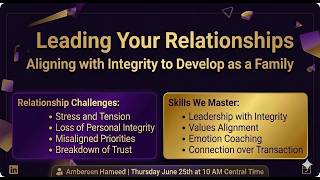
Coach Ambereen teaches the G.R.I.T. framework—Giving, Receiving, Impact, Tenacity—for leading relationships with integrity. She shares stories from her own life as a single mother of three teens and from clients learning to balance work, family, and self-care through intentional action and perseverance.
Chapters
Let's go ahead and get started. First and foremost, thank you for showing up for yourself, for your family, for your loved ones, and even for your career path. As you hop on in the comments, let me know where are you tuning in from.
And the biggest thing I want to actually talk to you about is today, what is going to be your takeaway as you're leading your relationships, aligning with integrity? What is your goal from today's conversation?
And what does that do? That sparks interest not only in you, but for every single person who's watching now, who may be watching later. Is what does it mean?
What does it mean when you start to show up for your relationships and really intentionally pour into them? Hey, for those of you who don't know who I am, my name is Coach Ambereen, and my mission and vision in life is to make family development a priority in your homes. Develop everything else, but we forget the people who actually are with us in the grind day to day. As we start, drop in the comments, let me know, what are your wins from this week?
What are wins? Everyone's always asking wins, like these ginormous things that you've done. No, no, no.
Tiny things that you have accomplished that you said you would, like pausing before correcting your kid, or Taking a moment to do something for yourself that you had committed to, or reading a book, or finishing a deadline at work, whatever it is, drop in the comments. What are we doing?
We're actually starting on a high note, right?
That means that you, me, us, we are all here together lifting each other up, being part of each other's journey.
Because what else is life, right, except for just a journey that we are experiencing with the people around us? And alongside us.
And these wins are essential because what I've realized is working with my clients, most of us are not taught to celebrate wins. So most of us don't celebrate wins. We don't look at our life as a journey that we are actually growing through. We look at our lives as like just getting by. And so these pit stops of celebrating your wins really uplift you. Now, as we get into this conversation, I want to ask you, and it's really important for you when you're going through these, you know, these trainings, these workshops, whatever, these classes, masterminds, whatever you want to call it. For me, that's not as important as what you take away from it. Ask yourself, what does integrity mean to you? Integrity is this beautiful word. Which has really helped me as a single mother of 3 with 3 teens.
Yep, that's right, 3 teens are living in my house and I am a single mama.
Now, integrity plays a big role in how I show up for them, show up for my business, show up for my clients, show up for these workshops, show up for these courses.
Why?
Because integrity means, am I going to do what I said I'm going to do? Am I upholding my commitments to myself? That's it. Are you somebody who is actually integrous? A great way to gauge this, right? Because a lot of people are like, yeah, I have integrity.
Let me ask you this: on a scale from 1 to 10, 10 meaning yup, you're doing it all the time, where would you place yourself?
As a coach, one of the most remarkable things that sets me apart is I have this beautiful ability to compassionately celebrate you, cheer you on, but then also courageously hold you accountable to say, oh, you're falling short on the values that matter to you, and that's no longer okay. You've made commitments to yourself that you're not upholding, like spending quality time with your husband. Or making sure that your wife is seen as a priority and appreciated every single day. Or that when you are getting heated with your kids, you ask for a timeout and you pause everything. So these simple actions really allow us to be in integrity with not only the best for ourselves, but also it leaves a greater legacy behind for the little people and even for our spouses. You know, once we're gone, what's the one thing that you and I are going to leave behind? It's just that— our relationships, our experiences, how we made someone feel. And integrity becomes a huge conversation topic when it comes to the way that you're living and leading your relationships. Now, I intentionally chose the word leading because leading for me is you are in control of your life versus your mind is running your life.
And I'll preface that a lot. A lot of people will be like, oh, here she goes again talking about the mind. Well, this bad boy is a tool. It's supposed to help you.
For most of us, it's taking us down because we're letting that be in control. Our mind has this ability and this need to protect us. To make sure everything is good. So it stops and blocks us when things are uncomfortable. And when you align with integrity, that's gonna shift. You're going to have to take a lot of courageous actions to move forward. As we are talking, I want you to kind of start to jot down after rating yourself on what the word integrity is, how well you're living into it. I want you to really prioritize today to be not only about how you're going to change and show up differently for your life, but I really want you to wear the lens of making family development a priority. And this is where a lot of people are having a challenging time. Are you making your family a priority, or are the screens taking over? And this simple conversation topic is really very important. Most of the parents that I meet, most of the partners that I meet, most of the, you know, family members that I meet, they're constantly saying to me, oh my God, it's so hard, Ambereen, it's so hard, we're so busy.
I say, yeah, yeah, we're so busy.
I'm like, busy with what?
You know, the kids. I'm like, yeah, tell me more about that.
You know, like, there's so much to do with them.
Okay, keep going. Now, if I were to ask you, are you busy? Drop in the chat, drop in the comments, let me know. Would you describe yourself as a busy person? 9 out of 10 people will tell me, yes, I am so busy. And I say, what is the difference between being busy and being productive? For me, the two very different things.
So what I saw myself doing is I was unnecessarily picking up my phone, to which I want to remind everyone that an average American picks up their phone over 100 times in a day. And I saw myself building a really unhealthy habit to do something similar.
So because I'm a coach and because I am my number one client, I'm always course correcting myself, trying to figure out how I can elevate and grow, I put locks on my phone.
I put a limit on my social media. I put a limit on my Messenger apps. I put a limit all over to make sure I'm practicing what I'm preaching. Why? Because my kids are watching. My 3 teenagers are watching everything that I'm doing, and their brain right now is super active. It's like monkey see, monkey do. So when they keep seeing mom pick up her phone, they're gonna do the same thing. But if they see that the phone is pretty far away from mom, she's attentive to us, engage with us, then my integrity goes up. Why? Because I told myself I'll monitor my screen time and that's not going to run my life. Because the more screen time that you consume, the more you're unable to control this bad boy.
Now, the way that I look at integrity is through this beautiful framework, and I don't know of anyone else who's done this. However, who knows, right?
So in the word integrity, there is a keyword, and that's the framework we're diving into today. The word in integrity is grit, G-R-I-T.
So I said, you're gonna be taking notes today. And in these notes, what you're going to be doing is you're going to be writing things down, answering questions, reflecting, thinking. This is gonna be like a workshop, right? It's not like a class you come to passively and then you leave. The whole point is that you elevate yourself by the end of our time together. So I want you to write that down. Today we're diving into integrity, aligning with integrity to lead our relationships through the G.R.I.T.T. framework. So G-R-I-T. And we'll continue the conversation and we'll kind of offload and explore what this stuff is.
Now, most parents, most spouses are giving to, to the other person. So the G is forgiving. They're giving all the time. As a husband, you're working to provide for the family, to give them better experiences, to give them a life, to give them their necessities, their home, the shelter, the food, the clothing, the utilities, the, the excessive things that come, the expenses that come from being a father. Oftentimes, I don't think men take enough credit for what it is that they're doing to bring ease into their family's life. Are you one of those people who does not give themselves credit? That you're so busy giving, giving, giving that you don't even know what it feels like to not give, to pause and to think about yourself, or to understand that with this giving, my cup just keeps getting more and more empty. If you can relate, I want you to let us know. Say, I am a giver, which is a brilliant quality to have, people.
It's not like, don't be a giver.
No, be a giver, because giving is really something that's powerful. Giving is how we express love. Giving is how we stay aligned with our integrity. Giving gives us an edge, because those people who are not giving are depleting their own energy, their purpose, their interactions, their love, and the strength of their families. Mothers and fathers, sons and daughters that don't give to one another are not closely knit. They're not a strong, tight bond. So giving is essential. And that's the first G that I wanted to dive in with you. Now, the next part of this formula is the R. R for the GRID formula.
This is impeccable. I, in my own life, was and have always been a giver.
I just know how to give.
I'm like, I have a PhD and a mastery.
I'm an expert giver.
What I wasn't doing is the core.
And this was literally one of the biggest breakthroughs in my life is I've never been taught to receive. R to receive.
And I know many of you are like thinking, whoa, where is she going with this?
Receive.
We've always learned give and take, give and take, give and take. Life is a give and take, yet it's not.
Givers don't know how to take because taking means you're snatching something that you don't think belongs to you, that isn't a part of you, that isn't in your nature. People who take are different kinds of people. They're not givers, which is why I said giving is essential. But also keep in mind that it's not good to be a taker.
However, receiving changes the shift and lens of every single relationship that you have. And you receive by telling and teaching people how to treat you. Write that down. You receive by telling and teaching people how to treat you. Most of us think that somehow the husband, the wife, the son, the daughter, the aunt, the uncle, the mother-in-law, the daughter-in-law, the father-in-law, they just know us. They just know what we need.
Nobody knows what you need.
Honestly, half the time, do you know what you need or do you know what you want?
Probably not. Once you start a family, your needs start to kind of go on the bottom of the priority. And the needs of everybody else kind of take precedent. And this is not good, this is not bad, it's an observation. So is this what you're doing? That your needs, that your desires are so far down and the giving has amplified? Well, guess what?
It's time to receive. And I am a faith-driven person. Okay, so for me, spirituality plays a huge role in a lot of the way that I live and lead my own life, which helps me align with more integrity, which helps me to really lead my relationships.
Now, God, the universe, Allah, whatever name you want to give this entity, something that's greater than you or me or source is such an enormously amazing giver. However, we are literally at bare minimum, and that's all we want to receive. Let me say that again. God loves to give. Do you love to receive? Chances are probably not, because you've been taught that people who take are bad.
Yeah, don't take.
Receive something. Now, in the comments, I want you to tell me, I want you to engage with us, and I really want to spark a conversation around this. Is what for you has been an insight so far? What have you already taken away from our conversation today? Because what this is doing is it's sparking social learning. Social learning is how people who are growth-oriented really evolve and elevate by learning from other people who have gone through similar or different experiences. And this really creates a community of people who are growth-oriented. And if you are here so far listening to this conversation, I only wanna impact people who are growth-oriented, who are action takers, who really desire that change in their life because they know their family development has been on the back burner. And they're really, really ready to prioritize it. We get coaching for everything from our sports, for our athletes, for our, you know, for our career paths, even guidance counselors in college and teachers and mentors. All these people along the way, they're coaching you, they're kind of giving you guidance, they're shepherding the way, they're teaching you the tools that you need to be successful.
Yet Most of us don't think about hiring coaches for our home. Are you ready to receive that?
Are you ready to receive breakthroughs after breakthroughs, tools, frameworks, foundations, mindset shifts, perspective changes, openness, growth, so that way you can be the best leader in your relationships?
If you are, you're going to love the conversation that we're going to continue to have. If you're not, I may be— I may not be your cup of tea, and that's totally okay.
So I tell everyone, the people who love to be in my community are people who are growth-oriented and do prioritize their families, and they recognize that the change begins within. So when you will learn to receive, when you will learn to receive by teaching people how to treat you And even asking yourself some really tough questions like, why do I feel like my— the love in my marriage has decreased? Where do I felt like I was so much more aligned, like I would do things that would really make me happier, and now all I do is the chores, the to-do list, the extracurricular activities, the work, just the go, go, go and the grind of life?
Receiving is this remarkable gift that really allows us to fulfill our cup, fill our cup so we can be giving more.
Now, receiving requires you to let other people in, okay? Takers, receivers. When you're receiving You're literally asking for something that makes you happier. So take a moment right now and write down 5 things that really make you happy.
5 things you used to do for yourself that you no longer are doing.
5 things that you really enjoyed but are no longer a part of your life. What are these things? Because these 5 things, how you're going to teach other people to that, that how you want to receive. So I have a client that I'm working with, and she's just a giver. When I began working with her, she was working 2 full-time jobs and managing 7 projects for her husband, who's an entrepreneur. So they kind of had a very, um, different life where The husband kind of took on this role of the entrepreneurship after the wife kind of catapulted and pushed him to see outside of, you know, a 9-to-5. And so, but what he didn't do is he didn't take on the operations, which is the most difficult part of any business. The systems, the services, the constant back and forth to really bring fruition into the business. So those 7 projects she's operating alongside with her 2 jobs.
And he's like, yep, she's always so tired, she's just emotional.
For her, she's always on her screens. I get it. Well, what else is she to do? She's not a taker, she doesn't know how to receive anymore, and all she can do is keep giving. And one day she broke down and she just cried, and she said, Ambereen, I'm just so tired and I'm so sad. You know, my kids, every time that they see me, they just see me with screens in front of me. I'm pretending to watch a series with them. I'm trying to sit down with them and play with them or watch them play. All I'm thinking about is working, getting through all the things I have to get through. It is so sad. And my kids tell me, Mama, can you put the screen down? And I, I can't. Now, in this situation, what we did is we workshopped the situation. We said, okay, it's a scenario, it's a circumstance. How do we level up? How do we align with integrity to really level up the whole family? So she had a conversation with her husband and she said, You know, I need to let go of one of my jobs if I'm going to keep supporting you with your entrepreneur endeavors. And for him, it was a pretty big shock because he thought she's got it all figured out.
Now imagine this: two full-time jobs, one is virtual, one is hybrid, and this woman is working even at 10 o'clock at night, and then she has these seven, you know, projects for her husband's entrepreneurship that she's managing. And she makes it seem like it's all possible, but what he's also sensing is she doesn't have the energy, the expressiveness, the generosity, the kindness, the spunk, the sass that made the marriage so amazing. Like, all that fulfillment and meaning, the connection is just depleting. Of course, she's one person.
So she went and spoke with him. He heard. He understood, he was open to it, because for him, he knew the life that they desire to live, the lifestyle that they wanted as a family, wouldn't be really possible letting go of the entrepreneur route. So came up with a game plan. And when is her exit, and which job is she exiting? Well, the job that takes the more out of her, the job that lets her— that drains her. That job, and that job, it just seemed to not be paying as much as the other one. And so within the time that we worked together, you know, for 90 days, within that 90 days' time, she was not only able to let go of that job, but she was able to transition to really level up their own entrepreneur experiences and their revenue to really set them up for success. Now she taught her husband that I'm a human being and I also desire to receive. I want to have some time back for myself without feeling guilty.
I want to put away my screen so I can engage with my kid.
I don't want to have to constantly think about work even at 8, 9, 10, 11 o'clock at night.
What a brilliant thing. Now if this resonates Let us know. Let me know. Say, this resonates so much. I'm that person who keeps go, go, go, go, go, and I don't know how to receive. Ambereen, thank you for teaching me there's something called receive. And I would say it's an art.
Receiving is an art. The more that you learn how to do it, the better your life gets, the more structure you have. The more productive that you become, the more joy that you add, the more connections that you have, the more richness of life comes back, even monetary richness. But the essence of life is to truly be lived. And a lot of times we may not be doing that because we don't know how to receive. You know, like at the start of your marriage, wasn't it so wonderful because The both of you were doing the I, impact. The both of you were impacting the relationship. So you've got the giving, the receiving, and the I in GRIT is to impact, impacting each other through those relationship. Why? Because you're leading your relationship. So impact is so essential. So essential in the way that we operate day to day, because that's what human beings desire. It's one of our desires. What are we going to leave behind? How am I going to impact my kids in small directions? How is this business going to change and serve more people? How do I show up in my own career to really be the kindest, best version for me and my team and our product and our services. It's all driven by this eye of impact.
Impact is happening all the time, folks. All the time. The way you show up with your kids, you're constantly impacting them.
Are you doing it intentionally is the question. And right here, take another moment. And reflect. Are you intentionally impacting your relationships? And by that, what I mean is, do you know how you want to show up for them and what commitments that you've made for them that you're really gonna uphold?
If your son says that he loves quality time, but you keep giving him gifts, that's lacking impact because he doesn't feel loved, cared for, because he wants quality time. Now you're fighting and saying, I don't have time. Well, I'm gonna tell you, when you put this bad boy down, you will have time. You will create time. See, all of us have the same amount of time, so how do some people impact at the highest capacity where they are able to tap in and serve millions of people, and some of us can't even take care of our own families.
No right, no wrong, no pointing fingers, no shame, no guilt, nothing. This conversation I told you is for people who are growth-oriented, who really want to change in their perspective, who are here to reflect and to change to grow into the best version of themselves. Why? Because their family matters, and prioritizing family is a must in this stage in life. So as you've thought about this reflection topic of impact, are you intentionally impacting the people around you? I want you to really write down the name of every single one of your family members. Your spouses, your children. Let's start there for today. Write that down. And next to it, I want you to write down what's one thing you have to start or stop doing to intentionally impact them. How can you make that impact something that you've thought through, something that they've desired, something that they've told you, right? That receiving part. Our loved ones are kind of dropping these, these wisdom nuggets on how they want to be treated and how they like to receive. Are you aligning with that? Are you noticing that? Are you paying attention to that? Are you appreciating that you have a roadmap through this, you know, through this grid framework to really be able to become more intentional the way that you impact your loved ones. Now, impact is remarkable because we're doing it in all of our relationships, I said, right? And what about the relationship that you have with yourself?
Are you a positive source of impact to you, to yourself. This is a game changer. Negative Nancy lives here. Debbie Downer lives here.
All the negativity that comes, comes from our mind, comes from our thoughts. The average person thinks about 80% of their thoughts are negative.
80%. That means you have only 20% room of goodness and happiness in your life. But we are here to change that narrative. Why? Because our families deserve the best of us, not what's left of us. Write that down. Our families deserve the best of us, not what's left of us. And when you fuel and pour into this unit of impacting, especially yourself, with positivity, with goodness, by seeing your own greatness and taking credit for the things that you do, which were the wins we talked about in the beginning of our call, those wins are essential in the way that you impact your own self. Folks, start to take credit.
The more credit that you take, the happier you'll be. The credit it takes to wake up every single morning and go to work, you know, to give your family the life that you desire. The credit that it takes to not react when you're angry and mad. The credit that it takes to have a marriage that matters to you, that you pour love and care into. The credit that it takes to be the mother and the father that you need to be to your children. The credit that it takes to show up for all the challenges in life and still keep going and marching forth. The credit that it takes to be here in this moment right now to prioritize and develop your families because family matters.
Folks, start to take credit for all the amazing things that you're doing, that you are doing.
The relationship with yourself is one of the key indicators of the relationship that you have with everybody else. A wise soul, many wise souls remind us, you cannot give what you don't have. If you don't have love for yourself, you're giving love to other people, but it's not full. It's not the best. It's not something that's been prioritized. I mean, that's kind of leveling up.
It's just there.
In order for you to impact others to the highest capacity of yourself, you've got to start impacting yourself positively too. And it all starts with those thoughts. So take a moment. And really ask yourself, when those negative thoughts come in my mind, what can I say differently? As my son, you know, he's a teenager, my eldest, was going through a lot of negativity, like self-inflicted negativity. His dialogue, his inner dialogue, was so bad that he had a difficult time even expressing it to me. Because he was so mean, so cruel to himself.
And I would say, man, you're so intelligent, your ability to figure things out, like, you're just remarkable.
And he would be like, yeah, Ma, you're— that's not true. And I'm like, that's not true?
Like, so many people come to me and say these things about you. He's like, I'm like, your teachers tell me all the time, like, he is intelligent.
But unless he believes it, none of it will matter. So here it is: in order for you to really start to shift and pivot the way that you're impacting not only yourself but every relationship, you've got to insert a thought, a positive thought, when those negative words come. Okay, we just said stop. Stop. Thank you for coming. Thank you for coming. What are you doing in this moment? You're turning something negative into something positive. Okay, just thank you for coming. Thank you for leaving. Thank you for coming. Thank you for leaving. In the beginning, we had to retrain his mind by saying stop because his mind would just go on and on and on for endless amount of time. So in order for us to kind of pull back Stop. Thank you for coming. Once that began to change, then through the power of coaching, I was able to really interject and come in and support him and give him the tools that he needed to use whatever he wanted to. He started saying, thank you for coming, thank you for leaving. That's not the truth. Whatever your narrative is going to be, I want you to really write that down. And if you're courageous and bold, I want you to let us know what that is in the comments. And what this is doing is, is it's normalizing our human experience.
It's telling me, you, all of us that we have negativity here, right?
All of us do. And your job is, you know, your brain's job is to protect you.
So it's gonna be like, oh no, remember last time? You gave so much and you got nothing in return, don't give anymore.
Just don't give it anymore. They just keep taking, taking, taking. Now, if they're takers, and of course reanalyze that, but if you enjoyed what you did, if that lifted your cup and you also got to receive, and your mind's like, oh no, but you gave like 63% and you didn't get that much in return, yeah, maybe you shouldn't do it. Now keep going. Now let's, let's kind of end with this last one. T, grit. G-R-I-T, right? We've got the giving, the receiving, the impacting, and the T in any family unit is one of the core values. Now you do it intentionally or you don't. It's tenacity.
And tenacity is ability to keep going even when things are so hard, they're so tough, and you're like, man, I just want to hit the brakes, stop, don't do any more of it.
But you say, you know what, I'm gonna march forth. Maybe the steps are closer together, maybe they're smaller, but I'm gonna keep going. And this is one of the most important parts about life. Any family that I've met is tenacious, but they may not be taking credit for it. Bringing a child into this world is tenacity. Having a marriage is tenacity. Really pouring ourselves into our work— tenacity. There's a lot that you're doing. There's a lot that you keep showing up for amidst the chaos, amidst the difficulties of life. You just keep rising, but Are you doing it willingly with the lens of tenacity? And tenacity is the essence of grit, right? To keep going when things are hard, to keep pulling forth, to believe in that vision and that mission, in that life, in that dream, so much that you're kind of catapulting yourself to keep going. Tenacity. Are you going to say and claim that you are tenacious?
That's what I want to hear. I want to hear you say that. I want to hear you say, I am tenacious. I have gone through college. I have gone through the workforce. I have gone through raising kids. I have gone through being married. I have gone through trials of life. I just keep going, which is why I kind of kept reminding you along the way to take credit.
Take credit, all of it. All of the times where you've had to level yourself up, you've had to budget, you've had to organize, you had to reorganize, to plan. You're doing all these things. You're being tenacious. Now you can be a lot more tenacious. How? By upholding the commitments that you've made to yourself. Integrity. People who are tenacious have high levels of integrity.
Why?
Because they're so committed. They're so committed to what they said they're gonna do that they have no choice but to be tenacious to actually get there.
Now, of course, tenacity is not— it's not like a skyrocket, you just keep going up.
It's like a bumpy road, it's like the ebbs and flows of life. And guess what? Then you meet, you meet together. However, if you don't keep taking consistent action, then you'll just stop here. Or you may not. You may not be living into full integrity with yourself. And integrity is extremely important when we're talking about families. And we'll talk about leading our relationships. You can be a bystander, you can kind of let life happen, or you can create a life for yourself that your kids talk about with their kids, that they remember 20 years later over Christmas parties, or that they recall as cousins saying, do you remember your mom and dad did that with you guys?
Yeah, man, that happened a decade ago. Yo, that was the best experience ever. I couldn't believe it. I was watching it and I was like, this is insane. You guys went on a cruise? Yeah.
Well, my mom and dad tell us later that they saved 3 years to go on that cruise. Tenacity. We had to budget, plan, you know, focus, shift, coordinate all the parts of life. The everyday life is the most difficult part of life. Everyday life requires a lot of tenacity and a lot of integrity. And that's what I want to leave you with, is you've heard me so far. I want to ask, how did I add value to, to your life today? How did I add value to your family? What perspective shifts are you really going to take back? Go ahead, share that. Just one thing. What's one insight? What's one value that I've added in your life that you're going to go back to really align with more integrity as you follow the GRID formula?
Now, this is something that I do all the time.
These workshops are regular, so, you know, keep a lookout for them.
Make sure you're able to attend and that you really come here because growth is not a one-time thing. How you growing? Like, boop, I'm done, I'm going skyrocketing up.
No, growth is consistent, it's constant. It's like the ebbs and flows, because once you accomplish this, then you want to go up even more. See, your kids don't require the same mother, father. Their needs are changing since they were 1, 5, 10, 15, 20. And as parents We have to change. We have to meet them where they need to be met. And the same is true for your marriage. So what I've begun to do now is I've begun to create group coaching programs, and this is what I would like to offer you. If you've enjoyed our conversation, if you've taken something away, if you're really ready to level up, it's a 45-minute commitment. Why? Because 45 minutes is just the perfect amount of time that parents can take out, that husbands and wives can take out to really develop themselves on a weekly basis.
The greatest part? It's virtual, all from your home, folks, which makes it so easy. You get a reminder letting you know, hey, your coaching is about to start.
These group coaching programs are essential to developing together. Why is together important? I said to you, social learning. Our community is one of the biggest predictors of how much we live in integrity, how great we're leading our relationships. I had a woman show up who was usually pretty on high vibes, but she was going through a tough day. There's a lot going on with work. And she kind of began to look at it from all the negative angles, you know, let the mind kind of take charge. And another man said to her, oh my God, what are you talking about? In what you're saying, I see so many wins. I see that you kept your composure when your boss was being very harsh. I see that you finished the deliverable like you said you would. I see that you put forth time, effort, intentionality in making sure that this project was done to your best. I see that the, you know, the boss changed the requirements later and you were kind of trying to figure out how to do your best. Now when you hear somebody else remind you of your greatness, doesn't that just feel good?
And these parents, these couples, they start to become your community.
Your accountability, your cheerleaders.
These people are lifting you up and reminding you of all the changes that have gone through alongside, so that way, because they've witnessed it.
I had another man who— husband, let's say, not a man only, but he was a husband. And for so long, this high achiever just kept thinking that all he needed was just, you know, the accolades, the status, the corporate ladder climbing, until he got there and he felt empty, like there was nothing. So what I know to be true is you, as a high achiever, you think you have it all, but without family, you have nothing. So he began to prioritize his family. We started with just the marriage, and as he joined coaching program, a coaching program with other couples, what he began to see is it was a recurring theme in a lot of the men, that a lot of men have been taught and trained to overgive at work and undergive at home. And he said I don't want my daughters to have that. I want my daughters to feel like they are in a companionship, that they're alongside somebody who understands their needs and pours into them and loves and adores and appreciates them and accepts them as they are, and then also cheers them on to make those ambitious goals possible. So I asked, how can you expect that when you're not doing that yourself? And within a month, this husband began to intentionally, you know, transform his relationship with his wife.
Why?
Because he wanted to really zoom in on that impact so he can start to give and receive and tenaciously do the difficult things to rise as his best. Why? Because your family is watching you. They're watching what you do. That's why it's monkey see, monkey do, not monkey see, monkey hear. Talk is cheap, talk is available.
Actions, now those speak louder than words, and actions are essential when you are leading your relationship.
Now I'm gonna drop all the goodness, all the details that you need alongside this conversation so that way You have access and you have this ability to show up for yourself, to join these group coaching programs, because what it does is every single week it gives you a reset and it allows you to step into greater levels of joy, fulfillment, productivity, which we all love, over the busyness. And it starts to rewire your mind to build and foster richer connections, which is what every single human desires.
Now, thank you so very much for tuning in.
Thank you so very much for prioritizing your family, because we all know that without family, there isn't much, which is why they matter the most.
So let's make sure that our families get the best of us, not what's left










