Grounded, Grit, and Growth: Embracing the Power of Resilience
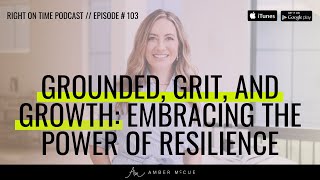
This is a YouTube video titled "Grounded, Grit, and Growth: Embracing the Power of Resilience" featuring a conversational podcast episode recorded in June 2023. The episode is hosted by Amber McCue and features guest Whitney Sullivan, a leadership coach and wellness expert. They discuss themes of resilience, knowing when to quit versus grit, self-awareness, mindset, and personal growth, with a focus on practical strategies for managing energy and stress in professional and personal life. The conversation is rich with personal stories, coaching insights, and reflections on navigating change and burnout.
To quit is letting go of what's not working. When the easy but wrong thing would be to keep going in it would be to keep gritting in it. And you know, sometimes we have to know what we have to let go of and that's a really difficult process. I mean, we didn't spend our whole lives learning how to quit, right? Like or like. And I think another way that we can look at quit is acceptance, you know, and that's another thing I had to learn in the last two years. Moving into this entrepreneurship space is like what's worth fixing and what's worth accepting as it is and just moving on and directing my energy elsewhere.
We are in for a treat Today on this episode of the Right on Time podcast, we're going to be chatting with Whitney Sullivan. She's a leadership coach, enneagram practitioner, keynote speaker, and team building. Her professional training and coaching business is designed to help rising leaders break through barriers to thrive, help professionals increase purpose, peace and performance at work, and help teams thrive at work with more bravery, belonging and ability to advance the bottom line. Her background's in fitness, wellness and student leadership programs in higher ed where she learned the hard way that becoming a leader requires a lot more than a change of title. She also learned that aligning your career to your purpose, values and strength strengths is continually evolving process, not a one time thing. She offers coaching she wishes she received so that emerging leaders can show up with clarity, confidence, resilience and purpose driven professionals can craft a career that aligns with your passions, values, talents, desired lifestyle. She's currently living in Bozeman, Montana with her husband Tim, where she's also an avid reader, outdoor adventure and cycling instructor. You know, I gotta say, Whitney's bio is good, but wait till you hear the heart and the uniqueness and the compassion and the brilliance that she brings to this conversation. If you have experienced burnout or think you might be, if you're desiring to make a change, if you have a nudge and a calling that you're not fully stepping into yet, this is going to be good. This is going to be really good. Before we step in, I'm going to share one extra thing with you because there's a point in this upcoming conversation where we talk about putting your hand to your heart center. And I want to share from Linda Graham, mft. She shares that oxytocin is the neurotransmitter of the calm and connect response and it's the brain's direct and immediate antidote to the stress hormone cortisol oxytocin is the neurochemical basis in our body for the sense of safety and trust, connection and belonging, which reassures us, everything's okay. Everything is going to be okay. Linda shares that oxytocin is the neurochemical foundation of resilience. Researchers have demonstrated that a single exposure to oxytocin can create lifelong change in the brain. And the very fast track way to release this oxytocin, calm down stress, even extreme stress, is through safe touch and warmth in a safe and soothing relationship. Safe touch anywhere on your body, even from yourself, triggers the release of oxytocin, brings us back to calm and trust. So there's a lot here that we're going to talk about. Actually, this is just one segment. There's a lot in this, one little piece of this episode. By simply putting your hand to your heart. And when this came up in this conversation, I knew I just wanted to go get a little bit more information on this for you. Because actually, a couple of weeks ago I read some research on this. I'm like, man, these small things that we do, like simply putting our hand to our heart, have a big impact. And the simple small steps that you may uncover and the simple quotes and the words of inspiration that you may uncover in this episode, in this beautiful conversation with Whitney, might lead to something incredible. I'm so glad you're here. I have a feeling this is going to be right on time and I definitely want to hear from you if there is a nugget in this episode that resonated with you. Of course you can leave a review wherever you are listening. You can also connect with me on Instagram @ Amber McHugh, let's get into this incredible conversation with Whitney. Whitney Sullivan, welcome to the show.
Thanks for having me.
Oh my gosh, I'm so thrilled to be here with you. I feel very, I don't know, something feels right on time about this conversation today, so I'm super pumped. You said something to me once. Quit is not a dirty word. This was a lesson that you shared. Was right on time for you. I have to know more.
Absolutely, yes. Quit is not a dirty word. And where this came from was in the process of. I had spent 10 years in higher education. I've always been a passionate worker. I've always loved what I've done. But I was definitely one of those folks that when the pandemic came, so many things started to shift for me. And I don't know if you experienced that, but I'm sure so many People have experienced that, that something about that season of life just really shifted things. And I kind of even came into it in somewhat of a unique situation where I was working, had had a couple of crises that led into that. So by the time the pandemic came, you know, things were just really starting to shift, personally and professionally. And I hit a point where, you know, probably, like, mid-2020, where, man, like, things were just kind of coming to head. And I don't know if you resonate with this, but I would say growing up, I always had this identity of, like, I'm not a quitter. Like, I never quit. You know, I'm so tough. I stick things out. I can stick anything out. But I would say mid-2020, with some work crises that happen with the pandemic, you know, I finally hit this point where I was like, oh, my gosh, I think I need to make a major change in my life, and that major change might be quitting my job. And I'll never forget that I was sitting in my office at the time, and I was about to have a call with my sister. And my sister is a leadership coach, and she's also in the business that I am in. And I was just trying to collect what it was I was feeling and what it was I was needing from her in this conversation, because I was just really at this crossroads, and I wrote down four emotions, and it was fatigue, high morale, low discourse, discouraged, and full of doubt. And the only thing I knew at that point was, like, that's just not how I wanted to feel about my career. I've always been a very passionate person. I'm usually pretty confident in the things that in my. In my work life and the things that I do. But by the time I talked with her and ended the call, that's when I kind of had that moment where I was like, you know what? I'm being so attached to this identity that I'm not a quitter, that I need to make things work, that I have to stick things out. And, you know, the lesson that was right on time for me during the pandemic was, you know what? Quit is not a dirty word. And my resilience in this situation is equal parts knowing when to grit and knowing when to quit. So that's a little background, you know, of that.
When to quit and when to grit.
Yes, absolutely.
Okay. So this journey is incredible. I just want to put a bow on this journey so we can understand where you are today. You quit and started your own business. And how long did that take. How's it going? How did you feel in between all of that?
Oh, yeah. How did it feel in between all of that? That's a really good question that we need to ask people more, right? Because we tend to focus on where you were and then now where you got. But all the good stuff happens in the middle, right? And so that would have been mid-2020. And I knew at that time that I was ready to move on. And I'll never forget that she asked me. It was just so. I wasn't expecting it because in the call, she was like, you know, Whitney, this level of burnout, have you considered that resigning might be your best option? And, you know, I'd never considered that because sometimes, you know, we're so focused on, like, how do you keep going? How do you keep gritting? I had never had somebody even suggest, like, well, what if you quit? And it wasn't like a, you know, throw in the towel and just, you know, rush out of there. It was just like, no, like, have you considered what could be next? Have you considered your other options? And so at that time, I knew that I was ready to move on, but I didn't totally know what it exactly was. And so my sister happens to be running a confidence and clarity career and leadership program that I signed up for, and she was new to the business as well. And, you know, I have to say that, like, when you're thinking about making a change, it's so important to connect with other people that you can see yourself in and, like, have role models and connect with new communities so that way you can see what's possible. And, you know, when I met these other women, I was like, oh, wow. Like, here's all these other really ambitious women, and I can be just like them. And then just the exercises she led me through, I was like, you know what? I love what I do as an educator. I love coaching, I love mentoring. I love everything involved with people. And so maybe I just need to go and create that myself. And, you know, it just kind of some stars aligned and things just kind of worked out that I was able to start a side hustle in January 2021, kind of get things going. And then by October 2021, I went full time in my business. And, you know, it just seems like a good time to take a risk. But, you know, I would say that overall it was like a year to 18 month process, you know, and people were like, oh, wow, like, you just did this. I'm like, no, no, no. I didn't just do this. This was like. This is like an 18 month, you know, and there's a lot of, like, inner work that happens when you make a change like that. So that was kind of like the middle. And, you know, the first year of business is really difficult. And I think that that's where I learned even more, the difference between grit and quit. And do you want to hear the definitions I've come up with? Yeah, absolutely. Yeah. So I like to tell people that for two years straight, I thought about quitting. Like, the first year I thought about quitting, you know, it was my last year in higher education, and, you know, I just couldn't stop thinking about, oh, just want to quit. Not it was the easy thing to do because it's the right thing to do. And then the second year, the first year of entrepreneurship, I still thought every day about quitting, not because it was the right thing to do, but because it would be the easy thing to do. And so that really kind of helps me look at, like, you know, what is the difference between grit and quit? When do we grit? When do we quit? And, you know, to me, to grit is staying the course and working hard when the easy but wrong thing would be to quit. And then to quit is letting go of what's not working and moving on when the easy but wrong thing would be to grit. And, you know, that distinction, I think, really helped me move through, you know, a difficult two years of basically having to learn to be a quitter. Like, I. For two years, I had to learn how to be a good quitter, what to keep doing and what to not keep doing.
I said at the beginning of our conversation, there's something right on time brewing and full body goosebumps and that welling of tears when you said when to quit, it would be easy but wrong, I think, is what you said. Did I get that right?
Yes. Yeah. So, like, to quit is letting go of what's not working. When the easy but wrong thing would be to keep going in, it would be to keep gritting in it. And, you know, sometimes we have to know what we have to let go of, and that's a really difficult process. I mean, we didn't spend our whole lives learning how to quit. Right. Like, or like. And I think another way that we can look at quit is acceptance, you know, and that's another thing I had to learn in the last two years. Moving into this entrepreneurship space is like, what's worth fixing and what's worth accepting as it is and just moving on and Directing my energy elsewhere. So big things to learn there. You're smiling because you're like, I'm an entrepreneur.
Like, yeah, I just love it. I love it. And if anyone is listening, thinking, wait, I need to hear that again, back it on up. Because you said some really powerful things in there. And so often many of us heard the messaging of, as you said, like, stay in it, keep going, push through, and reason for that. And there is a time when it is right and it is okay. And it is good to say, no, thank you. I am done with that right now.
Absolutely. And I think it's just about knowing what's the best use of your energy. And you know, my husband is also an educator and he's really into leadership and development and all that. And a follow up question, because we talked a lot about the difference between grit and quit. I mean, again, I'm not kidding when I say for two years I thought about quitting. So we talked a lot about what's the, the right thing to do, you know, what's aligned with your vision, what's aligned with your values, what's aligned with your energy, what's aligned with your strengths and weaknesses. And a really simple reflection that we came to was, you know, what's hard work and what's not working? And you know, when I thought about, like, as my time in higher education came to a close, I was putting in a lot of hard work, but it wasn't working. It didn't feel like there was any momentum. It felt like I was constantly going against the grain and it wasn't really quite a right fit. But then when I looked at the first year of my entrepreneurship, and I'm sure other entrepreneurs relate to this, it's really hard work, but it was working. I was proud of the progress that I was making. I was proud of the effort that I was putting in, and I wasn't proud of, like, what I was doing the last year in higher education. And so that's another way I think we can think of like, do I grit? Do I quit? And it's like, well, you know, what's hard work? What's not working? Are you proud of your efforts? Like, do you feel like, you know, you're just constantly pushing against the grain or your efforts producing something. So another way to think about what, do we quit? What do we grit? And it's really important for your energy because I'm sure that you've experienced that. Like, when we're constantly putting effort into the things that aren't working, it's just an energy drain. Right. Like, and it's just. And then, like, it really affects our ability to stay resilient in other aspects of our lives.
Okay, so speaking and shifting a little bit to the resiliency, how does that show up and impact our building our businesses are changing our lives?
Absolutely. Absolutely. Well, I like to think of resilience as a battery. And, you know, the more charge you have going into challenges, setbacks, failures, seasons of really hard work, the more capacity you have to thrive in the face of those. And so, you know, and I think sometimes we think of resilience or as grit, as, like, this sense of overall willpower. But I really like to view resilience and grittiness as a sense of your overall wellness. And so when you're really focused on your energy in that way, you know, that's where it kind of frames those reflections around grit and quit. Like, you know, which one is going to charge my resilience battery? And so that's how I like to think about resilience. I also like to think of resilience as the mindsets and habits that keep you grounded, gritty, and growing. And, you know, I call it the three GS of resilience. And those are the three things that are going to kind of turbocharge your resilience battery.
So good. The three GS of resilience. Grounded, gritty, and growing. Okay, let's dig.
Yeah.
So grounded. Well, how are we defining grounded?
Yep, I'm defining grounded as, you know, the things that you do, the habits, the mindsets that keep you connected to your vision, your values, and your inner voice. And because when we think about stress, like, you know, Brene Brown talks, has some really great language in her newest book, the Atlas of the Heart Around Stress. And, you know, stress in its simplest form really is just when life picks up to a pace that we feel like we can't maintain. Right? Like, it just feels like life is unfolding at a pace that we can't quite cope with. And so when I think about staying grounded, I think about those things that we do intentionally that help slow life back down, that help keep life at a pace that we feel like we can manage. And, you know, things like, for me personally, what keeps me grounded is exercise, getting outside, like, connecting with my friends, a journaling practice, making sure I have lots of spaciousness in my day. All of those things really help me stay grounded and connected to what I want, the things that matter most to me. And, like, you know, our inner voices, like, are really Quiet. That's really easy to crowd them out. So when we're staying grounded, we can. It kind of turns up the volume on our voice and turns down the volume on, like, people pleasing and other people's voices. So with that said, I'm curious, like, what do you do to stay grounded?
Oh, my gosh.
You know, I know I'm turning the tables here.
I love it. I'm so in that listening mode. Like, well, wait, now it's okay.
Talk.
You mentioned having space in your day. I notice when I am in Africa, it's much easier for me to have that space because kids go to school and I have all this time before people wake up where I can spend anyway. And I notice when I don't have that time for a week because, you know, something's got something every day or there's an event or whatever, I lose my balance a little bit. So that space is really critical. Journaling will bring me back. A conversation with my kinesiologist will bring me back, or conversation with a coach or even conversations with mentors and colleagues. So being in that space and what often happens in those spaces is the reorienting to my vision, my voice. So you also talk about a pro tip you've got here that I am chomping at the bit to know about, which is the truth diary.
Yeah. So, you know, I talked a little earlier about how, like, I would say in particular, like, I really had this identity of, like, I'm tough, I can handle things. You know, I'm not a quitter. And in this season where I had to quit a lot of things, and it wasn't just work, like, I just feel like the last five years, I just had to learn to be a really good quitter in a lot of things in order to stay aligned with my vision, values, and voice. And one of the things that I did, and it was something that my husband gave me the idea to do, and he was like, whitney, you just keep a truth diary. And he was like, don't make it for your business. Like, don't make it like reflections that you're going to use later. He was like, you know, just write down, like, the truth for you. You know, And I can't remember exactly how I said it, but I got the idea from him. And so one thing that really helped me quit was every morning, that grounding ritual of writing down the truth and just, like, being honest with myself, like, radically honest about how I felt about things, about how things made me feel about things that made me angry about like, naming my true emotions. Because I think sometimes what we do is, especially women, like, we tend to edit, right? Like, oh, it's okay. Oh, it's fine. And you know, I'm going to accommodate, right? And like, I just, I really got in this accommodation, kind of people pleasing season of my life. In addition to that, like, thought that I can't quit. And I would say, like, it not only helped me understand what I was really feeling, it also helped me identify the rhythm and tone and pace of my inner voice. Because I think the inner voice can be hard to find. Like, first of all, you have to have stillness, right? We need stillness and spaciousness. But also each of our voices has its own rhythm and tone and pace. And I think, like, that really helped me identify, like, oh, no, no, that's my voice. This other thing I'm thinking that I'm attaching to is not my voice. Like, this is what my voice feels like in my body. And it just really helped me connect with that. And it was painful, though. Like, it sounds great, but there was times it was like, really painful to like, write something down and say, like, oh, I didn't like that. Ooh, that made me angry. Or, ooh, like, this doesn't make me feel good. But, like, I think, especially like, when we're looking to make a lot of changes, to have that clarity of what we need to quit and what we need to grit, we need to have that connection to our inner voice.
I'm going to throw something in here that was not planned. Okay, y'. All, I let Whitney know before we started chatting and recording that there isn't a lot that I planned. Like, I have, I have some notes, but I didn't plan specific questions except the first question. I gave her a heads up what we were stepping into, but after them, like, it's just gonna flow. And this is one of those things that is just flowing. I this week have been working on a model for change. Like, when we are in this space of wanting something different. In fact, we host an event every year called the Plan, the planning event of the year for entrepreneurs. And There have been two times where we've hosted an Edit 2020, when all of our plans went out the window and we needed an edit. And in June of 2020, 23. So we've got two edits. And as I was preparing for the edit, June 2023, I wrote down three steps to sort of change. And then there are layers under this, but at the top level, it's what is the reality? Which when you said like this, what is true? Like, yeah, what is true? What do we know? What is happening, what is current, what is now? And that's feelings, that's thoughts. That's all of the things. It's our circumstances, what do we desire which propels us forward? And what is possible. Slash, what will be? Like, what will be. We can declare it and we can move forward to it. But I want to focus on this. What is reality? What is current?
What is true?
Because you said something that struck me so much. You said, what are we feeling? And as women, we tend to edit our thoughts. And there is growing up in coaching, even in some positive psychology space, in manifesting law of attraction. Like, your thoughts create your reality. And I struggle with this because when we landed in Ethiopia, I would walk through the streets of Ethiopia and I was like, you know, it is really privileged for me to be able to say my thoughts are going to create my reality and universally applicable. Because there are some situations you cannot think your way out of. Like, we can create. We can move the needle. We can, you know, but there are some things that. And so what is true? What do we know? And then taking it a step further, where do we want to be going? Where are we going? But I want your reaction to this, because as you said, we edit our thoughts. This came to mind. Like, we edit them. And yes, sure, we have beliefs and we have feelings, we have emotions around what is true. But sometimes what is true is true, is true. And you can't think your way out of it, but you can still create change and you can still feel a different way. So obviously, like, I'm still unpacking this and I'm still, like, working on the layers of this. But what you said around how we edit our thoughts, I mean, for a long time I heard this is recommended. Like, your thoughts become your reality. Are you thinking the right way? Like, I don't want to lie to myself. Like, another very tangible example was I was not good at webinars for a long time, right? Webinars or an event to invite people to the next thing and connect with people. And I was just not doing them well. And someone said, change your story. You are good at webinars. I'm like, well, that feels like a lie. No, I'm not. But I did want to shift my reality. So I started saying, I'm getting better and better at webinars. And then there were some after that, I was like, oh, that was good. Like, now I can say I am good. And that was good. So Reactions to this.
Yay. I have a few. I have a few.
Okay, good.
So, you know, I'm hearing that, like, so editing, right? And thought work. There's lots of layers of this, you know, and when I think of editing, I think, you know, for example, the moments we say we're okay, when we're not okay, right? Like, that's what I think of when I think of editing. Like, we have a different reaction than what we project out to the world. And I think that leads us into a burnout space that because we're not connected to ourselves, like, I'm angry, I'm sad, I'm grieving, I'm this. But we're projecting that we're okay, you know, And I, you know, I think that's editing. But then also, like, truth work and mindset work, I think is a little different because you said, you know, I'm not good. I can't remember exactly what I said it was. I'm not good at webinars, and I still think the truth work applies there to find to me. Truth is what feels good in your body, what feels expansive, what feels empowering. And so, like, I have a lot of mindset garbage around. Like, I'm not good at this, I'm not good at that, but where can I find the truth within that? So, for example, like, I will get better at webinars with practice. That feels more true, right? Because it doesn't feel true to be like, oh, just try. Just show up, Fake it till you make it. Like, that does not feel true to me. But what feels true to me is I will get better with practice. I will focus on small steps. One big thing that helps me with entrepreneurship actually is I'm not naturally extroverted. I'm not naturally sales focused. I'm not naturally that. But one thing that was true to me was I'm a really good learner. I'm really good at learning. I can learn skills. And, like, that mindset shift felt true to me, and it empowered me in order to move forward. So I think there's like, a little, you know, there's the editing piece that we have to be aware of that's really not good to our health. And it doesn't mean that, like, it changes the situation, but, like, I think it changes you and how you approach it. If you're honest, that you're angry that so and so did something. Like, I just think that we need to honor that truth. But then there's also the mindset, you know, work of like, yeah, like, it's not true to say, like, I'm just gonna be good until I'm good at it. Like, I'm just gonna try until I make it. I'm like, no, like, find what's true and empowering and then move forward, I guess. Does that, like, does that. How does that land with you?
It's so aligned for me as well. What is again? And it comes back to your original premise. What is true? We will create stories, and this will be a part of a visual lean exercise and pulling forward, but be grounded and rooted. Is what true? And don't deny what is true, because to your point, this is where we get in conflict and burnout. Yeah, that was good. For those of you who are listening and not seeing Whitney and I on video, my hands are frequently going up like, yes, cheering Whitney on as she talks. And Whitney, you, as you were speaking there, had your hand on your heart. What was happening there? What was happening?
Yeah. I think that, like, something with truth that I'm, like, learning is, you know, somatic awareness is so important to our resilience and our health because, like, especially some folks can be very sensitive to external validation and really needing external validation for a truth, then that's a slippery slope. I think there is healthy forms of external validation, but I think the most empowering thing we can do for ourselves is figure out what signifies truth for ourselves. And so, like, one way that, like, I've learned to do that, one way I coach clients to do that, is get in touch with their bodies and get in touch with, like, Amber, what does truth feel like to you and your body? Like, where do you feel truth in your body?
Oh, what I immediately felt as you asked that question. You said my name. You asked the question. My shoulders dropped.
Oh, yeah, right. And so the hand over the heart is, like, for me, like, I know at my core, I'm a very heartfelt person. And when I'm, like, really speaking from the heart and I feel things from the heart, that feels like truth to me. But when you do that compassionate touch with yourself, sometimes it's a lot easier to find that truth. And I remember my sister would coach me on this when I was really stretched and say, whitney, put your hands in your heart and name three emotions that you're feeling right now. And it just helps that, like, you're literally connecting with yourself. You're feeling your body and getting connected with your body, and there's just something heart. Like. I just know that my truth feels heartfelt. It feels from the heart. It feels warm. It feels expansive and it just feels like I'm really speaking from here. So that's something I ask every client is just like, what does a yes feel like in your body? What does a no feel like in your body?
Oh, so good.
I.
Well, side note here, I feel like you've got a little dream team around you between your husband, you and your all, like co creating some pretty cool stuff.
Absolutely. And that's something that we. I talk a lot about in my work, is the importance of connection. I mean, and who you choose to spend your time around is one of the most important decisions that you can make. Because one thing that got me into entrepreneurship is I took this course with people outside of higher ed because I love higher education. I still really connect with that mindset, but it is not a business mindset. Like, higher education is bureaucracy. It's, you know, it's just a completely different mindset around money. And when I got around other entrepreneurs, other professional women, I was like, oh, I see myself in them. And, you know, we have to have that tribe. Right. And so one thing that I really encourage people is like, who you invest socially and is one of the most important decisions you can make. And also one of the toughest truths that you can face sometimes is that like, ooh, this person's draining me. This person isn't going where I want to go. That can be one of the most difficult truths that we face. And that's, you know, it's a lot of grief work too. But yeah, I have to give a shout out to all the people that are close to me. And like, you know, I'm very lucky and there's a lot of choices to make there as well.
Oh, my gosh. When you were in higher ed, what was your area of focus and specialty?
Yeah, so I was in the health and wellness space. And so I worked in the division of student success, and I did health, wellness and recreation programming, and I managed group fitness instructors. I led student leadership training programs. I would do leadership trainings for folks on campus, and I did a lot of mentorship with the students that I manage. But I was in the health and wellness space. And so what I love about the resilience topic is that I feel like it combines all of my passions into one of, like, it's the leadership, it's work, it's health, it's wellness. And it just kind of combines all of my experiences into one.
So it's so cool talking to you and seeing these elements, kind of, which is why I was like, okay, I Want to put this full?
Yeah. Yeah. So my background's in health and wellness. I'm a fitness instructor. I teach cycling on the side, and I've taught, you know, I've been an educator and in the health wellness space since 2009. So now I just feel like I'm, like, bringing it all into one in this resilience piece.
Man. Okay, I've got, I think, three about other questions. The first one you touched on was the second G. How can you stay gritty?
What do you need to do to stay gritty? And this is where grit and quit comes in. And to me, staying gritty is like those mindsets and habits that keep you connected to your passion. So that sense of perseverance and, like, a sense of personal power and agency that, like, you can keep going, you can stay the course. But in order to have that grittiness, we need to have limits, right? We need to have boundaries in place that protect our energy. And then we need to know when to grit and when to quit. Because that passion, that perseverance, that personal power to engage in challenges from that space is all about your wellness. It's all about your energy management, because you simply can't grit everything. Right? And so in order to grit the things that are most important to you, you have to know what limits to put in place and then what to remove from your to do list entirely. So that's grittiness to me.
So good. I love removing things from the to do list. This is like, yes. Maybe one of my number one hobbies. Like, no.
Work. Yeah. Like Marie Kondo's book. The number one thing I took from her book. This. I mean, sparking joy. Yes. And discard, discard. Like, you know, you can have all kinds of fancy organization systems. You can have a fancy to do list, but in the end, what is going to protect your energy the most is knowing what doesn't belong on your to do list in the first place.
Oh, my gosh, Whitney. This reminds me of a story that a client brought back up to me this week. Just over a year ago, she was in my house in Chicago. We had an event in Chicago. She had a long trip to the airport or a long wait for her flights. I'm like, oh, come over. We'll hang out. You can work well, you know, whatever. We'll have some coffee, tea. And she got to the house, she's like, wait, is your house always like this? And it was pretty. I want to say it was, like, clean and tidy. But what really comes to mind is it was pretty sparse.
Like, there wasn't a lot to be out.
And she didn't see the bedrooms and she didn't see the office on that day. The office is usually like the most chaotic space.
Right, But.
And the beds aren't usually made unless my husband did it. But I was like, oh, this is a little bit. But we have gotten really good at discarding things, whether it may bring us joy or it may not. But do we need it? Do we want it because we move so much?
Yes, absolutely. And I would say, I tell clients, like, that's actually a great way to practice quitting. It's like it's the same thought process, you know, of does it stay or does it go? And when you can practice when the stakes are low is so much easier than, like, you just have a similar. You already kind of have a mental framework. You know, it's not this brand new skill that your brain is trying to work out. So, yes, discard. And I feel you. I live in Bozeman, Montana. It's a kind of a resort area. Like, we have a thousand square foot condo between me and my husband. Like, you learn how to discard really quickly.
Something in, something out, something in, two things out.
Exactly.
Oh, my gosh, I love it. Okay, the second of my final three questions is how can you grow? So we're going through, we're quitting, we're keeping our battery charged, we're discarding the right things. And then there is the season. We move into where we blossom and we get where we want to be going. And things feel so dang good.
Absolutely. You know, the biggest thing with the growing piece of resilience is staying connected to a learning mindset and keeping your world bigger. Right. And an insightful person said to me once, like, Whitney, the smaller your world is, the easier it is to shake. And the opposite is true. The bigger you make your world, the harder it is to destabilize. And I think when we have that kind of bigger, higher perspective, that helps us stay in that growing zone. Like, we're always going to be growing, and it helps us stay connected, that learning mindset. And you know what I really had to learn in that first year of being an entrepreneur? I mean, it was like a big shock to the system. To go from like a bureaucracy, like higher education to being an entrepreneur is like a completely different way to think. And I just had to constantly connect with, what am I learning? What is this challenging experience here to teach me? And so for anyone out there, like, whatever challenging experience you're going through. When you take that perspective of, like, what is this here to teach you? It just makes your world bigger. Right. And it just expands your world in a way that energizes you and kind of allows you to tap into that kind of higher level of the resilience battery. And I'd say another. I think of three things, too. When I think of staying growing is pride, progress, and process. So, like, what are you most proud of? Like, what are you proud of since the beginning of this year, since the beginning of your starting that business? And again, it just makes your world bigger. Because I think when we get stressed, it's not only that life is moving at a pace we can't manage, it's that we're getting too zoned in to this, like, one thing, and it's just overtaking our ability to cope. But when we can step back and say, like, what am I proud of? Like, what am I rocking at? What am I really crushing? And, you know, I was telling Amber before the podcast started, like, I get a little nervous before a podcast, but I'm like, I know how to talk. Right. I'm proud of my talking, and that keeps me grounded. And then another thing is the progress that you might have made. What progress have you made since beginning this challenging endeavor? And then I also think of processes, what habits are supporting your growth? Because sometimes when we lose that resilience energy, we're over focusing on outcomes and forgetting to focus on the inputs and the habits and the processes that lead to the outcomes and all of those things. A focus on what you're proud of, on the progress you're making, and on the processes that you're implementing. Those are growth habits, and those growth habits are what's going to charge your resilience battery and really keep you energized for anything that might come your way.
Okay. There was a lot in there, too. If you need to. That's probably maybe four minutes. Go back four minutes if you need to rewind for that little path. And the first quote I wrote down for this segment was, the smaller your world is, the harder it is to shake it off. Is that what you said?
Or the smaller your world, the easier it is to shake. And then the bigger your world, the harder it is to destabilize. And so we want to keep our world safer, big in our mindsets broad and our perspective high.
I totally wrote it down, Rock. Good. The smaller your world is, the easier.
Yep. And that was something that somebody told me a long time ago, but it's really stuck with me.
It's true. And I wrote down this visual of like, if we want to focus on something so we're not focused on all the things.
Yeah.
But I had this visual of, okay, we're going to focus, but if you're too focused, we're going to get stuck there. Right. And we're not going to see and leave room for magic. And we got to have that space versus man. What happens when you keep learning and keep perspective coming?
Absolutely. Keep yourself big. That's something I coach my cycling classes on. You know, when we do like a really big challenge, people make themselves all small. Like, oh, I'm going to sprint really small. I'm like, no, no. Make your body big. Make your movements wide and strong. Like, and that's going to help you show up to that with so much more openness.
Oh, it's so true. Something that is a part of my right on time way of being is if I am feeling like constricted or confused or worried or like just not surrendering attached to something, it doesn't matter where I am. I could be sitting in this chair. I could be on a call with someone. I could be walking, you know, at the kids school and I will just stand with my arms open or walk.
Down the street like, whoa.
It's an immediate shift of being closed off and being worried to just okay, what, what, what? I'm open to the possibility that something incredible is unfolding there. So go big, go big, go big.
Make yourself big. Absolutely. And if we have any Ted Lasso watchers out there, it makes me think of Rebecca. Makes her do you know I'm talking about when she makes herself big before she walks in. That's what I think of is how do you make yourself big? You know?
You know, Ted Lasso is the one show that I will wait for my husband on. We have so much fun watching it together. I like hearing him laugh. I don't know if he likes hearing me laugh, but I'm chuckling throughout.
Yeah. Oh, I love it. Such a great show.
Okay, the third maybe multi part question. There might be some A's and some B's in here, but the third is that you do work with Enneagram. Yeah, I do.
Yes, yes.
What's your enneagram type?
So my enneagram type, I'm a type 4. And for our extra enneagram nerds out there, I'm an SP4. So that's my subtype. But do you know your enneagram type?
I am a seven.
You're a seven. Great. Do you know your subtype?
I don't actually. I can't say for sure.
No, that's okay.
Think it's an eight. If I looked, I could confirm wing. Is that like wing eight?
Well, it would be a wing, but there's three instinctual drives that mix with your passion that create a subtype. So, yeah, so that's probably like a whole other podcast.
That's good.
But it's something to look into that there's 27 subtypes. So the wings is something different, but there's 27 subtypes. You can be a self preservation, you know, seven, a social seven, which has nothing to do with extroversion. Or you can be a 1 to 1 or SX7. So you'll. There you go. You'll dive into some reading later.
I am totally gonna dive into that. That's so good. When Enneagram, before I took the assessment, my friends were like, oh, I think you're a one, or I think you're this, I think you're that. So I'm gonna go and compare. Maybe that's like some subtype action happening.
Absolutely, absolutely.
Oh, my gosh. Okay, so this is gonna be like a part B someday on Enneagram. For people who are interested in Enneagram, where would you recommend they start?
Yeah, absolutely. Well, first of all, I mean, I'll give myself a shout out, like, follow me on Instagram. I talk about Enneagram on my Instagram. I also offer Enneagram packages. And then a lot of my coaching is done through the Enneagram as well. It's just a really insightful, useful growth system. And especially when we talk about resilience, the Enneagram really gives you good language as to how you respond under pressure, what your defense mechanisms are, what your triggers are, and then also what you need to generate security in your life and like, what your highest self looks like, what your most energized self looks like. So it's just this like, pool of language. So first of all, follow me, but there's lots of other great authors out there, like Beatrice Chestnut and Ian Morgan Cron. I would say those two authors are really great places to start if you're just getting into it.
Oh my goodness, Whitney, I am so grateful for this conversation. So right on time. We're going to want to follow up with you and stay connected. How do we stay connected?
Yeah, follow me on Instagram, I'm on LinkedIn, I'm also on Facebook and then my website is Whitney Sullivan.com so super simple. And then also I send out a newsletter every week too that you know, I go through series of topics. I talk about Enneagram, I talk about leadership, I talk about work. So you can subscribe to that on my website as well. And then also this Resilience topic is my newest keynote or webinar. So if you want to train your team in the Resilience Battery, in the three GS of resilience, I offer that training virtually and in person as a keynote or as a webinar.
Frickin awesome. Whitney Sullivan thank you.
Thank you for having me.
More from Amber









Embracing the CEO Mindset with Amber McCue! Strategies for Time Freedom and Business Success

