How to Show Up (Even When you do not feel like it)!
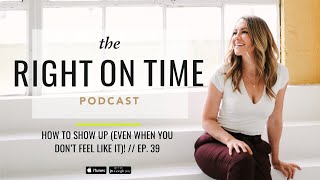
Amber McCue shares strategies for showing up to your commitments even when motivation is gone. She uses personal stories and research on habit formation to explain how discipline and consistency matter more than feeling like it.
Get ready, because everything is about to change. There's a new way of living life and doing business that will blow your mind. This is a podcast all about the timing of life and the timing of success. It's what we call the Right on Time Life. And you are listening to the Right on Time podcast with Amber McHugh. Hey. Hey. Welcome to the Right on Time Podcast. I am pumped to be sitting down talking with you today. In fact, I should say I'm pumped to be finally here chatting with you today because it took me a little bit of build up to get here. You know those days when you have to show up but you don't feel like it? Or those times when you have to execute or deliver on something, something that you've promised or committed to, but you are super, super stuck. Yes, it's true. Sometimes we have to show up even when we don't feel like it, even when we're stuck, even when we don't want to. And it took me a moment to get my butt into the chair today to sit down and record. But you know what? Once I get here, I am always so pumped and I'm always so excited. I teeter a little bit on that introvert extrovert line, so I blame part of it on that. It takes me a minute to want to get to the party, but once I am there, I never want to leave the party. I love hanging out with you in this space. And, you know, this applies to so many things in my life. Maybe you have experienced this too, but sometimes I don't want to sit down and play Uno with my girls. But. But when I do, I have a blast. Sometimes I don't wanna work out, but after I do, I feel really, really good. Sometimes it's hard for me to sit down and record a podcast or record a video when imposter syndrome is weighing on me. And sometimes you gotta show up and speak even when you don't feel fully ready. And there's more that you could do to improve or work on whatever it is, right, that happens in so many areas of our lives? Well, there are so many things that I hold back on. In fact, probably about six months out of the year, I don't feel like it at the start of the day because allergies kick in and oh, man, right after the medicine kicks in, I'm fine, I'm back at it. And maybe there's some seasonal depression happening because there are a couple of times a year when I just feel down even though I know things are fine. Even Though I'm happy, but I just feel a little bit down about either allergies or the weather or just feeling down or kids being sick or somebody being sick. And that's throwing us into a space where, oh my gosh, I don't even know what I'm showing up for. I'd say that's about half of the year, but I still show up. And once I do, I am so grateful and so glad that I did. And that's what we're gonna talk about in today's episode. How do you show up even when you don't feel like it? And in fact, for me, it always starts with commitment. Because once I am committed, then things like discipline and hard work and having expertise, expertise, those things help me. But first comes the commitment. I have to know what I am committed to. And that means that I've got to have a plan, right? I had to have thought about it. I had to have given some brain power and some space to conceiving the thing I want to do and the thing I'm going to commit to. And I also have to define what commitment looks like. Like for me, how committed am I? What does this commitment look like? And I really have to think and answer the question, am I really committed to this? Because if I am not fully committed something, chances are, I mean, it's probably a 95% chance. If I'm not really committed to it, I can't even talk myself into showing up for it. So it starts with the commitment. And Hailey Gabriel Selassie, Olympic gold medal winner from Ethiopia, actually where I am sitting right now, succinctly says, once you have commitment, you need the discipline and the hard work to get there. But it starts with that commitment. So then once you've got the commitment, I want to talk you through some strategies that will enable you to show up consistently even when you don't feel like it. AKA today for me. But I'm glad I got here because it's really nice to be here with you today. So that's the first thing I do, actually. I forward think a little bit once I know that I need to sit down and do that thing because I created the plan and I scheduled it. So I know it's coming, I know I have to do it. But if I'm still feeling resistance, right, I'm going to do this thing. I committed to this thing, then I future cast a bit. And I think when I am sitting down in that space space doing that thing that I committed to showing up for what is that going to feel like, how am I going to show up then? What will the benefits of me showing up be and what will the rewards I get after showing up? And certainly one of my big goals and my big values is to serve. So I get the joy of being in alignment and I get the joy of serving others. In addition, a benefit that I receive is that I straight up feel joy when we are sitting down and connecting. So I start to future cast and think, how am I going to be feeling when I'm actually in that moment? And then of course, if the things I'm thinking of aren't so positive like they are with me and you today, then I think about, all right, this could go a little bit funky, right? This may not be the easiest conversation. Even though I've committed to showing up for it, it's going to be hard and I have to have this conversation. So I plan ahead and think, all right, what's it going to feel like when I'm there and what am I going to say to make this situation better? Or even if it's a hard situation, I just want to make sure I'm planned and ready for it. So I think through in my head, all right, if this is how the conversation's going to go, all right, this is what I'm going to say, or I don't know, maybe the conversation is going to go this other way. This is what I'm going to say. And I literally test out different communication, different flows of conversation so that whatever way that conversation goes, whatever way that tough situation goes, I feel ready for it because I've planned and prepared. Now do I spend hours thinking through that? Nope. I probably spend as long as a shower and doing my hair. So. So you can time that a shower, 10 minutes, 5 to 10 minutes, let's say I'm not exactly sure how long my showers are. Plus doing my hair, blow drying, that's about five minutes for me. I have timed that before. And then curling my hair, that's also about five to 10 minutes. So we're looking at about 20 minutes of thought here. I'm planning for those difficult circumstances. So I am ready and I step into that situation confident. Then I oftentimes have to decide what will go so you can make room for what will stay. So first step we talked about was committing. Then we talked about planning and scheduling. Then I shared how I test out different game plans for how I'm going to show up when I get there. Then sometimes we just straight up have to decide what, what's gonna go and what's gonna stay. So when you decide to show up for things, sometimes we decide to show up for way too many things, right? So I have to scale back and adjust. All right. These are the things I really need to get done now. I've committed for these things, and I'm showing up for these things. And if I'm gonna give my energy to those things, I have less energy for these other things. And these things are not a priority right now. So these things are gonna go, and these are the things I'm going to cut. So I'm constantly deciding what's gonna go so we can make room for what's gonna stay. And that's a constant prioritization exercise. I've already hit on this a little bit, but I wanna go deeper into this idea of future casting and thinking about what it's gonna feel like when you sit down. I do this big picture as well, and I think about future me versus present me. Right? So in those moments when I don't want to work out, I visualize, like I said, what's it going to feel like after that workout? I'm going to feel pretty good after that workout. In fact, this. In the last. Well, since moving to Ethiopia, I had made a commitment to get back in the best shape of my life. Now, that means all sorts of different things. I don't expect I'm going to be in actually as good of shape as I was, you know, when I years ago, but I'm gonna get in pretty good shape. But the first year, I wasn't. I wasn't feeling it. I wasn't doing it. I. I was sick. We were sick a lot here our first year in Ethiopia, so all sorts of things were off for us. But coming into our second year, I thought, you know, I'm really committed to this. Yes, I am committed. So what does that look like? And I started visualizing, when can I work out? How can I work out? And I used what I call the try it on strategy. And the try it on strategy is basically taking different opportunities in your head and playing through them. For example, I have the opportunity to go to a Pilates class here. Nope. That did not feel. That did not feel aligned. I would work out really hard. I love the instructor, so I would love to see him and get inspired. Inspired by him and get some of his mojo. But I know when I push my body too hard before it's ready, I get wiped out. I will get burnt out, and then I won't be back four months so another opportunity I tried on was just to work out at home. During the summer, I had started doing a simple seven minute exercise times three. So all in all, a 21 minute exercise. And that felt doable. I could dial up the intensity or I could dial down the intensity based on how I was feeling in any given day. And I could pick when in the day that I would do it. And I could do it on my own schedule and use my own hacks. For example, if I put on Netflix just when I'm starting to work out, it doesn't feel like working out, right? I trick myself this way. When I'm doing some big planning to just put on some music and light a candle and get a cup of tea. Just, you're gonna have a moment of relax with your notebook and your 90 day plan in hand, and then my resistance goes down. Same thing when I'm working out. If I pop on a movie, all right, I'm starting to work out, okay, now I'm all working out and I'm not even paying attention to that Netflix anymore. So that trying it on, that visualization experience felt a little bit more aligned for me at the time. Now since then, I've shifted a little bit. And as I built up my stamina and my mental willpower to get into this workout routine, I have layered in other things, right? I've gone horseback riding, which is a definite form of exercise. Oh my gosh, my legs were sore for days. But I didn't start there. I. I started with a visualization exercise and trying on working out at home. And that felt most aligned for me at the time. And then as time went on, I layered in other activities and other exercises. So I use this visualization, try it on strategy for all sorts of things. If I'm committed to podcast, okay, I'm committed to doing a podcast episode or series. How committed am I? Am I committed to doing interviews? When we first moved here, I was absolutely not committed to doing interviews. I tried it on. I worked through different scenarios on how I could schedule those. And it just felt like a little bit much to scram into our schedule while we were just getting grounded and settled in a new country, while the kids were just getting started with new schools, while we were experiencing new germs and new sicknesses. And I just couldn't work out that that tried on in my head. But fast forward just over a year later and I am excited and ready to do interviews. I have visualized that and tried it on in my head and I can step into that confidently there's another benefit with thinking about future you versus present you. In fact, Hal Hirschfeld, a social psychologist at UCLA Anderson has done some deep research on this and he has found that when people look at themselves in the future, it seems like you're looking at an entirely different person, like a stranger on the street. In fact, you guys may have seen there was. There have been a couple of campaigns going around by various companies where you can look at a future version of yourself. Oh my gosh. My 90 year old self sky scared me. She looks totally different. I didn't. Well, I recognized her in so much as she had some similarities to my grandma, but outside of that it didn't look like me. I could not recognize her. Right. So one of the campaigns, Merrill lynch did a financial campaign and they found that when people looked at a future state version of themselves and they thought about where is this person person? Who is this person? What's she going to be doing? How's she going to be taking care of ourselves? Those people were willing to allocate more money to a retirement savings account. Like so when you think about your future self, you're more willing, it's more tangible, it's more real than just making up something or thinking about like when I present self am 10 years from now doing something right. It's not as real as you think about future selves. In addition, in four other more advanced studies around technology, they had people immerse themselves in a virtual reality, standing in front of a mirror in virtual reality staring back at a future version of themselves. So present version in one mirror as I stand today and looking at themselves in virtual reality and however many years from now and they spent about five minutes interacting with this image. Hal's research identified that all four studies that they did on this, those people who interacted with their future selves exhibited an increased tendency to accept later monetary rewards over immediate ones. So let's say you're making an investment in future self and you're not going to reap the benefits of that for years to come. In virtual reality, we are more likely to invest in future self than take immediate rewards or immediate gains. I love this concept and looking at the research around this, when there's a little bit of data to go with it, I'm always a little bit more inclined to step into it. And that's what when we talk, when we do anything, when I talk about anything, when I share anything, I like to either have practiced it myself or I like to either look at the research behind it so that we know that it's rooted in something. And I'm not just like, this feels good. I think this works. And there's something to that. But usually I'll give you a disclaimer when I'm just saying I think this works. But this future state thing, I started to practice this in my exercise and in my eating. Oh, my gosh, just yesterday, y', all, I ate two donuts. I was definitely not thinking of future self. But, yeah, what are you gonna do? Sometimes, Sometimes we can't win them all. We cannot win them all. With that in mind, one of the things that's really important for me to ensure I can show up on a consistent basis even when I don't feel like it, is to take care of myself. So I want to invite you to take care of yourself. Right. For me personally, lack of sleep leads to migraines, which can take me out entirely. But now I've worked with migraines for quite a few years. Actually, I got my first migraine when I was in third grade. They thought I was having a stroke. I was living in Saudi Arabia at the time. I know exactly where I was sitting. I can remember that very vividly. But even if now that I've learned to navigate migraines and I can still function when I have a migraine most of the time, even if I have that, it also leads to reduced decision making capacity and I'm taken down, right? I cannot communicate effectively. I cannot make decisions properly. And that all starts for me with a lack of sleep and increased stress. So now I also have to work to bring stress down. If I'm in meetings all day, I don't really eat. I've been on the phone, I get to the end of the day, oh, my gosh. And I might eat that donut yesterday, you guys, I was eating really well, but it was Audrey's birthday and I gave him like, oh, it's Audrey's birthday. We don't have donuts all the time. I'm going to do it now. It's perfectly fine that I did it. I'm not beating myself up about that. But there is that reduced decision making capacity when I'm not thinking about future self, for example, and I'm not taking care of myself effectively. I was also a little bit under the weather yesterday. So those things compound, right? So all of these strategies that we're talking about today, you can use in combo and pull a couple and pull them together to have increased impact. Number. What number are we on? Maybe number six. Accountability in place. It's really helpful for me when I have accountability right? My husband did not see me any of that donate until it was too late yesterday. He is a built in accountability for me at home. But in addition in my business I have accountability from my team, I I have accountability from masterminds and colleagues that I am participating in. Another thing that really helps me is to gamify it. And my favorite way to gamify is a basic checklist to do list. In fact, all of the upcoming podcast episodes that I am planning on recording are on a tiny little post it note with tiny little handwriting and I am putting check marks on on them as I move through it. And I am satisfied and fulfilled as I put those check marks on. And when I look at this list I'm like, all right, you got two. Two out of five episodes recorded as of now. I am really excited to put another check mark in today after this episode and I'm showing progress to a goal. Happiness psychology notes that when you show progress to a goal in the form of check marks, it can be simple, it doesn't have to be complex. But when we show progress to a meaningful goal, our happiness levels also go up. And certainly that fuels me wanting to show up more and showing up even when I don't feel like it. Because comboing this with the other strategy, when I see my future self at the end of checking off all of these, I know it's going to feel good and there will be rewards that come after that. Another strategy I leverage is the warm up. So today, for example, I wasn't quite feeling it, so I got outside and I shifted my mindset. I went on a walk. I dropped the girls off at school today. Actually, I don't usually do that, but I thought, you know what, that's going to be a great opportunity for me to walk outside a bit and and shift my mojo to shift my energy. Then I went through the routine of getting ready and I was strategizing and thinking and planning for the moment when I would sit down and record this episode and hang out here with you. So that was a warmup that I used to get into that space of being ready to have a great conversation. And then strategy number nine is to create hacks. I have shared a number of ways that I hack my way to feeling ready to show up even when I didn't feel like it at the beginning. But over time, as I go through these steps, over time, as I use these strategies, my energy level shifts and, and no longer do I Have that thought of, I don't feel like it, but I step into the space of, this is gonna be good. This is gonna be exciting. This is going to be productive. Even if I didn't feel like it at the beginning. Right. I've mentally shifted, I've energetically shifted, and I've stepped into a space where I can now show up with you, and I can show up for you, and I could show up for myself feeling better than I did just two hours ago. Now, one last thing I want to invite you to consider as you think about how to replicate this on an ongoing basis. I have shared how I use this strategy just today to prepare to sit down and have this conversation with you. But over time, as we build up our habit and we flex our muscles to show up on an ongoing basis, we can use the habit loop. And this is Charles Dwig talks about this in his book the Power of Habit. And it's an incredible book. If you want to increase and build new and different habits, I love it. I highly recommend it. And he's got a couple of follow on books that are also very good. But in terms of forming a new habit, you can break down this in three ways. There's a cue, something that prompts you to take a certain action toward a new habit. Then there's the routine. What are you going to do? What is the habit that you are trying to form? And number three, what is the reward that you will get as a result of executing on this habit or this new routine that you're trying to form? For example, every day when the kids go to school, I want to work on my book. I know that when I work on my book, I will be rewarded verbally by my team. Oh, awesome. You're making progress on that. Way to go. So if you could see there there was a cue, the kids are going to school. The routine, I will work on my book, and the reward I will receive. Attaboys. From my team. And from an accountability perspective, when my team is feeling good about what I'm doing as well, that energizes me and that motivates you. They might be different cues and different routines and rewards for you, but I wanted to share that as an example because having a cue or a trigger to help you step into a new habit or an old habit that you just want to tweak or you want to do more of. Right. Having those cues is powerful because it helps rally your subconscious to take action. If the girls leave for school on the bus, then you get in action. On that book. Now this actually just for full disclosure, this is not a cue or a habit or routine that I am actively following flexing. Although after we sit down here today I think I might that might be my new cue routine so that I can finish this book faster. We're actually in edit phases of the how to Clone Yourself book so that is coming soon. A little bit of a sneak peek and a preview as to what's to come, but I gotta get through the edits and just last week I unlocked some blocks around that while I was being very conscious of it and working on the how to Clone Yourself training updates. And so I am ready to finish up those book edits but I don't really want to. It is hard. It is hard to move through that. Once I sit down and get in a flow again once I show up to the party, I am all for it. But actually getting me to sit down to make the edits, that's the hard part for me. So Q. The kids go to school, I will then open up my computer and open up the file for the how to Clone Yourself book edits and I will get rewards because my team will be thrilled and excited that that is done. So I want to invite you to consider what are some of the cues that you can leverage to get into flow and action on some of the things that you want to shift and increase and create habits around in your life. Because when we show up and we have a plan and a strategy for how we're going to show up and why we're going to show up, incredible things can happen. So with that in mind, I would love to hear from you on Instagram, on Twitter, wherever, on Facebook. If one of these strategies for helping you show up even when you don't feel like it has been helpful for you, tag me in. I would love to hear what's shaken on your end and what you are going to implement towards reaching your dreams and your goals. Right on time. I will catch you next time. I cannot wait to hang out and chat and to hear from you online as well.
More from Amber









Embracing the CEO Mindset with Amber McCue! Strategies for Time Freedom and Business Success

