Gathering in Today's World with Amy Nelson of The Riveter | Teal Talk
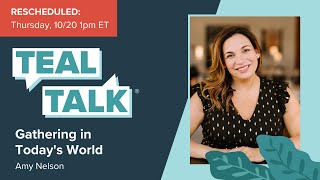
Amy Nelson, founder of The Riveter, went from corporate lawyer to building a network of clubhouses for women to work and connect. When COVID shut those spaces down in 2020, she pivoted to digital: virtual coworking, newsletters, podcasts. Now she's launching Riveter Spaces, activating hotels and co-working venues for in-person events. Women get only 2% of venture funding.
Chapters
Foreign.
Hello, everybody, and welcome back to Teal Talk. It has been a long while. I am Jenny Guy, your host, and I'm so happy to see you guys. Thank you for coming back and thank you for coming back back for this episode. That is a reschedule from our previous episode with technical difficulties. So we appreciate having you here to talk about how long it has actually been. Our last episode of Teal Talk was back in May, and then we had a whole summer of live, which was terrific. And now it is fully fall, y'.
All.
In fact, it is actually spooky season. It is coming up and I am hopeful. I don't know where you guys are here, but I'm hopeful that this Halloween will be the closest one to normal that we've had in a few years. You guys remember those times before, before you could watch like a movie with a big crowd scene that didn't make you go, am I the only one that does that? Amy, does that happen to you too, where you see like a whole bunch of people?
Totally happens to me where you're watching
and you're like, oh, my gosh. Oh, there's so many people in that tiny room. The circulation is probably terrible. The things that we never thought about but the before times. Halloween 2019. So everyone coming in now. Hello. As we are all abundantly aware, we've had a couple of years that have potentially redefined everything. But specifically and to do with our topic today, our communities and how we gather we. Which is what we are here to talk about, how we made it through these unprecedented times and how we are now peeking our heads out slowly and safely rejoining the world and our communities. And that is where my guest is coming in today. Amy Nelson is an American lawyer, political activist and entrepreneur. She grew up in Ohio and earned degrees in international studies from Emory University and law from New York University. Before she became a content creator and entrepreneur, she was a corporate attorney. And in January 2017, she founded and became CEO of the Riveter, an organization that provides workspace and other services to support working women. She spoke on stages around the world, and we are very excited to have her with us today. Amy, welcome.
Thanks so much, Jenny. I'm so excited to be here.
We are so glad to have you. And you actually just came off. I saw Amy in person because she the Riveter joined forces with Alts Summit, a popular content creator conference that came back for the first time this year. So if you don't mind just telling us a little bit about what that was.
Yes. So The Riveter joined up with Alt Summit to host an incredible one day event in New York just a couple of weeks ago on October 7th, and it was a huge success and it was also so good just to be around people again. Both all in the Riveter are communities where women who create content, who are building businesses, come together to connect, to learn and to meet brands. And while we can do a lot of that online, there is something so important to being together in person. And you know, those instantaneous connections, the sparks, all of that. I felt it happening for the first time in years and it just felt really great. We heard from some incredible speakers like Julia Hart, the star of my unorthodox life on Netflix, Sally Krawchak, who's a Wall street titan, and so many other women in between from all over the world. So we felt really lucky. To get to do
was a great experience and we had a great time being there. Mediavyme is a sponsor and it was can't speak enough to the power of being able to start gathering together in person. And actually that's a question for the audience. I'm going to ask you a question. Have you attended any conferences or events yet in person? Since we've slowly begun to climb out of this, we'd love to hear. So just drop that in the comments. And also as I asked you a question, please feel free to ask us any questions that you have. Drop them in the comments. I will make sure they get to Amy I want to start here before we dive into some great opportunities for our content creators and also talking about a post pandemic world. But I would love to hear some more context into your background as a content creator because as we heard in your bio, lawyer. So how did lawyer become content creator?
So becoming a content creator happened sort of accidentally after I switched from litigating to building my own startup in the Riveter. And when I launched the Riveter, I decided to build it because I was struggling to find a place in corporate America as a mom. I had one young daughter at the time. I now have four. I'm not having any more. But I was really struggling to find my place in corporate America and thought of going out on my own as a lawyer. And and in order to do that, I thought I should take some classes on how to start my business. You know, LLC or C Corp, all of those things. And when I went to take those classes, I was again faced with this paradigm of asking like, where are the working moms? Where are these other women doing this thing, I keep running into men who are great, but really wanted to connect with other working moms. So ultimately, I decided that instead of building my own legal practice, I would build a community and a space where women could come together to find the tools and resources to build their businesses and grow their careers. The Riveter grew very quickly from an idea to a community of tens of thousands with 10 spaces around the country. And we were on track for 20 million in revenue in March of 2020. But in tandem with that, as I started the business, I would always get asked why I had started the company. And so in starting to share the story of what the Riveter was, I started telling my own story. And I realized pretty quickly that my story was like millions of women in America, right, Of working moms that, you know, whose lives had changed when they became parents, who were finding a workplace that wasn't necessarily conducive to the growth that they wanted as both an employee and as a parent. And so I decided to start telling that story online, and not just in the one on one conversations I was having. And I chose the beginning of Instagram as a platform and then blogging as well. And the blogging turned into op EDS for the Washington Post and Newsweek and more. But I also found that creating content was both a way to market the Riveter and grow the business that I was building, and a way to really connect with people that are incredible and also helped introduce me to other businesses, to other communities, to other organizations that really, again, help grow my own business.
Yeah, that's a. I love hearing everybody's individual story. While there are always nuances, the common thread is finding a way to scale the story that you're telling on an individual basis. Or we have so many food publishers that are saying, I was tired of sharing my recipes one by one and handing them to people, and I wanted to do it in a bigger way. So hearing the way that this incredible career as a content creator gives people an outlet and an ability to connect across the world, and that became so important to us all during the pandemic as a way to stay connected when that was our only option. So thank you for sharing that story. I would love to hear more about the Riveter. You dived in a bit. You said you were on track to become. We were wildly successful. And then I'm guessing there was some pivoting happening in there, as many of us had to do in 2020. So please tell us a little bit more about the origins of the Riveter and then where they are today.
Yes. So when we started the Riveter, we had this idea that we would build a network of clubhouses where women first, but all genders could come together and have a space to work, co working, have space for events. And we would fuel the spaces with opportunities to connect through kind of cohorts or opportunities to learn and to be inspired. So that manifested in everything from courses on how to raise money for your business to conversations with Abby Wambach and Robin Roberts and Stacey Abrams and all sorts of really amazing luminaries. We ultimately opened 10 spaces across the country in Washington, Minnesota, Texas, California and more, and grew the business pretty quickly. Over a two and a half year period, we also raised $30 million. So we were a venture capital backed business on a big, big growth plan. Luckily, as a byproduct of building our physical spaces, we also built an online community and started sharing all of our events and content and resources in the digital space as well. I say luckily because we all know what happened in March of 2020. You can like hear my story with this, like, oh no, it's coming.
God, isn't that the truth too? In the same way that we're cring see the crowd scenes, we're still going like, and here comes, here comes 2020.
But really in March of 2020, we made a decision very quickly to shut down all of our spaces at once, both to keep our members safe and our staff safe. We were based in Seattle, where our headquarters was located, which was really kind of one of the epicenters of the early pandemic days, if we can remember back. And so then, and then we also stopped charging our members. Some coworking spaces around the country kept charging members and they couldn't use their space. But for us in really believing that we wanted our members to make money, we didn't feel like we could keep charging them when they couldn't use the spaces. So we pivoted everything online from gatherings to kind of like work hangouts, like virtual coworking, to our content and expertise. And it took us a long time to figure out, a, could we navigate the physical spaces on any level, or was the Riveter kind of an experiment that was over? And then B, once we actually figured out that we could navigate the physical space, meaning at the time, we actually exited all 10 of our leases, which took a year. It was a massive legal undertaking. So even though I didn't want to be a lawyer anymore, I got to be one again. But we had to ask, what are we and the Riveter always wanted to be a space of connection and learning. We took that and we've really continued to share our expertise online through articles. We have a great newsletter that goes out three times a week through a podcast called what's Her Story? Where we interview the most amazing women including like Melinda Gates and Huma Abedin and Gloria Steinem and Soledad o'. Brien. And then recently we just launched a new product which is super exciting because we did want to find a way for women to connect in real life again. We launched a product called Riveter Spaces where our members have access to work at hotels and other third spaces around the world. They can drop in, they get access to food and beverage discounts. Then on top of that, what we have found is we have this really great ability to fill spaces and activate spaces because hotels co working spaces, they all want cool programming, cool events. The Riveter can connect really awesome creators and makers with really cool spaces. So we do that too.
That is super exciting. Loving to hear the evolution from being an in person moving to totally digital and now going back into a in person offering. And tell me more about Riveter Spaces. I want. Let's go ahead. Since you brought it up, let's see, let's talk about how we could because this is how Amy and I connected when we were talking about Alts Summit and the Riveter coming back to in person and mediavine being a part of that. When she mentioned Riveter Spaces, I said, oh my goodness, this is. Our content creators would love this. So please tell us more.
Well, I think everyone in the world who is craving coming back in real life wants to find ways to do it that are both innovative and interesting and that are a win win on both sides. And so in a, in the old paradigm, in the before times as I like to call them, you know, hotels would simply be selling their event space, et cetera and moving on. Now hotels want to have a point of view. They want to be part of the conversation and other third spaces want to do this as well. So from you know, co working spaces to empty spaces and malls, you know, just all that think of all of the different things interesting. And so what they want and wanting to be part of the conversation is they want their space to be activated. If someone is doing a book tour, they might say, hey, I'll buy 30 books if you can come and do a fireside chat in our space. And so then that brings them new potential customers. Right? So for the hotel, that's A win. And for the author of the book, it's a great way to showcase the book and to have a free event space where they might have otherwise paid. We see lots of brands doing pop ups. We recently worked on a pop up in New York with a really great clothing brand and they also wanted to activate their retail pop up with some programming so that people, yes, they were coming to shop but they got to have some wine and they got to hear some cool stuff from some cool women. And so we're doing this kind of all over the country because we have partners from Charleston to Los Angeles and actually soon we have partners across the pond in Europe, which is really exciting. Exciting. Yeah. But I mean we have all of, we're fielding inquiries on both sides all the time from the third spaces who are like, do you have anything interesting coming into our city? Do you know anyone here who wants to do anything? And then from creators, retailers, you know, brands that are looking for space. And so we feel really fortunate to be in that middle ground being able to facilitate. Facilitate those connections.
Yes. And very exciting. And where I heard the synergy happening here was that we have so many of being a fully work from home, fully remote Mediavine is. And then content creators are. Because they're working for themselves so frequently there's not that opportunity to, to connect one to one. And we've, I think we've all been missing that pretty profoundly over the last few years. And I think that seeing in person, as you said, that feeling that you get when you're in a room together is pretty inspirational after having not had it for so long. So what I am so excited about, what Amy and the Riveter are bringing is that our publishers, our audience is going to be able to submit and how will it work if they're interested in some retreat space, if they're interested in finding a place to gather?
Yeah, absolutely. Right now you can email us at hello thereiveter Co for bespoke space if you're interested in popping up somewhere, if you want to book a retreat, if you're simply interested in being a part of our membership where you need somewhere to get out of the house and work or have a meeting. That's what I found. I use it for. I am mostly okay at home like I am now because I have 107 children. I need to get out sometimes. And then I also don't like having meetings in my house when I want to meet in person. Then you can join our riveter spaces which you can go to our website thereiveter Co. And and you can find a link there to download the app and join. But we would love to see you. And also when you email us@hello thereiveter.co, we welcome all ideas. We are creative, we're pivoters. Finding ways to pair people with space is fun and we're good at it. And so anything you can dream of might be something we might be able to help with.
Absolutely thrilled and excited. So please go ahead and do that. Send that email to hellotheriveter.co and we will. They'll be able to help you find space to take your retreat to another level or even make your retreat possible if you're wanting to keep the overhead low, which we totally understand. So loving this ability to open these doors and I'm just actually going to segue into this. So how, how have you. We both discussed that feeling that we've, we've gotten when we've seen people connecting for the first time in real life. And that's actually not a foreign concept to who are content creators? Digital. Digital entrepreneurs, because there are oftentimes relationships that we have that last years and then finally become in real life. But I'm curious to hear if you have any reflections or tips even for taking a relationship that has been virtual and making it in person without any speed bumps.
Yeah, I mean, I think of course, like, it's different with every single relationship. But for me, that I have found when I'm building relationships online with other creators, I try to make a conscious effort to make it a give and take where I'm not asking like, hey, can you submit me for this speaking event? Or, you know, will you pop. Will you put this in your newsletter? Or will you do an Instagram live with me? But also always asking, what do you need? How can I help? And I think just approaching it from that base level, look, we are all building things and what we're building is really important. But our life is not one transaction. Right? It's relationships. And so I think the transactions are a part of relationships, but they can't be the whole thing. And I've also always found there's this weird thing when you make an online friend or, you know, an online relationship, the first time you meet in person, like at the beginning, I was like, do I shake their hand? Do I hug them? What do I do? And now I just go in for the hug because this is someone, you know, I've, I've talked to over. Listen, if these are friends you made during the pandemic, you've Been building a relationship during a time of, like, incredible upheaval for everybody. There's nobody who wasn't impacted in a really big way by the pandemic. And so I think a hug is appropriate. I just think it breaks that barrier when you meet in person to really. To really become IRL friends and connectors.
And it definitely takes things to another level, for sure. Can speak that across the board. So can you tell us some of the cooler. You mentioned a little bit about a clothing brand wanting to have an activation. Do you have any examples of cool ways that space has been used or how the riveter has paired since coming out of this?
Yeah, absolutely. One of the coolest and most unexpected things that has. I'm sorry, I have to sneeze.
Oh, no. Bless you. Bless you.
It sneezed, like, 75 times. It's a.
No, that's good. Is it. Do you. Is there, like, a set number or is it. It could be anywhere. I'm like, yeah, all right. Bless you times four. Said one of our viewers. So, okay.
One of the coolest things and most unexpected things is we had a company approach us that wanted to do a camp, and I was like, camp? That is something I'd never thought of. But we were able to actually pair them with a camping company that was able to pull off the retreat, and we made it a little bit less expensive because the camp, it was great for the camp. It was great visibility. So we kind of brokered a deal where there would be amplification by the brand of the camp. And so that was a win win for both sides. I also would highly recommend it. It sounded like the most fun thing ever. And I think we don't think about going to camp a lot, but it's a really fun thing for grownups to do. But then really just. I mean, one of the things that we love doing, that we keep doing over and over, is partnering creators and authors with spaces. To be able to give creators and authors spaces that they're usually paying for is a gift. And for everybody, I think everybody wins because the hotels are getting to meet the creators community, which is someone they've never had access to. And I think that those authentic connections mean a lot more than someone seeing an Instagram ad. And so the hotels are seeing a lot of return of people feeling like this is a place for them, and they have warm memories with this place, and they're more likely to come back and to recommend it to friends.
Yes, for camp. Yes, for giving space to creators. All of that big Big, huge. We actually just had our media vine all hands and it was camp. It was camp media vine and it was a blast. So can fully attest to the importance of everything she was saying and the fun of being adult at camp. So I wanted to also talk about gender equity being such an important. As you were saying that you were just. You were. And this is another common thing with our publishers creating something because you didn't see it, it wasn't there. You walked out and you went, gosh, I really would. Wouldn't it be cool if this thing existed? And okay, I guess I'm gonna make this thing exist because it's not there. So I know that that is. That is a common refrain amongst our publishers. Can you talk a little bit about why it is so important to prioritize these relationships, these female relationships as female business owners as we are coming out into Covid. Coming out of a post Covid world.
Yeah, I mean, I think like pre Pandemic, there was a roar of a conversation around pay equity, around funding equity. There are a lot of things I didn't know before starting my own company, but I always look at this dichotomy that women are starting businesses at five times the rate of men, which is truly remarkable. At the same time, we have such lesser access to funding than men. And I think it's history. I think it's sexism. I think it's the way things have always been. It's an inertia that's really hard to change. But one example is that women founders receive only 2% of venture capital dollars, which means that 98% of venture capital dollars that are out there to fuel growth and innovation are going to mention 98%, which is a number that would make a lot of people not even really start. I always feel lucky I didn't know that number before I started raising money because I might have said, oh, well, it's not a good offer.
Never mind.
Never mind then. But I think that it's incredibly important that we keep speaking about it, because we can't change something if we're not even having a conversation about it. And just in having the conversation, I think it allows a lot of us to open our minds to the fact that there is this implicit bias out there. It doesn't make us bad people. It's not our fault. But how do we start to try to change it and make progress? Is it that we take more meetings with female business owners or creators who are asking to meet with us? Do we, you know, do we make A conscious decision to open our door a little bit wider for people who've had a harder time getting in. And I think that, like, at a base level, why is it important? Because women have incredible ideas. And I think also, like you just said, Jenny, like, I built the riveter because I needed to solve a problem in my own life. And if we aren't supporting women building businesses, then we aren't going to support ideas that will make women's lives better. And so it becomes this, you know, kind of vicious cycle. Right. Of women aren't able to fund ideas to change women's lives. And they're never, they never do change. You know, one example I always go back to is, is the breast pump. A lot of women use pumps to express breast milk when they're not with their babies. And for like four decades, the technology never changed. It was like you were like toting around something they built in the 1970s and it's 2014 and it's wild because this is like an evergreen market. Women are always having babies and a lot of them try to nurse. And so why was there not funding to build a new breast pump? I would say just because, you know, on the one hand, like, the people who are giving the funding are mostly men, and that is not a problem that they have. So they don't think. Right. Yep. So we need more women on the capital side of things too. But anyway, eventually there are new breast pumps. Now things are changing. But that's, I think, a really good example of why it's important to always be thinking about the need to fund more women. The need to support women creators and business owners to create innovative ideas.
Yes. And I will also say breast pump and menstrual products, they were pretty much the same thing for, I don't know, 100 some odd years.
They are.
And now we're seeing like, like, we can't do better than this. This is the best that we can do.
Really.
I feel like we can do better. So love, love that. And so I would also love to hear we love action items here. So turning that into action items, what are your top action items for helping other women? Nurturing other women creators, making space for their ideas?
Yeah, absolutely. One of the things that I do and that I would recommend that anybody do, because it's also a win for you, is to share your expertise at scale. So by doing a live on YouTube or Instagram, TikTok, wherever, where you share the thing that you're really good at, because you're all very good at Something and so kind of sharing that and your whole audience will see it and then they'll learn what you know and become a better expert too. And so I think just sharing your own expertise is. It's a low cost, great way to do things. It can also help you grow your audience and community too. So you're winning as well. And then another way which is also a win for you, which you might not think of, is holding expert office hours. There are all sorts of platforms out there right now that allow you to monetize your expertise by holding expert office hours. And again, it's a huge access point for people to allow people in the door. I think it's something that's great to do. And then also always just holding in your mind that you need to make a conscious effort to write back to more women who are asking for advice or if you're an investor, fund more women. It's something that it's really important to just always hold with us in all that we're doing.
Yes, absolutely. And thinking about that and you said low friction way to share is just to share your own expertise to offer your time. It's the most valuable thing that you have. Okay, so what is coming up for as. As we go into Halloween, closer to normal, closer to before times? What is closer to before times? Looking like the Riveter 4 at the end of 2022 and moving into 2023?
Yeah, absolutely. We're looking forward to more in real life gatherings which we help facilitate through Riveter spaces and that we're doing on our own as well. We'll be joining with Alt Summit again next March in Palm Springs from March 12th to the 15th. Early bird tickets are on sale now. There are only a few left. So we're thrilled to be headed to the west coast to sunshine to bring more creators and makers and builders together again. And we are actually also launching our own expert network. We are offering the Riveter as a place for experts to share what they know with our audience of half a million. And so we would love to meet anyone who's interested in that. We have women who are experts in brand partnerships, women who are experts in small business funding, women who are experts in TikTok. Right. You know, kind of all along the spectrum who want to share their expertise both with individuals, with small businesses and with big brands. Because we also work with big brands at the Riveter like AARP or Alaska Airlines or Procter and Gamble. So that's where we're headed. So it's busy it's so interesting to go on all these ups and downs of this journey. I think when you start a business or you become a creator, you really never know what the next month or week or year will look like. I think with the pandemic that was magnified by like a million times, but I do sense that we're reaching a new normal. I don't think I used to wonder when will it go back to the way it was, but I don't think it ever will. I think some things are changed for good. But yeah, we're entering kind of our new normal phase for the Riveter and
that all of that is very exciting. I know that we have quite a few experts, mediavine staff and also all of these publishers that we work with. So what is a good way to get in touch if we are interested in becoming part of that panel again?
Hello at the Riveter co our expert network is we're hand selecting people so we're not advertising it, but this is the best group of people to tell about it, which we're really excited to share because all of you are experts in your own field.
Okay, so to. To wrap up, we have the ability to offer space to any content. Female content creators who are out there wanting to meet up in re irl again. And is there any city restrictions? Are there any city.
Not at all.
Anywhere.
And also I will say I always talk about women because it's my passion, it's my mission in the world that women make more money. But we all do. Our tagline is built by women for everyone. So we do welcome everyone. And I know that men have a ton of great expertise, all genders do. So feel free to come to us if you're not at female identifying. But we do put women first because I don't think the world does enough.
I think that that is an amen statement for me. Okay, so hello thereiveter co. Share your expertise, find a retreat space. And we know that there are a lot of experts out here that that can share that, pass that, pay that forward. We will be. We will keep sharing. And then guys, for our next episode of Teal Talk. It's not going to be an episode of Teal Talk.
What?
Jenny, what are you even talking about? Okay, we've got something new coming. It's heading your way on Wednesday, November 16th. So we will be announcing more. We'll be leaking some more coming up. Some teasers are headed your way, but we think you're going to absolutely love it and we are thrilled to be bringing it to you. We are going to make sure that everybody has hello thereiveter co so that they can get in touch with Amy and her team and let them help you guys get back to in real life meetings and sharing your expertise to make a difference in this world. Amy, thank you so much. This has been a wonderful conversation.
Thank you so much, Jenny. I had so much fun.
I had a blast as well. All right, everybody, you have a wonderful and happy Halloween and stay tuned for some more hints about what we've got coming your way mid November. Thanks guys.
Be well.
More from Amy
Ed Rosenberg With Amy Nelson Of The Riveter on Building a Community Around Your Brand
SZN 4, EP-3. Amy Nelson, founder of The Riveter on Falling Apart, Fighting Back & Building.
From $30MM in Capital Raised...to Nothing...and then a Comeback, w/ Amy Nelson Founder, The Riveter
Amazon’s Campaign To Crush The Nelson Family: The Ugly Truth Behind Corporate Power And Greed
Amy Nelson, Founder and CEO of The Riveter - Founders Live Conversations (Full Video)