2022 0506 AJC Prioritization Lunch and Learn
This content was created by Andrea Jones. This content was uploaded by Andrea Jones. This is a YouTube Lunch-and-Learn titled "2022 0506 AJC Prioritization Lunch and Learn" (metadata created 2024-03-11) featuring Andrea Jones as the presenter. The content is a recorded presentation on project prioritization covering common pitfalls (leader bias, loudest voice, over-delegation, consensus delays), three objective prioritization methods (Impact–Ease tool for quick wins, a FMEA-inspired prioritization matrix for strategic/blank‑slate planning with optional regulatory weighting, and Weighted Shortest Job First/WSJF for ordering competing in‑flight projects using cost-of-delay and job size), plus practical facilitation tips (use a facilitator and scribe, include the right decision‑makers, leader settles ties, allow brainstorming). Examples include new product introduction, strategic planning, and biotech/regulatory considerations. The talk includes brief audience Q&A and references AJC’s client work and use cases.
Chapters
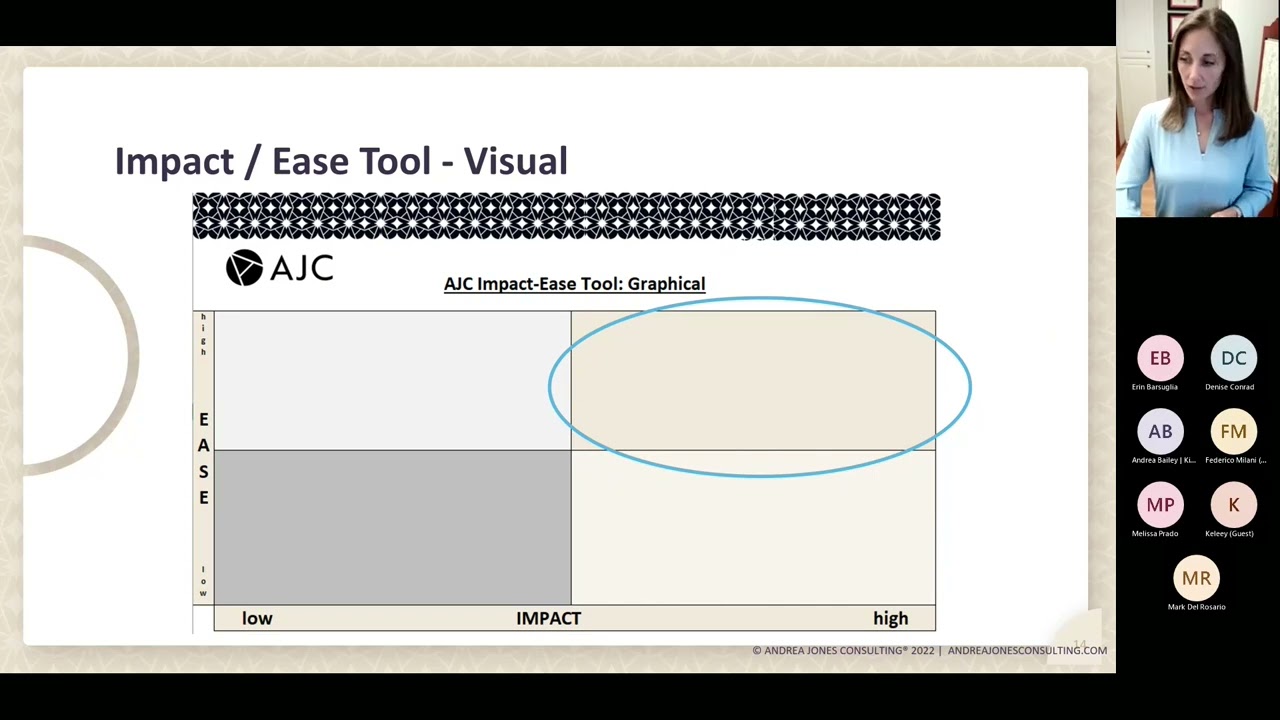
So today we're going to talk about why one would prioritize projects, some common prioritization pitfalls, the methodologies that we use to prioritize projects, and some tips. So, as I said in the teaser for this Lunch and Learn, there are always more things to do than people, money, or time in which to do them. And as you've all heard before, when everything is important, then truly nothing is. When we see prioritization happen, there are commonly a lot of things that can go wrong. One of them is often the leader will just decide, sometimes in a vacuum or in a bubble, and they may be doing this based on their own preference or perspectives, and their criteria may be subjective. Often the loudest voice is the one that decides. I'm sure we've all had the experience of being in a room where somebody has decided that they're going to be vocal louder, literally, than everyone else. And there are the same risks to that as to the leader deciding based on preference, based on subjective criteria. And that is another pitfall. Often the leader will delegate a decision on prioritization to an individual and the team might disagree, and this can have more pitfalls than just based on preference or subjective criteria. When this happens, sometimes people feel resentful that they weren't the ones to make that decision, and that even leads to another host of issues. So delegation for a major decision that is really cross-functional can have a lot of pitfalls. And of course, there are times when delegation is appropriate. That's different. We see this one a lot, consensus decision. In fact, we have a client right now who told us they were trying to prioritize their project list to support a long-term roadmap. They were talking about it for 2 months because they wanted everyone to agree on what was going to be done, and it was just taking a long time. Majority decides, this can happen. Let's just take a vote on it. And if this does happen, you might be missing some critical aspects from the people that aren't in that majority. Finally, and this would, I say, be the most common, delay the decision. Sometimes the delay is you can't get the meeting on the calendar, you can't, whatever it might be, or you're ineffective in the conversation. You're trying to do consensus, whatever it is. The decision has been delayed and you're really risking missing an opportunity. So, AJC has 3 prioritization methods I'm going to share with you today, and we'd like to think that these avoid those pitfalls. So our methods are based on clear criteria, they are objective, they're relatively quick, they align decision makers, and they can be used to seed various things. So a project management office or a portfolio. They can be used to seed an agile operating model, which is something that we also help clients put in place, or they can be used to seed continuous improvement efforts. So without further ado, here are our 3 prioritization methods. I'm going to give more detail on each of these. This is a summary. So our first one, we call it the Impact Ease Tool. I'm sure a lot of you have seen this. It's 2-dimensional, and it's used when you need to quickly make relative decisions for, let's call them quick wins within a larger initiative. I'll go into that in more detail in a moment. The second tool we have is we call it a prioritization matrix tool, something that I developed based on, for those of you who are engineers in this room, the failure mode effect analysis. So it's based on that. It has 3 dimensions, possibly 4. You'll see the difference. And the best place for this tool is when you have a blank slate or maybe a blue sky comparison for new projects or new initiatives that your team is going to undertake. And the 3rd tool that we use is the Weighted Shortest Job First, or WSJF, tool. This one has 4 different dimensions, and it can be used when there are multiple competing priorities, often things that are already in flight, and it's unclear where to start. So we'll talk about each of these in more detail. Okay, here is our Impact Ease tool. Again, it's to quickly make relative decisions for what I call quick wins within a larger initiative. And a place where AJC uses this a lot are for doing process mapping for a cross-functional process. We'll say, here's the current state, here's the future state, and here are all the things that need to happen to make that future state a reality. Here's all the ideas, all the opportunities, all the problems that need to be resolved, all the tasks or activities, and we'll list those out. And then we quickly go through on a high, medium, low scale for how impactful those are for the team and how easy they are to accomplish. So here's a specific example for a new product introduction process. So you can see that we listed out a whole bunch of things. I mean, this list was Maybe 5 times longer than what you see here. And the team just went through high, medium, low using numbers for impact, how impactful doing that thing would be for the team and how easy it would be to do. So it's taking something that's pretty subjective and quantifying it or making it objective. Once you've done that there on those columns, you can sort those things by the impact and ease, and that gives you a really nice list of quick wins. that you can accomplish. So here's a visual of what that might look like. You can see ease on the Y column and impact on the X column, and what we're going for are the things that fit in as high, high, highly impactful and relatively easy for your team to accomplish, and those are often your quick wins. So that's prioritization tool number 1. The second one, as I mentioned before, it's the prioritization matrix tool, and we adapted failure mode effect analysis for this utilization. So again, blank slate comparison, blue sky for new projects or initiatives for a team. Where this works really well is at the tail end of your annual strategic planning, and you're saying, okay, here's our strategic focus for the year and our, you know, our goals that we're trying to accomplish. And now what are we going to do to actually achieve those goals? It's, it's very ambiguous. There's nothing that you have to do. You're trying to brainstorm and come up with things. And then you want to prioritize what makes the most sense for your organization that is the most likely to accomplish your goals. So the nice thing about this one is you get to set those criteria yourself, but when you set them, you will give them scores. You will give each idea a score based on the criteria that you set. And then we do add this optional 4th column here of regulatory. We deal with a lot of biotech. Maybe you're in a financial industry or you're an ISO-compliant company. And you have an aspect of regulatory compliance that you must meet, whether it meets all the criteria as well as some other of the ideas, you might have to do it anyway. So I'll show you that in an example here. So you have a couple, 3 ideas, you've scored them, and when you score them, you multiply the 3 scores by each other so that you come up with a weighted product priority score. And if it's regulatory, you give it a 1. So you can see that these ideas 2 and 3 are both scored at 125 points, but one of them is regulatory, the other one's not. And so when you sort, you sort by the regulatory first and all the ones go to the top, and then you can see within those things what the most important ones are to do. Here's another iteration of that with a client that we did strategic initiatives for during their planning session. So they wanted to increase revenue over the course of that next year. And the 3 categories that they developed or criteria were looking at new client potential, looking at expanding their current customers, and then they also wanted to be a great place to work and they didn't want anything to undercut that. You can see we've given them different weights. So they weighted the most heavily their customer expansion and the second most their new client potential. That way, when you score them, you score them based on their weight. So if it's a 1 here, it becomes a 1.5. If it's a 1 here, it becomes a 2, etc. That gives you the priority number. And they took the regulatory thing and they decided instead of that, they gave it a gut feel. So they have this nice prioritized list and looking at the top prioritized things, we were able to go through and say, okay, these feel like they're going to work. You're not doing that on the whole list. Though you've already objectively scored again something that's very ambiguous. None of these projects have to happen, but some of them may be more likely than others to give you the results that you want. And that is how you turn that very subjective thing into something objective. Prioritization method I'm going to talk about today is the weighted shortest job first, or WSJF. It's easier to say WizJip. And again, this is where there are multiple competing priorities. It's really unclear where to start. And this graphic we took from the internet, it's talking about the cost of delay. We did this with a client that had 7 quality-related projects in flight at the same time, and all of them had to be done at some point. And they use the same resource base. And when I say resources, I mean team members. to complete all of these projects. So when faced with 7 simultaneous things that are actually on top of your day job, people just became paralyzed. They didn't know where to start, or if somebody was doing project work 1 and somebody else was doing 3 and they were dependent on each other within a project, it was hard to stay aligned and be in sequence with each other. So the way that WizDiff works is it looks at the cost of delaying for work. Again, this is stuff that you have to get done. It's not optional. And it looks at it with 3 very specific criteria. So the first one is in terms of business value, and this is a financial value. So what's the value of the work in terms of increasing your revenue, protecting revenue, decreasing costs, or cost avoidance? And you're looking at those again from a financial standpoint. The next category is on risk reduction or opportunity enablement. So are you reducing risk or are you providing new opportunities to the market? And the last one is on time criticality. So how urgent is it to get this particular project or initiative done relative to another one? And these are again relative to each other, but we score them using, in this case, the Fibonacci sequence. So we give them a number and the team does this together. We'll often use stickies. Everybody puts up a sticky for those different categories. And then there's a discussion for each one to settle on a number, right? So let's say that for this one where there turns out to be a 5, maybe there's a few people that put in a 1, couple people put in a 13, and a lot of them settled there in the middle. What we'll do is we'll say, okay, whoever put in the 1, let's give us an impassioned 30 seconds why you think this should be a 1. And whoever put in the highest score, the same thing, an impassioned view of why this should be a 13. And then after that, you kind of settle in the middle, and we'll talk a little bit later, but ultimately the leader finalizes that number, but everybody's voice has been heard. And when you have those, you add them up. So here's the formula to come up with the cost of delaying that particular work. And that orders things as far as this cost. But we also know that something that has the largest cost could also be the most Herculean effort. It has lots of dependencies and lots of activities. And that could therefore delay some of these other things. So what we do is we also consider a 4th dimension, which is the job size or the duration of the work, and we divide this score by that. So let's just imagine that you have the cost of delay here at a 26, but it's pretty easy to do. You divide it by— I know this shows a 3, but let's say you divide it by a 1. Well, then the points are still 26, but if you were to divide it by, you know, 5, now the point score comes down and it becomes less of a prioritized project. And I often cite Dave Ramsey. If anybody's ever watched Dave Ramsey, he talks about if you're really in debt and you have a whole bunch of debt, let's say you list all of your debt out in order of largest to smallest. He doesn't actually recommend chipping away at the biggest thing first. What he recommends is closing out that you know, credit card you got the last time you went to a department store and opened it up for $100. Just cross that one off the list. Get the easiest thing done first so that you feel like you're making strides and you're really accomplishing something. So that's kind of the concept here. You divide it by the, the job size or the duration, and that gives you your prioritized score again. So again, this comes up with very clear criteria. Everybody on the team is involved when making the scoring decisions. But once you have those scores, it becomes very simple to filter or sort them that way and turns what has been subjective into something objective and can be done in just a couple of days versus, you know, the consensus discussion that often takes months. I'm really cruising through this and I'm probably going to end early, but I will encourage you all to start typing notes in the, in the chat as I finalize the tips that we have for you today. Any questions you might have. So, here's our tips. You've seen now our 3 methods. You understand the pitfalls. I assume you're here because you've seen some of those to not using an objective scoring method. So, when you do this, and thank you, I'll see that in a second. I highly recommend having some form of facilitator and a scribe. And we talked about this in a recent Lunch and Learn we did on value stream mapping in a virtual environment, having these 2 roles. The facilitator is leading the discussion, keeping people moving. They are not involved in the project work itself. They really need to maintain objectivity. So whether it's someone in your organization that doesn't have skin in this game, or you hire someone externally to come in and facilitate for you, either way, I highly recommend having a designated person to do it and someone else to document, document all the ideas, document all the projects, document those final scores, filter and sort your spreadsheet for you so that you have something to look at in real time that is organized well. And then make sure that you do bring the right decision makers into the room. If you're doing this at the leadership team level, it's not okay for one of your key people to be out that day. It really does need to be done together since it can be done relatively quickly, as in, you know, a couple of days versus a couple of months. It's good to just set that time and get it done. But bring the right people into the room. It could be done virtually as well. I like to talk about the working genius and the brainstorming portion of this being that wonder invention space. If you've heard of that methodology, when you're brainstorming the ideas or the project list, especially in the impact ease or the prioritization model, Let people have their discussion and get all the ideas out there, because you will be sorting them and you will be evaluating them objectively. So it does no harm to have the list out there. When you need to make any sort of decision where there's disagreement or people aren't agreeing on something, have the leader own the categories in the prioritization matrix. For example, the leader would be the last one to say, no, these are the 3 categories. And really, once you get to the point of scoring, this is not a long debate. It is one 30-second impassioned plea on one end, another on the other, and then, and then you're finding and finalizing that score, which again, the leader will settle any sort of ties. There's not consensus, takes way too long. So those are the tips. And I think the final takeaway, of course, is when everything is important, nothing is. So I hope you'll be able to use some of these methods, and I'm going to get over here to the questions. Okay, with question tool number 2, how do I guide clients on deciding whom to include to determine the criteria? Let's go back to that. Here's an example of this one. For this particular one, it was a leadership team strategic planning offsite, so we had The leaders of all of the departments, including the president of the company, and I would recommend that that be the case. Any leaders that are involved with making these decisions again, this is blue sky blank slate type work. It's less likely to be at the individual contributor level here. That's more of maybe the impact ease type of an assessment. But here I would include everyone that has any kind of skin in the game as far as a cross-functional project that might have to happen. Thanks for that question. Does anybody have any other questions? Feel free to type in the chat. All right, well, if not, you just had a 20-minute high-level quick review on prioritization, and I hope you can see how using these tools will take something that again can be very subjective and unclear and ambiguous, turn it into something objective that the whole team can align to. Thanks so much for your time, and we will be sending the link out to this later on. Have a great day, great weekend.









