Acquire.com - SaaS Acquisitions Stories w/ Colin Keeley, Founder at Verne
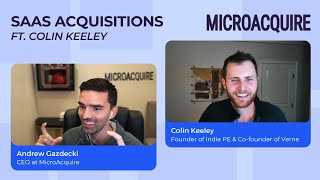
Colin Keeley, founder at Verne, talks SaaS acquisitions with Andrew Gazdecki. They cover how Verne buys software companies, what valuations actually look like, and what founders and buyers need to know about the market right now.
Foreign. Today I'm joined with Colin Keeley, the founder of Vern. Colin, how you doing today?
Excellent, thanks for having me.
So for those that haven't heard of Vern, I've been watching you for quite a bit and big fan of all your work and what you're doing. But what, what is Vern? Give maybe a quick intro on that for people.
Yeah, we just buy and grow niche software companies. Um, so it's me on like the, the business marketing finance side and then Brent Sanders on the tech and product side.
Nice. I love your deep dives into. I highly recommend anyone listening because you also have a course as well too, right? Called ndpe.
Ndp, yeah. So teaching people how to buy small businesses. Um, but yeah, best known for these operating manuals, as you kind of alluded to. Done a number of them. Mark Leonard, Andrew Wilkinson, Robert F. Smith. Yeah, a bunch of them.
Yeah, they're, they're, they're well done. I've read a few of them, so definitely check those out. But how did you get in all this? You know, it's not, you know, not a lot of people just stumble into buying companies and then doing deep dives on the biggest private equity firms in the world.
Sure. So background. I went to business school and I was like, little aware that you could buy a company, but I always thought it was like you could buy a box making company in Idaho. And so I was like, all right, not for me. Check that box. Going to go do venture capital. So background was the founder a bunch of startups, mostly failures, some small successes, software marketing, agency, TV and movie recommendations at a sharing economy startup that raised some money, flamed out through that process. Met a vc, didn't like the business but liked me well enough, so hopped on over there and we were generally leading series A deals, but we were also a startup studio. So once to twice a year we'd spin up new companies. And that's just a really hard process, even if you have money and have done it before. And so everyone does it kind of differently. And through that I just kind of became a student of like the different approaches and stumbled on Andrew Wilkinson, who started doing a bunch of podcasts. And I was like, oh, he just buys product, market fit and grows companies with like best practices. That sounds awesome. And his lifestyle of not running them sounds really appealing to me. So that was kind of how I heard about it. Wrote an operating manual on him, met him, hung out with them, grabbed dinner. And then, yeah, someone mentioned Microquire. And this is like when you guys are Starting and so that's how we found the first one and. And did our first deal there.
Nice. Well, let's talk about that if you're comfortable. What was the company that you acquired off Microwire or Micro Wired Off Microquire?
Microacquired. Blink Sale is the name of it. So it's like a B2B payments invoicing for freelancers. I think it was like the second Ruby on Rails app ever, so quite an old storied company.
Nice. And when did that start up? You.
Sorry, what'd you say?
What did Blanksale do?
Oh, it's invoicing for freelancers and small teams.
Very nice. How was the. The process with that?
If.
If I don't want to get too nosy, but are you comfortable sharing like the size and maybe kind of like maybe the structure of like how you acquired that?
Yeah, it was six figures. I don't know if I could. I don't think I could say exact numbers, but in the six figures is owned by this guy Brandon, who was a serial founder and had done acquisitions before. So like, we couldn't have possibly bet bought from like a better person because he just kind of walked us through the first acquisition. So it was really valuable as far as the structure. It was just me and my partner, Brent Sanders, own money and then we had seller side financing in there.
Nice. I remember when that one went up. Blank sale. I actually remember specifically how much interest that specific startup got. I think there was 60, 70 people reaching out. So I guess my next question is, you know, what is your kind of approach with, you know, founders when you see something, you know, maybe I might require? How do you make yourself stand out and give Sellers Commons that you're a serious buyer?
Yeah, I have a body of work on the Internet, so I say, hey, here's our website. Here's some deals we've done in the past. We probably should throw up more testimonials to be like, but these aren't just crazy guys on a software marketplace. They're like real people that haven't screwed up over a number of years. But yeah, just meeting with them, being pretty open that we're also founders and not like Wall street suits or something has gone pretty well. How we won that deal. I didn't know it was compet. Uh, you told me after the fact that was the case. Um, but Brandon and I had similar companies that had flamed out and I think we kind of bonded over that. And he listened to our podcast, he read my articles and just kind of Went off to the races from there.
Nice. So you got that under your belt and then before we started recording you said you're working on another acquisition. Are you comfortable speaking to that on a high level?
Uh, yes, we've done. We closed another one back in December. There's a database backups we're not talking about like the name of that one. It's a little more private, but we're working on another one that's on Microquire. I don't know when this is going to air, but I imagine it would be closed by the time that's done. I wish I could talk about it more. It's a really fun one. But maybe in the future I'll come back.
We'll have to bring back on because I want to know. But I guess my. I got to get a little info out of that one. I won't ask what it does. That might be a giveaway. But is it bigger than Blink sales? Smaller.
Yeah, bigger. I guess we probably quickly realized like if you're doing something that's 200,000 or like 2 million or 400,000 and 4 million, like it's roughly the same amount of work. So leaning more towards these like single digit ARR companies but yeah, bigger every deal since it's been a little bigger.
Nice. And how do you value these companies? Like do you have a valuation model that you follow or do you work with the founder on that? Like how do you get to like an agreed price when you acquire companies?
Yeah, as you look at multiples, so you guys put out a really nice multiple report that's kind of helpful to like know, educate founders. But I'd say price and terms are two different things. So sometimes founders have a certain like price in their mind and we could you know, move terms up and down to arrive at that price. But yeah, seller discretionary earnings is typically how we value it. And then we say we often pay like 1 to 4 times ARR. But that's obviously quite a range.
Nice. Yeah, I like that part you said about terms because you can have a better offer. I recently, by the time this airs, we, we, we bought a Shopify app as a group, me and some buddies and we resold it on microcquire. We had a offer at a much higher price, but the seller financing and all that stuff over 12 months and I ended up taking the all cash offer just because it's, you know, I don't have to chase someone down for 12 months. So leveraging terms can sometimes be just as powerful as the Purchase price. So I like how you get creative with the terms.
Yeah, I like the problem solving of it. Like I try really hard to understand like what is most important to the founder and obviously I know what's most important to us. And you try to, you know, craft a deal that works for everyone.
Nice. So let's say you're on Microquire. You look it around. What. Describe to me what like the perfect fit for Vern would be. Or maybe just founders like listening, like, and they're looking to sell their business. What would be like a bullseye for Vern?
Bullseye would probably be like a few million arrows growing, profitable, low churn. A perfect company almost. It doesn't exist. Right. Or else we couldn't afford it. So that's what he asked for.
Any, any specific like verticals or are you agnostic to any type of software? Just mostly revenue focused?
Yeah, a niche vertical is great. I mean like, I don't know very much in like the Constellation playbook of like Marina software, you know, left handed dentists, anything like that where it's not super competitive is great. But yeah, there's a saying that all software tastes like chicken. So like kind of fundamentally what we're doing is all pretty similar in our end. It's like the end customer is just different.
That's a good quote. That's vis Equity. Right, I get it.
Right, yeah. Robert F. Smith.
Yeah. Who. So you do deep dives on other private equity playbooks. What, what would be one of your favorite? I'm not going to ask you your favorite, but just you're not picking favorite, you know, of the PE giants. But who do you think has like the most interesting playbook that you know, you like to kind of learn from the most?
I would say most people in our space will look up to Mark Leonard Constellation Software. They've done like 500 plus deals. So they're like the originals. They're probably doing it the best. We just got beat out in a couple of deals by them recently, which is kind of cool. It's like, you know, losing basketball to Michael Jordan or something.
That is cool.
But yeah, that's probably who I look up to the most. Andrew Wilkinson's awesome. He's a little earlier. I think he's like 50 companies now on the other side. Those are like the good guys. And then I saw you guys were bought by esw, so I think Joe Lamont's like an interesting case study of kind of a more different approach where it's a more hardcore, more like automate Everything. Rip out the people and do assembly line style.
Yeah. ESW Capital, we, we had a good outcome with them, but they definitely run a different playbook. Instead of, you know, build and. But yeah, those deep dives that you do, I definitely recommend. Again, when I read that one, I was like, yep, that's pretty accurate in terms of, you know, where you want to take Vern. Like, how far, how far are you trying to go with this? Are you trying to build the next Constellation software, the next tiny capital? Like, what, what. Where. Where would you love to be in five years?
Yeah, I got my beard coming in, so in like, you know, 10 years, I'll be the mark Leonard with the beard down to the waist, looking like Gandalf. But yeah, that. I don't know. We're just going to keep doing it, scaling it up. I think it's pretty clear we need more money to compete with some of these bigger deals. I think founders really like us, but there's a limit to that. We found out the limit is like millions of dollars that Constellation can offer and we cannot. So just keep scaling it up, number of deals and then probably growing up a little bit as far as size of deals.
Nice. And then, you know, you, you talked to a lot of. So now moving over to just, you know, some advice that I'm sure would be super helpful for founders when they, you know, start a conversation with you. What are, what are some, like, a few tips you would give founders looking to sell their business?
I would say whether they plan to sell or not, like, these tips probably apply, but, like, just be super honest. If there's any hint of, like, deception or you're hiding something from me. I just said this before, but you can't do a deal with the bad person. It's just like, we're hands off.
That's a warrant go Buffet quote.
Yeah. And then valuation, having a realistic valuation is super helpful. I just have mostly given up on trying to convince people. Like, you could throw them the micro require reports and be like, well, this is what things are transacting at. But if people think their business is worth 10, 20 times, they are. It's just, you know, maybe they're boomerang back in the future, but probably not.
Yeah, we'll try. Just try doing that at micro require scale. It is the hardest, hardest part of our job, and just like a footnote for listeners is we, we do the same thing. We share the multiples report. We share everything we possibly can. Because when you price yourself too high, you know, people think it's ludicrous and you don't get a deal done. Yeah, it's tough and it's kind of like telling, you know, hey, your child's not as good looking as you think or whatever the phrase is. So yeah, that, that part's tough. It definitely can. Can, you know, really spark interest of buyers quickly or just completely because the gap is so big and you know, with buyers like you looking at many deals, it's just not worth the time.
To try and say whether it's like a negotiation tactic and they're actually open to like a reasonable deal or if they're just unrealistic and you're wasting your time. But my other, like the biggest one is just be organized, like whether you're looking to sell or not. Like, know your KPIs have orderly financials. I think that's just super beneficial for running a company and like knowing what matters. And then when you look to sell, it's way easier as well.
Nice. And then in terms on the buy side, if someone wanted to like, you know, get in acquisitions or listening to this podcast, what's like some advice you'd give them in terms of how to get started, where to learn? I know you have a course.
Yeah, yeah, the course is good. NDP.com we have a podcast where we talk about like our learnings kind of live. Although we don't talk about live deals, only after the fact. I never want to spike a deal because of something I said. Um, that's good. There's a lot of other good podcasts and Twitter out there. But my bigger advice is like, I think people fall into this trap of wanting to measure twice and like cut once and then they just measure forever and they never end up buying anything. And they're always learning about buying something. So like my real advice is not by the course or anything, but just like take concrete steps, go talk to sellers, go talk with brokers, you know, get on micro acquire and like cold email businesses they actually like is like actually making progress towards buying something.
Yeah. I always say, just when people ask me because we have a ton of resources on microguire. Shameless blog. You know, everything from due diligence, illegal to closing, literally. You could probably learn how to buy $100 million company from the resources. But I always just say just go micro buy something 5k. Go through the full motions, the steps, take it seriously. And then you'll have a startup figure out what is your playbook. What do you do? Are you a hold person? Are you a, you know, reduced Staff, you know, cut cost type person. Are you, you know, able to grow whatever. You just like, you can just learn so much which 5k just by kind of going through the motions, you know, experience is, is one hell of a teacher, I guess is kind of the, the, the point I'm trying to make, yeah, start small.
Make small mistakes. The other advice I kind of give people is like, everyone's like, software is the, the greatest business model ever. I want to buy a software company. It's like if you've never managed developers before, you're going to blow a lot of money trying to wrangle them in and build stuff. So like, you know, content sites or something like that I think is a little easier. Like a small content site to start.
Nice. Yeah, I would agree with that too. In terms of content sites, super, super easy to transfer. Another question I'd love to just get your take on because just your curiosity and just your learnings in the acquisition space. So this is a left field question, but what's like maybe two of your favorite acquisitions? Like, you know, it could be Salesforce acquired Slack or like really interesting ones. I could take mine.
Okay, go to yours. Yeah, to start.
Well, aside from my, my company. But no, just kidding. I would say in terms of just like what the fuck was Mark Cuban's company, how he sold that and then was actually shorting all the Internet companies. That's how he became a billionaire. He sold it and then he sold all he knew it was a bubble. And then he, I don't know the full details, but that's how he essentially became a multibillionaire. Then he bought the Mavericks and made some good investments. And then in terms of the best bang for the buck acquisition, I think that it has to go to YouTube or Instagram. So that probably might do.
Yeah. I mean the obvious ones to me are just as soon as something gets bought, it becomes significantly more valuable for the parent company. So like the obvious one would be Facebook and Instagram. But there's made no money before and now it's like it is Facebook effectively. I'm sure there's a bunch more like that. But now we're doing no gotcha questions. And here you are with the gotcha question.
That's not a gadget question, just any, any acquisition, like from any company. Which one do you think is interesting, fascinating, or just a good combo or just makes kind of sense?
You know, I'm just gonna stick with the Facebook Instagram one. I don't have a great answer right now.
I'll Tell you, I'll tell you a funny story about Instagram. So my, I had a small angel investor in business app and the first employee at Instagram was worked at his company. So he did a reference call with Kevin Systrom and Kevin was like, hey, we're, we have this photo sharing app. We're raising like a 250k seed round. Would you like to invest? And I've seen the email, I've seen it. I've seen like Kevin Systrom emailing this guy.
Yeah.
And if he put a 50k it would have been worth, I don't know, a lot. But anyways, in terms of, you know, where this market is kind of going, you know, as we were recording today, you know, the broad markets are kind of trying to figure out are we going into a recession? Are we in a recession? Where do you think just acquisitions in general are going to be headed over the next year?
I looked at this once back when I was a VC and there's a pretty significant delay between the public markets and the private markets. It's like 18 months before things really start to turn just because there's a lot of dry powder out there. But I wouldn't say we've seen multiples change that much. What's exceptional, exciting to us is like more of these companies that are, is like more of these compound. These venture orphans. I've seen a few come up on micro choir. I think we're going to see more of those pop up.
I'm seeing a ton, man. It's. And it's sometimes, you know, we welcome them because we'd love to see them, you know, see a soft landing rather than go out of business entirely. But yeah, it's coming.
Yeah, I think that's, I mean it's coming whether you like it or not, whether it's good or not. I think you're going to see a lot more bootstrap founders which make for like great financial exits for the founders, which is great. So excited to see more of that. These venture orphans are fun, but it's tough to get like a great outcome for everyone involved. You know, often some people are going to be disappointed.
Yeah, I would agree with that. I always say if you want to create wealth, bootstrap, if you want to change market, raise venture because your odds are, I mean, microcquires venture back. I know my odds. I got a 1% lottery ticket, you know, but by bootstrapped it you're, you know that now Jay always uses. You're kind of at the blackjack table. Of chips and you can cash them in, but then as soon as you raise capital, you got to make a lot more chips where you can do anything. So I think a lot of startups over the past year just raised at too high of a valuation. They're never going to be able to grow into it. Founders already kind of know it, and then I think over the next six months can be really interesting to see how they kind of think through that decision process. Like, do you want to stick into this for a decade or just kind of wave the white flash bag? I'm not really sure, but we, yeah.
We'Ve been talking with some of these founders and it's like the fear is that they're just zombie companies. Like the founders are never going to run the preference stack or the valuation and they're just like wasting another three years of their life trying. It's like they're better off just exiting. Hopefully the VCs forgive some and the founders go up there some money and like, take another bat, go do something else. Pick a different market.
Yeah, no, I think we're going to see some, some interesting acquisitions. I think, I think, you know, both in good scenarios where, you know, they go to a soft landing and this, you know, growth at all cost company is restructured to more sustainable, you know, profitable growth. So that is a net for customers, I think. Here's, here's a question. If you could only look at one stat when you're looking at one piece of data, it could be churn. I'm sure your answer to me churn. But if you just look at one metric when you're looking to acquire a company, what would it be?
Everyone's going to say churn. So I'm not going to say that. I would say pricing power. Like, not that we do it, but I think if you could double prices and see very low churn, I think that's like a meaningful measure of like how much value you're actually creating for your customer.
Yeah. Did you happen to catch Barometrics doubling their pricing?
Yes. Yeah, I saw the Xenon guys did that.
Yeah, that was fascinating because for those listening, barometrics is a SaaS analytics tool and they have something called, I believe, open metrics or something like that. So you can see how much money in real time Bare Metrics is making. And when they double pricing, you could literally see just in one day, they just doubled their revenue of their entire. It was fascinating. It's kind of like, it was kind of like, you know, get your popcorn, what's going to happen here.
I wouldn't have think, thought that they could have pulled that off because it was profit. Well. And there's like a million competitors in that space. But clearly, I mean, Amos had big customers, is very sticky and it worked for them.
Yeah, absolutely. Well, Colin, this has been a ton of fun. Definitely rooting for you and hoping you close another deal or two or maybe 10 on Microacquire. But if people want to learn, you know, more about you, Vern, where's the best place to find you?
Yeah, Colin Keely.com or Colin Keely on Twitter. My DMs are open. Happy to answer questions if anyone reaches out.
Right on. Thanks for joining the pod man. I appreciate it.
Yeah, great to see you again. Talk to you later.
All right, See you going.
More from Andrew



The Buyers Who Made the Move: What They Bought, How They Did It, and What Happened Next






