Bootsrapped, Profitable, and Acquired in Four Days
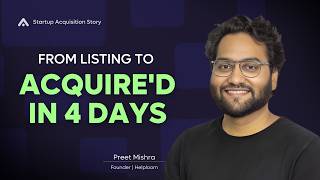
Preet built Helploom, a customer-support SaaS with unlimited pricing, bootstrapped it to profitability, and sold it in four days on Acquire.com. He found early customers through Reddit outreach and chose his buyer based on vision alignment rather than highest offer.
Chapters
All right, I'm here with Preet, the founder of Helploom. Preet, how you doing today?
Doing good. How about you? How are you? Doing good, thanks.
I appreciate you coming on the podcast and I'm excited to hear your, your story. But before we dive into that, you want to give a brief introduction of yourself for people that may not know you?
Um, I am Preet. I used to work as a software engineer for 4 years, worked at 2 startups, then I started building my own products. Nice.
Well, tell me about Helploom. What problem did it solve and how'd you get the idea?
Helploom was a customer support software. It had live chat, help center, and an AI agent that you could use to automate most of your support. I got this idea while researching what to build next. I wanted to build something which was an integral part of any day-to-day business, something that people would use daily and feel like this is an integral part of their whole infrastructure or how they do things. So Helploom, our customer support software, made a lot of sense, and that's why I started it.
Nice. Product looks slick. I was checking it out before the podcast. How is it different from, say, Crisp Chat or Intercom?
So my main differentiators were two. One was affordability. While these other platforms used to charge, and some of them still do, based on the number of team members or agents you have on the platform. So if you have a team of 6, then the cost multiplies by 6. And they also charge you based upon the number of conversations you have, number of customers you have. It's a, it's based on variable pricing. And that was sort of the moat or key factor for HelpLoom that everything was unlimited on the paid plan, unlimited team members, unlimited messages, unlimited customers. Nice. And sorry. Yeah. And this other thing was simplicity, simplicity, because all these platforms were very old and over time they accumulate features and shove things here and there. So when you land on these platforms for the first time, you're very confused about what to do and how to take control of the platform itself. So from that point of view, I, my goal was to make Helploom as simple as possible.
I can tell. Again, the product looks, looks super, super slick. And I think with AI, customer support is one of the most interesting areas where AI can help and automate a lot of stuff. So again, looks great. How did you get the first customers for Helploom?
My first customer was through my network. I used to work where I was working for my last full-time job, they were planning to build something like this internally with their engineering team. And they thought, why not use this existing SaaS than spend time building it on our own? So those were like— they bought it first. Nice.
And then what did you do for marketing past that? Did you do social media marketing? Did you do SEO or blogs?
I tried everything. I did SEO. I wrote a couple of blogs, spent time optimizing my website for SEO. I posted content, uh, posted on Reddit, tried paid ads. What worked out mostly, like all my customers who came through were through Reddit. So I would find these posts where, uh, somebody was asking about a competitor and they were not happy or not satisfied with what they were getting, either the price or experience. And then I would go there and talk about my product and offer them a demo or maybe a quick look. And that's where, that's how they discovered me and came to the platform.
Oh, nice. How would you find these, uh, Reddit articles? I guess put another way, how would you maybe advise another founder that's looking to implement a strategy like this? Just go to Reddit and search competitors?
No. What— so I would think from my customer's point of view, if you are looking for a software like this, what you would do typically is now you go to ChatGPT mostly, but or something like that. But usually what people do is they go on Google and search for Intercom. Alternatives or cheap or free live chat and then Reddit, some Reddit articles come on the first page, right? And then you go click there and figure out what people are suggesting. So I would do the same thing. I would go to those Reddit posts through this way and then I would leave a comment there. And when actual people came in, they would also go through the same process and see my comment and then come to HelpLoom. Nice.
And then what was the business model for HelpLoom? Was it just one subscription with unlimited users and usage?
There were two, uh, two plans. Uh, first one was unlimited everything, help center, live chat, and the upsell was an AI chat where you would get 5,000 message credits with AI. And in addition to that, there was a, there was an option to add white labeling. So you would, that would remove all Powered by Helploom and all of my branding from, uh, the chat widget and every help center and all of that. So these were the 3 things through which I was monetizing.
Nice. Well, it sounds like you had product market fit. You had a bunch of happy customers. What made you ultimately decide to sell HelpLoom?
So when I started all of this, my goal was pretty clear. I wanted to build a product which is able to sort of be run by a very small team, primarily me or with 2 people at most. And with a tool like HelpLoom, I didn't realize this when I was building it. I realized it when I started marketing and talking to people. Uh, with customer support tools, uh, the market is very saturated. Intercom, Crisp, and all these other platforms have been there for many, many years. So when you talk about features or table stakes, they have iOS app, Android app. In, in the customer support tool itself, they have integration with everything that's out there, like Facebook, Instagram, WhatsApp, Telegram. So I would have to build all of these features to sort of Somebody would come in and they would be like, oh, I need this. And then another person would come and be like, I need this. So I couldn't really sort of see myself building these features quickly. And another thing was that since the market is saturated, every platform out there has same kind of features. So Crisp also has all of those features. Intercom has also those features. So there wasn't any differentiator or, uh, mode that I could, uh, foresee through which I could convince people to switch from these platforms because the only differentiator that I had was cost and they would be like, the difference is not that much. And I also realized most people don't care about cost that much. They want, if the tool is working for them and it's not a lot, then they're happy with it. So considering all of these things, I thought about making an exit and the, it was growing, the growth was gradual, but it was growing and I realized for what I want to build as a business with my lifestyle and my constraints, solo bootstrapped, uh, this was probably not, uh, the kind of business that would, uh, make it for me. So I realized it would be better run by a team or people who are excited about these kind of products. So I signed up on Acquire.com and, uh, luckily found somebody who was looking for something like this. Exactly.
I think that makes a ton of sense. Tell me about the process on Acquire. How many buyers were interested? Uh, what did the first couple weeks look like?
Uh, so the process was very quick. I listed, uh, I listed, went to bed, woke up, and I think they— I got one comment about something, but it was overall approved very quickly. I was live in a day, and within, uh, 2 days I had received, I think, uh, 4 or 5 offers while there were like 15 or 20 people who were in conversation. They were asking questions, but I had 4 or 5 legit offers. With LOIs. So I think on the third day or fourth day itself, I got on a call with Sujan, who has acquired, uh, HealthBoom, uh, and we talked. And from there, it was mostly due diligence that took time. Uh, so overall, I think 3-4 days was the timeline from when I listed and it got sort of, uh, in the acquisition phase.
That's incredible. That's super fast. And Sujan's a great buyer as well. I've I've worked with him on a couple deals. What made Sujan stand out in terms of being the winning buyer? Did he have the best offer? Was he easiest to work with? Did he have the best terms or the best vision for the business post-acquisition? Why Sujan?
So we didn't talk about the offer initially, but he gave an impression that he was okay with the asking price. And in addition to that, I liked the vision that he has. So they have a portfolio of SaaS companies and they run these companies. They have a lot of experience running these companies. And I, for one, wanted HelpLoom to exist because I had built relationships with these customers and I didn't want HelpLoom to disappear in a week or two. I wanted it to exist. So, uh, and their intention was the same. They wanted it to grow and reach out to more people. So that was the more, more of an alignment part. Other people were interested too. But they, some of them wanted a part of the code and didn't really care about continuing it in a way. And some people just wanted to understand how all of this works. But I wanted somebody who was actually interested in improving it and keep running it over time.
Makes complete sense. If you were talking to another founder and they were looking to get acquired, what's a couple of tips you think you'd give them?
First and foremost, keep your accounts and everything that you're supposed to transfer, like credentials, platform access, accounts, code, call documentation. Keep all of that ready from day one because eventually— I believe in this— that eventually everybody sells. So you should be ready for that from day one. It makes everything easier. And when you are trying to get acquired, Have a valuation that makes sense. Your asking price should make sense to you and also to the buyer. In addition to that, be very transparent about what you're looking for post-acquisition. Be clear about the terms. If you don't want to be involved, be clear about it. If you want to be involved, be clear about that. Be very transparent about everything. I think that's pretty much it.
That's great advice, especially getting the asking price correct and then just being transparent with what you're looking for out of an acquisition with buyers. Can really help the process along and buyers will really appreciate that. What'd you do to celebrate when the wire hit your bank account and the acquisition closed? Did you go celebrate, go to a dinner?
Yeah, I celebrated it with my friends and family, dinner and food. It involved all of that.
Nice. Well, Priy, what's next for you? What are you building next?
I'm not sure about that bit yet, but I'm definitely looking to build something in the agent tech space, AI agents and everything around that. So I'm still exploring. I haven't logged in on anything yet. Nice.
Well, Preet, thanks so much for coming on the podcast. Congrats again. Maybe I'll see you back on here with another acquisition.
I hope so. Thank you so much for—
If people want to follow you online, where can they find you?
I'm active on Twitter, X, @wikidmishra.
I'll put that in the show notes. All right, Preet, congrats again on the acquisition.
Thank you so much.
More from Andrew



The Buyers Who Made the Move: What They Bought, How They Did It, and What Happened Next






