Buying Agencies in the AI Era: A New Playbook for Buyers
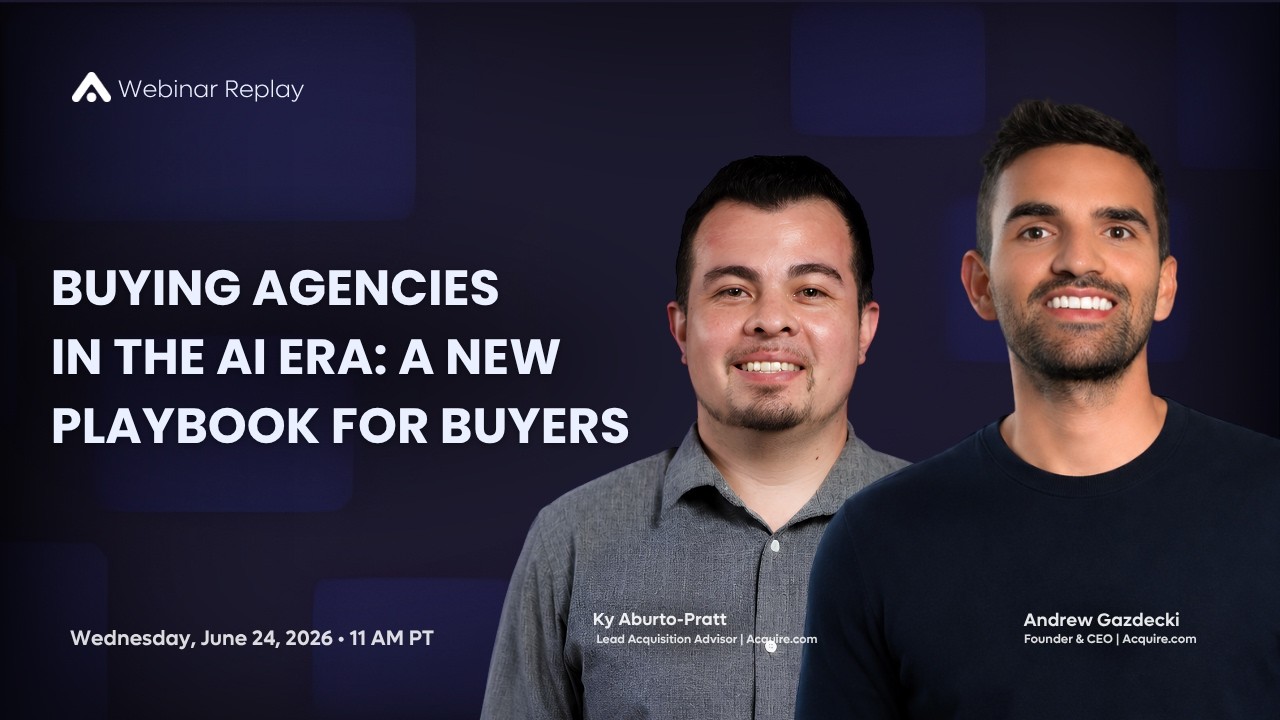
In this 2026 webinar, Acquire CEO Andrew Gazdecki and lead advisor Kai walk the audience through a comprehensive framework for acquiring online agencies in the age of AI. They begin by introducing Acquire.com – a founder‑friendly marketplace that has facilitated over $1 billion in deals and hosts more than 2,200 listings. The hosts then outline why agencies are an attractive asset class: a massive market of 100,000+ agencies, recurring‑revenue‑like client retainers, high customer‑relationship defensibility, and the ability to apply AI to automate low‑margin, labor‑intensive processes, thereby expanding margins and valuation. They contrast traditional, founder‑dependent agencies with “productized” agencies that use standardized service packages, SOPs, and subscription‑style billing, which are more scalable and buyer‑friendly. The webinar presents a buyer’s playbook: how to source deals on Acquire using filters (recurring revenue, vertical niche, data quality), what red flags to watch (customer concentration, founder dependence, lack of contracts or SOPs), and how AI can be a value‑creation lever (reporting, content generation, workflow automation, data analytics). Kai shares case studies of agencies that were acquired quickly because of strong SOPs, niche expertise (e.g., cybersecurity marketing), and clean data rooms. The hosts then detail the end‑to‑end acquisition process – from creating a profile, receiving deal flow, signing NDAs, reviewing mini‑data rooms, submitting LOIs, due‑diligence checklists, escrow, and transition support – and provide a typical 60‑90‑day timeline with tips on financing, exclusivity, and legal review. They discuss deal structures common to agencies (cash‑at‑close, earn‑outs, hold‑backs for key clients, seller financing, rollover equity) and the profile of an ideal buyer (existing agency operator or specialist in the target vertical). Finally, a live Q&A addresses practical questions about distinguishing a true asset from a founder’s job, assessing client retention post‑sale, and what to verify before submitting an LOI. The session ends with a call to action for both buyers and sellers to join Acquire.com.
Chapters
All right. What's up, everybody? Super excited for this webinar. I think it's a great topic. We're talking about buying agencies in the AI era. And with me today, I have a special guest, Kai. Kai, how you doing?
Doing well. It's good to be back. I know it's been a while.
Good to have you back. Kai, for those of you that don't know, is one of our top advisors at Acquire. So he'll be a perfect guest for this. He has a ton of deal stories and is helping founders every single day. So super excited. We'll get started here in a minute, but I guess while we wait, let us know where you're based. I'm in San Mateo. Kai, where are you at?
I'm in San Diego. A little bit.
Kai, have you been watching the World Cup at all?
I have. I have been watching the World Cup. We have a lot of Mexico fans here being so close to the border as well as US fans. So I feel like Some of them have bulk jerseys even.
Oh, nice. I don't think I mentioned it, but my son went to the Jordan-Algeria game on Monday night.
Oh yeah, that's awesome.
Yeah, pretty cool. All right, let's go ahead and get started. I think we got enough people here. As always, if you have any questions, feel free to just put them in the chat and we'll do our best to answer those as we get closer to the finish. Okay, good to go. So again, we're talking about buying agencies in the AI era. This is a new playbook for buyers. We hold a lot of webinars and we create a lot of content around selling startups at Acquire, but we thought this would be a good topic for those interested in potentially buying an agency and what that looks like and, and how you can get started. For those of you that don't know me, my name is Andrew Gazdecki. I am the CEO and founder of Acquire.com. I am a serial founder. In the past, I previously built a couple of different startups, had each of them acquired, and going through that process really is what led me to start Acquire.com, just seeing seeing how difficult it could be to find a buyer or understand what legal documents you need to sign or all the preparation you need to do to go and sell your company. So I thought it'd be really interesting to build a business that really helps empower founders and help them get acquired. And at Acquire, we facilitated over $1 billion in acquisitions, and it's one of the best jobs in the world seeing founders win. And I always like to say we're just getting started. And then Kyle, pass it over to you real quick.
Yeah, absolutely. Hey everyone, my name's Kai. I'm the lead advisor here at Acquire. My role is essentially coach in the corner. I work with sellers helping them achieve their exits. I work with buyers helping them find the right opportunity. And as Andrew said, we, you know, we're here helping people really make life-changing decisions. So when you achieve an exit or you acquire a business, it is a big milestone in your life. It's just really awesome to be a part of that. So if you ever have questions about how to navigate your exit or acquisition. That's what we're here for on the advisory side of Acquire.
And then a little bit about acquire.com. If you aren't familiar with us as a company, uh, who we are, we're the world's most founder-friendly startup acquisition marketplace. What we do specifically every single day, we're super lucky that we get to help founders get acquired, and that could be everything from helping them get prepared to meeting with their buyer to going through due diligence, and the most important part, successfully closing and having that life-changing amount hit their bank account. And the reason we do we do it to change lives. I know that can sound kind of cheesy, but like Kai mentioned, these are life-changing transactions for both founders and buyers. And just being able to be a part of that for both sides, I think, is, is amazing. And that's what we do. We like to think that we do it better than any company in the world. And the agenda today, we're going to go over really the thesis around why agencies are great investment with the AI layer. There's just so much happening with AI today, and We're going to talk about how that can be applied to businesses that maybe haven't adopted AI or how you could be looking at potential acquisitions through the lens of can this business be AI optimized? We'll also be going over the opportunity, just the market size of agencies. Give you a quick spoiler there. It's, it's pretty big. There's hundreds of thousands of agencies serving a vast variety of different businesses with different services and really talking about what makes these businesses durable from the trust they have, the customer relationships, et cetera. Then we'll touch on the buyer's playbook. So productized agency the filters we have on acquire.com, how you can find businesses that meet your thesis. Uh, we have a ton of them currently on acquire.com, and these are great acquisition opportunities. And then also talking about what buyers look for. So you, if you are a buyer and you're looking to potentially acquire agencies, what you should look at, what potential red flags could be. And if you're a seller on the call, this could also be helpful, just understanding through the lens of a buyer what they're going to be looking for so you can better prepare your agency in advance. And then at the end, we'll briefly touch on how we help, how we can help both sellers. If you're looking to potentially sell your business or if you're a buyer and you're looking to acquire a business, we're a marketplace that obviously serves both sides. So we'll, we'll talk about that. And then any Q&A, if you have any questions, feel free to put them in the chat and we'll do our best to get to those at the end. And just a little bit more on Acquire. We've been in business about 5 years, which is basically 20 years in startup land, if not more. Feels like forever. So we've been doing this for, for quite a while now. We've closed over 5,000 deals, over a billion in closed transactions. Today on the platform, we have over half a million registered buyers. These numbers are growing literally every single day, every single week, every single month. On the platform today, we have 2,000, 2,200+ listings worth over a billion in combined revenue. So just a ton of activity on both the sell side and the buy side. And we've also served over 100 different countries. So we're truly a global company, whether you're based in the United States or Australia or Europe or South America, we have served founders and buyers in your region. So we're definitely, again, like I say, just getting started. And then, uh, kick us off.
Absolutely. So, you know, over the 5 years that Acquire has been here, I've been here for 3, and I think I've been able to see some of the changes. And at first, Acquire was a very SaaS-focused business, still is, but over the time I've been here, I've seen the demand for agency. Really elevate. But some of the reasons why agencies weren't the first choice in the past were what you see here on the slide. Agencies, traditional agencies tended to be very labor intensive, a lot of founder dependent relationships, even, you know, relationships with friends and family within the agency clientele that made it really hard for a buyer to buy into. And if I'm speaking generically to all buyers, I think a lot of them look at predictability, and opportunity into why they would buy a business, and that just wasn't there for an agency. Another thing is if you looked at the traditional agency's revenue, it was very lumpy, project-based, one-time deals, things like that that caused just the volatility in their analysis, whereas a SaaS, you see the recurring revenue models, the churn rates, the retention rates that gave them some semblance of confidence moving forward. The other thing here is the low defensibility of a traditional agency, which was, you know, let's just say your marketing agency, a dime a dozen, you know, with respect to all businesses out there, but there are a lot of marketing SEO agencies out there. When we go through this presentation and webinar, we'll talk about some of the things that have now kind of flipped the script on these bullets here to make them more appealing, make them more attractive, and actually have caused the demand for agencies to increase over the years of what we've seen here on Acquire.
100%. And Kai, you've recently, you've closed, we'll talk about this later, but you've helped close some, some really large transactions with agencies. I think we continue to see that acquire, which is super exciting because they're great businesses. And I think with the AI opportunity intertwined, I think it, it becomes really, really interesting. In terms of the market size for agencies, there's, there's a whole lot of agencies, 100,000+ agencies supporting millions of businesses. And that's over half a billion in US digital ad spend, or excuse me, half a trillion, uh, which is an astronomical amount. I think what's interesting about agencies is the opportunity can appear endless in terms of the industries that you serve or the type of services that you offer. There's just so much demand and so much opportunity where you can have, say, 100,000+ agencies in the US. But when you look at SaaS businesses as maybe the counterexample, there's typically only a handful of companies that are really servicing a particular market or problem with their solution. And with agencies, because of the more direct relationship that's required to service a client and deliver the solution, it allows for a much larger number of businesses in the specific category. So there's a lot of opportunity on all fronts in this area, which I think make it super, super interesting. Guy, you want to add anything to this?
Yeah, it's an interesting thing and the whole topic of this webinar is kind of the rampant rise of AI and if there's so many agencies out there, there's got to be a purpose for them. So the integration of AI and how they're really finding their niche in these industries below there is what's gonna make them stand out. So it, it's just an interesting time because there are people on both sides of the fence of what's going to be more valuable in the future. So as we're talking about, AI is, is on the rise, a daily conversation in every circle, especially if you're in this founder entrepreneurial world. But what AI has really changed is that the, the smarter, stronger, bigger agencies are finding a way to adapt., and so they're utilizing AI to help with their production. What normally would be a low margin business because of some of the, uh, manual or intensive execution is now getting optimized through AI. Reporting and data is getting more streamlined and used more quicker, so the turnaround times are faster. All these things here for their automations and their workflows and analysis are Making the business more predictable. And again, back to what a buyer's looking for is a business that is predictable. What's not changed is some of the things that AI can't replace. And AI, in my opinion, is to be viewed as a tool, not an enemy or a nemesis or anything like that. But the relationships developed in agencies still takes time to build. There are still plenty of customers that want the expertise and aren't trusting directly of just a pure AI-run company. So it's really a nice harmony that's being found in the agencies that are making this work, that are optimizing through AI, but still leaning heavily on these client relationships, this industry knowledge, such as financial, health, government, those types of industries that are making agencies very attractive. So customer value is still one of the things that is very much founder-controlled, business operations-controlled, and not really being threatened by AI, in my opinion.
100%. I think I'll touch on it in this slide here, but the interesting part that stood out to me, Kai, is, you know, traditionally agencies could be viewed as, you know, low margin business. And really with AI, it just gives you so much opportunity to come into the business, look at the current operations and see what AI could automate or improve the efficiency. And I think that's what makes everything really, really interesting because you're right where the relationships with customers, that's not going to be automated anytime soon. This is, you know, a lot of times face-to-face meetings where you're sitting down with the client, you're understanding their problems, you're delivering the solution. But the nitty-gritty things that would normally take a lot of time and would typically require, you know, a big team of employees such as reporting, content research, creating new workflows, delivering, you know, reports on how things are going. All that, all of that right there can be completely automated with AI, and that will dramatically increase margins, which can dramatically increase the value of the business and increase profitability. Um, so that's where I, I think things get really interesting. But to, to really just touch on this slide here, you can look on the left, customer ownership. You know, you have things like retainer clients, long tenure relationships, recurring contracts. Um, all of this is built over years where it can almost appear like software-based recurring revenue where things are on yearly contracts, uh, fixed monthly pricing. Uh, you know, revenue isn't lumpy, it's, it's very predictable. And then when you are in a specific vertical with niche expertise, uh, you don't have necessarily as much competition. You're going to be very specific with the service that you provide and who you're serving it to. And we see a lot of agencies that really fit this bill. And again, the revenue profile is really strong. Expertise feels like a good moat. And these businesses, when you go through the operations and look for inefficiencies and make them more efficient, can provide a really great opportunity for potential buyers. Anything you want to add to this, Sai Kai?
Yeah, I think with AI, we all know how, even if you just have a toe in the water, how easy it is to allow AI to work for you. But the expertise element that you touch upon is the differentiating factor, especially in these high-risk industries. So anything like healthcare, government, financials, it's not just being able to deliver a report quickly with AI. It's a report that you can trust, a report that is validated by an expert or that will pass a compliance check if audited. Those types of things is where this integration really comes into play. So it's a harmony between, and that's where you see at the top, it's the customer ownership, the expertise, plus the AI operations that really makes the equation work, in my opinion. Yeah. So, you know, really, again, agencies can be a dime a dozen. We think of web dev, we think of marketing agencies. And while in general, that could be a very generic topic, we think about what can make that more specific and difficult to replicate. Specifically, I think of an opportunity that's on Acquire right now. It is a marketing agency, but it is specific to the cybersecurity industry. And they have very notable clients in the cybersecurity space with long-term relationships with them. So that, in my opinion, is what would have been a run-of-the-mill marketing agency and now a very niche-specific expertise agency. And that's where the depth matters over here. It's the, the knowledge of the industry, the ability to deliver perhaps blogs, newsletters, marketing information. That actually works and actually appeals factual and is sound and up to date with the clients they are marketing to. Whereas the, you know, other verticals that that really matters in is legal services, healthcare, financial advisory. All these things are ever-changing, right? We all know how the healthcare world changes. Financials are always changing in terms of what's best to do. It's something that AI itself cannot really do on its own. You do need someone there to continue to train the models, to continue to audit, continue to fine-tune, and then just the customer element of it all, having a person there you can trust. So there are a bunch of agencies, as we've seen in the TAM slide, but not all agencies are created equal. Hopefully in this, we're, we're allowing you to see some of the differentiators that make an agency worth the exploration and potentially the acquisition.
100%. I think what is eye-opening too to think about is when you go that specific, it's a marketing agency for, say, cybersecurity firms. You may be thinking that's a small TAM, but another way to think of it is how much does, you know, a cybersecurity firm spend each year on marketing? And I have to assume it's in the billions and that's pretty niche down, which is, is pretty defensible. So again, opportunities is just huge.
And then for the deeper dives, and this won't apply to every buyer, but there are buyers that see the bigger picture and they're not just looking at what the agency currently does. They're also looking at what else is available to them, whether this is a growth opportunity or a bolt-on opportunity. They're looking at how well do these agencies keep their data and what type of data do they have. So the more an agency is utilizing proper data handling, proper data analytics through AI in this case, The better the opportunity is because you could be getting a wealth of knowledge that you could then be using into a cross-selling opportunity, into a strategic synergy opportunity, but it comes down to how the business is run. So, uh, I, I know I've seen it a lot working with a lot of agencies. I'm sure you've seen it too, that some agencies are razor tight in how they keep their data, what data they store and what they're analyzing. And others, on the other hand, maybe don't know much about their customers and, and there's a clear line of what's better and what's worse. In that scenario. How valuable do you think this kind of extended data analysis is, Andrew?
I think it's pretty valuable, especially if it's unique data. Like, as an example, the question I had is, you know, how much do cybersecurity firms spend on marketing? If you're able to, you know, have a generalized view of that data or how they market, I think it can be incredibly valuable. And then number, number 2 on that, The more data that you capture, the more efficient you're going to make your other clients. But like you said, I think it really comes down to, you know, how is the data stored, how organized is the business, and that's going to increase the quality of pretty much everything. But absolutely, data valuable. And I think even if you go to acquire an agency, you're able to implement a strategy to capture more interesting data that could later be potentially an interesting item to add if you ever go to sell the business again, where you have a large amount of data of this particular customer type. So yeah, absolutely valuable.
Yeah.
And then again, distribution really is— it's becoming more valuable than it's been in the past. And I think a big part of this is as we see AI make it easier to build products or software or you know, quote unquote businesses, you know, you're flooding the market with different products and different things, and trust becomes harder to acquire from a customer standpoint because you're just being flooded with so many more, maybe offers or products or solutions. And if you're working with a business that already has the established brand and already has the established trust and has the case studies and has the customer referrals,, and things that really point to this is a legit business, they're good at what they do, uh, that is absolutely massive. That is potentially years of work, uh, cannot be replicated overnight with AI. And that's really what becomes defensible in businesses like this. Um, so really just going over the slide, customer acquisition, it's still hard. It's always going to be hard. I think the most eye-opening part of everything I personally have seen at Acquire from my lens is really seeing that building the product was always the easy part. It was always the easy part. The hard part is getting customers. It's building the brand. It's getting people to care. It's getting someone to take out their credit card and pay for a product or service. Um, and really understanding, you know, trust compounds over time. The longer business has been around, the more customers they're going to have that trust them, that share with their friends, and helps grow the business to more customers. And it just takes so much time and effort to correctly build that trust over time. Um, and I think another interesting part of agencies is switching costs. They are real, where if you're working with a specific business and things are going well, they're delivering on whatever problem they're looking to have solved, and, uh, they're happy with the service. It's pretty rare for a client to cancel or switch to a different vendor. Unless things just aren't going well. And again, this is what makes the revenue predictable and easier to underwrite from a buyer perspective. But absolutely, as we continue down this world with AI, I, I believe distribution will continue to become even more valuable. Businesses that have a leg up and have been around will become even more valuable in my mind because people are going to be looking for the solutions that they can trust and they see, you know, the effect from other customers using the business and things are going well and they're going to naturally gravitate towards these existing businesses. Anything you want to add to that, Guy?
Yeah, it's a great point. I was actually speaking to a buyer this week from family office and they were valuing distribution and trust. They were more so not focused on growth at all costs. They were looking at businesses that had the longstanding records. That had the trust, so something that could withstand kind of the times right now where things are still evolving. And when I think about agencies, there are certain agencies that do stand out and they're the ones that have a few years in business that have a track record of brand because that brand can't be easily replicated so quickly as perhaps development can these days with all the AI coding with proper layers of, you know, security and ops. But still things are a lot quicker to execute on the coding side these days and then producing a software than it is to develop years of trust with a very reputable company and a business. And that's exactly what you see here kind of in this, in this illustration is cost to build is going down, uh, cost to build trust is still there. Really the only thing that could really wipe out trust is perhaps, uh, you know, improper management within your company and, you know, just poor customer handling. But if trust has been built, it usually took a road to get there. And once you get there, it's held as long as you continue your level of service. Whereas AI now we know is allowing this evolution of this industry to allow things to be built quite quick. It all comes down to everyone's buyer thesis too, but if you are looking at an agency, these are some of the things that can't just be spun up overnight, right? You find an agency with a good brand and a good name, and then you're also acquiring that, which is gonna aid to your ability for distribution because they're still gonna know the name of the company, the level of service, and now it's just you under the hood in terms of operations. So it's that distribution that you spoke about that is something that just, just can't be, you know, snap your fingers and it's there.
100%. I would argue it's getting harder, but in terms of distribution, I mean, I think building trust, building distribution is absolutely getting harder. But I think if we revisit this graph in this slide, maybe in a couple of years we might see a trend upwards. And that really, you know, kind of comes into the argument of, you know, when you're buying these businesses, you're buying a big part of the trust and the customer relationships they've already established. And naturally, over time, trust does get harder to, uh, acquire or build, then the value of the business naturally increases as well, I think. Okay, now talking about what AI actually improves. So I'm sure everybody on this call could immediately say 10 different things they use AI for. I know I can. It's been absolutely incredible to see just even how it's transformed Acquire and the things that we're able to do now and the time we're able to see— the time we're able to save, I should say. Uh, but when it comes to an agency, I think there's just so many perfect, uh, examples of ways that AI can improve the business. Because a lot of the improvements that we see at Acquire are really operational, um, or marketing behind the scenes. So things like reporting, analytics, content production, campaign analysis, workflow automation, research and intelligence. I know I handle a lot of the marketing at Acquire and A lot of the marketing that we do now, AI is absolutely at the forefront. And if we're doing, say, a paid ad campaign, we'll just screenshot that campaign, we'll put it in ChatGPT, we'll run it through Claude, we'll ask it to create A/B campaign tests or copy that we should be using. Basically, things that would require a senior digital marketing expert to execute now takes us 5 seconds and a couple prompts., and that's just one example. But when you go through things like, you know, mundane reporting or creating reports for clients or building out an internal dashboard, that would typically take, you know, someone with engineering abilities, creating reports that could just be very time intensive. There's so many examples like that. And when you're able to use AI to improve all these processes or automate these processes, You're directly impacting the profitability of the business and improving the margins, which then increases the overall value of the business. Kai, anything you want to add to this slide?
Not on this slide specifically, but all good points. Absolutely. So the, the agencies that sell, and we'll actually have a couple examples here in the call later to allude to, are ones that are doing things right, for lack of better words. And so in the background, what you may not see, but what you'd want to uncover as a buyer is how the agency runs. And yes, you're getting revenue, you're getting customers, you're getting a business and a brand, but you're also getting how the agency is run through SOPs. So these productized agencies have really provided a system to what they do to combat what used to be the problem, which is It's body revenue, one-time projects, things like that. So in all of these kind of fields here, you're starting to see more and more SaaS adjacent business models. So recurring revenue through email and CRM providers, social media marketing companies that are more of a subscription-based service. But on top of that comes in the human element. And we've all seen the AI slop. You know, almost everyone on LinkedIn is probably using AI to, do their posts and it starts presenting a level of desensitization to people. But the agencies that do it right are using AI, but then have a layer of humanness to them to make sure that the content that they're delivering in SEO content or PPC is actually relevant. So the good agencies are winning. The other agencies are still trying to figure it out, but that's what it kind of comes down to is you want to look for these product type productized agencies that have these recurring revenue models, that have these systematic backgrounds, that is really something that could be transferred over to someone to execute on day one.
100%. Maybe just a little tangent on the productized agency thought. If you're an agency owner and you're running an agency through fixed, or excuse me, you know, variable product. Costs where every project has a different pricing or amount that you're being paid, try and switch to a productized agency. Because when these go live on Acquire, we see a ton of buyer interest, a ton of different offers. Uh, the, the valuation of these businesses I think is, is materially better. And Kai knows firsthand. I know Kai's helped, uh, countless productized agencies get acquired.
Yeah, yeah. And I have a question for you, Andrew. So when it comes to productization, obviously it's like a set model, certain package that you're offering compared to the alternative, which would be kind of individualized custom work. And while customization is certainly valuable, I feel like from a business model standpoint, it can provide a lack of structure. Do you, do you agree with that or what's your feeling on like custom work and opening up that kind of avenue in a business?
That's a good question. You know, I, I think they both have their place, but it depends on what you're trying to optimize for. Like, I have a friend who runs a design company, and he recently switched over to, uh, a monthly design service business model, uh, and he says it just improved so many different things about business because a lot of people will come with these big massive projects and it'll be done under time crunch, and now they get to, you know, 30-day window where every customer is resubscribing, but there's not necessarily that time crunch. Clients will, you know, fill them in on what they need every single month rather than, all right, we need everything right here. So long story short, what I'm trying to say is it's just made his business easier to run. It's made his business more valuable. It's given his clients a better experience. So I guess, you know, in a way there's almost no downside to it.
Yeah.
So I think it just depends. But if it was me and I was running an agency, I would absolutely do everything I can to have a productized version of that.
Absolutely.
Okay, so now, uh, kind of a small, um, tangent with this slide. You know, I, I, you know, we're up here saying, hey, agencies are amazing to buy, etc., etc., um, but I want to preface that with, you know, they're, they're still hard businesses to run. Um, I see this all the time on Twitter and LinkedIn where people are talking about, you know, you should buy a restaurant or a franchise or a laundromat passive income, you don't necessarily have to do anything, you just buy the business and life is amazing.
That's never the case.
But another benefit of agencies and specifically online businesses is you don't have this physical infrastructure that you have to maintain that's going to add cost to the business and additional headaches. With everything being digital today, you can have just much higher margin businesses that don't require you to be in a physical store every day or require you to fix different equipment. So I'd go and say the risk of these businesses is going to be lower. It's still high, but I think not nearly as high as, say, acquiring a restaurant or any other, you know, Main Street type businesses. All businesses are extremely hard to operate. But I guess from my point of bias, I do think online businesses have a better advantage in a lot of cases. Guy, anything you want to add to this slide?
I agree with what you said. I mean, it's what we do here. We specialize in online businesses. So there's going to be a road to— you got to put in work in any business, but that's what we specialize in, online businesses, and there's a reason why.
100%.
So just a couple of things to look out for, you know, in terms of as a buyer, what you want to look for. The agencies with recurring revenue, those matter the most. All online businesses and why we believe in them so much is there's no physical footprint. So there's no brick and mortar element to it that allows for a lot of freedom to do what you want. In terms of the ability to go, you know, take it, go to market, it's a lot easier when you don't have that kind of physical footprint. And then if done properly, the whole concept we've been talking about is AI to optimize. But these are some of the things that some buyers are looking at. I know a buyer specifically that is looking at businesses and actually not even looking at the existing margin. They're looking at what's causing the existing margin. And then they are looking for opportunities that they can implement AI to increase that margin tremendously. So it's rare. Most, most people are looking at that margin initially, but this buyer specifically is looking at that top right box is How can I use AI to dramatically improve the expenses to make this just even more profitable in a quicker amount of time? So I think we can— yeah, go ahead.
I was just gonna say, I think that's the most interesting part of agencies today is just the margin expansion opportunity.
Yeah, absolutely. Absolutely. Now we have some great agencies on the market. So on the next slide, we're actually going to talk about one that's, that is live right now on the market. And it's fitting a lot of the checkboxes we've talked about today. It is an agency for sure. It's been around for several years, US-based, but it is in healthcare development and has a lot of notable clients, great track record with them. And what's great about this agency is I've gotten to know the founder, gotten to learn a lot about the businesses. They are implementing AI in many different ways through their use of electronic health records. So, you know, integrating with things like Epic, Epic Charts. But having AI compliantly infused with these processes. And then through the development side too, they're utilizing AI with their devs as a layer to then streamline everything, increase profits, just make things better for their clients. So this is an agency that I feel has that moat that's doing things right. It's priced well on the market as well. So if you take a look at it, it's kind of right in that EBITDA range that people are looking for. So it's just a matter of finding the right fit and finding someone to carry on the legacy here. So if you want to take a look at it, we will provide a link to this agency. And there's a couple others on the market right now that are really checking a lot of the boxes we've talked about today. Love it. This slide here is a case study. So two agencies that I happen to work with myself, as Andrew Gazdecki mentioned, I work with a lot of the agencies here. That were acquired within probably a 6-month window if I look back at it, but these agencies were actually acquired by the same buyer. And this buyer, their plan, as you can kind of see here, there was a synergy between what the agencies were providing. But if I take a look back at the similarities between the two agencies, one was a digital marketing agency, the other one was a remote staffing agency. Both of these founders, the selling founders, had everything down to a T. They had SOPs, they had structure, they had basically a science to how they did things. And that made it a no-brainer for this buyer to say, hey, when I buy this, it's something that I can follow, it's something that I can iterate upon. And they just happen to be kind of in a shared customer base where the synergy made sense to increase the distribution, but also continue serving the the clients that they did. So, um, a rare occasion, I would say, but there are buyers out there that kind of have this angle. They're not just looking for one business. They're looking for businesses that synergize and bolt on together. So that's an angle that you can approach buying with. Uh, Andrew, you got to speak to both of these founders through our podcast. So without naming names, you can find them in our podcast if you want to learn a little bit more about their journeys.
I got a question for you. What would you say like the best profile is for a potential buyer of an agency? Are there any like skills that you see commonly across all the acquisitions you facilitated?
Yeah, I, you know, a lot of the buyers that have bought agencies are existing agency operators, so they have the experience to know generally how an agency is, is working. They are good in customer relationships. The ones that are first-time buyers that want an agency, are probably just targeting a smaller bill, if you will. So not the largest agency you can find, but I think in some of these agency acquisitions, which range anywhere from $500,000 to $5 million, the buyer profile is an existing agency operator that is bolting on or expanding or even getting back into the agency world.
Makes a ton of sense.
Yeah. Specifically too, before we get into this, you know, you mentioned profile. There was another agency, which was a medical marketing agency, and the buyer was a former physician. So they had the experience within their career of being in that field. So that helped because if you think about it, you're now becoming one of the faces of the business. So you have to know what you're providing. You have to know what you're talking about. And if I know nothing about medical, it doesn't make too much sense if I'm the head of a medical agency, especially when it comes to credibility. And how, you know, clients are assessing you. So, uh, this is a checklist, you know, for anyone on the buy side or even on the sell side. I think it's always great to keep one foot in the buyer's shoes, but when you create a listing or if you're evaluating listing, you want to evaluate these things. Uh, retention. So how, how predictable, how consistent are these things? Is there recurring revenue? Customer concentration is one of the things we haven't talked about yet, but it's a huge thing with agencies. And it is making sure that there's enough customers to not provide just a blatant risk. So if an agency only has 10 customers, let's say they're all paying the same thing and one leaves, that's 10% of the revenue. That's a significant amount. But if agencies start having 50 to 100 customers, um, that revenue gets more dispersed. So the more customers, the better. As you grow, you're, you're going to hit customer concentration. It's not a bad thing. You just got to keep acquisition happening to make sure that concentration gets diluted. But all these things matter. I would use this as, you know, a go-to checklist. These are the things that I would talk to any seller about of making sure that we can present this data accurately and easily for a buyer so they can say, hey, I want to spend time with you to evaluate your agency.
100%. And we have so many agencies on Acquire that, I shouldn't say so many, but we have a good amount that really meet the bill with a lot of these. Items here, and we have— we make it super easy to evaluate these things. So, so absolutely check it out. Yeah, um, so I'll go over a little bit more about how Acquire works. Uh, if you aren't on acquire.com today, it's super easy to get started. Uh, first step is you create a profile, and what makes this easy to go through deals that you're looking for is you can set your criteria that can be based on the budget or the category or the revenue range or the profitability range or the location.. And then from there, you'll get instant notifications based on what you're searching for. You can browse on the marketplace. We have live metrics where sellers will connect their billing system to show an anonymous view of the financial health of the business. So we have verified revenue, traffic data, basically all the things you're going to need to initially get interested to see if you want to learn more about a business. And from there, what you do is you would Click to learn more about a business. You would sign a non-disclosure agreement with the seller, and then from there you can speak with the seller directly where you can schedule a call. You can ask questions you may have before scheduling a call, whatever you prefer. And within that, you're going to have a mini data room as well, which is going to typically include a detailed P&L or a buyer overview or a, a SIM, which is a confidential information memorandum, basically more information to help you evaluate the deal and see if you want to pursue this acquisition. And if everything looks good, you go ahead and submit an LOI. We have letter of intent builders at acquire.com where we make it as easy as just typing in the amount, going through the deal terms that you're looking to close with. And this makes it just super easy for both sides. Again, that's really what we try to do at Acquire, is just make the acquisition process as easy as possible for both buyers and sellers. And then from there, once you have an LOI in place, you go through due diligence. This is where you typically gain access to a much larger data room. You go through a much more detailed view of the business. We have due diligence checklists, pretty much everything you're going to need. And then from there, you're going to utilize escrow, head towards closing, transfer assets, go through transition support by the seller., and we assist with this entire process with businesses that are typically over a million in enterprise value. Um, but again, our job is to make things as easy as possible for both, uh, buyers and sellers. So if you have questions along the way, we have a full support team available to assist. Uh, so if you haven't checked out acquire.com, absolutely get on the platform today. Uh, we put new deals on the marketplace live every single day. Um, and again, we're here to help. So if we can assist in literally anything regarding the process of both buying or selling, that's what we do.
Okay.
You want to add anything on this or you think I covered it pretty good?
I mean, you covered it pretty well. I think we dive into it on the next slide, but absolutely, we're here to help. And regardless of the business size, we're always here for spot questions too. So just don't be afraid to reach out. I'm always, always happy to answer some questions.
And then this is kind of what I just went over, but just from a timeline perspective. So if you're sitting back and you're wondering, you know, how long does an acquisition typically take? I think a good timeframe to keep in your mind is between 60 to 90 days, probably closer to 90 days if you're a first-time buyer, this would be your first acquisition. But again, the first couple of weeks are going to be really around initial conversations, finding potential acquisitions that meet your list. And then week 2 and 3 is going to be really meeting with sellers to learn more about the business, asking specific questions that you may have. Learning more about the seller, why are they looking to sell, really to see if there's a fit between both parties. Week 3 and 4 is going to be initial LOI, acceptance of the LOI. Week 4 to 8, which can be longer, it can be shorter depending on the complexity of the business, is going to be due diligence. Week 8 to 10 is going to be purchase agreement, escrow, asset transfer. Week 10, ideally you've closed and you've acquired a business and now you're moving into transition support with the seller. Some tips here, you know, you definitely want to have financing arranged before submitting a letter of intent with sellers. That's a very, very quick way to lose a potential acquisition. I would say, you know, in terms of terms on the LOI, you want to request 30-day exclusivity just to ensure that both of you are truly on the same page towards closing this opportunity. And absolutely don't skip legal. That's another big recommendation. I know AI has really made leaps and jumps in the legal field, but you still really want to have someone looking over the most important legal document you may ever be signing in terms of a business investment. Kai, anything you want to add on this one?
Just the first point, the lightning bolt, is obviously that's a variable timeline. The things that are in your control as a seller is how clean your data room is. Those are things we help with. And on the buy side, time matters. Time kills deals. If you're the quickest to the deal, then you can often win the deal that way. Everyone's always on their own time until it's time for momentum to kick in. So if you're a buyer that knows what they want, come into the listing, ask the questions, tell them what you're looking for, kind of present your thesis. And often, you know, you're going to beat people because You're more organized than the other buyers out there.
100%. Time truly does kill deals. We've both seen it many times.
Yeah. And speaking of deals and agencies, certain deal structures are involved with agencies more so than other businesses. We did get a question in the chat that was around because the relationships and knowledge are so important, are you seeing buyers requiring clawback clauses, de-risking the acquisition of locked lost clients in the purchase agreement. So, uh, that's what you're going to see here. So the answer in short is yes to that question, and here's how. So obviously cash at close is going to matter in terms of purchasing power. You do want a significant cash at close for the deal to be attractive to the seller. But usually in an agency, especially if there's a concentration risk or a big client representing 10 to 15% or more of the revenue, there's probably some sort of clause or holdback around that client renewing. And this is normal. It depends on how much of the purchase is allocated to this, but having that type of a clause is normal. But being able to transfer over the client is expected. So when you get your deal structure in there, it's just a matter of understanding, is that earnout going to be achieved from the seller's perspective? Is that client going to be disrupted? If they find out that the company was sold, and there are many different ways to present that information to your clientele, but in theory, a good agency is not tied to the founder. That's why founder dependence is always evaluated. A good agency is tied to the quality of work, which would still carry over through the SOPs and the way the business has been run being transferred to the buyer. So keep those things in mind. Um, other deal structures that do come about. Seller financing, which is essentially a deferred payment. So a portion of that purchase price paid out to you over time by the buyer, usually through the proceeds of the business. So this comes down to how well the business is going to do in the following months. And then in rare occasion, you know, minor, minor stake, 5-10% rollover equity to be on board with the agency under the new management. So all these things come into play. All these things are normal to see. I think what it comes down to is what percentage do they represent? What are the protections on both sides? And back to what Andrew said, this is why having proper legal is important. You can always start with the Acquire document builders, which were written by an M&A attorney, semi-customizable to kind of minimize the legal fees and minimize the legal drag. But you do want eyes on this from a professional. To make sure you're properly protected on both sides.
Great points, guy. I got a cool question. What percentage of deals that you see close, specifically agency deals, are 100% cash at closing?
Yeah, I think it comes down to the size. So once you start getting into $750,000 upwards of a million, the likelihood of 100% cash on close becomes far less and less. But if The agency is, you know, down around $500,000 or less, $200,000 smaller agencies. The likelihood of full cash on close is certainly possible. Still, from a seller's perspective, you probably want to shoot for something over 50%. Obviously, the more the better. The risk profile will naturally pull that or push that in terms of what's normal. So don't just go in expecting 100% cash. Expect creative deal structures. Expect to, you know, reach out to us and talk about it in terms of what actually makes sense and what's normal. And then always kind of view a deal structure as this: in the worst case scenario, what do I earn? In the best case scenario, what do I earn? And then you can kind of get a better picture of if it's worth accepting or if it's even attractive if you're trying to evaluate it on the buy side. All right.
Well, if you're thinking about buying, definitely check out acquire.com. You can again sign up today, create a free account. And begin receiving immediate deal flow to either Slack or email right on the platform. Every day we're putting new deals live, pretty much every size, every type of business from SaaS agencies to e-commerce, mobile apps, AI businesses. If you're looking to acquire a business, there's truly never been a better time with AI. There's just so much opportunity to acquire businesses, improve the operations with AI, increase the margins, and increase the value. And then if you're thinking about selling, uh, reach out to us, get a free valuation. We'd be happy to go over things to really think about when either you're preparing to get acquired or if you're looking to go to market immediately. Um, and really just tell you what we're seeing. Like Kai on this call, he speaks with founders literally every single day. He's helping founders get acquired. Um, there really is no one that can tell you more about what the process is like, what you need to be doing today, uh, really what to expect. So. If you're looking to buy or sell, feel free to reach out to us and we'd be happy to help. And then at this point, we'll take a few questions, then we'll wrap it up.
Okay.
How do you think that went?
I thought that was good. I'm excited for the Q&A. It's always my favorite part. I was glad we saw a question mid, mid-presentation. That's always nice too and puts us on the spot. So I enjoyed it.
All right, man, let's get to it. I'll give this first one to you. Okay, why would a buyer choose an agency over a SaaS business in the AI era? I like this question.
I do too. I think it kind of comes down to the relationships and the expertise. You're acquiring a brand, you're acquiring a stamp in the competitive space. That's something that certainly within a SaaS you can acquire, but you're also acquiring kind of the product risk over in the SaaS world. And I think the threat of AI is more over there. Not the SaaSpocalypse or anything like that, but there's different threats. So maybe you're not a product person, maybe you're not technical, and the agency world appeals to you more, especially with these increasing margins because of AI optimization. They're just becoming more and more attractive that way. And like we said in the presentation, AI is not building years of relationships within the healthcare or the financial or the government industry, things like that.
Agreed. Okay, I'll take this next question. How can I tell if an agency is a real asset or just a job the founder wants to exit? Yeah, one good way is to just ask. How much time does the founder spend in the business? What does that day typically look like? How are they acquiring customers? That tidbit at the end can help you because if it's their personal brand or they're typically on every single sales call, that can give you an idea if this business can truly operate without the founder. But just having an honest conversation around it, I think can, can usually give you the answer to this question here, because some agencies are entirely dependent on the founder and you will be buying a job. You know, that doesn't necessarily mean the agency is a bad business. It just means it may not be as far along as some of the agency businesses on Acquire that are going to be materially bigger. They're going to have a team behind them, higher revenue, etc. And that could be an opportunity depending on what you're looking for as a buyer. If you're looking for a business that maybe is on the smaller sides that could fit your budget, you should have an expectation that you're going to acquire the business and likely take over the entire job that the founder is doing themselves today. And if you're able to grow the business, you can then build out the team yourself, etc., etc. But I would just ask, just have an upfront conversation about it. Kai, you can take this next one. What makes an agency risky to buy even when the revenue looks good?
I like this one. We see it often. There's a headline number that's great in terms of revenue, even profit, but then when you dive under the hood, you see maybe they have 5 customers. So customer concentration can be the hidden factor there. The revenue numbers look great again, but 5 customers, very concentrated. Unless that offer is rooted in conditional statements around those customers sticking around., it's probably too risky of a sale to be sellable. Uh, another thing to look at is what type of revenue is that? Was it a large project that was a one-time effort and that client has no history of coming back for repeat projects? That means that while it was great, that revenue was achieved, there's no semblance of that type of revenue ever coming back to you. And then the other thing I would say that would make it risky is how customers are being acquired. And this is often a split road, but a lot of sellers will say, we've never done marketing. It's a great opportunity to just turn on the marketing jets and you'll be a billionaire. But if marketing has never been done, if there's not a way to acquire customers, that means probably the brand is not that strong. It's more of an experiment that hopefully works, but it's much better when a buyer sees, you know, even if you failed, that marketing has been tried and there has been efforts to acquire customers some systematic way.
Yeah, I agree. I think another thing to look out for too sometimes is how is the service being delivered? For example, if it's like a very specific UI design service that only the founder knows how to do or something just very, very high end, we're replacing that would be incredibly hard. So that's another, another thing I look at. I'll take one more and then Kai, you take one more. Sound good?
Sounds good. Okay.
How do I know if clients will stay after the agency is acquired? Uh, I mean, one way to ask is start with the founder. Ask how long these clients have been with the business. Uh, have you spoken to them recently? Has he thought of the communication he plans to do with the clients post-acquisition? I've also seen situations where some buyers will require that existing customers sign to be on board when the business is acquired. So that's something you can do as well. But just putting some thought into it, having conversations with both the founder and potentially the customers, I think it can usually be more than enough. Anything you want to add to that? I know you've seen that firsthand many, many times.
Yeah, it's— it comes down to understanding the contracts. And what, what the rules are, because there are some contracts that would require the re-signing, and that can be problematic if we have to go one by one to all 50 clients and get them to re-sign. It's just a pivotal point. It's very risky. So I would say that's something to look at is the contract structure, and that's something that can be presented even pre-LOI. You can redact information from the contracts, but you can kind of see what the structure is and if that would be a deal breaker. Overall.
Love it. Okay. Last question. This is for you, Kai. What should I look for before submitting an LOI on an agency? Okay.
So to not repeat some of the checkboxes, like the recurring revenue, the concentration, uh, let's stick with kind of contracts and SOPs. So we talk about relationships being a big thing in agencies. And a lot of the times, especially in kind of the younger agencies that never really thought about selling. You start seeing more handshake agreements, lack of contracts, things like that. Those become more of a risk profile to look for to decide whether or not an LOI is ready to be submitted. SOPs is another thing is, and we got the question of how do you know if the founder's just trying to sell or they're actually, you know, just looking for a job that they're trying to pawn off on somebody. Are they actively running the business through structure? And so if the SOPs are there, they're running the business with the intent that, hey, if this doesn't sell, it's still going to be my business and it's going to succeed. That's a great thing to look for. But when all these things start checking the boxes, you can start putting it into a valuation range, usually on EBITDA, sometimes on recurring revenue, but more so on cash flow. And submitting that offer has to be something that you do with confidence, because if you submit an offer And then diligence reveals a lot of information that makes you shake the offer. It can be a bad look. So hopefully the seller's providing enough ahead of time that this offer holds some weight really before you actually decide to submit it. So start the process early, look at the right data. Hopefully the seller has the right data. We're here to help sellers present the right data, those types of things.
That was a killer answer. I got nothing to add on that. Great, great note to end on. All right, everybody, thanks again for joining. We love hosting these webinars. Thank you so much for taking time out of your day and joining us. We got another one coming next month and hope to see you there. And until then, feel free to reach out whether you're buying or selling. We're happy to help.
Great to be here. Take care, guys.
Thanks, everybody. Thank you, Kai.
See ya.
More from Andrew



The Buyers Who Made the Move: What They Bought, How They Did It, and What Happened Next






