Ep. 25 - Build Smart, Exit Better: Startup Acquisition Advice with Andrew Gazdecki
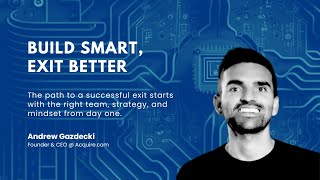
Andrew Gazdecki, a founder and entrepreneur, shares lessons from his startup experiences and offers advice on acquisitions, team building, and sales. He discusses what he learned from failures and how founders can navigate the acquisition process strategically.
Sam, Andrew, thanks for coming on the Unstacked Startups podcast. Really appreciate having you here and I think our audience is really pumped to get to know you, learn more about yourself. Before we jump into it, you're the founder and CEO of Acquire.com. maybe you can fill us in on Acquire. How did you come to starting Acquire, Let you take it from there?
Yeah. Well, first, thanks so much for having me on podcast. Stoked to be here. Yeah. Acquire.com it is the largest marketplace to buy and sell profitable online businesses. Started the business after selling two different startups, my own. I think the most eye opening process of the acquisitions for me was just how little entrepreneurs know about getting acquired, how to find a buyer, what are the legal documents? What do you do during due diligence? What are some really easy things that you could avoid to make sure your transaction goes through or attract a different buyer? For me, these were just black box mysterious things and I had to go through an acquisition myself to really learn how all of it worked. And I remember when my first acquisition closed, I had a ton of friends texting me, where'd you find the buyer? How'd you do that? I want to sell my company. And I think just, you know, when you think about the startup ecosystem, there's so many books on fundraising, marketing, sales, but there's not much on what I would argue is the most important part of the founder's journey, which is the exit. So that's why I started acquired.com was to just bring more transparency to that process and make it a little easier for startup founders around the world. So more specifically what we do is we've curated a network of about half a million different software buyers that we have collected information on exactly what they're looking to acquire. So if you're a founder and you have a SaaS company doing, let's say a million intercurring revenue, we have data on thousands of different buyers specifically looking for businesses like yours. And we'll help document, or excuse me, we'll help create legal documents from letter of intents to asset purchase agreements. We'll help you securely and safely close through escrow. So just making that process a lot easier than what it typically is.
You know, it's interesting, when I started my career, I started out working in venture capital and there's this whole mantra from that side of the table and a playbook to the portfolio companies and grow, grow, grow at all costs, you know, and everything else. But at the same time, that was back in like 2011, 12, 2012 and at that point, startups think there was still a learning curve in terms of them trying to figure out where to turn to to raise capital in the first place. I think that with venture capital being prevalent everywhere, you know where to turn to, forward, et cetera, that largely has been solved. But this is a sort of a, I don't know, an open box here where downers. Yeah, I don't think there's necessarily a playbook for it or they don't know where to turn to for it. So kudos to you for. I mean, I. Dyna. I mean you felt this problem and this need from selling businesses in the past, but it's clearly a need in the market. So kudos to you.
Yeah, definitely. I think, you know, in the past, you know when you would, when you wanted to sell your company. There's a good mantra. Great startups aren't sold, they're bought. Advice is be really passive when you're looking to get acquired. Let buyers approach you, which is great advice. If you're one of the startups that's just growing 400% year over year, you're getting tons of acquisition offers to your inbox. But the reality for a lot of businesses and startups is you're kind of in the middle. You're not failing outright. Cause if you are, you just shut the company down. But you built a profitable business. Maybe it's growing modestly. Maybe you're too small to work with a traditional investment bank. And so that puts you in this weird limbo stage where no one wants to give you advice because you can't afford it. You're too small to work with a firm that traditionally will help other companies sell. So I just saw that as a big void in the market and a big opportunity to just help a lot of entrepreneurs. Yeah, it's super fun company to run too.
That's amazing. And it's. You're making a difference. My understanding is you facilitated directionally around $500 million in closed startup acquisitions.
Yeah. And over over a thousand transactions too. We typically will do about two acquisitions per day. So it's closings and these range in different size. Some are as small as, you know, you know, 25, 50K and then on the upper end is, you know, 5, 10 million. Like last week we had an acquisition close for 4.45 million in cash. That's life changing for the entrepreneur. That individual gets to probably buy a house, maybe invest some of it, and they're pretty set after that. So that part, it's super rewarding because Even, I guess even if you sell for a small amount, you get to move on to something new. You get to use that capital to start a new idea, whatever it may be. I get emails all the time or I have calls with entrepreneurs that are just super grateful to work with us.
It's interesting because you know, unicorn or bust is sort of that, you know, narrative as it relates to like your traditional venture backed startup. But selling for four and a half million dollars would probably change most people's lives, you know what I mean? And kind of normalizing that small to small to medium sized win and you know, that may otherwise not have become a unicorn and may have not worked out is I think a win for the ecosystem as a whole as well.
Yeah, I think it's more realistic too. Like fun fact, I believe 98% of all acquisitions are under 50 million. But it's just like the big billion dollar headlines that you typically will hear about because they're sensational. You know, someone starts a tech company, four years later they're a billionaire. That's an amazing story, but it's just, it's really rare and I think it's more rare than what headlines and you know, tech, media, whatever you want to call that makes it out to be. And yeah, I think a lot of entrepreneurs, if they were just really honest with themselves, they would be just as happy with you know, a few million bucks as opposed to $100 million. And I think their probability of achieving that is just so, so much more greater. There's a good quote I can't remember off the top of my head, the entrepreneur that said it, but he said after 5 million bucks the only thing that changes is your house gets bigger and your car gets faster. I, I think there's a lot of.
Truth that totally, that's interesting. I like that and I, I, you know, from working with founders, you know yourself having founded businesses, many founders imagine getting acquired by you know, a Google or a Salesforce or Meta or whatever it is. You know, you talk a lot about individuals buying startups. What, what kinds of buyers on the buy side are actually fueling this void? Who are the types of buyers you're working with?
Yeah, yeah, so the typical players that you would probably guess. So we, we do have strategic buyers. So think other companies buying companies that'd be your Google, your Apple, your Facebook, etc. And then a lot of financial buyers. So private equity firms, family offices. But our largest buyer pool is actually high net worth individual buyers. So this is repeat entrepreneurs. This is a VP at Facebook, who's really good at marketing and they want to be the CEO of their own company. You know, that pool of buyers I think is also the most interesting as well because they're willing to step in to the role as CEO and operate the business as, you know, a lifestyle business. Oh no. Which in tech has I think a negative connotation. But again, looking at really awesome businesses where maybe the entrepreneur wants to grow the billion dollar outcome and that's what he wants to keep swinging for, she wants to keep swinging for and they're able to sell to an individual that is perfectly fine operating the business with just how it is, where it's profitable, maybe it generates a few hundred thousand net profit per year. But yeah, I think that's also one of the coolest things we do because when you sell to buyers like that, it's not very obvious. What I mean by that is if you're looking to sell to a private equity firm, they have on their website specifically what they're looking to acquire. We want to buy SaaS, companies, over 5 million revenue, enterprise mission critical, et cetera. But to locate as many just individual buyers or high net worth entrepreneurs that are looking to acquire businesses, it's not as easy. And that's a big part of the value that we bring in acquirers and bringing that community of buyers together to bring liquidity entrepreneurs.
That's awesome. That's great. And if I were to just flip to the other side, if you put yourself in the founder's shoes, and I asked this because I've had conversations with venture funds about this, where they provide advice to founders early on to create optionality as it relates to whether that is to sell one day or strategic partnerships down the line and always be networking and building relationships. Is there what comes to mind? What do you tell founders that may not even, I don't know, they might not even know they're in the market to be acquired. Like does optionality, is that something you advise to go out and you know, build relationships with potential buyers even if they're not in the market?
Yeah, I mean the reality is, you know, a strategic buyer is always going to pay more than a financial buyer and definitely more than an individual buyer. So that's always a box that you should be checking as a founder. We'll probably talk about this later, but my second company, the way I sold that was when I started it, literally day one or week one. I reached out to all my competitors or companies that I thought would potentially be interested in maybe acquiring it one day. If things worked out. And then when the time came, I continued reaching out to that list. I had built a relationship and it fast tracked everything. And if I hadn't done that, I wouldn't have been able to sell the company. So you should absolutely do that. But the thing is, it's just. It's not guaranteed. Like, one thing I learned through my first company, we. I'm sure we'll talk about this too. I don't want to jump too far.
That's okay.
But we had a mobile app builder for small businesses, so I always wanted to sell to GoDaddy. And I would reach out to the corp dev person at GoDaddy constantly. I'd always update him, stuff like that. And he'd always take meetings and kind of string me along. And I just didn't understand why things were moving forward. Like, we were perfect for godaddy, right? Like, you just take our product and sell it to your 5 million customers. You make so much money. Um, and that was literally a real pitch in my head. I was like, it makes so much sense. Why aren't they buying us anyways? We ended up selling to a financial buyer. And then I actually got on a call with this individual post acquisition maybe two years after close, and I was like, why did you always take my calls? Like, why don't you just tell me you're not interested or what was going on? And he was like, oh, we don't. We don't actually take very many inbound acquisition opportunities. My job is to work with the chief product officer, and he'll come to me and say, hey, we want to potentially build this product. Can you go out and help us potentially acquire a team with the product instead? And so he was essentially saying, I had no shot ever. And he would just work with the chief product officer to figure out what his mandate was to go out and buy. And he would, of course, just take calls to kind of learn about the market. I think the lesson there is, again, like, even if you think it's a perfect fit, you don't want to just rely on a strategic buyer because you have to have essentially, the stars need to align. They need to essentially see your company as more valuable to them than it really is to you. And that's how you see those crazy multiples. So it's not impossible, but it's rare. But it's absolutely box that you should be checking as a founder.
Very, very interesting. That's an interesting example. I guess some strategic buyers are extremely. What I'm hearing from you very Deliberate. It's like they're like snipers when they consider buying something. In that case, it would come from the chief product officer who would work with this individual to go and identify potential teams. Where. I mean, in your mind, it just seemed like such a seamless fit with GoDaddy, but they had their own way with it and that's where, you know, there's value and.
Yeah.
Being in touch with many different types of potential buyers or, you know, folks who can add value down the line.
Yeah. Because essentially what you need to do is you need to disrupt their whole product roadmap. You need to be so compelling that the head of product, the head of finance and the CEO or whoever's going to be involved in the decision stops everything that they're doing to acquire your business. Because the other priorities that they said at the beginning of the year or even two years ago or even three years ago is not as important as acquiring your company right now. So it's just a lot of mountains to move. Yeah. Not impossible. It's your best option. Don't want to rain on anybody's parade, but it's not a slam dunk like I once thought it was.
There. That's great. I'm excited what you're, what you're building@acquire.com it's incredibly impressive what you've already built. I'm very pumped about what you're going to do. Appreciate that moving forward. So. So, Andrew, I guess at this point you're a seasoned vet of startup land. You've started companies, you've been an entrepreneur in residence at 500 Startups, you've played the CRO at a scaling technology startup. You've started, you know, acquire.com helping buyers, helping founders. Like, you really played in, on, on a lot of different tables here. You've obviously built teams at startups you've been a part of. What were, what are some of the lessons when you think about building teams? I mean, I know you're very talented, but I assume that some of the success of these organizations was due to the overall teams. And I don't know, what do you think about when you think about the teams that you've worked with and built and shaped?
Yeah, I. One of my favorite things to look for when hiring people is I look for attitude, motivation and skillset, in that order. Because you can't teach the first two. I can't teach a good attitude. I can't teach someone to be motivated. Um, and in all the businesses I've started, I don't usually have the capital to hire the super experienced VP or the person that's a perfect fit skillset wise, like they've been there, done that. I think a lot of founders are in that position. So you need to get really good at spotting up and coming talent, in my opinion. So just figuring out, you know, is this person an optimist? Does this person bring me energy? Because you feed off, you know, energy when you're working with people. Someone that you know always is, you know, looking at the bright side because there's so many down moments in startups I think is huge. And the motivation as well. I think in a startup the role isn't always as defined as it's going to be in a larger company. Onboarding is probably going to be really bad. Training is probably going to be really bad. So you need someone that's intrinsically motivated to learn and bring themselves up to speed and kind of define the role themselves. Not all the time, but most of the time, especially in startups. So that's, that's been a big one for me. Everyone that I've worked with that's just been exceptional at their job has always been kind of like a, like a fringe hire or a stretch hire where maybe they didn't have the perfect experience but they really wanted to do the job. Really great attitude. They kind of lifted up everyone around them and they just are incredible learners. It's hard to spot people like that and you definitely, you know, make the wrong decision all the time. But when you get those, those hires, right, those are the ones in my experience, I kind of change the trajectory of the teams I've worked with.
It's amazing. I agree with so much of what you just said. There's an energy when looking for a, you know, important hire for an early startup, an agency about the individual, a, a, an orientation towards action to doing as opposed to theorizing or hypothesizing 100%. And that's, that's great. If you think, are there any hires you've made that have changed the trajectory of, you know, the companies you've been a part of or the teams or some of the teams you've worked on at companies you've been a part of that come to mind. You don't have to reference them by name. You can if you want. Is that something that you recall?
Yeah, yeah. I mean one individual, his name is Brian Cross. He's my CFO at Acquirer. He's my VP of finance at Business Apps too. My first company. Before hiring him, like we Would just, especially in sales as an example, we would kind of just try and grow, but we didn't have like a mathematical view into it. Like this many leads come in and this many leads convert into this many demos and your demos close at this rate and this is the close rate of, you know, these sales reps. And then, you know, once that kind of clicked, working with, you know, head of marketing and VP of sales, we just were able to work more cohesively. And this initially was back in 2014, 2015. So now you can have, you know, HubSpot set up and track all these things really easily. But back then it was kind of like we used to track like churn and stuff in a, in a spreadsheet before like chart mogul. So he was super impactful to me and my team, just bringing us all together so we have a shared understanding of how the business grows. Kind of fell before he came in. We were kind of flying the plane at night, so to speak. Another individual, her name is Rosa Romaine. She works with me at Acquire. She also worked with me at Business App. She was chief customer officer and just a powerhouse. Just extremely good at, you know, building cohesive teams, getting everybody on the same page. Just a really, really big on culture, making sure everyone on the team is happy. And we're not just, you know, working together, but we're also having fun together. And I could probably name 10 other people, but those two, you know, really.
Come to mind when you, yeah, when you, you know it. When you know it and when you've been working with them and, and you know, they just find ways to create value, you know what I mean?
Yeah.
And they're just move a million miles a minute, you know, find a way to get things done. I don't know, I feel like it's just the attitude you need to have, you know, if you want to succeed and build a team at a startup that's going to succeed against all odds, you know.
Yeah. Especially just moving quickly just because, you know, if you compound the speed at which you move over the course of a year, it's a crazy difference. Like the difference between someone that will get something done the day that is a problem or even the next day, as opposed to someone who pushes it out to next week, schedules a meeting, needs to talk to two other people, sleeps on it, wakes up the next morning, changes their mind, is having another meeting. You know, it's like a two week period as opposed to 48 hours that over the course of a year, you know, 56 weeks in a year, divide that by two, that's 25 weeks. So you can do that 25 times and the person who does that and 48 hours, 365 days in year, you know, 150 days divided by two. So you're just. The amount of times you're able to cycle through that are staggering if you can move, you know, that much faster.
Oh, so true. I mean, if you compound it out over a year, I mean, imagine compounding it out over three years, you know, and then doing the analysis. I mean, we're talking a delta of, I don't know what it is, but probably 10x, you know what I mean? And how quickly one team, one group can get something done versus another.
Yeah, 100%.
So that's, that's great. Andrew, is there any, any advice you, you know, some of the founders and I know you're typically giving advice as it relates to thinking about an acquisition and that whole thing, but I assume part of that journey is, you know, you need a good team to build something that is acquirable and whatever else. What advice would you give to founders that are hiring their, I don't know, first handful of engineers or go to market folks or any advice you'd give to them?
Yeah, I think understanding the first 10 hires that you make or first handful of hires, that's going to set your culture probably for the next, maybe the lifestyle lifetime of the company. So really index a lot on culture, you know, make sure that this person's a good fit. Whatever you define as your values, whatever your expectations are of whoever you hire initially set really clear expectations up front. I think a lot of founders, when they bring people on, they kind of expect people to almost read their mind. Like, you know, I want you to work really fast and really long hours. If that's your expectation, you need to articulate that upfront before the person joins their company. Otherwise you're just going to get off on the wrong foot and it's not going to work out. And then next thing you know you're going to say, oh, I've hired like five people for this role and it just hasn't worked out. And just understanding it's okay to take your time with bringing on these hires too because it's kind of painful to make a mishre doesn't work out. You spent all this time onboarding the person, training them how the company works, and you both really wanted the role to work out. So it's completely preventable in my opinion. So I think just spending a Lot more time with candidates, you know, interview more than once, do your reference checks, be really clear about your expectations, outline your values before you bring them into the company. I think if you do that alone, you could set yourself up pretty good and avoid a lot of mistakes.
Andrew, when you and I were speaking, I think it was a few weeks ago, you described. It was a great line. You described your crypto startup Altcoin IO as landing a plane in the Hudson River. That was kind of your landing a plane in the Hudson river moment. What does that mean? And what did that experience teach you about risk, failure and how to pivot while working in startup?
Yeah, let me give a little context for listeners. So I started this company called Altcoin L. This is after Business House, my first startup. Bootstrapped my first startup to about 10 million in revenue and then sold it when I was 29. So I was coming off hot off of a big win. Kind of thought I was invincible, you know, built a SaaS company. Why don't I jump in and start a crypto company? That sounds like a fun idea. I actually started the company while in due diligence at my first company. And this is in 2018, when kind of the first bitcoin bull run was happening. So bitcoin was like a thousand bucks or something. And I just thought it'd be really cool to build this crypto exchange on the Ethereum blockchain. Kind of the pitch was, you know, coinbase is quote unquote, what you'd call a centralized server. And the problem is, excuse me, centralized exchanges, not server. The problem with centralized exchanges is they can be kind of more easily hacked. In reality, it's actually the decentralized exchanges are more easily hacked. I won't go into the details, but during the time I thought it'd be really cool to work on something new, different technology. So we started building this decentralized cryptocurrency exchange on the Ethereum blockchain. And the idea was you can use your own tokens. No one would have access to your cryptocurrencies other than you. So it makes it safer from hackers that were known to target centralized exchanges. Fast forward about a year into the business. We've been working on it for, you know, months and months and months. It's starting to shape up pretty good. And we were positioned as, you know, a faster version of this decentralized exchange called Ether Delta. Ether Delta got hit with a basically jail sentence from the SEC because what they were doing was operating unlicensed securities exchange and they were doing it unknowingly. Because Bitcoin is a commodity, some cryptocurrencies are considered a security. So the SEC hadn't really deemed what's a commodity and what's a security. And so at the time, you know, me and my team, we looked at each other and we said, do you like cryptocurrencies that much or should we fold up shop? The answer was no. And I actually put in a proactive call to the sec. I had a friend that had a much more successful crypto company called Wyre and talked to them. They're extremely knowledgeable about what we were building, knew the ins and outs of the technology, how, you know, everything worked to a degree. I was very surprised. So we told them we're not going to launch. We didn't know that, you know, we were any compliance issues. And if you're asking, you know, why don't you just become compliant? We just didn't have the capital to register as a broker dealer and get a money transmitter license. They say that it takes around 5 million to years of time. So we just didn't have that. So we thought, what can we do? We didn't want to just shut the company down. I actually thought about it because that's kind of. There's a really good blog article called A Superbug by Marc Andreessen, talks about just crazy, like something comes out of left field and completely wipes out, you know, any chances of success. And that, that's what it felt like. And so we decided to pivot the company to being a white label cryptocurrency exchange, meaning if you were a company with the proper regulatory licenses, you could white label the software under your brand and then compliantly launch your own security token exchange. And this was a playbook from my first startup where the main go to market model was white labeling the software we'd sell to digital agencies and that's how we sold to small businesses. And that actually worked. We found one partner that successfully launched the exchange. And then we said, do you want to just buy the whole company? And we didn't get much for it. That's why I say just landing the red plane in the Hudson River. But it was a good time. It's a good story now.
And I bet, I bet you learned a lot. And you know, but I did like the way you described it, landing a plane in the Hudson.
Yeah, it was incredibly humbling. You know, the technology we were working with was incredibly difficult to use. You know, we were working with like, like Theories around how this blockchain technology could work. Yeah, just, I'm a big fan of just different business models. You know, my first company was a SaaS business. This one was a crypto business. My company now is a marketplace. I just think it's interesting how different businesses could work. I'm so glad I hopped in there, tried to make something work. And yeah, at the end of the day I think the lesson there is not every startup works and that's okay. You know, it's okay to build something, have it not work out for whatever reason. You know, for me it just, I gave it my all and at the end of the day it didn't work and I'm happy with that. And would I do it again? Absolutely. Because I think you do learn the most from failures and things that don't work out. And after having a startup that was somewhat successful, it was very humbling. And yeah, it's definitely a lesson that I think every entrepreneur should go through. Because really every behind every entrepreneur is a ton of failure and a ton of lessons learned.
Absolutely. Kind of. On that topic, what do you think most early stage founders or leaders overlook when they start a startup or as. Or they've started the company and they're starting to grow quickly. And it may not be an exact learning from that experience with Altcoin, but I don't know, what do you think they overlook?
I think just the importance of sales and marketing. At least with the founders that I see on acquire. I see a lot of really great products, ones with sometimes just too many features where it feels like it may have been over engineered. And I think that's because a lot of founders have more of a technical ability rather than a sales and marketing ability. Distribution trumps product all the time. Where you see these really crappy products that have really great distribution and they end up winning in a market. Not saying that one is better than the other, but you absolutely need to have a grasp on how to acquire customers, how to retain customers, how to speak with customers, and then depending on your product, pick up the phone, call people, schedule demos, get face to face with people, get feedback, hear what they love, hear what they hate, really listen to customers. Because it's rarely, you know, that one or two extra feature that's going to save you. It could be, you know, one or two customers. And I think a lot of software products with users, 10% of the features derive 90% of the value. So you don't need to, you know, build everything all at once. I think just really nailing one use case, one problem, even one, just go to market channel rather than just trying to bite off more than you can chew. Yeah, sales, marketing focus, talking to customers.
Right. So maybe another question here, you know, advice for founders. And I think you're uniquely positioned to, you know, answer this given what you're doing@acquire.com. what does a founder friendly acquisition process look like in practice? Like if you were to spell that out, what does that, what does that look like?
I think the two things that come to mind are going to be the due diligence process. So due diligence is essentially where you sign a letter of intent, a formal offer to sell your business, and this is the part where you're verifying everything. You're going through the financials, you're going through the source code, you're going through SOPs, you're asking questions around how does support work, how does marketing work? Because the new owner wants to essentially wrap their head around the business before they wire the funds and acquisition closes. When I think of founder friendly due diligence, you know, fast, where you're not necessarily wasting a ton of time, you're not stretching it out over 3, 4, 5 months. A common practice, unfortunately is during due diligence, you just stretch it out a long period of time. Entrepreneur gets desperate, I shouldn't say desperate, but tired, meaning they just want the deal to close and at that point the buyer starts to sense it and they do what's called a retrade and that's where they change the price based on some arbitrary item that they quote, unquote just found that's wrong with the business. The most founder friendly transactions, they move quickly, let's call it 30 days, maybe six weeks. Everything goes as planned or what was communicated before signing the formal offer and the terms as well. It doesn't have a huge earnout, it doesn't have some deferred payment that's going to be received in, you know, two years or something like that. The majority is going to be cash on close. It's a clean exit, allowing the founder to move on to whatever they do next. So when I think of founder friendly acquisitions, that's what every founder wants, is quick due diligence and as much cash at close as possible.
Gotcha, gotcha. That's great. I mean there's a, there's a dance at play there, I imagine, and a, a momentum of that process that, you know, needs to play out in good faith to come to a win. Win. Yeah, makes, makes total sense. Maybe, you know, I Know from speaking with you and getting to know you, Andrew, you have a five year old son.
I do.
How? As do I. And we were both talking a little bit about how great and exhausting it is. How has, how's fatherhood shaped your mindset as a founder, as a leader, as an entrepreneur in any way?
Yeah, I think now I try to be much more efficient with my time because like on the weekends I can't just work on my startup all day long. Those days are long gone. I just hang out with my family every Saturday and Sunday. And then just also building something that he could be proud of, giving him an example to look up to. I try to instill in him, you know, the importance of hard work and effort. I don't necessarily say like, hey, you're like a genius or anything, but I say hey, you know, you know, we work really hard. Gazdeckies, you know, put in a lot of effort and that's how we get good at something. So if you want to get good at baseball, he's really into soccer right now. You're gonna have to practice and practice how you get good at something. So just being efficient because I have to allows me to spend more time with him and then, yeah, setting a good example for hard work, effort. I think those things are important.
Love that. I think as a dad, everything you do is an example. Your kids are watching every step, every movement you make, everything you do. You know what I mean? And one day, you know, he'll see how much you care about the business that you're building and your customers and the founders you are helping. And one day he'll understand it all in more detail. But I can imagine he can pick up on how much effort you put into what you're building and that'll go a long way.
Yeah. Yeah, I hope so.
That's, that's great. And maybe, maybe one final question. You've said you're one of your favorite parts of building Acquire has been helping entrepreneurs realize, you know, life changing events by way of their companies being acquired, which in many instances changes their lives. Is there a story from the platform that, that really sticks with you that you'd want to share?
I think one of my favorite ones, probably one of the first acquisitions, there was a, a company called hello Median. I like sharing this story because just of what it meant to me when the transaction happened and what it represents too. So it was started by two YC founders. They had built this really cool live. You're on someone's website, it says, hey, do you need help and they can actually take over your browser. So it's like browser takeover. And they had sold one time licenses to two really big public companies and they couldn't figure out how to get customers so they wanted to sell the business, move on to something else. So they were kind of stuck. They couldn't find a buyer, traditionally too small for an advisory firm or investment bank. And they list on acquired.com found a number of different buyers that were submitting offers to them within the first 30 days. And then the winning buyer was, you know, what I described earlier, which is an individual buyer that saw this business as a great cash flowing asset, something that they could see themselves running for the next few years. It wasn't going to turn into, you know, quote unquote unicorn or go public or probably see a huge acquisition, but it was a business that could produce, you know, hundreds of thousands or potentially millions in yearly profit. So acquisition closed. Fast forward, you know, to today, which, you know, the acquisition took place, let's call it three, four years ago. The founders are now running a company called Workshop, which has like 250 employees. They're doing extremely well from what I can tell. So we were able to unlock them from running the startup that didn't necessarily meet the goals that they were trying to reach for themselves. And then the other individual who bought the company, he's still running the company today and it's doing great. So just, you know, I love those acquisitions because it's two people with different goals in life and they were able to work together and we were able to assist or help. So really, you know, create a win win acquisition. We see stories like that all day long.
That's awesome. It's great. It's a win win for all sides. And that's the, the holy grail, right? So yeah, Andrew, I really appreciate you doing this. This was, this was a lot of fun and I hope to have you come back for part two at some point in the future. So we'll have to get that done.
Yeah, thanks so much for having me. I appreciate it.
More from Andrew



The Buyers Who Made the Move: What They Bought, How They Did It, and What Happened Next






