From Side Project to Exit: How Johann Sold His Startup Without VC
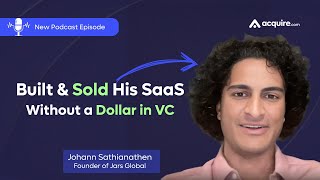
Johan built Jars Global and sold his app Quora on acquire.com without taking venture capital. Andrew Gazdecki talks with him about product development, customer acquisition, and how he navigated the acquisition process.
Foreign. I'm here. Johan, the founder of Jars Global. Johan, how you doing today?
Doing good, Andrew. Happy. Good to be here.
Yeah. So hey, you recently got acquired on acquire.com. excited to hear the story. Before we dive into that, do you want to just give a brief introduction of yourself for people that may not know you?
Yeah, of course. So I'm 20 years old. I'm a college dropout. Right after college I joined Cisco Systems software engineer. As your youngest full time engineer. 18 years old. But I'm an entrepreneur at heart. So I was building tons of stuff on the side, putting most of my Cisco income into like having a team for my like building a portfolio of companies and just started building. I love, love building even though some stuff might not turn out how I want them to be. And now I'm still doing that, just building stuff and doing what I like doing.
Right on. I love that. Yeah, I mean you'll build stuff and it works out. You build stuff and it doesn't work out, but that's how it goes. Tell me about Jars Global. What does it do? Just give a little background on that.
Yeah, so I, I suffer from shiny object syndrome, but I think same same thing as saying like multipreneur. So I like building tons of different projects and I feel like I've sort of gotten better at it where I'm working on like setting up teams around those projects. That way there's actually growing without me being there and they don't just sort of sit stagnant. And Jars Global is just the holding company for all the projects I have. I honestly can't even count how many different things I have going on. But it's a good way to just organize it all under Jars.
Nice. Love it. Tell me about Quora, the app that you got acquired on quora.com. what did it do? What problem did it solve?
Yeah, so we started Quora. Like when I first started Jars, one of the things I wanted to do is make a new product every month. But then Core was like the second product we made and that got decent traction and all it helped was like non English speakers easily reply on Twitter or agencies who are growing personal brands help them engage at scale on Twitter with AI replies.
Nice, Simple. I love it. How did you get the first customers?
Purely through cold dms. The good thing is that we we focused only on Twitter at the start. We sort of branched out after we have LinkedIn now. I think now there's a few other platforms but yeah, old cold DMs nice.
How long did it take you to build the product.
It took like less than 48 hours to get the whole product built. It was very nice.
Love that. How many users and how many customers did you have on the platform? Just like roughly?
Oh, we had like 1500 users, but we had a chrome extension which was sort of the main thing. And I think we had like around 500 on that one. And then the rest of the users were using our other features which were like repurposing. You also had like bio generators and tons of random small AI tools to help Twitter growth.
Nice. What was like the most interesting thing that you learned building this product? Was it like some of the replies that people would write on Twitter or like how people grow their accounts or using OpenAI? Like, what was just something cool you learned?
I think something cool maybe just that sometimes you don't necessarily have to like innovate with a product. I think there was quite a few competitors and we sort of had the exact same thing. And at a certain point, and almost like we didn't need to add any new features, we just kept the same things. Maybe some small tweaks and improvements, but majority of the work was purely on growth as opposed to developing new features or anything like that.
Nice. Tell me about like growth. Was there a certain marketing channel that worked really well for you aside from cold dms, was there like SEO traction or did you launch on product on or did you pay that? Was there like one channel that you know, you started investing in? It started working really well. Maybe it was unexpected. Anything around growth, that was maybe an interesting learning.
One thing I learned was definitely just like double down on whatever works. So at the start we were doing like cold DMS on Twitter, making content on LinkedIn, focusing on SEO. But we realized majority of the results were coming from Twitter. So we got like Twitter organization verified, like did twice the amount of cold dms, a lot more replies only content on Twitter and dropped everything else. Um, and Twitter accounted for like 85% of all of our customers. The other were like scattered across SEO. Some came from lifetime deals with AppSumo. Yeah, mostly old Twitter.
Nice. I see that so often where one channel is driving the majority of the customers. And that's great advice. Just double down on what's working. Don't get super complicated with your marketing strategy. Just mastering one channel, I think is. Is the way to go. So, so right on. Um, so it sounds like you had product market fit, you had happy paying customers. Quora was growing. What made you decide to sell the app?
Mostly focusing on Other stuff. So, like I said, I. Shiny object syndrome. Like, it got to a point where I was spending very minimal time on Quora. Like, I had a team that automated everything for it. And I was all, my focus is going towards other projects, but Quora was still a little bit of. I was still putting a little time into it for the admin stuff. And it got to a point where I would just much rather get rid of any of the time spent on Quora, get a little bit of cash and put it towards my next projects. So that's what ended up pushing me to list on a flyer.
Nice. That's smart. I mean, if you have a ton of different projects and you want to focus on a different, you know, product project, having that extra capital and being able to focus without having to answer questions or update software, whatever it may be, just that focus and that time commitment is so huge. So to be able to get that back, that's big. Tell me, so you list on acquire.com what were your expectations? How did the first week go? Give me, like a quick, you know, rundown of how that went.
Yeah, so I believe I list on Acquire, like end of December, and I was thinking, like, I hopefully close by the end of like, quarter one 2025. So like end of March. But I feel like it was a lot faster than that. Within the first week of listing, I got way too many NDAs to even count. I had like 3 buyers who were very, like, was seen very interested. They were asking for meetings, asking for more details. Then obviously it, like, as. As it progressed, some buyers dropped off, but one buyer stayed very interested, and that was a buyer we ended up moving forward with.
Nice. Was there anything about that particular buyer that stood out or something they did or a question they asked that made you want to go with them and sell your business?
I think one thing that really stood out was that tool similar to quora, sold on acquire.com not sure how long before us, but they were also in talks with them and so they. They mentioned that, hey, we. We've seen a tool similar to Quora and we wanted to get it, but it was just not a right fit at that time. And so knowing that they've already sort of been sold on the idea, they've probably had growth, growth China or growth ideas in their head. Like, knowing. Knowing that was like, okay, it's probably a good idea.
Nice. And then you get an offer, you sign the loi, you head into due diligence. How did that go? Any hiccups? Any? Did it take A super long time.
Due diligence was really fast. We had a pretty long, like, negotiating process before due diligence, where we got everything combed through. So due diligence was really just making sure the financials were in check. And then other than that, I think due diligence was right around a week. So no hiccups at all, which is good.
That's fast. Sometimes I see due diligence, you know, two, three, sometimes four months. That's on the long end. Yeah, that can be a finances involved. So if there's an SBA loan. Oh, yeah. Or if it's just a really complex business. But a week is super fast. That's awesome.
Yeah, I think we sort of worked it out well where due diligence was starting pretty early, like they were checking stuff out, working well before the LOI was accepted or the apa. I forget which one it actually was. So that the actual due diligence term was very short and it's like double checking everything.
Nice. How did transferring the assets go? We're using Stripe. Did you transfer the account? Did you just transfer over server credentials or did you move the software to a different server? What did that look like?
Yeah, so that's one thing that we sort of worked on was like a handover period. So one thing I told the buyer is that I have everything sort of scattered across everywhere, so I wanted to ensure they have everything. So on closing date, we transferred the domain. We use lemon squeezy. So we transferred that and quite a few other stuff. But then we said over the handover period, we'll just ensure that if anything else comes up, we'll make sure that's handed off. Because there's a lot of small stuff in the tech stack that we added and we didn't necessarily add documentation for because just focused on shipping and getting customers as opposed to documentation and all that.
Nice. I like that. Did you do any transition period with the buyer, meaning you'll stay on for a month or at least be available to answer any questions? Anything like that?
Yeah. So it's a two month transition period. So we still have like one month left and it's just ready there to answer questions, helping them sort of vet the new team to run it and have the same setup that I had where the team's running it on autopilot and the buyer can be there for strategy or however they see fit, but if they want to, they can just hold it like a passive. Passive asset.
Nice. If you had to give three tips to another founder looking to sell their business. Based on what you've learned going through this acquisition process, what do you think.
Those three tips would be from the start? Probably start building for an exit. So document everything. That way when you're ready to exit, you have all the assets in place. Maybe keep all the assets under the like same email. So hello@your product.com or AI nowadays. Number two, I'd say just try like maybe not too important, but try automating stuff like make it where it's not something dependent on you. Make sure a team or whatever can run all the operations. So it's incentivizing for the buyer. Do whatever you can so that if they maybe aren't a technical founder or whatever, whatever they are, it's still incentivizing where they can buy it. They get a return on their investment. And then three, I think the most important one by far, if you're thinking for an exit, you have to list on acquire.com no other option.
I love that. I love the third one especially. I'm obviously biased. That's awesome. I'm so glad to hear the acquisition process was super smooth. Found a great buyer.
Sounds like.
Was there any headaches? Did anything go wrong or unexpected or.
Not that I can think of. I think there's like small, smaller stuff, but everything. Like one thing I, I tried making sure was that when anything came up with the buyer, like we hopped on a call as soon as possible just because it's a lot easier to explain stuff over a call. And by doing that like everything was sort of answered and went smoothly because of that.
Nice. That's a good tip right there. If there's any sort of like miscommunication or you know, question that you could answer over email, but just getting on a call in case there's a follow on question just to keep the momentum on the deal and everyone's nerves at ease. So you don't, you know, answer something and then another question comes up but you miss it and then a day goes by. So that's smart, man. I love that.
Oh yes.
Right on. Well, hey Johan, what are you working on next? What's next for you?
Like I said, a multipreneur thing. So I have I think right now like three projects in my sort of pipeline work. I have a few other projects that I've already had. So I'm working on sort of just scaling those as well, getting them to the point where automated streaming in cash. And then my goal is hopefully within the next three months, launch those next three products. Two of them are sort of agencies, and then one of them is a actual product. So launch those, get teams set in place. That way they can sort of just.
Start going right on. Well, hey, when you're ready to launch one of your new products, let me know. I'll be happy to share those on Twitter, LinkedIn help, you know, maybe drive you some customers.
Thank you so much. That mean the world.
Yeah. All right, Johan, thanks again for. For coming on the podcast. Congrats again on the acquisition and hope to have you on here again, man.
Oh, I hope so. Thank you so much, Andrew. It's nice.
Of course.
More from Andrew



The Buyers Who Made the Move: What They Bought, How They Did It, and What Happened Next






