From Zero to a Business Ready to Sell
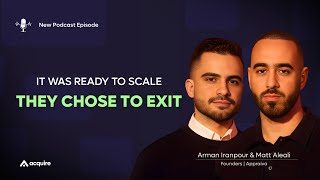
Armin Urimpur and Matt Ali built Apreva, an AI platform that finds off-market real estate leads using street-level imagery, grew it to 170 paying customers, and sold it. They prepped for months with clean financials and a data room, ran 30-50 NDAs in week one, and closed in 90 days with a buyer who got their IP.
Chapters
All right, I'm here with Matt Narman, the founders of aprava. How you guys doing?
Good. Thanks for having us.
Yeah, thanks for coming on and congrats on the recent acquisition. Before we dive into that, do you guys want to just introduce yourselves and share a brief background for people that may not know you?
Sounds good.
I'll go first. Yeah. I'm Armin. I'm one of the co founders here at Apreva, and we started this a little over two years ago now. And before that I spent about five years in the e commerce technology space. And I'm just a serial entrepreneur. Basically before that, I'd started a couple startups as well and just loved the process of building.
Yeah. And I'm a serial founder, product builder. Been building software since pretty much high school, and then ended up connecting with Armin here on the Internet when the AI moment was really starting to hit. And we really complimented each other well, and, you know, got to work on this thing together.
Nice. Tell me about apravo. What did it do? What prompted it solved? Let's start there. Sure.
I'll take this one. So initially, you know, we sort of, you know, realized that through one of our other co founders, we had a sort of, you know, good distribution advantage with specifically real estate investors. And we, we came across this really interesting use case of using sort of of public street level imagery with, you know, these sort of multimodal AI models that could actually interpret imagery. And, and, you know, these real estate investors that we were talking to that, you know, they sort of brought up this use case of what's called driving for dollars in the industry, which is, you know, driving around looking for, you know, fixer upper properties that are off market, you know, abandoned properties that they could, you know, buy for cash and, you know, sort of invest the resources in rehabbing them and them back up on the market to make them sort of livable. And so, you know, they would drive around looking for these properties physically. And we sort of realized that through the combination of the, the public imagery and these, you know, vision AI models, we could actually sort of automate that at scale and, you know, sort of sell the data as leads for these real estate investors. And so, so that's, you know, what we decided to build and got some good early feedback and traction and, and, and that was how. How it all got started.
Nice. So it's kind of for like rundown old homes. Is. Is that maybe a good description, kind of.
Yeah. Off market? Yeah. Properties?
Yeah, yeah, pretty much. I mean, over time, you know, we sort of moved in the direction of like, you know, being a marketing intelligence tool, pretty much trying to move up market, you know, just having these marketing data sets that, that people can use to do campaigns. Like, because a lot of real estate investors, they don't really buy stuff off of Zillow. Right. So they're looking for specific things that are off the market. So. So that's sort of the, the niche that we were serving.
Nice. That's super interesting. How'd you guys get the first customers? Because I assume they're real estate agents. You guys had to find out where they're hanging out. That. What did that look like?
Yes. So interestingly, as, you know, sort of second time, third time founders, one of the kind of core tenants of, you know, sort of building a preva was, you know, sort of starting with some advantage. Right. And so through our, a co founder who I mentioned earlier, we had a little bit of a distribution advantage through. He already had a community of real estate investors that he built. And so we were sort of selling into that community early on. And that's really how we got our first, I would say four or five customers locally who actually paid us money and validated our ideas at that point.
Yeah. What's funny is we moved out of that market. We started there in the Canadian market. We didn't end up serving the Canadian market where our co founder had that channel partnership. We moved completely to the U.S. but what that was was like a nice early win to give us the momentum to figure out the more scalable channels that we ended up sort of scaling on further from there.
Nice. What was the business model for this? Was it a monthly subscription? Was it pay per use?
Yeah, we experimented a lot with pricing throughout the entire process. It was always a subscription model initially, a lot more, you know, monthly plans, quarterly plans, you know, pricing it up, pricing it down, you know, sort of experimenting a lot. And you know, today it's. It's pretty much all annual data licenses that we sell, you know, of varying, different sizes depending on whether the customers are more SMB or enterprise.
Nice. How many users or customers did you guys have? Just so I can get a sense of the scale of the business.
Yeah, we're about 170 customers today.
Nice.
Yeah.
And then are these all in Canada or are they in United States too, or all over the globe?
Today they're all in the US that is awesome. Yeah, right on.
And then you guys clearly had a product market fit. The business was profitable. What made you guys decide to eventually sell the business I'll let Matt take this.
Yeah, I think it was just a good time to take some chips off the table. You know, we were just going at this for a really long time, and yeah, I think it was. It was a good opportunity to just, you know, take some chips off the table and look at. Look at what's next because it's really fun. I think we really like the sort of 0 to 1 that we were able to do, and there's so many fun ideas and things to do in AI right now. So I think. I think it'll be fun to sort of give it another go with a blank slate at some point.
I think that makes a ton of sense, especially when you look to sell when the business is doing really well, like yours was. Tell me about the first week on acquire. What were your expectations? How many buyers reached out? What did that look like?
Sure, I'll take this one because I was a little bit closer to the process on platform, so to speak. Yeah, I mean, I think we had gone through a lot of prep, sort of calls with our advisor, and, you know, we'd actually explored listing months prior to when we actually did list. So, you know, we had time to prepare some stuff. I think, you know, we put a lot of effort into preparing this sort of data room package that folks got access to as soon as they signed the NDA, made sure we had some different documents available there that were really well organized. And then, you know, the actual listing itself we made sure was. Was really thorough. So that when we went live, you know, I think within the first few days, we had upwards of 30, 40ndas, and then I think got up to closer to 50 over the next week or so. So, yeah, it was really smooth. I mean, you guys have done a great job of building out a lot of different, you know, tools and resources. You know, our advisory team was really solid and, you know, kind of made everything pretty smooth.
Nice. And then the buyer that you sold to, what stood out about them? Is there just a good fit? Did you guys get along? Was there specific terms that they offered better than other buyers? Like, what about that one buyer made you want to get acquired by them?
I think I'll take this one. I think part of it is when you have these buyer conversations. You know, we talk about it after and we're like, okay, you know, do we like this guy? You know, do we want to work with them? Do we feel like he'd be a good person to sort of, you know, hand this off to? And yeah, the. What he wanted to do with the business, I think aligned well with what we wanted as well. And we still had a lot of ideas for the business to grow it and take it to the next level as well. And he sort of wanted that as well. So, you know, we stayed on with him for a while. We're, we're, we're still working on, on taking a prebu to the next level with him and that was sort of a, a nice fit for us. Obviously the terms were, were good as well and worked well.
Yeah. Just to add one more thing there as well. He was one of the people that understood our business immediately really well, just based on his own experience too. So I think that also made it more attractive for both of us because he really sort of understood the gap we were filling with our, with our product.
Nice. From what I've seen in most scenarios with acquisitions, the buyer that sellers move forward with, there's usually just some part that just clicks immediately. It could be just the vibes are good. It could be industry experience, it could be technical expertise. So I think that sounds great. Tell me this, was there any hiccups during due diligence? Any surprises that gave you guys headaches? How was that process and how long did it take?
Yeah, I mean, as far as any hiccups or surprise, both Matt and I have been through acquisitions before. So, you know, we were sort of somewhat familiar with the process and knew what to expect for the most part. And I think we're pretty prepared for it. So I, I don't, I don't really think there was any, you know, hiccups or, or you know, any, anything that, that we didn't expect to happen through the, through the process. It was a Basically, I think three month process from start to finish, about 90 days.
Yeah, I think it would have been a lot faster if, if it wasn't the end of the year and we hadn't hit like Thanksgiving weekend and, and then, you know, the, the holidays. But I think the buyer had some, some financing that you needed to come through as well through like the sale of their company. So that, that was something as well. That made it took a little longer, but I think, you know, overall it was, it was, it was pretty smooth, for sure. Nice.
Did you guys agree to any transition plan or anything like that? Like you'll stay on for three months or you'll work part time or anything like that?
Yeah. So part of, I think what made the deal work really well, I think for both parties. You know, given that we didn't ne the Founder, core, founding group, didn't necessarily have something immediate that we were going to tackle afterwards. And the buyer in this case didn't necessarily have like a team to immediately deploy into the business. You know, we sort of, you know, offered the buyer 12 months of commitment from the entire team to stay on and pretty much execute on. The plan that we had sort of proposed to him would be how he could increase the value of the company, you know, over the next few years. So we're going to kind of work with the buyer over the next 12 months to execute on that plan together.
Nice.
That's huge because when you offer a transition plan, especially at that length, what you're doing is de risking the acquisition for the buyer. So that's a massive win. Did you guys do anything to celebrate when the wiring hit you guys bank account? Did you go out to a nice dinner or take a day off? Did you do anything?
But Matt, you can go first.
Yeah, I mean, we weren't all in the same city, but you know, we had a lot of, you know, FaceTimes of like, dude, you know, this is it, it's done. Go celebrate. Go enjoy. You know, I, I went out to Vegas and played some poker at some, some bigger tables than I had before. So that was kind of fun. Some, some higher stakes. So that was fun. But yeah, Armin, you can say how
you saw me, yeah, I had two pre planned vacations that just happened to be scheduled for the day after the wire hit. So the timing kind of worked out really well. And pretty much the day after the wire hit, I flew out to Orlando and then San Diego and we actually have a team trip to Dubai planned for next month. So really excited about that.
That's awesome.
Yeah.
If you guys were talking to a founder looking to sell and he wanted some advice, what's maybe two or three tips you guys would give them?
Yeah, I can take this one. Yeah, I think really prepare the business. You know, put yourself in the shoes of the bo. The buyer and think about how if everything is polished, all the processes, you know, all the books are clean, all that stuff helps the buyer obviously feel more confident in making that purchase. So that's, that's how I would do it. You know, just make sure you're, you're giving the buyer something that, that they're confident that they can, they can grow and do whatever their goals are and you know, achieve whatever their goals are with the business.
Yeah. And I think one more thing to add is just, you know, for the most part, at the end of the day a lot of the. Of a buyer's, you know, calculus comes down to the numbers. Right. And so, like, not losing sight of. There's a lot of distracting things you can do kind of leading up to an acquisition. But, you know, one of the things that we tried to stay really focused on leading up to it and throughout the process was just like, revenue and profit, you know.
Yeah.
So just staying focused on. On. On those things and, and then. And one more thing for us, like, you know, just leaning into your. Your strengths. For us, like, a part of what was really attractive, I think, was our ip. Right. And so, you know, kind of really leaning into the unique IP and building out that narrative, you know, throughout the listing, et cetera, et cetera, was important, I think, as well.
I think those are all a great piece of advice for sure. I think just to focus on revenue and profitability and really pointing out what makes your business defensible, I think is huge because that's what a lot of buyers looking for is acquiring a business with product market fit. It's profitable, not easily replicated. Those things are huge, and you guys absolutely crushed it.
Thank you. Appreciate it.
Thank you.
So what do you guys work on next? What's next for you guys?
Yeah, well, I mean, we're really excited to continue, you know, building out, you know, the next phase of a preva with the buyer. It'll be a fun opportunity to kind of have someone who is a really skilled operator who's built, you know, businesses much larger than then we have sort of step in and. And work with them to grow preva over the next 12 months and, you know, see where that takes us and then, you know, figure out what we want to do next. I don't know if you want to add anything, Matt.
Yeah, I think. Yeah, I think so. That's. That's the plan for now. But, you know, overall, I think vertical SaaS, I think we're. We're sort of. We like that space and there's a lot of opportunities with AI, I think, to do. To do really fun stuff. So we'll have our eyes on that and, you know, do little experiments here and there and see, see, see what's going on.
Right on. Love it. Well, congrats again on the acquisition, you guys. Thanks for coming on. If people want to follow you online and hear more about your story, where
can they find you? Armin urimpur on LinkedIn. And that's pretty much it on that.
Yeah, me too. Matt. Ali. Ali on. On LinkedIn x DMs would be good, too.
Right on. I'll put that in the show notes. All right, guys. Appreciate it. Congrats again, and looking forward to seeing you guys crush it some more. Thanks, Andrew.
Appreciate it.
More from Andrew



The Buyers Who Made the Move: What They Bought, How They Did It, and What Happened Next






