Getting Deal Ready: How to Prep for a Smooth, Profitable Exit [Webinar Replay]
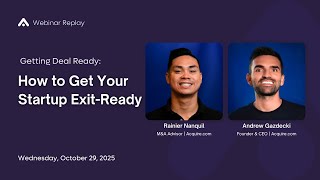
Andrew Gazdecki and M&A advisor Ranier walk founders through selling a business. Get your financials clean with recast P&Ls, build a data room with customer metrics and contracts, and know your buyer profile. Preparation increases valuation and prevents deals from falling apart.
Chapters
Foreign.
What's up everybody? Let's go ahead and get started. Thanks everybody for making the time. I really appreciate it. We got some good content here and also Govern here as well. So we're gonna hopefully help all of you get acquired. And without further ado, I'm gonna go ahead and share my screen and we'll kick this off. And then at any time, if you have any questions, feel free to put that in the chat. We'll do some Q A at the end of this and we'll see if we can answer some questions along the way as well. But today's topic we're going to be going over how to get deal ready. How to prepare for a smooth, profitable exit. This is something I talk about pretty much every day at Acquire. I meet with a number of different founders looking to sell and a lot of them want to go live immediately. They want to go on the marketplace, start speaking with buyers. But what we're going to do today is go over just the importance of preparation, how it really sets you up for success as a founder. Before I get into that, here's today's agenda. We're going to go over some quick introductions, why preparation is so important. What are your acquisition goals, how to think like a buyer, getting the basic right. And then how do we help you@acquire.com if you're thinking about getting acquired or you're thinking about buying a business? We'll go over just how we can help facilitate both of those. But for those of you that are not familiar with acquire.com, we are building the world's most founder friendly acquisition startup marketplace. We've been in business about four years. I started the company during COVID which feels like forever ago. We've served over a hundred different countries, which I think is pretty amazing. We've had acquisitions on legitimately every single continent. It's an absolute pleasure and honor to be able to serve so many different entrepreneurs all across the world. And today we have over 2,000 listings on acquire. We've helped over a thousand startups sell and we've closed over half a billion enclosed transactions. Very active marketplace, over half a million registered buyers and all these numbers are growing every single day. And quick introduction on me, I'm Andrew Gazdecki. I've helped thousands of founders get acquired. I build and sold multiple different startups. Before acquire.com I bootstrapped a mobile app builder to about 10 million in recurring revenue and that was acquired by private equity firm when I was 29. And that's what really gave me the idea to start, acquire and really build something that helps founders with such an important part of their journey, which is to exit. All day long. I'm helping founders exit smoothly with the right buyers. And my promise is, you know, help you navigate, evaluate, negotiate, and close amazing acquisition opportunities. And with that, Ranier, you want to give a quick intro of yourself.
What's up, everyone? My name is Ranier. I'm an M and a advisor. I've been in the business for over a decade now. I've seen hundreds of deals, good deals, bad deals, everything in between. Every single deal is different and exciting. However, there's a lot of trends and pitfalls to avoid, and I'd love to help my clients avoid some of these pitfalls to get the best price, best exit, best transition. Previous to acquire, I was at Empire Flippers. Before that, Cushman and Wakefield and Marcus Milchap. My background is everything from commercial real estate to SaaS to E commerce content websites. Dealmaking is in my blood. Love it.
Okay, now moving into the reason you're all here, right at the top, I'm going to go over, why is preparation so important? Why should you care? Why does this really matter? So the first way to think about preparation is closing the knowledge gap for buyers. So as a founder, you know your business better than anybody. You know how much revenue you're generating, you know the profitability, you know things that aren't working in the business, the things that are working, the things you wish you tried if you had more capital or things you did try and they didn't work out, favorite things about the product. I can go on and on and on, but essentially there's this gap where you're explaining your business and questions that buyers have. And your job when you go to market, if you're looking to successfully get acquired, is you need to close that gap. So everything that you can do to explain your business, there's documents that we put together that help you do this, such as a P and L statement, being able to clearly show the revenue and the profitability, and then also putting together documents to answer questions that every single bar has, such as a confidential information memorandum, that's a sim, a due diligence checklist, and a transition guide. A lot of the questions that buyers have, they're going to be very common questions that we see across every acquisition that we do. And so the idea here is you're building trust with buyers up front and saving time when you speak with them so buyers don't have to answer. Ask These questions that they essentially need to know to assess if this is a good acquisition opportunity. And what that does is it creates trust so you can create interest for buyers. When you create interest with buyers, you can typically have more offers, more offers, higher valuation, and so on and so forth. So closing that gap. So again, you may think that a lot of things may be obvious in your business where you can just look at a few things and just have a few scraps of different documents and a buyer is going to pull all that information out of you. And that's not the case. The more you prepare, the better overall experience you're going to have selling your business. And that really translates into the final sale price. So maybe an even easier way to think about why this is so important is you can get acquired for essentially more money if you spend the time and properly prepare your business by making it easy for buyers to wrap their heads around the business and understand why this is a good acquisition opportunity. More on why being deal ready matters. Deals don't collapse because buyers disappear. They clasp because founders aren't ready. I see this all the time where there's a really good business, they list on acquire.com and there's just not a lot of activity from buyers. And this is typically because buyers aren't able to make an easy assessment on if this is a good opportunity. Another thing to note is buyers today move fast. They're comparing five to ten listings at once. If your documentation isn't tight, they'll move on. That's absolutely true. There are literally a thousand plus businesses on acquire.com and your job as a founder is to stand out from other businesses. And one of the worst ways to make that not happen is not being prepared and not providing. Everything that a buyer needs is to really make an assessment on if they should move forward or if they should pass on this opportunity. And just putting that into, you know, context of, you know, when you're selling your business, you do have competition, you do have other founders that are looking to sell. So there's also a certain bar that all buyers have and there is a bar in terms of preparation that they, they simply expect. And so if they don't see these items available for them to quickly learn more about the business, they're not going to feel that you are serious about selling the business and you're not respectful of their time. So the more that you can do to prepare in advance to give buyers the view that you're taking this seriously, you want to sell your business quickly, the better experience you're going to have. So at the bottom, being deal ready gives you leverage. It shows you respect the buyer's time, builds confidence, and helps you close faster. And we see examples like this all the time. Where on the right, we have a SaaS founder on acquire.com cleaned up his metrics dashboard, uploaded clean docs, and had three offers in a week. There was actually someone I was helping just this past week who had been on the marketplace. They reached out to us@acquire.com and they were looking for some help on how to get more interest from buyers. And usually the first suggestion that we have is around the items that are uploaded or the data room that they prepared. And so with this founder, we had some light feedback on how to make the listing better, but most of it was around how to better prepare the business to be evaluated by buyers. And so they updated their metrics, they uploaded new documentations. She had a wonderful SOP guide for her e commerce business. And once that was done, we told her to reach back out to buyers and let her let buyers know that she's essentially revamped the data room and there's a lot more information to look at. And then from there, she literally received an offer the next week, which I thought was pretty amazing. And that's not a single case. We see that all the time. So again, going back to my original point, if you're serious about selling your business and you want to sell it for the highest valuation, being deal ready is so, so, so crucial and can really make all the difference. So what does it mean to be deal ready? What does that look like? So on the left, probably the most important piece, organized financials and a clear story behind the number. Every buyer is going to be looking to understand the health of the business. And this is done through understanding the revenue metrics and the profitability of the business. So being able to clearly tell the story of your business's health in terms of how much revenue is generating, where expense is going, what is the profitability of the business is absolutely key. And this is something that I think I can't really name too many acquisitions I've seen where financials aren't organized. And if we have, in my view, you leave money on the table because you're not able to facilitate as much interest from buyers as you could otherwise. Number two would be customer data, anonymized but verified. So showing how many customers there are, anonymizing the data so it doesn't specifically say who it is, but letting buyers know, is there one large customer that takes up most of the revenue. Is it scattered across many small customers? Letting buyers understand the health of the revenue is also key. Clear handoff plan for customers and operations. I love this part because it shows buyers that you've essentially thought through what's going to happen if someone was to buy this business. And that's one of every buyer's question is, how do we hand over these assets? Can the business operate without the founder? Has this been thought through at all? And for the deals that I see successfully close, it's almost always a part of the conversation where upfront they've discussed what do things look like without the founder? How do they mitigate that risk? Having that upfront, at least as a talking point, can make all the difference. And then transparency around what does and what doesn't work. You as the founder know so much about the business, you've been operating it, you've been building the business. And this could be a great opportunity to get buyers excited around things that you've done right or things that you haven't had a chance to execute on. It could be certain marketing channels. It could be you've never done a price increase. You may think that these are bad things about your business, but a lot of, a lot of buyers will view these as opportunities for them because they might have a marketing background, they might have experience with price increases. There's a list of things that you can point out in your business that you've done and you haven't done. But doing all that really brings all this together. Buyer now has a clear view into the financials. They understand what the customer mix looks like. There's a plan for handoff for customers and operations, and then there is an outline of what you've done, what you haven't done. Right at the bottom. Buyers don't fear problems, they fear surprises. And this is absolutely true. If there's something bad about your business, definitely tell a buyer up front because they will learn about it at some point during the due diligence process or another point. So surprises are always best avoided. And if you do all this correctly, your chances of getting acquired are much, much higher. Ranier, is there anything you would add to just key things that you should absolutely have to be deal ready?
Yeah. The main thing, as Andrea had mentioned, is, you know, help the buyer mitigate their risk. They're trying to understand the growth opportunity for the acquisition. So help them one mitigate their risk by understanding what could go wrong. What could go right? What are the growth opportunities? Let them have a firm Understanding of what the upside in the acquisition looks like and the clear handoff, as Andrew mentioned, that's very important, the transferability of the business and that you know exactly how to transfer and transition the business post sale. And then lastly the documentation. All of those SOPs are extremely important. The more documentation you have, the better. And again, it's not problems that kill deals, it's surprises. So everything that you think might be wrong, that's someone else's upside and opportunity. It's just surprises that are found last minute that could, that could make or break any deal. So all good, all good information there?
100% completely agree. All right, near, I'm going to pass it over to you. How can you think like a buyer?
Awesome. So this one I really love. You want to put yourself in the buyer's shoes. And we'll go over that on the next slides here. So what are your acquisition goals? As a founder, you want to know ideally who your ideal buyer looks like and then in terms of what your ideal exit looks like. So if we go through the first part, why are you selling? So if you're retiring, you've got a new venture, financial reward, taking chips off the table sellers, that's going to be the first thing that buyers ask you. It's like, okay, well this looks like a great business. Why are you selling? So have a firm understanding and explanation of why you're selling. That's going to be probably the first question any, any buyer asks you. The second part, what life do you want post acquisition? Again, the transition part. Are you open to staying for a period of time to help the buyer transition or are you looking for a clean break? Is there like some sort of emergency you have to take care of? You have another venture to, to jump into as soon as possible. Help the buyer understand that because they're also going to ask you, okay, why are you selling and why are you looking to fully transition and then how flexible are you? Because a lot of buyers, they want to know if you can help out with the transition. They want to make sure that there's a smooth handoff. They want to at least have their customers and contract agreements go through an easy transition post sale. The next part, what kinds of deals might get you there? So are you open to creative deal structures? Do you want or prioritize cash, seller financing and earn out retained equity or a combination of these things? Many, many deals can get really creative. And as a seller, you want to know exactly what is an ideal exit for you. Is it price? Is it timing? Is it the transition, you want to have a firm understanding of all of these things so that the buyer knows exactly what you're looking for and you can meet in the middle to have an ideal transition and transaction for the both of you. Lastly, how can you convince buyers to offer the deal that you want? Well, first you need to know what you want. What's your ideal buyer profile? What's your ideal exit look like? And some of these points are key. Being easy to work with, being honest, being prepared, being realistic about asking price, being responsive and just asking. As a seller, you want to be upfront. This is why I'm selling. This is my ideal exit transition. This is my ideal cash amount at close, earn out, etc. You just want to be on the same page so that there's trust on both sides. You could have the most valuable business in the world. But if you're not easy to work with, if you're not prepared, if you're not 100% honest and the buyer senses that it's going to kill a deal, they're going to look at the five to 10 other deals that they're looking at because of any of these other points. So the main thing here, again, have a firm understanding of why you're selling, who your ideal buyer profile looks like, what your ideal transaction looks like, and then from there you can meet in the middle with the buyer and that's how you're going to have the smoothest exit to get you the best price, the best timing, the best transition for an acquisition. Anything to add there, Andrew?
No, I think you nailed it. I think one thing I would point out is also understanding how much of this is again closing the gap where a buyer may be on one side and you're on the other side, where you want to exit the business. But really understanding what does that look like? Is it because you need to move on and start working on another company or you've already started a business? Just being able to articulate that can help buyers because that can help them structure the deal in a way that can help you accomplish those goals. So I think going through this exercise, size of outlining why you're selling, what life you want, post acquisition, for example, the post acquisition piece, are you even able to do a transition? If so, what does that look like? All of this can ultimately determine what type of offer you're going to receive. So that's why I think this is such good content, where just by writing down all of these simple questions can really help a buyer understand what's Going to work for you and what's not. So what I mean by closing the gap is for buyers, does the creative deal structure work? Are you able to do a transition and closing the gap by helping them understand if you can or can, I think can be the difference between a great acquisition or one where both sides kind of just dance around what they're looking for. Nothing really happens. But like you said, Renee, every buyer asks these questions, why are you selling? That's usually the first question. So having a good, honest answer to that, I think is key. And then also really knowing I can you do a transition? Can you stay in the company for another six months or a few months or longer than that? Because that can also help you get a higher price when you, when you exit. But if you can't, why not? And you know, being able to articulate, communicate these things I think is key for buyers. So they can put together an offer and deal that really works for both sides.
All right, next slide here. Common due diligence items. So what buyers are going to expect to see is your profit and loss statements, ideally the trailing three years. So make sure that's all up to date. Customer and revenue concentration. Have a clear picture, have a clear explanation for any trends of an increase or decrease in customer and revenue. Have your MRR and ARR metrics, insurance trends available. And again, any buyer, they're going to see a spike or a drop. Be able to explain any of these trends, especially if things are seasonal during certain times of the year. The next thing is active contracts, IP and vendor agreements. Again, you want to be able to provide as much documentation as possible. They're going to want to look at your standard agreements, your standard contracts, and then code, ownership and team structure. They want to see how the team is laid out, who's responsible for what, who, which employees can transition with the business, which contractors can transition with the business. And Again, product documentation, SOPs. Document anything and everything as you're preparing or going live on the marketplace, as well as due diligence. Buyers want to see all of these things. If you're missing any of them, that's a quick way for a buyer to move on to the next deal. Because if you're not prepared, it just, it just shows that you haven't thought about these things and you haven't put them together. And it just shows a buyer that you're not serious. And if you are serious, you're going to have all of these things, at least the trailing three years, if not more. And being able to explain Any trends for any of these documents? Anything else there, Andrew, that you'd like to add?
I think it's a great list. I think one tip that I love to share is have all this ready in advance for when you meet with buyers for the first time. It's because just being able to see this available in a data room really separates you from probably 90% of deals where immediately a buyer could say, oh, this founder's really done their homework. They're likely going to sell their business. This clearly gives them an indication that you've done your homework, you're serious about a sale. And they know other buyers are going to see this too, where they see a really prepared data room, all the information that they're going to need for due diligence prepared in advance. And buyers recognize that this is how acquisitions get done. And this is how this is where most offers are made. And that alone can just really separate you as you're selling your business. So the list can even get more extensive than this. Every buyer has their own unique due diligence requests and stuff like that. But if you have all this together before you go to market and it's available on day one, when buyers are quickly skimming over your business in the marketplace, this is going to make them stop, learn more and get really excited. Right here. Next slide.
Yep. So then, next slide here. How buyers evaluate readiness. So what buyers are looking for. Here's our green flags, speed and clarity in your responses. So a saying in our business is time kills deals. If a buyer is asking you questions and you don't respond in a timely manner, it just shows that you're not serious. If you're responding in a timely manner and you've got your questions answered, that's perfect. That's going to streamline the deal. It just shows that you're serious, you've thought about it, you're ready to sell and you're not goofing around and you're serious about finding the right buyer. So have a timely response to things. Set up meetings instead of going back and forth on the messages on the platform. Say, hey, that's a great question. That's a great reason to meet. Let's get together. Second point, confidence in your numbers. Again, being able to explain your financials in the trailing three years. If there's any trends again going up or down, be able to explain confidently what happened, what you learned, what could have been better. That way the buyer understands and can mitigate their risk, and that helps them evaluate the upside of the acquisition. The Third thing here, organized documentation. Again, they're going to want to see as much as possible documentation of the contracts with clients, with vendors. They want to see exactly if there's any hidden language that can make or break some of these. You know, again, if there's a buyer looking for price increases, they want to know exactly what type these agreements look like for a logical growth narrative, even if it's modest. What you want to do is explain trends and explain different things that happened in the trailing three years, for example, of these documentation and trends. What you don't want to do is have some pro forma promise saying, hey, this is gonna skyrocket in the next few years. You don't wanna do that. The reason you don't wanna do that is buyers will say, great, you're promising that the business is gonna skyrocket. Let's actually make my offer contingent upon that promised growth. And so you're kind of shooting yourself in the foot by over promising versus just saying, hey, this is the trends of the last three years. You can come up with your own conclusions, but the proof is in the pudding. The proof is in the numbers. We've got a slow and steady growth trend, or this is what it looks like. But just don't promise them. You know, this is going to go up and this is going to double or this is going to do xyz, because you're just shooting yourself in the foot there essentially by over promising and potentially under delivering. So on the right side, we've got the red flags. So if you have vague answers, as if I'll have to check on that, that just shows you're not prepared, shows you're not serious. Buyers are going to move on to the next deal, they're going to move on to the next seller that's already prepared with all these questions and then missing data. Again, this is going to kill a deal. If you've got missing financials, missing contracts, you haven't thought about putting these things together, it just shows you're not prepared. That's the easiest way to kill a deal. Inconsistent financials. If you've got inconsistent financials and you can't explain what's happened on these different trends, up or down, or if you're not updated to the latest month, if you've got three months trailing, that's missing, it just shows that you're not prepared and you're not up to date, and that's just a bad sign. Fourthly, hidden liabilities or unclear ownership. Again, if there's anything that you think is a problem, it's okay to disclose it. Again, surprises are the things that kill deals. If a buyer finds something that you didn't bring up early into the conversation, that can erode trust and that can easily offset any deal and any momentum that you have. So just be upfront, make sure you have everything organized. And it just shows you're ready, willing and able to transact. Because that's the biggest thing for a buyer. They're investing their time and energy into the due diligence. This is not an easy process for either party, but if everyone is prepared, it streamlines the business. And what that ultimately translates to is getting you the best price, best terms, and the best close for both parties. Andrew, anything else you'd like to add on this slide?
I would just point out again the importance of not leading with projections, meaning this is where revenue is going to be in two years and we should have a multiple based on that. I've seen that a few times, and that can kill a deal faster than anything. I think it's also important to just understand how important these first impressions are, because in this example, this was a really good business. And this founder was adamant on going to market with projections. And we said we strongly recommend against that, but we let it. We let him proceed anyways. And the deal essentially fell flat almost immediately. And eventually he course corrected, went back and was successful. But I think if he had correctly valued his business based on what had been executed up until that point, he would have had a better process. So maybe another thing to note is buyers are going to value your business on what you've executed up until today, not the future potential of their business. I think that's a big difference in acquisitions and what you would see with an investor as an example, where investors are going to pay on a multiple of sometimes a future revenue mark that you could potentially hit. And buyers during an acquisition are only going to value the business on what you've accomplished today and not necessarily things that could happen in the future or potential of the business. So again, coming down to just having all of your documentation and numbers in order and not leading with numbers that essentially haven't happened, I think you'll be in good shape.
All right, next slide here. When you're not ready. So if you don't have a clear P and L and you can't explain these revenue shifts, again, this just shows that you're just not ready and you haven't thought about it and buyers will move on to the next thing. If you haven't updated your churn or customer data in months. Again, it just shows you're not paying attention and you're missing the last three months up to today. It just shows that you're not ready. You can't show who owns the code. Again, if you have no documentation. It just shows that you haven't pulled these things, you haven't thought about these things, and you're not serious. And lastly, you rely on verbal processes that aren't documented. If you don't have any SOPs in place, that's, that's just a bad sign. You never want to be in a position of like, trust me, bro, like, it's, it's all there. It's, you don't have to worry about it. You don't want to be in that position. You want to make sure that the buyer doesn't have to trust your word. They can verify through all of the documents, all of the P and L, you have everything ready to explain. And again, as soon as they start messaging you these questions on the platform, you want to say, great, let's jump on a call and I'll be able to explain all of these things for you. And ultimately, the buyers want to mitigate their risk, understand the growth opportunity of the acquisition, want to know that it's easily transferable and there's a process in place and it's well thought of so that both parties can streamline the acquisition. Anything else you'd like to add, Andrew?
I would just add, you know, it can definitely take time to put these items together, understanding your churn cohorts and having a clear P and L documenting processes. But I think it's important for founders to realize you will sell your business for more and have more offers from buyers and be able to see better terms by getting this done. So in an indirect way, you, you get paid for putting this together and it's completely worth it. Okay, what is the importance of data rooms? If you've heard data rooms before, I'm sure you've seen or heard of them in an acquisition process. I'm going to quickly go over, what are they? What do you put in them? Just give you the basics of them. So getting the basics right, this is generally the five steps that we like to take@acquire.com so the first is prepare your financials, build your data room, complete your listing and profile, know your ideal outcome, be personal and responsive. Look how prepare your financials and build your data room is before completing anything on acquire.com and I think it's just good housekeeping in General to just always have a data room available in case you're approached by strategic competitor or just someone to that's interested in buying your business. Having this available can just come come in so much. It can be so key during this process. So in terms of preparing the data room, here's what goes in it. You can pack this thing with really anything that's relevant about your business. But there's a few parts of this that every buyer is going to want to see. The first one right at the top is going to be financial statements. So this could be a P. Now this could be a recasted financial statement, this could be a bank statement. Something that gives buyers confidence that the revenue numbers that you're saving are in fact real and they can verify that with these documents. Second is going to be key customer metrics. Anonymized monthly recurring revenue, annual recurring revenue churn cohorts. You could put more detailed customer metrics in here. The more the better. But I think if you just have the high level metrics you'll be just fine. I also love product demo and or loom walkthrough. I also love seller welcome videos where you go over the entire data room itself and the company you built and why are you selling from a recorded video. So if a buyer comes across your acquisition at 10 o' clock at night or something like that, they are able to somewhat meet you, learn how the product works from your viewpoint. What do customers love most about it, where's some opportunity, who built it, stuff like that. Sometimes it could be just a quick five minute walkthrough and that's more than enough ownership documentation. This could be code overviews, cap tables if you have one. Anything related to the ownership of the business would go here marketing acquisition channels. So you could break down how does Google Analytics work? If you use HubSpot, how does that look? This is also a good area to record a video just outlining your main marketing channels, just being really specific on how you acquire customers, showing that these things are tracked, showing that these things are repeatable. Essentially showing a potential buyer that this is a well run machine and if they were to buy this business, all of these parts of the business would keep moving. And then last would be handoff plan for team customers and operations. This one is hugely important because every buyer is going to be thinking this like how do we transfer everything? What does post acquisition look like? Have you put any thought into this process? And just the fact that you've put a little bit of time and thought into this is Huge. Just saying. I'm willing to do six months of post sales support. I could work 20 hours a week. Here are some things that we would transfer over immediately. Here's all the services the business uses. This is where I've documented all the processes for my employees and my team. Again making it easy for the buyer to wrap their head around how the whole business works. Rene, would you add any, anything to this side?
Yeah. At the end of the day, this is what buyers want to look for. They want to make sure you've done your homework, everything is prepared. A buyer's worst nightmare is they see your listing, they read the description, they see the multiple, everything looks nice. And then they look at the data room and it's empty. And they're like, oh no. They're just not prepared. The seller is not serious. They're one foot in, selling one foot out. It just shows that you're not serious versus if you take the time and effort to put these things together. And again, it does take work and effort, it's going to be worth it. You're going to get a better price, you're going to get a better, better offer. And again, the cool thing about acquire.com is we have templates for all of these things, we have examples for all of these things. So we make it as easy as possible for you to have all of these items in your data room.
100%. So now moving over to the recast. Showing true profitability. What is it? A recast adjusts your financials to show normalized profit, removing personal or one time expenses. The recast is huge. We provide this@acquire.com if you have a P and L statement and there's certain expenses like most typically your salary, sometimes one time expenses that a new owner of the business won't see, we can add that back and you get something called seller discretionary earnings. And really what you're doing is you're, you're showing the true profitability of the business. So why it matters, buyers want to see operational profit, not just accounting profit. Example, a founder added back one time legal costs and personal software tools. His EBITDA went from 120k to 150, 155k and added 100k to his valuation. Common misconceptions. Recasting isn't inflating numbers, it's clarifying reality. Don't over adjust. Keep it honest and defensible. And all the time I come across businesses where maybe they're slightly profitable or not very profitable and the founder doesn't Know that a lot of the expenses in the business are coming from themselves, meaning what they're paying themselves each year. Maybe they have a large salary on the business and they run it at break even because they're paying themselves in ways where there's no excess at the end of the year that can be added back to really outline that profit to a potential buyer where if that founder isn't in the business anymore, it's going to be more profitable than what you see on the surface. So a key, key thing as you're thinking about your numbers raniere, anything you'd add on the, the recast.
On the recast. It's, it's very important. It's, it's a fine line of adding back outrageous things. It's going to be heavily scrutinized. So anything that you add back, make sure you have a firm explanation for. But if you're able to do it right, the example that we had, it's 100k added to the valuation in terms of the profit, that's 400,000 to 500,000 depending on the multiple that you just added in value. So that's a huge, huge difference in terms of the overall price of the acquisition and potentially cash up front. So the cool thing again about acquire.com is we can help you understand what are normalized expenses and how to prepare to explain these add backs and recasted financials. Because if you are going to add back these expenses, just expect the buyer is going to heavily scrutinize every single add back. But again, this is par for the course in terms of founders that have been paying themselves and running at break even because of tax implications. There's a lot of reasons for this. But the cool thing at Acquire, we're going to help you try to get the best price and terms and we'll help you with this recast process and understand what you're able to add back and what you're not able to add back.
100%. I think the last thing I would add is most buyers expect this as, as well it's not an uncommon process and like you said Renee, we do help with this. So if you're unsure, reach out. All right. Showing customer data safely. So just some three tips here, some pointers. When you share customer data, you obviously do not want to just go into stripe, export the whole customer list and share with buyers. Do not ever do that. What you do want to do is you want to anonymize this data but keep metrics visible. For example, you can change customer's name to customer A, B, C and so on. What you also want to do is you want to validate these revenue sources, meaning they come from a reputable place. It's not like a made document or something like that. We also have a way for you to just connect your revenue sources on acquire. That's the first thing I recommend. It connects straight into your stripe billing. It's anonymized, but it gives buyers a true view into the health of your business. Saves you a ton of time if you're not able to do that just high level exports from stripe you anonymize the data should suffice. And then showing retention patterns and lifetime value trends. If you're a SaaS business, this is hugely important because every buyer is going to wonder how sticky is the revenue. And this could be such a wild swing in your valuation where if you have really low churn, you want to bring that to the forefront so every buyer can see that immediately because it can really sway the valuation of your business. Because if you have a reliable SaaS business with low churn, you're going to see a high number of offers. But you need to be able to show that in ways that buyers understand. So showing maybe a cohort retention. How long have customers been with you? How, how long does it take until they churn? At what point? The more insight you can give buyers on your churn, the better you're going to be ranier. Anything you'd add on this slide?
Yeah, this is an important slide. It's you're essentially doing a mini quality of earnings report or explanation for the buyer. So they want to understand one time revenue, repeat revenue. In terms of all of these things, it's, it's equivalent to putting an appraisal together for selling a home. They want to know all of these things so that it matches your revenue and your profit that you're putting on the listing. And then when they get into the nitty gritty of looking at your financial documents, your documentation, everything is easy to understand. And they know exactly what monthly recurring revenue looks like, annual recurring revenue looks like. What are one off revenue, one off expenses, repeat expenses help them understand as much as possible. And these things are all key again to getting the best price, best terms, best outcome for both you and both buyer and seller.
I like the way you put that reer as a mini quality of earnings report. I completely agree. All right, what to show on acquisition channels. So show where growth actually came from. If you haven't done marketing, don't frame that as an opportunity, buyer's value, proven repeatable channels, even small ones. I think the main thing to get across here is similar to your financials. Customers or buyers are always going to be wondering where is the growth coming from and how repeatable is it, Is it from just only paid channels? Do you have something that's more defensible such as SEO rankings or maybe you have a brand social account that is absolutely crushing it. You want to really point that out and show that how you get customers is something that's repeatable and can continue to happen. When a new buyer acquires the business, then you step out of the business. And then also just showing how much you understand the the customer acquisition I think is key. So the more data that you can bring into this, I see it's very common to almost show Google Analytics as if you would your P and L where there's a breakdown of the regions that the customers come from. Where did they, what channel brought them in? Is it SEO? Is it paid? Is it social media marketing? Is it content from your blog? The more insight you can give buyers on your acquisition channels, the better because this is where you can really show opportunity where maybe if they double down on SEO, if they double down on maybe it's your blog content that really drives customers to sign up for your product. Is there an opportunity to hit the gas on that a little bit or is it something like direct sales where you don't really have a marketing presence, but you guys just have a really, really strong outbound sales motion, whatever it may be, that gives buyers an insight of how the business moves forward and is there an opportunity to potentially hit a little bit of hit the gas on that? Ranier, anything you would add to this one?
Yeah, all good points there. At the end of the day, buyers are looking to uncover hidden value and understand the growth opportunity. And a lot of these buyers, they have expertise in marketing. In sales, they want to understand what you tried, what you haven't tried. And then they're going to think, okay, they haven't tried this and I'm an expert in this type of marketing or they haven't really put in a proper sales process. And my background's in sales. I have a sales team ready to go. That's the way that they're going to uncover hidden value and really see the growth opportunity in acquiring your business. So all good points there.
Okay, bad good. Great data room examples. Bad would be naming inconsistency, incomplete docs and random folders. I've seen this one a ton where you take a screenshot, you upload it on acquire, and the screenshot name is just random 2, 2, 1 or something like that. You want to really organize these items, just make it easy for buyers. Good would be organized financials label correctly, basic folders and gray would be recast summary up front, fully structured folders loom explainer videos, dated files. And you just see how the difference in bad to great and really getting to great doesn't take too much time. But the difference on first impressions with buyers is absolutely massive. When they open up the data room folder and it has everything they need to understand your business and if they should move forward in making you an offer or at least schedule a meeting. Um, again, I think the main point I'd love to get home is by doing preparation upfront, you can absolutely sell your business at a higher price, get better terms, get more offers, and just have a much, much better experience selling your business by just putting in up from work at the bottom. Not all templates are perfect yet, but it's about clarity. The easier you make it for buyers, the faster you'll close. So everything comes from the preparation, how quickly you close, the quality of buyers that you attract. Even just the amount of, you know, good questions and meetings that you have are all going to start by that first impression. So I highly recommend putting in the effort, putting in the time. I'm really building out a great data room. Raniere, anything you'd add to this?
Yeah, all great points here as well. It's a buyer's dream. When they see everything completed. What you're essentially doing is you're answering the questions before they're even asked. So they're like, okay, perfect. I already have all of these basic questions answered. Let me meet with the seller. Let me understand what their ideal buyer profile looks like, what their ideal offer looks like. Let me write an offer that's as streamlined as you can get. And you do that by putting the work up front and putting all this information into your data room.
100%. All right, we're going to go over a few acquisition stories now. So this is an acquisition that I facilitated. It was KissMetrics. They were founded in 2008. SaaS, business revenue, revenue, multiple around two acquisition details. Timeline was about one month. I remember this one specifically because of how many offers Jen received. Renier, do you remember this one? I don't. I don't know if you recall how many offers it got, but it was like six to seven.
Yeah. Yeah, it was a handful.
It was a lot. And they all came quick, too. But the point here is Jen did a ton of preparation upfront. There was a full data room. She had all of the items that we recommended. And I think that really came off and was apparent when the offer started coming in. And I should also note, this was an all cash deal, so 100% cash closed quickly. And the benefit of getting so many offers like that is you have so much leverage as a seller. Meaning Jen was able to negotiate the best terms. And the term that she really wanted to go for was all cash at closing. And she was able to do that because all the buyers knew that this was a very competitive, competitive acquisition process. And if they were to turn down the terms, then she would likely go to the buyer next until she eventually got what she wants. So, again, preparation is, is the name of the game. Renier, pass it over to you.
Rothbar. Yeah, this was a great deal that we did. Again, short timeline, just under two months. We had 45 buyers sign an NDA multiple offer situation, ultimately sold to a private equity firm, all cash, relatively quick close. And again, the seller was very prepared, had everything ready to go. Especially with private equity buyers, they have a checklist of items that they look for. They've met with hundreds and hundreds of founders, have probably done several acquisitions already. So the more prepared you are, the better outcome. And again, the cool part of about having multiple offers and multiple buyers is that they're competing for your business and that you're going to get the best price, you're going to get the best terms, you're going to get the best acquisition possible because you've done your homework upfront. And the best feeling ever is when you have multiple buyers with multiple offers and they're essentially competing against each other to get you the best terms. If you don't have your data room and items properly prepared, you may have zero offers or one offer. And it may not be the best terms. It may be a lengthy timeline of, you know, could be months and it could be very little cash at close. That's, that's a very bad situation to be in because you have no leverage. The cool thing about this growth bar deal, we did everything right, everything we talked about on this webinar, and we had the most successful close that we could think of with this private equity buyer. All cash, 60 day close. This is ideal of an acquisition as it gets.
Well said. Again, the name of the game is preparation, because that's what gets you leverage. 100%. This is conch. This is another acquisition I facilitated. Awesome business founded in 2018 SAS. This one closed in about 90 days. 102 NDAs, major classic cash at close 15. Two month holdback. Individual buyer. Same story on this one. Where they prepared up front. I worked with Sean and Anders to make sure that they were prepared when they went to market. And when they went to market, the interest was immediate from buyers. And like Rainier had touched on. It is the best feeling in the world where you have tons of offers coming in, you have buyers competing for your business and if something happens with one of those buyers, because it does happen, you have other buyers that you can immediately go to. The opposite of that is where you're scrambling to get buyer's interest, you're scrambling to get offers and it's just not. The momentum just isn't there. And it's a completely different experience. And a lot of that can be prevented by preparing up front, going to market properly with a fair valuation, because ultimately all that adds up to better terms, higher valuation. Multiple people bidding on your startup, you get to pick the buyer that you work with. And that's exactly what happened in this case. And we see it all the time in Acquire. All right, final takeaways. If your business looks clean, it feels valuable. So clarity, definitely be type. You want to make things as clear as possible. For buyers, organization equals leverage. In acquisitions, leverage really is the name of the game. I tell you, close deals, that's how you get multiple buyers to the party. And it really starts with just the basics. Preparing, getting your house in order, understanding what buyers are going to look for. What's the expectation when you go to market. Being easy to work with. All the things we went over on this webinar. Transparency builds trust. Buyers are always looking for things that don't add up or things that don't feel accurate. So the more you can just have a clear, just view that you should be transparent, you should be honest. Every business has bumps and bruises. That's okay if you have them, because your business does, frankly. But being upfront with them and being transparent, it builds trust and that's what gets deals across the finish line. And lastly, be ready before you list. That's when you gain negotiating power. It makes all the difference. It's worth the effort. It's all we practice and preach at Acquire because it truly makes all the difference when you go to market. Renier, anything you would add as a final takeaway?
Yeah, as a founder, this, this is exciting. You, you built your startup, you have proven market fit, you have all these customers, you've had it for several years. You built this revenue, you built this profit. Let's get to the finish line. Let's do it right. Let's get you the best possible exit that you dream for. That's when you, when you thought of and dreamt of making your startup, there was always some sort of dream exit in mind or some sort of thing that you wanted at the end. Let's do it right. Don't, don't half step it. Let's make sure you do it right. Everything we talked in the webinar is how you do it right. And then you're going to have that dream exit that you always wanted.
Well, as well said when you're dream exits, let's go acquire.com resources we do have a ton of things available for founders completely free. We have free templates, data room, financials, recast buyer insights from top deals, one on one help for our M and A team from start to finish. We're here to help at Acquire. So if you'd like to learn more, go to acquire.com, we'd love to chat with you and how we help. We improve listings, we coach founders, we market listings, we do everything needed to help founders successfully get acquired. We've helped over a thousand founders. We're excited for the next thousand coming up. And if there's anything we can do, whether you're a buyer or seller, we'd love to chat. And if you're ready to list your business, you can reach thousands of buyers instantly. You can follow up close and move on to your next chapter. Get deal ready. With support from people who've been there. Me and Raniere have both seen more acquisitions than I could possibly count. It's what we love to do. So if there's a way that we can help you definitely reach out Dot com. All right, everybody. That was a lot of fun. I hope you enjoyed that content. We're getting a little over on time. So Raniere, you want to maybe do maybe five questions from the audience?
Yeah, sure thing.
All right. Okay. Right at the top. How early should I start preparing for an acquisition? I'll pass that over to you to start over. Near.
Yeah. The earlier the better. You saw how much homework that it takes to get the data room, the documentation. Ideally you want to have at least a few months to prepare. The worst thing you'd want to do is just wake up one day and be like, okay, I'm going to list and I'm going to put this listing up on acquire.com, no data room, no documentation. That's again, that's a buyer's worst nightmare, seeing that, because it just shows you're not prepared and you're not serious. Again, we've helped and coached several, several founders. Whether it's several months in advance, a year in advance, a lot of times founders, they'll get an unsolicited offer and then they'll ask us, hey, is it time to take this offer? They're still going to need to put these documents together anyways. The data room, all of these documentation sops in place, make sure you just take the time to do these things. And typically it takes a good amount of time and it could be at least a couple months to a month, ideally six months or more.
I agree. I don't know if I would add anything to that. I would say just start preparing today if you have the time. It doesn't have to be like a complete data room if you're not going to market, but just start putting stuff in certain folders and just putting a. Have a place where things can easily be found and when the time is right, just that alone will help move all the work forward. Okay, what are the most common reasons deals fall apart? We see a ton of different reasons, but I'd say when there's surprises where a buyer maybe comes across something that was communicated differently, specifically financials, that's a huge one. Renier, if you had to say a common reason, what would that be?
A common reason that I see all the time is not having a clear understanding. If you're a seller and you're ready to go through an acquisition, have a firm understanding of who your ideal buyer profile. What is it a individual buyer? Is it private equity? Have an understanding of what that buyer profile looks like and what's important to that different type of buyer profile. 2. Have an understanding of what your ideal exit looks like. Is it majority cash upfront, Is it the cash or the dollar amount? But maybe you're okay with a longer transition, turnout, etc. So have those two things in mind and don't go back and forth. The last thing you want to do is tell a buyer, hey, this is my priority, and then you change it up on them and it's moving goalposts. That's, that's one way to kill a deal is when a buyer sniffs out that you don't even know what you're looking for in terms of an ideal exit.
Yeah, good points. Because, I mean, like, there's a lot of founders that do have that figured out. So When a buyer talks to a founder with clear communication around why they're selling, what does a good offer look like to them? The difference is very apparent when they talk to someone who doesn't know those questions. So again, bringing back the point of you have competition when you go to sell your business and just understand what buyers are going to ask, you'll be in good shape. Okay, how do I know if my business is actually ready to sell? That's a good question. Rainier. You want to take the the first crack.
If your business is actually ready to sell. Again, just put yourself in the buyer's shoes, what they're going to look for. If it's a financial buyer, they're going to put a multiple on the revenue or on the profit. And again, if you have these things in mind of what your exit, ideal exit looks like, start thinking about the transition. Again, the transferability of the business is important. If you don't have any of these things in mind and a buyer asks you a what's the next steps? That's then you're not ready. You're not ready. If you can't explain what your ideal offer looks like, what your ideal outcome, ideal transition looks like, you're not ready. So have these things in mind and you'll know you're ready. The buyer knows you're ready, and that's how you get to the finish line.
I think one way to look at it too is put yourself in the buyer's shoes and ask, could you take over this business if you knew nothing about it? If you know nothing about it, how do you start to learn about the business? Is there a PNL that you don't have access to stripe anymore? You don't have access to the sensitive, you know, HubSpot, all the customer lists. Is the buyer able to learn all these things? And if they aren't, then you're not ready. What's the difference between a financial buyer and a strategic buyer? I'll take this one. Financial buyer is a buyer that's going to be valuing your business on a multiple of typically EBITDA or net profit. And the reason for this is they are buying the business as a financial buyer to recoup their investment typically over three to five years. So they're going to be paying a multiple on profit to receive the profit back to recoup their investment over five years. And a strategic buyer is typically a larger company that is buying your company to enter a different market or to expand services that they offer to a specific type of customer. So an easier way to think of it, financial buyer, is typically a private equity firm. They have different reasons for buying businesses, but it's typically always financial, meaning they see a way to leverage profitability of the business, buy a company at a certain price and see what's on investment that way. And a strategic buyer, you can think of them as a large company, Google, Apple, et cetera, you know, maybe a competitor that's around the same size as you. And they're acquiring businesses to specifically grow their existing company by expanding services, to have more products to sell to their existing customers, move into a different market, stuff like that. All right, last question, Ranier. How does my documentation really impact valuation?
It impacts valuation in that it could make or break the deal. It's either getting no offers and getting $0 or getting several offers and several buyers. So again, that's the main thing. But also going back to the recasted financials and add backs, you saw that example where there was a, it could be a 400,000 to $500,000 swing if you're able to put the financials together and understand what's able to be recasted and added back. And so make sure that you just do all these things. And as we mentioned before, the cool thing about acquire.com is that we help with all of these items. And again, we're incentivized to get you the best price in terms as well. So we're all on the same team.
100. I think just the main takeaway of this, this whole webinar is the time that you spend during preparation will absolutely pay off in dividends with the final valuation, the term. So can't recommend it enough. All right, everybody, I know we're at the the top of the hour. I appreciate all of you for joining. I hope you enjoyed this webinar. We'll have the recording probably next week. And when you're maybe we'll do this again in a couple weeks.
Yeah, perfect. Thanks everyone for taking the time to join us. We'd love to see you again.
Thanks everyone.
More from Andrew



The Buyers Who Made the Move: What They Bought, How They Did It, and What Happened Next






