He Listed His Startup as a Test. An Offer Changed It All
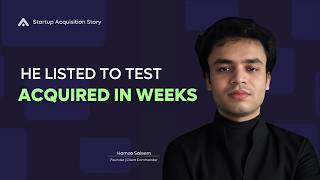
Hamza Saleem built Client Commander as a side project and listed it on Acquire mostly to test the market. Two weeks later he got an offer from a PE-backed buyer at his expected price and sold. He now advises founders to be fully transparent during due diligence, since hidden surprises kill deals.
Chapters
All right, I'm here with Hamza, who recently got acquired. Hamza, how you doing today?
Good. How are you, Andrew?
Doing good. Thanks again for coming on the podcast. I'm excited to hear your story. Before we dive into that, do you want to give a brief introduction for people that may not know you?
Yeah, I'm Hamza. It's H-A-M-Z-A-S-A-L-E-E-M. I'm the founder and director of Hamstack and Client Commander, and we are building autonomous AI agents to automate workflows. And yeah, looking to— was looking to sell on Acquire and it was a great experience overall.
Right on. Well, tell me about Client Commander. What problem did it solve?
What did it do? So Client Commander is— was basically a CRM, particularly for real estate and recruiting industry. And the idea came from my previous iteration of similar CRM, which was already working and I had some clients on it, so I was pretty familiar with the market already. So when I built Client Commander, I actually focused on some different sets of things like marketing. So I was trying to build something that would be useful for anyone who is looking to automate their business and have a bunch of good tools, especially with AI growing. They should have all the tools in one place to automate their business. And that is how I built the whole whole system. And it only like took 2-3 months to complete it. But then once the feedback, feedback start getting in, I was spending some more time on building some features on it. So it was really just me doing some sort of a side project. It was nothing serious at the start, but it get pretty big pretty quickly.
Nice. What did you do to market the business? Tell me how you got the first customers.
So marketing was— so online marketing was not my particular expertise, nor I spent a lot of time on it. So as I said, I was already in the business, so I just reached out to a couple of companies. I called them, emailed them, and told them about Client Commander, made some videos, made some introductions. And yeah, that is how I got my first few customers. And then the rest of the customers got from referral and online SEO and a little bit of posting that I do on my social media. So I wasn't doing proper marketing. Yeah.
Nice. So it sounds like things were going well. You had product-market fit. What made you ultimately decide to sell the business?
Yeah. Interestingly, I wasn't actually trying to sell it. I was— so I knew Acquire already. I knew, I knew you, I knew MicroAcquire already, and I was familiar with the market of how people are selling these startups nowadays. So I just, I was just testing the waters. I just posted it on required to go through the process because it was my first listing and I wasn't even sure if I want to sell before I start getting good offers. I mean, I was surprised how many companies are there already on the platform who were looking to acquire something like this. And once I started getting queries, I think it took about 2 weeks to just get my first offer from a company. And that made me double think about, about if I should just let it go and focus on what I'm building in my company mostly. So using AI and stuff, so AI tools and stuff. So yeah, that is when I decided to just sell it.
Nice. How did you end up selling to the final buyer? Was it the valuation? Was it the deal terms? Did you guys just get along really well? What made you decide to sell to this particular person?
So, so this was more of like a corporate company, like corporate business. So they were already have like access to private equity and they were just looking to acquire a bunch of different softwares related to different industries and then just grow them on their own because they had like full marketing team and stuff. So when I got a call with them to demo the system, I actually just was talking for an hour and there were like 10 people on the call and they were just listening. And that is when I understood that, I mean, this is something that they are interested in because from the start there weren't many questions, but once the call was done, they just sent me the LOI and they were very happy with the demo. So I didn't have to actually do a lot of work for that. And neither I discussed anything else. So this was like very quickly. I just got the LOI. I just got the offer and decided to accept it because it was near to what I was expecting.
That's amazing. How did due diligence go? What was that process like?
Yeah. So it was, again, as I said, with a corporation like this, it was a little bit of overwhelming side for me because as I said, I wasn't actually looking to sell and I didn't have any previous experience selling. So I had to actually ask a lot of questions and they were kind to respond to all of those. And that is how I, I mean, they bring up the profit and loss statements and other documentations that were needed to some. So we actually didn't use the on-platform due diligence portion of the listing. We actually just did through emails. So they were just sending a bunch of questions from their engineer and I was just responding it, like attaching some documentations and video recordings to tell them what exactly to do. And where to look for, for a particular set of functionality if their, their engineer wants to take a look at, look at the code base or anything.
Incredible. What did you do to celebrate the acquisition when the money hit your bank account? Did you go to a nice dinner? Did you buy anything cool? How'd you celebrate?
Well, I did a few things with my family, but mostly I added all that money to my AI accounts to actually fund the next thing that I'm going to build. Because I mean, I want to spend all that time and money to fund the next big project that I'm building. And I think I'll actually be deciding to sell that. So I'll be planning differently for, for the next project because that is something I know it's a market fit and I have done some research. So I think that is where most of those funds will go.
Love it. If you were talking to another founder and they were looking to sell, what do you think some advice you can give them?
Sure. So, as I said, I mean, this is not something I would be expert on to— I mean, yet to give somebody good advice on how to sell or how to list, but it's very important to be transparent and it's very important to just share everything you have as it is without making extra effort to make it look good. Because I mean, the effort you do making it look good, it actually doesn't matter a lot because sometimes buyers who are looking to buy, they are not looking at it through a perspective of a customer who want to use that system. They are also looking to sell. So they might also be a founder. So they also would appreciate if you just give it to them, everything as it is. And there can be problems in that. There can be some things that are not working correctly. If you're talking about an application that already has customers and there might be some problems that you might have support tickets pending. So I think it's important to be transparent. Yeah. And if you just share everything as it is, you might have to answer a few more questions, but that will also put you in a good spot.
Then, yeah. I think that's great advice. You want to know what the number one killer of deals is at Acquire?
Sure.
It's surprises. When you're not transparent about everything and you try to make everything sound perfect and then you go and do due diligence and it's not how you advertised it, and that makes deals fall apart quickly. So completely agree with your advice on transparency.
Yeah, I can imagine that. Yeah.
Well, Hamza, tell me what's next for you. Now that you've been successfully acquired, what's next? Tell me more about the new business.
Yeah, so I've been very much working in a recruiting business with some of my partners, and we have been doing very good in that industry. I mean, I've worked in recruiting or real estate most of the time, so I've built a lot of systems, a lot of automations, and have set up a lot of, a lot of things for people who work, who are doing real estate and recruiting. So I think next big thing would be to actually remove the bottlenecks that currently recruiting business face, which is not having good tools to analyze candidates for particular jobs. So who don't fit the job criteria, or if someone is talented and they just don't know how to get a proper, proper job to them. I think some things to build there, and there's a gap to fill where using AI there would be tools that would correctly analyze and correctly connect the job to a person who deserves it.
Love it. I'm sure I'll see you potentially back on this podcast with another huge acquisition. Hamza, where can people follow you online to learn more about your story?
So I'm mostly active on Twitter, so they can just go to Twitter. It's _hamza_saleem. That's my Twitter. If someone is looking to sell and they just want to chat and see how they would set up the documents and how they would go through the process, I'll be more than happy to chat.
Right on. Well, congrats again on the acquisition and thanks again for coming on the podcast.
Thank you. Yeah.
Cheers. Cheers.
More from Andrew



The Buyers Who Made the Move: What They Bought, How They Did It, and What Happened Next






