How Focus Led to a 30-Day Startup Exit
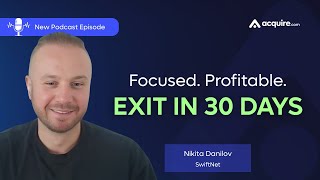
Nikita Danila sold Swiftnet, his multi-carrier router service for RV owners, 30 days after listing it. He'd built it to 300-600 active users using Facebook ads and Shopify funnels, then exited to focus full-time on Upside, his other brand selling through Amazon, Shopify, and 400+ retailers including Urban Outfitters.
Questions this video answers
Between 300 and 600 active users.
30 days (from first message to close).
Started Swiftnet in summer 2022 (zero-to-launch in under ~10 days).
Soft launch January 2021.
About 400 retailers (small/mom-and-pop shops plus some larger lifestyle retailers).
Foreign. I'm here with Nikita Danila, the founder of swiftnet. Nikita, how you doing today?
Good, good. How are you doing?
Good. Well, hey, you recently got acquired and I'm excited to hear the story. But before we dive into that, do you want to just give a brief introduction of yourself for people that may not know you?
Yeah, My name is Nikita. Been doing startups and e commerce and tech startups and just basically entrepreneur stuff my whole life. And definitely took a lot of practice. A lot of failures. Some successes actually. No, no failures. Just lessons. Really good. Really good lessons all the time. And yeah, swiftnet is the first company that I started from nothing and scaled up a little bit and was able to pass it on to to a new owner who is now planning to really take it to the next level.
Right on. Well, tell me about swiftnet. What problem did it solve? What did the business do? Let's start there.
Yeah. Well, swiftnet is a rural area and especially one of our biggest customer bases is RVers. Right. Huge industry in. In the US obviously, a lot of people have RVs. A lot of people love to travel, big country, beautiful places. And the problem that it was solving is that you can go to like AT and T or T Mobile or Verizon, vital hotspots and things like that, but there was nothing, or at least very limited options on something that you can buy, put it in your RV or even have it at home. And then when you go. And when you go out in your rv, you can just bring the router with you, plug it in and be connected like, and not need to change any passwords or turn the hotspot, the hotspot off and on again, connect your devices again. It's just a, you know, it's just a pain in the butt. I just want to watch my TV in my RV all the time. Or, well, not all the time. Hopefully you're being adventurous and outdoorsy, but you know what I mean? And essentially, yeah, I had absolutely no experience in with Internet and had no idea what broadband or anything is, but I kind of learned about the fact that this industry is there, and I looked at some options that are available and I just thought to myself, well, I have a lot of e commerce experience to start with drop shipping. I caught the last year of the golden age of drop shipping in 2018, back when you could click a button and on Facebook, just some ad and boom, you're making money. That obviously ended in like 2019. But that experience kind of taught me how to work with Shopify and set up email flow or SMS flow and just, just things like that, how to capture the leads and what can I add to run that will have a good click through rate. So just basically, yeah, all of those lessons as I said earlier, right. Kind of gave me the education that I needed that I was like, I can do this. I mean I just need to figure out the. Learn the technical aspect of it. Right. And then, and then just some Googling. Yeah. Get yourself a little educated. It's. But essentially from zero to launch it was less than, less than probably 10 days.
That is incredible. What a story. Did you have this problem yourself? Do you have an RV of your own?
I, I don't have an RV of my own, but I did stay in RVs a couple times. We just, I would, we just rented like RV for a festival or like that. And I was thinking, wow, this is really annoying. Like I have to turn on my hotspot on my phone to connect my computer if I need to work and things like that. So I kind of experienced it. But it wasn't like a daily, daily thing. Right. But with that said, when traveling, like just like going to Utah or some national parks or things like that, I realized, wow, it's hard to get Internet sometimes. Like oftentimes if you go to a small town, right. And then my phone's T mobile if I'm in an area that T mobile is not, not doesn't have coverage. That's it. But AT&T does like you're out of luck. Right. And so I quickly realized, wow, what if we offer something that they can use like all three and turns out there was options to do that. And yeah. And so yes, to answer your questions in short question short, I did experience it myself, but it wasn't like on a daily, daily thing. Like I have normal Internet at home, but, but I definitely knew people that who this would, would be helpful for and if I just made it, if I just made it like easy to try risk free and not try to like scam people or, or take out every dollar. Right. If you actually try to let it just give the value, the money, the money is the side effect. Right. People will give you money to show that whatever you're doing is valuable.
Yeah.
And so, so I just took, I kind of honestly, I think Jeff Bezos is. Yeah, this is what Jay Bezos said in one or a couple interviews where he basically says like just we are focused on the customer. It doesn't matter if we lose a little bit of money as long as the customer is Happy. All is good. And I kind of took that culture, I guess, into this business, which is why I think it survived and succeeded and so on. Is. Is because, yeah, people just need to trust the company. And then once they trust you, how often do you change your Internet provider? Like, that's amazing, right?
So give me a sense of the scale of what you built. How many customers did you end up having at the time of sell?
Well, we have a lot of. We have customers that are like, activating, reactivating service because we have. Because we have the. It's month to month, right. So we give people the opportunity. If you need to pause it, you can, but it's between 300 to 600 active users, so it's not even that crazy. Right. But when you have a loyal customer base and it's a subscription business model, it just keeps growing that way. As long as you're doing everything right in the way that, once again, as long as you're keeping them happy.
I think what you build is absolutely incredible. It's such an interesting. And it sounds like a untapped opportunity, but it's just the last type of business I think a lot of entrepreneurs would look to go at, which I think is probably a big reason of why you succeeded, is you just were able to narrow in on such an interesting market opportunity for such a specific type of customer.
It is very specific. I was surprised myself. I don't remember how I found out about it, but I just kind of saw that. Wow. Yeah, this is interesting. This is not just selling some more iPhone cases on a Shopify store, you know? Yeah.
So how did you find all these people with RVs with this problem looking for a solution, money in hand? Like, you literally found, like, it sounds like close to a thousand of these people. Like, how. How did you get the first, like, hundred Facebook ads?
You just. Just Facebook ads. So if you. You just have to learn or partner with someone who knows how to run Facebook ads on an extremely small budget. Right. There are certain, like, tiny tricks they can do inside of the business manager, like duping the ad sets and just setting up the rules. It may sound complicated, but once you kind of know it, it's literally copy and paste. And so ultimately, as long as you know what a good ad should look like, like, there's specific, specific things that, once again, I learned from my dropshipping days. Like, the first three seconds, you must show a human.
Right?
And then you must answer what you are within the first, like, six seconds. Right. The first three seconds, you're not Showing a human the click through rate is a lot worse. So you're going to be spending a lot more anyway. So I just took all of those experiences selling iPhone cases and things like that and put it, put it into this and the budget was like I started maybe like $20 a day and then on day two after launch, first customer purchase, I was like, all right, awesome. And then from there you just keep, keep going like, like that. But Facebook ads is still by far the Facebook and Instagram meeting, right? Meta ads, by far the number, the number one thing and you can. And I didn't even, even up till now. I didn't have a single influencer. I didn't have a single like what would. Yeah, I guess influencer partnerships. I didn't do any TikTok. I didn't do like any of it. Just specifically Facebook page and run the Facebook ads.
Nice. Do you think Facebook ads could apply to any sort of startup? Is there like limited, you think anything know everything.
Facebook knows everything about you. Maybe more than you know about yourself. If you have it, if you have Instagram or Facebook or you use it even a little bit.
Yeah. Let's say you were talking to a founder that had like a, a small budget. They were looking to use Facebook ads for the first time. Do you have any like piece of advice you give them? Like you mentioned ads are super important. Obviously like person and first three seconds.
Yes, I would say how I started, I bought a drop shipping course. I was lucky that I actually got one that was really, really good back in the day 2018. But essentially if you're not doing drop shipping, if you already have a company, you just want to learn how do I run Facebook ads? Because by the way, do not hire advertising agencies. That's the one rule that I applied to this business and that I'm applying to all my businesses. The one that I'm moving on to right now as well is that if somebody comes to you and says, oh, pay me a retainer of whatever, 3000, 2001, even if it's $100 a month and I will run your ads, just say no right away because they will not, they will not care. They don't care if you're profitable or not. Right. So two options. It's either you partner with somebody who already knows how to do it and he just takes over and you guys figure out either he becomes a shareholder or you profit share, whatever that may be, or take the time and just learn the basics yourself. You can find there's so many courses so I would just advise drop shipping course, Facebook ads, drop shipping course. If you like, just, just look that, look that up and within one week you'll be good.
I think the reason I, I think this is such good advice is I love how you're bringing up dropshipping. I think a lot of entrepreneurs would say drop shipping is a terrible business, blah, blah, blah, blah. But what I think is, you know, like any business, to make drop shipping successful, you have to be really good at marketing. You have to know how to get the product in front of people. You have to know how to differentiate. And it sounds like what you've done in your career with this business to make it really successful is you applied a lot of marketing tactics that you would learn from a different industry and applied it to this business and did really well. Would you agree with that?
Yeah, yeah, absolutely. I mean marketing is. Well, there's a lot of different types of marketing, right? But if we're talking specifically Facebook ads and meta ads, it's, it's the same. You have to bring the customer to your website. First of all, you have to make the customer watch your video. Don't run, don't run photo ads. They will tell you this in the drop shipping boards. Of course you can run retargeting image ads, but only video ads. But you have to know, how do I make that 30 second video good enough for people to watch at least half of it and then want to check out more. Come to the website, right? And then when they come to the website, be sure that you get their information right. Give them some kind, a discount or whatever, whatever you need to make sure that you can save their email or phone number or name, right? So it's just the funnel. The funnel is the same in any business when it comes to meta ads. So yes, absolutely. Drop shipping is a great. And it's, and it's also how you do it, right. Like there's been, there was a lot of scammers back in the day, right? Never shipping the products. But if you do it right, even drop shipping can ultimately turn into making your own white label product. That's actually what I did. I started off with just selling like this pearl oyster necklace thing. It's like you open the oyster and there's a real pearl. It's like cool product, right? Different. And then ultimately I ended up selling it on Amazon because it was, it was like I actually, you know, got the maid with the, with the logo, with my logo and and so on. So the point is it's, it's just how you do it.
I think that's incredible advice. Well, tell me this. It sounds like the business was, was doing fantastic. You were scaling business, you had a ton of happy customers. What made you decide to sell it?
Well, two, two things. First of all, first of all, I real. I realized that it's time to take it to the next level, right? So with our team and our, our resources, I feel like we kind of hit like the ceiling. So now it's like, all right, we have to hire more people. Actually have a dedicated marketing person on board. Right? Like, let's take it to the next level. But in doing that, obviously as the founder and by the way, there is no such thing as being completely hands off. You know, they say it's automated. There's also. There is no such thing. You can automate a lot of things, but your fingers are constantly feeling your own pulse in the way, you know, like so. Yeah. So because, because of that, I kind of sat down and I have another business here. I actually have a box here a cold upside. It's. This is, this is the anti summarized anti hangover supplement. It's a South Korean product. You eat one before or while drinking and in the morning you like, you'll be shocked. And it's all natural. It's, it's only, it's like I said, it's South Korean products. There's no aspirin, no caffeine. Anyway, without going further into the de details, but this company is like really fun for me because we do a lot of events. We have annual music festival which we've been doing for the last three years in Sequalia National Forest with like DJs flying from all over the world. Like it's, it's just really cool and it's right, right down my alley in the sense that I love, I don't want to say party, but I love to be out amongst people and socializing and meeting new friends and so on. And this company kind of entails that because we go to a lot of events and at the same time it's E Commerce, right? So it's Amazon, it's Shopify. It's the same skill set that I had from drop shipping and Swiftnet. So anyway, this company I've had since 2019 when first developing the idea and so on. So it's actually before Swiftnet. Swiftnet I started summer of 2022 and so I sat down and I was like, what do I see? My. I can't do both. I'm not Elon Musk unfortunately. And I actually like to sometimes enjoy and, you know, spend the weekends at the beach. So I just sat down. I was like, what do I see myself doing full time ten years from now? Right. And although Internet is incredibly lucrative, I just made a decision that upside is what I want to. I'm totally cool with doing this for the rest of my life. Right. And maybe. Maybe I don't. Maybe I will sell it as well later on, but kind of made that decision. And so that's when I decided to. Okay, well, let's. Let's start learning how do I sell a business? Because I've never done that before either. Like, zero idea. Like, what is due diligence? Like, I don't know.
Yeah, right.
So. But I was like, all right, well, as always, I'm like, I'll figure it out.
Yeah, absolutely. I think the process you went through to figure out which business you should focus on makes a ton of sense. And I meet way too many entrepreneurs that have, like, three, four different businesses. And the reality is, is they'd probably be much better off if they just focused on one, the one that matches their skill set the best, the one that they're most excited about, because then you could pour everything you have into it rather than, you know, being pulled in different directions. And that's a great product, too. You actually gave me one of those at our conference earlier this year.
Yeah, yeah, yeah, yeah. But you. We weren't drinking that much, so we'll need to do it again.
Absolutely. Well, tell me about the first week on Acquire. What was your expectations? How did it go? How many buyers reached out? Like, what was the first week like?
Well, the. So I actually first. When I just decided, okay, I'm gonna start planning to. To sell it, and I created an account to acquire. And I love that about Acquire, by the way. They. They came back and they. And I forgot who it was. But basically they said, great business within has a lot of potential, but you have to come back in, like, three to six months. You have to hit certain points to be there, which I thought is, like. I didn't take offense to that. I actually thought, that's great. Like, wow, Acquire actually does their due diligence and doesn't just allow anyone to list. And I. I assume that probably doesn't allow just any buyer or investor come in and make an account and just get confidential information with the P. Ls and everything. Right? So I was like, okay, sounds good. So then I came back, I think maybe five months after, and we. We got Listed and instantly a lot of, a lot of buyers were reaching out. And Kai, who is, who was my account manager, was very helpful, like answering questions and following up actually with the buyers as well. And so, yeah, the first two weeks there was a lot, a lot of interest. And then after that it slowed down a little bit. But still, but they were still trickling in and I was getting the calls, I was, I was doing, like, I was doing the interviews and we're going in in depth, which was great for me because there was practice regarding, okay, so a buyer is interested, like, what do you present him or how do you present it to him so that there's not a million things for him to look at. What are the most important ones? Right. So after, yeah, it was, it was great practice. And I, I can't say exactly, but probably at least like six months we were, you know, we had the list, we had the listing there, talking to buyers, doing all that. And then Kai. And then afterwards it kind of slowed down, maybe for like two weeks. So Kai and I sat down, we revamped the listing one more time. So we kind of added more details and things like that. And from that, from that point, I think within, within the month, the, the company that purchased Star holdings reached out, reached out and we started the conversation. And the craziest thing is that, you know how some buyers, like, okay, well let's do a follow up next week or like in two weeks and things like that. From the day of the first message to close, it was 30 days.
Wow.
Because of the experiences that I had for whatever six or eight months of talking to all these buyers, I already knew. Like, okay, first you figure out, you have the initial call, then you sort out the loi start, by the way, and then the, then the purchase agreement, right? And, and so kind of like, because I knew the structure of how businesses are usually sold, I didn't have any questions. And so I could not push the buyer, but just ask the questions like, okay, loi is done. Let's, let's start this next, right? And then, you know, if they say, okay, let's schedule a call for next Wednesday, I'm like, it's Tuesday. It's. It's Wednesday. It's Wednesday right now. It's 12. Why not do it right now? How about a call an hour? Because if a buyer want, because if it's a good buyer and they actually want to move forward, they move forward fast. That's, that's one thing learned.
If they're serious, you're super, super Spot on. That was, that was an incredible just recap of, you know, that initial period where you're getting towards the offer and great job sticking with it too. We see that with a lot of acquisitions where, you know, initially you'll meet a lot of buyers, but it takes some time to meet the one that's going to finally buy your business and spend an offer. And I think another just great tip that you shared was, you know, be fast when buyers reach out, like schedule a meeting that day, answer their questions quickly, don't let things sit, because it's really just sales at the end of the day where when you follow up quickly and you show that you have your stuff together and you can move quickly, you're going to get that in exchange from a buyer. Exactly. I guess my next question is, what was the hardest part throughout the whole acquisition journey? Was it that six month period where you were just trying to find a buyer? Was it due diligence? Was it something else?
I guess maybe like psychologically there's actually, this is really important for everyone who's selling for the first time, is that when you listed your business and so on, and you made the decision to sell it right, you can't relax in the sense that, okay, I'm selling it. Think like you're not selling it and it's still your business and you're still responsible to yourself and to your team. If you have a team to continue growing. Because if you're not growing, you're dying. There's no such thing as. And you know, sure, you can have a little plateau, but if it, if it, if it stays for too long, ultimately you will end up going down. So you constantly have to have this, this feeling of pressure that every month I must, I must grow, grow by 1%, grow by 0.1%. Like to me in On Shopify, if month to date suddenly went into the red, like of even 2%, I would be like freak out mode. Like, okay, cancel all plans. Like I'm doing these sales calls myself type of thing. Because, because while the due diligence or talks with the buyers are happening, you know, mine was quick, like a month. But all right, let's say your business is more complicated and it takes you three months. If your business, if you relax and it starts going down, you're jeopardizing everything. So don't think that when you listed it or you made a decision to sell that it's sold. It's not incredible advice. You might not sell it for another two years. How do you know Right. But so you have to continue making money and growing. Growing is, is important. Even by 1% a month. Even by 0.1% a month. Just as long as it's green at the end of, at the end of the month.
I could not agree more. I think that's incredible advice and it's true. Like if you can just get 0.1% of growth, that's so much better than negative 0.1 or something like that. But it also helps acquisitions close as well. When you're in even, let's say due diligence. Like if you're able to show the business is trending upwards, that makes everything so much easier. And then when it starts trending down, that's where every discussion with the buyer is going to be about the decline. Why is it declining? What's happening? Can we negotiate a better price? I don't want to pay this valuation because things have changed. So you're absolutely correct. Keeping growth on track is, is massive. What did, what did you do to celebrate? You had a, you know, fairly life changing acquisition. What did you do when it all closed and money was in your bank account?
I thought that, I thought that, all right, we're gonna throw a party or, or something like that. Literally the day we closed, it was Wednesday, right? Like escrow was released and actually the money hit, the money hit my bank account. We started, we do, we had calls all day transferring the assets and things like that. But at from 6am was the first call because they're eastern time. Right. So it was, it was a long day. Right? From 6am to 6pm I was at the office. And then from there I had to go home, pack and head straight to Upsides annual festival which was happening in two days. So I had to drive to Baker to Sequoia National Forest to start organizing that. So to answer your question, nothing. Like I didn't celebrate at all. It was just straight back to work mode. And then when I came back, obviously the transition and then was even busier with Upside. And so yeah, I just continued, continued on like it was, nothing happened in a way.
Oh man, Nikita, you are a true entrepreneur. No, no days off.
I try to take Saturdays and Sundays off. I try to take it, but, but, but yeah, there was no celebration, which surprised me.
You know, I, I, I can, I, I hope you get those off because you, you deserve it at this point. If you're talking to a founder though, and they had a business they were looking to sell, what's maybe one other piece of advice you would give Them you mentioned a few really great ones, but is there another one you'd share with them?
Yeah, one other one would be for the buyer who you're talking to. They will ask this question or maybe they won't, but you should tell them, what is your plan? How, how to 10x it. Like, what do you need to 10x the company? Let's say within the next month, right? Let's say that everything's available, resources are available. Just imagine, right, not being crazy, I need $100 million. But like, what is your plan that you could share with the buyer? I'm passing this on to you. Do this, edit it how you need. But if you do this, you will 10 exit. So have that plan. Or yeah, the work of action that you can share with the buyer because that will make them feel way more confident with the acquisition. Acquisition. Because they're like, okay, well, I know what to do to get my, get my money back. And more obviously, because why are buyers buying a business? Is to scale it and to make more money, obviously.
I think that's great advice. Incredible advice because you're right. I think just putting yourself in the shoes at all of understanding, like, yes, buyers are looking to get a return on investment. And if you can show them the path on how they could potentially do that, that'll get them more excited, that will potentially lead to an offer from them and just make everything that much smoother. In terms of the exit, tell me more about what you're doing next. I know you, you mentioned upside. How big is it? You said it was in business since 2019. Where can we, where we buy it?
Well, we did it was it. We started developing it in 2019. Right. But we did the, like the soft launch, I guess you could say January 2021. So it was Covid.
Right.
So for a party product, like all of our plans of like, okay, we'll put in bars and this and that, like, everything's closed. It was locked down. Right. So it was a soft launch. You could, you could say, right? So really it only started going like, we started making moves like summer of, summer of 2022 in a way. But yeah, this is my full time now. With that said, I'm part time and very heavily part time still with swiftnet because, and by the way to. So everybody knows when buyers buy your business doesn't mean that you just leave. They will typically want you to stay and they. Nobody will pay you 100 up front. Right. Because they want you to be there to help them, which makes perfect sense. So you have to actually be confident in that, that you can 10x your business and have a plan like you, you know, you can't BS your way. Maybe some people get lucky, they just BS their way, but typically not. Right. So essentially yeah, I'm helping part time with swiftnet and regarding Upside, Amazon and it was just essentially kind of like on autopilot, right. I use a lot of AI so for the while I was working on Swift and heavily it was just essentially Amazon and retailers who would buy from us. We're, we're like 400 something retailers. But the small mom and pop shops, no like massive chain chain stores. Right. So now the goal for me with Upside is to scale our retail. Finally start running Facebook ads because I can have the time to like manage it. And once again taking, taking the swiftnet experience and taking the drop shipping experience, implementing it to the brand for retail and getting into, getting into larger, larger stores. Like we did get into Urban Outfitters. They reached out and stock Stockdust and Anthropology. So now it's like getting it on the shelves at liquor stores essentially. You know, because for any brand being in stores, some people say, oh, that doesn't matter anymore. No it does. Wholesale is majority of the business always if you, if you can make it, make it work. So yeah, that's, that's the plan for me. An upside down focusing on growing the retail and getting more distribution.
Right on Nikita, I love how you're, you know, you had one successful exit. Now you're moving on to what appears to be a much, much larger business. And I'm sure this is going to be really successful. Keep trusting it, man. I love to hearing your story. You have a ton of just great wisdom and advice. For those that want to keep following your story online. Where can they find you?
I guess, I guess you can find me on Instagram. It's just, it's easy. Kind of matches the vibe of the vibe of Upside. It's Nikita will vibe. Yeah. And I'll be sure to try and post more things on regarding, regarding business stuff. You know, I post a lot of upside, but if anybody has like questions, please DM me. You know, I always try to get back and, and kind of like help if I can. I think that it's important. You know, there's been people along the way that gave me advice and answer questions for free. Just giving value and I think it's nice to put that energy out into the universe because I do believe that when you give out the good vibes, they actually come back tenfold. To you. So, yeah, please DM me. I'll. If I can, I'll love to help.
Right on. Nikita, you're a legend. Congrats again on. On the acquisition. And thanks for coming in the podcast. I'll. I'll be sure to put all that in the show notes.
Cool. Thank you. Thank you, man.
More from Andrew



The Buyers Who Made the Move: What They Bought, How They Did It, and What Happened Next






