How He Turned a Startup Shutdown into a Profitable Acquisition
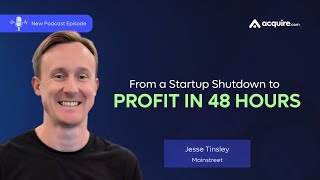
Jesse Tinsley, CEO of Main Street, acquired Bench after it suddenly shut down, getting customers back online within days. He explains his acquisition-led growth strategy for building a back-office platform for small businesses, and why buying struggling companies often beats building from scratch.
Questions this video answers
November 11, 2025.
Term sheet/letter of intent by the end of the day (Saturday) and restored service by Monday morning (~4–5am Eastern).
Guest cited media reports mentioning approximately $9 million (cash) but said he could not confirm the exact price.
Guest stated that on an adjusted EBIT basis the business reached 'low eight figures' in 2025.
Guest stated Main Street is in the 'high eight figures' ARR.
Chapters
Foreign.
I'm here. Jesse Tinsley, the founder and CEO of Main Street. Jesse, how you doing today?
Good, Andrew, thanks for having me. Excited to be here.
Yeah, thanks for coming on the podcast. I've been following you from a distance. I've heard a lot about your acquisitions. But for those that may not know you, do you want to just give a brief introduction of yourself?
Yeah. So the version is I grew up in the Bay Area. I went to school with a bunch of tech founders, kids. So I got into tech pretty young, one of which was Steve Wozniak. So I had all the latest Apple products growing up from like 10 onward, which, which was definitely helpful later on in my career. But yeah, went to school, went to college, dropped out, started a consulting company in recruiting and helped scale a bunch of different companies like Coinbase Scale, AI and, and others, and kind of saw that playbook for talent density and started another company which kind of became the genesis for Main Street. Lawyer.com, recruiter.com, everything. See today. So live in Sacramento these days. And that's the. That's me. That's 60 seconds, the short version.
Right on. So how do you think about entrepreneurship? I know you run employer.com, you, I believe, acquired Main street and a few others. Do you. Are you a fan of just build from scratch? Are you a fan of buy and roll things up together? What's your view on you're currently doing and tell me more about that.
Yeah, so I think that the biggest thing for entrepreneurship is like, what's the, what's the strategic, like inflection point you're at in your market, right. And like identifying the macro trends that are happening. I think that's kind of how I look at it. So right now I think is a great time to buy businesses because I think that generally SaaS is undervalued in the marketplace basically because of AI. SaaS multiples have swung too far to one side and so there is a bit of a pricing inefficiency there. But I think the best thing to do is to be, you know, long term is to be to produce your own products and go to market. But I think right now, thing I've been talking about a lot on social media is distribution. So the biggest thing for startups when you can have, you know, I can go on replit and basically go and code, no code, you know, by code, a solution and literally hours and get an MVP going. I think that with that, the biggest thing when you have thousands of new startups every like week or month is distribution. How do you get customers? How do you keep customers? I think that is where we've been focusing a lot of time and effort to get scale. So I think that's a moat. Nice.
Tell me about your businesses. What do they do? What problem do they solve? How do they all piece together?
Yeah. So originally we. We acquired a few companies. We rebranded everything under Main Street. The simple way to think about us is like G Suite for business back office. Main street basically automates for SMBs like accounting, tax filing, bookkeeping, workforce management and payroll and like SMB banking. So it's like the simple way. Like a better comparison might be even rippling for. For small businesses focused on the accounting and kindness side, which the payroll HR side.
Nice. How did that acquisition go down? Because you acquired Main street and then you also acquired. I'm creating a name. I think it was maybe Bench. Bench. It was Bench.
Bench was the big. The big acquisition beginning to Europe with. They shut down abruptly on a Friday night. I remember that.
Yeah. And you came to the rescue. Tell me about those.
Yeah, so Bench was a really unique situation. I was actually on vacation again. It was just after Christmas. I was in Florida and I actually missed the news of like Friday night. I think the co founder, original founder and CEO posted something about on Twitter that went viral and then, you know, Ben should abruptly shut down. And we. I didn't hear about it till Saturday morning. And you know, I think it's probably the quickest acquisition, maybe history. It was pretty, pretty quick. It was basically, you know, we had a term sheet out by the end of the, like in the letter intent by the end of the day and went and had the service up and running by like Monday morning at like 4 or 5am Eastern. So it was pretty crazy. And I mean that's. That's a business that had zero employees, you know, zero customers technically at the time because it had shut down. Basically everything was at zero. So it was quite the sprint.
How did. Walk me through how you made that happen because I remember when the shutdown announcement came out, a lot of customers came out upset. The co founder had the viral tweet go out. Did you just reach out to one of the founders? Did someone approach you?
Did you. Yeah, I had a acquaintance that I was connected with on LinkedIn that was on the C suite. So I reached out to them and asked to be connected to the board and they connected me to some of the board member. Like I think the. Yeah, a few different board directors and anyways, picked up the conversation there. So it was a whirlwind. I didn't sleep much that weekend, nor did our team. But it was a quick turnaround and it was kind of on our radar. Like, take a step back. Like, this wasn't some random acquisition. We had bought a ERP component, like enterprise Resource plan like component, and we were looking for an accounting and like general ledger solution that we were going to API into or like either partner with or build our own solution. And so when this came about, it was very opportunistic because I just talked to my co founder and CTO Ben week prior about this exact type of like thing we need to build in Q1. So it was just very fortuitous timing for all intensive purposes.
Nice. How do you value a business like that? Because they were technically shut down and then I assume you acquired the assets and the customers, but the customers also technically were, I assume, canceled because they made that announcement. They were seasoned to operate. Like, how'd you value that?
It was definitely more difficult than most with a lot less information, very condensed diligence time window. So in that case, like all things, it comes down to price, right? So like you got a really good price, I think on the business overall to make that make up for the fact that things were not in the best of shape and I mean, by the way, and also further going to go into further decline come Monday or Tuesday of the following week. Right. Because now you have like a melting ice cube effect where you have an ice cube in the hot sun, all your customers are just churning out. Right. And all the competitors be reaching out over the weekend and Monday. Right. So that's point being is you, you would get a very good price. I think some of the reports I want to say by Axios and others had reported, I think 9 million or something like that, cash, something like that. Like that's what was reported. So I can't confirm exact price, but some, some number that was a lot lower than overall, I think, like enterprise value from my perspective.
Nice. It seems to have been a good acquisition too because the services now up and running, all the customers are happy.
Yeah, yeah, totally. And we're running. Right. I think it's important to note to like anyone that's using like Bench now rebranded as Main Street. Like we're profitable, we're bootstrapped. There's no, there's no interruptions of service that that can happen moving forward. We've, we've turned that from a business that was focused on. And this isn't a knock on Bench, just to be clear, I think this is like some of the 21, 22, 20 companies grow at all costs and they had really good growth and they're one of the leaders and that was awesome. What we're really good at is operational efficiency and everything else. So, you know, you went from a business that was burning a lot of money in 2024 to like now on a EBIT adjusted basis, you know, low eight figures and EBIT in 2025. So that's quite the swing from operating in a loss for focusing on growth versus focusing on, you know, efficiency of dollars essentially.
In about the Main street acquisition, was it in a similar spot where they needed a buyer? I know they had raised a lot of venture capital. I assume maybe they were underwater on that capital and they were looking to sell, or was it different? I don't know what their water.
I don't look at waterfalls so much. I think the. I can't speak to like what their valuation. I don't actually know like what the previous valuations were. I think there's some TechCrunch articles that talk about that. But what I would say is that more importantly, we've become like a very good like, like steward of businesses that are like really great. I think Main street, the RD tax credit solution is a fantastic product, right? Like with a business that scaled to, you know, eight figures in revenue and was profitable and doing really well. But the tough part right now is again, when you go back to like that distribution channel is like, do you have a path to be like a venture scalable company, be a $10 billion company, or are you kind of stuck in this couple hundred million dollar valuation range and like you have like steady growth, but it's not like parabolic, right? Which is where VC dollars go long term. So we got introduced by one of their investors to, to Main street. And again, this is because we've had a good track record working for other funds like Greylock and Excel and others that brought us, you know, businesses they've rolled equity into. And, and same thing I think applies for, for Main street without getting specifics of the deal, but they have a fantastic business. It's a very nice component to what we offer now across all things accounting, bookkeeping, tax filing and tax consulting, as well as like tax R and D tax credits, which if you're a business and you're not using it, it's just free money like R and D tax credits for Main street or we don't charge you unless you save money on like taxes for R D tax credit filings. So definitely worth checking out if you're not using it. And you run technology business, love it.
Where are you going with all this? Are you trying to take these companies public? Are you keeping them private? Are you focusing mainly on profitability?
We're focused on growth, contrary to like, we obviously like to operate in the black is how I call it. But you know, I think focus on growth and, but like sustainable growth. Right. So instead of like burning money, we'll spend exactly every dollar we earn towards growth and long term. You know, we want to be the number one accounting software platform, you know, for SMB and eventually mid market and enterprise customers in the world. So I think like, you know, we want to be like the modern day, you know, QuickBooks essentially, but with a full platform for SMBs which I don't think exists currently in the. Everyone's using lots of point solutions. Right. So you use like Carta and QuickBooks and like Gusto. Right. Like you should have a platform that has all of those together. Not that we're competing with Gusto on the payroll space, but more so like finance and cap table management and accounting, all that. So yeah.
What other acquisitions are you looking at? You don't have to give specifics but I assume your strategy is to buy other companies and continue growing your portfolio of products or do you plan to build other products?
Yeah, it's really just a market like timing thing. I think right now we look at like the pace paradox of like how long does it take us to like build and then like go to market with that product to get the same revenue versus just buying today and arbitraging that delta in time. Take that time. But we'll, we'll continue to build around like everything that gives you full data insights across the financial stack from like contracts to invoicing to you know, bill pay to, to SMB banking which we just rolled out and lending eventually and other things and everything in between. So basically had a full like you know, financial stack for SMBs in one platform. That's awesome.
You were talking to another entrepreneur that was thinking of buying instead of building. What's like some tips you would give them in terms of maybe red flags to look out for ways to think about it.
Yeah, so if I was buying, I think like giving advice, I think the tough part is like we've, I've given other deals that didn't fit our thesis or like what we're doing to other entrepreneurs and oftentimes they'll overpay like on legal and like, you basically need to have like a fixed cost. Right? Because the, the deal is only as good as the value that you're expending to like get in. Right. So if you're spending a half million dollars on legal fees and we spend on average 75k, that's a huge significant difference that we're like. So you need to look at all your input costs, not just what you're paying for the business, but how much is your legal, how much is your accounting and everything else that you're doing due diligence that business and close on it. And I think that's really important that like, especially in the micro business side, like kind of like acquire. Right. Like with dot com, like it really matters how much money you're spending, you know, as an incremental in code. If I'm paying 2x ARR versus 4 might, the total yield costs on a small acquisition might be 4x. And you include legal and tax and every, you know, everything else. So.
Yeah, I completely agree. I see that all the time where legal fees run up to like 50, 60, 70k and it's like 100k or 200 or something like that.
Crazy. Yeah. Well, one of the tips I can actually give it like. So if you go and call a bunch of lawyers, I figured this out early on when I was doing my first few acquisitions. You call a bunch of lawyers and ask, I'm doing an acquisition, they're immediately gonna say, you know, 100 to 150k. Right. That's a good price point. Right. But if you say I'm doing a business transaction, which is true technically at a small scale. Right. A lot of these like deals are basically like small, like partnerships or businesses, like they're, you can call them acquisitions, but small scale, they're really business transactions. And you just have the lawyer charge you hourly for that. The business transaction is going to cost you 25 or 450k. But because you say it's an acquisition like the framing of it now is instantly a higher benchmark, even though the hours are the same. So it's a little bit odd, but that's a bit of a hack, I'd say. That seems to have worked better in my experience when I was doing like very, very small acquisitions a few years ago. So that's a tip. Get them to help you with the business transaction and then, you know, partnership, so to speak. And then.
That's clever. That reminds me of where some venues will charge you a lot if you say it's a wedding and if you say it's a family event, it's like a fourth price or something like that.
Yeah, I've never, I've never heard that, but that sounds exactly right. Right. It's just all the framing, like people willing to spend more because of the milestone or significance of said event. So. Yeah.
What are your favorite growth levers when you look to buy a business? You mentioned distribution a lot. Do you look at pricing? Do you look at synergies across customer bases?
Yeah, definitely synergies. I think the biggest one though, especially at like our scale now as we start to get much, much larger, the biggest things like team, like the alignment there, it's like, you know, like we want to make sure we're aligned with the team. So we also look at it from the perspective of like an aqua hire. Like are we getting good talent with them too? Right. And are they aligned culturally? And then I think beyond that we're looking for, you know, things that can plug into an end to end platform. So like things you can build off of a build around. We'd be much less interested in like standalone products that are completely disparate from what we're working on. So that's probably the big thing. My best advice for like any founders or people looking to get their business acquired would be businesses are bought, not sold. So like if you're trying to spend a lot of time to sell your business, what I would say you can definitely run a whole process and that's helpful and use a platform like Acquire. But I would say that like the best thing you can do is start to build those relationships and partnerships with like potential acquirers years in advance. Like a lot of acquisitions we've done have been with companies we've known for some period of time other than like Bench, but we've at least known people that work there or people that you know, we are familiar with the products and services with those companies. So that makes a big, big difference. Right. It makes it much easier. The trust is there and everything else. And I think that goes a long way with sponsors internally at larger orgs, especially in corp dev site.
Completely agree. I think a lot of entrepreneurs underestimate just how long a strategic acquisition can take and how important that relationship is when the time comes to sell their business. So. Completely agree.
There's.
Let me ask you this. If you had, let's say a million bucks and you were starting over entirely, you didn't have any businesses, you could go acquire businesses, you could start something new and an interesting space. What do you think?
You do.
You have to rewrite everything that you.
Know, I'll give you, I'll give you a better, a better answer to your question. I'll reframe. The question is I 0. How would I go scale to like a lifestyle business of like 1 to 2 million error. You can do it with zero. So that's really cool. I've been telling people this for like, I've been trying to shout this from the rooftops on like Twitter and stuff but. And I got way too many dms. But there's lots of businesses right now that like took venture capital founder, got burned out, left, and they're stuck at like a hundred to 500k. And those businesses go to zero. They literally I've had a deal like two or three years ago where we, I won't mention anybody, any names of anybody, but like I offered 75k on a business that like ended up going to zero. But you can do different things. Once you have like a base platform, let's say like uh, let's say you have, you build something yourself and you spit up some like no code solution. It cost you basically nothing. Let's call a couple hundred bucks right now. You can say, hey, my goal is to add on these other platforms we're gonna have like a micro role, like a tiny code like Andrew Wilkinson's company, right, where we're just gonna plug in all these great. But we're gonna do it from Micro Sauce or like Greg Eisenberg, right, That's done something similar I think with some different products on a smaller scale than Andrew obviously. But I think like in that same vein, like you can go and do all equity deals or all earn out plus equity, say hey Andrew, your business does up to K a day. I'll give you 100k a year for the next two years and then I'll give you a million dollars in equity or whatever the price is. And you can basically do that saying hey, the total enterprise value 10 or 5, whatever it is, your small business plus, plus this. And you basically negotiate deals like that left and right. They're all over my inbox. So if I was starting at zero, let's say everything I went bankrupt and I was starting over tomorrow I would just go do the same thing. Hey, I'm going to take sweat equity. So I'm going to take let's say $2 million. Your business is worth $2 million. I'll earn out my equity over this amount of time. I'll give you cash for your business on an earnout Basis plus equity in this new entity that I'm going to go build the next main street and build a billion dollar plus business. Right. So I think that would be my playbook for founders. I think you can do a bunch of micro roll offs where you can pay out small amounts of cash and bold equity and I think that's there all day, every day. I could roll up you know, a couple hundred thousand, you know, in a month basically. I think at least two or three deals of like that, that scale. So I think that is there. And then with efficiencies on like AI and automation and offshoring, you could basically run those businesses like very profitably and scalably like with a very small lead team and have a very nice lifestyle business. The true like four hour work week like you want. The true four hour work week. That would be it. Other than spending a lot of time in M and A for a couple months.
Yeah, I love that. I see it all the time at Acquire with people rolling out really, really interesting SaaS businesses and some of them build you know, some mini empires that are doing you know, millions in profit per year and they don't spend too much to get there. It's cool to watch. I completely agree with you.
Yeah, it's kind of an inflection point myself like too like we either go and like swing to like go do something really big, which is generally where I'm at. Ambitious like from an ambition perspective. But like you know we're, we're in the high eight figures in ARR and growing pretty quickly like. But I own, I have complete board control and own, you know, over 50% of the business. So like the point being is I don't have to go. Don't have to. You could run it as lifestyle business if you wanted to and make you know, quite a lot of money and have a really great impact on your, for your customers too. There's no, yeah, there's no scale issues.
Love it. All right, final question. Five years from now, where would you love to be? What's your ambition? What's your goal? What does that look like?
Five years is probably eternity. It seems like with how busy things have been, it'd be tough to say. I think like when I look out like a year from now, I think you know, we can hit, you know, mid mid 9, 9 figures ARR and like a very clear path of getting there ourselves and continue to grow to basically, you know, become the next, you know, accounting leader in the software space over the next, you know, the next year. Two years, three years and definitely over five. So that's where I'd see myself in that perspective.
Boring.
I'd say last thing is boring. Software is the best software. So anything like you have to have like so first thing you do when you start a business like accounting, payroll tax, like banking, anything like that that every business has to have or incorporation services like those things are very, very interesting even though they're not like sexy to the massive deals. It's a great business to.
Right on. Well Jesse, you're building a massive business. It's been excited, exciting hearing about it, excited to watch you continue to grow and for those that want to follow you online, where can they find you?
Find me on Twitter, LinkedIn and just Effy Tinsley. First last name and we'd love to connect.
Right on. All right, thanks for coming on the podcast.
Yeah, likewise. Thanks.
More from Andrew



The Buyers Who Made the Move: What They Bought, How They Did It, and What Happened Next






