How One Simple System Sold This Startup Fast
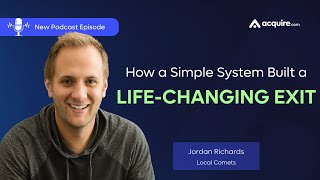
Jordan Richards built Local Comets, a digital marketing agency for home-service businesses, from lawn mowing to a sellable company. He documented everything in SOPs and videos, listed it on Acquire.com, and got solid offers in 30 days. He also navigated COVID, a failing marriage, and cancer diagnosis in 2020.
Questions this video answers
January 2020.
Yard care (lawn/yard services).
Month-to-month service agreements (no long-term contracts).
At least 200 videos (he estimated it felt like 200–500).
Within about 30 days of going live.
Chapters
Foreign.
I'm here with Jordan Richards, the founder of Local Comets, who recently got acquired. Jordan, how you doing today?
Doing good.
Hey, before we get into the story of the acquisition, do you want to give a brief introduction for those that may not know you?
Yeah. So yeah, Jordan Richards, owner, founder of Local Comets. Also kind of in my backstory. I founded another marketing company a little bit before that. Live in Utah, have a one year old son and loving wife, and love to do entrepreneurship.
Nice. Tell me about Local comments.
What did it do?
What problem did it solve?
Yeah, so we are a digital marketing agency. We do the classic stuff, web design, Google Ads, Facebook ads, with the main goal of helping our clients show up more on digital platforms and therefore get them more leads and work coming in. Right on.
What was the hardest part of building that business?
Man, there's this. The second you think you've learned everything, you realize you know nothing still. And then being in the digital space, especially with like, stuff like SEO, the second you got like a solid strategy down, everything changes. So just like the relentless, like refining of your systems, nothing's ever just finally got the system perfected. It's just always moving. And so that was definitely, definitely a challenge there.
As a marketer, I can completely relate to what you're saying. Tell me about the customers. What size were they? Were they any specific verticals? Were you agnostic, meaning focus on every type of client, or did you have a specific vertical that worked really well for local elements?
Yeah, so we. I'll dig into more of my backstory later to explain why we chose these verticals. But mainly we stuck inside the home service businesses such as cleaners, landscapers, plumbers, electricians, those kind of guys. And th. Those are who we focus on? Yeah, just the local. Local meaning they're small in their. In their local area, all over the United States. That's who we work with.
Well, tell me, why'd you focus on those types of businesses?
So the reason I chose. So our first vertical we really focused on was yard care. And the reason we chose that really intertwines a lot with kind of like our backstory, how we got started. So I'll kind of dig into that really quick. So back when I was actually in high school, I worked for this lawn care company, not doing anything fancy. I was really just the one pushing the lawnmower. And once I graduated high school, I get a. I get a call from my lawn care boss and he's like, hey, why don't you come work for me again? And I said, you Know, I think I'm done mowing lawns for. For one lifetime. I mowed, like hundreds and hundreds of lawns. You know, me and my buddy would work for him and mow like 30 lawns a day and, you know, five. 30 lawns a day, five days a week. You know, 150 lawns a week is. Is, you know, enough for me. And so when he called me, he's like, hey, why don't you come work for me again? Like, oh, no, I think I'm done mowing lawns. He's like, no, no, no, no. I heard when you were in high school, you took a web design class. And so I don't want you to come mow lawns for me. I want you to come work on my website, make it better. I'm like, yeah, sure, let's do it. He's like, sweet, you're now like the CMO of my company, basically. And I was like, whoa, okay, well, I am underqualified, but let's, but let's give this a shot. So I started, you know, working on his website. We were able to make all the tweaks he wanted. He had been going from marketing to market marketing company to marketing company, not really being satisfied with the service. And so that's for. That's why he gave me a shot. And like I said, we slowly, over time, kind of built what he wanted to be built. And then once we got the website down, then he's like, hey, why don't we try Google Ads? Then we got that figured out. He's like, why don't we try Facebook ads? Then we got that figured out. Why don't we try SEO? Then we got. So eventually we like made this service that really worked for his business and it started working for him pretty good. And, and he's part of other entrepreneurship groups, and other people in the group saw what he had and they wanted what he had. And they're asking him like, hey, what marketing company are you using? And he's like, oh, I'm just, you know, using this kid named Jordan. Kid definitely being the right word there, because like I said, I just recently graduated high school. And so they're like, oh, why don't, why doesn't Jordan come give me a shot? Come do that same thing for me too. So I actually at one point had four part time W2 jobs, kind of recreating the system that I made in the first company for multiple. So I said, once I had four W2s, that's when we realized there's A need in the market for this. So that's why one of those four W2s and I kind of joined forces and we turned it into a business named Kudos Marketing. And that's where the, that first marketing company was, was born. And then about a year and a half later, I started local comets that had the same service offering, but a little bit of a different client base and a little bit different way of doing things. And so that's kind of how the businesses got started. And that's why we chose the first vertical of yard care. Because it was my first four clients were yard care guys. And so that's just what we knew. I. That's what I literally did, mowing loans. And so that's where we came from.
Right on. How was, how did you get new clients? Was it mostly referrals or did you do some marketing yourself?
Yeah, so at the beginning we really. That that business partner I told you about, he. We really used his network to get those first few clients. And so that was really great, a great resource for us to get started. And then as time went on, we tried to spread the word more in those markets. I got some Facebook ads going. I failed. I tried different ones that failed. I tried different ones that failed. I probably spent tens of thousands of dollars on failed attempts of sales funnels to get us new clients. And then I finally found a recipe that really worked, getting like the right message, the right funnel, the right follow up, the right sales pitch to, to, to get more, more clients that way. And then once we started growing, we had enough people that referrals started coming in as well. Nice.
What was the business model? Was it set a fee and then a monthly service fee? What did that look like?
Yeah, we made it really simple. The thing that kind of separated us, especially at the beginning was like I had mentioned in our backstory, my initial boss was going from marketing company to marketing company, not being satisfied. So our business model was, hey, why don't you make a list of everything you hated about your past marketing companies? And our business model is to be opposite of that. And so one of those things was he hated that like he got locked in for like a year on like contracts. So like what made us kind of special is like, hey, why don't we do month to month? So we were, our business model was, was. Was month to month services.
I think that is so awesome the way that you counter position and you look at everything someone doesn't like in a market and you offer the exact opposite. That is awesome. I Love that. If you had to go back and change one thing as you were building the business or do one thing differently, what, what would that be like? A learning through working with clients or maybe the pricing or the service. What's like one thing you would do different?
There's a million things I would do different.
I.
Cause the business at the time I sold it was like the most evolved phase of the company, right? All the tweaks were made. There was no, There was no like one tweak that changed everything per se. I think it was just a bunch of the little ones. But I did really see that things started taking off once I got the right people in place. He hired a really good account manager that changed the company for the better. And there was another time I hired a really bad account manager that lost us like a hundred thousand dollars worth of revenue in a year. So by me taking the slightly cheaper option of the bad account manager, that saved me like 500 bucks. Like 5,000 bucks over the year. It cost me a hundred thousand dollars in mistakes that I made. So if I had to choose just one thing, it'd be hire the better person from the start instead of hiring it, losing all that revenue, and then hiring the right person.
I feel like that's a mistake. All entrepreneurs just have to make themselves and live through it. Sometimes the cheaper option is actually the more expensive option for sure. That makes complete sense. So why did you want to sell the business? You had product market fit. It was an extremely profitable business. Tons of happy clients. What made you decide to sell?
I got to a point where, so as an entrepreneur, like, we. We were super, super excited about ideas and stuff. I got the business to a point where every, every role was filled. All, all the responsibilities I had. There was an employee who, who now had that task. And I didn't really have to work on the business too much. And I got to a point where, okay, there's all these improvements to scale the business. And I looked at that list and I'm like, I think I'm more passionate about starting businesses more than like scaling them per se. And so once I kind of realized that that's my passion is building, not scaling, that's when I was like, hey, what, you know, what would it. I started asking my. Myself the question, like, what would it look like if I, if I sold this? You know, use it. Use this chunk of. This chunk of change to start a new one. What's more, what's more? What am I more passionate about? Starting that, that second one or doubling this existing one. And I just naturally felt more excited about starting a new one. And so to follow my passion, I wanted, I wanted to go with, with, with that route. And yeah, that, that's where the conversation came from.
Makes complete sense. I talk to entrepreneurs all day long where they're in a similar boat, where they've started a business, it's grown to a certain point, they're starting to get bored. And I think that's huge because whatever you're most passionate about, that's where you're going to be really great. That's where you're going to typically add the most value. So I think that makes a ton of sense. Let's move forward a little bit. You reach out to acquire.com. what were your expectations? Let's start there.
I didn't, I didn't really have a lot of expectations. Like I, this is, this is unknown territory to me. I had heard about acquire through like social media or something. I wasn't 100% sure how the. Because I'm, I'm, I'm, I've been, I have a lot of experience with building businesses and stuff like that. I've never really been like the person to like, build, sell, build, sell, build. So, so this is kind of a first for me. So I had heard about Acquire. I just listed it on the, the platform for, just to see what would happen and it seemed, seemed to work pretty, pretty good for me. I had a coach who kind of helped me know what things look best in the listings and stuff like that and help me build that. And once I went live, within a month we had a couple, a couple really solid offers. Nice.
How did the process go towards close?
Any hiccups?
How did that whole journey look to you?
Yeah, it was, it was pretty, pretty seamless. We, you know, we found a good buyer who, who, who wasn't trying to be unfair. The, my acquire coach found me a lawyer who could help be on, who can help me in my side of the ring. And it was, you know, pretty, pretty seamless really. The only hiccup we had is after everything was done and closed when the, when the buyer went to go transfer the funds, the bank like was just process funds for like a little while for, for no reason at all. And he had to just go get like double verified or something like that, which, you know, just gave me anxiety for like a month. But, but we got it all solved out and there wasn't, it was all stuff on the buyer's bank. It wasn't the buyer's fault. It wasn't acquirer's fault. It was just the bank's fault for being ridiculous. But other than that, pretty, pretty, pretty seamless. Yeah, I remember when that happened and.
The whole acquired team was watching it and monitoring it, so I'm happy to see it successfully close. What were some common questions that other buyers had about the business? Was there a certain sticking point? Was there a part of the business that got them really excited?
They. So unknowingly I created. Unknowingly I created like the ultimate SOP system. So basically, whenever an employee would ask a question, I would answer the question on zoom and I would just push record every time. And so out of laziness, I created like this FAQ document that says the question and then answer is just a link to the video. Question, answer, link to the video. And so over the years, I created like 500 or like, like, I think two. Two. I know it's at least 200 videos. It felt like 500. And I created at least 200 videos of like, every possible question and answer you can come up with in the business. And I also did, whenever I, like, showed them how to do something, like a tutorial, I also recorded that as well. And, and that document itself. When buyers were asking about my company, they, they, they, that was, was really valuable to them. So they're like, oh, like, you know, because usually they're like, one of the questions they kept asking is like, oh, if, if you leave the company, is it going to be really hard for me to take over from here? I'd be like, no, because every question you could possibly ask me is already answered here. I could get hit by a bus tomorrow and you'd be just fine.
That is incredible. That's one of the strongest things you can do prior to selling a company. Because what you just brought up really is every buyer's biggest fear is they take over the business, there's something that they don't get to learn. The business declines in revenue. So having like a full SOP library like that is amazing. Especially since you're able to build it over time. That is, that is great. Tell me, though, tell me more about the hardest challenge that you had going through all this.
Yeah. So, you know, any entrepreneur can agree that starting a business is hard. There was, there was one or two things that made it extra, extra hard for me. So I want, I want to tell you about my year, the year 2020.
Right.
So let's, let's do a quick timeline here. So January 2020, I decide to drop out of college and build this business, right? February 2020, I start dating who would one day become my future wife. March of 2020 is when Covid becomes a thing and like, becomes a problem in the world. And so if starting a business wasn't hard enough, I now have Covid to deal with and scared clients, scared economy, all these, all these uncertainties going on along as well. So I said, start the business in January, Covid hits in March. I'm doing my best to build this business. August of 2020, I end up marrying my wife in August. And then three weeks after we get married, I get diagnosed with cancer. And so all in the year 2020, I went from starting a business dealing with COVID dating my wife, marrying my wife, and then cancer hits. And this is the kind of cancer that you can't just cut out. There's, you know, I'm not a doctor, there's a billion types of cancer. This is the type of cancer where you need to be in the chemo chair, like being pumped full poison, losing your hair, losing your eyebrows. And so all this while trying to manage a business, right? And so there were, along my journey, there were several times where I was like literally in the chemo chair, getting have an IV in my arm, filling me full poison as I'm building a website, taking client calls. And so between Covid and cancer and all this, and this is the first year of business and all this stuff just the process was, was, was way harder than needed to be. I think I had. And this was, this wasn't just a one and done chemo thing. This was, you go in multiple times a month for, I think from this first chemo treatments. The last was like almost three years. So the first three years of business, a lot of it was spent in the chemo chair. So that was like three dozen chemo treatments. I even had, I think like a dozen radiation treatments as well. So all this while trying to run the business. And there was one point where I had to, like, make a decision where it's like, you know, I'm chasing my dreams of building this business, and so I have to make a decision. And it's option A, I can feel like garbage, or option B, I can feel like garbage and chase my dreams. So I went with option B. And so like I said, I was really fighting for this. And in a way, it helped me get my mind off of the chemo stuff, off of how I was feeling, so I could hyperfocus on the business. And so in a way, the business helped me through it, because it allowed me to, to hyper focus on things.
That is amazing. I think that's one of the greatest parts about entrepreneurship, is you were obviously passionate about building the business, otherwise you wouldn't have gone through that and pushed through and really fought during those, those hard times. And I like to think it was all worth it. You built a successful business. You successfully sold it. That is incredible.
Y. So now I want to, I want to. One of the first things I want to do with the, the, the funds that we received from selling the businesses is take my wife on a second honeymoon. That's not Covid or cancer restrictions at all. So that's what works. That's what we want to do.
That is amazing. Well, if you can build a business with something like that hanging on your back and pulling you down, I can't wait to see what you build when you're completely healthy and you don't have to go through something like that and you're building something new just as passionately. What are you doing next?
What's next for you? Well, that's a good question. That's been on my mind a lot recently. I said, this is kind of my first and only job after high school because like I said, I went from graduating high school to, you know, this is, this has been my whole life. This is all I've ever done post high school. So I, that's a great question. I might try out, I want to try out a few things using the funds from this business. I now have the leverage to take my time, try a bunch of things. So I'll, I'll be trying a bunch of things. But my wife, when I was telling my wife this, she's like, she just started laughing. She's like, there's no way. I, I, I said, I'm gonna try a bunch of things. I might take a break for a couple months. We'll see. And she just laughed at me. She's like, knowing you, you'll have a new business up and running within like 30 days of, of being done. Don't even, don't even kid yourself. So and so, and she, and she's, she's right. So more than likely we'll, we'll be back in the building business phase. Cause like I said, that's what I'm passionate about with it here. Soon I have a giant spreadsheet of every business idea I've ever had while in the shower or waking up in the middle of the night. Ooh, this would be a good business idea. So I have plenty of ideas to try out. So that's probably what's next for me.
Nice.
Love it.
Last question. If an entrepreneur came to you and they wanted to successfully sell their business, what's one or two pieces of advice you think you'd give them?
I would say set up the B for the lap a year before you sell. You need to be setting up your business for success in a sale.
Right.
There's certain things that buyers really look for, such as, you know, having having those SOPs I had, having having clear a clear service, clear profit margin, clear way of sales. It was an extra bonus for me to have all responsibilities off my shoulders. So it was an easy transition for the, for the new person to take over. And then I, you know, my experience with acquire was, was. Was seamless. So I would, you know, it worked out really great for me, you know, found a buyer within 30 days of going live that I was a great offer. So that's what I would recommend. Those things is what I would recommend.
Right on. Well, Jordan, thanks so much for coming on the podcast. It was great hearing your story. Congrats again on the acquisition. All right, Jordan, thanks for coming on. I appreciate it.
Thank you. Bye.
More from Andrew



The Buyers Who Made the Move: What They Bought, How They Did It, and What Happened Next






