How to Sell a Micro-SaaS Without Funding or a Team
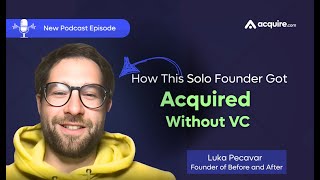
This is a YouTube video titled "How to Sell a Micro-SaaS Without Funding or a Team" containing an English podcast-style interview recorded in April 2025. The conversation features Andrew Gazdecki interviewing Luca Pechavara, founder of the Before and After SaaS application, discussing the origins, growth, revenue, acquisition process, and future projects related to Luca's business ventures.
Foreign.
I'm here with Luca Pechavara, the founder of before and After. Luca, how you doing today?
Doing great, Andrew. Thanks for having me.
Yeah, for those that may not know you, do you want to just give a brief introduction of yourself?
Sure. I've been in tech since yeah, like more, more than a decade. So building different SaaS, business software, service apps, stuff like that. And yeah, it's, it's great to be on this podcast with, with our first acquisition.
Yeah, I, I love what you built. I'm excited to, to hear your version of it. But before and after, it looks like a WIX simple add on application. Do you want to describe what problem it was solving? How'd you, how'd you get into it? Or let me just get like the short story.
Sure. So it all started I think in well in 2013, 2014. We were building like a so called Wix competitor, like a tiny website builder. The notion was at the time a lot of businesses were on Facebook, so they were just on Facebook without the website. And we wanted to create like website builder that turn Facebook pages into websites. And so you know, I was, I was very into all website builders and checking what they're doing and how WIX was growing and their marketplace, etc. And at the time there was like also one popular website where you could purchase different either WordPress plugins or HTML plugins. It was called CodeCanyon. I think it still exists. And I was checking it regularly just out of curiosity. And the before and after slider became like a very popular trending widget. It was like a widget that you had to purchase there and then set it up on your own, on your own server. And at the same time when I was, you know, exploring weeks and there they had the forum I saw that people were asking about before and after slider on wix and how to put it there. So I kind of got two signals that people would be interested in this thing and I said to my co founder, let's just, let's, let's play, let's do a weekend hackathon and put this together on wix just to see how that works on a larger scale. Maybe we'll learn something. And yeah, we put it together, put it on Wix. That was probably 2015, I guess, early 15 and it was, you know, really size project. It was just there. We didn't touch it for a long time and it kind of picked up. So people were started to using it. It was a freemium model. You could create two free sliders but you had like brand name on it and then it was like a premium version of that, very affordable for like less than three bucks. But yeah, people kind of started buying and it kind of took off. Also, the marketplace was really tiny back then and we kind of grew together with wix. You know, they were growing, they were growing and we were growing with them. So that how it started.
I love that. Are you comfortable sharing the revenue figures for the business? You don't have to if you're not comfortable.
Well, yeah, at the end it was north than a hundred thousand a year.
That is just incredible for how simple the application was. And if I'm understanding correctly, it's a slider where you have like an old picture of a house and you slide it over and it shows a new picture of a house.
Exactly, yeah. So before and after, like slider, you put two images and you slide it. So in a way it's a simple app, maybe like a trivial app in a way. But when you are in a business where you want to showcase the transformation that your service provided, it's actually a really useful tool to have. It's like for makeup artists or photographers who are retouching images for home improvement companies, architects, you know, it was so many cases that we did not envision at the beginning. I mean, to be honest, it was just like a really tiny side project that we wanted to do without a lot of thinking who could use it. But again, with signals from the market that people would like to have something like that and they are actively purchasing on other platforms. Um, so yeah, that's, that's the case. Yeah.
These two images, it's a beautiful, beautiful business. I remember when you first listed it on Acquire, I was like, this is incredible. And to see the amount of revenue that you were generating from that business, that's. That's awesome. Congrats. How many users were using the product and then how many customers?
I think we had around 30, no, around 50,000 websites had this widget on and I think around 3,500 customers. So paying customers.
Man, that's impressive. I love it. Tell me about, in terms of the maintenance of the product, was it a lot? Did you have a lot of customer support questions? Was it more passive? What did that look like?
To be honest, it was very low maintenance. Well, we kind of rebuilt it from scratch somewhere in the middle of our time having this app. But other than that it was, it was quite simple. From time to time we had to change something because Weeks did some upgrades. But other than that, you know, it was quite straightforward for users. So maybe a couple of emails per month.
That's awesome. What a great asset. You were generating over a hundred thousand dollars, some from just a passive SaaS application on a third party marketplace. I think the last thing here for me at least is just the amount of potential in third party marketplaces like Wix or maybe, I don't know.
I mean Shopify of course. I mean Shopify is huge with Mark with apps on marketplace, you know, there's a lot of apps doing way more than we did which, which I found normal because you know, when you have a website sometimes you know, website is not as an important asset as a web store because online store is your main revenue generator. Website is in many cases for like local businesses is, you know, not the main thing. So they're quite satisfied with and don't need that many, you know, special features that like custom apps provide usually.
Yeah, I agree. Tell me, why did you want to sell the business?
So with the co founder we kind of started another project a bit, you know, let's, let's call it a bit more serious project that we wanted to scale and we, we really didn't want to raise money even though we, we had some, some inquiries if we would be interested in accepting some funding. But we wanted to, to go like self funded and scale it on our own and you know. Yeah, this was the main case, to be honest.
Nice. That's smart. So you can use the proceeds of the sale to fund your new venture essentially.
Exactly, yeah.
Nice. Walk me through the acquisition process on acquire.com. what was your expectations, how did things go? How many buyers you talked to? Let's start with that.
Yeah, I mean the whole process was very smooth. I mean you have this quiz that is very, very, very good to navigate, you know, the whole process at the beginning. And then we were connected with one of your colleagues and she helped us, you know, improve the whole listing, gather some other data that we didn't put into the quiz at the beginning. And yeah, once it was listed I think, yeah, it went surprisingly smooth to be honest. I probably talked to a dozen people, a dozen interested individuals, like three, four were very serious and yeah, we closed the deal in like 10 days I guess.
That is awesome. Tell me about the buyer that you ended up moving forward with. Was there something that they did in particular that maybe.
They were having? I mean they acquired a lot of mobile apps for iOS and Android so they were having, I think this was their, their main business and I, I haven't asked them that But I assume that they, they see a potential in this third party marketplaces, as, you know, iOS and I mean Google Play Store and App Store is in a way third party marketplace, so they kind of nail it there. And I assume they wanted to do something similar on other marketplaces as well.
Right on.
All right.
In terms of the due diligence process, how did that go? Any hiccups, anything that surprised you?
No, no, no, no hiccups. Nothing? Nothing surprisingly. Yeah, nothing really surprised me. I mean, I'll be honest here. Our setup was very simple in a way. You know, we generated all the revenue directly from, from wix, not a lot of different, you know, payment providers. So they were in a way our own only client because they collected the payments for clients and then, and also we didn't have a lot of like costs for running everything. So it was, you know, on our end it was very simple, simple business. And I think because of that it was also a simple transaction.
Yeah, I mean your business, again, they're beautiful businesses because they generate a lot of revenue. They're extremely simple to run, easy to transfer. Again, Awesome. I guess for my next question, if you had three tips to give another founder or someone looking to sell their business, what do you think those three tips would be?
Yeah, I would say so if, if, if you plan to, to sell in the future, I would definitely suggest to clean up the, you know, the invoices and organize everything so it's very straightforward and clean so that there are not a lot of. Because buyers will have questions about everything and you want to be as prepared as possible not to. So they don't like surprises there. So it's also good that you are kind of detached from the, from the business a way that always help because if you are the center of the business and it cannot run without you, then it's going to be much harder for them to, you know, continue growing in a way that you are currently growing it and managing and running it. So I would say this would be the core things that I'm also, you know, trying to set up with every venture that I, that I run to, to have this streamlined.
Nice. I completely agree. That's great advice. Did you anything to celebrate when the acquisition closed? You got acquired for hundreds of thousands of dollars. Did you go buy anything? Did you go with one? Like what did you do?
Well, it was, I was on vacation when we closed the deal, so. But the vacation were planned before. But yeah, I did, I did treat myself with new skis.
All right, hey, well deserved. Luca. Are you, what are you working on next? What's next?
Our next project is called Outreach Tool Software. So it's kind of. We are in this space since we built that website builder for Facebook active businesses. At the time, we saw that we could get all these emails from local businesses that were on the Facebook pages, and we built like a tiny outreach software back then in 2014 and use it to grow that business. And since then, we are kind of involved in this space. And yeah, we kind of. We launched it actually for one, we got one client for lead gen services in the past and he wanted to have his own cold outreach system to really like a scalable one. And we build that. That and use it as our own and for him. And then we, we decided that we, we. We want to launch it as a, as a, as a, as a product. So it's called Many Rich. It's. We are kind of a bit different in a way on the market because it's not a subscription business. It's not subscription, it's pay as you go. So because we, we, we figure that a lot of businesses, you know, start with cold outreach and do it for maybe one month, two. And as they're learning, you know, these businesses, these tools for outreach tend to have high churn rates. And we said just let's do it differently. Let's do it a bit more fair in a way, a bit open. So it's. You buy credits and you can use them for as long as you have credits. We don't. Unused credits never expire. So it's, it's a, it's a great tool for every. Anybody that's starting and also a very powerful one for, you know, everyone who's sending like millions of emails per month.
Right on. I'll be sure to include that in the show notes. I want to check that out. That sounds. That sounds slick.
Thanks.
All right, Luca, thanks so much for coming on the podcast. Congrats again on the acquisition. Love the business that you built and excited to see where your next one goes. For those that want to follow along with your journey, where can they find you online?
LinkedIn or Twitter, but more or less LinkedIn.
All right, I'll add that to the show notes too. All right, Luga, thanks again for coming on.
Thank you.
More from Andrew



The Buyers Who Made the Move: What They Bought, How They Did It, and What Happened Next






