How to Sell Your SaaS From a Founder with 3x Sold - Alex Rainey, Founder of MyAskAI
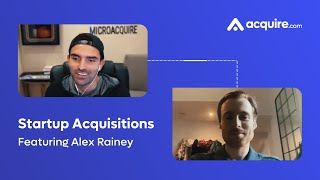
Alex Rainey has sold three startups and shares what he learned about timing, due diligence, and finding the right buyer. He walks through the practical steps of positioning a SaaS for sale and what happens after the deal closes.
Foreign.
I'm here with Alex, the founder of my Ask AI Alex, how you doing today?
I'm good. How you doing, Andrew?
Doing great. So you were telling me before we started recording that you've had three startups acquired on acquire. That's incredible.
Yeah, I mean, you guys make it super easy to sell businesses, so contact with the credit. But I guess once you get going and you start to understand how it works a little bit now, you can sort of package up these businesses and build these things quite quickly and understand the traction points needed to sell, then it can become quite repeatable. At least that's what we found.
I can tell the results speak for themselves. So I guess I'd love to just take a moment for people listening. Do you want to give a brief introduction of yourself?
Yeah, sure. So I've been in technology for my entire career. That's kind of 10 plus years. Started life actually as a consultant in Accenture in London. Worked there for about seven years, learned a ton there. But eventually I always had this kind of burning desire to do my own thing. So eventually kind of left the machine, left the big corporate and started my own travel startup. Raised a bit of money, and then we ended up getting crushed by the pandemic because we were focused on travel and obviously that was a really tough spot to be in for a couple of years. But interestingly at the back of that I got into indie hacking and kind of building these micro businesses like you kind of mentioned before, and just got on a bit of a roll with a few of these and they've all kind of led me to the next one, led me to the next one. And now it's just put me into being obsessed with and totally focused in the AI space, which is where I'm at now.
Nice, I love that. Let's talk about the first acquisition that you went through on Acquire. I'm sure as each acquisition went you learned something. The process was easier the second time and third time. That's usually how even just building startups go. What was the first startup that got acquired?
Yes, it's, it's quite a random idea. I mean, I actually developed it during my paternity leave. We were talking about our kids at the beginning of this. My, my little girl was born about a year ago. That was in summer, just as the pandemic was starting to fade away and travel restrictions were opening up. So everyone in the UK at least was trying to get their passports renewed because it all elapsed over the kind of two years in Covid because No one needed them. So it was this crazy rush for passports and no one could get appointments. And I realized that from done some basic web scraping stuff before that I could ping these appointment sites with a government passport service and find out when appointments are available, where they are and these kinds of things. So I quickly spun up a kind of quite simple consumer kind of SaaS product that would allow people basically to get alerts for when appointments came out for passport renewals. And this was in super high demand. And it just took off. And at its peak we were doing about a thousand plus dollars a day just piling money into Google Ads as well. Because it's just a brilliant strategy, at least for that business. Hasn't always worked out of other ones, but it just really took off. But obviously it was quite seasonal. We managed to kind of capitalize on that and package it up in a nice enough way that it could be rolled out to other regions, other countries that were going through similar things. And then first experience on acquire.com put it on there. And then I think within a month, month and a half, I had a buyer, an American in the UK who bought it. And I was just completely blown away by how quickly that all happened. Within the space of kind of three and a half months, like standing this thing up, getting to decent revenue, revenue that I never got to with my previous data, where we raised over one and a half million dollars with a team of like 12 and then sold it. And this will happen in three months. I was just like, wow, like what is this world? Like this is pretty cool.
That's an efficient business. Congrats. Also a great use case too. Just in general, helping people go see their again, you know, that's awesome. Okay, so let's move on to the. What was the second startup that got acquired?
Just after that first one, I got introduced to my current co founder, a guy called Mike, and we started to bat a lot of ideas around. Initially we were there to meet up and talk about freelancing, but we never got on to speaking about that. We just got tons of ideas in our head and we're both very similar people who were just like, you know, screw freelancing, let's just go and build out our own ideas and just run with a couple of things. So we started playing in the AI space where the GPT3 APIs were coming out from OpenAI and it was all becoming a lot more accessible. And the first use case that we came to, maybe questionable ethics, but it was a tool to help students write their university applications in the uk, which is called a UCAS statement. And the kind of generic generative model was fairly average. And when we started to train the model on a bunch of examples, we realized that we could create this really powerful, quite unique tool to create these pretty bespoke and high quality university applications. We actually wrestled with OpenAI a few times because we were like right in the gray area of like what's acceptable for doing with generative AI, at least when they, when they were coming out with it. And we certainly paused and thought, okay, maybe the bigger opportunity here is actually with the fine tuning. Because fine tuning an AI model is quite a difficult, complex process. It's a little bit tricky, but it can kind of 10x5x your results in terms of the quality outputs. So we thought we'll put a pin in the kind of consumer facing business this UCAS statement writer and we'll list that on acquired.com maybe it can be some seed capital for this next business. We very quickly moved on to another one straight after that and to just jump in straight on that. Basically it was a tool to allow people to fine tune AI models with no code. So you could literally get a CSV spreadsheet load of examples of what you want to create, put them into the tool and then it will train a GPT3 model behind the scenes for you with no code. And then you can start to leverage that to write emails, write tweets, right, University, whatever it was your business or you did, you could, you could kind of create these much quicker. So we very quickly jumped from that first idea to this other one.
Nice. I love how you capitalize on just chapping ChatGPT and just the general AI trend. I really wish this tool, specifically the one where you could write papers, was available for me when I was in college. I've actually seen professors recommending that you write papers in an AI. That's a whole other conversation that we have, but it kind of feels like it's not going away. It's a tool that everyone should know how to use. Reminds me of like typing classes when I was in elementary school. But that's a conversation for another time.
So.
Okay, so three acquisitions. Okay, that is awesome. How did. Let's, let's start with maybe just some of the learnings because a lot of people listening to this are probably looking to, you know, sell their business or potentially, you know, buy a startup. How did you position these with buyers to attract the most interest? What are maybe like some initial and we'll go down like the Timeline from interest, due diligence transfer. What are some of like the things you think you did really right when you were speaking with buyers or positioning it when buyers reached out after signing NDA? Yeah. How did that initial phase go and how did you handle it?
I think the first thing was that I definitely learned through each of the three stages was the timing in terms of creating the listing. And by that I mean how much traction did we have when we put the listing together? The ucas, the university statement writer one was actually one that sold last even though that was listed on the platform for maybe two or so months. And the main reason for that is when you compare it to the other ones is attraction was it was a good proof of concept from a technology standpoint. And we only really launched it and ran with it for a couple of weeks. The revenue was basically nothing, couple hundred dollars. So we felt, hey, this is a good enough proof point for people that want to kind of take this tech and use in other applications. But looking back and comparing it to the other two sales, it's like that doesn't really fill a buy with confidence. That you've only run this thing for a couple of weeks and generated a few hundred dollars, like that doesn't really prove that much. The buyer that ended up did buying it was really interested in the technology path. And so I think we got a little bit lucky with that side of things. And they weren't really buying it for the kind of revenue generating like normal traction metrics that you would expect. So that's one thing. Timing, know, don't, don't put it on there too early. Get a, get the right amount of traction, especially revenue. I think that's just like probably the most important metric on the platform and for most of the buyers and certainly from all the questions that are going to receive across all the listings, it always comes down to the money, what you're making and eventually the margins and stuff. So the timing was an important one. The second one was I think making the, making the listing really simple and trying to answer a lot of the questions that you're going to get as part of the kind of initial due diligence process like as they're signing NDAs that processes that's going on. You can answer all those questions already I think just by trying to put the buyer's hat on, trying to think, you know, if you knew absolutely nothing about your business. So it was a really hard thing to do as a founder. But if you know nothing about your business, you know, what am I not explaining to people, you know, really explaining it in the most simple way possible. Breaking out the tools you use, the different cost bases within the product and all these types of things as well. How are you getting your users and all that kind of stuff. So I definitely got much better with each sale at crafting. You know, still a concise listing because we're not going to put in like tons of information, but one that was super simple. Kind of almost felt dumbed down. I think it worked much better like that and just broke everything down into kind of nice neat blocks of the product, how it was built, the growth and the acquisition mechanics, the costs, the revenue, the traction, that kind of stuff, all the kind of key areas in the business. So I think those are probably looking back, the big learnings for that very early phase.
Yeah, yeah, that I would agree with 100% in terms of just the, the preparation really, because during an acquis position like your, your main job as the owner of the business is to close the knowledge gap for buyers, make it really easy to understand what is your tech stack, how are you growing, obviously. What are your financials? Just some more information you can give to buyers, the more interest you're going to get by a lot. Because the other option is they have to, you know, ask for it in advance and then if you're slow to respond or that's kind of a signal of what the whole acquisition process is going to be like. So I really like how, you know, just keeping it simple, making it really easy for buyers to wrap their head around your business, which, you know, you might think is easy because you're operating it every day. But for a buyer looking at it for the first time, they're going to have questions. And the more you can prepare in advance for those questions or just think through them, it's just going to make your life and then the buyer's life a lot easier and then also increase your chances of, you know, selling, getting acquired. So I like that. So now that you know you found your buyer, how. How did you, let's say, you know, vet or verify or choose or pick the right buyer. What made you comfortable with each acquisition? So you don't have to name the name of the person, but what qualities do you look for in buyers? Just to make sure that when you sign a letter of intent that it actually closes. Acquisition doesn't, you know, fall through midway.
Yeah, yeah. And, you know, look, we definitely had some acquisition buyers where Lois were signed and we felt like we got far along and more and More DD was shared and then they kind of suddenly fall off the radar. But I think looking back that could have probably quite easily been seen and I could have probably teased, tease that out a little bit early through some conversation. So your question is like there's some basic things like the verified funds badges I think are really important one, like if someone's speaking to me with a verified funds badge, then I'm instead going to take them like 10 times more seriously as a buyer for sure. So any kind of buyer badges that they have on the profile, then that's just going to elevate them straight away beyond that and really just kind of looking at trying to put in a kind of polite way but you know, like the intelligence of their questions. If, if I feel like they have a grasp on what it is that we're selling and the kind of basics of running a business and they're asking the right questions about how we're acquiring customers, you know, what those unique economics look like, what are the margins on the revenue that we've listed there? So it's not just like losing money or barely making any money. They're starting to dig in with a few of those kind of slightly more educated questions that maybe this isn't the first time they've done this or they've got a bit of a business hat on. Then again, I'm going to take them a lot more seriously and probably be a lot more inclined to sign the other way and share a lot more information with them and then ultimately spend the time working with that individual versus someone who's asking a bunch of unrelated questions, clearly hasn't read the listing and you know, maybe is stopping you from for information or just like wasting your time. And obviously as a founder of always just got to be careful that people trying to waste your time. So yeah, they're asking intelligent questions and that's going to kind of push them up there and make you engage a bit more.
I like that too because it's a two way street, you know, because the person that you sell to there's going to be due diligence, there's going to be a transition plan usually where you're gonna have to work with this individual. And if they're asking questions that maybe are off base or you just don't feel like they're the right personnel in the business, it could save you a huge headache. Because if you sell to someone who maybe just doesn't understand space or it's a really technical project and they're not technical, those should all anything, if there are concerns, you should discuss all those things. And yeah, what I always recommend too is before even signing an li have a pre LI call just hey, we're going to sign this. Let's review due diligence as a plan. Again, what are we going to do? How long is it going to take just to really kind of confirm you have a plan going into due diligence because it just increases your chances of the deal closing. And another tip that, that I've seen work really well in terms of verifying buyers and making sure that you know they're the correct one is if they previously acquired a business, you can ask for references like do you have anyone I could speak to? What is it like working with you? That's entirely appropriate because again, it's a two way street. I'm going to be potentially, you know, selling my business to you and you say xyz, I'd like to just verify that. So just a tip there. Okay, so you, you, you found, you found the buyers and now you move into due diligence. How did you go through due diligence? How did you think about it? How did it work out with the buyers?
Yeah, so I'm fortunate in that come from a background where I've raised money before, spoken to investors, had to put together data rooms for previous businesses in a data room for listeners who don't know. Essentially a collection of all your important documents as a business, from your financials to pitch text to sales pipelines, whatever is relevant to you, but basically a bit of a dump from all your internal systems and knowledge repos. So I had some experience putting these things together and knowing what makes a good data room. Obviously these weren't as sophisticated as ones who were trying to raise, you know, much larger amounts of money. But the core components of answering all the questions about how you, how you're acquiring your customers, what are some of those economics look like in terms of the cost? If you're running Google Ads, maybe some exports of some of the campaigns you've done there on Facebook, for instance, that kind of stuff. Obviously your financials, whether you're tracking that yourself or and in my business's case always stripe, we always just had the latest stripe extract or a little bit cleaned up and organized with some charts as well. So buyers could just jump in and see all of that data and even play around with themselves. And we had to do a share and link basically instead of giving them stripe access or anything like that. So it was a lot of putting those kind of documents together, which were probably more data heavy, kind of numerical heavy in general, to be honest with you, Because I felt like those are the kinds of questions and conversations that we got into most. And then the only other topic aside from that where there was always a lot of interest was, yeah, like where is the technology? Where is it all based? What's it written in this kind of stuff? But how are you going to hand it over? And then the big question, which I think is one of the biggest variables, which maybe I didn't think about enough and I wonder if a lot of buyers think about enough as a way to, to change the sale prices around how much support you're going to provide after the sale. Maybe you want to cut clean and just sell the business and not provide much support. But I think you'll be surprised where a lot of the time I found with buyers that we didn't sell to, but a lot with the buyers that we did sell to is they're really interested in what you know about the space. And most of the time they want to keep you on board as a kind of advisor, consultant, Even in a low kind of rate or amount of days per month or something, possibly indefinitely, possibly for six months, something like that. They want to keep the relationship going because they see you as a really important kind of leverage to keep improving the product. If they feel like they can fund the marketing expansion and do the sales side of it, they see you staying on and doing a bit of a product role within that. So it's just an interesting model that I normally think about when I first started using the platform, because I just thought it would be like straight up, just here are the assets move on that important kind of lever to keep improving the product. If they feel like they can fund the marketing expansion and do the sales side of it, they see you staying on and doing a bit of a product role within that. So it's just an interesting model that I normally think about when I first started using the platform because I just thought it would be like a straight up, just here are the assets, move on next. But I think a lot of buyers are looking for some handholding afterwards and maybe even a relationship. So yeah, if you're open to that, I think you can. You're going to increase your chances of a sale and then you'll be able to top the price as well.
I would, I would 100% agree with that. I would say almost 90% plus buyers will ask for some sort of transition period. And the reason for that is there's parts.
But I think a lot of buyers are looking for some handholding authors and maybe even a relationship. So yeah, if you're open to that, I think you can. You're going to increase your chances of a sale and you'll be able to up the price as well.
I would, I would 100% agree with that. I would say almost 90% plus buyers will ask for some sort of transition period. And the reason for that is there's parts about your business at again, you know, you can't get through every detail, but when you finally actually own the business as a buyer, there might be a customer with a unique discount plan or something, or a bug that can be fixed by you in five minutes. But it take someone new two days to figure out how the whole system works. So just having value your business ad, again, you know, you can't get through every detail. But when you finally actually own the business as a buyer, there might be a customer with a unique discount plan or something or a bug that can be fixed by you in five minutes. But it take someone new two days to figure how the whole system works. So just having the owner and then the theme of all this is just de risking the acquisition. And that's key when you're, when you're selling your business is again your job as a founder, the owner of a business, when selling is really helping a buyer understand your business and then de risking it for them in terms of, you know, having a plan of transferring the assets, creating a data room so they can understand the business. And then, you know, post acquisition, just letting them know that, you know, you're not just gonna hand the, hand over the keys of the car and then leave. You know, you'll still be available as just a safety net should the servers crash, should you lose access to some service that you use to run the application. There's so many different edge cases like that, so definitely. And the way you can, I've seen a lot of people, you know, make this work is like you said, just agreed upon transition period, period. It can be one month, it could be three months, and then after that a consulting agreement where you have some sort of just hourly rate if needed. And you want to be really specific with that as well. So you don't get stuck with a consulting job full time. You know, maybe it's 10 hours a month or something like that so the buyer doesn't rely on you unless you're okay with that. But typically that's what I've seen work really well for both Buyers and sellers.
Yeah, agreed.
So now you got, you know, know three acquisitions on your belt and you know, it sounds like all of them went, you know, really, you built a good product, you got customers and that's really what people are looking for. Product market fit, you found it, you successfully went through due diligence three times. That's, you know, quite the feat. What are, what are like your top three tips to people, you know, looking to sell a startup if they had nothing, they knew nothing about acquire? Like what are maybe the three things you would say to that? You have to get these things right?
Yeah, I think first few points may contradict a little bit, but the first one is linked to my previous point which is around timing is you need to have some kind of numerical objective traction that a buyer with no knowledge of your business or space or belief around the hype or vision that you have or all the potential that you may see in your business if you strip all that away. You need to be able to see some, some hard cold facts about the amount of money you've made, the growth of those over a period of I would say at least kind, three to six months. But even, you know, in general, I think with your platform you're kind of looking for, for the last 12 months is like a really important metric for businesses. So I think waiting to get to that point is crucial. And, and you know, you can, if you list too early, I guess you can pull it down and you can list again. But I think you'll benefit from kind of strengthening the business and thinking about okay, what am I going to get challenged on here? Like I'm spending way too much on paid ads and the conversion is terrible. Like that's going to be a difficult set sell when it comes to speaking with a buyer. If you can focus on improving a couple of those key areas and kind of beginning to think about how this thing is getting packaged up and presented and answering those questions in advance, then I think you're going to do much better. So yeah, I think there are just some fundamental traction points that are required if you're going to sell on acquire.com and I think I saw you mention this to a buyer recently, but you do let some pre revenue or very early revenue businesses go on one, but they're kind of, they're a bit of an edge case or an exception. And in general you look for people that have a little bit more solid traction. So partly platform policy from you guys, but obviously that's done with a reason that you have the knowledge and view across all these acquisitions, you know it works, right? And you know that financial traction works.
Can we pause on that one? The, the pre revenue ones, those ones break my heart when we list them. Because if you just get a few customers, going back to the theme of de risking the business, when, when buyers excited about a business, it's because product market fit has been found. You found a way to get customers. It's been proven people are using the product and so you get way more buyer interest. And it doesn't have to necessarily be a lot of customers, but just a handful enough to give feedback about the product, are using the product. And then your sale price is so much higher if you're able to just get a few customers. Because without that there's so many assumptions of do people actually want this? Will they ever buy it? If there's, you know, maybe a month of just customers using it, will they continue using it or will they cancel? So you really can, if you just take, you know, two months and just prepare your business for sale, you know, really try to focus on sales and marketing, really de risk the business. You can sell it for so much more than if it has no revenue. But we see a lot of them. So we, we list them. But we're, we're picky in terms of, has to be a really good, really a strong product that we feel that could benefit another business or something like that. But I, I agree with you. If, you know, if you're able to just get a few customers compared to zero, you'll get so much more interest from buyers and it'll make the acquisition process easier.
Yeah, definitely. And I think point number two might contradict that slightly. But you know, you see a lot of builders, indie hackers, always a bit worried about launching on product time, for instance, you know, got to get things perfect, got to get things right, got to launch at the right point. But I think a lot of them probably launch too late. And there's some as you can learn from just putting it out there. And I think the same can be said for acquire. You will get a lot of really interesting questions from a bunch of buyers. As long as your business isn't like, you know, totally uninteresting with, you know, zero traction, you'll probably end up speaking to a few buyers and you'll start to understand what buyers are interested in, what parts of the business they want to scrutinize and where they view the weak points. And I don't think there's any downside. You may say differently as the platform owner. But you know, if you go back and it doesn't work out and you know, you get grilled on how you're acquiring customers or the margins, then you know, you can delist, you can start to work on those areas of the business and you can come back again and relist and go for it again. So, you know, you'll learn a lot from, from any listing exercise. Even with a kind of small level of interest from buyers. You'll start to get some interesting questions and just start to understand how the platform works a bit. So yeah, don't hold off on it too long. Like with all new things, you just got to kind of take a plunge from time and list your business. And if you get no interest, like we thought about this with my, me and my co founder before. I think we've listed one that didn't get really any interest sell. And we thought this thing was a great idea and people are going to buy it and they're going to be interested because of the timing with it and some other trends happening. And it just didn't really get anywhere. And that was a kind of really important just like realization for us. Just like, okay, we were living in a bit of a bowl. Like let's just get back to work on either something else or make huge improvements to what we're doing. So I think there's a huge opportunity to like take some real world learnings from just like putting your business out and trying to sell it as well.
Yeah, I mean even, even. Okay, let's say you're at um, you know, pre revenue. Here's what I would do. Like listed on product Hunt, listed on a few startup directories, talk about it online a little bit, create some sort of, you know, any sort of traction. It could be free users, just anything, anything. Because that really helps buyers understand is there excitement around this? What is the potential? And all that is unknown until you do that. And when a buyer does buy a pre revenue startup, they're going to do all those things for you. They're gonna put it on product hunt, they're gonna talk to potential users like they're gonna figure out how to get those customers. And if you can figure out how to just create that small spark, it really does help a buyer kind of visualize. Okay, well this works over here. Obviously it's not a company doing millions in revenue, but there's potential to get there or whatever the number might be, but just some sort of like roadmap, like here's what people said about the product or their feedback can really make the. This is just a product I built and this is a product I built. But here's what users are saying or my handful of paying customers. So that's why I always say just spend like a little bit of time just getting a little bit of outside traction because you could share that with buyers as you know, you're buying product market fit here to some degree of whether you're paying customers or users or whatever it might be. But just that traction is really what draws buyers in my experience.
Yeah, yeah, definitely agree. I guess final or final tip would really be just. We spent quite a bit of time looking at your docs, looking at previous interviews you done videos, look to previous listings as well, looked at other listings rather. And we got a pretty quick sense of like what a listing entails, what, what is a good listing, what is a bad listing. And I think it's actually quite easy to stand out and create a really strong listing if you just spend, I wouldn't even say a huge amount of time like putting your listing listing together. I'm sure you see a lot of it, but a lot of listings feel like they've been put together like very, very quickly. So I think with a little bit of effort, structure within your listing and how it's organized and how it's put together and you think through the big areas within the business. Again, going back to the like, what is the. What is the growth? Like, what is the product? What is the technology stack? Like, what are the kind of core components of the business and kind of spelling those out and listing them out. I don't know. But I'd have a theory that it would put you in the kind of top, like 15, 10 if you just like kind of logically and simply just like, like put out these different areas and just explained the kind of core components of your business. I just think you would. Yeah. Massively help like not as gap as you said to buyers.
Yeah, no, I completely agree. I think that includes any sort of metrics that you have. Do you know your customer acquisition cost? Do you know your lifetime value? Do you know your growth rate? How many free users do you have? Because that's an opportunity to convert them to paid just. And then when it gets to growth opportunities, like really write growth opportunities out. Have you ever conducted a price increase? Have you ever. What have you done with marketing and sales? What's worked, what hasn't worked? Because that shows again, all the knowledge that you have that a buyer can benefit from because a buyer doesn't want to go and run a marketing campaign that you tried and didn't work. So that again, de risks the business so you don't send the buyer, doesn't go in the wrong direction. There's enough information to say, okay, if I acquire this, I'm going to try and grow this. So just any sort of direction or tips to head in the right direction can help a lot. So I agree with you. I guess my last. And thanks for all those tips. Those are really, really good tips that I with entirely. So I, I gotta ask now you're, you're working on a new startup. Tell me about it. What, what is it? What does it do?
Yeah, so on the back of the fine tuning business, which was the last one that we sold, we started to learn about embeddings, which is a kind of AI model or technology that's provided by OpenAI and a bunch of the other big providers. And this came out just in the middle of when we were building this other business. And basically what it allows you to do is AI powered semantic search, which is basically finding pieces of information that is similar to a question that you have or another piece of information and where it's really useful. I'll kind of explain in a second. But this new technology came out as we were building our other business and we just literally took a step back and we're like, this is game changing in terms of what, what kind of capabilities you can unlock for businesses and for customers with this. So that's why we actually sold them the business because we just saw a bigger opportunity that was complet, I mean related I guess in the AI space, but fairly different. And that's what drove us to sell it. Not really anything else. It was just like, okay, we want to pivot to this bigger opportunity and it's great that there are platforms like acquire.com where you can kind of put a pin in the business you built, sell it, get some seed cash and you know, you move on to the next one. So that was pretty cool. This new one now is called My Ask AI. Been running it since about February or late February this year. And the basic concept is that you as a business can get all of your internal docs, all of your help docs, all of the information that's on your website, whether you provide a SAS tool or an E commerce site that sells, you know, fashion or clothing items, whatever, it can be a whole range of different types of businesses. You upload all of your content, the AI model will process all of this, then you can basically talk or chat to your data and use a conversation interface and ask questions about all of the information on your site, all of the information in your company with us, you can launch it on your website, you can integrate it within Slack, within teams, within Zapier, you can do whatever you want and basically create this tool where anyone in your organization, or anyone, any of your customers, can ask a question about your entire organization, whatever it is that your business does, and get an answer in two or three seconds that may be better than an answer that someone could have come up with in the business and is obviously certainly much, much faster, more efficient than customer support team doing it, or the data team digging out that answer, or that internal comps team digging out that answer, whatever that might be. So hugely time saving for people and for businesses. They want to either create a tool for customers to service and launch it to their customers, or create a tool for their colleagues and launch something internally or with the goal of getting access to your content, getting answers, and basically leveraging this new technology like ChatGPT and leveraging that for your business. So, yeah, that's what we're doing.
I'm looking at this now. This is awesome.
Thanks, man.
I think we might actually use something like this. Let me ask if this is a use case. So we have a lot of blog content. We've written about deal structures, how to finance an acquisition, what is monthly recurring revenue all the way to, you know, how to make sure an LOI closes, pretty much everything about acquisitions and startups. If we were to install this on, let's say, our blog, would it digest all the information and then we'd have kind of like a chat bot where instead of searching our blog for the right article, you could just ask a question like what is a common deal structure? Or something like that. Is that that correct?
Yeah, that's exactly it. So when someone's setting up on the site, you would put in, you know, blog.acquire.com if that's all the content you wanted to grab, we would scrape the entire site. We'll get all the articles, we'd ingest those and put them into the system and you could create a chat bar on the back of that. You can brand it and give it the acquire.com blue, put in all your fonts, everything else, make it look and feel like it's really part of the site and then embedded across the entire site or embedded across a couple of different pages. And as you say, the really important thing is the aim of it is to really replace se and to replace having to use tools like Intercom and other things that obviously take a huge amount of time away from a customer support team. Because, as you know, like, pretty much every answer that, pretty much every question that a customer asks you guys, you probably have the answer tucked away in some blog. You've probably written about it at some point. And maybe it's an answer that's amalgamated from a few blogs and it'll do that as well. Just a really powerful piece of technology. And for business like yours, I mean, that's a really good use case.
That is awesome. Well, Alex, congrats on the acquisitions and hopefully I'll get you back on here. Maybe not too soon, but this, this business looks awesome. And I'm not just saying that. I'm excited to see where this goes. If people want to learn more about, you know, you or your story or more about your. Your current startup, where can they find you?
Yeah, so myaskai.com you'll find a bit about me and my co founder, but importantly, everything about the business. Sign up in minutes. Sign up for free. Just check it out.
Sounds good. I'll put that in the show notes. Well, Alex, thanks for coming on the podcast and congrats on all that great acquisitions. I'm hoping. I got a feeling this next one is going to be your biggest hope. So for you.
Thanks, Andrew. Appreciate it. Thanks for having me.
All right, cheers.
More from Andrew



The Buyers Who Made the Move: What They Bought, How They Did It, and What Happened Next






