Inaugural Seller Education Webinar - MicroAcquire
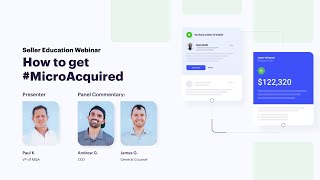
This is a YouTube video titled "Inaugural Seller Education Webinar - MicroAcquire" recorded in January 2022. The content is a detailed webinar featuring multiple speakers including Andrew Gazdecki, James Graves, and Paul Kelly. They discuss the process of selling a business through MicroAcquire, covering topics such as valuation, preparing a business for sale, handling buyer inquiries, due diligence, negotiation of offers, and transaction management. The webinar is educational, aimed at entrepreneurs looking to sell or grow their businesses, and includes Q&A segments addressing common seller concerns.
Foreign.
The founder of Micro Choir and I will be here to support Paul. Paul is our. He's going to introduce himself, so I'll save him for that, but he's a subject matter expert here. So really excited to kick this off and just really excited to help all of you get acquired. So thank you for joining, especially for everybody in different time zones, people in Australia enjoying summer. It's just really inspiring to see just so many entrepreneurs looking to sell their business or grow their business from all across the world. So thanks for joining. Long winded answer, but yeah, I'm Andrew. I founded Microacquire and super excited for this webinar.
Yeah, great to have all of you here. I think I've been emailing with a few of you over the last week or so, so thanks for joining. I'm James Graves, I'm the general counsel here. I'll be chiming in here and there supporting Paul and yeah, just really excited to get all your questions answered and hopefully get you guys some exit soon.
So I'm Paul Kelly. I'm. I'm VP of the M and A Marketplace. Super happy to be part of this team. What, what an awesome team I got to join here. You know, at the beginning of, I guess it was the end of November, we started doing some outreach to founders to find out really what pain points they were experiencing, how we can help them along. You know, our goal is, you know, to, to help founders get acquired. So how can we best serve the community? And what we've learned through that endeavor, through a ton of outreach is that there's a lot of need for some just basic education. So our goal today is not to tell, you know, Ali in Los Angeles how to sell your business specifically, however, but to give you an overall kind of understanding of the process, what to expect and how best to prepare yourselves. Also knowing that we're here, if you have any questions, you guys all have our emails. We'll either do our best to facilitate some answers for you or to direct you to someone that can help. So also, just as far as the entire presentation, you know, we're giving our opinion as far as what structure and process should look like. But as, as in anything with your business, if you know, you should always seek out professional guidance and, you know, legal advice should you get into a transaction. So with that, I'm going to do my best to stay on schedule here. As Roger said on the opening, we're going to break this into. We're going to have a couple breaks during the not breaks where go have lunch, but breaks to ask questions. So it'll be pertinent to that section. We will be recording, as you guys know, we'll send it out to everyone. And the questions that we don't get to, we'll be logging. And we'll be getting back to you after the, after the webinar. So we will answer all of your questions. And with that, let's go into the agenda. You know, what we're going to try to cover here is how to prepare for a sale. Determining the value of your business, that's. That's critical. How to prepare your present. You know, how you're going to present your business. We'll break, then we'll go into the next section, which will be how to fill the buyer inquiries, how to, you know, vet the buyers, how to, you know, qualify them. There's some tricks of the trade there that I'll share with you. When to share your company information, you know, Fielding, Lois, reviewing Lovis, what to look for. We'll break again there. That last section will be due diligence. What financing, escrow and funding process looks like, allocation of purchase price. A lot of people don't even know what that is. So we'll touch on that. Every transaction will have one. If you're going through an escrow process, buyer and seller disclosures and the importance of those, and closing escrow training, you know, if there's an organization with, you know, staff and there's going to be a transition period in training and we'll want to talk about that as well. So with that, let's get into it. Okay, so really the first thing when you're thought, when you're thinking about selling the business is really a needs assessment. And when I say that it's what are you as a range, at least hopefully bracketing what your expectations are. Clearly, if you want to get, you know, a really precise valuation, we have a directory of professionals that you can go and access valuation experts to, you know, to hire and get a proper valuation done there as well. And again, you know, keep in mind that it all trickles back to what, what do you try, what do you have to do? If you're really trying to get this moving quickly, then, you know, think about how you're gonna, how you're gonna price it. Determining value is, is again, you know, it's all over the place. So there's, at the end of the day, it's going to go off of your financial metrics and some multiple of.
That.
Unless it's really a true startup that's we're seeing a ton of these things transact where it is a buy versus build strategy for the acquirer. So instead of them going out and developing and building out this platform, they could just come to Microacquire and pick it up by the API and drop it on top of their stack and they move it. More traditional ways of valuing are just multiples of SB or net profit or ebitda. SD is a discretionary, seller's discretionary earnings. So that is basically taking your, your financial report, your profit and loss statement and adjusting out any owner benefit, meaning anything you pay yourself. If you put your health insurance and your families through the business, you're going to adjust that trip to Hawaii once a year, what have you going to push that back to conclude an FTE and then net profit and then EBITDA are also other metrics. And what we're also seeing a lot is multiples of gross sales typically in these technology companies. So with that again, it's, it's, it's complicated. There's various rules of thumb. We're happy to help you try to get there. It's, it's not an exact science and what I didn't do when I opened up and introduced myself is qualify myself. You know, my background before joining Microacquire over the past, gosh, a little over 20 years was in main street brokerage and lower middle market M and A. I managed an office here in San Francisco for a little over a decade at about 25 agents working with me. So saw a lot of transaction, a lot of deal flow. And then I left and started my own firm with a partner focusing on the lower middle market, true lower middle market, 25 to 5 to 25 million dollar type transactions. With all of that experience, I can tell you there's no exact science. At the end of the day, businesses will sell what somebody is willing to pay for that business at that moment in time. So keep that in mind. Don't get frustrated. It's a process and you know, stick to the process you'll define. Also there's a lot of other factors that go into valuing a company or determining a market price. So you know, we've heard a lot about, well, you know, similar business like mine sold for, you know, 10x or 15x. But what you're not seeing when you're reading about that is all of the other intricacies of that businesses, the nuances that add value. And that's just the realities of the marketplace. Good housekeeping is critical. I'VE always been a big proponent of getting your house in order before going to market. Buyers, interestingly want to find a way to devalue the opportunity that they're looking at. Don't give them the opportunity to do that. You know, you want to have a proper package put together. You want to present yourself as organized. And that's everything from how you're responding to inquiries to how you're presenting your business, to how you can speak about your financials. It's really about, you know, what is the old adage about first impressions. It's critical here. And again, don't give buyers the opportunity to devalue your business. Get your house in order when you're going to market. All right, okay. When you are preparing your business, you're going to be, you're going to want to present it in detail. And what we like to see, particularly on the larger businesses, is a memorandum put together that really details the operation. And you can see here that it is very detailed. It's everything from the overview, the growth opportunities, the highlights, you know, investment highlights, what the competition is out there, who owns the business, what operating characteristics, what products and services you offer, and the various slew of other things there. So it's really explaining the nuts and bolts of the operation and getting somebody a well rounded understanding. What I always like to say is you want to answer the question before it's asked again, going back to presentation and how you're, how you're perceived from the buyer. And I always suggest as well, when preparing the memorandum, due diligence on yourself. Create a data room, due diligence on yourself and go through it. We have a pretty good idea and I could share with you kind of a standardized diligence list that, you know, most people were going to ask for the same generic set of things. There'll be nuanced things that some people ask for, but we know the recurring things that they're going to be asking for. So due diligence on yourself. Prepare all that, put it in a room and, and, and then again, when you do get to that stage, you're going to look uber organized and don't give anybody an opportunity to devalue. So I've done well with the first section. Roger, if you want to open it up, or James or Andrew if you have any comments on that first section, please chime in. Otherwise, we could answer some questions.
I would just say that your point on doing DD on yourself is huge. They're going to come in and tear your data room to shreds and if there's any sort of outstanding liability or any sort of thread that hasn't been tied up, they're going to use that opportunity to either delay the deal or, like Paul said, devalue you. So if you get ahead of that as quickly as possible, it really closes the door to any sort of devaluation or delay in your deal, which, I mean, obviously can kill at the very end, which is the last thing you.
Want the adage in the saying the business is time kills deals. So, you know, any delay, oh, gosh, I don't know where those, that license is or the stock certificates or, you know, if you have to go scramble and find something and you're waiting a week or two. I've seen deals fall apart because of that, because that buyer is looking for something else and they move on. So don't give them the opportunity.
Okay, so we have actually one question from David. So how do I overcome people who ghost after introductions? It seems like 90% don't reply after getting access. Is our deck really that terrible?
No, don't, don't take offense. Keep in mind that Microacquire is a behemoth. It's. There's, you know, we've got over a hundred thousand registered buyers over, you know, 3,003, 500 premium buyers. So, you know, a lot of the buyers. And I'm going to touch on this later, but, you know, a lot of the buyers are window shopping. Some of them are just really looking for something and they're just hitting. A lot of businesses treat every one of those like that's the buyer until they, until they're not. So I wouldn't get too concerned about ghosting the buyers, but I'm going to talk about how to handle buyer inquiries a little bit later in the presentation. Is there a particular. Did you want to ask the Michael Bush. I can answer that one.
Yeah. So Michael asked, is there a particular size of business where you'd expect to see a cim?
I would. I mean, really, it's about. I mean, I would think that anything over half a million, frankly, I think every business should have one. You should at least have a executive summary, which is the light version of the SIM. But again, if it's, even if it's a $50,000 transaction, do you want to get the most you can for your business? And if you're going to put in the work and present yourself as, as is a very serious operator, it's going to show the value of the business. By the way you're presenting it if that makes sense. So when I had the brokerage and I was managing folks, I would say anything over a half a million dollars had to have a memorandum put together.
And one thing I'll add to that too is we're happy to create a light SIM for you. And for those of you that aren't familiar with a sim, it's basically a pitch deck in reverse. Instead of pitching for investors, you're giving information to buyers to make a decision on acquiring your business. So when you list on microacquire, we'll send you a type form and we're happy to create a pretty detailed SIM for you completely free. So if you list on microcquire and you see that type form, definitely fill it out and we'll add that to your listing completely free.
We have a few other questions here. How do you factor in size of the market into valuation from keyboard? I'm not sure if this is something that we could take on right now, but Paul, I don't know if I.
Exactly understand the question. I'm not seeing it either.
I think. Do you care if I get this one, Paul? So size of the market? Yeah. So I see this kind of a lot like, hey, I have a email building tool and my competitor sold for $10 billion, so I'm pricing it on their multiple. That's not a correct way to value your startup. That's not very defensible. But what I would do in terms of, you know, if you're in a big market, point out the opportunities. Like maybe there's things that you do better than your competitors, you really want to highlight the good parts of your business, but then also the things that maybe you're not doing well that are growth opportunities. I know this sounds counterintuitive and Paul, maybe you have different feedback on this, but from my experience, when I see a listing come in and it's doing really great financially, there's a lot of happy customers, but maybe the website looks like terrible and it's in a great market. That's an opportunity for a buyer. So a buyer is going to look at that and say, hey, if I can improve conversion rate optimization or when leads come in, I can convert them at a higher rate to paying customers. This business is going to potentially take off. And there's a number of different ways to grow a business. But in terms of market, being in a good market does help. But I wouldn't anchor your valuation or your positioning too much towards like, hey, mailchimp sold for a hundred times revenue. We're in the same market, so we should be valued too. That's just not how it works. And then also in terms of just really how I think about valuations is buyers are valuing your current traction and not your potential traction and execution. So there's a big difference there. So that's where you see the huge valuations from investors because they're valuing essentially the next three years potential revenue. The buyers are valuing the execution and revenue that you've already accomplished today. So being in a big market is great and to your advantage. But I wouldn't anchor on it too much and compare yourselves to some of the leaders in the market to arrive at your valuation.
And just to close on that topic. Thanks, Andrew. The market that you're in, that's great, that's a value add, but that's going to not add a point to the multiple or five points. That's going to help you reach the maximum of your present value. So there's always going to be a range, right? There's going to be low range and the high range. That market and the appeal and the market size, that's just going to help you reach the max of the multiple. That's going to be applied to your financial metrics. Of course, again, nuances to the business. If there's some proprietary tech ip, what have you, that's different and that's a different way to value it. But if you're just going off of sheer financial metrics, the market size will add value to help you achieve the max value multiple for which your business's performance.
All right, guys, we have a few more questions, but we got to move on.
Let's. Yeah, again, everyone, we see all the questions, we're going to respond to them all best we can after, after the webinar concludes. So let's move on to the next section. So pertinent because we were just talking about it, so fielding inquiries. Yes, you will get a lot of inquiries, I think. Andrew, you said that there was over 30 unique buyer interest for every single listing that we have. So it's, it's phenomenal in that regard. I've seen that initial message that says, and I'm sure that you guys have, if you're on platform interested or send me more information. And you know, in my world, previous micro require, I would have just said, keep it moving, guys. I wouldn't even respond. Not the move here. The move here is to respond to every single one, to treat every single one of those inquiries as if that is the buyer until they disqualify themselves as such. And so the way that I've been helping founders kind of feel that and often it's a lot of traction. So it takes some time. Create yourself a cheat sheet of responses, cut and paste them into the chat. Right. So if you're an e commerce business. Oh, thanks Andrew, for your interest. Do you have experience in e commerce? Wait till they respond. That's the first. You're going to have them jump through these subconscious hoops to basically qualify themselves. They're going to perform for you. So if they respond to that one, yes, I've experienced in e commerce, great. I have a deal book I'm happy to share with you. But you know, if we do get to the finish line, how would you plan on funding this? Get them to answer that question. You're not asking for their bank account right now. How are you going to fund it once they answer that? Fantastic. I've attached here a confidentiality agreement. If you're care. If you do care about confidentiality, you know, I would say before sharing your sim or dealbook, have them execute one and that would be the third kind of hoop that I would have them jump through. And that's, that is a way of quickly qualifying buyers. And if they ghost you don't, don't be sad about it, just know it's. You're going to probably have eight ghosts to get to one buyer and just count them off. You just tick them off and say, oh awesome, another ghost. I'm getting closer to a sale.
So yeah, and 1, 1 comment I'll add there too is, you know, just like in sales, you know, every no gets you closer to yes. And most people, instead of just telling you they're not interested, if they don't respond back, just assume they're not interested and move on again. Just like in sales, if it's interesting but people would rather receive 10 emails from you than just say hey, I'm not interested. So, so if you feel ghosted, that's really a way of just saying I'm not interested. And they just weren't, you know, polite enough to just say no. Which is something that you know, we want to address. But again, like Paul said, treat every lead that comes to you as, you know, the potential buyer and then also do due diligence on the buyer too. Check out their LinkedIn profile is like you can probably get a good feel of if they can track transact acquisition just based on, you know, their LinkedIn profile. Have they had a previous exit? Are they the CEO of A company, are they, you know, Corp Dev team, which is corporate development is the title of a person inside of a company that acquires companies. So you can do a lot of due diligence on the person just ahead of time to really get a feel. If you're selling a business for a million dollars and it's a college student, they're probably not going to be able to transact. So just simple questions like that, like Paul said, where you're just asking how would you fund this can really go a long ways. In terms of screening buyers, it looks like Paul's going to tackle all this.
You've done most of it for me.
So yes, sorry to get out of here.
As Andrew said, the buyer inquiries will come with, you know, you could check out their LinkedIn profile. They have to have a LinkedIn to participate on the platform. So that's a, that's a big indicator right there. And again just having them jump through those, those subconscious hoops is I found anyway a very good way to, to qualify them. And it's, and it's judging their performance. You know, if they're not responding and they get back to you in a week or if they don't want to sign a non disclosure agreement, why, you know, on the flip side of that is, you know, the question I've heard a million times is if the business is so great, why are you selling it? Be prepared to answer that question. That's a valid question. Why are you selling it? Because if you don't answer that and it's not a satisfactory answer to the buyer, then they're going to think that you're hiding something. And even if you do get to diligence, the diligence is just going to be a, a more painful process where they're going to really dig and try to find something. So again, it goes back to presentation, be prepared, answer the question and you know, you'll be fine.
Could I have one small piece too? There's a question from Matei in terms of hopping on a call with buyers. You know, when you, when you sell your business, you know, you, you want to get to know the buyer. Like it's not a transaction where you're just buying something off ebay and you hand over in zit. You know, there's going to be a transition period. There's potentially going to be terms in the acquisition for you to be available for consultation questions. So it's also really important to, you know, have a good relationship with the buyer because if you have a bad relationship with the buyer right off the bat, that's probably a big, big indication that this is going to be a headache acquisition. And I suggest that to buyers all the time too. It's like, you know, your reputation is important and if you're rude to sellers, like no one's going to want to work with you. So you know, this is a two way street where you know, you both need to get on the same page. And sometimes, you know, selling to a buyer that just makes it really easy, really understands your business is super excited about it, you get along great, that's there's a good plan and that's all achieved by just getting on the phone and chatting with them. I always say, you know, a five minute phone call is the same as sending 500 emails.
So to Andrew's point, as far as that process, when you're qualifying the buyer, you know, we talked about that, say they performed, you've sent them the deck when sending it pre schedule a follow up so you know they're going to get the deck or the sim, they're going to clearly have questions about that. That's those questions will then be your agenda for that call. So set up a zoom call, Google Meet, what have you. I suggest doing it with a video situation like this. If it wasn't for these crazy times, I would want to get in a room with somebody. I would always say that, you know, when I was pre microcarry I would always want to get the parties in front of each other right away. It doesn't need to be a love fest but there needs to be a fair amount of goodwill and common goal because you know, deals are complicated and you want to at least have a good working, a decent working relationship to get through it. So you know, they've reviewed it, you set up a call. The agenda for that call is whatever questions they have, barring deep dive diligence questions that's safe for diligence. But during that call, you get to know them a bit, they'll get to know you, they'll ask the questions and frankly at that point, sans maybe one more call, I would say that they have what they need to either move forward with an offer or to pass on the opportunity. And don't get discouraged if they pass, it's okay, you're going to learn from it, you're going to tighten up your deck. Maybe you're going to, maybe they asked a question that you didn't include and you'll add it. So just take it as a learning exercise on this journey when you do get an offer. Most of the offers you'll see here are going to be in the form of an loi, which is a letter of intent. And the letter of intent is basically mapping out, outlining the consideration, the price, the structure of that price and the timing of that price, the timing of the close, the diligence, you know, everything. All the components of that offer, Lois, are not binding. And James, you might want to touch on the LOI piece. The only thing that is typically binding in an LOI is a no shop or you know, exclusivity clause. And we see this often where you'll get these, Lois, for you know, a smaller size business and they have like 90 day, 120 day exclusivity period. That means that you can't market the business, you can't talk to any other buyers and it's, you know, for the smaller businesses it really doesn't make a lot of sense. So I would try to color, you know, tighten up that diligence, that no shot period to make it, you know, germane to your transaction. James, did you have anything to say about that piece?
Yeah, yeah. So like Paul said, there's typically only two pieces in the LOI itself that are binding. That's the no shop clause. And then if you enter an NDA that's contained within the loi, that'll be binding as well. Most often that NDA will come maybe a couple of weeks before the loi, so it'll be in a separate document. But what I always say, especially from the seller perspective, is that an LOI is a negotiable instrument and it should be heavily negotiated. A lot of people just get them in PDF form and roll over and accept the terms as is. And although most terms aren't binding, it's very psychologically valuable. And if you detract from, you know, the general outline of what's set forth in loi, the buyer will keep coming back to it and you know, basically accusing of you or reading on the terms that you initially agreed to. So I mean, don't be afraid to negotiate it, don't be afraid to involve an attorney as early as the initial NDA. So they're prepared to look at the LOI when it does come in.
Awesome, thank you. And just NDA, just so you know, you'll hear NDA, you'll hear. Cause if it's confidentiality agreement or non disclosure agreement, they're somewhat interchangeable with some nuances there. But it's basically saying, I'm going to share info you can't tell anybody about it. And then as far as the, you know, James touched on it, when you do receive that offer, that is the first step towards the negotiating dance. You know, it's, there's various components to a transaction or to an offer, the way it's structured, you know, the cash component to it. If they're going to ask you to carry any paper seller note, it's where sometimes they'll ask if you would be willing to carry a percentage of the transaction, meaning that you would be paid back over time for that period. You're lending them money like a bank would. That's very common upfront cash. You know, there's sometimes earnouts included. You know that, that example we heard about the market size and they want to get max value. Okay, well, we can work on that. But you have to share in the risk and they'll, I mean, I'm speaking as if I were a buyer and we would share in that risk, meaning I would, I'll pay you over time, as long as the business performs as you think it would. So. And then the. James, why don't you touch on those last three bullet points there too? Because that's, those are in your arena.
Yeah. So you'll be, you're talking about the reps and warranties.
Reps and warranties particularly.
Yeah, yeah. So you're gonna have to, you know, any buyer that's really worth a salt, it's going to require you to make substantial reps and warranties about the business. And this is really where the DD thing and what we mentioned earlier comes into play and why it's so important. They're going to want you, the rep that you, you know, all the shares are issued outright, you're caught up on your taxes, you own all your assets, you know, your CapEx for the last year has gone over a certain point and they're going to want you to make pretty substantial representations about all the contracts you're involved with. So making sure those are all in order. If you have any issues in contracts, you know, you're able to at least explain those away at the very least. And then in tandem with the reps and warranties, you're going to have to make a bunch of disclosures that are exceptions to the reps and warranties. Right. So there's the, on a typical asset purchase agreement, there's the agreement and then attached there too is the disclosure schedules, which is usually a very, very expensive document that lists everything that you say in the reps that isn't quite correct. So again, attorney is really valuable at this stage. I'm obviously a little biased, but you need those, those are, you know, actual representation warranties. So if they turn to be false in the future, you know, you open yourself up to liability. So be careful there. Don't just skim over those. And if necessary and you think it's prudent, have an attorney help you out.
Thank you, James. So you've gotten there, you've got, you've accepted an loi, you've reached terms and then you begin the process of going through diligence and diligent. And this is also why it's important, important to do that upfront diligence so you're prepared, everything's already there, you're ready to rock and roll. So the buyer is going to want to see clearly, they're going to want to dig into your financials, they're going to want to make sure that there's no, you know, that you've paid the tax man, that you paid your tax obligations and escrow will do a search on that to make sure that there are no outstanding liens or encumbrances to the business. So when somebody takes it over, they're not going to have to have something come up out of the woodwork. They'll want to look at, you know, your, who comprises your team, you know, what kind of marketing you do, you know, the market share. Are you. I sold years ago a very profitable multiple kids summer camp. And I was like holy cow, this is a cash cow. This guy takes off seven months a year. You go to Europe and we do it all during the summertime. So there is some, you know, some seasonality definitely with that business. So does your business have that? And they'll dig into, you know, the churn, the, you know, your customers. Is there any customer concentration issues? Meaning, you know, do you have one contract with the city and county of San francisco that's make making 90 agreement in the contract. And so again do the diligence on yourself up front and it will help this process a lot better. Again, how you present yourself and your business will get you through this easy as possible. So we have, did you guys have any questions, comments on that, James or Andrew?
No, just maybe some advice that I have is typical contracts that a buyer will sort of take issue with, a lot of those are open ended contracts that you can't terminate like at will. So if you want to terminate it, you have to go into negotiations with the buyer and sometimes they'll do your shakedown contracts where you owe out a bunch of money with no really determinable end in sight. That's also a big one. Contracts that are unassignable. So just general things to think about when you're entering agreements and partnerships with people. Take care not to enter. Just enter anything and sign any document just off the cuff and make sure to at least take a quick look at it to make sure it's not going to be really onerous and be a huge red flag when due diligence comes along.
And that's also again, harping on the pre due diligence on yourself. Look at your contracts. Not only the contracts with your customers but, but the contracts you have with your vendors, with your employers, you know, employees. You look at all of that because you know they'll have terms in there as far as if you get acquired or if you sell your company or more than 50%. There's different, there's all kinds of stuff there. So you'll want to understand what that, that looks like. What's painful is if you get there and you get to the point where you're looking to assign contracts and there's a problem and then all of the work that you just did for the last 30 days just falls on the ground. So uncover that yourself in advance and you'll have a smoother transaction. So we're almost on point here, Roger. We have a few minutes for some questions about this section. Yes.
So we have a question from Rachel. I think these questions might be a little bit all over the place, but Rachel says if you know that a big customer is going to churn in six months, do you disclose it? If so, when? It doesn't show up anywhere in financials until six months from now.
So when you put together your there's a buyer and sell it, just like when you buy a house, there's a seller disclosure and the buyer will also have a disclosure statement that's filled out. I would always have those in the memorandum. Again, no surprises. Time kills deals and so does surprises. Surprises kill deals. So if you're aware of that, that is most definitely something that you're going to want to disclose. Any kind of market conditions that you're aware of, you will need to disclose. And you know, subsequently when I was working with clients and I would take one on and they would tell me something like that, now I have a notice, I have an obligation and a fiduciary responsibility to disclose that as well. So you do want to disclose it. You want to be have full clarity and transparency and what you don't want to have happen is have somebody buy the business, that customer go away, somebody finds out you, you knew about it and that that could be problematic and you have James calling you.
Yeah, I don't do that type of law anymore thankfully. But I was going to say that generally a standard indemnity provision in an M and A agreement is indemnity for a breach of any of the reps and warranties. So if a rep is breached then you basically have to reimburse them for any damages they have as a result of that. So it's going to end up being really negative to you and disinfectations to you if you do that. So like Paul said, just reiterated his point.
Awesome. One or two more.
Yeah, I have one from Ronnie Aroni. I listed my website on microacquired to see if there's traction. It's not completely built. I have zero MRR zero users but I have more. I had more 10 listed buyers interested. Let's say if I want to sell it at that stage of development, how do I price it? This might be a little bit too.
Deep, but let me know that is going back to the initial buy versus build. We see this and Andrew, you could speak to this because you see it all the time. I mean that type of a transaction, I mean how to value it, that's the tricky part. But if you want to feel that one. Andrew.
Yeah, so that one's kind of tricky. So you can have a situation where I guess. Let me start with this. So what you really want to be doing when you're selling a business that's say pre revenue, not a lot of traction but it's a great product. You want to find a buyer that sees value in the product and the traction that you have accomplished and then that negotiation is the value in terms of how you get there for if it's a business that sells that specific customer and they see a clear way to grow that very quickly, they may be willing to pay an outrageous multiple and we see it all the time and, and sometimes we even kind of raise our eyebrows. But it makes sense to the buyer because you know it's a great return on investment. On the other hand though, you know, it just, it really depends on the quality of the product. But I would say, you know, just being patient is, is also huge because you know we have a lot of buyers or excuse me sellers that go on microacquire and expect sort of like instant like loi. But you really gotta, you know, sell the business. So in this situation you want to be pointing out like how this could fit perfectly inside of this other buyer's businesses or business and how they could potentially grow it. So you know the business better than anyone. So share what you've tried. Maybe you just developed it and you don't know how to market and that's not your thing and you've already moved on to something else. So just being transparent on why you're, why you're selling, how this could be a good fit. And then really from there getting to evaluation is just figuring out what you and the buyer feel is a fair price for the asset. But there's so many variables in that, you know, complexity of code, you know, the list can kind of be endless. I'll stop there. But I'll also note that we generally don't list a lot of preferences pre revenue startups anymore. That's, that was a decision that we made. So my next piece of advice, if you're at pre revenue and you're looking to sell your business, is to just get a handful of customers that could take the interest of your business from like here to here. Because a lot of buyers, what they're looking to acquire is product market fit. They're looking to acquire proven traction in the market to save themselves years of time from building a product, you know, message, figuring out the messaging with customers. And if you can figure that out, you can take your valuation from here to up here and have a lot more interest from buyers. So that's what I would personally do. But if you do have a business on microguire with low revenue, low traction, you know, you're looking for a buyer where it's going to be a great fit in their business and it might take a while to find that buyer because again, you're selling not a lot of product market fit and that's really what a lot of the buyers on Microcar are looking for.
And thanks Andrew. And there's one question here that's just we're over the time allotted but I'm going to answer this quickly just because it's a good question. So Osman asked about M and A advisors are saying that they're only doing exclusive agreements to market your business. And that standard and your feeling is that working with only one M&A advisor seems risky. Well, keep in mind particularly if that advisor and yes, it is very common. It is. But keep in mind if that advisor is doing that on contingent basis, they have an interest in getting it done and what they don't want to have happen is do a bunch of work on it and somebody else swoop it out. That said, it's up to you to check references and to make sure that that is a qualified advisor, that they have experience in your space, that they have recent transaction, you know, proof of recent transactions, that they're active, that they have their, you know, licenses in place and it's pretty easy to vet that out, ask for references. But yes, that is a very standard thing. And the good advisors they're going to become by the time I would go to market with somebody's business and I built that memorandum, I'm an expert on your business. And so yeah, it is a very common thing. So onto our last section, transaction management. So you're in a deal. And I would, you know, I was very surprised when I took over managing broker of that brokerage that I managed for 10 years that there was no, there was no plan. Once somebody got into a transaction, you know, the buyers and sellers, you know, they've met a few times there, there's all this goodwill going into it. They get into an agreement, it's all rah, rah. And then they go into their separate corners. And the only time they talk to each other is either at the closing table or when there's a problem. And what you don't want to do is not speak to somebody for weeks and then only be talking to them when there's an issue that needs to be squashed. So to maintain that continuity of goodwill and transparency, I always said make a plan. I created a transaction planner that you would once a week get together, go over what everyone's done that week. How we're doing it keeps the goodwill going and helps going through that. But stick to whatever plan it is and stick to it. Escrow and close closing documents. The allocation of purchase price and the disclosures. So the allocation of purchase price is. Every deal has various components to that deal. So if it's a, say it's a million dollar transaction and it's a, a restaurant for just for the sake of this discussion. So there's, they're paying on a mold, they're paying for goodwill, they're, they're buying the inventory, the fixtures, all of the stuff that comes with the restaurant. Perhaps it's a, you know, so popular that they patented like a name or you copyrighted it. So there's all these different buckets where you would place that value. And if, you know, this gets somewhat complicated, there's different for those different buckets, they're going to have different tax implications for both buyer and seller at the end of the year when it gets to your taxes. I've seen transactions and I'm sure James can speak to it at a higher level with real MA transactions that the allocation of purchase price negotiation can be more complicated than the negotiation for the original purchase price because there's different again different implications for both buyer and seller. Gabe, did you want to touch on that at all?
I was just going to anecdotally talk about how a deal I was involved with last summer before I was with Michael Klire had a, had a member of an LLC that was in the UK and it almost went, it almost died because the purchase price allegation negotiations weren't up to snuff in his opinion. So Paul is totally right that this, I mean generally decides what tax rate you're going to get taxed at. And you know, if it's too high sometimes it just doesn't make sense to sell the business. So heavily negotiated, extremely important, often overlooked.
Yeah. And another anecdotal one, I helped a guy acquire a. There was a high tech shop that made machines for pharmaceutical automation. So we're talking about laser plasma cutters, all this really cool stuff in this shop, about $5 million worth of machines. And the, that bucket for FF&E had $5 million. Well guess what? That was in the, it was on the peninsula. It was like 11% tax that needed to be paid at close. Not even at the end of the year but at close for that piece of it. So very important if you've got a sizable transaction once you get there. I would we highly recommend you talk to an accountant to make sure that you get that right. That is also a piece that it's important to understand that the allocation has to be agreed. It has to be the same for both buyer and seller. The buyer can't have a different allocation than the seller has to be negotiated and agreed to disclosures. We talked about this earlier but it is, you know, if there's anything about your business that you know that could affect future performance, if there's past issues, if there's ending legal action, you need to disclose that and explain it. What you don't want to do is not disclose something and then have somebody find out about it during a diligence period that'll, that'll kill you deal in a second. And then also there's, you know, if it's not disclosed and then six months later something's found out, that's again something you don't. That's a Hard lesson to learn. You don't want to.
One thing I'd add on here is just from personal experience. So disclosures a lot of the time will come up in the purchase agreement. So this is your opportunity within the purchase agreement. And Paul, correct me if I'm wrong, but my purchase agreement for business apps, we went through tons of disclosures. Everything from, you know, you're really just listing out, like, things that, you know, you want the buyer to know in advance that may not be good about your business, but they should be aware of. Like an example, have you ever had a lawsuit? Is there. Has there ever been, like, a breach or, you know, stuff like that where, you know, if they find it after the acquisition and it's damaging to their acquisition and the price they paid for the business, they could come after you legally for not disclosing it. So you have a legal obligation to. And again, I'm not an attorney, so don't take this as. As legal advice, but just personal advice. So definitely take. You know, I guess my main point is the more upfront you are and the more honest you are with buyers, buyers can sense that, like, you're honest, you have everything put together. You understand, you know, the acquisition process and you understand the importance of these items. So definitely, you know, put a lot of thought into them. For sure.
Yeah. I was just one more point to add. That's actually ironically, not necessarily a legal point, but important components in any transaction are rapport and trust. And, you know, those are sort of slowly cultivated and they take a while to, you know.
More from Andrew



The Buyers Who Made the Move: What They Bought, How They Did It, and What Happened Next






