Inside Acquire: How Quality Seller Prep Helps Buyers Win Deals Faster [Webinar Replay]
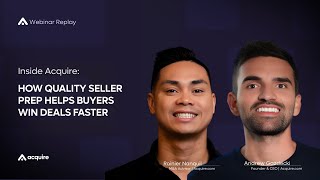
Andrew Gazdecki and Ranier explain how acquire.com's curated marketplace (20% approval rate) speeds acquisitions. Sellers who prepare structured documentation, financials, and tech stacks help deals close in under 30 days. Buyers should complete profiles, show proof of funds, and respond within 24 hours.
Questions this video answers
About four years.
Over 2,000 listings (hosts also reference 'almost 1,300' live/available at one point).
Over $1 billion combined revenue.
Over 2,000 acquisitions.
Over $500 million in closed transactions.
Chapters
All right, so today we're going to be going over how quality seller preps help buyers win deals faster. So a lot of what we do at acquire.com is we curate every listing that comes to us and we're going to be going over how we do that, how it benefits buyers and then also sellers because that's what leads to successful acquisitions on acquire.com so today we're going to be going over how listings get curated@acquire.com what sellers complete before going live, how buyers stand out and win competitive listings. I'll also be talking about the tools that speed up sourcing and diligence. We built a lot of different tools that makes the whole acquisition process smoother as acquire, from drafting listings to connecting into escrow.com or even things for buyers such as sourcing deals, being able to search by profitability, business type and a number of other different factors. Then at the end we'll go over some questions. So if you have any questions, feel free to post them in the chat and we'll be sure to get to them at the end of the webinar. And then for those that aren't familiar with acquire.com we are building the world's most founder friendly startup acquisition marketplace. We've been in business about four years. We've served over a hundred different countries. Today on the marketplace we have over 2,000 listings with combined revenue of over 1 billion. We've done over 2,000 acquisitions, which is pretty crazy to say. So every day we see about one to at most at five acquisitions per day. So every day we're seeing new deals happen. At acquire.com we've closed over half a billion dollars in closed transactions and we have over half a million registered buyers. And quick intro on me, I'm Andrew Gazdecki. I've helped thousands of founders get acquired through acquire.com I built and sold multiple different startups. I built acquire.com to make the whole acquisition process easier for founders. And today my promise is to help you navigate, evaluate, negotiate and close amazing acquisition opportunities. And then Ranier, over to you.
What's up everyone? This is Ranier. I have over a decade of experience in M and A capital markets and investment sales. Previous to acquire I was at Empire, Flippers, Cushman and Wakefield and Marcus and Milchap. We've seen all types of deals, crazy deals, fun deals. And Andrew and I, we can go on with different deal stories and case studies. But I mean we're here to help you get the best deal, best price and least amount of Headache for your acquisition?
Absolutely. We've seen so many different situations and acquisitions that we could go on and on about that. Maybe, maybe a time, a story for a different time. But that's what makes this job fun is bringing together buyers and sellers and successfully closing deals to kick things off. I'm going over preparation, so why this matters. Better prep reduces diligence cycles. So a lot of times when buyers reach out to sellers, we want to make sure that they're prepared and they're ready for the questions that are going to be asked. So diligence moves quickly and both sides can get to the finish line faster. Cleaner listings mean fewer surprises. There's a good saying that surprises kill more deals than they've helped and. And buyers who show credibility early get priority. This is a big one because a lot of buyers think that when you reach out to founders, you should be short or extremely direct. And there's a good balance there. And I'll be going over what that balance is more on this webinar, but giving you tips on how to win these deals, how to earn the trust of founders so both sides win. And when both sides move fast, that's how deals close fast. That's everyone's goal here, is to find acquisitions that don't stall and are going to be successful from the start.
So a little bit about our. Yeah, what were you going to say?
I was just going to say, at the end of the day, that's to get you the best price, the best terms, best timeline, and the smoothest acquisition. So pay attention to this webinar. It'll help you achieve those goals 100%.
And a little bit about our marketplace philosophy. So we are a curated marketplace. So this means not a free for all. We ask for documentation up front. And really our goal is transparency between buyers and sellers. We understand that a marketplace is best suited for businesses that are prepared, and that's what buyers are looking for. And so when founders come to us to list on the marketplace, we'll work with them to make sure that they're prepared in terms of documentation. We'll review financials, we'll help prepare documents with them. In some scenarios, we'll recast financials to pull out the true profitability number of the business. And what this translates to is we only approve about 20% of submissions on acquire.com so every minute of every day, we're looking at hundreds of different businesses. We're asking questions, we're polishing the listing up with them, we're helping them prepare to meet with Buyers. And what this ultimately does is this helps us help more founders get acquired. Because when you look at certain businesses, there's just a level of information that you're going to need to make a decision. And so we really try to bridge that gap. Raniere, anything you'd add to this slide?
Yeah, I've been on multiple marketplaces. I'm sure a lot of our buyers on this webinar as well. The most difficult part is sifting through a lot of listings, especially when they're just free for all. And it's sifting through that needle in the haystack where it's just, it just a lot of time wasted and trying to filter through the good deals and the bad deals. So again, 20% of our submissions are approved and that's to help you to get you the deals with all their information out there available. So all of your questions are answered before, before they're even asked.
Absolutely.
So how sellers prepare to go live? Well, to start they would complete a structured workflow. So this is signing up on acquire.com last step, high level information about their business. What is it? What is the URL? What are the high level financials? From there we guide them on key financials and operational details such as do you have a P and L? Do you have a transition guide? Can you connect your financial data to give buyers even more transparency into your business? After that we'll move towards the docs that they're going to need, such as the P, Ls, the traffic data, handoff docs, if they've created those, even founder introduction videos to go over the opportunity, why are they selling who the best potential buyer will be? And then we'll also prep them on what to expect when they go live. To Rainier's point, we do all this to save buyers time and also sellers time as well. So there's less back and forth. Buyers have all the information they need to understand if this is an acquisition they want to pursue. And then lastly, listings only go live after meeting curation standards. So there's a number of different reasons why we would reject a listing on acquire.com it could be because the business looks kind of shady or the founder simply isn't ready or needs more time. Maybe the valuation is at a level where we don't think they'd be able to find a buyer. There's a number of different reasons, but we do all this to bring both buyers and sellers together to make acquisitions happen. Renier, what do you think?
Right. And whenever we put ourselves in the Buyer's shoes. It's the worst thing that we can see is an incomplete listing. It just shows that the seller is not serious, hasn't put their full time and effort into it and that already kills the deal right from the get go. So make sure that we make sure that you're ready to go complete and that just helps buyers speed up the process and you as a seller as.
Well, a hundred percent. Because a lot of what we do is education. We're educating sellers on what buyers need to see to pursue an acquisition and ultimately again, the time savings make it absolutely worth it. The recommended documentation for sellers. So we asked for things like a clean income statement, revenue breakdown and growth metrics. We want to see customer and traffic insights. They can connect metrics to show financials or Google Analytics to show traffic. What is the tech? Is it php? Is it built with an AI program? Is it a newsletter on Beehive? Every buyer wants to know the tech stack and so we get that up front as well as an operational outline, who operates what, how do certain things work and then a post acquisition plan. Every buyer is wondering what happens post close, how I'm going to operate this business. Is there a transition support involved in this business. So we try to get as much as that as we can up front again to save buyers time.
Quality control how acquire curates listings so it starts with our curation team. We review every single listing. There's not one business on acquire that goes live without our approval. We ensure financials and claims are clearly presented. And sometimes this is just educating sellers on how things should be presented, what's accurate, what's not accurate, what's adding up and what's not adding up. Sellers must verify their identity, often the business. So we ID verify every seller that comes onto the marketplace because we understand that there's a lot of bad actors in the space and we want to reduce the risk as much as possible to make sure both buyers and sellers are comfortable. We flag unclear areas to sellers, tighten up documentation. Again, a lot of this is just educating sellers on what buyers are going to need to see and what's going to lead to a successful acquisition. And the benefit here is you see stronger listings from day one. So every listing on acquire.com has gone through this process and this is the standard that we hold ourselves to to really make sure we have the best marketplace. Renier, what, what would you add to this?
Yeah, that's, that's all good there. Again you're, you're doing as much of the pre diligence up front. So again, it speeds everything up, make sure that there's no guessing of what's going on, everything is clear up front, complete, and just speeds up the timeline for everything.
All right, passing over to you.
Cool. So the benefits to buyers.
So common issues that we help sellers fix, so we get these resolved before buyers see the listing. So confusing revenue explanations, missing or inconsistent financials, weak operational descriptions, big workload expectations for transition planning. If you're missing these things or have it incomplete again, it's so much guesswork that a buyer goes onto the listing and there's so many questions. And right now we have almost 1300 listings on our platform that are listed and available. Now, if you have any of these that are missing, buyers are just going to go to the next deal because the ones that have complete information, they know that they're serious, they know that they're ready and buyers are going to go to those listings.
And I think the big takeaway we try to educate sellers on is putting all this information together makes a buyer's life easy where they're able to understand how the business operates. And if this is something that is going to be interesting to them. And like you pointed out, Raniere, if these things aren't in place, it's a huge waste of time. There's so much extra back and forth, it delays everything. And that can really make an acquisition stall.
Cool. And then why this matters to buyers, these curated listings means you get higher quality deal flow. So clean listings save hours of back and forth, faster decision making, higher trust in both the seller and the asset, and then lower diligence risk. Again, when it comes to these acquisitions, they can move fast. Buyers and sellers that are serious want to make sure there's no back and forth and there's no inconsistencies. And again, all of this gives you the better price, better timeline, smoother acquisition, and it's just to help both sides make the deals faster in a more complete way.
Yeah, I think the key theme is just increasing trust and reducing time for both sides because again, without having this information upfront, buyers have to go get it. The deal stalls out, and then an acquisition usually never takes place. And that's really what we're trying to prevent here, is having quality businesses sell to quality buyers.
And then the buyer experience. So these are going to win competitive deals. So if you have strong intro, fast communication, professional behavior, clear intent, the what Andrew mentioned earlier is the time kills deals and problems. You know, it's not problems that kill deals, it's surprises. So the sooner that you can get into the complete listing. Call out anything that could be a surprise and make sure that you have everything completed on your listing. Again, this is going to speed up the process. Speed up the acquisition shows that you're serious and gets the deals moving towards the finish line 100%. So hire how buyers stand out on acquire so you respond quickly, under 24 hours when possible. Send professional intros, ask smart specific questions, provide timelines early and keep the communication consistent. So again, time kills deals. If a buyer asks a question and it takes days to respond, again, there's 1300 listings on our platform, they're just going to move to the next seller. So again, make sure that time is of the essence. And then if you're going to ask questions, make sure that you've done your pre diligence. Because if the question is already on the listing and it shows that you haven't read it, haven't thought about it, then the seller is going to think, okay, this buyer hasn't even read my listing or went through the listing, went through the pre diligence documents. And again, that that disrupts the trust and efficiency of the deal.
I think you brought up a great point, Rainier, in terms of reviewing all the materials and the listing and making sure if you do ask a question to a founder that it's something that wasn't covered in the listing. Because that can be.
Not necessarily a red flag, but maybe a yellow flag or a frustrating experience for sellers. And if it's a competitive acquisition that's going to put you maybe behind another buyer. So I'm going to go over buyer communication a little bit in these next slides because as a buyer you want to build trust with sellers, buyers who send this up front. Move to the top. As a buyer, you can prove your funds with acquire.com so if you have let's say 10 million cash available or 50,000 in cash available, founders want to see that. They want to know that you actually have the funds to acquire their business. And this could help you with data requests or setting up meetings with founders. No one wants to waste their time and be able to prove your funds is huge for credibility if you have prior acquisition or operating experience that is amazing to share. Again, every founder wants to work with a buyer that has some operating experience for the specific business that they're looking to sell. And they want to know that if they go through an acquisition process with a specific buyer, it's not going to be a complete headache and draw drawn out and there's going to be issues. So if you have experience that you want to highlight, I highly recommend you do that with sellers. Complete buyer profile Every seller is checking profiles on acquire.com they're going to look at your LinkedIn profile, your picture, your short bio that you include, any acquisition experience that you have completing that takes two seconds and will definitely give you an edge with other buyers and then a clear outline of your interest and next steps. So this is your initial reach out to sellers, how you're presenting yourself. But I think the takeaway here is understanding that a lot of these opportunities on acquire, they are competitive, there are other buyers reaching out. And so you want to do everything you can as a buyer to stand out and look professional and capture the attention of sellers. Anything you need to add, right?
And again there's, there's over 500,000 buyers. And if it's a competitive listing, the best thing a seller wants to see is that you know what you're doing. Even if it's your first acquisition, make sure that you know what you're doing and the seller knows what the next steps are. Because the worst thing that you can show to a seller is you don't know what's going on. You haven't showed your proof of funds, you haven't showed your prior experience and that'll stall a deal 100%.
They're little things too, and they add up and they do help. Here's some common buyer mistakes that I've seen and how to avoid them. One sentence intros such as interested, can you share metrics? You want to say a little bit more here. You want to personalize yourself, such as, hey, I'm Steve. This is my experience. I'm looking to acquire business in this space. I'm really interested in your business because of xyz. Can you share metrics? Just something a little bit more friendly and warmer. The second one would be asking for everything at once. If you're asking for just a huge data dump and you haven't really earned that right with the founder, that can hold you back as well. Going silent mid conversation. This is a big one. If you're not interested working with the founder, acquiring their business, just let them know. Because it is a small community. Founders do talk and so you want to have a reputation and moving quickly, being professional and easy to work with. The last one here would be being unclear about intentions or timelines. So again, you want to be upfront with what you're looking for, reasons you may not want to move forward, what kind of timeline you'd look at if they were going to sell their business to you. These are all extremely important in competitive situations and every little piece adds up and can help a lot. Ranier, is there anything you would add?
Right. And just to emphasize the going silent mid conversation, that's, that's the worst thing you could do is to ghost the seller. And again, a lot of these clients on both the sell side and the buy side ask us, hey, have you worked with the seller before? Have you worked with this buyer before? And if you're ghosting people on our platform, the word gets around and it shows that you're not serious, you're not easy to work with. So just make sure that you're upfront with every, with everything. And if the listing isn't of interest anymore, just let the seller know. It's as easy as that. Don't go silent, don't ghost. That's, that's a big issue there.
Well said. So crafting a strong first message. This is an easy framework of how to think about that initial reach out. Who are you? What are you looking for? Why this listing caught your attention, what you want to learn next and then clear next steps. It could be you need more information. It could be it's missing a doc that you'd like to see or you'd like to set up a call, but something to break the ice rather than coming out the gate with a direct request or a ton of different questions. Let the founder know who you are. Because there's another saying where you can't do a good deal with a bad person. And a lot of the successful acquisitions that I've seen are really built on trust and when both a buyer and a seller get along together. So I highly recommend putting things on the right foot from the get go. Renier, how often would you say that the successful acquisitions we see usually comes down to a buyer and seller getting along really well?
It's almost 100% of the time. You could, you could be the most qualified person in the world. But if you're copy and pasting just a short intro and it's very vague, the seller is not going to take you seriously. And again, if you're taking too long to respond, get things together, that's another yellow flag. So just make sure that you do these simple things that go a long way in getting you the best acquisition possible.
Yeah, I would say it's about 100%. And sometimes I talk to founders all the time where I ask what made you choose this buyer? And a lot of the times it does come down to, you know, we worked really well together from the first call. I was just having a great conversation with them. I liked where they were thinking about taking the business a variation of that. So again, you want to, you want to make that first impression count.
So. Buyer outreach framework. Introduce yourself concisely. Share your criteria or experience. Explain your interest in this business. Number three is probably the most important, important piece where you're not just copy and pasting the same introduction message to a bunch of different founders. Really let them know what you like about their business and why this business caught your attention. It could be something specific about the numbers, it could be the customer that they serve. But tailor each message to sellers, then outline next steps. This is the structure that I've seen when conversations puts you on the right foot forward and gives you that best first impression with the founder. Anything you'd add Raniere right.
And then move to the next step. Set up a meeting once you introduce yourself, let's get to the next step. Hey, when are you available to meet? Let's discuss these things and then move the deal forward.
And then if there's founders listening to this as well, I think the best thing you could do in these situations when communicating with buyers, respond quickly, be prompt in your replies. Always be pushing for a meeting if you can get to know buyers because it's a sales process where every buyer that you reach out to is a potential lead of a buyer of your business. And you want to be quick with these follow ups. And that goes for buyers too as well, the quicker you move. Typically that's how you win deals.
All right, cool. So the next one here, winning deals.
So diligence done right and good diligence builds trust and speeds up the closing. So request the documents in logical phases. Explain why each request matters. Be respectful of the seller's time and keep communication steady and clear. And I want to emphasize, explain why each request matters. If you're going to ask for another document or explanation on a certain thing, let the seller know your thought process there and that there's a reason to what you're asking. Hey, I've already looked at these documents. I want to get some clarity on this. It'll help with my XYZ financing thought process. And from there it shows that you're serious, you've done your homework, you've done the diligence. And it also helps the seller know why you're asking for these specific things. Because again, once, once you get to this initial step of the communication, you want to Build trust. You want to build rapport and explaining why each request matters, that that goes a long way for both the seller and the buyer.
100 I. I like be respectful of sellers time too. Because acquisitions, they are time consuming. I've seen sellers just get exhausted from the timeline of meeting with different buyers, feeling like some buyers might be wasting their time. So you know, explaining why you're meeting what your objective of the meeting would be. The more you can do to be respectful of sellers time the better. I've seen acquisitions go.
Next slide here. How buyers create momentum. Again, momentum equals deals closing. So you create it by responding quickly, keeping a predictable cadence, setting expectations on timing, making decisions efficiently. And the one thing that matters most in my opinion for acquisitions is clear expectations. So if you're, if you're a buyer and you're asking something from the seller, hey, if everything checks out, I can get you an offer by this time. And for the seller as well. Just making sure that the expectations are lined out so that there's no guesswork of when is this buyer going to get to me, when are they going to make an offer, are they going to make an offer? So again the sellers are going to prioritize buyers who make this process easy, transparent and predictable.
Yeah, you hit the nail on the head. A lot of it just comes down to good communication, just open lines of communication. When a buyer expects to be able to do something by whatever date, whether that's make an offer or close acquisition or how long due diligence is going to take, that part is huge. I completely agree.
Next one here. The acquire edge and the buyer tools that we provide. So we have verified buyer profiles, save searches for your exact criteria, real time deal alerts, secure messaging, analytics, when the sellers connect the tools. And these tools are to help build and it helps the buyers move faster, more confident. And again, at the end of the day, this is to just move things in a smooth and predictable and expedited process. And all of these tools are on our platform for a reason. So we help guide both the buyer and seller move to the next step so that there's no guesswork of okay, what's next? What do we do? What do we provide? And again, this is going to help you move towards the finish line as fast as possible.
100%. And one thing to note too is the analytics piece. Sellers are able to connect both financial metrics and search traffic as well. So if there's ever a situation where you're not 100% sure, the numbers add up. You can always Ask sellers to connect the tools or we do that ahead during the curation process. So again, like Renier said, tools built to make sure that deals go smoothly and much faster.
And then optimizing your buyer profile. So stand out before you ever send a message. So short, credible bio, your acquisition criteria, past experience, operating or buying, and proof of funds or verification documents. These are the strong profiles that dramatically increase your seller reply rates. So again, once if you're a buyer, you want to make sure that the seller has the ability to look you up, make sure that they know what your background is, that they know that you're a good fit for this acquisition. And that's really the main thing. If you're competing with 500,000 buyers on our platform, you need to stand out and you need to make sure that the seller understands why you're interested in this specific listing and this specific acquisition.
I think the one that stands out for me on this is proof of funds. If you're a buyer and you have funds available to acquire business 100%, recommend verifying those funds with us because again, every seller is going to look at that. So if there's three different offers, they're going to go with the one that appears to have the lowest risk. And it's easy thing to do, it takes 60 seconds.
And then using our search filters to your advantage. So save searches, get the alerts automatically. You've got the business model, revenue, tech stack, multiple profit valuation. Again, I've been on other marketplaces and if you're missing any of these, the buyers are just going to move on to the next deal. It's so much back and forth trying to get all of this basic information and you want to show that you're a serious seller, completed all this information and this is the bare minimum. You got to have all of these.
Items then also as a buyer too, if you're looking for just businesses with a certain tech stack, you can search and filter based on the specific tech used in a business. Maybe you're looking for a certain size of business or at a certain multiple. You can use all of our search filters to go through all the listings that match your specific criteria. So definitely use them to your advantage.
And then how to interpret metrics quickly. So for software, e commerce agencies, content businesses, focus on your revenue consistency, churn retention patterns, gross margins, owner workload, customer concentration, growth direction, and not just the number. You want to make sure that it's predictable and durable revenue. So again, there's no, it's not vague at all when a Buyer is looking at these things on your listing. And if you need more explanation or you need a little bit more insight on what's going on or why things are happening, just ask the seller. And again, let them know that you've reviewed the documents and why you're asking these specific questions 100%. And then why acquires curated listings win so the quality listings means quality outcomes. Sellers come in more prepared. Documentation is clear. Deals move faster, fewer unknowns, higher buyer trust. So again, trust transparency. That's going to get you the best price, best terms and the smoothest acquisition.
All right, bringing it all together. So we do all this for a reason. We do all this to bring buyers and sellers together to have successful acquisitions. And this is an example of pretty much every acquisition on acquirer where seller has documents, buyer needs buyer reviews that both sides are able to communicate fast. This results in due diligence being faster and smoother deals closing in under 30 days without what we do at acquire.com acquisitions can go on for six months because of the additional back and forth and putting materials together. And then for one reason or another, it all falls apart. So our job@acquire.com is to bring buyers and sellers together to help businesses successfully get acquired.
What can you ask today? So how to write better buyer intros, what to request during due diligence, how to navigate competitive listings, how to evaluate seller documentation, how to use Acquire's tools more effectively. Bring your tough questions so final takeaways. Curated listings equal cleaner buyer experience. Credible buyers win the best deals. Speed and clarity close deals faster. Acquire gives you the tools to move confidently here to help you succeed in every step of the way. So if you're ready to close better deals, you curated listings today. Again, only 20% of the businesses are approved on acquire.com you can evaluate startups faster and with more confidence. Win competitive deals by showing real buyer credibility. Get started@acquire.com.
All right, let's move to some Q and A. How much should I share in my first message? Without overdoing it, this is a buyer question.
So you want to keep it short and sweet. But again, you don't want to copy and paste something vague. You want to keep it three to five sentences, short and sweet. But the seller can understand what your background is as a buyer, why you're interested, and you want to make sure that the seller feels comfortable. You've done all your homework. You've looked at the pre diligence questions, complete listing, all the documents and from there a short and sweet intro. Three to five Sentences. And then the action step of hey, let's jump on a meeting at your earliest convenience. I want to go over these things and this is what I'm looking forward to in the next steps to make an offer.
Yeah, I would say three, four lines. It doesn't need to be a full story or multiple paragraph, just quick, short, to the point. But not just two sentences. I think three to four. Where you're introducing yourself, you're adding a bit more context and personalizing. It can go all the way. Okay, next question. What docs should I ask for to keep diligence moving quickly?
So again, once the documents that are already on the listing, you want to make sure that those documents are already there. So again, it's most likely going to be P and L. Any cohort.
Cohort data. Those are the most important. And again, if there's any additional items that you're looking for, just reiterate that, hey, I've already reviewed these documents from your listing. Here's anything else that I'm looking for. I'd like to get some clarity on what happened here. Excuse me. If there's any trends from either cohort or revenue, you want to make sure that the seller understands what you're asking for and why you're asking for that. And that'll just speed things up and it shows the seller you've done your homework, you've done the pre diligence items, you've already looked at these different things and then that'll help set up a meeting to get further information from the seller.
Yeah, I think it's important to point out too, it's not necessarily bad to ask for documents, especially if you need them to acquire the business. Just make that upfront with founders. Let them know why you're requesting the doc so it doesn't seem like you're creating unnecessary work. So what docs should you ask for to keep diligence moving quick? Whatever you need. I would just ask for it up front and give some context as to why it's needed and why what that's going to help with.
Moving on to another buyer question. When multiple buyers are circling what actually makes my outreach stand out. You want me to take that?
Sure, if you want to take this one first.
Yeah, I'd say just being number one friendly, being responsive, having a complete profile on acquire.com, having proof of funds, having a brief explanation of who you are, what experience you have, but moving quickly is probably the biggest one. I would say being able to set up a meeting and meet that day or responding to questions quickly, reviewing all the documentation on the listing. So doing all your homework, reaching out quickly, setting up meetings fast, just being easy to work with, that's been a huge one in my experience.
Right. And then being easy to work with, that's going to win you a deal. If there's a competitive listing and you've got multiple buyers, if you can be personable, easy to get along, the seller might favor you versus another buyer that has more proof of funds or more experience. It just makes it easier for the seller to work with you. And it's, you know, a lot. I've seen a lot of deals where the seller will pick a buyer that may be a first time buyer, but they just relate more, can understand that the buyer is going to take the business to the next level. A lot of time it's the seller's baby and they want to make sure it's in good hands. And that's how you win a competitive deal. Especially if there's other buyers, private equity buyer, etc. You want to make sure that you're personable and it's going to be an enjoyable process to get the acquisition to the finish line.
I hear that all the time, Raniere, literally every day. Because acquisitions are a risky experience for both buyers and sellers. Where they're, like you said, they're selling something they put blood, sweat and tears into. It's their baby. They want to see that business live on. They want to see the business continue to thrive and grow. And so when they feel like they found that with one buyer versus not with another buyer, every single time, they're going to work with a buyer that helps them transition the business in a way that's really important to them. That's also a great question for sellers too is ask them, you know, what's most important to them. If it's a very competitive process.
You know, are they looking to continue the legacy of the business? Do they care at all? Is final price most important to them? There's a number of different things that founders care about. It's going to be different for each one. So just asking up front can be a great way to, to win a deal as well.
Moving on to some seller questions. How do I show my financials so buyers don't get confused early? Want to take that one first?
Yeah, I can take that one. So it's, it's going to be very important to show that you have historical financials. So if you have a P&L 12 to 36 months, the longer the Better and it can show just any trends of the business and that's what buyers want to see. It's not problems that kill deals, that surprises. If you can show historical data, they're going to ask, okay, what happened? Why was there growth during this time? Or why was there a dip in growth during this time? That's, that's going to be something up front that, that you want to address early. Because again, the more problems that you address up front, the better. The worst thing that can happen is there's a surprise later on and you just either tried to think that the buyer wouldn't notice. That's a quick fire way to kill a deal. So just make sure you have historical data. That's what I'd suggest.
Yeah. I love the point on just being upfront with bumps and bruises on the business. I think a lot of founders don't realize you need to be upfront about those things and they're not a bad thing. What I mean by that is this expectation that when you sell a business, it needs to be, you know, the best business ever and in perfect shape. But in reality, most if not all businesses have some bumps or bruises or things that, you know, aren't necessarily good things. Maybe churn is high and they haven't been able to figure that out. Well, a lot of buyers will view that as an opportunity. If you get churned down, the business will grow more, it'll be worth more. So bringing those things up early I think is absolutely the way to go. Because if you don't, they're going to be found out at a later point. It's going to be a surprise and that can derail an acquisition. Okay, next question. How transparent should I be about post acquisition workload? I'll take this one first from here. Really transparent, 1000% transparent. Because again, anything that you're not transparent about, buyers are going to figure out one way or another and then the whole deal is going to blow up. So I think the question there is do you want the deal to blow up? If you don't, then I would be as transparent as you possibly be. One tip here is outlining this up front where you outline what does the workload look like? What sort of support could a new buyer expect from you? Is it three months? Is it six months? All of this is negotiable. So you're not locking yourself into anything but communicating that and at least saying that you've thought through it a little bit without having to meet with the founder. You as a buyer meet with them Ask them these questions. It saves a lot of time, it can get buyers interested. And it also addresses just a key risk question, which is what's going to happen post close? Who's going to help me learn the business? I think addressing that up front is the way to go. And then be super transparent about it.
Right. Just 100%, just clarity. That's, that's going to get the deal to the finish line. And then again, buyers, they want to mitigate their risk. They have some questions of what, what will happen post acquisition. As a seller, you want to be helpful and make sure that you're there for the buyer so that there's no surprises. Their, their worst fear is that they take over the business. You end up just ghosting and then they have all these concerns post acquisition, just make sure you let the buyers know, hey, I'm going to be there. We can negotiate if you need some type of support for a certain amount of time. And that'll help these deals get to the finish line and help the buyer with ease post acquisition.
Yeah, and it's all negotiable. It's all negotiable. Next question. What's the best way to show churn retention and customer concentration?
Again, the cohort analysis that's going to be most important there. And then again the historical data to see if there's anything that happened in the past, why it dipped, why it grew. I think that's going to be one of the most important there.
Yeah, that one's pretty straightforward. There's not really many clever ways to show churn retention and customer concentration. You're just going to want to show exactly what they are, whether that's in your P and L or your customer cohort. I've seen a time just giving access to a data integration. So whatever shows it, just make sure the accurate, the numbers are accurate. That's going to be the most important thing. And then if you do have say high churn or low retention or high customer concentration, just call that out up front because every buyer is going to immediately go towards that. But if you have a reason for it, like for example, on some acquisitions I've seen where there's this extremely large customer, but they're on a five year contract or something like that, call that out and address it up front. So there's a little bit more context which should make something, you know, maybe not so good look, you know, pretty good with context.
Okay, next question. How do I reduce buyer ghosting during negotiations?
Yeah, I can take this one. So again, ghosting that's, that's the worst thing you do both buy side and sell side. Just make sure you're clear up front, especially with timeline expectations. If everything checks out, I expect to make it, you know, an offer around this time. If you're a seller, I'm looking to make a decision and pick the winning buyer by this time. Just make sure that the expectations are laid out and that'll make things smooth.
Yeah. One tip here could be consider controlling the timeline. You kind of alluded to it Rainier, but communicating with all buyers that you're expecting offers by a certain date and you're going to select the winning buyer by a certain date and letting buyers go down that timeline with you. Some buyers will just bow out, unfortunately without any communication. These aren't ideal situations, but it's also something to expect. So ways to reduce that would control the timeline. Be prompt as a seller with any questions, meet as often as you can, address any questions up front and then move buyers through the timeline.
All right, maybe two more questions. Raniere, what do you think? Or three.
Sure, either one.
All right, let's see. How does acquire decide a listing is ready and what's the minimum info needed? I can take this one. Deciding if it's ready, that's going to be up to the founders. Some founders want to go live by a specific date, some want to go live immediately. So we work with them to see what type of timeline they're looking to sell and then the minimum information that they need. It's going to depend on the business. If it's a business that's going to be sizable and we expect that to be a life changing acquisition or require a buyer to put down significant funds. For example, let's call it over 100k. We're going to require a P and L. We're going to want to put together a presentation with them. We're going to want to really walk them through everything that they're possibly going to need for a buyer to be interested. If it's a smaller business, we require less.
But yeah, it just depends. It depends on the business and the opportunity that we see. Next question. Do deals really close faster when sellers upload metrics up front? 100. 100. Because you're saving buyers time. When you save buyers time, more buyers are going to be interested. When more buyers are interested, you see more offers. When you see more offers, you see a successful acquisition. So 100%. The, the other road of that is you don't have clean documentation or metrics upfront and then Buyers meet with you and they have to ask you these things. If you think of it like a sales funnel, you lose a bunch of buyers at the top because they don't want to deal with that friction. Or like Rainier always points out, they're just going to go to another listing that does have this information. Everything today is just very competitive, where there's a lot of businesses for sale, there's a lot of buyers looking to buy businesses. And so if you're a seller and you don't have these things, then buyers move on to another one. Anything you'd add to that, Renier?
Yeah. And again, it's not just faster. This is the difference of closing a deal at all. I've seen in other experiences of different sellers where it could take 6 months, 12 months, or just not sell at all. So this is just the basic minimum that you need to have in order to show that buyers that you're serious, you're ready to move forward. You've thought about the price, you've thought about what's important to you. You thought about the ideal buyer profile. You've thought about all these things. And this is the difference of not closing at all or closing in a and getting your best price, best terms, and best acquisition experience possible.
That's what every founder wants. Best price, best terms. No headaches. Okay, Next question. Maybe we'll do two more.
Sure.
Okay. What seller? Red flags signals inexperience or low seriousness?
What seller? Red flags again, if you're a buyer and you're copying and pasting a vague question on the chat, that's. That's already a yellow red flag there. And if you're asking for things that you could have looked at on the listing or on the documents, again, those are yellow flags that could stall a deal or, or have a seller move to the next buyer.
What would you say red flags are for sellers?
For sellers. If, again, if you're, if you're a buyer and then there's a red flag for the seller, it shows that you haven't thought about what your ideal deal structure looks like. You haven't thought about how to answer questions on different trends of the business, of why it dipped or why it grew at a certain time. It just shows that you haven't thought about these questions and these are the basic questions to expect. So if you're a seller, just put yourself in the buyer shoes of what you want to know and things that you want to explain and need to explain during this process.
Yeah, red flags for a buyer. I would Say, rushing towards an offer. We see that sometimes where an offer is sent without meeting with the founder, not all the times, but that sometimes is a red flag because it's a process where you need to meet with the founder, review the docs, come to evaluation together, then submit. I think having an incomplete profile where the funds aren't verified, the LinkedIn profile doesn't go anywhere. That can be a red flag.
Meeting a lot and not having it really result in anything where there's multiple meetings needed with multiple questions, or I should say multiple topics, like one meeting for product, one meeting for marketing, and then at the end of all of it, it's not really moving towards anything. I think that's a red flag. And then for sellers, I would say just lack of preparation, lack of, like you said, Ranier, not putting yourself in buyer shoes and understanding what buyers are going to need to see to be interested in acquiring the business. I think that can signal inexperience and low seriousness. All right, last question here. Is there a fast way to judge a listing's viability from the initial data? I can take the initial crack on that, sure. Yes and no. I mean, there's a good overview of the business. But I think you'll really want to dive into the docs. You want to sign the NDA, you want to see what the business is.
Use the product, meet with the founder. But in terms of viability, you. You can look at the valuation. If the valuation is really high, it might not be something worth pursuing. You can look at the growth rate, you can look at the profitability of the business. But I think to really get into if it's a viable acquisition opportunity, you have to meet with the founder, you have to meet with the founder, you have to review the docs, you have to dive a little bit more deeper than just the what's initially on the surface.
Right. I would just add to that and going back to your example earlier, where there's Lois that get sent before these meetings, that is a little bit of a yellow flag because you haven't even talked to the seller. You don't know what's important to them. With this acquisition, they could be in some sort of emergency where they'd rather close quickly. And so maybe price and timing, there's a difference of someone wanting the highest price versus someone wanting the highest cash up front versus someone closing in the fastest timeline. So just make sure that you meet and, and that'll address the questions for both buyer and seller.
All right, everybody, well, thank you so much for, for attending this webinar. I hope it was helpful. We'll have the recording out sometime next week. And, Renier, what do you think? Should we do another one in January after the holidays?
Yeah, whenever. Happy. Happy to help.
All right. Well, everybody, happy holidays. Thanks again for joining. And if you need us for anything, you can reach out to us at Acquire. We're here to help both buyers and sellers. And we'll see you next year.
Thanks, everyone. Happy holidays.
More from Andrew



The Buyers Who Made the Move: What They Bought, How They Did It, and What Happened Next






