Interview - Andrew Gazdecki founder of MicroAcquire and Akeel Jabber founder of HoriZen Capital.
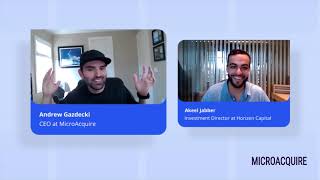
This is a YouTube video titled "Interview - Andrew Gazdecki founder of MicroAcquire and Akeel Jabbar founder of HoriZen Capital" recorded in August 2020. It features a detailed English conversation between Andrew Gazdecki and Akeel Jabbar discussing Andrew's entrepreneurial journey, including his first company Business Apps, his experience with acquisitions, and his current venture MicroAcquire, a platform for buying and selling micro SaaS companies. The interview covers topics such as startup growth, exit strategies, content marketing, and the SaaS acquisition market for startups under $500k ARR.
Foreign.
Hello everyone, this is your host Akil Jabbar. And welcome back to another episode of SaaS District. In today's episode we're talking about how the current micro SaaS acquisition environment looks like for startups under 500k in ARR. Today we have our guest Andrew Gazdecki joining us. Andrew is a storyteller and an entrepreneur. He started his first company Business Apps while still in college which was an affordable mobile app development platform for small businesses. He initially raised around $100,000 in funding and by the time the company was acquired by a private equity firm, they had grown to $10 million in ARR, operating in 40 countries and employing over 100 people. His second business, Altcoin IO was a decentralized exchange for trading digital assets. By trading on their decentralized non custodial platform, traders could protect their assets. Altcoin became a champion of security in a market dominated by custodial platforms that put users fund at risk. They were eventually led to the company eventually led to a company being acquired by a global investment firm called BNK to the future. So welcome Adri, glad to have you on our show today. Hopefully that was a good introduction.
That was good. Thanks for having me. Big fan of what you guys are doing over there at Horizon. So this is gonna be fun.
Yeah. Awesome. So we do have to give a quick shout out to Nathan Latka. So he introduced us indirectly and I'm pretty sure we'll do something together and he sent some deals to us. So if you guys don't know Nathan Latka, check him out. We also had, we did a video together last week on his SaaS dealer bust on his YouTube channel. So if you guys are listening, check that out.
That was fun. Yeah.
So Andrew, tell us a little bit about your story. I want to hear that first business you built in college, business apps in 2010. Tell me about the story. What happened there? How did that idea form and how did you get to where you were today?
Man, how much time have you got? So yeah, I'm kind of like. So to just kind of like kick things off. I'm a die hard entrepreneur. I was at kid, you know, 10 years old, I had like an ebay store, maybe like 12. I used to sell like Pokemon cards. I had. This is kind of embarrassing but I had like a World of Warcraft website that sold like digital gold when I was like 17 or 18 or something like that. So I had this thing where I was always trying to start a new company every summer. So I Went to csu, Chico State, started a company called Phone Freelancer. This is how business app started. So it was a simple job board that connected businesses with mobile developers. Remember when the iPhone first came out and everyone was like, how do you build apps for this? This is revolutionary. Do you remember those moments?
I remember, yeah. First iPhone.
And so I saw that kind of as like a paradigm shift and we could talk about this. But I always view the businesses that you can build are ones that have kind of tailwinds, market shifts. And so I knew there was opportunity there. So long story short, created a job board that connected mobile developers with businesses. Just bought like freelancer.com script I'm a non technical founder, got some design chops, I can do HTML. Most of my background and expertise is in go to market, sales, marketing, operations, culture, jokes, I don't know. But so that, that company, it wasn't really a company, but I sold it in college for, you know, an amount that felt like a trillion dollars, you know, because everyone's broken college. But the reason I sold it was I kept seeing people posting the same sort of listings. They said, hey, I'm a restaurant. I want to build an app that does these five features and then it would pay a developer like 50K to develop it. So I thought, all right, well let's sell this thing and then I'll have seed money to create a template, kind of like WIX or Weebly, but for mobile apps. And we eventually expanded into progressive web apps, Android apps and some other cool stuff. But yeah, started very humble beginnings. I was just a kid in college. You know, candidly my motivation is I wanted to get rich. Over time, motivations change. But when you're young and come up from a lot of money, that was kind of my drive. And so I knew I wanted to start a company and I did. So, yeah, business apps launched in 2010. I was 21 at the time, raised about 100k. And what's interesting about business apps a lot of people don't understand is so when you look at the website, it's still up. It looks like it's for SMBs, right? So when we first started, we were like cold calling all these small businesses and we call restaurants like, hey, like, are you interested in like mobile app? Like, what are you doing for your mobile marketing? Be like appetizer, like, what are you, what are you, what are you talking about? So struggled with that for a while. And if you build, you know, the best businesses, you want to have like, you know, an LTV above, like 10K, 20K, mid market. Big fan of those businesses these days after learning through micro part or not micro part business apps. So what we did was really just talk to customers. I saw one customer building like five apps for these big Grimata hotels in Switzerland. And I'm thinking, okay, there's this like really rich person on business apps, like building apps for these hotels that he owns. This is cool. And again, I'm 21, so I'm like, I want to talk to rich guy. Called him up, he's in Switzerland. I'll never forget it. And he, I just asked him like, hey, thanks for building these apps on my platform. How can I help you build more? And so that's when like the huge light bulb went off. And this is when basically the trajectory of business has changed forever. And what he explained to me was he was a marketing company, an agency. So he's working with these hotels. And he told me that if I could white label the software, this amazing mobile app building software that we built, he could then, you know, sell this as like a semi custom solution to the hundred hotels and hospitality companies he was working with. And I remember Wikipedia, like, what does white label mean? Like, I had no idea. And that's, that was really the business apps model and that's how we were able to bootstrap it. So instead of focusing on, you know, one small business at a time, we ended up partnering with, at its peak, about 5,000 web agencies all across the world. We were in 40 different countries. Translated the app more languages than I could. I can't even remember some interesting ones, like, you know, Hebrew. You know, it's like right to left. Didn't know that. Also didn't know that, you know, Portuguese. Brazilian. Portuguese is different from Portuguese in Portugal. That was an interesting situation because we had a big client in Brazil. We did Portugal, Portuguese. So, yeah, man, you know, just started it really. The goal was to just not get a job. I thought, hey, I'll build like 20 apps for these businesses in my college town, which I did. And I don't got. I don't have to get a job. Cool. And then, you know, we stumbled on to something a little bit bigger and it just kind of, you know, scaled up from there.
Yeah. I usually hear there's kind of two types of entrepreneurs that I run to. One are the ones who are like, I just know I'm an entrepreneur. Like, doesn't matter. When I was a teenager, I was trying different things and you just keep having to do something and build something new and then there's ones who are like, you know, I just kind of stumbled to this problem and somebody said they want to buy it. I said, hey, maybe I can monetize it and. But it was just like. And then it ends up doing well because they're solving a really good problem. But I think you're me and you are pretty similar on that. That side.
Yeah, I mean, there's no like, there's no like. Right. Path. I think, I think the key is just, you know, just having fun, you know, really understanding yourself. And yeah, like when you're motivated and you're passionate about something. Startups are hard. I know. You know that you, you buy them, that's like the hardest thing. But that helps you through the ups and downs. Because, you know, business apps wasn't always just like, oh, this is, this is so easy. Like, we had so many moments for Z. Up and down. But you know, either entrepreneur, if you're passionate about it, you know you're going to do well.
It's funny you say that story about the job board, actually. I remember when I was in college, I did the same. I actually started like a recruitment company for, for tech startups and I was helping them kind of recruit all these people. So I did that really well, you know, built at least like 10k MRR for, you know, in college. That's a lot of money.
That's a ton of money. That's like a trillion dollars, dude. That's how I felt. I was like, this is like a billion. Everyone's broke.
I felt the richest kid at school. But yeah, yeah, right on. But yeah, I didn't do anything as interesting as you. I just like shut it down. I mean, I should. I didn't know anything. Looking back now, I didn't know SFPs, how to hire, how to do systems and automate, you know, now it would have been done much better. But it's okay, you know, cold calling and making sales, it's an experience you'll never forget. Right.
I think it all worked out for you.
Yeah. Yeah. Where did you spend that money? So you actually went out, raised the 100k. Did you end up raising any more or was that it?
That was it. So business apps as a model was so cost effective or efficient in terms of how we spend cash. You know, we kind of did the Silicon Valley thing too, which is interesting. You know, we were named to Inc. Magazines fastest growing companies twice. We stopped reporting numbers because people were looking at our business really closely after that. And a fun fact, if you get on inc500. Like you have to change your cell phone like every recruitment company, everyone calls you. So what we did was we have 100,000 cash. You can't really hire too many people. So we focused on innovating on distribution as much as the product. That's what I was always telling my team, like, hey, we have a great product. We need to find a cost effective way to distribute this product. And the white label channel proved to be that model. And so we kind of went all in on that model. And the unit economics were great. We had customer payback within 30 days. So within 30 days of partnering on, we were profitable off. That could reinvest that back into the business. We also did a lot of larger deals with agencies where we do a discount if they paid annual up front. So it was like a mid market company, but just customers coming in paid for, you know, the company to grow. So to answer your question, like 100k, what did I spend it on? Barely anything. Like I always say, the best source of funding is customers. And so we just found a way to bring in customers very cost effectively. And then, you know, you might be thinking, okay, how do you, how do you find all these people? How do you, you know, get 5,000 partners or whatever? And we focused heavily on brand and storytelling and pr. So if you look at business apps and press mentions, we were in TechCrunch like 10 times. I like built relationships with all the writers. Anytime we had a product release, I made sure to pitch them. And even if they said no, it still kept them in the loop on what we were doing. Milestones. Have you reached 500,000 apps built? We even did something where we were giving away free app accounts for students. So we focused heavily on brand and that's something that I think a lot of startups should do. Just establishing yourself as the market leader. People hear about you the most anytime in our market. If you looked anywhere online related to mobile marketing, even today, if you look on G2 crowd, even two years later, after I've sold the company, we're still like the market leader. So just focusing on brand is what I did. Just these marketing strategies that just didn't have any cost to them. It worked out, man.
Cool. And then eight years later, 10 million ARR. What was the decision at that time to exit the business versus continuing to grow? Did that private equity firm just come up to you and sounded like a good offer or were you guys like, all right, I'm kind of tired of this and looking for a buyer at that point?
Yeah, funny Enough. So I hired an Investment bank in 2016, and again, I'm like, 26, man. So if you ever want to do a podcast again on all the mistakes you could possibly make running a SaaS company, I could run an hour on that. So hired investment bank, won't say which one. You know, got a few interesting offers. Earnouts, had to move part of the team to a certain state where they're headquartered. We had one really large private equity firm looking to do like, a 30% or a 70% buyout, but I turned them down. You know, I'm sure you run into founders that are always kind of debating, should I sell now or should I keep going? And I was young and the market was still growing, so I just said, hey, let's keep going. So, funny story. Two years later, one of the PE firms that the investment bank introduced me to, we ended up selling to them, and they reached out to me, ended up selling to an individual named Andy Treva. Amazing dude. I still keep in touch with him to this day. I look up to the guy and, you know, working with them. And I think this is probably similar to the terms that you give founders was, you know, I was getting tired. I was running the business for, like, eight years. I had already started working on another company, and it was a good business. It was profitable from, you know, pretty much year one. Turned down VCs, like earlier when I was like, 23, 24, 25. Kept it bootstrapped. And, yeah, so I just kind of got tired. And candidly, I got an offer where, hey, if I take this, I don't really have to worry about finances ever again in my life. So that was obviously appealing and the terms were great. It was. I don't know if I can really say the terms, but they're similar to yours. There's things that they did that just really incentivized me to do the deal. We had about 2 million cash on hand. They bought that it was a stock purchase. So the tax liabilities were super low and quick transition out, really straightforward due diligence. ESW Capital has a stellar reputation for, you know, when you sign loi, that's basically, you know, what to expect going through the process. So it was just time. It was time to move on. I had learned so much mostly through mistakes. Happy to talk about those if you want, but, yeah, I mean, long winded answer, but I just wanted to move on. I wanted to, you know, I like building companies. I feel like I built business apps to a spot where it was in a Good place for a potential sale.
And you got a good offer you couldn't refuse. Yeah, that's kind of our sweet spot. Most people think we look at, you know, early stage or like two, three years old, but it's actually around that five, six, seven year mark. I think you were eight years where the founders kind of burnt out. They're just like, you know, they've kind of hit the plateau of where they want to take it and they want to move on. And there's like, okay, cool, we'll come in and keep growing it for you. Right?
And yeah, eight years of startup land. It's like 50 years, like a long time.
So that's true.
It worked out and I couldn't be happier.
So cool. And looking back now, so a couple of years now since that happened, do you think it was the right time and right decision at the time to exit?
I mean, now that I know. I mean, so every founder, when you sell a company, it's your first time, so you don't really know, like, you know, what other options you could do. You know, if I can go back, I wouldn't change a thing. But now knowing kind of like the PE landscape and how to, you know, potentially position my company better for other private equity firms, you know, maybe I would have ran like a, you know, process where, you know, I brought a few more buyers to the table. But again, it was just an offer I couldn't refuse. I just said, hey, let's, let's go, let's do this. But no, I, it worked out so well that, you know, that's. That's a really good question. And I'm kind of, you know, debating my answer right now, but I'm going to go with no, it. I wouldn't change a thing.
Okay. No regrets. That's good. That's a good answer. And then from there, you went and built another company, Altcoins, and then had an acquisition exit within like another year or so. Bank to the future.
Yeah, so I had two acquisitions in a year, which was kind of cool. So I think one interesting thing that happens when you sell a company is you learn how to build a company with the purpose of getting it acquired. And so that was the idea with Altcoin. And it was in like, it was when like, you know, Bitcoin was going crazy. I kind of fell into that hole deeper than others, ended up building some pretty interesting technology, and then just sold that to someone who could take it farther than I could. And also, candidly, I'm a SaaS person so I realized I didn't want to be in that industry. I do, you know, think that whole space is interesting a little early. So for one year it was a good ride. And yeah. And then candidly too, what's interesting, when you sell a company too, you're kind of like, what do I do next? And so, you know, I immediately rolled into that company and that one also worked out pretty well.
Yeah, just that's what when I was at the previous firm I was working at before. So when I left, that's kind of what happened. It was during the same time period where they kind of all the partners were getting excited about all this, you know, crypto world. And, you know, I kind of stepped back. I saw the opportunity, but I did see it was kind of early. So that's when I decided to, you know, build Horizon, you know, and they did make a lot of money with it, but it just wasn't for me. Right. I'd rather focus on what I enjoy. Right.
It's a tough market to make anything work. Like they, I think that market has a few years to go, but we were still able to make a couple breakthroughs that were, you know, fairly valuable. And I love technology, I love digging in on like stuff that is over my head, which it probably was to some extent. And again worked with, you know, I view startups as like, you know, these journeys where you get to bring together awesome people that you know you're going to be friends with for life and got to do that again and hopefully I'll do that again in the future.
And then I think you're now like 28, 29, you finally get your first job at Spiff or you're like conversion, was it Chief Revenue Officer?
Yeah.
What happened there?
Yeah, so since you're not an employer, I'll tell you my age. So I sold business apps when I was 29, Altcoin was acquired when I was 30, joined Spiff when I was 31. And the story there was I was originally going to be an advisor. So talk to Jaron, the CEO. One of the most brilliant product developers I have ever met. One of the best CEOs. I consider the guy like one of my really, really good friends. That whole team is amazing. And so it started off with me just kind of like taking calls, giving some advice on how I do things. And they had just left their, they had just let their prior CRO goal go and so they needed some help on just the general go to market strategy as a whole. Like the sales process needed redoing they had a good baseline of customers, but they had no, what I call unaffiliated customers. So all their customers were essentially referrals from people that they knew, their board members that so came in there, optimized the sales process pretty quickly, didn't do anything magical, but ended up growing the company about a thousand percent. Got them into TechCrunch, Forbes, helped them with their brand, their storytelling, their positioning, had an absolute blast. Ended up raising a 10 million Series A. And then I just kind of felt, you know, my job was done. I helped them recruit a world class replacement for me who's way smarter than I am. So I'm really excited for them there. But yeah, being an entrepreneur, you know, I felt like I helped them win like the first championship and now they got to go do the three more, you know, dynasty type play. So you know, they're doing the series B, series C thing and I'm, I'm an entrepreneur. So yeah, back in entrepreneur land, I guess you could say.
Yeah. So Back to today, 2020, you now decide to build your next company, which is Microacquire, where you help companies, other SaaS, founders sell their business without a broker in between. What's your vision with that platform? And if you're not charging intermediary brokerage fees, how are you planning to monetize that?
Yeah, that's a good question. If you have any ideas, let me know. You know what I did was I just basically wrote down all the things that I want in the next company that I start. Love working with startups, love meeting interesting people like yourself and just helping startups think through, like how do companies get acquired, how do they get value? What do buyers look at? What is due diligence? Like, what should I expect? And I'm not super hands on with this stuff because again, I'm not a broker. I don't take like any sort of fee. But the way I kind of view it is, you know, you have brokers in the market, I'm sure you work with a ton of and then you know, a lot of, you know, some of the best companies that you can acquire usually like you know, the diamonds and the rough, where you got to go find them, hold email, just keep relationship with them. I view microcquart kind of as a middle ground where you know, the founders are able to, you know, speak with buyers directly. They're not committing to anything, there's no commissions on either side. So that's, that's kind of the vision for it is there definitely is a Purpose for brokers, investment bankers, 100%. But then there's a lot of startups that are comfortable meeting buyers directly. And so that's kind of like the void in the market that I'm trying to fill. And candidly, even before I joined Spiff, I was looking to buy a company. And so I didn't know about any of the brokers, I knew about all the investment bankers, but I did not know that world existed. I didn't know there was these websites that sold these like, you know, micro SaaS companies. And so I just thought, hey, like it'd be really cool if I can kind of cut these people out and speak with founders directly. And so I just kind of scratched my own itch and just built it. I can't believe people use it to be honest.
I guess it's also good for deal flow for yourself too, right? A good way to get your own deals and get first crack at some of those.
You know, funny story. So, you know, I put out an LOI on a company that I loved. I won't say the company, but every company that goes on Microfire, I put it on the marketplace. I don't do anything where like I get first look, then I'm like, hey, you gotta take my vehicle or anything like that. So he goes on the marketplace, gets like 50 requests from potential buyers, weeds it down to like 10 people, gets it down to like five Lois. And then I'm like, you mind if I submit an loi? And there was one at the top that was priced over. What I was expecting was real. So I was the second highest bidder and I was really excited about that company. Still friends with the founders and obviously they took the higher price. And so my payment for basically shooting myself in the foot on that deal is some. I'm expecting a bottle of wine from France in the middle, so that's what I get.
Nice. So you still haven't figured out how to monetize it yet? Right, but just building it up right now, see how dominate and then monetize kind of model.
Yeah, I'm really just focused on trying to really solidify Micropower as like the go to place to buy and sell micro SaaS companies. There's still a lot of work to do, I'm still figuring a lot of stuff out. But there's a wide array of buyers in there, which is really cool. It's like, you know, people that are looking for things on the smaller end. It's called like pre revenue 10k, like just, you know, hobby things. And there's the, you know, hundred, five hundred K. That's like where I envision the whole platform to be perfect for. And I still do. But now we're starting to see, you know, larger companies coming in interested and just meeting with buyers, feeling out the market.
So yeah, I feel like that 100 to 500k is probably a lot larger buyer pool there. And I feel like, you know, somebody with some, you know, a bit of cash can, can pull that off versus when you get to the higher range, you need a lot more, you know, capital to, to back you, I think. Right.
So yeah, that's, that's when I, that's when I, you know, come to you because it's a better experience for everybody because not a lot of people have, you know, a couple million bucks to just do a SaaS acquisition. And then, you know, my experience selling business apps I sold to a buyer that had a great reputation, I knew what to expect. So if a founder comes onto Microquire and it's clearly probably too big for 99% of the people on the market, you know, happy to make introductions and just point them in the right direction of firms that are reputable buyers in the space. But yeah, the majority of deals that go really fast on microquire are between 50k mrr or not mrr ARR up to 500. That's the sweet spot that I see a lot of interest in, which is really cool.
And how do you kind of streamline that selling process because you've obviously been through it. Buyers need enough information to be comfortable acquiring the company. How do you make sure that the seller provides that and still efficient for you and your team and it's not taking about a bunch of your time.
Yeah, definitely. So I try to talk to every founder. Now that I'm able to do this full time, I spend the majority of my day just set expectations correctly. Sometimes it's harder, easier said than done. It can be hard to tell someone like, hey, your baby isn't as good looking as you think. You know, it's probably not worth like 10x top line. ARR. So I run into that sometimes and then, you know, I'll try to, you know, just tell them what to expect. But the cool thing about Microacquire is you can connect your stripe metrics chart, mobile bear metrics, profitwell, so you get real financial metrics that you can view about the startup from their MR, AR LTV. So that's one way I'm trying to streamline due diligence where you don't have to go through like a P and L before you even get excited about the business. You can see real financial data being shared, obviously anonymized, but that's kind of like the way I'm looking to streamline the due diligence process for the buyers, but then also give them some confidence like, okay, this is, these are your true revenue metrics. We're pulling the information directly from whatever billing system that they use.
And are you providing them like a range of how they should be pricing it or they can price whatever they like and see what kind of bites out there.
Yeah. So, you know, two things usually happen I've written about, you know, valuations and what to expect. But again, some founders will go on there and say, hey, listen, I spent like 300k making this, so I need to sell for like 500k, but it's making like 50k. And it's like, like okay, but this is, you know, the market multiples that, you know, I tend to see go pretty quickly and I usually will just in those scenarios rather than saying like, hey, you can't be listed. Sometimes if it's just completely ridiculous and it doesn't make any sense, then I don't approve it on the marketplace. But I think it's a good way for founders to let the market tell them what their startup is worth rather than me. I think that's the most powerful way of. These are real buyers. They are really interested in acquiring your startup, but not at this price. And then they're able to justify their valuation at this level. So I do a little bit. I say, hey, these are the ranges that I recommend. But it is up to the founder. Again, the whole purpose of Microfire is just to connect, you know, sellers with buyers. They want to price it on the moon, that's fine. I do not recommend that. And again, if it's that high, I'll kind of like tell them this isn't going to work. But generally I'll give guidance. But it is, you know, up to the founder entirely.
Cool. Yeah, that's probably, I'd say the number one reason we probably have to turn down like we have a good conversation and there may be kind of interested to see what they can get. But yeah, it's always like their valuation expectation. I don't know, they always want a 10x. It's always 10x. Somehow the calculation ends up being that and it's hard to justify. So I mean, yeah, I think the.
Public markets and just like venture backed businesses have kind of put that thought into founders heads that you know, if you have 50k ARR will multiply that by 10. That's what your business goes for when you're looking to get acquired. Buyers, you know, will value your business much differently whether that's a strategic buyer or financial buyer. So yeah, I definitely hear you there.
What's like the minimum amount of information that you need to provide to the buyers you're seeing right now that they're able to make a decision and buy other than you just connecting to their account, verifying their payment and that's enough or what else are you giving them?
I have like a questionnaire that I usually have sellers answer just like what is you know, trailing twelve months revenue? What was profit? You know, what's involved in operations, how much time are you spending on support? Who's updating the code base? Just general high level questions that you know I think every buyer will want to ask like have you raised any venture capital? Is there any debt on the companies? What are the liabilities? Do you have a P L available? If they have all that information, great. But that's, that's kind of the bar that you know I try to implement on microquiry but it is on the buyer to do all the due diligence, you know, verify all this information. Because again I'm not brokering these deals. So I'm not like hey this is like all the information I've done. I just kind of help sellers understand these are the typical questions that buyers are going to ask. So it's got these, you know, formatted, let's put it in like a presentation. And again it's also anonymous too. So when you go into micro acquire sellers can you know, approve or deny access to their private details. And that would include the revenue metrics or any sort of like P L or company presentation that they upload. But those are, those are generally the high level requirements. Is like you got to give a buyer enough information to understand the business. What does it take to operate? Do you have like your numbers even close together like how organizes the business. But I'm also still working on, you know, streamlining that part as well. So I've gotten a ton of feedback on how to make that better which I'm going to be implementing soon. I'm excited about that.
Why did you decide to focus only on that, you know, less than 500k? ARR. I know you do. You are getting some different deals now, bigger deals. But what was the reasoning? Because you know, it's a smaller market. I Mean bigger buyer pool probably, but maybe less, less efficient maybe.
Yeah, no, I agree with that. I just kind of threw it up there. I was like, hey, like, you know, maybe you're too small for a broker or an investment bank. You're definitely not growing fast enough for venture capital. You're definitely too small for private equity. So I just really wanted to niche it, I wanted to really niche it to, you know, the perfect example would be a company recently that I know was acquired. They were doing 75k in revenue, they had some, some good enterprise deals. So it's B2B. They ended up selling for I think 4x of top line AR which was really all profit because there's just two people running and I think that's just kind of the sweet spot. There's really no good place to buy those types of businesses. So rather than just starting a marketplace where it's like hey, I do the same thing as like these brokers except you know, provide less information, that sort of stuff, I wanted to just kind of like create an area for startups that it may not make sense. He's a broker and if they do use broker they're going to be paying 10%. And so and again the audience on Microguire is definitely, you know, within that range. But you know, I'm probably going to expand it just because I've been seeing a lot more deal flow that's doing 1 million a year as high as 2 million a year. One came to me and they were doing 10 million a year and I was like wow, did you see Microbase? Just general high level questions that I think everyone on the name go find an investment bank, you'll be much better off. So just to start it was just like I see this as a need in the market and you know, just started it there. But I think, you know, I'm going to expand. That makes sense.
Yeah, I think there's a. So Empire Flippers, I think that's how they started. I actually bought my first acquisition was actually through them back in like 2014 about like a 50k site. So I know that that thinking of how to buy a site but they started off smaller as well and I think eventually now I think their average size is like in that seven figure range. So I think even though they're charging fees, I think you'll eventually move up is my guess.
But yeah, I mean it's like anything you start small you learn and then you know, you let the market kind of pull you in the direction that makes the most sense. And, you know, I'm still figuring that out to some extent.
Yeah. I want to hear about your content marketing strategy. So you did that really well. You talked about that with, you know, business apps with Spiff, and now you're publishing a lot of content. See, on Twitter, LinkedIn and other guest posts. I want to learn a little bit more from you, I guess. What's more important, the content you publish and just being kind of yourself or where you publish it. Tell me a little bit how you set that up for yourself.
Yeah. Thanks for reading my tweets and LinkedIn posts, man. I mean, when I post stuff, what I've found is, obviously, I think there's a huge opportunity for people to build personal brands, tell their stories, and help other entrepreneurs or whoever you're selling to by just reading the content that you're putting out. And I guess the way I think about it, it's pretty simple. It's just whenever I'm just kind of feeling something, like, maybe I just talk to someone or maybe I don't have a list of buffer posts ready to go. Literally in the morning, I'll just be like, I'm just kind of feeling this right now. I'll just write it. And then if it gets a bunch of likes, cool. If it doesn't, I don't care. So I don't have, like, a strategy, but I do like posting on Twitter. I do like posting on LinkedIn. You know, it's a great way to connect with people. I've made a lot of interesting relationships and met some cool people. Just letting people get to know you, because I think that's a big shift that we're seeing with just companies in general, is people want to know the person running the company. Their personality, who are they? Are they an ethical person? You know, they're. They're talking about building companies. Have they ever built a company? Like, maybe this is something you can learn from. So, again, big fan of storytelling, and I just do it for fun. When I think of just something that, like, you know, this. This seems like I just want to get it out. It's when, you know, I'll post something. But I've definitely noticed this, though. I recently became more active on Twitter. Way more entrepreneurs on Twitter than LinkedIn. It's so weird. I don't know if, like, sometimes I want to write something and say, like, hey, you probably won't like this because it's about how to, like, start a company because maybe your boss will see it or something like that, and, like, it'll Tip you off or whatever. Yeah. So LinkedIn, I have more of a tone that applies to, like, you know, company culture, scaling a team, you know, you know, for, you know, businesses further along. And then Twitter, you know, I like to post stuff for bootstrappers, people just getting started, that sort of stuff. I found that interesting.
That's a good point, actually. I can see why I don't want to. I don't publish personally on my LinkedIn because I think, you know, there's, like, people who follow me from years ago. I don't want them knowing what's going on. But Twitter, yeah, it's just, you know, it'll disappear in a couple days. Right. So who cares on their feedback? Interestingly, that, yeah, I didn't have a Twitter. The only reason I started Twitter was because of our podcast. I was like, hey, let's start this. I had it years ago, and then I stopped using it. But then because of that, I just commented on one of Nathan's posts, and then that led to being on the show that we were on, and then kind of led to other things. It's kind of cool how Twitter can be a little powerful there, but I had no idea, Right.
People are raising funds off Twitter. It's ridiculous. It's insane. It's amazing, you know, so you never know, like, who you'll meet. I always get excited. Like, I had the CEO of Zoom follow me, and I was like, no way. Like, just like other people. So, yeah, I love Twitter. I'm a big fan.
Cool. Is there anywhere else you kind of looking to decide where you should publish your content or where you pick to publish, whether for Micro Acquire or for yourself? Or is it just those two?
Right now I write for Forbes probably about once a month. I'm writing a book, too. I don't know how that's gonna go. So I do write a lot. I've always just enjoyed writing. That was also a big strategy at Business Apps, I guess. Posted on every customer blog. I reached out was a publisher for Entrepreneur Magazine, TechCrunch, VentureBeat, Inc. Magazine. Now, that's like, Hustle, too. I was like, here's like, a bunch of good, like, content. Like, can I. How do I be a guest publisher? So I enjoy writing, but, yeah, I'm writing a book right now that I've got, like, 50 pages through. I don't really know where it's gonna fit in the book sphere. But, you know, my ride at Business Apps was just so interesting. I want to just document it. So before I forget it, I Have it out on paper?
Sure, yeah. Send it my way. When it's done, I'll definitely promote it. Interesting. So like Forbes, entrepreneur, TechCrunch, is that just, you know, reaching out, building relationship, and just creating the content and keep sending new content ideas to them, or are you like actually writing it and then sending to all of them and seeing who wants to take it?
Yeah. So Forbes has a like tech counsel, business council. It's invite only. I don't know how they let me in or why, but I was super excited when Forbes reached out and said, hey, do you want to write for us? I was like, sure. Entrepreneur magazine, we had a partnership with them at Business Apps, and so they would syndicate a lot of the blog posts we post on Business apps. And so that gave me a guest contributor account for them as well. TechCrunch is a little bit harder. You need to have a really good story. I wrote about how I moved my company from San Francisco to San Diego. This is probably a story for a whole other time, but that was probably my 15 minutes of fame. I moved the company down to San Diego to focus more on operational efficiency, profitability because San Francisco is super expensive and blah, blah, blah. But when I went to San Diego, I was on like five news channels and like it was just like a bombing off. And I wrote a follow up piece of how do you actually move a company? You know, it was in the same state, but you know, San Francisco, San Diego is a long way. So sure. Just having a really good story. I know that sounds very simple, but it's actually really hard at the same time, like really understanding. And with TechCrunch too, there's a lot of talk around people leaving San Francisco or San Francisco. And this was in 2016, and obviously this talk has accelerated today, but there is some talk around San Francisco kind of losing its luster. And I felt that as a bootstrap company surrounded by companies that have raised like $10 million, 20 with less revenue than my company and people would kind of. It just isn't the place for a bootstrap company. And I realized that and so I wrote about it. And again, I think it just comes down to, you know, having a good story to tell and telling it from like a very unique perspective and then just keep trying. I mean, there's countless pitches that I made TechCrunch. Like my pitch success rate to. Let's say TechCrunch is probably 1%. Like, okay, yeah, just any product release, you know, name it something cool, pitch it. You know, you have an idea for guest post, pitch it. So just persistence, I guess you could say.
Cool. So that's gonna be interesting times to see what happens. Right, with San Francisco. And you know how companies start shifting to other cities and building other or even outside of the city remotely. Right?
Yeah. I got a lot of friends moving out, moving to Tahoe, moving to anywhere, literally. So yeah, it'll be interesting to see, but I don't think anyone likes being in an apartment. You can't leave paying an absorbent amount, so.
Exactly.
It'll be interesting.
Sure. Yeah. So with that kind of situation with COVID you know, obviously on the buyer and seller side, there's a lot of opportunities in the market. What are some of the challenges that you advise to them and maybe they should be aware of, you know, both from like a short term and long term, long term pressure. Right. Because some SaaS companies might be having like a decline in sales, maybe their churn rate is going up and maybe they're feeling that pressure to just sell it. Are you, are you telling them anything to or are you just letting them kind of sink or swim kind of thing?
Yeah, no. Good question. It depends on the business. I mean, the ones that are, you know, getting a tailwind from COVID that could be a great time to continue growing the business or potentially exiting the business. Because I think businesses that are able to survive or grow in this new reality, or whatever you want to call it, are going to be really valuable businesses. So, you know, when I was selling business apps, like I was always told, you know, a bird in the hand is worth more than two in the bush. So it's that constant sort of like, should you sell now or should you potentially take a risk and, you know, grow it like a business apps? I had offers to sell it and then I went, waited like two years until my tail with my investment bank ended and then I sold the company. But in that two years, like, a lot of, a lot of things could have gone wrong. Like the market could have changed. Like, you know, that was a big risk and looking back, I might have changed that. But so I'll, you know, I'll tell founders how it is. I have no incentives. I'll say, hey, I think you have a great business. You should just keep going. Like you're missing X, Y and Z. Happy to set up a couple calls and walk you through how I think about growing the business. But also I'm seeing there's more activity than I've. You've been in this market longer than me, but Just the Appetite for acquiring SaaS companies has never been higher from what I'm seeing on my end. I don't know what to attribute it to. I think maybe the stock market is just so high and everyone just dying to get their money out of it and into an asset that, you know, they understand a little bit more. I'm not sure if you're feeling that way too, but I definitely have seen that where like Covid started and then sign ups on microcquire just started going through like the absolute roof which was, you know, I never want to benefit from, you know, a situation like we're in but you know, the way the world has kind of shifted and I don't know, it's been interesting to see and I don't know what's really been causing it.
I think as a partial side to that, I'm going to say coming from Ryan Culp, I don't know if you know Ryan his course, I've had a few people reach out to me and say, hey, I want to get into it. I went through his course and they want some advice on how to buy companies. So it's interesting how that happens. Actually, you know, Ryan too, he worked indirectly with us on a couple of deals at the previous firm as well. So it's kind of cool.
Yeah, yeah. I think there's also just a lot of like, you know, Ryan has done such a great job at, you know, educating the market.
Exactly.
You know, Nathan Lacker with Dealer plus also kind of, you know, educating the market. Like you can buy a SaaS company and you don't have to necessarily be like a multimillionaire. You can buy like a 500k, a SaaS company, look to grow it. I think that concept for people is just mind blowing. So I think just more people are talking about it too as well and that obviously increases market interest and all that fun stuff.
So now with this post, kind of COVID World Deb markets reopening, have you seen any change in the number of deals for acquisitions and any trends or is it just going to keep growing from last couple months?
It's been growing pretty steadily. I mean, yeah, just kind of like it's definitely a full time job at this point. You know, speaking with founders, speaking with buyers, figuring out, you know, what they're looking for, you know, what sellers or you know, what, what can they expect. So will it continue to accelerate for the reasons that we just talked about? I think so. I hope so. I think it's awesome. It's just so Interesting. When you think about the path that most entrepreneurs have been told, which is great idea, go find investors, build idea or product, go find more investors. When it's like there's so much risk along that when you can just kind of skip over that and just buy products, you know, apply, you know, your skill sets, maybe your former CRO or, you know, BP sales, and you have like a little bit of technical chops. Yeah, it's like this new form of entrepreneurship that I think is being, you know, maybe democratizes is the word a little bit. So I'd say it's going to continue, but I mean, time will tell.
Sure, yeah. So for the sellers out there that maybe have high expectations, what kind of valuations are you seeing on deals and that are able to sell quickly and pick up buyers interest.
Yeah, I'd love your thoughts on this, but for what I'm seeing, and again, I don't get too close to the deal, so I'm not there all the way to the end. The way I hear about a deal going through is typically like, hey, can you take my profile off Microquire? I sold it. I'm like, all right, cool. But typically I see even die 3 to 5, sometimes as high as 7 on the lower end of the company. So if it's a smaller company, I can see, I have seen that once. And then top line are 1 to 3. But then there's outliers, there's like below and then higher. That's, that's kind of the range that, that I've been seeing. What do you, what are you seeing?
Yeah, that's typically what we're looking to pay, you know, that three and a half to five ebitda or you can say two to three, three. ARR. I think a lot of that will just come down to growth rate. If they're, they're flat, if they're declining, you know, on the lower end, probably closer to like a three. Or if they're flatline, if they're growing, you know, 20, 30% year on year, you know, higher end. And if they're growing, you know, 70, 80%, obviously they can, they can demand a lot more. Right. That probably get 4, 5, 6x. Right.
Tons of variable churn, you know, how long have you been in business? You know, how stable is the revenue, how many customers? Market. Yeah, a lot of variables.
Yeah, exactly. So I guess from your opinion, you have your own investment criteria too. I know you're looking at some deals. What do you consider examples of good companies that you consider high quality? For your acquisition and what makes them a good acquisition for you?
Yeah, so dude, I'm a rookie in this game compared to you. But I'm looking to acquire something doing between like 100k to 500k as my first acquisition using my own capital. I don't have a fund or anything like that. And the size range because you know, I know what I don't know. And I've been on the sell side way more times than the buy side. So I'm looking for a company that I can see myself 10xing less of a financial buyer where the model is, hey, I'm going to hold this thing for four years and pay five times profits and then, you know, maybe optimize a little bit. So I'm looking for something that I can really get passionate behind. So that's kind of my criteria is, you know, ideally B2B something that has a clear ICP or customer I can sell into. Built by, you know, maybe a group of technical founders that didn't really build a good go to market strategy or a revenue engine or whatever you want to call it. That's kind of what I'm looking for. And I'm being super picky and super patient, but that's kind of where I'm looking at currently.
Cool. Yeah, there's a, I don't know if you follow like search fun. But essentially when you're ranking deals, you know, it's always better, better to do a really good deal as number one, number two, not do a deal at all. And then number three is, you know, do a bad deal. So it's better to do not do anything than it is, you know, people think you should be doing a lot of deals but you know, don't do anything. Then it's better than buying a crappy deal that you're stuck with, right?
Yeah, especially for my first one. And then I'm like, I never want to do this again. Yeah, because like when I think like, you know, a few years down the line, you know, I'd love to have like a few, not like a mega portfolio, but just ones that you know, maybe have like, you know, some cross sell opportunities and stuff like that. Like a small roll up. But yeah, if I bomb the first one, I'm gonna be like, this is.
Yeah, yeah. It's interesting because my first site I bought, like I said it was about you know, 50k, it was a smaller site, I was doing like two, three grand a month. And then, you know, the only difference, you know, what everybody says is, you know, it's actually better to go bigger because it's the same amount of work and energy and mind share. It's gonna take you to work on a bigger deal than, like, a smart deal. And. But I think it's really just, like, internal confidence level. And I think the only way I got it was through the experience of doing, like, 10, 12 deals on the buyer side with that firm. These were like, 1 million, $2 million deals, and I got to manage and play with it. And then even now, people ask, why aren't you doing 5 million plus? And I always think about it, that it could be interesting. Obviously, there's more stability, there's more cash to play with. You can build a bigger team. But then at the same time, it's like, I just haven't done it, and I just don't know what. I don't know. Just like you said, right? Yeah.
Well, you're like, a year ahead of me or two, man, so. Or even more than that. So, dude, you're doing something right. That's for sure.
We'll see. We'll see. Just hopefully we don't get one of those crappy deals, but it's part of the game. Cool.
Hopefully it's not for me, man.
No, don't send me. Don't send me.
I'll keep that away.
What are you most excited about for the remainder of the year? And what changes can we expect to see with Microacquire on. On your development roadmap?
Yeah, end of the year. You know, I've been on this, like, sprint with SaaS companies for. Since I basically got out of college. So I'm kind of like, you know, just letting this one take me where it goes. I'm just having a ton of fun just talking with cool people like you, dude. Or entrepreneurs, like, helping them figure out, like, does it make sense to go to market or how can I grow my company if I don't? So, yeah, over the next year, just. I'm just gonna have fun. That's. That's. That's my main goal. And if I come across something interesting, maybe I'll make a bid on that, and who knows? So cool. I don't have an answer to that question. A concrete. My goals right here on here, which I'm failing at, which is read one book every week, workout every day, and I'm failing at both those things. There's a few others, so mostly just kind of like, you know, enjoying life for a little bit, and Microfire is really helping me do that. So I like that. In terms of, like, what I'm adding to microfier, I'm adding just more verification, like, you know, search traffic. I'm gonna have a Google Analytics integration completed by next week. We're adding profit. Well, upgrading our own internal stripe analytics. Probably getting a little bit more diligent on the deals that are going on there. So less deals, but higher quality. Because I don't want to be the next flippa where there's just a bunch of junk in there. And then maybe even having like a verified trusted buyer. Because sometimes when sellers list, they get like 50 requests and they have to kind of like go through and, like, figure out who's legitimate, who's not. But mostly just all this is from just user feedback. So I'll just continue listening to the users and just keep working on it.
Sure, man. Just have fun. Take it day by day. That's a nice, nice story. We're actually interviewing the Profitwell founder, what's named Patrick Campbell, next week. So that'll be interesting. Yeah. Do you have any questions for him or do you guys chat?
I've met him a few times. I got a proper will hat, like right over here. And then Eddie from BigCommerce intro me last week to work on the integration. So cool. Maybe just tell him I said, what up? I doubt he remembers me, but I'm a huge fan of what he's doing and his product is awesome. So that'll be a cool conversation.
Yeah, Yeah. I love Profitwell. Last question. This was really fun, by the way. I enjoyed this. How can our audience get in touch with you and learn more about what you're working on? I know you're on Twitter. LinkedIn.
Yeah, you can add me on LinkedIn. Andrew Gazdecki. If you can figure out how to spell my last name. We got the zoom recording right.
I think we'll get it right on our. On our podcast here.
Yeah, so just LinkedIn, Twitter, microacquire.com or you can just shoot me an email. Andrewicreguire.com I actually will respond. Yeah, multiple ways.
Awesome, man. Thank you so much for this. I really appreciate it. It was good.
Yeah. Akil, this was fun. Again, big fan of what you guys are doing. And, dude, just keep kicking ass, man.
Thank you. Thank you. Appreciate.
More from Andrew



The Buyers Who Made the Move: What They Bought, How They Did It, and What Happened Next






