June Deal Review with Rainier Nanquil and Christian Steverson
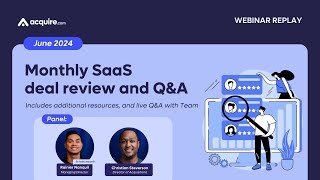
This is a YouTube video titled "June Deal Review with Rainier Nanquil and Christian Steverson" recorded in June 2024. It features a detailed presentation and discussion by Rainier Nanquil, Managing Director of M&A at Acquire.com, and Christian Steverson, Director of Acquisitions, reviewing multiple SaaS business deals. The content covers deal analysis, buyer considerations, founder preparations, financial documentation, and market insights relevant to potential buyers and sellers in the SaaS marketplace. The format is a professional webinar-style presentation rather than a conversational dialogue.
All right, welcome everyone. Welcome to today's June 2024 SaaS deal review with the Acquire team. We'll go over the introductions of ourselves, why you're here, reviewing some deals together, and then how to get matched with the best. So a little bit about ourselves@acquire.com and our impact. We've been in business for over four years now. Over 100 countries served. We actually recently did a deal in Singapore, Canada, Argentina, and Andrew likes to joke around that it's like, we'd like to get a deal done in Antarctica. So if you can help us start up a deal there and get that sold, that would be awesome. We have over 600 listings on the marketplace, over 1200 deals that we've sold, and that's over 750 million in closed transaction volume. And as of today, we have over 500,000 registered buyers. And I feel like every webinar, that number goes higher and higher pretty quickly. And that's thanks to all of you. We're growing at a fast pace. So awesome for everyone signing up and fraying their friends. A little bit about ourselves. This is our beautiful team. This was at our last off site in San Diego, in La Jolla. A little bit about myself. My name is Rainier. If you haven't seen me on any of the other webinars, I am the managing director of M and a here@acquire.com. i have over a decade of experience in M and A investment, sales, capital markets, sold all kinds of different types of deals, over a billion dollars of volume, source, analyzed and brokered. Before my time@acquire.com, i was with Empire Flippers. Did a lot of e commerce, a lot of content websites. Prior to that, I was at Cushman, Wakefield and Marcus and Millchap, selling shopping centers and commercial real estate across the country. I'll pass the mic over to my colleague Christian.
Thank you, Rainier. Hi everybody. I see some contacts I'm actually working with right now. Glad to see you all attend and good to meet the rest of you. I'm our director of acquisitions. I have over a dozen years of experience leading divisions in sales, tech and SaaS. Now in specific, I'm working with a lot of our founders on really making sure that they are well prepared, going live on platform, specifically within the Guided by Acquire program. We really take a lot of the valuable feedback from our buyers. Learn what you like to see in terms of the listing, prepare documents and for due diligence and all of that. So we really make sure that we have leading with our best Foot forward with documents that you'll review. So I'm excited to be here and go over some deals.
Awesome. All right, so let's go over why you're here with us today. We're going to look at the best deals and what makes them special. We have a monthly showcase of our biggest and best SaaS deals and these deals are pre vetted and recommended by our team of advisors and we'll show you our expert analysis, key insights and we'll do a Q and A at the end as well to give you just how a buyer or even just anyone would look at a deal. First, things they look at, maybe some red flags or things to note and questions to ask. So let's go over the deal review. Let me go ahead and share my other screen. Go over the first one. So this one is going to be interesting to kick off. This is a great deal. Bear with me one second. All right, Christian, do you want to kick us off with this Shopify app startup?
Absolutely, absolutely. I would start right off the bat with this founder. You see the multiples as far as the profit and revenue, pretty respectable. We really make sure that we look at any unique value propositions and add that context into it in the Shopify space. What's nice about this too, Rainier, if you want to dive into the business description section a little bit is there's three smaller segments and assets as a part of this transaction. So there's a lot of growth opportunity to expand from within the core competency of the business. And what's nice too is you see the team size. So I've actually worked with this founder in terms of his preparation and it's operable with just two people, one full time developer and the founder. Here is a little bit of management but in the space for over you see now about six years. So a common theme you'll see today and what I experience a lot on our side of the house is a lot of builders and designers, but not a lot of desire for sales or marketing experience. So the foundation is there and key that can really be expanded upon quite well from some of our buyers that have that background in sales or marketing. But those were a couple of the early ones that I thought would be really nice to reflect upon and then no Rainier, you probably want to discuss some of the growth opportunities within the business as well.
Right? So what I like to do, if you've seen me on some of the past webinars, there's a few things that I like to look at first. So let's see what they do. Shopify apps for social media tracking and analysis. It's a Shopify app. Let me wrap my head around, like, what they do. It's like, okay, it's a sounds like Facebook TikTok Pixels for Shopify and it helps track visitor interactions and behaviors to convert more sales. It's like, okay, that makes sense there. Look at the multiples that's in line for what's selling in the marketplace. And if you've seen me on the other webinars, it's like here at Acquire, we know what deals are selling for, we know what they're trading for, how long they sit on the market. We have a good pulse of the market and what's trading and what multiples are actually selling. It's one thing to list at a multiple and it's another to sell. So when I give you these type of examples of like, okay, this is in line, it's not in line. It's a little bit aggressive. That's from the context of even just today, Christian and I were looking at our deal. Deal sold year to date. So as of today, June 26, we have 256 deals that we've sold year to date. We have another 181 deals under offer closing in the coming weeks. So again, when we say our fingers on the pulse of what's trading on the market, this is something that's right in line. And then next thing I look at is revenue and profit. So huge profit margin, well above, you know, 25%. I like to say it's like, already you're salivating. If that's a, that's a great profit margin. Now you're above 50, close to 75%. So this is great. And then when you start looking at date founded, I like to see the year founded, how long it's had, product market fit. Anything above three years, I really like to see because it gives you some form of predictability. If it's a business that has a year or less, it may have huge growth and you just don't know how it's going to be the next year or the following year. At least with a business that has several years of history, you can see the trends of it going up, down, sideways. And if it's going sideways or down, it's not really an issue. It's not problems that kill deals, it's surprises. And if, let's say, as Christian mentioned, some of these builders, they just don't have sales or marketing expertise. And that's the reason that it became stagnant or even started to decline. Then as an investor or buyer, you start to salivate because that's a value add opportunity of low hanging fruit to put in your sales experience, marketing experience and start with the business on a running start. So let's keep going a little bit more and this is what I really like to see on our listings. It's the reason for sale and then seeing if it's bootstrapped. So it's bootstrapped and then the reason for sale. So it's a lifestyle change, financial gain. Sounds like the founder wants to take some chips off the table. Been in business for about six years. Lifestyle change. As a buyer you want to reach out and say can you provide a little bit more context on the reason for sale? Is it another business venture? Is it something family related or life related? And it's good to know because the real question that you're trying to ask is is there something wrong with the business or if it's a life event, then that's great. It's like, hey, I'm getting married, I'm having a kid. Like okay, great is a normal reason for sale. So then that checks off that box there. So you look at the growth rate. 15% ARR$200k, lots of customers. So again it doesn't look like there's any customer concentration, risk and there's a ton of customers and it's very lean. As Christian said, there's only two people on the team. So overall I start to think about the buyer profile. Who is the ideal buyer profile for this business? Okay, it's in the 575k range. This is going to be somewhat passive if it's two members on the team. So it's sort of a lifestyle business. And this is great for maybe a first time user entrepreneur, first time buyer on our platform to dabble into becoming an entrepreneur, acquiring their first business. This is great. If you have any experience in Shopify, in marketing in this type of space and you have a partner or maybe two or three partners, this is ideal for that as well. So I'm starting to think of the ideal buyer profile for this. Overall it's a lot of fundamentals that I look for. Anything else that you'd like to add?
Christian, I think you said instead of best, Rainier hit the nail on the head. Really what we try to find is the businesses and making sure they're very vocal about if you're in the space and you can run with it, here's the way to do so. And if you're not, if it's applicable and able to scale very easily and you can grow in the space. And what's nice about this particular listing is and we'll talk and we'll dive into this a little bit later today. But the founders prepared a lot of documentation on that very same subject. So if you're in the Shopify space, there's a blueprint on being able to take this and run with it. And if you're not, there's ability to learn quite quickly. And so you'll find things that are very extensive in P. Ls and transition steps guide and SIM and we'll talk about that. But just know when you get into that listing there's quite a bit that details the opportunity for you. I saw that chat from Deepanchu and about founder startup history in the sim which we'll dive into a little bit later today. You'll be able to see that from the founder so you'll have all that information at your fingertips prior to any formal engagement.
Excellent. All right, well let's move on to the second listing here. Let me share my screen. Christian, do you want to start off this one?
Yes, yes, I'm partial this one. The founder has done a really good job with their preparation. What's a good opportunity with this is it's a hybrid so it's SAS and agency somewhat together. And what's really great, of course with this, you'll see in the description there is they really focus on the ICP with doctors and plastic surgeons, but therapy and therapists, it's hard to get into that field. This founder's done a really good job of creating a really good market fit and has really got great customer feedback. And you'll see in terms of some of the security and assured revenue moving forward is the commitment level from the clients. The five to six month contracts, you see the web hosting there for 24 months now that really can provide good security and peace of mind as a part of the acquisition. And then Rainier and I always like to play devil's advocate and making sure you as a buyer say okay well let's maybe dive into the that to see you know, when those contracts are renewing and what's been the lifetime value of those clients. But what's nice is somewhat like the previous listing you see there. This founder here is an outstanding developer and designer but just doesn't really have a lot of the marketing experience to take it where it can go and has been running this really as a very, very small team. So the opportunity to expand on this one is quite a bit. And as far as details, you'll see everything from introduction video around ideal customer base and growth market fit. And it's a, it's a pretty clean transition as well. So a lot of good opportunities with this one. And it's like you said earlier, Rainier, hey, looking to start a new venture, lack of time, not for, you know, lack of the business being successful. But we always try to make sure we're very upfront about that too, for our buyers, you know, it's important. So you get a good idea as to, okay, you know, what is the reason for sale at the end of the day.
Nice. Yeah, that's a great summary. This one's very interesting. So let's, let's start from the top here. So rapidly growing digital growth solutions for doctors and therapists. It's SaaS, it seems, half SAS, half agency, or some portion of both. And so if I'm wrapping my head around it, okay, so it helps doctors and therapists create websites and marketing tools. Okay, that makes a lot of sense. And then I start looking at the multiples. So you start thinking, okay, well, this is price to sell. Price aggressively shows that it's a motivated seller. And then you start thinking, okay, well, if it's at this multiple, there's an indicator, typically, okay, is it a younger business? Is there a level of risk? And then I see right here the date founded. So I start thinking, okay, it's below the three years that I typically salivate at. But it's still an interesting opportunity. Now because it's a younger business, as a buyer, I want to make sure that I can limit my downside risk by doing some sort of creative deal structure to limit that. Because it's a newer business, it's harder to predict what's going to happen in the future. At least with a business that's three or four or five years, it's like up, down, sideways, as I mentioned earlier. So that's just one thing that I take of note. But again, this is a lean business. B2B overall, very strong profit margin. Again, well above the 25% that I usually look for. So this is 50, almost 75%. So this is great. Even though it's a younger business, the margins are incredible here. So then you just start thinking about downside risk when it comes to forecasting future revenue. So it's okay. So if the contracts are five to six months, 24 months, as Christian mentioned. Okay, well, is there any seasonality? Did a lot of These contracts get signed in the summer, towards the end of the year. You want to know that because once you have your close date, once you purchase and acquire the business, you don't want all these contracts to expire. And so another thing that I would mention or provide as a tip is to figure out if there's a way to do like an anonymous survey with some of these clients to maybe add value or see, you know, what they like in the product or the service and that they could renew or want to renew and what they like, what they don't like. Try to do like an anonymous survey to get some of these things. And again, these are things that you'll do closer to the end of the sale and we'll talk about that a little bit later. So next thing here, reason for selling. I'm looking to move towards software creation versus fulfillment. So again, this is a good answer. You just want to get a little bit more color on it. Okay, sounds like you're doing half agency, half software and maybe you want to get into venture of full type of SaaS where it's less fulfillment. Okay, is it a personal reason? Is there something with the business? Is there something in the industry? Is there something with like doctors and therapists that I should know? And if there's no red flags then great. But again, one man's trash is another man's treasure. If it's someone's reason for selling, it's like, hey, I'm not a salesperson, I build things. It's like, okay, well I'm a sales guy. I'm going to salivate towards this because there's tons of low hanging fruit for this business and I can add value pretty quickly. So that's the way that I would look at it in terms of growth rate. It's growing fairly quickly. Again, it's over two years around two years in the business. Customers, you want to know that there's no customer concentration risk if there's a couple customers that are making up a huge portion of the revenue. You want to know that pretty quickly. But overall I think this is a very interesting opportunity, especially if you have sales and marketing experience and you have agency experience and have experience with either the space of doctors and therapists and looking to dabble into both agency and SaaS. So again, if I look at the ideal buyer profile or more most likely buyer profile, it's okay. Probably someone that's acquiring their first business or maybe has a couple businesses that they've acquired before and maybe has a partner that has agency experience SaaS experience, sales experience or marketing experience, that's who I think would be the most likely buyer profile for this. And looking at the multiple and looking at the profit margin and growth, I think this is going to sell pretty quickly. I think this is a great business. Anything else to add, Christian?
No, I think you hit the nail ahead on this one as well, Rainier. Just the space medical field, as you can imagine, is very difficult to get into. So as you said, if you're a first time buyer and of course if you're a repeat buyer, this could be for you as well. But for a first time buyer and you want to get into the space, this founder's in a lot of the legwork for you to take off and run with it.
Awesome. Okay, well let's call a timeout here. We've gone over a couple deals and I want to talk about a little bit more about some of the items that you go over, Christian, and how you prepare some of these founders to go on the market and prepare for sale. So let me go ahead and share my screen and then you could kick us off on deal prepping and what that all is excellent. Here it is.
All right, perfect. So what a lot of I focus on with our founders is making sure you'll see these top five points at the top. I know we have some founders on the call as well. Number one, debunking misconceptions. It's, it's interesting. Of course we'll get some founders. Founders are very eager and say hey, I heard about the days of 10x and 15 and 20x and we're definitely want to make sure we have good hope, but we want to. We're in the business of really focusing on market realities just for the sake of efficiency and effectiveness on market for both our buyers and founders. So that's number one is we just get a better idea and give a good idea of the pulse of what recent trends have been. So the founders should have really good expectations when you first hop on with them, particularly those that are advised by a member of our M and A team here, Rainier, myself, some of our other colleagues and these four on these. Right. I'll dive into in the following slides but just know that we try to make sure that at the least those documents are there and filled out accurately. We do know that from a lot of buyer feedback that we do source. I mentioned at the top of the call it's very important to get a good perspective of this so you're not having to uncover and turn over Rocks. During due diligence, our MA team focuses intently on the work prior to even launching. So if you want to move to that next slide. Ringer.
Yeah. Awesome. And just to add before we move on to the next slide, it's the key prep for founders is crucial. It's if, if you're a buyer listening in, write in the chat about like a crazy experience working with a founder off market and their expectations are not aligned or their due diligence documents are not put together or their financials are not put together, there's a lot of headache in that and there's a reason that we put these, these items together before we put up a listing so that we can compress the time from list to sale. And that's what's really helped US do over 50 transactions a month up to this point. And again, this is all to help you as a buyer, but also to help you as a founder to get the best price, best terms and the smoothest exit by doing this homework up front. So well said.
Well said. Yeah, I would say that's just so key to great transactions Sim being a chief item that really ask for. You see the definition in the top left comprehensive marketing package for the business. So as a buyer you get the perspective of any recent sales trends, any experimentation when it came to marketing, any competitors that should be worried about ownership information, complementary products that can be scaled up. It's just very important we know as far as the segmentation of when you get access early on of can I get all this information early on and make sure it's worth my time? You know, we're in the business of making sure it's, it's effective for both our buyers and our sellers. So this is something that our team assists with. Very detailed, very comprehensive and it gives you a good idea around the most pertinent information leading up to due diligence so that you feel very comfortable extending an alloy.
Awesome. Yeah, that's a great summary there. And then if I can give a tip to our buyers, a lot of our sophisticated buyers know this, but if you're a first time buyer and you sign an NDA, you look at a listing, jump right into the sim. This is going to give you the nuts and bolts of what this opportunity is, how the business functions, all the history about it, and then reach out to the founder if you want to set up a time to meet or if you have any further questions. This is your chance to do your homework upfront so that by the time you reach out to the founder, you can show that you've already done some research on the business.
Excellent. Yes. We asked our founders for this for sure. So P and L most here probably are very familiar with this. We do ask for this to be very detailed. We know that P Ls can be quite comprehensive. Some may want to do it on a cash basis, some accrual basis. Just know that our M and A team will review this with our founders. At minimum, we ask for trailing 12 months broken out monthly just so you as a buyer get an idea of maybe any ebbs and flows. I know Rainier likes to talk sometimes about if there's any seasonality in the business as well. And then ideally we try to get a trailing 36 months so that you can see the history and then compare that with the SIM round. Any experimentation that was able to assist the business, was it through marketing, was it through organic, anything like that. So we'll have everything itemized, you'll be able to see the expenses and really as you see on the bottom left there, beyond the words, you get insights through the numbers. So you'll see the motif here is all about prep and information at your fingertips. Early on. The P and L, I would say, and you probably say as well, Rainier, the most important document to review first and foremost with the sim.
Yeah, yeah, yeah. The SIM and the P and L are critical. If I'm a buyer and the listing sounds smooth, description sounds awesome opportunity, it's like, all right, let's jump into the numbers. The numbers will speak for themselves. It's like, all right, strong profit margin, year over year growth and you see if there's any consistency over the months or if there's any seasonality. That's why we like it broken down monthly. And overall this is as a buyer, again, if you're in the chat and you've had some, some just opportunities where you try to buy a deal and there's no P and L or the financials aren't clean or they just aren't put together. That's a very annoying process. And again, if you don't have this put together as a founder, buyers will move on to the next deal. So have these items put together and that will do yourself a favor.
Absolutely. And in that Lou at Wheats, that's why as a part of our many team we have a financial specialist to help out when it comes to that. Recasting can be challenging. It can be. Especially if it's maybe a first time selling this document may be in this process, could be a little bit Intimidating, you'll see that's our goal is to make it really as easy as possible. So with this we're just standardizing the way you're viewing the information. So as a buyer you get a better idea of what the discretionary spend was. Is there expenses for meals and travel that won't really be a part of the transaction? Was the owner paying themselves a million dollars? Were they paying themselves, you know, a hundred dollars? You know what's market reality as far as you being an owner, operator and or having to hire someone support the business so you just get a clearer picture in comparison. In conjunction with the P L on what the expenses will be moving forward, we try to get a good idea for your EBITDA and SDE so you can evaluate those metrics and use those. And also of course the bottom left there lenders will require recasted financial to secure financing. So it's in your best interest as a founder to do this as well to assist the transaction when it comes to certain creative deal structures. So this is just a very detailed way to get a good idea of what you're expenses will be moving forward as a new buyer.
Right. That's a great summary Christian. And as a buyer my tip is look at the P L and look at the recasted financials because a lot of time if you're working with a first time founder that's selling their first startup, you may be able to look at some expenses that are normalized or not normalized and find some low hanging fruit. So just take a look at both. If you need help figuring out or have any questions of what's a fair add back, what's not, what's standard, what's not, ask the founder or ask us and we're always happy to help.
Now your transition steps, this one's pretty straightforward high level overview of the tools that are used to operate the business day in and day out. We just want to make sure from a buyer's perspective, if you are in the space and you already have a portfolio that this can roll right into fantastic. You may not even need the founder for that long. You can pick up and run with this and it gives you an idea on timeline for you to be able to spend the time review doing versus maybe you're new to the space or a solopreneur or a small team and you need the founder as a subject matter expert to really assist. Well great. You have all that your fingertips early on to know exactly what's going to be a part and what will be responsible for in terms of moving this business forward. So it just gets you a good expectation on both sides of what the seller will be able to help you out with and really can give you leverage on either side as well. Hey, if it's going to take more time, maybe I'll offer a little bit on this side. Or hey, if it's going to take me less time, maybe I'll extend and give on this. So it just helps to again, get everything up front so you have a very clear picture on both sides to help you along with the negotiations. So you'll find that on a lot of our listings as a requirement there as well.
Awesome. All right, well, let's move on to the next one, the data room. What is that?
Yes, yes. Now, this crucial, of course we have. This is a lot of your sensitive information. We ask that all of our founders have this in their listing as well. So your sensitive data, your client contracts, customer information, product roadmap, technical documentation, all will live here in your data room. Keeping your receipts is a saying that Rainier and I like to say too, is that we just have really good ideas and you have good context and your information really easily found. And again, as we segment down this line, we want to make it a clean, easy process for you to find all of this information after you've had the discussion. And now I've gotten to the point to move forward, you know, to an loi. So we have data room framework that our team be able to provide and assist with making sure all of your documents are in lockstep. And you'll see the bottom right has a lot of the big focuses that our team works on our founders with.
Awesome. That's a great summary there. And again, as a founder, you want to make sure that you get ahead of this and start organizing early, well ahead of you listing and going live on the marketplace. Because there could be a time, and this has happened several times here, where a buyer can move and close quickly. We've closed deals within 30 days, and that's due to having your data room neatly organized and ready to go if a buyer can move quickly. So that's just one thing I wanted to add there. Christian, do you want to go over these timelines?
Yes. Well said. Right before we hop back into the rest of the deals is our timeline. So you get an expectation on both sides for our buyers and our founders. Typically, I'm the initial contact. We go over a lot of the documentation we just covered as well as the listing. We really try to standardize the process so you have good expectations on the buy side of what you'll see. I'll have a prep session. We'll obviously work down the step three with building the necessary documents and assets, and then our founders will hop on with our M and A team. I give them a good idea of, of course, market realities and great discussion points. And then the fun happens at step five, which is we get to market the listing. When I say we really source our buyers and your feedback, we really do. We try to get a good idea of what you're looking for. You obviously can search the filters, but from, you know, even beyond that, we try to have customer interviews to get a good idea of of what you're looking for and then the founder and all that up front to make sure that it's worth time for both of our founders and buyers to meet. And then effectively make sure you're getting in the business in front of you so you don't have to dig and search through any crates. We know there's a lot of listings, so the easier we can make it on you, the better we try to do on the side.
Awesome, awesome. That's a great explanation there. So with that, let's jump into our last couple of listings that we'd like to present, and then we can jump into the Q and A. Bear with me one second. Let me share our listing number three. Jump in. All right. Christian, do you mind if I kick this one off?
No, please do.
Okay, cool. Yeah, I want to kick this one off because this is a deal running point on. So I'm really excited about this deal. This is a new listing that we just launched. It's a SaaS deal. The only conversational AI appointment booking solution for a $3 billion calendar SaaS platform. So in terms of what they do. So AI solution manages and responds to leads on, let's say, Facebook, Instagram, Google 24 7. And if you look at multiples, obviously I always like to say look at the multiples and see if it's in line. This is priced aggressively and you'll see why as I start scrolling down. So if you look at the profit versus revenue, it's 2 million in revenue. That's huge. Typically, private equity is looking for a million plus. So once you start getting well above that, the multiples start getting more aggressive. There's more buyers start getting private equity buyers, sometimes even family office, sometimes even public companies. But also this is in the realm of an independent operator, a partnership, investment group, or private equity. Those are the buyers that quickly. I Start thinking of when I start looking at the these numbers and then TTM profit, so great profit margin. It's doing very close to 50%. Right. Right between the 25 to 50% that I like to recommend, anything above 25% that's already getting a lot of buyers salivating. But as you get closer to 50% it's even better. And another thing that I really like about this, it's pre approved for financing. So one lender has already provided a pre commitment letter for this so you can leverage to acquire this. And then if we start scrolling down team size, it's very lean in terms of a business that's doing 2 million in revenue and then the date founded. So this is what I like to look for first and foremost. It's almost four years old. It's well above the three year requirement that most buyers are looking for B2B businesses that it targets. And then if I scroll down reason for selling and seeing if it's bootstrapped. So bootstrapped even at this bigger price point that's churning numbers, that's a huge green flag there. And then lack of time and starting a new venture. So if I can provide more color there, it's three founders, they all have worked on this together, they want to go ahead and start a new venture. So if you're a buyer, good idea to get some color on that. Okay, are you guys going into this similar type of space or similar type of industry? Obviously there's a three year non compete but if you want to just know like okay, why are you guys leaving and starting something else totally different industry? Why is there something in the industry that I need to know about if it's in AI? It's a very hot topic right now in that there's tons of AI companies being built and sold and it's a double edged sword in that AI is moving at the speed of light. So think about like ChatGPT, what you could have done a year ago or six months ago versus what you could do now. It's moving very quickly. And the good thing is it's an exciting industry. The bad thing is you're always wondering, okay, is my product going to get affected by some of these new developments? What is my protective moat? So as a buyer you want to know what your protective moat is for this type of anything that's AI related, but just any business in general, what is the protective moat? What is the current trend over the past months as AI is quickly developing and hear from the founders themselves, like how do you expect ChatGPT or any of these other software and AI tools to affect the business. What is your moat and how do you plan on defending that moat? And if I look at some of these last metrics, customers, you want to make sure there's no customer concentration risk with any couple customers making up a huge portion of the revenue. You want to know what the churn is like. It's been four years, so you want to know in the previous months, how's a churn and how are you growing and getting new customers? What are your sales and marketing efforts look like? And then you look at Arrow, that's great there. Annual growth rate, that's great there. How sustainable is this with the AI developments that you're seeing and how can you continue to grow this business? At the end of the day as a buyer you want to limit your downside risk. What is the upside, how much value can you add and what ways can you limit your downside risk? And there's different ways of doing that. There's different ways to creatively structure a deal so that you can put cash up front along with let's say seller financing or performance based earnouts. There's different ways to get a deal done to make it a win win situation for both you and the founders. And the best way to get to know what type of deal structure they're open to is by looking at the sim, the P and L, all of these documents that Christian lent over. And then afterwards setting up a time to meet with the founders and hearing from themselves. Hey, I like your startup. I have this background in this industry and this is how I plan on acquiring the startup. Do you have time to meet? Let's chat. What type of deal structure are you looking for? What is your ideal buyer profile that you're looking for? These are all great questions to ask if you're an interested buyer looking at one of these startups. Christian, anything else to add here? Anything that I missed?
Yeah, protective moat. I gotta take that. I like that saying. That's a good phrase for, for that business description section. If you, if you don't mind going to that a little bit towards the bottom. What I know you and I and our team really looks for is any great growth opportunities and ability to scale and or on the flip side any red flags or potholes. The two, I think opportunities here, if you look in the middle there, it says In September of 23 they stopped offering lifetime deals and now focus on reoccurring revenue. So of course that's going to be a really big value add. Knowing that moving forward, hey, this is where we were offering the one time payment. Now I know it's reoccurring. That's going to be something that can be built upon. And then that next sentence there as well is they are the only conversational AI solution that integrates with Calendly. I know most here are probably very familiar with Calendly and how great that connection is. And then in terms of the platform being able to be white labeled for agencies. So there's just great opportunities where I really will recommend stress to our buyers here. Just dig a little bit deeper. I know it's easy to sometimes go through and look at the short description at the top and go through and look at the top line numbers. But it is very important and we do spend a lot of time on making sure the founders do tell the story from where they first started to where they can go and some of the changes that they made to get there. A lot of that you'll see not just in the documents on the right hand side after you sign the NDA, but also down below in the bottom of the business description section and in the growth opportunity section.
Excellent. Awesome. All right, well that was the third deal. Let's go into our fourth and last deal that we will do today. So let me go ahead and share this screen here. Awesome. All right, Christian, do you want to kick this one off?
Yes, yes. This one I'm quite a big fan of. Just in terms of the space that they're in, I feel like it's such a need you'll see here. But an automated interview prep for career readiness organization. So this founder works with high schools and government agencies and job training programs. This is something that's always going to be needed, especially in the days nowadays where there's not great communication. So I find that the space that they're in really can be a good focus and focal point. This. And I know you'll dive a little bit more into some of the nitty gritty, but I know this founder has really operated this with a very, very small team. The profit margins are, are pretty good. Pretty good. From doing that. This person's. Well, not a ton of experience in terms of some of the marketing and sales, so it can be expanded upon there as well. But a good niche focus, that's something that we try to find is it's great to be in a really popular space. But if you have a niche focus, you can get a lot more of that market share in the TAM if you have some of the experience and being able to scale and grow and take some of the feedback from the founders. It just is a cleaner process to move forward. And I always look as well for the reason for sale. And this founder just had a child, so it's not necessarily. I think you mentioned that example earlier. It's not that hey, I'm trying to offload this business for going down or anything. Just hey, I have a child and now my time is spread a little bit more thin. But you see there run as a small operation for now, almost six years. There is some good bones in this business. Could really be a good opportunity for a buyer.
Excellent. Yeah, you're selling me, I'm like salary. So the first thing is I look at you're getting the trend here. It's okay, let me wrap my head around the business. Okay. So it's mock interviewing tool that provides instant feedback and is fully automated. Probably tons of questions. It seems like you can record yourself going through a mock interview. You'll have tons of questions, you'll get tons of feedback. So that's okay. Yeah. This is something where you start partnering with schools and different programs. There's a lot that could be done here. You look at the multiple again, this is price to sell. This shows that the seller is motivated. The asking price is on the bite size range. So I'm thinking about the ideal buyer profile. Probably independent operator or even a first time buyer on our marketplace looking to dabble into being an entrepreneur. Entrepreneur through acquisition. So you start looking at the metrics. You've got a great huge profit margin. So this is well above the 25% that I like to stress. You're getting closer to 75%. And you look at some of these other items here. Date founded many years of proven history and seems like it's a very lean team size. And you start looking at some of the other items. I was really just just looking at the reason for selling here. It's like, okay, this is a life event. This is as motivated as you can get. When you talk to a founder, if you're in the chat and if again you think about an experience, feel free to share an experience where you had a great offer with a founder and you try to buy a deal off market or somewhere else and they're just like oh you know what, I changed my mind because they're not motivated or something like that. This is a reason that shows motivation. It's priced to sell and they've been running it for six years. And again taking chips off the table. Lifestyle change, take some money, take care of the child, spend some time with the child. This is a great reason and it's bootstrapped. So I would say the only thing here is the growth rate and I would suspect because the child is on the way, maybe that has something to do with it. But you just want to ask. But overall, another thing here, 10 to 100 customers make sure that there's no customer concentration risk. But overall, I think just general business fundamentals. Price point, multiple reason for sale. This is a deal that I would suspect going to sell very quickly. Anything else on this to add? Christian?
No, I think you did a good job. Maybe one just that as the buyers from that perspective too, always feel free to ask the founder a little bit more around the reason for sale. I speak with a lot of founders that you know, sure, top line numbers are important, but you'll see a lot of our founders, they really care about their business and they want to make sure it goes into the right hand. So, you know, a really good argument on that side from the buy side can be, hey, here's my experience in it, here's my plans, and here's how I really plan to take care of it. That can go a long way. You know, I know it's probably hard to believe, but founders do really value that because this for a lot of them, it's their baby. So if they know that you'll take care of it, you have a plan in place, there may be an ability to have some of that negotiation that's not looking solely at just that final number. So I do stress to look into that in terms of the listing and just your conversations early on.
Yeah, this is their business, baby. It's awesome to see that they're looking for the right buyer who cares about the space because oftentimes you may be worried that there's other buyers that you're competing against. But if you really get to know the founder and the reason for sale and get to know them on a personal level level, oftentimes you could beat out these other buyers that are all cash and can close and have bought several other businesses, you can oftentimes win. If you're, let's say a first time buyer, this is something that you maybe want to talk to the seller about and see, okay, what are you looking for in an ideal buyer? What is your ideal deal structure? And just get to know them on a personal level. Talk about family life and what's important, how they started the business, how they got into the niche that's all going to be very important when you see the reason for sale like this versus a buyer that shoots a blank offer, doesn't do any small talk, and is planning to add value and then maybe flip the business in a couple years. So just know who you're talking to and what the founder is looking for and that'll oftentimes give you an edge on beating out some of these other competitors. Because if I were to guess this is going to get multiple offers and will sell quite quickly. So if you want to get an edge, talk to the founder, see what they're looking for.
Absolutely. And in the same, in the sake of just efficiency we really have with these transactions and deals is you'll find with a lot of the listings that our advising team has spoken with, you'll find even short videos, three minutes, five minutes, that touch upon why the business was built in the first place. To Rainier's point, the ideal customer for it, Any growth opportunities, unique value propositions. So you'll be able to even get a bit of an idea and insight before you even hop on and maybe hold a meeting with the founder. So always when you're digging, just look for that, that video. It tends to be pretty helpful and giving you a good pulse and good direction before you have to hop on and have an extensive conversation.
Excellent. Okay, well, that's a wrap for the four different businesses we went over today. We've got a ton of really good questions in our Q and A, so we'll just dive right in. So first one here. What questions should I ask when there's a negative growth rate? So this is a great question. Christian, you mind if I take this?
No, please do.
So this is a great question. So if it's a negative growth rate, again, it's not problems that kill deals and surprises. You just want to know why it's a negative growth rate. And if it has over three years of history, then that's great because you can see if it once went up and then it went sideways and then down, at least you can see a trend. And to answer your question, what should I do? Or what question should I ask? First of all, read the sim, read the financials, do your homework, do some digging in the P and L, because if it's broken down monthly, year over year, you can see certain months that it started to dwindle down and that by the time you reach out to the seller and have a meeting, you can show that you've done your homework by saying, hey, look, In December of 2023, it looks like sales started to decline and now you have a negative growth rate. Can you tell me what happened there and then if they have a reason? Oh, you know, I didn't really put any sales or marketing into it. It was organic previously and I kind of just let it run on its own and that's why I'm selling. And it's like, okay, if you're a buyer, you should be looking at it like this is low hanging fruit, value add, opportunity, especially if you can turn it around. And then as you're trying to figure out the answer to this, you want to ask, okay, well, what is the cost associated and what type of work do I need to turn the business around? Oftentimes you can ask the founder, hey, if you had a million dollars to get the growth rate back to positive, what would you do with those funds? Oh, I would hire a sales team, marketing team. I'd run a bunch of ads. They'll tell you exactly because they've been running the business for so long. And then you can think if that's something that you want to do or if that's feasible. And then you can obviously make a creative deal structure where you can have some seller financing, some sort of earn out to limit your downside risk. Christian, anything else to add on that question?
Just that I would stress that for a lot of our founders, I mentioned it earlier in the call today in the webinar is that there's a lot of developers, a lot of designers, right? So it may be a, Hey, I just, I built this and I wasn't sure where it was going to go and it took off and now I'm not quite sure how to continue to expand. It's not my lane, it's not my area of expertise. So it's nice to look into that and say, okay, I can see that the foundation and the bones of what I could thrive on is there. And now I'll take my experience and my level of success in another arena and take it here and apply it there.
So.
So always look for that.
Awesome. Yeah, that's a great point there. Okay, let's jump into the next question. What are the risks of acquiring a SaaS company in an emerging sector like AI? You mind if I take this one first, Christian?
Yeah, go ahead.
Okay. Yeah, I kind of went in this a little bit when we were looking at the third listing. So at the end of the day, it comes to predictability and limiting your downside risk. The more history you have on a business, the better you can see different trends and the thing with AI, it's a double edged sword and it's a very exciting industry and there's tons of people making money in the AI industry and creating all kinds of different tools and software and solutions and making hand over fist when it comes to making money. But when it comes to selling a business, you have to think about the buyer and the risk that they have to take. Put up however many years of cash flow upfront. If it's a 3, 4, 5x multiple, it's going to be hard for them to justify paying all cash when there is a real risk that in 3, 6 or 12 months ChatGPT or some other competitor takes a huge portion of market share and now they're struggling to recoup their initial investment. So you have to think about that as a founder or as a seller to really display what your protective moat is against the speed of AI as well as competitors and then be reasonable with the buyers to limit their downside risk. Put yourself in the buyer's shoes. Would you pay four or five times your earnings in an industry that's moving at the speed of light right now? So that's the way that I would think about it. Again, deals are still getting done in the AI space. We're doing them them still. The real question is how are they getting structured? And, and how are you limiting the downside risk for the buyer? Christian, anything you'd like to add on that question?
That's a good point. You know, how do you look to de risk the acquisition for you on your side? Is there some part of the deal structure that may be a conditional holdback? Looking to see if the revenue stays at this number? Just staying plugged in. As Ranger said, AI just goes, it's, it's so, so quick. I just watched the. Sure, you guys watch the Apple WWC DC event. It goes so quick. So being able to stay up to speed on some of the later trends is important as well. There's an open source version, but also you'll find the listings. We do stress because you'll find a lot of AI listings. What's unique about the business? If there's multiple even on acquire, what makes this so different? What's the sticking point? What can I build off as a foundational building block stock to then further explore? And it's not just a flash in the pan. You know, we, we usually will advise our founders, hey, if you've been around for three months or six months and now looking to go live, we actually advise against that. We want to make sure. That this business can stand up over an extended period of time. So you'll find that usually when you go on and, and look at our listings that they've been around for a good amount of time. They have a strong value proposition and something you can feel more comfortable comfortable with potentially investing in.
Excellent. Okay, let's go to the next question here. Here's a good one. What's the typical transition period for SaaS companies? How long can I realistically expect the founder to help me get set up and succeed? Christian, you want to start this one?
Oh, yeah, that's. That's a fun conversation. That, that I would say is first and foremost. Expectation setting is just really, really important on both sides. Communication is very important. That can be in terms of, again, if I am a subject matter expert already and it's in my space, I may only need you for a couple months or less if there's less assets that need to be transferred. Typically speaking, if it's a very involved transfer and transaction, I would say what about three to six months is probably fair. Rainier, you'd say about that. I would say that's what we see most common in the space. And it just. That's what I'll do. I'll lead back to some of the documents that we have prepared earlier. Before you even extend your letter of intent, you'll have a two sheet or rolling list of all the items that would be a part of that transfer and what you need to prepare for. So I would say as a founder, you want to at least count for at least a couple of months, just at minimum, and leave room for growth and leave room for negotiation. I would really stress that too, on both sides. Don't plant your flag and say I'm only, you know, maybe like one of our other founders that has a child on the way. But if you're not and you're looking to move on to your next venture, this is still your baby baby. So I would say just be very flexible, be very malleable in terms of that discussion there. But it really, it comes in tune. I would say that with our founders, we advise if you have team members that can assist, maybe a CTO or a coo, have them help with the part of the transition. It doesn't mean maybe if you're not a solopreneur and you have a couple people on your team, you don't have to be the sole person responsible for the back and forth. Employ a lot of your colleagues who assist there too. But I would say we normally Say about three to six months or when you, you get into the multimillion dollar deals then I'll hand it to you, Rainier. That's when it may be a little bit longer and it really depends on the deal structure too.
Right, and that's a good rule of thumb. And I'm glad you brought up the ability to negotiate because again, it's all negotiable. As a founder, there should be some months that you want to make sure that the transfer succeeds. But also let's say if there's a sticking point to the cash upfront and seller financing and a performance based earnout you could throw in. Hey, low, look, I'm down to stay for up to a year and make sure the transition goes well because I also have more skin in the game if there's other creative deal structure points. I'll even offer a couple hours of consulting or I'll even offer XYZ service during this time and use that as like a negotiation tool in case you want to bridge a deal to make it a win win situation. And you can also make it that, that you know, if it's three months is your max and you've got other things to do well, hey look, pay me, pay me as a contractor. I'm, I give, I'll give you a few hours or X amount of hours as long as you pay me market rate. I'm happy to help answer any questions post transaction. I'm not here to just sell you the deal and run away. I'm here to help make sure it's transition and I want to see the business do well, you know, post transaction as well. So that's a great answer. I think we have time for a couple more questions so let me jump into another one here. Realistically, how much of a startup's ip, let's say code, for example, can I reasonably, reasonably ask to vet pre and post offer? Do you mind if I take this one, Christian? Yeah.
Good.
So again, this is all going to depend if it's like proprietary secret sauce and you're asking for proprietary code. Client names, vendor names, contract agreements, expiration dates, vendor names. These are all things that are sensitive when it comes to doing a transaction. Obviously as a buyer you're going to need this information in order to close. But there's a correct way to go about it. You can't ask for the secret sauce until you've proven that you're a serious buyer. You've already done your homework, looked at the sim financials, what we call pregnant in the deal. Once the deal is getting very close to closed, yes, you're going to need to do the final parts of due diligence by looking at the code, looking at the contract agreements. But you need to make sure that the goodwill between both buyer and seller are there and the deal is very close to closing. Because if you're a buyer and you haven't done your homework yet and the seller doesn't know or is unsure if your ability to close is there, you can't just ask for the secret sauce and then they're wondering if you're going to run away and use that information against them as a competitor or something like that. So to answer your question, it's sensitive. Depending on the type of business, towards the end, when you're getting very close to close, you'll be able to get the secret sauce, the contact names, vendor names, client names, all of that. Christian, anything else you'd like to add on that question?
No, just. I've heard some nightmare stories about source code being extended too soon. There's definitely a process, so we just try to make sure there's good checks and balances as a part of the process. And again, if it's your first time going through this and you're not sure how much I should share and at what point just really heavily lean on our M and A team. We have not only documentation on it, but of course we're happy to hop on and walk you through exactly what to share and at what, at what stage.
Right, I'm glad you mentioned that as well. Because we provide an escrow service. We'll cover the escrow fee. We'll make sure that you, as a buyer, you send in your funds, all the assets are protected. Once everything is in escrow, then it gets released as both buyer and seller check off on these things. So that's part of our service. We're making sure that everyone walks away, gets an ideal transaction. It's a win win situation. There's an escrow service to make sure that the funds are really there before we release the assets. So that's all part of our service. Anyway, we're getting to the final minute here. Let me go ahead and share our closing slide. And if you have any other questions, feel free to reach out to us. You have myself, Christian, our entire team to reach out to. We're always happy to help. Thankful that you have tuned in again. So let me go ahead and share our closing screen here. So if you're a buyer, enter your criteria and get deals like these delivered straight to your inbox. Let us know if you have any questions. We'll help you with that process in terms of custom tailoring your search criteria. If you're a founder and want support, let us know you have our M and a team that you can reach out to. If you're a founder and you want to get complimentary broker opinion of value, let us know as well. If you want to you know, if it's early and you're not sure if you want to sell or anything, but just want to know what it's worth, let us know. So Visit us here. Acquire.com backslash guided by Acquire. Reach out to us, both buyers and sellers. We're always happy to help. Thank you again for tuning in and we'll see you next time.
Thanks guys. See you.
Cool. See you all.
More from Andrew



The Buyers Who Made the Move: What They Bought, How They Did It, and What Happened Next






