March SaaS Deal Review with Andrew Gazdecki and Rainier Nanquil
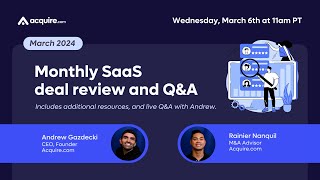
This is a YouTube video titled "March SaaS Deal Review with Andrew Gazdecki and Rainier Nanquil" recorded in March 2024. The content is a webinar-style presentation featuring Andrew Gazdecki, founder and CEO of acquire.com, and Rainier Nanquil, an M&A advisor. They discuss and analyze various SaaS startup acquisition opportunities listed on acquire.com, providing detailed insights into business metrics, growth potential, profitability, and buyer considerations. The session includes introductions, deal reviews, and advice on navigating the acquisition marketplace, aimed at potential buyers and founders interested in startup acquisitions.
Foreign.
Well, let's go ahead and kick this off. I'm going to go ahead and share my screen and we're going to dive right in and just for a little bit of house cleaning, we will do some Q and A at the end of this webinar. So feel free to put questions in the chat and we'll be sure to check those out after we go through that. All right. We're acquire.com the world's number one startup acquisition marketplace. And I'm really excited to invite you all to another SaaS deal review webinar. So quick agenda just we're going to do some quick introductions and we're going to go over really why you're here and you know, the value that we want to deliver to you. And a big part of that is reviewing some of the most profitable SaaS acquisition opportunities on our marketplace today and really also help you understand how to get matched with the best and how to find the best listings on our marketplace. So some quick introductions. With that being said, Raniere, I'm going to hand it over to you.
What's up everyone? My name is Rainier of the in house advisors here at Acquired. I have over a decade of experience M and A capital markets investment sales. I've seen hundreds of deals go down. My goal is to help you get the best price, best term through this transaction.
Right on. And I'm up next. I'm Andrew Gazdecki. I would consider myself an entrepreneur. Obviously I'm the the founder and CEO of acquire.com but in a prior life I built and sold two different businesses. One was a SAS company, Bootstrap that and then one was a crypto company. So been on, you know, both sides of the fence in terms being part of an acquisition process personally and then obviously helping thousands of other founders get acquired@acquire.com so that's me. And really our mission@acquire.com is we want to build the best online marketplace to buy and sell startup. And I'll go into detail on, you know, really how we accomplish that. But first our impact. We've been in business for about four years. We've had acquisitions successfully closed in 100 plus countries. We have over 1500 listings on our marketplace today. We facilitate over a thousand startup acquisitions, over half a billion in closed transactions and we are closely nearing about half a million registered buyers on our marketplace. So lots of activity, lots of deals and we're going to go through some of those today. So now really getting into the parts that I think are most important is why are you here today? What sort of value are we trying to drive? And really what we're going to be going over is a showcase of our some of our biggest and best SaaS deals. So every single month on acquire.com, we are working with founders and we are helping them prepare, prepare to be acquired. We are helping them go to market. So this means that these listings are pre vetted and they're recommended by our advisors and they contain a lot of the information that you're going to want to need or see as a buyer to make a decision on if this is a good acquisition opportunity to pursue. And then at the end we'll do some live Q and A. If you, in case you have any specific questions, they can be related to the deals that we show or just acquisitions in general. Um, feel free to put in your questions. And one thing I just wanted to touch on is just how we maintain high quality deal flow@acquire.com so really it starts with our strict vetting and curation process. So fun fact, only about 45% of startups get accepted onto our marketplace. So what that means is we actually have a very specific type of business profile that we will accept on the marketplace. And what this does is it saves you a lot of time in terms of not having to comb through every single listing. Def a diamond in the rough really. Our goal is to have the highest quality listings that are vetted by our team. And so we put a lot of effort into that. And then number two would be our, our guided listing process. So when businesses come onto acquire.com, we id verify the owner of the business. We even verify the business's entity for security. And then also probably my favorite, we specialize in SaaS. We have the biggest pool of SaaS founders and buyers. I built a SaaS company, a lot of members of my team have worked at SaaS companies. So we like to think of ourselves as experts in SaaS acquisitions, building companies and also getting them acquired and then also expert support. So we do have an in house M and A team plus acquisition success managers. So when you're looking at listings on acquire.com you can rest assured that again, they've been vetted by our team. We're assisting the owner of the business and properly preparing them to go to market to help save you time and really just make it easier to quickly make a decision on if you want to learn more about the business. So a little more detail on that. So what do we actually do to make sure that these listings are high quality. So when we speak with founders, we'll give them essentially a listing scorecard. And this is just one of the things that we do. But I wanted to highlight this specifically because we go over, we talk about the business's health, we talk about their metrics, we review their profile, we give suggestions on how to improve pretty much all of these items here, including the seller's level of preparation. So when we review sellers, you know, items that we always try to get intact is a clean profit and loss statement. So you can accurately review the financial performance of the bit of the business. And then also things like a transition guide where you have an understanding and a plan in place where if you do acquire this business, there's a plan post acquisition and also things like a completed seller profile so you can do due diligence on the owner of the business, who are they, real person, person, all that fun stuff. And then a completed listing that gives you enough information to get excited about the business, to then sign an NDA and then get access into the data room. And I'll show you the mechanics of how that works in a second. But this is the level of preparation that we, we put founders through. And really we do all this not just to the benefit of buyers, but also for the benefit of startup founders. Because Our goal at acquired.com is to help startups get acquired. And we realize that, you know, our job is to bring both parties together. So we're going to be going through some listings that we've done all of that with today. One other item to note is we've recently added a new feature where we actually will verify US entities for every business that comes on acquire.com that's based in the United States. So what essentially that means is we have a third party company called Persona that reviews and verifies the incorporation certificates of businesses. So essentially helps you have assurance that this is a legit business. They're incorporated. Are they an llc? Are they a C Corp or an S Corp, whatever it may be, and that's reviewed by a third party company so you can rest assured that the businesses are indeed legit and of high quality. So with that said, Renee, are you ready for this to hop into the deal review aspect?
Let's do it. Deal review time.
All right, let's go. I'm going to now share my screen. Let me get a heads up. If everyone can see this, can everyone see the marketplace open? Let me get a thumbs up. I'm gonna need five thumbs up and I'm gonna keep going all right, we're good to go. Okay, so when you first log into Acquired a. Com, I wanna just show this part first. So what you're able to do is set your criteria specifically on what you're looking to acquire. So you can sort by startup, type, asking price, revenue, multiple profit, multiple gross revenue, net profit, interest industries, business models, you name it. So if you haven't Already definite your acquire.com account and set your buyer criteria. Because we also have a feature that enables you to get instant notifications. So when a new startup comes on in the marketplace, you can get notified immediately over email and then also download our Slack app as well. I love this app. If you live in Slack, you can also set up your criteria there as well. So you never miss out on a deal. And sometimes we see acquisitions go really, really fast. So definitely check that out. And the last thing I wanted to point out is in terms of, you know, the highest quality deals, just simply go to our marketplace, click highlights and guided by experts. And these are the deals that we have put a little bit more emphasis on in terms of preparing the founder, making sure they have all the documentation. So again, you as a buyer have all the information you need to potentially make an offer on these businesses. So without further ado. All right, Renier, let's kick this off. We got business number one. So I'll read the headline raniere, and then. And I'll let you take it from there. Does that sound good?
Cool. Let's do it.
All right, so this is a B2B sales and marketing platform that helps teams increase revenue through custom data solutions. Where do you want to go to? Starving here.
Okay, yeah, let me scan through this really quickly. So B2B, huge profit margin. Been around since 2017. Okay. So just looking at this upfront, I'm salivating. If I'm a private equity buyer. Let me tell you why. It checks a lot of the boxes that private equity buyers look for in B2B SaaS profitable with high profit margin in that 1 to 5 million ARR. That's typically in their requirement in terms of ARR year over year growth, 107%. And then it's also based in the US so it's got a lot of the fundamentals that a private equity buyer or even some of these investor groups that we work with, even private investors. Well, checks a lot of these boxes. Nice price point as well.
Yeah, my take on this one is very similar to yours. And what I love about this business is there's. There's multiple players in the market and they're all extremely successful. Zoom Info as an example I believe is publicly traded at a couple billion. And so this business, one aspect that I like is their ability to offer custom data enrichment solutions. So when I see this business I agree with you in terms of, you know the, the profile of the buyer is probably traditional private equity and institutional buyer but potentially also a individual buyer because this would be SBA loan improved. But if I was to buy this business, you know, really what I'd want to dive into is what, what is the competitive advantage over the other competitors? And there may not be one and that's okay. And that gives you opportunities to maybe focus on a certain customer profile, really understanding how are they achieving this 107% yearly growth. But when you look at the margins alone, this is a well run business. And if there, if I had to point out like any red flags to me would be if it like one year, like less than a year old or something like that. But been in business for six years, seven years and again these are really, really healthy margins. So this is a, this is a good acquisition. I guess maybe one concern would maybe be the customer concentration count. So I would want to know who are the customers? Are they enterprise customers, Are they individual sales reps at different companies? Really understanding that. And then also just how are they acquiring customers with so much compet position in the market. But I always like to say, and I'll probably repeat this at other times during the webinar, but you can come in 99th place in industry and still build a business worth tens of millions of dollars. And I think this is a testament to that. So I, I like this business as a, a sales and marketing person. All right, ready to move on the next one in there.
Cool, let's get to the next one.
I'll kick this one off and then I'll give you my initial thoughts and then I'll hand it over to you. So this one is also based in the United States. This is the AI powered toolkit fueling data collection, user engagement and monetization for leaders in sport. I love sports. So right off the bat things that are drawing my attention are number one, I'm a firm believer if you're, let's say an individual buyer rather than a strategic buyer, you want to get into an industry that is interesting to you, that you can see yourself having fun being the CEO of the company. But aside from that, the year over year revenue growth, 62% is pretty impressive. And then also just the amount of data points that they're collecting. So there seems to be a data play in this. But let me review this a little bit more. So fan engagement platform powering data collection and new sponsorship inventory. Oh, I like this. All right. Our white labeled embeddable tools are customizable. So essentially from what I'm gathering from this overview is their go to market is they have software for leaders in sports. I'm assuming sports teams. And what's interesting now what I'm thinking is the market size of that because you can go professional sports, you can go college sports, you can even go high school sports because it looks like it's a client management relationship platform for that. And then they white label it. And so what could be interesting about that is you could white label the platform for again, like major sports teams, potentially college sports team, high school sports teams, you know, even maybe lower than that. And then what else do I see here? So other things I'd look at is why are they selling? So founders ready to move on, meaning they're motivated. This is probably the biggest red flag. I'm gonna hand it over to you on, on this one. Renee, what do you think about this? Profit at zero, but revenue at around 600,000 in TTM gross revenue.
Yeah, if I put myself in the buyer's shoes, there's a lot of questions off the bat. So there's zero in net profit. What exactly is happening? Are you reinvesting into R and D? Is the overhead really high? Do you have a lot of full time employees? Want to get an idea of why the profit margin, how to improve the profit? Where is the low hanging gear? Can you easily increase revenue? Can you increase the profit margin? What is the play here and opportunity for you as the buyer? If this business has been around since 2019, what has the founder been doing the last few years in terms of growth? Is it growing really quickly and they had to reinvest all the profits back into growth? Both. There's. Those are just some of the questions that come up for me on that.
Yeah, let's, let's pause on that. So when you see a listing with no revenue, generally when I see that, and again I'm viewing this as, you know, I don't know anything about the business at all. But typically when I see that, I'm assuming you're reinvesting everything into growth. I did it at my first startup where we essentially ran at break even because we were pushing everything back into growth. So what's your take on that? You know, if I'm a buyer, should I Be scared of that. How should I think of that? How should I factor that into my, you know, if I want to make an offer on the business? What's your take there?
Yeah, that's, that's a great question. Well, first of all, they're generating revenue. They've been around for more than a few years. So they're in business, they have a niche, there's product market fit. The real question for me as a buyer, if I put myself in the buyer, hey, where's the value add? What's the play here? What exactly has been going on? What has the founder tried over the last few years? And then how can I increase that profit margin? I need to focus on getting into to another niche. Do I need to focus on pricing? Pricing changes if I've had customers for quite some time. What, what exactly is the play to make it profit? How easy is that and how long would that take? Add that value?
Yeah, and typically there's two ways to increase profitability. Increase revenue or you decrease expenses. So there could be some easy wins in terms of reducing expenses. But I'm, I'm a growth focused founder. So I'm always thinking, you know, how could we achieve this? And you know, when you're looking at these listings too, and just to kind of give a little color in terms of how to access this, simply just sign the NDA. You just need an upgraded account on acquire.com and you're able to do that. But you can just ask the owner of the business again, what are you doing for growth? Whereas you know, all of the revenue being spent, is it like you said, on improving the product, Is it on the go to market strategy? You can learn so much just from a quick conversation with the founder or just reviewing the sim, the confidential information memorandum or reviewing their P and L that I think that would really bring out a lot and give me confidence in terms of, you know, you know, could expansion be the way to go? Because I like all of these items right here in terms of. Yeah, expanding potentially beyond sports. That's interesting. That's a conversation I'd love to have with the owner of the business. How they're thinking about doing that. But then yeah, also understanding, okay, so the business is five years old. Is this growth of something recent that was done? Have they always been growing at this clip? So good stuff there.
And if I can, if I can add one more thing to this listing, Just because it's not profitable yet doesn't mean it's a bad deal or it's really, there's just more questions. I've had lots of founders that have sold, I've helped them sell not profitable businesses with high growing revenue. And really a lot of those reasons is hey, I'm really good at starting a business. I have no sales or marketing. I'm not good at scaling business profit margin. Whereas lots of buyers, even private equity partnerships, they're really, really good at taking a business that's had three or 10 experience and then supercharging it with their sales, marketing and then also capital that they can.
Yeah, I like that too. And this could be a really, really high quality product as well because they have an API and SC sc. So there, there is technology built out for kind of like a partnership go to market strategy for people to build on top of this platform. So if you're into sports, this one, this one could be for you or if you run a company that serves people interested in sports, whatever it may be. I think that industry is going to continue to grow as a sports fan so a little bias there but. All right, ready to move on to the, the third one Rene? Okay, I'll kick this off with just the high level items and then I'll hand it over to you Renier so you can kind of give your, your commentary that work. Okay, so we got another SaaS startup. This one's based internationally in Belgium. High quality push ads monetization provider are created for publishers by publishers. It's currently doing 2.9 million in revenue, about 900,000 in TTM net profit Raniere. What's your take?
Yeah, first thing I gravitate to is the profit and profit margin almost around a 30, 30% profit margin. That's great. Business has been around since 2021 so that's good. It has a few years under its belt and track record. The profit multiple and revenue multiple are in line. What's trading in the market and and the reason we know that is at acquire do tons of deals. Just last month in February we did 46 transactions. Got another 142 in escrow. As of today we know what deals are trading marketplace and this deal here is right spot on in terms of profit multiple asking price. Asking price.
Yeah, you hit the nail on the head. We you know just to maybe touch on that a little bit again when, when we give you know our opinion of value to startups. This is based on data of essentially again thousands of acquisitions that we over the course of, you know, every quarter, every month. So we see kind of how the market's moving and this one's priced well. And other things that I personally like about this business is the potential opportunity to bring this into. So going back to the listing is I see it's only based in France, Germany, Italy and Latin America. And then I see the scale too. So this thing is generating 1.5 billion push notification impressions. So um, based on reading this description right here, what this does is essentially sends web push notifications. So that little bell that like pops up in the top left corner, great way to bring users back to any web property, whether it's a content site, SaaS, business, e commerce, you name it. Um, so it looks like they, they're at scale in terms of they're already active on over 1500 site 1,5 billion push impressions monthly. That's no joke. And then oh, this is interesting. So out of that 1.5 billion push impressions they receive 5 million in clicks per month. That's a met. That's a more important metric in my opinion than how many push impressions. So that essentially means they're driving 5 million new clicks per month to these 1500 active site. So if I was looking at this business, you know I would, oh, I like how they added this in. We do not accept campaigns for cryptocurrency, gambling and other related industries. So essentially what you could good way to think about this is how do, how do we bring this into, you know, whatever region of the world that you're in. That's always just a very easy strategy and it might be just localization in terms of is this business in a different language? If so, is it easily translatable into English? I'm going to assume yes on that. And then also I love how the business is again bootstrap. So they've definitely accomplished getting. I always like to say this, only 4% of startups get over 4 or 4% of startups get over a million in revenue. So this is. And doing it bootstrapped, I think is, is incredible and doing it while profitable is even more incredible. So I see a lot of potential in this one. But if I had questions to ask the owners of the business, it's I, I always, I always want to learn from the owners of the business in terms of how are you acquiring the customers, how are you maintaining what's the churn like? You know, are we seeing churn on the business in terms of the customer concentration? They have a hundred to customers. Do they have like one really large customer and then a long tail of little customers? Someone just posted Shopify is still unprofitable. That is True. Amazon as well, I believe. All right, getting back to. So long story short on this one, you know, the questions I would ask is again, you know, how, how are they acquiring customers? Is there an opportunity to bring this to or expand this into different markets? And then again, just learning from, from the materials provided because again behind this listing is a completed sim, a completed P, now a completed due diligence checklist. All the listings that we're showing you today have all like a, a trove of information behind them. So that's where you can learn a lot. And then you could schedule a call with the owners of the business to go over the questions that are most important to you. But I, I, I, I, I like these businesses in terms of the ability, any sort of ability to capture some, some a customer's attention and then drive them back to your business I think has a clear roi. All right, moving on to this one. You want to read this one? Raniere, you kick it off?
Yeah, let's do it. So SaaS startup based in the US and Arizona. Highly profitable AI powered SaaS trading algorithm that generates profit asking price offer. Okay then if I can jump in here, I quickly gravitate to. Yeah, like what you're seeing there. 95% gross margin, 1.5 million TTM revenue, thousand TM profit. So about a third in the profit margin which is X. Excellent. And then if you scroll down a little bit, let me see when this business started. Okay. 2020. That's great. It's got a good track record there, lean team of people on their team. And it looks like they've got 12 proprietary indicators trading view. Okay so there's like stock related stock pick or algorithm related business. Yeah, this looks good. This is interesting for anyone that has like interest in financial businesses, stock trading business, this is great. Profit margin is there in terms of history. It's over three years old. I mentioned this on the last webinar. There's a lot of boxes that you check off as a buyer. Good fundamentals for a listing business overall if it's got over three years in business, if it's profitable, if the profit margin is a third or even half, that's excellent. And then just the growth right there, 30% year over year growth. So this is hitting a lot of the box check off as a buyer or a listing that's has traditional good fundamentals.
Yeah, I agree. I see someone posting it. It'd be great to see LTV to CAC for SAS deals. So that information is, is provided behind the data room. So you'll find that in the due diligence checklist, the sim, all that information. But that's definitely a great question in terms of, I'm always wondering in terms of, you know, how efficient is their customer acquisition strategy and can I improve it? Can I make it better? What are, what is a low hanging fruit? Also understanding what is the owner of the business's strength. You brought this up earlier, Rainier, but are they really technical and they just need, you know, some new energy or a new, new sort of take on the go to market strategy, the sales strategy, the marketing strategy to acquire more customers? Do they need to stop doing certain things that maybe are, you know, a go to market motion that isn't that profitable? Meaning you're spending a dollar, getting a dollar back at break even or maybe spending a dollar and getting 50 cents back. Is there any sort of waste within the business? So that would be probably my, my first few questions is just, you know, how, how are you operating the business and what's really standing out to me though, though. Okay, so the reason for selling. So this founder has essentially he's already running another VC backed startup. So this one is priced to sell. And also I love how it's a lean team of just two employees and they were able to accomplish all this. So that would give me a lot of confidence in terms of okay, if I want to grow this business. This is essentially what I have to work with. 600,000 per year. If I'm able to just figure out a way to either accelerate what's already working, just double down on what's working, cut out the stuff that's not. I think this could be a great buy for an individual that is interested in specifically the stock market. If you're in a stock market all time. I mean, I think this could be a really fun buy especially if you know how to, you know, I think, you know, the people who build the best businesses understand their customers most. So if you understand this type of customer, someone who trades stocks on a daily basis, I'm sure you could think of new ways to grow this business. Stand up a new customer, customer acquisition channel. And yeah, this, things are getting serious in this 100 buyers are in active conversations.
Yeah. And if you look at it, it looks like a lifestyle business as well. As you mentioned, there's two full time employees. The founder has already replaced himself with someone else. Sounds very hands off. So if you're a buyer looking for something like that, a lifestyle type of business, this could be a great entry point. And as Andrew Mentioned, it's always good to look at the reason for sale because at the end of the day, every founder and seller on our platform is here, human. Everyone has limited time or limited resources for this particular seller. They've got another startup that's VC backed that they need to prioritize so they're looking to sell. That's always good to know when you're reaching out to a seller of what's important to them. Is it price? Is it timing, Team transition? For this particular seller, it looks like timing, time is. Timing is of the essence for them to use their time and energy on their other startup.
Yeah, I completely agree. Especially, you know, there's a saying, you know, you can't, you can't do a good deal with a bad person. And there, that's a Warren Buffett quote and there's a lot of, of truth behind that. And at, at Acquire, what we always say is, you know, it's really hard to get an acquisition done without some form of goodwill. Meaning you, are you getting along with a buyer or, excuse me, the owner of the business. Do you understand their motivation for selling? Because that can really help, you know, align what their goals are and your goals are towards an offer that makes sense for both of you. Because the best acquisitions are always win. Win where? In this scenario, it seems like the founder is just ready to move on, he's got a bigger business. And then as a potential buyer, maybe you can find a way to structure a deal that makes sense to close quickly, maybe keep the founder available for some sort of transition period if needed. But understand. Yeah, why are you looking to sell? That's always one of my top questions because it really tells you a lot. But one thing I want to. Let's chat about this Renier asking price, open offers, good thing, bad thing. How should buyers look at that?
Great question. And we get asked that a lot. And it's very nuanced in that businesses and listings that have open offers. It's not as easy as slapping a multiple, you know, 3x4x5x of profit on it. There's a lot of different nuances in terms of growth, terms of years in business, profit margin, niche. For this particular listing, it seems that the seller may be testing the market to see, okay, I've got another business that I want to focus on, but I'm not really sure, maybe, maybe what's important to buyers in the marketplace, if it's a different multiple or timing, if it's a lifestyle business, how do you even put a multiple on that? If sellers working four hours a week or less. So to answer your question, it's, it's a nuanced answer and it's best to ask the seller what, what is important to you, Mr. And Mrs. Seller? Price, timing, transition. What is your ideal structure? That.
And again, I love that answering and I always view this as it's a negotiation. You know, just ask like, hey, where are you at in terms of price expectations? What's important? Maybe it's terms, maybe it's, you know, they want a serious buyer that can move quick, that won't, you know, drag them through the mud for nine months and due diligence and doesn't know what they're doing. Those things are important founders. It was for me when I was selling, you know, specifically my first business. So just, yeah, understanding the motivations of the seller and then also just asking like, hey, where's kind of your expectations with this? They may truly be open to any sort of offer. Like, hey, I'm just looking to sell this thing that's important to me. Speed is the number one. Or maybe they're just not sure of, you know exactly how to price this given the uniqueness of the technology or the growth rate or the, a number of different other factors that can go into that. But again, always realize it's a negotiation and you know, you won't know until you just ask.
If I can add on to that as well. I've, I can count different deal stories where price is obviously important, but more important was a seller's feeling that the buyer was a good acquirer, going to take the business to the next level. They had the proper skill set, knew exactly what the need seller. And many times I've seen buyers come in with a lower asking price than a competing offer and win the deal because they've had a good relationship and goodwill with the seller and they really understood what the seller were because obviously price is important, but there's many other things that are important to a seller as well.
Yeah, I agreed. I think, you know, with acquisitions there's, there's such trust is such an important factor in creating that trust and being able to, because you're going to, to, you know, it's one thing to issue an offer, but you're going to go through, you know, let's call it two months of due diligence once you have successfully acquired the business. Ideally, you know, you're on good terms with the previous owners. So if a random bug pops up or something like that, that's going to take you two weeks to find. You can just ask them and they can say, oh, this is how you fix it. It takes five minutes. So again, goodwill is, is, is big with acquisitions. So to all the buyers out there, you know, when you, when you speak with buyers, you know, understand or excuse me, when you speak, speak with, with owners of these businesses and startup founders, you know, the best acquisitions are win win, where, you know, you walk away from the first call feeling good all the way towards, you know, when you finally close and sign the purchase agreement, transfer the assets over. Those are the best acquisitions, and those are the ones that typically do win, even if the price isn't necessarily the highest. But it does come down to, you know, what is important to the owner of the business, and just ask. Pretty simple. All. All right, we got two more. Rainier, we got 20 minutes left. I'm going to try to get everybody out on time. So let's power through this one. I'll. I'll kick it off and then give my take and then I'll hand it over to you. Reneer. Okay, so this is another SaaS startup located in the United States. It's a revolutionary patented AI neuroscience technology tool that enables users to train like the pros. That's a lot. So right off the bat, I'm thinking, okay, what is patented? What is the AI component? And what I like about just the headline is this seems pretty advanced in terms of the technology aspect. And then also it looks like a consumer product. I could be wrong, but let's keep digging. Okay, so now I'm gravitating towards healthy profit margin. TTM revenue at around 637,000 per year. Been in business since 2003. That stands out immediately. Competitors, TBD. I'd want to know just, you know, what other. Other businesses. Typically every startup has competition. So that's a question that I'd want to dive into is what similar businesses are successful or what other options do customers have for a solution like this? Or maybe it's just so niche that they're, they've kind of just tapped into something that, I mean, I, I would never start a neuroscience business that's a little above my head. So this, this could be a very valuable piece by p. Built by a technical founder, perhaps, where again, it's, it's, it's being managed well, profitable. Let's scroll down. I want to see the growth rate, so. Growth rate 1%. So that would make sense given how long it's been in business. So my first question right off the bat now is how sticky Is the product. Because this may be a complete passive business where they're not necessarily acquiring a lot of new customers. It's just cash flowing. 150,000 in profit every year. Ren, I'm going to hand it over to you. What do you think?
Yeah, that's, that's a good point. Gravitating towards the age of the business. So it's over 20 years old. There's a lot of questions that come up for me. Okay, well, why sell now? What exactly is happening as you scroll down to the bottom? It's 1% growth, it's flat or stagnant growth. What that means to me that either the founder is lacking capital put back into the business, or maybe getting some founder fatigue growing the business. They're looking to partner with someone to reinvigorate either capital, some sort of way to essentially get the growth back up. It looks like the profit margin is great for it's about 25% profit margin. They've got a good amount of different customers. No concentration risk there. And then if it's 20 years old, another question for me that comes up is the tech stack up to date, what does that look like? And this type of business, I don't know if it's like a Moneyball or like a Lingo type thing, but for it's kind of like Madden or FIFA. What would be the difference of buying a PlayStation or an Xbox and getting the latest version of FIFA playing that, that versus something like this? So you got to think about like competitors, industry in the space niche, how does it compare against all these different competitors or different things in the industry that's going on. Those are just, you know, I'm just thinking out loud here on first things that come to mind for me if I'm a buyer looking at this business.
Yeah, I, I completely agree with that. In terms of, you know, the, the business being over 20 years old, you know, that brings its pros and its cons. You know, obviously there, there has to be some customers that have been around for a very long time. So the lifetime, those customers could be extremely large, meaning they just never leave. So that's where I'd probably dive into first. Obviously you always want to understand, you know, the motivation of the business owner. Why are they selling, you know, where is kind of, you know, the opportunity within the business. But I'm really gravitating towards what is this stickiness of the customers and how did you find those customers? Again, these questions to me just tells, tell the story so much in terms of what what, what's working in the business? What have they tried? Because I love businesses where again there's an opportunity to potentially double down on a customer acquisition channel that's really working or they just haven't stood up other customer acquisition channels that maybe I have some expertise in. So we could increase revenue cost effectively and then also increase the profitability of the business as well. But I'd also have questions around just, you know, the product roadmap too in terms of a new mobile version will allow a very significant jump in some sales. Okay, why do you believe that? What makes you think that? How many customers are waiting on it? What is the cost to develop that? Is there an opportunity to potentially have that built in, in the offer perhaps as like an additional fee on the business? So there, and I've seen that before with legacy acquisitions where it's a carve out from a larger company. We're actually working on an acquisition right now and you know, just act asking, you know, how old is this, you know, piece of software? And most of the times you'll be surprised at how willing the owners of the business are to maybe refactor a few things or stay on for a certain period of time under a contractor agreement to help ensure that, you know, as the platform transitions over to you as the new owner, you want to add certain functionality or deliver on what customers are waiting for. You could, you could possibly bake that into the structure so that, that could be an interesting conversation. But again, behind this listing, if you sign the NDA, you get a SIM due diligence checklist, full profit and loss statement. So I think you know, the devil's in in the details in this one. But I, I like this one. I'm probably going to say that on this one as well. All right, so Renier, you want to kick this one off and then I'll, I'll come in last.
Yep. Let me kick this one off here. SaaS startup based in Poland. Version Rate Optimization SaaS with powerful analytics, heat maps. Asking price 950,000 multiple 2.9x of profit racks of revenue. Observation Asking price 950,000 multiple:2.9x of profit racks of revenue. Oh wow. High profit margin. So out of that 3.88k TTM revenue, there's 324k of trailing twelve month profit. So that's a profit margin. It's pre approved for financing guided by expert to me me just off the bat before even scrolling to the rest of the listing, it's price to sell, massive profit margin. Again as I mentioned before, see tons of deals, tons of listing at 2.9x profit. I'm telling you that this is price to sell.
Yeah, I would. So I was, I was trying to hold back on this. I love businesses like this. I'm kind of a, a marketing nerd, if you will. And given this also stood out to me too. So it's been in business for, for quite a long time and they compete on so many different levels. So they're competing with hotjar, Google Analytics. I've used Amplitude, haven't used these other ones. But essentially it's addressing so many marketing pains that you have as a marketer with analytics. A heat map for those that aren't familiar with that basically gives you like a visual of where users click on your website so you can track and test. Let's say you want to change up, I don't know your. The hero text on your landing page and get data around. You know which one converts better. So I love tools like that. So I would have some questions around which. Which piece of functionality is being used the most because I think there'd probably be a great opportunity to really niche down into. Cause I always say you want to, you want to, you want to build a business where you're solving one problem really well rather than a bunch just. Okay. And so I think there could be an opportunity to really double down on where are users spending 80% of their time. Is it in the analytics? Is it in the heat maps? Is it in the A B testing? Because there's a bunch of different competitors. But it's. Let me see if it's raised any capital. So it's raised a little bit of capital. And then reason for sale, lifestyle change, retirement. I mean this is definitely a business that will sell. Oh, here we go. We got 70% growth rate as well. So now I'm on wondering where did that growth come from in the last year? Was it from a new campaign that was started? Was it. Oh, here's another one too. So in terms of customer concentration, 10 to 100. Are we at 20 customers? Are we at 99 customers? Let me see if I can actually find that in here. Yeah, here we go. Okay, so company serves 13 clients. So that would be something I'd really want to discuss because that is a low number of customers. But on. So the pros of that is obviously if you lose one of these customers, and as I'm reading this more, there's one customer that accounts, or wait, notably revenue from outside of Poland accounts for less than 15% of revenue underlying company's strong domestic presence. So they have six clients in Poland and they have seven in these other markets here. So this again this could be just a really, really powerful product with that's again solves and I think this is a trend. I'm going to go on a soap soapbox here but I think a trend that we're going to start seeing in software is you know I did mention like, you know, figuring out what, what piece of functionality is being used the most by users. But I think what we're starting to see is companies building out basically end to end platforms that solve all of my marketing pains as a marketing marketer. I think, you know, HubSpot is a great example of that where they have a CRM, they have the ability to host your website, they have customer service all built into one platform. So if the product is able to compete on analytics, heat maps, a B testing all at once and I'm a marketer and I'm using these other competitors which I have as a, as a modern marketer. You are using heat maps, you are using, using analytics tools, you are using anything that can just basically help you with understanding the data that you're bringing in to make data driven marketing decisions. But what I really want to understand again, how did these, how did you land these clients? Are they on contracts? How big are they? Is there one customer that has been using the product for a long period of time given the age of the business? Because I think if there's just, you know, know of just a handful of clients that have been using the product for five plus years, that's a good sign and that tells me that there's a lot of opportunity to potentially focus on the go to market strategy where let's just replicate, I know I'm oversimplifying this, but replicate that go to market strategy and let's go from 13 customers to a hundred customers to a thousand customers and then you have a pretty sizable business. So this is a great buy for I'd say kind of everyone. So if a strategic as a tuck in or as just an individual buyer where you have, have again you want to understand the customer as much as possible and the more you understand the customer or ideally if you are the customer, you are a marketer that allows you to really understand the pain points and potentially even adjust things like the positioning or the messaging or you know, which features to you know, really focus on the most. So this is borderline one I would maybe even look at acquiring if I was not, if I didn't have require.com on my hands because I love products like this. All right, well, that's, that's all we got. And with that said, I got a lineup of questions. So how did everybody enjoy that? Those, those deals that we went through? Just maybe in the chat real quick. And I got about 10 questions that will quickly run through. All right, appreciate that. Excellent deals. Thank you, Ron. Thank you, Ben. Thank you, Graham. All right, I appreciate you all. Okay, let's dive into this. I'm gonna see if we can get this done in eight minutes. Ok, so first question. If margins are high but growth rate is low, is it still worth acquiring? I'm going to pass to you.
Margins are high and growth rate is low, is it worth acquiring? So again, there's, there's obviously a nuance to this and you want to know what the seller specialty is. If they're technical and they don't have any sales or marketing experience and that's your specialty, you're going to be salivating because it's an easy value add for you as the buyer because you can increase revenue and profit as well as well, if that's what you're special. Again, it, it really depends on the business and you need to know the reason for them selling and really get an idea of what your strengths are so that you can implement it in adding value and maximizing value type of acquisition.
Yeah. Okay. So again, the question is if margins are high but growth rate is low, is it still worth acquiring? My take is absolutely because the region, the reason it probably has a low growth rate is they're not investing in growth. They're focused on profitability and just maintaining the business. So if you want a high growth rate and the margins are high, like the last business, I is a great example where it's at like 90% margins. If you're able to take some of that margin and lower it and find a way to push up growth, that solves the problem immediately. So typically when you see businesses with, you know, high growth rate, high margins, those are absolutely like the best businesses to acquire. But is if the, if the business has, you know, a low growth rate but high margins, it's definitely still a great acquisition because you have working capital to work with. You have, you have cash flow coming in at the other end where you can invest that towards growth if you want to, you know, expand the business, which ideally you should if you're looking at acquiring a SaaS business, in my opinion. Okay, next question.
Add to that real quick. So then if it's high margin and low growth. What that also signals to me as a buyer. Okay, well, maybe this founder doesn't have the capital to infuse back in the business or maybe getting founder fatigue. So there's a lot of upside there. So just ask the question. You'll get a better idea of where to add value.
That great. I love that you said that, Rainier. Yeah, because just that like ask, you know, the founder might just be like, hey, I'm not focusing on this business at all. And you know, you can say that's a downside, but when I hear that, all I hear is opportunity. Okay, you're not doing anything. Okay, well, if I just do something, then, you know, I hope this business will grow. So that gets me excited when I hear it. Okay, next question. What are the risks of acquiring a business with flat growth? Okay. Team.
It's almost a similar thing if it's slow or stagnant growth. Questions are, okay, well, how long has it been flat? Has it been the last year? A couple years? Why hasn't the founder put any capital into growing the business? On the business? Many times I've seen situations like this and it's opportunity cost. The founder has another business that they want to on. Maybe there's like a life event that happened. Want to focus on spending time with family. There's a lot of different ways to go about this, but I see opportunity most of these situations.
Yeah, agree. I think that this question is very similar to the question just, just answered. But again, getting really clear on, you know, why is it flat? You know, is again, some of these businesses are. The founder has moved on and they're working on a completely different business. So it shouldn't scare you away. Your, your, your goal should be to have that question answered. Why is it not growing? Are they optimizing for profitability? Are they just not focusing on it at all? Is it a combination of both? Just having a candid conversation with the owner of the business can give you, you know, of. Okay, that makes sense. You know, that's obviously why it's not growing. You're not focusing on it or you're optimizing probability, but getting that answer directly from the owner of the business because they know the business better than anybody. They've been in it for years. So maybe they. It was growing and then they made some changes. But again, having that conversation can obviously be very informative. Okay, so next question. How can I use competitor information to evaluate and grow a business? You care if I take this, this.
One first re yeah, go for it.
Yeah. So you can learn a lot from competitors. And I actually view competition as one of the best things in a market. Number one, that's what makes business fun. It's a game, you know, but also you can learn from competitors in terms of what's working, what's not working. One common tactic is to just go on a company, just type in the company name and reviews as their competitors, and then see what everybody loves about the business and see what everybody doesn't like about them, the business. And that can give you an area in terms of understanding where is, you know, the competitive advantages with the business that you're looking to acquire. So you can learn a lot from competitors. But the last thing I'll leave, last note I'll, I'll leave on this question is you do not want to be customer obsessed or, excuse me, competitor obsessed. You want to be customer obsessed. So, yes, every business on acquire.com has competition. Every business in the world has competition. Competition. To some, there's a few outliers. But if you don't have competition, you are either a genius or the exact opposite. It's just how business goes. So expect competition with any sort of business and learn from them. But I would focus on learning from the customers more than the competitors. What's your take, Renee?
When I think of this question, I think of the quote, the riches are in the niches. So let's take, for example, a big CRM company like sales riches are in the niches that if you have a CRM focus on something very particular in an industry like dentists, commercial real estate, something like that, you're not playing in a huge space where you're in the eyes of these big players in the market, but you can still make a lot of money focusing in your particular niche, particular industry. That's, that's the way that I look at it.
Yeah. That's actually a, you know, a great strategy. And I love seeing that as any sort of CRM that's specific to a specific audience because there's, there's, there's so much power when you speak specifically to a certain customer profile. So I, I agree with that advice. Okay, next question. Do acquire.comm&a advisors participate in buyer seller calls all the time right here?
Yeah. And the thing there, we're going to prepare you before and after the call as well. We know exactly what questions are typically asked from different types of buyers. Private investors, investment groups, private equity, even public companies. Companies. And we also arm you with questions to ask the buyer because just as important is diligencing the buyer qualification if they're a good acquirer startup.
Yeah, I mean a big part of why I started acquire.com was to really help startup founders, you know, understand the acquisition process. And so I always say there's a hundred books on marketing, there's a hundred books on AC or sales, but there's like two on acquisitions. And that's it is the most important part of the founder's journey, arguably. And so, yeah, when founders list on acquired.com not only do we help them prepare, but we walk them through step by step what to expect when they speak with what I assume to be buyers on this call and how they can successfully have conversations that are valuable with buyers. Where you as a buyer you don't feel like you're wasting your time and you have all the information you need. You have the sim, the P and L, the transition guide, the due diligence checklist to get a good, really real, you know, real accurate view on the health of the business opportunities before you even speak to the owner of the business. So, and then when it comes down to, you know, closing, we absolutely step in and we'll help on the buy side and on the sell side because our job again is to help startups get acquired. And if that means speaking with the buyer about, you know, how do we get this, you know, deal over the finish line or you know, really kind of clarifying what is the most important thing to the founder of the business? Um, you know, we do that often. So again, our goal is to help startups get acquired and bring a big part of that is bringing, you know, founders and buyers together and really, you know, closing expectation gaps. And so we do that, we do that quite a bit over here and we love it. Okay, so next question. What are the risks of a non technical buyer acquiring a SaaS business? Can I take this one here?
Yeah, go for it.
Okay, so what are the risks of a non technical buyer acquiring a SaaS business? So I'm not technical technical and I've started a SaaS business, a crypto protocol company. For some reason both those companies were acquired and then now acquire dot com. So the risk of being a non technical buyer is obviously if something happens to the, the quality of the code when you've already bought the business and you don't have a relationship with the original owner, you could be stuck with basically, basically a frozen platform. So if you're a non technical buyer, here's what I recommend. Find an agency, reach out to an agency that does software development and tell them you're looking to buy a business and then leverage them for due diligencing the software. So you want to make sure that the software is usable. It's, it's easily understandable. I wouldn't expect something absolutely perfect. Every software has, you know, different issues, different bugs, whatever it may be. But you need to get someone technical on your side, especially with the really technical businesses that we work with and having an understanding of, you know, do I have a engineer that is familiar with for example Ruby on Rails or something like that? And so if you can just get ahead of that as a potential buyer and say again, hey, I'm looking to buy a company and I'm looking to buy with this tech stack and then working with an agency that can go a long, long ways. But the biggest risk is you can't get in there and code. But the biggest benefit is you can spend all your time on stuff, sales and marketing, which is what I've always done as, as a founder. Anything you'd add to that, Renier?
Yeah, just what you said at the end. If you're not technical, then I hope that you're really good with sales or marketing or you have a really good idea. Building teams, being a leader, having a vision, met countless founders and worked with countless founders and buyers where they're not technical but they're really good marketers, really good salespeople and just really good visionaries in terms of okay, I know what a good deal is. I know where to add value. I can hire a team or work with a team to add this value even if I technically don't know how do it. That's my vision. I know how to add value and maximize my value. After the yeah, we actually have a.
Full course that we, we bought. It was made by an individual named Ryan Culp and He had acquired 10 different software companies. And there's a part in the course, a module that goes over how to hire developers, how to manage developers. I always say if you're not technical, at a bare minimum, learn how to manage engineers. You don't need to learn how to code in my opinion, but you at least need to know how to manage, you know, product roadmap, have just the basic understanding of how does a server work and stuff like that. Otherwise you could get into, you know, some, some problems where if you're stuck with a piece of software that you don't have anybody in your corner to help fix, the original owner isn't on a transition plan with you to help Fix whatever problems might arise that can be bad. And we don't see that too often, but those are the biggest risks and they're easily avoidable if you just understand what you're getting into. Upfron. But I think the benefits outweigh the risk a lot more in my opinion, because a lot of these buys are just great products and typically it's just lacking a strong differentiated sales and marketing motion. And so that brings a lot of opportunity for non technical buyers, in my opinion. All right, moving on to we're going to do. Let's try and do three more questions because we're already over time. In your experience, what are the most effective growth strategies for SaaS businesses? Oh boy. You want to take this one, Raniere?
Yeah, I'll start real quick. So effective growth strategies again, I've mentioned this before in the webinar. What are your particular strengths and weaknesses? You're a good marketer. If you're a good salesperson, focus and double down on that. And to give you like a real life deal story that I'm working on now, there's a deal that has been around for many years, profitable, been on maintenance mode, and the buyer was trying to figure out, okay, do I increase the customer and increase revenue there? But instead they figured it would be a better way to use their time and energy to focus on existing customers, add value, increase and change pricing, since they've never done that before and that was a good way for them to increase revenue and focus on their existing clients at hand.
Yeah, I agree. I mean, raising prices is, is definitely. I think there's a good saying, you should review your pricing strategy at least two or three times a year. Um, but in terms of other growth strategies, I mean, I would, I always go back to, you know, I want to know what's working and what have you done in the past that hasn't worked? And I usually learn more from what hasn't worked. More than what does work and what does work. Obviously double down on that. So that could be. Maybe they have a really strong social media presence. Maybe they have a really good SEO presence. Maybe they have a great referral presence program. Maybe they're. The front end of the website is optimized really well, so it converts very, very well in terms of conversion rate optimization. Maybe they have a direct sales strategy. So whatever is working, obviously double down on that and, and really learn why it's working and then figure out what are the strategies that they implemented in the past that didn't work out because the things that didn't work out doesn't mean that it won't work out in the future. Maybe it wasn't executed correctly. Maybe the original owner just didn't have expertise in that type of growth strategy. But you do. So understanding, you know what works. And really, I think it really comes down to. To simplify. The most effective growth strategy for any sort of SaaS business, or really any sort of business in general, is just understanding your customers. Where do they hang out? What are their problems? Like what language do they speak? And what I mean by language is what sort of vernacular do they use? Is it it, you know, you know, financial, you know, people that will speak differently than salespeople. You know, you really want to understand your customer to a T and be able to message the problem that this business is solving to them. Because sometimes we'll have businesses where, you know, even just slight messaging changes can, you know, increase the conversion rate optimization or. Excuse me, increase the conversion rate. So what I mean by that is when people come to the website, they convert to a free trial or paying customer better because they better understand. Understand what the product does. So there's a lot you can do on. On SaaS growth strategies. Next question. All right, two more and then we're going to wrap this up. Okay. So does acquire.com match buyers to startup? Yes. So again, going back to why I, I would love all of you to set up your criteria is when you do, you'll get instantly notified when any new startup comes live on a platform. So we automatically match you as soon as it goes live. And so, so to answer your question directly, yes, we do that in multiple different ways. We have a newsletter that we, that we send out with some of our top picks, and then we have a newsletter that goes out showcasing typically all of our new listings. And then we also have Slack notifications. So we do a lot to connect you based specifically on the criteria that you're looking for. But you got to set it up in here so we can gather that information. Information and then make sure that we're sending you most relevant deals. All right, last question. Renee, ready for it?
Let's go.
Okay. How do you prepare sellers for buyer conversations to avoid either of us wasting time? Great question.
Yeah, I can jump in here first. You want to have an agenda. Whenever you're taking the seller's time, know that they're meeting tons of other buyers and have an agenda. Make sure you stand out. If you can, do a demo on their product before beforehand. Great. Did you study the sim, the financials all these metrics so you're not asking stupid questions that you had answers to before. Essentially do your homework before the call and then really get on a personal level again. People are human. Founders are human. Get an understanding of what's important to them. Because if you're in a situation where you're bidding against multiple buyers and they like you better as a person and understand their goals and needs, more likely than none, you're going to win the deal.
I don't think I could add anything to that. Yeah, I mean, the way we prepare sellers is we just give an honest sort of take on, you know, what to expect from buyers and really what to look for. And also kind of, you know, red flags too, you know, full transparency. A red flag to me as a buyer is if we have put together a sim A P now due diligence checklist, There's a ton of information available, and then we get on a call and the buyer hasn't looked at anything like that to me is just like, we've like, hey, like, this is a competitive process where there's a number of other buyers involved. So that's number one. Number two is, yeah, like, we, we, we definitely, you know, encourage startup founders to, you know, really move forward with a buyer that they get along with, that they aren't, you know, yelling at each other the whole time. They have, you know, like, they're able to laugh together because again, there's a lot of trust involved in acquisitions. Obviously, a lot of us see risk with, you know, legal documentation, due diligence in the business, but it's just, there's, there's so much importance in acquisitions related to, to goodwill because it just makes everything go smoother and it creates a win, win acquisition for, for both the owner of the business and you as a buyer. So we could go over a number of different things, but really what we coach sellers on is just how to prepare, how to provide you as a buyer all the information you need before that initial call, what to expect on that initial call. Like Ranier said, having an agenda. But we could dive into that. We could probably have a whole webinar on that. All right, well, on that note, thank you everybody for joining. I can't say how much it means to me, me and our team joining us on these webinars. Can I just get a quick sort of, just quick feedback? How was this? I'd love to know. We're going to start doing these probably every other week. So any feedback like, how did this go? Any feedback on what you'd like us to see, you know, do better. What you loved about it, put it in the chat right now and you know, we'll, we'll definitely utilize this feedback into our, our next webinars because we love to do these on a recurring basis where we go over just a great deal deals that we're seeing all the time on acquire.com.
Awesome. Awesome. Great feedback. Yeah. Thanks for coming, everyone.
Yeah, I love all this. So much learning. Great session. Thanks. All helpful. Thank you. It's all just kind of coming in real quick. All right. This is great, everybody. I appreciate this. And then again, expect more of these webinars in the future. We're gonna come back with some, some more great, profitable SaaS deals. But in the meantime, meantime, they're on the marketplace every single day, so you don't have to wait a month. With that said, I hope everybody has a, a great march and we'll see you probably next next time around. Thanks, everybody.
See you. Take care.
Cheer.
More from Andrew



The Buyers Who Made the Move: What They Bought, How They Did It, and What Happened Next






