Partnership Announcement: MicroAcquire x Wefunder
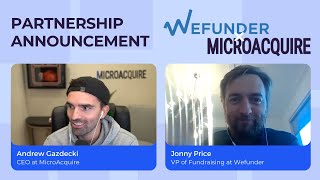
Johnny Price from WeFunder discusses a partnership that lets non-accredited investors fund startups. WeFunder has run community rounds that democratize access to early-stage companies, moving beyond the traditional venture capital model that excludes most people from startup investing.
Foreign.
I am live with Johnny Price from WE Funder. I'm super excited for this one because we are partnering together. Microcurrent, We Finder. Kind of a match made in heaven, I've heard. I was telling Johnny before we started recording that I've had requests more than I can count for Micro Fund financing before getting acquired, and it just made natural sense to work with the best. And so here I am with Johnny from Weave Hunter. So, Johnny, thanks for joining the pod.
Thank you, sir. It is great to be here.
Well, I love your. What is that light buying you? That's like a octopus.
It looks like a. I should probably make this into an NFT because it's kind of coming in front of my face. It looks like I'm a hologram maybe, but it's really me. I'm not a hologram. I'm a real person. But yeah, the light is from our office, our Nashville office here in We Fund. Our office here in Nashville, Tennessee, which is our second We Funder office. We're based in San Francisco, but I moved out here June 2020 and we now have eight of us here working out of the Nashville office. One of the things we want to do at We Funder is get more capital flowing to founders throughout the country, not just on the coast. So it's awesome for us to have a physical presence here in the heartland.
Nice. Do you remember when I stopped by the original. Maybe it was the original We Founder office?
Yeah. In San Francisco. Noe Valley, I think.
Yeah. Good times. Yeah, that was like three years ago or five or so. I don't know, 2018 maybe.
Yeah, I used to. I used to live two blocks away from that office in no Valley. We did the classic San Francisco thing. My wife and I were. We lived in the Mission, you know, in our fun loving twenties. And then we had kids and moved to Noe Valley and then we had another kid and moved to Nashville.
Nice. We could probably have another podcast on that. Just in terms of. I lived in San Francisco for five years, became a dad and then moved to. Well, I moved to San Diego, company was acquired and then moved to San Mateo and now I have a two year old son. Anyways, we're here to talk about. Just so everyone knows that doesn't know what does we fund or do. What's the founding story? Let's start there in zero Texas.
Yeah. So we fund was founded back in 2012, six long years before I joined the company in 2018. Our founders were frustrated that they had all these smart friends that were starting companies, they wanted to invest in those companies, but they weren't able to do so because they were not accredited investors, they weren't millionaires. And they said, this isn't very American. I can go to Las Vegas and drop $5,000 on the spin of a roulette wheel. I can invest in public companies on the stock market. Why the hell can't I invest $5,000 in my friend's really cool startup when I know him and trust him? And so they lobbied Congress and managed to change the securities laws that have been in effect for 80 years, since the 1930s, that basically prohibited non millionaires from investing in startups. And so in 2012, the Jobs act was passed through Congress. The SEC rolled out the new rules in May 2016. And so for the last five years, coming up in six years, I guess we fund has been leading the charge and enabling founders, enabling startups to raise capital not just from rich people, not just from accredited investors, but also from their customers and their community and their fans. We use this exemption called regulation crowdfunding. There were some updates to those rules in March of last year which now enable startups to raise $5 million per year. You can publicly promote the raise. You can use the weird and wonderful new thing called the Internet to actually, you know, promote your fundraise.
The Internet, huh? Tell me more, tell me more. Let me pull that back and see if I can simplify. So yeah, you gotta be an accredited investor to invest in startups right now. So that means you gotta make 250,000 or more a year or maybe, yeah.
200K, 300k household income or a million liquid as.
Yeah. So yeah, you gotta be making some cash. Yeah. So WE Funder and I've invested personally just for disclosure. I mean, I've invested in W.E. funder and a number of companies on W.E. funder and I think it's just awesome what you guys are doing in terms of leveling the playing field for amazing companies that you just can't get access to for one reason or another. But I think the main reason for not getting access shouldn't be how much money you make. I totally agree. So I love your mission. I love how your founders went and fought for that law to be changed. So that's badass, I guess. With that being said, tell me about maybe some of your favorite We Funder. I really like the concept of the community round where you can get capital from many different sources today. But getting investment from your customers and your biggest advocates, tell me maybe like one or Two of your favorite community rounds that you've seen. I probably invest in one of them.
Yeah. So Mercury Bank's definitely up there. Rocket ship startup, 40,000 startup customers. They're building a bank made for startups. And so he'd raised a 120 million Series B. I think CO2 led it and Jason Horowitz were in it. And then he said, I don't need the money, just raise this Series B. But hey, I think it would be a good thing for my business if I open up a small allocation to let my customers invest. And so he, he opened a We Funder round, community round and literally within five hours, I think maybe sent one email and his, his customers just kind of flooded in and invested on the.
Same terms as I was one of them.
Yeah, you're one of them. You probably got the email. So that's a really cool example. I mean you talked about kind of leveling the playing field and letting anyone invest in startups. Right. Not just rich people. That's a huge part of our mission. That's one half of our mission. The investor part of our mission on the other side of the table. Right. One of the reasons I work at We Funder is to level the playing field and enable more founders to raise capital, make it easier for them to raise capital. Right now if you look at the percentage of venture capital going to black founders, 1% female only founding teams is 3% versus like 80% male only founding teams, only 23% of VC goes to the states that aren't California, New York and Massachusetts. So what we're trying to do is to say if you can democratize angel investing, let anyone angel invest, then hopefully we can get more capital flowing to women of color here in Tennessee, where I am. And so just one example on that note, Kim Lewis, the founder of Curlmix CPG company, Black female founder, amazing woman out in Chicago just recently closed 3 1/2 million dollars on We Funder. Two Latina founders, Lil Libros, it's a company that's make publishing books in the Spanish language featuring Latinx people. Just kind of more representation among the Latino community. And those two Latina founders are coming up on $4 million raise. So those are so. And kind of if you read the comments. Right. This is one of my favorite things about wefunder. I don't know if you've done this but like reading the investor notes. So when people invest we ask them why did you invest? And if you read the comments on the Lil Libras page, everyone is Like, I'm so excited to see more representation of my community. So that's why I'm investing this hundred dollars. I really believe in you. Like, you know, and you can just tell those people then, now they're an owner of this company, they're enthusiastic about this company before, now they're going to be kind of supercharged ambassadors for this brand. That is really what the community round is all about.
Yeah, that's, that's so awesome. And those numbers you shared are unfortunate and definitely need to start trending in the right direction. So that's great to hear. You guys are leading that initiative. And then I guess my next question would be in terms of, you know, startups go through, you know, financing and they get to a point of an exit. How do you see founders benefiting from Microacquire just as an example?
Yeah, I mean you've done a good job in selling me on this with various. You've done an amazing job kind of building in public and I love reading your updates to investors that you put out. And I've had many horror stories over the last few years working at WE Funder. I'm sure you've had many more of just founders kind of going through the acquisition process, getting kind of strung along for, you know, months and months and then everything falls through at the last minute is a very common one, right? Or just like not having any transparency into the process. I mean, it's kind of like when you raise your first venture round, right, you don't really know what you're doing and there's all these complicated terms and you don't know the dance. And so just more transparency, more kind of support for founders along the way. You know, a marketplace where um, you're just trying to, you know, put buyers in touch with sellers and just modernize, modernize that process. It's, it's desperately needed as I think you're, you're seeing by the hockey stick growth that you guys have been seeing over the last year or so, it's clear testament there's a real market need for the product you're building. And obviously, you know, we fund the founders there, you know, seed rounds, even friends and family. Honestly, you know, I say run a friends and family round and we fund it, right? But pre seed, seed series A B early stage rounds and then hopefully in a few years time they're looking to, they're looking to get acquired. So obviously it's, I think it's a much mean heaven partnership wise between we Funder and Microacquire.
You pitch Microacquire very well, and thank you for that.
Hey, if wefunder doesn't work out, man, it's good to know it's a home for me on your PD team.
I think that's the most. The part I'm, I'm, I'm most excited for is, number one, just, you know, you know, bring more attention to, you know, I think community rounds and giving people the opportunity to invest in companies they would never have access to. And also helping with, you know, the diversity problem that we have in terms of people of color or women looking to raise financing. It just. There's a clear gap that needs to be closed, and I love how you guys are fixing that. And then when you go and sell your company, I always say, you know, founders are not trained to sell their company at all. We're not, you know, we're. We're taught how to grow it, market it. There's thousands of books on all those topics. But when it comes to the end, arguably the most important part of the founder's journey, it's like a bl. It's like, what do I do? Does Google just show up with a check and they're like, hey, hey, you're getting acquired. So we, we're doing our best to educate founders and, you know, helping them, you know, go through that process with.
A little like, buying a house. Right. I've now, I guess, bought three houses. And so it's. There's a lure of diminishing returns, I guess, where. Or it's getting easier over time as I like, you know, start to familiarize myself with this strange process. But, you know, the first time you buy a house, it's literally more money than you've ever spent on anything else by one, maybe two orders of magnitude. Right. And, you know, this agent is kind of walking you through the process, and you kind of hope that they're doing you right, but you really don't know much about it, and you're trying to read up on it, but you learn lessons along the way. And I also feel like there needs to be more support. Maybe after. After you, you know, after you microacquire is. Has made it, then you can go on and fix the home buying process as well. But very similar thing. Huge, huge decision, huge process or very opaque process oftentimes that needs modernizing.
Yeah, I love how this partnership is where you guys help companies that may not have, you know, access to, you know, a large network of VCs or something to get financed. And then with microguire same thing. You don't have to hire a broker, you don't have to hire an investment banker. You connect with buyers immediately and globally as well. So if you're in every anyone. We've done acquisitions on every continent except Antarctica. I always joke about that.
So that's next.
Yeah. If anyone's watching this and you're in Antarctica, please list on Microcosm. But I guess to wrap this up. So, you know, on Microcosm, I do hear from founders a lot where they, you know, are in this decision of should I sell my company or should I raise money? There's no really a right answer to that. It's a very personal decision. And I've had, like I said at the beginning of the podcast, so many requests to, like, where do I raise funding? I can't find investors. And naturally I've just been kind of referring them over to like, hey, check out We Funder. They're fantastic. So if there's someone watching this and they're looking to raise on We Funder, can you outline just like, the process, like, super simply, like, how does it work? How do they get started? What do they need? Should they expect.
Yeah, wefunder.com arrays is where you can go to get more info and start an application. Or you can hit me up, you can find me on LinkedIn, Twitter, and I respond, respond on both those places.
And Johnny does I confirm that. John, you're quick to respond, man.
Thank you, man. You basically, you start an application. Our team will walk you through the whole process. Right. So we will reach out, get on a call with you, and explain to you in a lot more depth than I'm about to do. So hold your hand every step of the way. I think I heard you guys do the same thing with your clients, which is super important. Again, it's like the house buying process. Right? It's like when you're getting acquired. Ah, I haven't done this before. Help. And so if you can provide that support, it's super valuable for founders. And so we try to do the same thing on the fundraising side. But you put together a profile page, which is kind of like a pitch deck. There's a button to upload a pitch deck to the webpage, polish that, make it sparkle. You are required on we funded to find a lead investor. Typically, they're putting in a minimum of 5% of the round. So if you're looking at raising half a million, maybe they're putting in 25k. So maybe it's an angel investor investing 25k. And so that lead investor is kind of prominently featured on the campaign page. They're going to lend their credibility to help you successfully raise. They're also going to vote for the shares of the individual investors in the spv. So we roll investors to one line on your cap table and the lead investor is going to vote for those shares. So finding a lead investor and with the lead investor, you're kind of negotiating on the terms, right? So are we raising on a safe, a convertible note, a price round? Are we doing a loan which we allow on We Funder? What's the valuation cap? What's the discount rate? How much are we looking at raising? So set the terms and then you can pull the trigger and launch. And we've had companies basically go through that whole process and launch on We Funder in less than a day. It can be very easy. We try to be very, very founder friendly and kind of fast moving. Before you get the money, you need to do some legal paperwork with the SEC Again. Our team will walk you through that. You need to share financials as part of that and then file the form C with the sec and then we can get you the money. And the average campaign on We Funder, I would say probably lasts for two or three months. Like I say sometimes Mercury, which glad you got into because that was $5 million in five hours. So sometimes it can go super quick if the company has a big audience and it's a really hot company, but probably average company is two or three months and then, yeah, close it and get the money. We take a percentage fee through the partnership with you guys. Any microacquire customers are getting a discount on. We fund the fees from seven and a half percent to six and a half percent. That's how we make our money. But it's a very kind of simple, clear fee. We're also the cheapest platform in the industry. So yeah, that's the process in a nutshell.
Smooth. I dig it. How much have you guys helped founders raise in total to date?
We just passed 400 million. Last year we did about 200 million. So you can see like we'd have been around for 10 years and we did half of that in the last year. So it really is like 10 years to be an overnight success kind of.
Thing, quite literally with you guys, really.
It's a cool story, actually. I think you tweeted something like this the other day, right, where it's like our founders, Nick and Greg, just immense resilience. When I joined We Funder was pretty flat. The rules were not in our favor. We couldn't do one line on the cap table. Companies were limited to a million dollars per year. Now it's 5 million. But they just had the tenacity to hang in there, keep at it, keep plugging away. And then when the law changed last year, Pandemic, I think, also accelerated our growth. And now they're reaping the reward for having the resilience to stick at it for literally a decade. And if we look ahead, like the pipeline of companies we have now that are going to replicate that Mercury playbook levels is live right now. Rome research was a cool one that we did last year. It's really exciting imagining we grew by roughly, I think about 4x last year and we're on track to keep that growth going in 2022. It's really exciting.
Nice. I'm excited for you guys and congrats on all success. And then I can speak from the whole microglire team. We're definitely excited to formalize a partnership with you guys. And to summarize, so anything that heads over any Microquire user that raises on we funder, you get a 20% discount. Johnny will roll out the red carpet for you if he doesn't shoot me an email and I'll make sure he does. But Johnny, thanks so much for joining me on this podcast. I again, I've been a huge fan of W.E. funder for years, as you know. And I guess if people wanted to, you know, get in contact with you directly or anyone at We Funder, which is general questions, where should they go?
My email is johnnyeaffunder.com j o n n yefunder.com or like I say, I respond. I think I have open DMs and Twitter LinkedIn, so I'm pretty, pretty accessible. Busy, but accessible.
Well, Johnny, thanks again for this chat and again, really excited to be working with you guys and great job on all the progress and keep fighting for founders.
Thank you, man. You know, Angie, today is my birthday. It is.
Happy birthday, man.
2024 today. 24 plus 15. But yeah, it's, you know, I couldn't think of a better, better birthday present than spending these precious minutes with you, sir. So thanks. Oh, Johnny, thanks for that birthday present.
You should have told before we were chatting, man. Happy birthday. All right, well, I hope you have a great day.
The cards in the mail, the car.
Is in the mail. I got something better going. No, just kidding. But Johnny, it's been a pleasure. I think a founder a lot of founders are going to benefit from this and just everything you and the WE Founder team does. So I'm rooting for you guys all the way and guided to be working with you.
Likewise. Cheers.
All right, man.
Cheers.
More from Andrew



The Buyers Who Made the Move: What They Bought, How They Did It, and What Happened Next






