Profitable. Focused. Built for Dogs. How This Niche eCommerce Brand Got Successfully Acquired
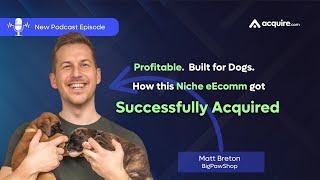
Matt Breton built Big Paw Shop into a profitable dog collar business and sold it through acquire.com. He discusses the strategies that made it work, the challenges he faced, and what he learned about selling a niche eCommerce brand.
Foreign.
I'm here with Matt Breton, the founder of Big Paw Shop. Matt, how you doing today?
Andrew? Doing well, thanks. Thanks so much for inviting me and having this awesome opportunity to meet with you.
Of course. Well, you recently got acquired on acquire.com. i'm super excited to hear that story. But before we get into that, do you want to give everyone listening a brief introduction of yourself?
Yeah, absolutely. My name is Matt Breton. I was the owner and founder of BigPaw. Bootstrapped it from a 9 to 5. It was. Yeah, it's a fun story. We'll get into that in a second. But I'm an E commerce professional through and through. That's what I do in my day job as well. And. Yeah.
All right. Big Paw Shop. What did it do? How'd you get the idea? I'm gonna take a wild guess. And you served something with dogs?
Good guess. Good guess. In 2017, I was working corporate job that I was not really fond of. Felt like I was just not being pushed creatively. It was a very sales driven type job. You know, boots on the, knocking doors, quoting and doing all that. I also didn't own anything. I didn't own a home. I didn't own, you know, my car. It was leased. So I was like, you know what? I'm kind of tired of this path that I'm on. It was 2017 and so Shopify was really starting to pick up. A lot of people were starting to do drop shipping and look at different business models and dogs. And a dog niche fit really well for me because I had two dogs that I loved. You know, they were a big part of my daily life. And, you know, I was thinking of business ideas. And one thing that came to mind was that every dog store that you go to in Canada, maybe in the US as well, but a lot of the brick and mortar stores have the same products. You know, it's always, you know, I don't want to necessarily call out names in a bad way here, but you do see, like, Kong a lot. Chuck it, you know, it's just the same brands over and over. And so I was inspired by some really niche dog products that we found on Etsy that we saw out in Europe, in Sweden, and different places of the world.
What kind of products were they specifically?
So Big Paw Shop, when we first started, our goal was to bring an abundant amount of products to Canadians that were incredibly unique. And that's really what we wanted to focus on. Almost like the Chewy of Canada, because they're not here. They weren't at the time. So we had ambitious goals to have a really wide assortment, and we focused on drop ship a lot at first, and if the product was unique enough, we would stock it. Um, what ended up happening, though, was the store was getting traction. I think I made my first sale within a couple days, which was pretty cool. Um, but what we noticed was that the repeat customer rate was pretty low. And, you know, that was just kind of the nature of the business and learning how to, you know, run an e commerce site and, you know, how you attract them to come back. But one day, you know, a very odd turn of events, a woman reached out to me and she tried to onboard onto my site and she was like, hey, you know, I sell dog collars. I, um, you know, I would love to list my products on your website. You know, I love the way it looks and all that. So I said, okay, perfect. Let's do this. But meanwhile, in the background, I was like, I'm never going to sell this lady's collars. Like, I'm not doing enough business to do, like, official onboardings. But as soon as we launched those products, you know, they really started taking off. It was a very unique business model, but customers loved it and they kept coming back, and the repeat customer rate was there, and it was really engaging with our audience. And so what we did is we remodeled the entire store and we had like a more. I want to call it, like, a more aggressive look, I guess. When we first started, you know, the logo was red and it had some more raw features to it. And when we decided to do a rebrand, we basically made it a children's store for dogs. Going off of that theme, my own dogs, you know, I know that they are like children to people who have families, and so really played up the pastel colors, the purple circles, and really made the site very easy to shop. Great selection. We had a ton of products, and I can get into how we did that too, but it was just a wide, vast product. And so what we did is we cut out all the stuff that wasn't those dog collars and just really went all in on that one product.
That is awesome. I love how that's a. It's a good story of just like, if you stay in business long enough, I'm a true believer something good will happen. Like, you'll get lucky. You'll figure something out. Like, you test something and it just works.
Yeah, that is.
That is just. That's a cool story I've heard all week, for sure, all month.
Yeah, Well, I appreciate that. Thank you. It's super nice to say. But yeah, you know, that. That would be one piece of advice that I have for people, anybody who's, you know, looking to get into a business or even sell a business. The way that you start a path, and I agree with you, it evolves over time. You might change your strategy, businesses change, it flows, but you have to be willing to make those adjustments. But, yeah, we did, and we saw.
Great success from it, 100%. Tell me, how did you market the business? How did you attract customers? I'm honestly not a big e commerce expert like yourself. Like, what are the common paths? Did you follow those? Did you do anything unique or different?
Yeah. So, you know, we started in 2017.
Really.
We're trying to figure out what our brand meant to us and, you know, what resonated with consumers. Kind of figured that out in late 2018, 2019. And actually, if you're curious, have a funny anecdote later. But we were trying a lot of different stuff and got the store shut down by accident, which I can go into if you're curious. But, but going back to the marketing, you know, we. It was a lot of word of mouth. We found that the repeat rate, repeat customer rate on our products was. Was really high because what ended up happening was our products were geared towards the personalities of pets. So it wasn't just selling like a black dog dog collar or a blue dog collar. They had specific text on it, graphics, you know, just a. A funny one that I loved for my dog. You know, my dog was part of this business. He's always been the model. We had a caller for him that said branch manager. And so it was a lot of word of mouth. You know, we saw our callers out in the wild. My wife was always super. She wasn't my wife at the time, but she'd be like, oh, my God, like, that's my husband's, like, brand. You know, very cool. Where'd you get it? And they. They were over the moon about the product. And so it was a lot of word of mouth in the early days of Facebook ads. Again, it's evolved very quickly during COVID but in the early days, we did a lot of Facebook ads. You know, we learned how to do that. Google advertising, Google Shop. Then eventually we did PMAX campaigns and things like that. But most of the of the revenue came from word of mouth.
That's amazing. Tell me about the price point for these collars. Was it a high price point? Because I've heard Dogs to be one of the best industries to go into because you have something called like buyers are not as price sensitive because they love their animals so much. I think weddings are also in that category. And also babies you mentioned dogs are like your baby. But this could be wrong. It's just an interesting anecdote I thought I'd share.
No, it's absolutely right. You know, I learned it's a niche that I went into because I loved it. It resonated with me. You know, a lot of people say don't get into business that you're too close to because you might overlook certain business decisions and things like that. But for me it was the opposite. I loved it, I thrived off of it. I was very curious. But what I learned later was that the dog niche and the pet industry in a whole is, is almost recession. People will continue to spend on consumables that they need. You know, think toilet paper, makeup, whatever it is. And also their pets, they're going to continue buying dog food. They're going to continue buying those small little luxuries for their kids. And so. That's absolutely right. And we saw that during the pandemic too, which was really what led to a lot of our growth. But yeah, it was, it was a great lever for us to be in.
That niche a hundred percent. I have a dog and we've bought the craziest stuff for him that makes no sense. He's a mini, a small mini Yorkie. And we bought them like these sweaters and you know, ridiculous stuff and we spent like 50 bucks on them. More expensive sweaters than I have.
Yeah, sorry, I, I, yeah, I, I kind of blew past your question about the price points. Our products were not entry level priced. You know, you could go to the dog store like I was mentioning before, pick up a basic dog collar for I don't know, eight, ten dollars here in Canada, in the U.S. maybe even a little bit less. So our collars were priced in the range of 24 to $52. The $52 collars were simply very wide. So one of the things that separated our products to other ones was, yes, the uniqueness of the patterns and the amount of designs and fabrics that you could choose from, but it was also the width. So you have a small dog and so you probably bought a normal 1 inch size collar or maybe even a 3 quarter inch collar and that was sufficient for you. But a lot of people who own larger dogs, 50 pounds, 100 pounds, 125, 180 pound dogs, their necks are incredibly large. And so we sold three different sizes of collars. And the largest size obviously had the most beautiful print on it because it was 2 inches of real estate that you put fabric on. So that was what differentiated the prices. So they were a little bit higher. But you know, going back into the amount of money that people will spend on their dogs, we had one customer who spent over $1,600 over the lifetime with us on dog collars.
I believe it. I 100% purchase one item too. I bet that person's like total dog bill is like 20,000, 30,000 at least.
Yeah, maybe we own most of the market share of her, of her wallet, I don't know. But yeah, we, she did buy a lot from us.
Gosh, tell me this. What are some common mistakes that E Commerce stores? Is it wrong products? Is it wrong marketing channels? What are some common things that you see with E Commerce founders getting it wrong?
Yeah, that's a big question to ask. That's a good one.
Putting me on the spot. Maybe just like one or two or the biggest one. I'm just curious.
Sure, yeah, I think really differentiating yourself, but also really honing in on the marketing material that sells your products. Why do customers need your product? And I'll give you a really great example. If you, anybody who's been in the dog niche for some time, maybe even yourself, because you own a dog, you've seen the ads for it. But a couple of years ago, those hand mittens were everywhere. That removes hair from dogs. Like that's the most basic product of all time, you know, and it's, it doesn't look good. You know, the assets were usually from overseas and they weren't overly thought through, but they sold so many of them because they, they solved the problem, but they also really demonstrated how they were solving that problem. And when customers are shopping online different than a brick and mortar store, you can't touch the product, you can't feel it. So you really have to create a visual of this customer using the product, you know, showing the dimensions, if that's relevant to them. Because they just see a picture on a screen. Is it, you know, a five foot, five foot gnome or is it a five inch gnome? You know, really showing customers why they need the product and really doing a great job. A really great vision board of, you know, how this fills their, their life.
It's awesome. So the business is doing well. You clearly have a ton of happy customers. It's growing extremely fast. What made you ultimately decide to sell the business.
Yeah, there was a couple different factors that came into it. You know, I would say the primary one was that I had a child in 2022 that was a little bit eye opening for me. I was first time I had a child, so I taking on that task was, was a lot. Um, and I also really wanted to be involved in my son's life. As I mentioned before, I also work full time in a. As a national account director, my full time job. And so I'm traveling a lot, you know, have a lot of responsibility there mixed in with this E Commerce business that I was trying to scale and grow. I would say that that was the primary reason was, was limitation in time. I had done a great job of automating the business, but the limitation time to be able to scale the business to the next chapter and continue making it worth my time. Let's say there was a lot of opportunity with that business. We'd slowed down the marketing side of it and really relied on word of mouth. And I felt that I was doing a disservice to the baby that I created. It being the business, not my actual child.
Yeah.
So. So I ultimately made the decision to sell.
Makes a ton of sense and I think it's a great decision too because you're essentially getting paid cash and then also time back your life back, you know, to focus on things.
Yeah. And we had a team working with us as well. You know, we had customer service reps, vas seamstress who all had responsibilities and you know, we were contributing to the livelihoods and you know, the sales were very strong for a couple of years. You know, they blew my expectations out of the water. I was always impressed with, you know, the, the amounts that we were doing and you know, watching me slowly stepping away and backing away from the business, it was always in the back of my mind, it killed me. Um, I hated that. And so, you know, that's really the decision for it.
That's incredible self awareness. You know, if you can build a business, then sell it to someone who can, you know, breathe new energy into the business and take it a bit farther than maybe you were able to for time constraints or sometimes I see, you know, just you're a builder and someone else is a scaler. I think that's some of the best win wins that I see at acquirers. You build a business to a certain point, you hand it off to someone to take it farther. So huge win.
Yeah. And, and I think it like tied, you know, looking on acquire. I think that was really great too because we were able to see a lot of the skill sets that a lot of these potential buyers had. You know, engaging with them and seeing how this business fits was, was impactful to me because at the end of the day, yes, I wanted to sell the business, but it also mattered what its legacy would be. And I feel really strongly about where the business landed and, and who runs it today. You know, love their skill set and love where they come from. So it was a great match all around.
Right on. Well, tell me, I'm going to take a few steps back. I'd love learn a little bit more about why did you pick that buyer, what stood out about them. But before we get into that, you go onto acquire.com what was your initial expectations? How did the, the first couple weeks go? Did it surpass that? Were you surprised in any way? How many buyers reached out? It's a lot of questions all at once.
No, it's okay. I got you. I got you. Yeah. You know, well, I guess before I get into the Acquire piece, I think it's important to take a step back because when I was originally trying to start the business, I know a fellow entrepreneur and they put me in touch with a couple different brokers outside of, of, you know, outside of Acquire and I tried to meet with them and you know, it was just like, it was really rough going. Like I really had a poor experience trying to work with somebody to sell my business and I didn't really know how to do it. I'd never done it before and just kind of left me feeling a little bit sour. And so, you know, I did some online research, came across acquire.com was optimistic, I would say. You know, I thought, you know, we were talking earlier about really telling the story that you have to offer and it resonated with me. And so I listed the website up for sale. I, I don't remember all the initial pieces. I know that, you know, Acquire stepped in a lot more than I had envisioned that they would. I thought it would be very self run. That wasn't the case. You know, we had a great CSM working with us to help us get the listing perfect, find out what price to put it at. But yeah, there was. And then yeah, going into your, to your last point about the amount of buyers, it was, it was overwhelming. You know, I felt like I was signing an NDA five times a day at least. There was a lot to, to look at and you know, maybe I'm getting too far ahead of myself. But going back to what I said, you know, you can kind of see what their experience is and how it ties into a business like yours. You could also take a look at what they do and look them up on LinkedIn and make sure that you think that they're a viable fit for, for your, for your business.
I love that. Tell me about the step forward now. Tell me about the buyer that you ended up selling the business to. Was there something that stood out about them? Were they E commerce background? Did you just get along with them? Was it the best offer? The mix of some of those?
It was, yeah, a mix of all of it. We, we. So I met with a lot of different buyers who had varying degrees of, of opportunity to, to present something to the table in regards to an offer. And when I met the gentleman who ultimately purchased the business, we hit it off right away. It was like we were talking as if we were friends. So that helped a lot. What I particularly liked about his background though was that he was a EVP at AP firm that's quite large. And so I felt like, you know, if he's engaging with me, he's seen my P and L, he's seen, you know, I had a robust amount of data that I shared with, with the potential buyers. And you know, I was like, if he likes it, he knows what he's doing. He has the background and in acquisition, M and A and all that. And so I figured if, you know, he was interested, he's somebody who's actually interested. And so we got along great. He really enjoyed the way that we were able to handle our data room, the insane amounts of data that we provided, the decks that we, we submitted. We really came very well equipped. We were very serious to sell the business. And so I think he appreciated that as well. And you know, he jived with us and yeah, it was a great match all around and he felt very comfortable with, with working with.
There's so many things about what you, what you just said that I absolutely love. The first is just, you know, the importance of just getting along with the buyer. It's massive because you have to work with that person to some degree. You have to transfer the business over. Usually you're going to be working with them for at least, you know, a couple hours a week or, you know, you're going to want them to carry on what you built. And so just vibing with them can go such long ways. And you also just build trust when, you know, you each just align on values or how you see the business moving forward. So I'm glad you just kind of kicked it off of that buyer and it went well. The second part that you said that I think is amazing, which is the amount of preparation you did with the P and L and the decks that you put together in the data room. There is just so much value in doing that for buyers. And another piece of value is when you start meeting with buyers, it becomes very obvious which buyers are prepared and they've done their homework. And that should really separate, you know, serious buyers from non serious buyers. So great job there. So you pick the winning buyer, you're going to move forward. You have a letter of intent, you sign that, you move into due diligence. What did that look like? Did you have extra inventory on hand? Did you have a lot of assets that you had to transfer? How long did that process take?
Yeah, a lot of questions there too, but if I forget one, just please remind me. I'm doing my best to remember them, but. So, yeah, we get into the due diligence phase and actually it was incredibly easy for us because of how well prepared we were with our data upfront after signing the NDA. Like I said, we had a vast amount of information. And because we're using Shopify, a lot of it is integrated direct reports out of there. You can't make up an order number, for example. And so I think he trusted a lot in which was presented already. And so when he went into due diligence, it was more just assigning permissions so that he can physically go into Shopify, let's say, and look at the reports with his own eyes. And Shopify is great for that because you can assign certain permissions so that they can't go in and let's say, you know, change all the prices of your products or change your passwords or whatever. So. So he was able to go in and take a look at the reporting, gave him permission for that. And yeah, he was satisfied with everything he saw. And so the due diligence phase was. I was prepared for it to be almost grueling, so to speak. You know, I was. I was anticipating that. And just because of how well prepared we were, it was. It was a very easy look over took, I want to say, two weeks, if that, maybe a week and a half, and moved on to two next steps.
Right on. I think what you just outlined to me is again, the importance of picking the right buyer. Sounds like he was experienced, you knew what he was doing, and then you were also very prepared up front, which saves a lot of headaches during Due diligence. So glad it went smoothly. What did you do when you actually closed? Did you celebrate anything? Did you go buy something? Awesome. Did you invest the money? Money? Like, what was. What was your acquisition day like?
Yeah, so we closed the day before or the day after Christmas. I can't remember it was. But it was very close to Christmas and he was trying to close out before the end of the year, and so was I for tax purposes, you know, we used escrow.com closed there. And that was a very seamless thing to do as well. It was very easy and received the, you know, the funds that are. That the funds were going to be released and the weight of relief off of my shoulders. Like, I did this. I did it. I. I sold a business. I had no idea how to do it and, you know, work through all the steps that were clearly outlined and. And accomplished it. And I had a. I probably had a scotch and sat down and relaxed for a minute, took a. Took a breath, and the money came into the bank account and right out into my investments. And I never saw the money. So, no, didn't buy anything fun. But, you know, I have. I'm actually enrolling right now to do an mba. And the reason I can look at advancing my education and career and. And all of that is thanks to being able to sell my business. So hopefully I get in.
That is awesome. Matt, you're a legend. I mean, you built something extremely valuable. You found a buyer, and it was acquired. That's something that literally every entrepreneur dreams of doing, but very few actually accomplish. And then you did it around Christmas, too. That's awesome.
Yeah, it was very exciting. My whole family was invested. My wife's family was invested. You know, every week they'd be like, so did you get a new lead, a new buyer? Did you have any calls? Everybody was really, really ecstatic. It wasn't just for me. It was. It was. Everybody. It was. Everyone was excited. Even acquire.com was super stoked. You know, clicking that button, getting the confetti, I was like, oh, this is the best.
Gotta throw some confetti at you.
It's lovely.
Part of what we do. Well, tell me this, Matt. If another entrepreneur is listening to this and you know, you had to give them three piece of advice to successfully get acquired, what do three piece of advice would be?
Yeah, believe in what you're selling, right? You might get pushed around on price a little bit, but know what your company is worth. Know that you've put the time in. Don't get overly emotionally Attached to it. Do the, the research, figure out what it's worth and, and stand by that if you feel that the price is right. But also don't be afraid to negotiate somebody who's very serious about acquiring your business. You have to be a little bit flexible and it's not always on price. It could be on assets and inventory and other things. But be firm, be flexible, where you think it makes sense. And then the other piece of advice that I have is, you know, stick with it. It took me a long time, Andrew. I knew through listening to your old videos that it took you a long time to sell your business. So that video gave me a lot of hope. You know, I didn't feel like I was behind because it can get discouraged. Don't get discouraged, you know, stick with it. Continue to motivate your potential buyers with new data. We went viral one time and so we created a new pitch deck and sent it out to all the potential buyer buyers and told them what was happening and where we were ranking in SEO. Keep them up to date, give them updates, continue working on the business, keep it, keep it valuable. Yeah, I guess those are the two biggest things.
That is massive advice, especially the second part where updating buyers with additional pieces of information, continuing to get them excited. Because anything you can do to create momentum with buyers with something that went awesome or you know, a month's numbers that are really good or better, better than expected. Literally anything but a follow up that just says, hey, how you doing? Like, hey Steve, I'd like to show you something awesome. Let me know if you want to chat and just do that as much as possible. I've seen it work hundreds of times.
Yeah, providing value all the time. You don't need to just say, hey, like you said, what's up? Provide value. And then you know, the last one that I just kind of want to re. Reiterate too, but, but it's a classic quote, but time kills all deals. Like if you see somebody who's in, who's interested in your business, keep them engaged, keep working them, keep massaging it. You gotta, you gotta keep with it. You know, they're gonna be looking at other deals, they might be busy, they might be doing all these kinds of things. You don't wanna be annoying, but you wanna make sure that you're giving them call to actions to take action by a certain period. You know, let's get on the phone tomorrow. Are you available next week? Oh, you're on vacation. Okay. When you're back, you know, I'll contact you. We'll set up a new time. Just stay on them. You have to, because everybody's busy. You know, selling your business is incredibly important to you, but at the end of the day, they're buying something, and so they might be a little distracted. So stay with them.
100. It's a sales process. I work with so many founders where they think, you know, you list on Acquirer, you kind of step back, and if a buyer wants to acquire you bad enough, they'll figure out a way to get a hold of you, but it's, it's, it's going to be further from the case. You have to reach out. You have to schedule meetings. You have to, you know, put in the effort and the time and give buyers a reason to want to acquire you. So great advice. Yeah. Well, tell me, Matt. I usually, you know, kind of end this with what are you doing next? But it sounds like you're getting an mba. You're going to build another e commerce empire. What's.
What's that? Yeah, that's my dream, you know, continuing to grow my family, spending time with them, doing my mba, furthering my career. But really what I want to do is at the end of the day, you know, in five years from now, I want to start a company that I know how to scale, that I can take to the next level and grow globally. We were a Canadian business, and entrenching ourselves in the US Was difficult because we didn't have boots on the ground. I want to scale globally. I want to be one of those big brands. I want you to be like, hey, I know that guy. Yeah, he sold his first business on Acquire. I want to be that guy.
Well, Matt, you're. You're an inspiration. You drop so many just gems in this podcast. Thanks for, for coming on. If people want to, you know, out to you or follow your journey online, where can they find you?
Yeah, LinkedIn is probably best. Matt Breton on LinkedIn. You'll find me there holding two dogs. So reach out. I'm. I'm an avid person. Like, I really believe in helping others. And so please reach out if you're curious, have any questions. I'm more than happy to help out. And thanks so much, Andrew, for inviting me today.
Yeah. All right, Matt, thanks again for coming on the podcast and congrats on the acquisition.
Yeah, thanks so much. Take care.
More from Andrew



The Buyers Who Made the Move: What They Bought, How They Did It, and What Happened Next






