Rapid Road to Sale - From LOI to Final Offer w/ Andrew Gazdecki, James Graves, and Rainier Nanquil
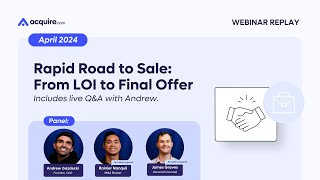
This is a YouTube video titled "Rapid Road to Sale - From LOI to Final Offer w/ Andrew Gazdecki, James Graves, and Rainier Nanquil" recorded in April 2024. It features a webinar-style conversation with multiple speakers including Andrew Gazdecki (CEO and founder of Acquire.com), James Graves (general counsel), and Ranier Nanquil (M&A advisor). The discussion focuses on the startup acquisition process, specifically the importance of the Letter of Intent (LOI), how to get and close acquisition offers, deal structuring, due diligence, and best practices for sellers to successfully navigate acquisitions. The content is educational and aimed at startup founders looking to sell their businesses.
Foreign.
Go ahead and share my screen. And when I do, if you can just give me a heads up so I know I'm not just showing you random slides of nothing. Give me a heads up. Can everybody see the this initial slide? Cora.com all right. We have thumbs up. Okay. In this webinar, rapid road to sale from LOI to final offer. Going over a quick agenda. We're going to do introductions of our company for those of you that aren't familiar with acquire.com and then also everyone in attendance in this webinar or I shouldn't say attendance, I should say speaking. So we got Raniere and James on the team and also while you're here, so what are you going to learn? And then we're going to talk everything, Letter of intents, the importance of getting that first offer, how to get it, how to close them. So we're really going to be focusing in on that formal offer that really kicks things off with acquisitions and then eventually closes to a successful acquisition. So without further ado, quick introductions. My name is Andrea Zecki. I am the CEO and founder of Acquire.com I've previously started and founded two different startups, both acquired. So I always like to say I've been on both sides of the table where, you know, I'm selling a business and I've helped others sell their own, their own businesses. And that's really, you know, why I started acquire.com to make it easier for startup founders to get acquired just after going through the painful and confusing process myself. So that's me and I'll hand it over to you. Rene.
What's up everyone? My name is Ranier. I'm one of the in house M and A advisors here@acquire.com I have over a decade of experience in M and A capital markets, investment, sales. I've done tons of deals and my job is to help everyone get the best price, best terms, best deal possible.
That is a fact. James, you're up.
Hey everybody. My name is James. I'm the general counsel here. I've been working in law about over a decade now in M and A for about seven, eight years now. Yeah. So I can come at this from a unique perspective. I like to think both on the deal side and legal side and I work with Andrew and Rainier and tan them to get the best terms and see the most successful exit possible for our customers.
Love it. And then for those of you that aren't familiar with acquire.com our goal is to build the world's most founder friendly Startup acquisition marketplace in the world. And a big part of that is really educating startup founders just the process of getting acquired. And big part of that is letter of intense. And we're going to be going over that today. It's a topic we could talk about for hours, days, long time. But before we get there, just going over impact. We've been in business about four years. We've helped over a thousand startups get acquired, totaling over half a billion in closed transactions. We have about half a million registered buyers on acquire.com now. We have thousands of listings and we've actually served 100 plus countries. I always like to joke that I'm actually not joking, but we've closed an acquisition on every continent except Antarctica. So we're still trying to get a startup in Antarctica close. So if you know one, let us know. But moving on to the good stuff. So how to get an acquisition offer to close. This one's pretty straightforward and really the point of this is when you, when you receive a letter of intent, the, the main thing I want to get across with this slide is getting a letter of intent is really just the start of you getting acquired. It does not mean that you've officially gotten acquired and you need to continue to sell your business all the way until the wire hits the bank. So I always like to say an acquisition is not closed until the wire hits a bank. No matter how great the loi looks, how great the buyer says everything is, always be selling your business all the way until the wire hit the hits the bank. So we're going to be talking about that. So pre loi. So how do you get that initial offer? And so we're going to be doing a little bit of commentary here. I'm going to be, I, I guess a com commentator and then James and Rene are going to be driving, so really just diving right in. So why is that first offer so important? Why is that first letter of intent so crucial to having a, a successful acquisition process? And James, maybe I'll toss it over to you first in terms of the first item. So in terms of, of gives you leverage. What does that mean to you when we're talking about the importance of getting the first letter of intent in play?
Yeah, it's gonna kick off the process and I think most importantly it's going to signal to the other buyers that it's a company worth selling and worth buying for them. So people are off the table. They're going to come to the table and they're going to recognize that they're It's. It's something that other people are looking forward to, which is really powerful psychologically.
Yeah, I would definitely agree with that. And leads into these other items here. So, Ranier, do you want to take the next two boxes and then, James, you'll take one. Actually really have a letter of intent in hand, but you're able to use that as, you know, a conversation point, saying, hey, I have another buyer that's interested, and that allows you to potentially to take terms or increase valuation. But moving over to these other one, James, in terms of, you know, when you're selling your business, you know, it's such a long process. How does it motivate you and how do you interpret the last one, which is, you know, it. It could be, you know, the offer that you end up taking.
Yeah, I. I mean, you've done all this hard work of creating a business over the course of the years and put in blood, sweat and tears to it, you know, hoping it can be sold. But as soon as you get an offer, which is, you know, a written document that shows a price tag on it, shows it that, you know that. That you can start this process and that you can close it. So I. It's really, really motivating. And, you know, you pivot that how many offers you'd like, and then same with a good one. Right. I don't think most off or most deals close with the first offer, but you got to treat it like that, and that's also really motivating as well.
Yeah, I completely agree. And, you know, a lot of people, you know, they go into an acquisition process not understanding that, you know, it can take sometimes weeks. Sure. But typically it takes months. So getting that first offer can be so motivating. And I think we can all agree. I liked what you said, Raniere, where it really does kind of kick off the party where, again, once you get that first loi, you're able to parlay it to other buyers. And known feature on acquired a comm is when you receive a letter of intent from a buyer, all buyers are anonymously notified. So what I mean by that is they're notified where they'll get an email saying, hey, this business that you're interested in has just received a letter of intent. Terms are not disclosed or anything like that, but it lets everybody know that you have actually received a formal offer and there are other buyers interested. So, again, when you're thinking about getting your. Your first offer, you know, you may be thinking, okay, I'm not there yet. What am I Doing wrong. So these are some of the most common reasons and I'm gonna hand these over to starting with you, Raniere or actually no, let's do this. Renew. You pick maybe the top reason. So we work with a ton of different startups. Not all of them get offers. Some of them get offers at, you know, different time periods, whether it's within weeks or within months. What would you say the top reason out of these five is? The not is the number one reason that a startup founder would not get a letter of intent.
Yeah, that's a good one. I'll pick my favorite. Have you been priced strategically? So at Acquire, we've seen tons of deals just last month in March. Of those 48 transactions, we have another 217 under offer. So we know exactly where the market is at, where multiples are trading at. We've got our finger on the pulse. So if you list just a little bit, 5, 10, 20% above what's trading on market, buyers are going to go elsewhere. There's, we have 1400 plus other listings on the marketplace. They're just going to go to another deal. So you've got to price it competitively to really get traction offers at the end of the day.
Yeah, I completely agree with that. All right, James handing it over to you. Rainier took his, his top pick and I, I think we would all agree or let me ask you this, James, would you agree in terms of, you know, the number one reason for not getting an pricing too high and out of market ranges?
I definitely think so. Just via the platform. A lot of buyers will, they'll filter via multiples and so they may not even see you. Or if they're not doing that, they'll see something at like, you know, 8, 9, 10x profit, for example. And like Rainier said, it's just the pass, it's just a swipe left on that because it's just not going to be worth their time in their minds to negotiate when there's better offers and better prices listed.
Yeah, and I would say, you know, it's, it's, it's interesting because, you know, you want to list with the importance of listing at, you know, fair market value or really just the valuations that we recommend. So if you aren't sure how to price your startup, I highly recommend taking that advice because you don't have to sell at that price. But what it does is it allows buyers to at least take a look at your listing. So they'll go over your sim, they'll go over your p L. And you have to have an understanding that some buyers are looking at, I always say sometimes between 20 to 50 deals per day. So if you don't have your, your business price within the ranges at which they will not go outside of, they won't overpay in terms of at least showing interest, you're just going to miss out on a ton of buyer interest. And again, the more buyer interest you're able to create, the more offers you're going to receive and that's how you can increase your valuation or that's how you can negotiate against terms. So yeah, just wanted to, to really stress the importance of, of pricing because that is definitely the number one reason that startups don't get offers. But James, let's talk about two and three. You know, what's the importance? So I don't follow up on every lead. I'm not being professional and responsive. Like what, shouldn't a buyer just send me an offer because my business is so great? Why, why am I not getting offers? Because I'm not, I'm not.
I can unpack this a bit. I think there's a couple things going on there, right. Like, even though I think it's shifted into a seller's market a bit and entrepreneur entrepreneurship via acquisition and they're been more popular. Startups are sold, not bought. So you need to treat every buyer as if they are the buyer that's going to close with you until they tell you explicitly that they're not. There's a lot of buyers that are really busy, are, you know, looking at a lot of deals. Some have full time jobs, you know, really like sort of high level jobs too. So not going to be able to respond quickly and they might forget to respond. So it's your job to keep them apprised. It's your job to make sure they have enough information and it's your job to, you know, frankly make sure they still pay attention until they say, hey, no, I'm not interested or else like I said, any buyer could be the buyer and they are the buyer that you should consider is going to close with you until they tell you that they're not going to.
Yeah. And this is, this is a big thing that we help with@acquire.com in terms of, you know, educating you on again, you were selling your business. So you need to be following up with buyers even if they don't respond to your initial message. But you have to send an initial message. You have to send them a link to be able to book a meeting with you, you need to be in term. When I, when I see professional on this list, really what that means to me is you're prepared. You have all the proper documentation that buyers almost required to schedule a call with you, which includes, do you have a clean profit and loss statement? Do you have a transition guide available? Just how easy have you made it for a buyer to wrap their head around your business? And then are you responsive to questions that they ask? Because if you're not responsive, really what you're doing is you're giving kind of a, a little bit of an indication of what due diligence is going to be like, how hard it's going to be to work with you. So completely agree with everything that you're, you're saying, James. Okay, so we have these next points. Renee, I'm going to hand both these over to you. So be being open to creative deal structures and then asking for help. Walk me through. Just, you know, how these can, you know, help you get an offer if you haven't received one already on acquired account.
Yeah, these are two good ones as well. So price and obviously communication is important, but these being open to creative deal structures, being open to creating a win win situation, that's going to be important as well. So price is important, yes, but also as important terms. Let's say if there's a holdback, there's seller financing, there's other parts of the deal that can help get to a certain price point. Being open to that discussion with the seller and the buyer, that's, that's all going to be helpful in piecing a deal together. It's very rarely that we'll see an all cash deal at list price nowad. So being open to asking the seller, hey, what's important to you? Is it price? Is it timing? Is it deal structure? You tell me.
I agree. James, you want to add anything to number four?
Yeah, I think just to echo what Rainier said, all cash offers, especially in the higher ranges, are pretty rare. If I had to guess, I'd say like less than 5% of the time.
Let me ask you, why is that though? Why no all cash? Why I want all cash?
Yeah, I mean, it's a lot of it is just a buyer just doesn't have that amount of cash on hand or if they do, they're going to allocate their capital elsewhere. Another reason is that the buyer wants to mitigate their risk if they just turn all the cash over to you immediately. And maybe the business isn't what they thought or something goes Haywire or something. It's really hard for them to roll that back. So a lot of times they'll turn it over to an indemnity holdback. Sometimes an earn out on a seller note. Sometimes that seller note can be offset by the indebted obligations of the seller too. So there's a bunch of just different levers that I can pull to help spread out their risk and make sure they're not completely exposed should something go awry.
Yeah, I like the, the part you brought up in terms of just the reducing risk. You know, as a, as a buyer, buying a startup is, is fairly risky. You know, I don't know what's behind. You know, every startup typically has some skeletons in the closet post close. So typically what you'll see and if you're articulating this to buyers saying you're open to creative deal structures, what you're really saying is you're saying, hey, I'm open to 80% cash on close and then maybe the remaining 20% is seller finance. Maybe it's an earn out. More often than not it's going to be seller financing or it's going to be some form of maybe conditional holdback. Seller financing is by far the most common structure or additional, let's call it deferred payment. But just letting buyers know that you're willing to work with them to reduce the risk of buying your business will help you get to acquisition offers. And then we, we do see all cash offers from time to time. But again, I wouldn't, it's really the exception and not the rule. And it's only for businesses that are typically very competitive bidding process, they have multiple offers on the table, you're able to command the terms and basically just say, I only want all cash offers. I have 10 different offers. Those scenarios, they do happen, but again they're the exception and not the rule. So being open to creative deal structures can possibly get you to an all cash offer if that's what you're really looking for. But again, when you signal to buyers, then just say, hey, I'm open to, you know, entertaining all types of deal structures. I'm open to being creative with offers can go a long ways because again, what you're telling buyers is I understand, you know, this is a risky acquisition. I am motivated to sell my business. And the more offers you draw in, again, the more offers you draw in, the more leverage you have to increase valuation or, or terms or whatever is most important to you. So the last point is, is just asking for help. I'M asking both you, Renear and James, you know, if, If I'm on acquire.com and I'm not getting any offers, how do we help you? How does like how do you help me, Rainier?
If I could go first. So ask for help. We're always happy to help. We specialize in these type of startups, we specialize in these type of business. We do hundreds of transactions so we could get as creative as needed to piece the deal together. And really just you asking for our help, we could tell you how your price looks compared to market pricing, what buyers are looking for. Again, we've got our finger on the pulse of what types of buyers are out in the market right now and, and what type of deal structures getting deals done.
James, anything you want to add to that?
I mean, yeah, that's basically whether we're advising on your transaction. Like if Rainier is like your, you know, the broker on your transaction or you just want to write into our customer support. We see, you know, hundreds if not thousands of these every month. Today already I've worked on like 15. You know, this is, you know, the seller is probably only transaction in their life or maybe it's just one or two. And we work on these all day. So don't, don't hesitate to reach out. Please let us know if you have questions. We'll help on pretty much anything.
Yeah, there's, there's been multiple scenarios where you know, starter has been listed on Marketplace for months and then when you finally, because what we've done@acquired.com that a lot of people, you know, I need to remind is, you know, we built out a full MA advisory team so we're here to help from start all the way to exit. So whether you've received an offer and you just want to high level opinion on if it's a good offer, we do that all the time. And then also really helping you, you know, position your listing better to potential buyers or pointing out what's missing or are you priced strategically like Rainier mentioned. All these things we can help with to ensure that you get an offer because our incentives are entirely lying. We want you to get acquired. So if you are on acquire.com and you're not, you know, seeing those offers come in, definitely reach out because like James said, we, we do it all day long so we can, we can definitely help there. All right, so post loi. So this is where again you receive a letter of intent and now your goal is to make sure that it closes again when you receive An LOI you have not sold your company. It's the first step to a process of selling your company, getting acquired. But it's really important to note that just getting an LOI is really, really the start. Renier, do you want to walk just kind of through these stages in terms of, you know, getting to all the way to close?
Yes. So here's the roadmap. There's going to be negotiation and really just getting to the specifics of getting to the finish line. Due diligence, Technical dd, Financial dd. Everything needs to check out. Then you've got the asset purchase agreement, which is the legally binding document to sell the deal and then you've got escrow. That way the buyer can wire their funds and then the seller can sign off. Make sure everything checks out before releasing the funds and then avoiding surprises. There's always something that comes up in every deal. I've been part of hundreds of deals and it's not problems that kill deals, it's surprises. So the sooner that you can anticipate something coming up during the post LOI portion, the better. There's nothing worse than a surprise coming in at the 11th hour right before you're about to close and it just blows up the deal. That's, that's especially when buyer and seller are very emotional and you know you're getting close to a deal when the buyer and seller get emotional. I've seen it happen time and time again. So just avoid surprises by just looking out for these different things ahead of time.
Yeah, I completely agree. And James, anything you want to add to just kind of the, the timeline?
Yeah, I, I agree with rainier100. It's not surprise, it's not problems, it's, it's surprises. So just being upfront about everything throughout the process and making sure there's nothing hidden. If there's anything that you think might be somewhat hidden or covert even just be proactive about disclosing it to the other side and you should be in good shape.
Yeah. One, you know, real life example too is I always recommend this, but I recommend a pre LOI signing call and I was on one just last week. It was for a multi million dollar transaction and there was just like a few things that the seller just wanted to confirm like just hey, are you're aware of this? You're aware of this? You're aware of this, you're aware of this because the last thing you want to do is sign in a lie and then you find out the buyer missed this key point or you know, and you should be at a point where, you know, the buyer has reviewed all your documents, they understand what they're getting themselves into, and you're going to move into due diligence and everything's going to. You have a plan with due diligence. But just having that, that quick call before you actually sign an LY can really go a long ways. In case there's a few staking points that could be, maybe, I don't know, revenue dipped last month, or there's some. It could be a number of different things, but just that, that level of honesty that you display before you enter a formal agreement to sell your business or get acquired is huge. Because after a surprise comes up in an acquisition, like Rainier and James have mentioned, the buyer can kind of like it. You know, you start to question sort of everything. And so again, anything you can do to avoid surprises, especially during due diligence before you sign an LOI is absolutely huge. So definitely, we're, We're. I guess if you get anything out of this one slide is avoid, Avoid surprises and just be honest. And again, bring your business. There's a saying it's okay to bring your business with, with warts and bruises and bumps and all, because those can be viewed as, you know, maybe you had a marketing campaign terribly wrong or something like that, but those can also be viewed as opportunities. And so, again, the more honest you are and the more upfront you are, and the more you get ahead of surprises, the higher chances you have of making a letter of intent close. Okay, so we're getting a theme here, which is making it easy for the buyer in terms of closing the letter of intent and getting in front of certain issues. But also, there's certain things that you as a seller need to do to ensure that a letter of intent will close. So I'm going to hand this over to you, James. I'm going to let you pick one through five in terms of, you know, how does one of these items help ensure that a letter of intent closes? And why is it important that a seller goes through this?
Yeah, I'll knock off number one. A lot of times where you're based, it will change funding options. So just being ahead of that, making sure the buyer knows that, for example, if you're not in the US you can't have an SBA loan. Maybe a blue post is another option there. Some other times there'll be restrictions on transfer of assets in certain countries out the world, so just be aware of that. This is primarily legal, so maybe an Attorney then just to get a broad view of what an asset sale to potentially a foreigner might entail. And don't expect that the buyer knows this. It's your job to be prepared for this and let the buyer know ahead of time whether anything's a complicated deal.
Yeah, and we see this quite a bit too. International buyers are not bad at all. But just understanding what you're getting yourself into, and I think that's probably a theme that we'll also have. All right, we're near your next. You got either pick, pick 2, 3, 4, or 5 and give us your opinion on why it's important.
Let me go with number four. This is one of my favorites out of these funding. Confirm. Before signing, make sure you have a firm understanding of where your buyer is coming up with the capital. If it's a traditional lender, sba, lender upos, you want to get an idea of what that process looks like. If you can help provide any of those documents to help speed up the process, introduce yourself. That way, if anything comes up, you can answer any questions. And more importantly, get an idea of timeline, because it's the worst thing that can happen is both the buyer and seller think that they can close in 30 days, but the lender needs 45 or 60 days. So really it's just managing expectations with the lender or whatever that capital.
Yeah. And what's. What's like, what's a great way to verify funding? Like, okay, so I'm. You're going to buy my business, Renee, How. How can I verify that you have the capital on hand?
So there's a cool feature on acquire.com where you can upload your funds. So we have, out of all the buyers, we have over 500,000 buyers. We have 1.8 billion of verified funds on our platform. Do yourself a favor, upload your proof of funds. That way the buyer can stack, rank you higher than the other buyers or other offers on the table because they know that you have the ability to fund with your own capital. And then from there, it's just an easier discussion to talk about different funding sources, timelines, where you're going to come up with the down payment for the deal.
Yeah, I like that. I mean, it's simple as that. Just ask, just be like, how. How do you plan on funding this acquisition? And then also ask the buyer to confirm their funding. With acquired.com, we will review whatever documents that they submit. There's a number of documents we accept. You know, anything from a bank statement to, you know, a brokerage Account statement. So if you go into a transaction without confirming funding, you're put, you're setting yourself up for, you know, potential risk. And this is unfortunately a reason we've seen, you know, multiple transactions just get delayed or, you know, maybe they're fundraising in the background or what. Whatever it may be, it's such an easy bar to clear in terms of just confirming that the buyer does have funds. Just ask and then just tell them, hey, can you verify it through acquired.com and then the benefit to you as a buyer is next time you acquire business or you are, maybe you're in a competitive, you know, bidding process again, you've verified your funds and that gives sellers just so much more confidence to move forward with you than some person who maybe even has a higher offer. But they can't confirm funds or it doesn't make sense or they say they're gonna finance it with this third party company we've never heard of. So definitely utilize that feature. So shameless. Plug verify your funds unacquired dot com. All right, James, we got handing it over to you. We got number two, three and five left. Why, are they important?
Yeah, I'll knock out three real quick. You know, if it's a complex transaction, you're in a high value transaction, you probably want an attorney on that. It's your job to get one. I'd recommend bringing one in around the LOI when you have a draft of it. You know, most attorneys won't really have a ton to say on the loi. I mean, if there's anything glaring, they, they'll obviously bring it up, but it's more so, so they can get familiarized with the transaction, make sure you're not agreeing to anything crazy. After that they can sort of take over, you know, all the legal components which should be running contemporaneously alongside the due diligence process so that you minimize the time under LOI and keep it as quick as possible. And then usually if you have any questions, in my experience, I used to run deals as an M and A attorney. You'll probably ask your attorney everything under the sun, things that they can't answer. They'll probably recommend a cpa. So at that point you'll know whether you need a tax account as well. And then a CPA is a really good option to just, you know, to really map out and model out your deal. What's going to look like post tax, are there any working capital adjustments, stuff like that, so you actually know the dollar amount is going to hit Your bank account?
Yeah. I mean, really, again, this is where you want to avoid surprises. I remember one time, this doesn't happen too often, but we had, again, if you receive a letter of intent, we are able to give high level opinions on it. We cannot represent you as your attorney, but we do have attorneys that we can recommend. We have a, a full bench. So we have multiple different attorneys that we can recommend to you. But one, remember this, James. We got this LOI one time and the seller refused to, you know, talk to us. And so we just said, all right, but within the loi, there should always be a disclosure of how the payments are going to be made. And what I mean by that is purchase price is $1 million. Okay, so how is it all cash at closing? Is it 80? Cash at closing? 20. Seller financing. And so they go through due diligence. They go through. Again, this is a, a business that we weren't representing, so they were kind of just doing it on their own. And again, we are here to help and we want to help and we, we reach out to help. Um, but sometimes, you know, we don't get in touch with everybody, but on this situation, they get the APA back. Now that's the document that really goes over how the funds are going to be dispersed. And I believe it was 10% cash on close and then 90% seller financing. Yeah, yeah. And then of course, at that point, you know, the, the owner of the business, you know, enrolled, enlisted with us or engaged with us to help them with their transaction. But again, if, if you're unsure as you go into this process, always remember the Choir.com team. We're here from start to finish and just catching little issues like that, you know, we can be in your corner whether that's, you know, hey, this LOI checks out. Here's an attorney that we recommend. Here's a CPA that we've worked with on a number of different transactions. You know, we will help make sure your deal goes smoothly. And when you list on acquire.com there is a 4% closing fee. So you might as well use our expertise. It's included entirely free. So that's just one sort of it. That's very rare, but it does happen. So those are things that we can help with. Now moving over to James Renier. You guys took care if I take one of these two, two or five?
Go ahead.
All right, you guys pick which one? Two or five? Two. You, you guys know it's my favorite one.
A joke mean you're got the decision.
Yeah. They, they know me too well. So I this, so if I'm ever, you know, advising a deal or, you know, giving advice to my team, I'm always saying, hey, before you sign in an loi, get some sort of plan in place. And so what that means is typically get a due diligence schedule. And that could just be an email that just kind of outlines, you know, after I sign this loi, what happens? Week one, we going over financials, are we going over, you know, marketing, sales, product, what is it? And really you're setting a timeline to close. So you're setting up a plan. Where are we closing in 60 days, 90 day, 32 weeks? Like, what is the plan? Because if you go, if you sign an OI without a plan in place, every time I've seen it happen, it just goes kind of awry. And you know, week one, you're like, I think I feel like looking at this stuff, it just, it's, it's such a smoother process. If before signing an ly, you align with the buyer on exactly again, what are you going to do? Week one, week two, week three, how long is it going to take to get to the asset purchase agreement? How long is it going to take to final close, really aligning on those items? And they're all very basic questions and they can also give you insight into the experience of the buyer as well. Because if they can't answer those questions, like, I don't know, we're just gonna kind of go about like you're just again, you're opening yourself up to again, you get an loi, your goal is to increase the chances of that closing. And there's a lot of things that you can do before signing it because you don't want to go down a two month path. And then at the end of it you're like, whoa, that was a complete waste of time with these simple questions such as, do you have a due diligence schedule? That just basically means a formal guide of this is the process I'm going to go through with you to due diligence your company to head towards a successful acquisition. So just ask like, how long is due diligence going to take? What are we going to go over? What's sort of the plan? You know, another reason to have a pre LOI call just getting on the same page. And I think the buyer would also really appreciate it as well. All right, Ranier, you're left with number five, regular check ins. Why are they important?
Regular check ins. So when you're Going through this process, timing is of the essence. Our main saying is time kills deals. So you're going to be responsible for pushing this towards the finish line. Check in both buyer and seller every week. Make sure both parties know exactly what they're working on each week. That way there's no surprises like we said earlier and it's just sitting on their hands wondering what happens next. Check in every week, manage expectations, tackle each problem or objection head on and work your way towards the close. The last thing you want is wondering what the other party is doing and when they're going to get it done. So that's again regular check ins. Keep that goodwill and make sure you keep chugging along, keep getting towards that finish line.
Yeah, I think those are huge. And agree to those before we even sign loi as well. You know I again I was on a we, we signed an loi with or we, we assisted with a business signing a rather large loi just last week. You know, set them up with hey, this is kind of the weekly, you know, check in schedule. Like just aligning on all this stuff before you go into due diligence just saves a ton of headaches. And again aligns you with the buyer on what is the plan. But yeah, regular check ins it can be. How's the weather? Great. Okay, here's like the five things I need. Like even if you don't have anything to talk about like it, check in every week just to make sure the deal is on track because it keeps momentum, it keeps excitement and most importantly it increases the odds of the acquisition closing. Which again when you get a letter of intent, your main goal is to increase the odds of that closing and you want to continue to sell the business, you want to be in constant communication with the buyer. So regular check ins can be a great way to do that. Whether that's opening up a slack room. It could be weekly zoom calls, it could be just having them on text or just 15 minute phone. It could be so simple. But make sure you check in every single week. Do not go longer than a week without a check in. So that's all we have for this webinar. We're going to move over to Q A since we have an additional 20 minutes on this one. But if you're ready to close your dream offer, get in touch with us again. We are here to help. We, we love helping startups get acquired. It's what we do all day, every day. So if you're at a point where you're looking to sell your SaaS company. We'd love to speak with you. We'd love to get you that first offer. We'd love to get you that offer that is above your expectations and really lead you from, again, from, from start to finish, all the way to a successful exit. So reach out to us. We. We definitely were here to help. Now we're gonna move over to some Q A. You guys ready? James Raniere. Yeah.
Do it.
All right, so starting at the top, and then, Roger, I know you're in the background, so you're gonna have to feed me some other questions. All right, so if I like the offered price but not the terms, should I still accept the loi. James or near. You want to take that one?
Yeah, I. It's so hard to know without knowing the terms. You know, I would say if they're out of market terms, probably no. If they are in market terms, probably yes. So just as an example, using what Andrew just said, if it's 10 cash down 9% on the seller note. Yeah. That's not one you want to take. But if you flip that, you know, easy answer is if it's 90% down 10% on a note, probably something that you do want to take. So just knowing what's common and customary in terms of how the structure is paid out goes a long way.
Renee, what do you think? Let's all. Let's go. Let's go around and let's all answer these. These questions that I got at least give our takes.
Yeah. To me, price is obviously important, but so are the terms and the deal structure. If you're listing for a million dollars and someone says, okay, I'll give you full purchase price, but I'm putting a hundred thousand down, that puts a lot of risk on potentially not getting that 900,000 on an earnout or seller financing. So you've got to meet somewhere in the middle where it's a win win situation for you as a seller. Think about what's the price? Is it timing? It goes quickly. Let's say if you got something in your life that has come up, maybe it is worth getting that 100,000 because you've got an emergency that you've got to pay off. So it really depends, case by case of what your personal.
Yeah. Again, restating the question, if I like the offered price but not the term, should I still accept? I'm going to give a hell no on that. I would say terms are as important as the final purchase price because again, you can get into a situation where the terms are terrible. It's like, you know, I'm gonna give you no money down and I'm gonna put this whole thing on an earn out. I haven't seen an LOI that bad, but again, terms. You have, James?
I think so, yeah.
I, I haven't seen that. No money down and just a full earnout.
Yeah, it was something like that. Or like 5% down or something like that.
Oh, gosh. See that, that's not even an offer. That's. That'. Offer. So that's not even a real offer, in my opinion. So I'll just give some, you know, you know, personal anecdote as well. You know, a big part. You know, I, in a previous life life, I had sold a, a SAS company. And a big reason as to why I accepted it was the terms. What was important to me was a quick transition out of the business, quick due diligence. I wanted to work with a firm that, you know, would move quickly with due diligence. And, you know, the, it wasn't necessarily the highest offer that I had received, but the terms were more attractive than, say, an additional 20 where I got to stay in the business for, you know, four years and a big earn out and stuff like that. That was not attractive to me. So again, I would say to summarize this question, terms can be as important as the final purchase price, depending on what's important to you. Okay, so moving on to the next one. How do I know when to accept an offer or wait for a better one? That's. That's a tough one. All right. Okay, so Renee, you're up on this one. How do I know when to accept an offer or wait for a better one?
That's, that's where you try to make the best decision out of the information that you have. It's like, what is that saying? You've got a bird in the hand and one in the bush. It's like if you've got a really good offer and you put that buyer on ice and you drag it out for too long, you. That buyer is not going to be happy and they're going to pull out. It makes them feel like you're shopping their offer to other buyers and waiting to get them to pit against each other and increase their offer. So it really depends, case by case. If you've got a buyer that's ready to pull the trigger and meets your terms, it's more often than none best to take that offer versus trying to drag your feet out for 5% or 10% more. It's like, are you willing to lose the deal for a 5 or 10% difference?
Yeah, James, I'll hand it over to you, but I got to, I got to agree with Renier on this one. This one absolutely breaks my heart when I see it happen. When you get a great offer and you try to push for an extra 5 or 10%, and this is where I say, you know, don't get too greedy because the difference between like 5 or 10% or 0%, losing the offer. Because as a buyer, the last thing, if I, if I am submitting a multi million dollar offer to, to acquire your business and then I feel like you're shopping my offer and you're not getting back to me, and all of a sudden we were on great terms and now you're ghosting me. I, there's a good chance I'm going to pull that offer. So when you receive an loi, you need to make a decision somewhat quickly. You cannot sit unless you've communicated with, say, a deal schedule, which is a tool that you can use where you tell buyers, hey, I'm going to select a winning bid by this date. But if you haven't done something like that and you let a buyer just wait and wait and also think about what the buyer is going to do when you let them wait and wait, they're going to probably start looking at other businesses because they're actively looking to buy a business. So if, if you're really just kind of like, you know, it's close, it's, it's a good offer, maybe it's, you think you can get a little bit more. But again, more often than not, I've seen offers like this fall through because the seller gets greedy. They get greedy and they, you know, start shopping the offer and then the buyer backs out. And, you know, kind of a big part of acquisitions is that goodwill, and so you don't want to lose that. So if you get a, if you get a good offer, you know, consider it. And consider it to a point where, you know, this may be the best offer that you're going to get. But if you have other interested buyers, definitely let them know, say, hey, I've received another offer. Are you in? Are you out? It's, it's kind of time to make a decision, and that's where you have leverage. But again, if you have a good offer in hand and it's really hitting the number that you were looking to sell your business at, I would not risk it for an extra 10, 5, 10% or something like that. That's just my personal opinion. But James, what do you think? So how do I know when to accept an offer or wait for a better one?
Yeah, I mean, you guys kind of, kind of COVID the waterfront there. So I don't have a ton more to add. But I think, you know, the maxim that time kills all deals is particularly true between getting a signed offer and loi accepting it. Because like Rainier and you mentioned, and Andrew, you mentioned too, that's, you know, it's a, that's a effect of good goodwill between you and the buyer. But once you start to like drag your feet, you know, once it gets past a week, week and a half and it's pretty obvious that you're shopping around, it's going to shut it down and that's going to eliminate that offer asap. So just keep that in mind. You know, if that 5, 10% is worth it to you to lose that good offer, then I don't necessarily agree with you, but good on you. But you know, if it's not, then I would take something that's, you know, almost to the perfect point rather than something that's absolutely perfect.
Yeah, and, and just one example, I'll just give high level details, but we had like a 15 million dollar offer and the owner of the business couldn't make up their mind whether to accept it and kind of, you know, gave the buyer, I would say, let's just say they, they didn't seem interested. And it was a very generous offer. We strongly recommended it. And then the buyer backed away, rescinded offer. And then guess what? And then the seller, as soon as the offer is rescinded, wants offer back and the buyer said no because all trust and goodwill had been lost. So those scenarios really do happen. Buyers will back out of deals if, you know, you, you breach trust or goodwill or, you know, it just, it, it doesn't feel right, especially when we're talking, you know, millions of dollars. So if you're not sure, definitely, you know, reach out to us. You know, that was one where we were managing and we were saying, you know, I strongly recommend you, you consider this offer. And it was unfortunate that, you know, at the time when they got to a point where they wanted to move forward with the offer, they had just ways waited too much time trying to get just a little bit better of an offer and that one just didn't work out. So that happens. Okay, next question. How do you manage your buyer relationships when you have multiple offers? All right, Rainier, you want to take that one?
I was Going to say Rainier?
You bet.
Yeah. Rainier is good on this one.
Yeah. These are fun. It's. It's fun when you get multiple offers, but as a seller, it's the golden rule. Treat others how you'd like to be treated. Make sure that you have an open line of communication, you're honest and you're fair with all the different buyers. Be upfront. If you've got a deal schedule and you've got a deadline, remind all the buyers we've got a deadline by the end of the week to respond. I'll respond to all the offers and just make sure that everyone has a fair shot, everyone has the same information. And from there, again, just the golden rule. Just keep that goodwill. Treat others how you'd like to be treated, and you'll have a good outcome.
I love that. James, what do you think?
I think that's the same. You know, really similar to what he said is it's just treating it with everybody, respect. All the buyers are going to respect that you want to get the best offer and the best terms, and they're going to be okay with that. What they're not going to be okay with is feeling like they're being used by you. So, you know, tread that line. You know, keeping that balance is absolutely key.
Yeah. And one thing I would add, too, is, you know, when you have buyers with, you know, multiple offers, it's perfectly okay to just tell them the situation. And this is something that we actually do@acquire.com it's one of my favorite things to do, as you guys know, is, you know, we'll do diligence buyers. So you may be in a situation where you just don't know which offer to pick. And so what we'll do is we'll line up calls with each buyer who submitted an offer, and we'll say, hey, here's the situation. John has, you know, four offers from different buyers. We'd love to know how you're going to finance acquisition. We'd also love to review your due diligence schedule, and we're going to need it by, you know, Friday, and we're going to look to select a winning bid by next week. And what that does is that helps you understand the experience of the buyer. Do they have a plan? How are they going to finance acquisition? But again, it's us coming in and, you know, really telling buyers, you know, this is a competitive bidding process, so we can kind of play the middleman where, again, you maintain the relationship, but you ask the hard questions. That you're going to want to ask before moving with any buyer, especially if you have multiple offers. And this tactic, you know, it's, it's not necessarily a tactic, but. And a lot of, a lot of times when we do this for our larger transactions, sometimes we'll see buyers increase their offer, change their offer, because we're able to go to them and say, hey, we talked to John and what's really important to him is XYZ cash on close, or if you could just get to this Mark, he had a great conversation with you. He, he'd love to move forward with you, but he just needs to get it here. So we can also help when you have multiple offers as well. So can I add one thing to that, Andrew? Yeah, go for it.
So when you do this process correctly, these backup buyers that don't win the deal, you'll have a good relationship with them, that they'll say, if anything happens with the first buyer that you select and it, let's say, falls out, just keep me in mind. And that's the best thing you can do because not all deals close with the first buyer. And if it doesn't, you've got happy backup buyers to go through and step right in if something with the winning bid.
Wow, that's so huge. Yeah, we definitely gotta, we gotta touch on that. Yeah, let's talk, let's talk about backup buyers. No one, no one has asked this, but how, how do you manage backup buyers and what are they? Renier.
So let's say you've got four different buyers and you're selecting the top bidder. What you want to do is again, be up front. Let every buyer have a fair shot at the deal. But if select someone else, have the courtesy to give them notice. Hey, we're going to go with this other buyer. We enjoyed meeting with you. We think you're more than capable. If anything happens with this buyer, we'll keep you top of mind as a backup buyer. Is that okay with you? And if they say yes, you've kept that bridge open, you've got a good relationship, they're not feeling sour or salty that you went with another buyer and that's, that's the best outcome. And then just keep that relationship because anything can happen.
Yeah, that's, that's absolutely huge. And we, we've seen that play out, you know, many times where the initial buyer maybe, you know, financing falls through or maybe, you know, they had cold feet or buyer's remorse or whatever it may be, because again, not an loi isn't guaranteed to close. You can do everything you can to get to 100, but it's impossible to get there. So if you do have other buyers interested, politely let them down and then also thank them for giving a formal offer on your business, spending the time to put it together. They really made an effort to, you know, take care of what you had built. And so at the very least, you know, they deserve the courtesy of, you know, being, you know, updated that they're going to be. You're moving forward with another buyer. You really enjoyed their conversations or getting to know them, and if anything falls through that you'll let them know as soon as possible. So that's also a great way to ensure that you, you get acquired in case there are any, you know, issues with the buyer that you do move forward with. Okay, next question. What do you mean by price strategically? James, you want to kick that one off?
Yeah, I mean, we touched on this at the beginning quite a bit. You want to be priced competitively and close to what you want to eventually close for. But you also want to be priced attractively enough where you garner as much attention as possible, being within the multiples range that we suggest is really good and effective. And again, ultimately, your goal is to get as many eyeballs in listing as possible, get as many offers as possible, and then have the offers compete against one another and drive the price up to the point where you're comfortable closing there.
You want to add to that, just.
Echoing what James said, it's price it to what market is actually trading at. It's one thing to price it and list forever and test the market, but if your goal is to sell soon and sell quick, price it accordingly. If you go 5 or 10% below what's trading at market, you may get 10 plus offers. There's a deal that we had 18 plus offers and we actually ended up bidding above the list price, closer to an aggressive price, that it's just better more often than none to price accordingly or maybe even below. And then just get that bidding work. If your goal is to sell sooner than later.
Yeah, and I would say just to understand, you know, pricing strategically, it's under. It's understanding what buyers are currently paying for profitable businesses and how that works. Like just, I'm putting up like a little box right here. Buyers will not go outside of the box. If you want them to go outside of the box. The best way to do that is again, creating a bidding war to the point where buyers are so invested in the deal and they see Value in a strategic manner that they're willing to bid outside of, you know, their, you know, whatever their valuation ranges are. And we have so much data on these valuation ranges. And of course, you're always going to hear about, you know, startups getting acquired for 20 times, you know, annual current revenue or whatever it may be. But again, those are the outliers. Those are strategic acquisitions, and those are not financial acquisitions or the norm. So when you hear that, just kind of throw it out the window. It's not happening. Like, maybe it's your best shot, you know, you know, reaching out to your top competitors. But if you're looking to really sell your business, understanding, you know, the data that we have on buyers that are willing to acquire your company, not just in a year from now, because that's typically how you get those outsized multiples is building, you know, strategic relationships which again, don't always work out and are definitely not guaranteed. But buyers, we have data on specifically what they will pay for your business and the reasoning behind it. And you got to put your, your, your buyer hat on. You got to think, okay, this buyer, this private equity firm, or this individual, this owner, operator, they need to see a return on this acquisition. So how are they going to see that return? And it's typically over a period of, you know, let's call it three to five years. And that's driven by the profitability of your business. So what they're doing is they're taking a huge financial risk saying, hey, I'll pay you five times forward profit. Because I think over the next five years, I can maintain that profit, get my investment back, and then after that it's going to be, you know, free cash. Free cash. Excuse me, free cash flow for me. And then that's how I get my investment back. But that five year period is very risky. So understanding just again, how important it is, if you go outside the box, buyers may never see your business and you may be missing out on, you know, an even better offer that you would see if you had priced it correctly. All right, so we, we probably got time for one more question. Um, let's see. Um, let's, let's do a fire round on these guys. We're doing three more quick answers. All right, I got an offer, but the buyer hasn't secured financing yet. Should I accept it? Rainier?
No, James, There's a little nuance, but no, as the ground rule, I'd say, I'd say no.
I mean, definitely verify they have the funds, otherwise you're setting Yourself up for trouble. Okay. How often should I check in with interested buyers, Renee?
As often as possible. If they're interested, don't keep them on.
Yeah, as often as possible.
Yeah. I would say, you know, just like in sales, as. As often as possible. The one thing I'll add to that is follow up with, like, some new information, some. Something exciting like, you know, you close a new customer or, you know, a different document maybe they haven't seen. Or use our living Q A where you're sharing other questions from other buyers. More information about your business, the better as you're going through an acquisition process. And then obviously once post LOI, you know, @ least once a week. All right, last question. Then we're going to call this one, because I, I want to be respectful of everybody's time. But if I sell to an international buyer, would they expect me to create a new entity in their country?
Rene James, you want to take the. This.
Yeah, that feels like a James question.
Not usually, no.
Yeah, so that would basically be on. That's the responsibility of the buyer. So to answer your question directly on that one, it's no. All right, everybody. Well, thanks again for. For coming to the acquire.com webinar. I hope everybody enjoyed that. Let me get just some feedback in the chat. I always like to know just how we did. How was that? Everybody enjoy it? Could we improve anything? Did you learn something?
Cool?
All right, we got this. This was a great seminar. Thanks.
Thanks, Earl.
Great. Very impressive.
All right, thanks, Peter. Thanks.
Yeah, thanks for coming. This is fun. And we're again, we're gonna keep doing these, so we'll probably start diving into different topics again. Every two weeks. We're doing a webinar, so keep your. Oh, man, everyone's being so nice. Very insightful. Thanks. Great session. Great seminar. So appreciate all you. Thank you so much for taking time out of your day to. To learn about letter of intents. And again, remember, when you work with acquire.com we, we have your back from start all the way to a successful acquisition. And I'd like to think that we do this better than any other company in the world. So if you're looking to get acquired, reach out to us. We, we're happy to chat. We're happy to walk through acquisition strategy and get you acquired. So everybody, enjoy the rest of your week and hope to see you on the. On the next webinar.
See everybody.
Peace.
Cheers.
More from Andrew



The Buyers Who Made the Move: What They Bought, How They Did It, and What Happened Next






