SaaS Acquisition Stories Podcast w/ JJ Englert, Founder of Jump Studios
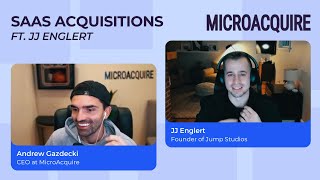
This is a YouTube video titled "SaaS Acquisition Stories Podcast w/ JJ Englert, Founder of Jump Studios" recorded in November 2022. It features a conversational interview between Andrew Gazdecki and JJ Englert, discussing JJ's journey as a non-technical founder building Jump Studios using no-code tools, the process of selling the startup on Microacquire, and insights on no-code scalability and startup acquisitions.
Foreign.
I'm here with JJ Engler, former founder of Jump Studio. Jj, how you doing today?
I'm doing great, Andrew. Thanks for having me on.
Yeah, my pleasure. So for those that may not know you or Jump Studios, do you want to give a brief background on yourself and Jump Studios?
Yeah, sure. So I'm a former founder, founder, started in 2017, a non technical founder, Built my first startup, raised angel investment, did a accelerator in San Francisco. That whole thing spent a lot of money building technology and it was really painful, which eventually forced me or brought me into learning no code. And now I'm one of the premier no code developers building on Bubble and other low code stacks. And Jump Studios was my first forte into building my own applications with Bubble. And I had always had this dream of I wanted to build this suite of tools out for filmmakers because that's where I previously came from. I spent 10 years in the film industry, making movies, et cetera. I stumbled across this problem, wanted to solve it, then I got into it. Now I love tech, but I, I wanted to build this suite of tools and I just couldn't afford it with a traditional stack. And so I was like, well, why don't I just try to build it with no code? And so I taught myself no code. At first I was super afraid, I didn't think I was smart enough. And then slowly but surely I just stuck with it. It's kept building and like six months in the first version of Jump Studios, which just got awful. But then like a year in it got to be like pretty good. And I was doing some pretty advanced stuff. Jump Studios is a suite for media creators where you can upload invoices or create invoices, proposals, and most importantly, share creative assets. So I come from the creative world where we're creating videos and photos and sharing it with clients that we created it for. And when we go to share, we need a seamless way to get that feedback in an async way. And so JumpStudios provides this review suite where you could upload videos or photos and and then the client can click on the photo or the video anywhere and like draw and leave annotations. It's all time coded, really easy back and forth so that way you know exactly where they want to make this cut or where to lower this or to change this, et cetera. And so I launched it and given my previous background in the film industry, I had a good amount of user base to launch it to and I built it for last year and just sold it recently. Microacquire.
Right on. Well, congrats on the acquisition. That's super impressive. I think what's even more impressive about your story is not being a technical founder and using no code tools to build a platform. Tell me about that. So when you, when you listed on Microacquire, how was buyers, you know, initial reaction to your product being on no code as opposed to, you know, something custom or built on some fancy technology? Did you have any buyers showing hesitation or was it a benefit from buyers?
Yeah, you know, I think it depends on the price too, right? Like this was a lower price startup, you know, the MRR was pretty low and comparatively. So it's not like a multimillion dollar startup where maybe they would have vetted that tech a little bit more. But really the folks that I was talking to, and I talked to a lot of folks over like two to three months, probably like 50 to 60, and then I went pretty far into due diligence with like three or four before I ended up eventually finding the buyer. And it was really just about the business. The technology wasn't the biggest thing. You know, I had to first once I sold them on the business, then I was like, all right, now tell me about the tech. Can this scale? What does this look like? What does maintaining this look like? And they quickly learned that actually it's advantageous to build on no code in many ways, especially in these early days because the cost to maintain it is lower, the ability to ship is faster and that gives you the ability to move quicker and to adjust to your customers needs faster, which helps you find that product market fit faster. And it also makes it so that you could fail faster and, and it doesn't cost you as much. So in those early stages I'm just a huge fan of no code, especially to just get out there fast, see what's working, iterate fast. And then beyond that, I've also built like I work professionally as a no code developer and over the last year and a half I've built no code systems that natively on bubble process over 20 million workflows a month without a problem.
Right.
So I've seen no code scale and I haven't been able to really break it yet. So I have also been able to give that context to my buyers are like, listen, we're. I built it in a scalable way, you know, using the latest API, et cetera. It's on AWS servers, it's really easy to manage. So after a couple hours of teaching you, you can run it yourself. You can respond to customer complaints or bugs. You can easily authenticate as a user to see what your customers are going through and pinpoint those things instead of bringing in an expensive engineer.
Right.
So it allows like non technical founders to get in there earlier and easier as well. So I think running it and scaling it in those early days, there's a huge advantage being on a low code stack.
Yeah, I would completely agree. I like what you said about just getting products out as soon as possible because, um, yeah, the just the longer you wait and the more you think, you know, you're delaying feedback from the market that you just have to need or you have to hear to, to build a good product because you can't build it in an echo chamber. And I think what's also interesting about, you know, no code bubble and some of the other, you know, no code platforms is I could be wrong here, and correct me if I am, but I feel like it would expand the buyer pool because I'm not technical. And finding a bubble developer is probably much more affordable than, you know, react, native or whatever code that you know, you're in. And it just seems like, you know, really de risk the business because it's on a platform that has a lot of other developers, even if you don't know anything about, you know, engineering. So if you don't, you can hire someone cheap. If you just want to learn a little bit, you can do it yourself. So I feel like it kind of, it could broaden the buyer pool. Like you said, you had 60 conversations. That's correct, yeah.
Yeah, I completely agree. I think it's more about the, the stigma of no code. And so people think, oh, it can't scale. And so you got this guy get buyers past that and then you show them what they can actually do. And it's like, oh, this makes so much sense.
Right.
Like there's a lot of times during a customer call where they'll submit a bug and just during the call with them, I'll fix it for them.
Right.
And it's like you got anything else right. It's just the ability to move that quick. So you could just focus on your business rather than focus on your tech is the biggest thing from a buyer standpoint and an operator standpoint.
Right.
My first startup, non technical Founder, built on a net stack. We spent over $300,000 in the technology. We were just spent the whole time, two and a half years, just trying to make the technology work. It was a pain in the ass. We had to find these really expensive Engineers in San Francisco that know the stack and then getting them up to speed from a non technical standpoint was so hard. Anytime we needed to change an email address, it was an Azure database. I couldn't even access it. They needed all these scripts. Like it was impossible to operate that business as an app. Technical founder.
Right.
With this, within an hour or two hours I could teach you how to do all those operations yourself. Immediately cut out that.
Right.
And so it's just from an operations standpoint, it's almost a no brainer. I think it's just informing people and educating people that these tools now exist and I think it's a smarter way to especially get out into the market with your business.
That's awesome. I completely agree. I think, you know what no code tools does is it really democratizes building startups. So people that, you know, you think 10 years ago it was kind of just, you know, engineers building startups. Now it's people that can quickly build with no code that might have some expertise in sales and marketing, which can, in my opinion is more of an advantage today than being able to build a really good product. Just because there's so many startups today and just being able to stand out. So the quicker you get the market, the quicker you get that feedback. And then I think it's really, I think it's so cool how you said, you know, even during due diligence you just fix a bug on the spot. I think that really just kind of like shows the power of, of no code, if you will. So I guess my next question would be how did you, you know, land on, on the final buyer? What was, did you guys just kind of kick it off? Did they offer the highest price? Was it a mixture of both? How did, how did that.
Yeah, so I went through a couple of buyers. The first one was my first forte. I didn't really know what to expect. He offered the loi, I accepted. And then we go out into due diligence and they eventually found another product that fit them better. And then the second one, I received an LOI and she seemed pretty serious. We got on a phone call. I walked her through everything and I could just tell that she just wasn't really fit to like really keep this going. And I was important for me to find someone that could keep it going because I put a lot of sweat equity into this.
Right.
Like I want to see succeed. It's not just a payday. The amount that I sold it for, it's not that much.
Right.
It's more about, you know, making right for my users and making sure that everything keeps going. And so when I eventually found this buyer, I wanted to make sure that they also had enough resources to continue marketing it, continue investing in it. And what I was selling it for wasn't going to deplete all of their assets, right? So that was a big thing for me is like, hey, what are you going to also invest on top of the purchase price? So I know what this kind of looks like going forward. And so I found someone that was able to do that, but I also just found someone where I connected with at a personal level, which I also thought was really good because I'm not just going to leave them after the sales done. You know, like if they have questions, I'm here to help. I can somewhat be an advisor without being really hands on of just, hey, you need a bubble dev, let me find one for you. I could work to help you find it. Oh, you're running into this. Look here. You know, so like I knew that relationship was going to exist and I wanted it to exist because I want the company to succeed, right? And so I wanted to find someone that I connected with, but also someone that was ready to invest and put in the work and just knowing that I didn't have the time to do it, you know, I really wanted that person. And so I was talking with this person for a couple of weeks and it was just good. We were just working on trust for most of it. You know, we didn't do a ton of documentation and ton of due diligence. I just walked him through a lot of it, showed him and was very transparent about everything. And in the last moment, a new buyer emerged and offered $4,000 more than asking price. And he actually was a great buyer too. He came from the film industry. He got him on phone and it was like, you know, I was like, man, if you were here three weeks ago, I would have sold you this company. But I feel really good about this other buyer and even though it's less, I don't want to start bidding where I just, I feel like he could do this well. And I, so I went with the other bio buyer and it worked out and you know, the money has closed and we're now in the transition period and, and I'm really happy with it.
Nice. That's awesome. I think that that's so important in terms of, you know, I think one thing that people don't think enough about is when they sell their business. It's not like handing over Keys to a car and you say bye, you know, so, you know, just being able to get along and I think this applies to buyers too, is just being respectable, you know, building a relationship with the seller and vice versa. Because you're going to be working together in some form, whether that's transferring the assets or, you know, they have questions about how this product works. Can I get a bubble developer or whatever it may be, it just. And it makes it so much more of an enjoyable process for both sides because it's a complete headache if you have a buyer or a seller where you're just not on the same page and it's just a full transaction. Obviously there's many different scenarios, but I think that's awesome you found a buyer like that, so congrats on that. Thank you.
You made it possible.
I didn't do anything besides building the platform. You didn't do anything, so, yeah, I'll take it. Well, I actually, I'm not technical, so I didn't build the platform.
Still made it happen. You're still the builder behind it. So in one way or the other.
I bought the domain. I'll take credit for that. But anyways, tell me about. I'm really curious about transferring the assets. So it's on. You mentioned aws, it's built on bubble. I have to assume it's just much easier to transfer that than a normal SaaS company. Did you just kind of like give them login information? Did you have to. Were there any bumps in the transfer? Because I've also acquired a bubble app before, a very small one two years ago. And it literally was like, here's the password, here's the password. We used AP or 2 or Zapier, however you pronounce it. And that was it. We were done in like 30 minutes. It was really easy.
Yeah. So we. We have three or four different APIs striping one of them.
Right.
And then we use a video processing API called Box. And so really just giving them transferring ownerships of those APIs and then transferring ownerships of the Bubble app was the biggest thing.
Right.
And so that. That is already done. And so now it's about. Okay, we've. Everything's transferred to you now. It's. I've already kind of done an hour training session.
Right.
And then I also am just doing a little bit of like, just nitpick, just cleaning up a little bit of things here just to make sure I'm leaving it in a good spot for them.
Right.
So, yeah, I mean, it wasn't bad at all, really, all things considered. I think the hardest thing that I had to do with this process was create a PNL sheet, you know, and like, just go back two or three years into my records to get all those piano. That was the hardest thing. Otherwise, listening was easy. You know, the buyers came to me. It was a lot of work engaging with so many buyers. Especially kind of like they, they chat and then they fall out and then they chat and you kind of re have those conversations again, you know, and so that was a bit draining. And it's like my time is so limited and so hopping on a 30, 45 minute call with someone and they just back out. Those kind of things I was trying to prevent, you know, because it just, it took so much time. So I think eventually I figured out how to manage that process better of like, you're receiving a lot of inquiries, how to do your own due diligence before they suck up your time. But at the same time, you don't want to lose a sale. So that's a little bit of a balance too. That, yeah, I had to learn.
But what, what tips would you give in terms of like, managing that many buyers like filtering out. Because what we recommend at Microquire is, you know, make the buyer perform. And what I mean by that is, you know, ask some questions like, hey, thanks for reaching out. What experience do you have in, you know, the no code space or, you know, if we get to the finish line, how do you plan on funding this? And just having them answer those very basic questions because at that point they, they've already looked at your application. They've already, you know, probably tested it out and you're kind of seeing how interested they are. And if they have experience, then most importantly, if they have the funds or are you willing to sign in. Yeah, but we have that built in a microcquire. Now, that used to be a previous question. So I guess how are you filtering kind of like the, you know, tire kickers as opposed to the serious buyers?
Yeah, the biggest thing that I did was I recorded a demo, I recorded customer interviews, and I made my piano public and was like, here's everything, right? Don't really come at me unless you're ready. You've watched all of that and you're ready to actually have more serious talks.
Right.
Like, I didn't want to answer. Very basic. What do you do? What all this kind of stuff, like, if you're, if you want to take my time, first you got to look at the demo, read these customer interviews. CRP these answers 95% of all your questions. And then if you're good from there, then that's just get straight to the point of, you know, yeah, oh, you do have money after the investment. What is your vision for it? All that kind of stuff. So that was a big thing is just recording those assets, having those links available, made public and. Or just DMing those links if they didn't receive them, make sure that they did that. And then it kind of got past my gates at that point.
Yeah. One other tip I have for sellers that might be listening is just creating like a simple data room like it sounds like you did, but a more informal one. Just like having a Google Drive folder with, you know, a video of you walking through the product, introducing yourself, a P and L. Just some basic questions, like as buyer questions come in, just keep a Google Doc where you just add like question just because a buyer, another buyer might ask the same question. And every time a buyer reaches out, you just send them, hey, here's the folder. Review it. And then let me know if you want to set up a call or something like that. But you give them enough information to not waste your time and have to get on all these calls. But, you know, as we're in the end of this, you know, I'm curious, you know, now that you've gone through this acquisition successfully, what, what are, what are like the top three tips you give to, you know, other founders looking to sell their startup?
Yeah, you know, I think revenue is still king, and it probably always will be. That's what you need to run a business, is you need revenue. So it's really hard to sell a business with no revenue. I tried to sell my first tech startup, the one I invested like 300 grand into, but it had no revenue and I couldn't even sell it. I couldn't even sell the technology for it.
Right.
And then let alone I build my own, you know, thing, and I am able to sell this because it has a small amount of revenue.
Right.
And so, yeah, I didn't spend nearly 100% of that or 1% of that on the technology, but I was able to make a business that generated revenue and that's what sold.
Right.
So revenue is king. Other than that, I think, you know, be open and transparent with, you know, who you're buying or who you're selling to. Like you said, it's not a used car. You don't just give them the keys. Like your reputation's on the line and also your customers and what you've built, you know, it's still going to kind of might come back to you and, or you got, you got this relationship to manage. So make sure you find someone that you want to manage it with.
Right.
And that you don't just regret picking up any other call. And, and I think finally one last tip would be, yeah, automate as much as possible.
Give.
If you're thinking about like put yourself in the shoes of the buyer, what would you want to see when you buy something?
Right?
Like demos. You want to hear customers speaking about it. You want to see the P. Ls you want to see anything that really makes this business operate and just put it together in a really easy data room, spreadsheet, anything. So the buyers can just go through that, do their own due diligence and it will save both of you guys time and then hopefully connect you with, you know, the right person for you. And, and then I think just side note, one of the things that worked really well for me is whenever anyone sent me an loi, the buyers that were kind of watching my startup were also notified. And so there was one night where like one person sent an alloy out of the blue and then I got like four more right away.
Right.
And so like I love that part of Microacquire is like they you automatically keep interested parties up to date with that kind of listing. So luckily we have resources like Microacquire available to us because I can't imagine selling something without it.
Right.
And you take a lot of the legwork out of it for us with these automations and whatnot. So really grateful that it exists.
Yeah, I got to give my product team a shout out for that because I didn't think of that feature. But I recently sold a Shopify app on my require just going through the. Something really small and that, that feature when, yeah, when you receive an ally, all other buyers are notified. And then all of a sudden all these other Lois come in and when I was selling the Shopify app and this is a story that I'll be sharing soon because we just finished it but the first LOI didn't work out and so you might be thinking, oh no. But what happens is, you know, all the buyers are notified once you're. Once you sign an loi but once you cancel that LOI because you can't get the terms, all buyers are notified again, like, hey, this is up for sale again. And so I remember on a weekend and my team, my product team had just released this functionality, but I just forgotten about it. Specifically or how it was working. I was just kind of eating my own dog food, if you will, but on a Saturday, I just canceled it. And then I was like, why are all these, like, otherwise coming in right now? Yeah, my product team. And I was like, oh, yeah, this is live. This is awesome.
Yeah, it works.
You know that FOMO so well just lets buyers know there's other interested buyers and if they don't move quickly, they might miss out on a deal. So. Well, huge congrats on the acquisition, man. Where can. Where can people find you if they want to connect or just learn more about you or. No code or bubble or.
Yeah, sure. So you find me on Twitter @JJ Englert. Englert. I again, work as a bubble developer. I manage a team of bubble devs. I run product at a VC backed startup in Miami. We're building everything on bubble and low code and everything. And so I manage a team of devs there that building our startup. I also teach for bubble. I teach bubble for bubble and then I have courses and all this kind of stuff too. So if you want to learn bubble or if you just want to follow how I'm using low code in an enterprise format, find me on Twitter.
Right on. Jj, thanks for coming on the show. Appreciate you, man. And congrats on the acquisition. Thanks.
Thanks for making it happen.
More from Andrew



The Buyers Who Made the Move: What They Bought, How They Did It, and What Happened Next






