SaaS Acquisition Stories Podcast w/ Stephen Nancekivell, Founder of RealEmail
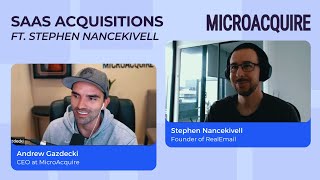
This is a YouTube video titled "SaaS Acquisition Stories Podcast w/ Stephen Nancekivell, Founder of RealEmail" containing an English podcast conversation recorded in November 2022. The discussion features Andrew Gazdecki interviewing Stephen Nancekivell about his startup RealEmail, its acquisition via MicroAcquire, and his new project Polo. They also share personal insights and advice for founders looking to sell their startups.
Foreign.
I'm here with Stephen Nanscible. I hope I pronounced that correctly. Did I get it right? Yeah. There we go. Well, Steven, thanks so much for joining me on this podcast.
Yeah, well, thanks. Thanks for having me here. Great. It's great to meet you.
My pleasure. So for those that may not know you, do you want to give just a quick introduction of yourself?
Yeah, sure. I'm Stephen. I'm a developer, had a go making a few startups. Always, always loved startups. And yeah, I managed to grow real email and sell it on microacquired.
Nice. So you had real email microacquired for five figures, is that correct?
Yeah.
Nice. And then congrats on that. Now, I guess my first question is what did, what did real email do? What problem was it solving?
Yeah, so it was mostly about email address validation. Certainly not sure if people are familiar with that. But like when you're sending a lot of email, it can be quite bad if the email addresses are invalid or like the fake emails because that means your emails don't go through and they get marked as spam, which then if you're sending a lot of email, that's bad for your reputation. So a sender can get blocked if they send too many emails to invalid addresses.
Nice. Well, what made you want to build this service? I know there's a few others. What made you want to build this specific product?
Yeah, yeah, it's definitely, I guess it's a bit of a competitive market to kind of get into. Yeah, yeah, I just sort of got interested and really interested in the space and sort of dived in and was interested in how they did it, how it works technically and what it really involved. And yeah, I guess I sort of started and just made a little library and then sort of the depths of a COVID lockdown. I thought I should, you know, really give us a go and make a. Make a process out of it and. Yeah.
Nice. How'd you find your first customers for real email?
Yeah, that was interesting. It was definitely, you know, it takes a bit of, bit of determination to go from like no one to kind of hit some people. But yeah, it took a lot of kind of social outreach. Like I was mostly diving into stack overflows about the topic and kind of trying to help people and shows and that, you know, rejects is only going to get them so far and that kind of thing. And then, then I managed to get a bunch of help documents, bunch of articles, kind of started to rank in search. That's sort of kept the ball rolling Nice.
Good old, good old SEO. Never fails.
Yeah, just want to get going.
All right, so you, you built real email, you grew it to a certain revenue point, and then you decided to, to sell it and you listed it on Microcore. How did that, how did that process go? How did you find, you know, the, the right buyer, so to speak?
Yeah, no, it's, it's pretty interesting kind of listing it because I guess I was a little. I was pretty hesitant about, you know, if it's even big enough to. To sell on Micro Acquire, because I saw a lot of other, other people's stories saying that they were doing, doing it right. And so, yeah, listed it and was overwhelmed with the, the amount of interest that it got. But yeah, it was interesting. You know, it's quite a few different buyers sort of asking and you know, some of them, most of them were very nice. Some of them seemed to be playing hardball or something, but really the ones that stood out were the, the people that just sounded very interested and they, they had kind of complimentary products themselves. Um, and as you know, having. Having built it so far, I really wanted the thing to kind of carry on and do well. And so selling to someone who, you know, who was interested in the space and had had some complimentary products that seemed like it would fit in with were. Was. Was good.
Nice. So you find the buyer. If I can ask, how did you structure the deal? Was it all cash up front? Did you do, like, milestone payments? How did that part of the acquisition work?
Yeah, well, we wanted it to just be pretty simple. Like, they just sort of plugged the idea of me retaining some stock and stuff. But I thought like, the size of the deal was just simpler. It was kind of a clean handover. So we kind of did all cash up front. Nice.
Those are always the best cash up front. So nicely done on that, I guess now I'm wondering. So you had a lot of buyers reaching out to you. If you had to give, like, advice for other founders maybe listening to this that might be looking to sell a business, what advice would you give to them when speaking with buyers?
Yeah, I think, I think it was good to that. I was just kind of quite open, like, very open with everything, and I was kind of ready with, you know, I had screenshots of, you know, the slack dash, sorry, the stripe dashboard and search console and analytics and stuff. Just kind of giving, kind of giving the proof up front. But. And even then I was very happy to kind of jump on calls and kind of give people a walk through and kind of had. Had a little slide deck there. It's very clear about, you know, what you're getting. You're definitely getting, you know, the demand, the code, some help to get going and stuff.
Nice.
But yeah, so I guess.
Yeah, go ahead.
Yes, I was just going to say like, like plenty of some, some video calls and walkthroughs of it all. And I guess I was probably, probably overshared a little bit, which I think maybe, probably help to build trust with the. And build the relationship. Yeah. I think one thing you mentioned, I've heard mentioned on your part is that you shouldn't really share your customer list. That was something didn't really know, shouldn't have been doing to the eventual buyer.
If you do that. I recommend anonymizing the data just so they don't have all the emails and stuff like that. But it still shows proof that there's transactions going through. And then also, depending on the size of the deal, you can always reach out to us as a team and we can help you through that. But I guess now I'm just wondering about. Okay, so you found the buyer, you got the terms. How did the, the transfer of the assets go? What did you, what did you do for that part?
Yeah, so it was, yeah, it took took a little bit of time there. I had kind of built everything in sort of my personal AWS account. But really for the handover, it made. Just made everything so much easier for it was kind of its own accounts and just kind of everything was all together and there was only one sort of password to kind of kind of hand over. So spent a little bit of time kind of getting, getting that all, all in line to make it easy. But then it was yeah, very much just like there was, you know, handful of accounts we kind of just went through and, and yeah, hands over the passwords, which make sure they could kind of get in and stuff.
Nice. I always recommend, number one, having everything in a separate account, because I've heard a lot of stories of, you know, you got 10 different projects and one AWS account and you got to move it over to another one. And just being able to kind of hand them over that whole account makes it a lot easier. And then also just having, you know, a plan, like a transfer plan as you're selling the business, because once you get to terms with the buyer, you both might be in a situation of like, what do we do now? So to speak. So just having like, like, you know, here's basically all the assets that I use. We'll start by transferring this one and this one and this one and then, you know, milestone payments along the way, depending on the size of the deal.
Yeah, it's interesting how many things you kind of end up with. So it was like a spreadsheet with like just the line and it's like the aws, the stripe.
Yeah, that's definitely like a product that we're looking to build in a microcore. Basically like an asset transfer list that helps make it a little bit smoother. But moving over to, you know, I guess, you know, as more and more founders and going through this process of being acquired, it sounds like you've learned quite a bit. If you had to give like three tips to potential founders looking to sell their startups, what would they be?
I'd say give it a go. Like. Yeah, I mean it takes a bit of effort and bit of self belief that you can kind of really build something and get and grow it, but it could be pretty stubborn and I think, yeah, just, just giving it a go is kind of the biggest, biggest thing. Like all the time I spent kind of wondering about if, if I could ever kind of get if anyone was ever going to use it or if anyone was going to be interested in buying it. You just kind of gave it a go. Would have been better. Yeah. Another one would be, yeah, kind of like looking for the right buyer. Looking for a buyer that's interested in seeing your thing carry on was pretty nice. And yeah, I guess those separate accounts help or separating the accounts so you can easily hand over passwords. But I guess I had also had infrastructure as code which helped a bit with that.
Nice. And then I definitely got a feeling you're, you're probably working on something new, I assume.
Yeah, sure.
I want to hear what is it? What is it?
Yes. This is about a problem I sort of experienced with real email. Had a bit of, I think this is a pretty common one is hard going from to help users convert from your free tier to like your paid tier or people often have issues with like their trials people trying to convert people from trial to pay. So I'm working on Polo. We're a small startup helping in that space. So you might have heard of like Netflix kind of helping, kind of cracking down on the password sharing and trying to help grow those accounts. So we're sort of helping to do that, hoping to bring those sorts of tools to, to everyone else. It's the main way we do this. We look for opportunities of how you can kind of help onboard those users. So it might be that they've already had a couple of trial accounts, and then they might just be signing up for a new trial account just to get the next episode of Game of Thrones or something.
Interesting.
So we kind of detect, like, oh, you've already had one. We may as well not give you a free one. How about we give you a discount, get you kind of paying a little bit, and then people are more. More interested in kind of carrying on. I love it. Everyone is like, yeah, people sharing their accounts. Like, you might. I guess it's the main thing with Netflix. You know, people kind of give their password to their mom, their brother. There's all these people on an account that's supposed to just be one person. So, yeah, we sort of help that and kind of encourage people to kind of get on the happy, happy paying path.
I like that. I mean, admittedly, I. There's a few services where, you know, I'll share. Not frequently, but I've definitely done that. So I understand that being a big problem for a lot.
Yeah. Like, it's just easy. Right. And it's really hard to kind of tackle properly unless you're sort of. Unless you're able to devote a team to which most people aren't. So that's where Apollo's sort of stepping in.
That's awesome. Well, I'm. I'm happy you got, you know, micro acquired and now it sounds like you're moving on to something, you know, bigger and with potentially more potential. So excited for you, man.
Yeah, cheers.
Well, so that's. That's all I got. I got just one last question that I always like to ask. This one's kind of out of the blue, but if you were stuck on an island and you could only bring one thing, what would it be?
One thing. W. You know, love those survival movies, the ones where, like, someone's stuck on a. Yeah. Stuck on an island and they have to have to make a hut and stuff. I could see myself doing that. So I reckon a knife would be like, just the practical. And I help you chop down some trees and make your little hut. What about for you?
I feel you have this plan out. What would I bring?
Yeah.
Um, you know, no one's actually. Actually reversed that question on me. Well done. If I was going to bring anything to an island, I'd bring an iPhone of full service. Get out of there. Tell everybody where I am. Get me out of here. Yeah. All right. See? Well, this has been a lot of fun and congrats on all your success and Congrats on the acquisition, Renfrey man.
Yeah, thank you. Cheers.
More from Andrew



The Buyers Who Made the Move: What They Bought, How They Did It, and What Happened Next






