SaaS Acquisition Stories w/ Conor Chamness - Corporate Development | M&A at Dura Software
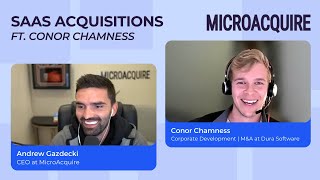
Conor Chamness from Dura Software talks acquisition strategy and what makes a good target company. He shares advice for founders planning to sell, plus insights into how SaaS deals actually work.
Foreign.
I'm here with Connor Chamness from Dura Software. Thank you so much for joining me on this podcast.
Glad to be here. Thanks for having me.
Well, hey, big fan of what you guys are doing over at Dura and more than anything just wanted to, you know, learn more about your firm and help other people looking to sell their business learn about you guys. So with the first question, could you provide just a little bit of background on Dura, your track record, just any information that you think buyers or sellers should know?
Totally, yeah. Happy, happy too. And apologies in advance, I have a scratchy throat and I've been drinking out of a measuring cup all day because I think you can't convince me there's a better vessel to drink out of. But I'm not a crazy person, I promise if that pops in and out of frame. But yeah, so Dura Software, Software holding company exists in the universe of kind of software consolidators who are buying lots of smaller businesses into sort of one larger package. But really we see ourselves as a software company that just happens to be growing through acquisition. So we kind of view everything through the lens of how do we build a big exciting company out of smaller ones. And that means a couple of different things. Just in terms of for a seller, it means we're permanent capital, we're not going to sell your business. And so we're taking a long view on it. And so we're going to be likely to take care of your employees, your customers, all that kind of stuff. Right. Your legacy. That stuff really matters and it's really important to sustaining a business over a long period of time. The other thing that I think we've really found is what matters to people over the years is giving us a smaller kind of, we buy sub $10 million software businesses, but the sweet spot is kind of 2 to 2 to 5. And usually we're buying a niche, a business that has some sort of relatively narrow focus or niche. And those markets can be hard to grow in, capital intensive, to develop a product, all that sort of stuff. And what we've started to really focus on is how do we help those kind of smaller scale businesses act like big ones. And so, you know, we focus on giving, you know, the companies that we buy the opportunity to focus on winning, making their customers happy, selling more of their product. And then we help on the back end with, you know, there's kind of the strategic stuff where we'll have input on sales and marketing and et cetera, et cetera, you know, Playbooks for that were very serious and methodical and how we deliver that information to you. But it's up to our businesses because they know their customers best to go to go do that. But then on the non strategic stuff, you know, software tools, buyer buying power on licenses, back office function recruiting, etc. Right. We help take care of that. So, you know, kind of, if you had to boil it down right, it's. It's enable our companies to focus on winning.
Nice. How many acquisitions has Dura Software made to date?
We've done nine acquisitions so far. Hoping to do 10 and 11 here in relatively short order. And those have really run the gamut. You know, where we say on our website we buy hypernetch and we mean it in more ways than one. We purchased, you know, maritime email software. We love the fax industry, virtual events IDD software. Some of these companies predate the Internet. Some of them are relatively new.
I got a question for you. So if you describe the perfect acquisition target, so if this came across your desk, you'd be like, oh my gosh, we got to buy this. Like what would it. You're literally, you're literally drinking out of a measuring cup. I love it. Like what would be. What would be like Connor's like dream, you know, acquisition target, you can make it up.
Totally. Yeah. So dream business for Gura is, you know, has a couple of key ingredients. There is kind of the financial profile, which is high retention, moderate to low growth, could be slightly underpacing inflation to 15%, maybe, maybe a little bit profitable, break even. But the big thing is that the customers really like it and the owner of the business wants to go do something else. I think I maybe skipped over a big part of our model at the top, but that's one of the biggest ones for us is we oftentimes are buying from founders who are just looking for a good home for their business. You know, somebody that, whether it's they want to retire or, you know, they started a business and that's what they're good at, but they don't want to grow it or you know, keep working day in, day out, they, they move on. And you know, so we want kind of good bones to the business financially. We want a very clear and defensible niche or moat and then some unexplored opportunity. Right. It could be just that they've never put much emphasis or focus on sales and marketing. It could be that they never picked up the phone and called their customers because they didn't feel like it. Right. But something on the operational side of the business has not been invested in because the founder either couldn't due to time constraints and energy constraints or you know, just didn't want to because it wasn't their core competency. And so that's really what we're seeking to do is buy kind of smaller businesses that are, are itching to go to that next level from a founder who wants to see it go there, but not necessarily take it there themselves.
Gotcha. Well, let's go, let's go a little deeper than that. Let's go. Think of like an industry company size business model. I'm gonna give you, I'm throwing here like, like DevOps tool that's been around for five years. If you just had to make up like an imaginary. Gosh.
Okay, if you want me to. All right, we'll start with what the company does. I would love a, I would like an ERP for trophy engraving companies.
Okay, so when you, when you say niche, you mean it?
Yeah, niche.
You're literally, you're niching on the trophies.
Absolutely. We'll take, we'll take trophy engravers and whatever they use to run their shop, manage their orders, et cetera. Right. Something that's really mission critical and like they can't do their day to day without. Right. Something that impacts the bottom line. I would love it if it was four and a half million in revenue. My preference would be that it's you know, SaaS or multi tenant or in the cloud. However, you know, say they started back in, you know, the 90s, back when, you know, in the glory days of trophy making and you know, they had an on prem solution, that's totally fine as long as there is predictable maintenance revenue. Because buyers like us, we need to buy predictability. So you know, north of 70% recurring is ideal. You know, we would love it again if the founder was ready to move on. Let's say I think average age of our deals. I might just be making this up, but you know, probably 15 years old, could be older, you know, founder, owned and operated.
And what about growth opportunity? Would it be like a B2B sales opportunity? Would it be like a marketing opportunity?
So generally speaking we like businesses where we can build a list of customers and go find them. So we like a direct sales model or a channel sales model to a really marketing heavy or marketing intensive business. We'll certainly do a more self servicey business, but we really thrive honestly in complex selling environments which is part of cost to do in business. When you buy a niche product, generally Speaking. Yeah, I can give you an example on that. We got a company called Lane, which is a faxing solution. And it's really hard because the faxing component is a tiny sort of, you know, it's a bell on an overall, you know, architecture for a hospital, for example, right about they have all these, you know, sort of document managed record management tools usually related to something like an Epic or a Cerner or something like that. The faxing solution is really necessary, but it's a small piece of that. And so generally a business like that really benefits from a channel strategy which, you know, takes a different set of skills than, you know, a marketing heavy business.
Nice. I like that. If I come across a business that engraves trophies, please do so. You know, there's, there's a lot of founders, you know, looking to sell their business. A lot of the times it's the first time. I'd say probably most of the time it's the first time. What's maybe two tips you give to founders looking to sell their business this year or the upcoming year? Yeah, maybe they come to Dura Software, they say, hey Connor, I got this trophy engraving business. What's two things they can do to maybe make your life easier or make the decision on whether this is a good opportunity?
Yeah, so yeah, I can answer that in two ways. One is from the Dura perspective and then one is just maybe from a buyer perspective, I mean a seller perspective. So on, on the buyer side, you know, a buyer like Dura really has to make, you know, sound financial decisions. And so we are very careful in our financial study of the business. You know, we try not to ask for too much and be overly cumbers. But in a small business, every single customer, especially if it's an enterprise software business, every single customer has a huge impact on the top line of your business and even your gross margins. And so providing a level of access and granularity to that customer base is really big. And along with that, especially a lot of times these sort of founder led businesses can have cash based accounting or something like that. Be willing to share your invoicing data so that we can look at the financials properly and get a feel for what recurring revenue is or what is the driver of your growth. Was it you sold a whole bunch of new licenses and that made up for you losing a bunch of customers? Or if your churn was bad last year, is that because you have a product problem or because one really important customer left and you knew that they were going to leave for the Last five years. Right. So allow the buyers to dig in deep enough that they can get answers to the questions they need to know and sooner rather than later. Because that's the big thing that I run into a lot is especially in a competitive market, there are going to be buyers that don't want to do the work and then they'll throw out a crazy number and the seller will go ahead with them. And then those buyers will start asking for the information that they could have had access to earlier and then they'll retrade on you, which generally leaves nobody happy. So I think access to data and granular data is big. I think on the other side, or maybe one more point on that, when you're negotiating with the buyer, especially a financial buyer, make the negotiation about your specific business, not your market. Right. There are a lot of things you can point to external to your company that are going crazy in technology. But at the end of the day, your growth is your growth, your churn is your churn. It's not somebody else's. You know, I try to caution people from, you know, looking to public markets or even crazy, you know, private equity transactions with strategics. Right. Every deal is different. And you know, it's best when you're defending your business to stick to your business because that's what you know best.
Nice. I like that. Yeah, no, I run into that a lot like, oh, but our competitor sold for 100 times revenue, so that means we're so. Yeah, that's, that's, that's great advice. Favorite acquisition that you guys have done. Do you have one? I know that's kind of like, you know, what's your favorite kid?
But yeah, I'm going to make people crank. I mean, the most. I'll, I'll give you two answers again. One is because it was just an absolute whirlwind, you know, crazy thing. We have a virtual events business called Six Connects, which we purchased in 2019. And so we rode the pandemic wave in an insane way. That business experienced growth like few people ever see.
Oh, you bought that before the pandemic?
Oh, yeah.
Oh, wow. Timing.
They're calling me Nostradamus in some circles.
Wow. There's a really good TED Talk you should check out about market timing being one of the big, biggest indicators of like a startup success. So obviously different this circumstances since you bought it.
But I think, I mean, there is, there is an important point. You know, part of what I'm doing here is selling us. Right. And there's an important point with what we did on. On six connects.
Right.
Which is when we purchased was a very good business, but it would not have been able to achieve even close to the scale that it did or be able to capitalize on that market without the Dura integration. And I think that is really a prime example of what we're trying to do here. We were able to get infrastructure in place so that the business could scale well. I don't want to throw out their financial numbers, but pretty absurdly over a short period of time and keep up with that market demand. So.
Nice. I like that.
Yeah, the most. The. My real favorite though, and the most surprising is the fax company that we bought. I won't talk too much about that, but fax is not dead folks. And they're great, they're great businesses.
So I'm going to look into that company just because I'm curious. But I'm sorry to inform you I won't be a customer.
Well, that's all right.
Past my generation. So last year, I mean, I guess in the last like two years, ma activity has been crazy. Do you have any sort of like just industry takes predictions for 2022?
Yeah. So I think in terms of takes, I'll probably say some similar things to what I'm sure other buyers tell you. Right. There's been an amazing confluence of factors over the last year. Really frothy public markets, a bunch of dry powder and PE and then insanely low interest rates. There are private equity firms out there that can buy companies with none of their own money. Right. And so there is just a frenzy to deploy capital. I don't see all of those things continuing forever. For better, for worse. I mean, I think selfishly that creates opportunity for a buyer like Dura that is more focused on the fundamentals. But also I think it will yield better kind of long term outcome for founders, especially ones that sign up for structured deals and things like that. Is right now I think that sellers are getting a lot of promises that aren't going to be delivered on because they're just not, you know, not realistic. You know, I hope one of the things that maybe changes is, or honestly, just as there's been a proliferation of buyers like sellers will start to study who's on the other side of the table from them a little bit more and get to know their intentions a little bit better or even what the structure of the deal means. There's an anecdote that I think pretty well sums this up. I was talking to somebody that sold his business for Some absurd multiple. And it was after a bunch of buyers backed out. And he said, yeah, I mean, of course I'm going to take this deal. What they just told me is that they're going to be able to grow my business 100% better than me for the next decade and then exit it in order to make any sort of reasonable underwriting standard. Which is fine in some ways. Right. Especially if you're the seller and you're getting a big paycheck. But you also, it also makes you think about who's on the other side of the table. Right? Like, is the seller doing the work to. I mean, sorry, the buyer doing the work to understand what it takes to grow your business or if that's reasonable. Right. If they have a particular hurdle rate or cash flow requirement that they need to see in X number of years, if they pay you a crazy amount of money, then they're going to have to make some pretty dramatic changes for better or worse in order to see that. So you get into financial engineering territory and, and I think we, as buyers, we dura, really try hard to not base our financial outcomes on anything other than running a good, solid, predictable business and kind of growing it long term.
Cool. I agree with you. I mean, 100% for 10 years, year over year.
That doesn't make any sense. Yeah.
I'd make a bet on that in Vegas if it was available. But. Okay. I got three more questions for you that I. These are just random ones. Favorite book.
Favorite book? Should I give you a business answer or just my actual favorite?
I want to know both.
Gosh. Okay. I think my favorite business book, it's just the best one I've ever read, was never split the difference. I think primarily because it helped me be a better question asker and to better put myself in the shoes of buyer or sellers. I think when you buy somebody's software company, there is a certain level of humility that is often lacking, especially for somebody that's in my seat that is doing very little of the doing post acquisition. And so that book gave me the tools to better articulate kind of where I'm coming from, but also better understand where they're coming from. So that's a really good book. And then on a personal level or on a, on a fun streak. I really like the First Law trilogy. It's a fantasy series by Joe Abercrombie. It's, it's good read.
I, I haven't heard that one, but I'll check it out.
Check it out.
Second question. Who's your favorite entrepreneur if you had to pick one?
Oh, maybe this is probably a lame answer because he's the guy that hired me and brought me into the fold. But, you know, I. Michael Gurdley, who, you know, is amassed quite the Twitter following. He's. He's kind of the guy behind Dura, but I say him, maybe it's a little bit of a cop out, but I think there are very few people that in business treat people as well and as fairly. You know, I really admire in entrepreneurship, you know, there's kind of, you know, a go getter mentality that's great, like, you know, hustle, hustle, hustle. And he certainly works incredibly hard, but I think more important than that, he's just incredibly thoughtful about the people around him. And to me, you know, that's kind of the ethos behind Dura and the teams we bring into the fold. And it's been, you know, impactful for me in my personal life and I think goes hand in hand with that never split the difference thing of. Of, you know, making sure that you are a student of the people around you first.
Nice. Yeah, I'm a fan of Gurley too, but I haven't heard a comment that strong. So maybe I'll give you a raise or something after this.
Unfortunately, he's not. Not that involved at Dura anymore.
Well, hey, Connor, I really appreciate your time on this podcast and people, if, you know, a founder's listening to this and they think Dura might be a good fit or just a conversation, where should they reach out?
Just shoot me an email. I mean, you, Connor. C O N O R dot Software. You know, you can check out our website, Dura Software. Follow Michael on Michael Gurdley on Twitter. But yeah, if you want to talk to me, just give me a call or shoot me an email. My phone number. Do I give that here or.
No, it's 911 and they'll route it straight to you.
Perfect. Yes. I got ties everywhere.
All right, Connor, I appreciate your time, man.
All right, man. Likewise.
Cheers.
More from Andrew



The Buyers Who Made the Move: What They Bought, How They Did It, and What Happened Next






